
Psalm 25
22 verses · Acrostic prayer
To You, O LORD, I lift up my soul;
Introduction
David, the Alphabet Prayer, Book 1: The book of David, Poetry, Psalms Overview.
David's name heads this prayer, and he wrote it in an ordered form, each verse opening with the next letter of the Hebrew alphabet. Inside that order the troubles arrive together. Guilt, loneliness, enemies and the need for direction come as they do in a life, and the prayer holds them in one breath. Listen for the requests to be taught, for the pauses where the prayer stops to consider what God is like, and for the last verse, which reaches past the singer to the whole nation.
Context
- Who
- Israelites learning to pray a whole prayer by heart
- What
- An acrostic prayer, one verse to each letter of the Hebrew alphabet, asking to be taught, forgiven and kept.
- Where
- Judah, in a prayer shaped to be memorised and repeated.
- When
- The reign of David, about 1010 to 970 BC by the superscription.
- Why
- To give a person one prayer for guilt, loneliness and danger together, asking God to teach the way through them.
Historical context
The request to be shown the LORD's ways and taught his paths uses road language in a country of tracks. A traveller in the hill country followed footpaths along ridges and wadi beds, where the wrong one could cost a day or a life. The plea that God remember not the sins of his youth fits how Israel thought about record, since God's remembering or forgetting was covenant language rather than a matter of memory. To not remember a sin is to decline to act on it. The confidence the LORD gives those who fear him, in verse 14, uses a word for a closed circle, the small group of counsellors a king sat with behind shut doors.
Significance
The prayer refuses to sort its troubles. Enemies, loneliness, affliction and personal guilt are all named in the same breath, because that is how they arrived. Its last line steps outside the singer altogether and asks God to redeem Israel from all its distress, so a private prayer ends by praying for the nation.
This chapter in Jewish lifeWhat this chapter is in Jewish life and reading.
How it is read
This psalm runs through the Hebrew alphabet, and the site treats that shape at /featured/the-acrostic-psalms. Rashi is the only commentator the corpus carries with an English text on this chapter, and he keeps his notes short. He is quoted here from the Judaica Press Tanach with Rashi. Lifting up the soul in the first verse he reads as a turning of the will: "I will direct my heart" (Rashi on Psalms 25:1:1). The traitors of the third verse he takes for robbers and impounders "who leave the poor destitute of their property" (Rashi on Psalms 25:3:1).
The sixth verse asks God to remember his mercies from of old, and Rashi's note on it is the traditional insight this chapter is worth reading for. He dates the mercies to the first man. They have stood "since the days of Adam", to whom God said that he would die on the day he ate. Then "You gave him Your day, which is a thousand years" (Rashi on Psalms 25:6:1). On that reading the sentence was carried out and mercy was shown inside it, because the day of the sentence was measured by God's clock rather than by a man's. The rabbis' arithmetic there rests on the psalm that says a thousand years are as a day, and a Christian reader will recognise the same verse from the second letter of Peter. The site reports the reading as the rabbis' teaching, and Rashi's as his own.
The seventh and eighth verses set out how forgiveness is asked for and why it is given. Rashi has David ask God to remember "what is deserving of Your kindness", and names those as "the good deeds on my record" (Rashi on Psalms 25:7:1). Then he gives God's side of it in eleven words. The Lord is good and upright "and wishes to exonerate His creatures" (Rashi on Psalms 25:8:1). At the eleventh verse the ground shifts from the man's record to God's name, and Rashi reads the plea as made for the sake of the great name (Rashi on Psalms 25:11:1). Those two grounds standing side by side, the good deeds and the name, are the whole of the doctrine of pardon in this chapter. A Christian reader should mark that the second is the one the psalm itself reaches for last.
Rashi's remaining notes are pastoral. At the twelfth verse God guides the man who fears him "on the road that he chooses; that is the good road" (Rashi on Psalms 25:12:1). At the thirteenth he takes the abiding in prosperity past death, so that when a man "abides in the grave, his soul shall abide in prosperity" (Rashi on Psalms 25:13:1). At the sixteenth he explains why a king says he is alone and poor. The eyes of the public are on him, and he asks for grace "because my prayer is necessary for the salvation of all Israel" (Rashi on Psalms 25:16:1). At the eighteenth he asks that the affliction itself do the work of pardon, so that God would "through them, forgive all my sins" (Rashi on Psalms 25:18:1). Ibn Ezra and Radak comment on much of this chapter, and the corpus carries their refs without English text. They stand here cited and unquoted at Ibn Ezra on Psalms 25:1:1, 25:2:1, 25:4:1, 25:10:1, 25:14:1, 25:15:1, 25:17:1 and 25:20:1, and at Radak on Psalms 25:2:1, 25:9:1 and 25:22:1.
What the rabbis say
The corpus carries forty locators on this psalm and the text of none, so each is cited and linked here rather than quoted. Five are Talmudic. They stand at Chagigah 12a:14 on the sixth verse, Makkot 10b:2 with Jerusalem Talmud Makkot 2:6:9 on the eighth, Tractate Kallah Rabbati 1:5 on the ninth, and Jerusalem Talmud Taanit 2:9:3 on the eighteenth.
Midrash Tehillim carries sixteen, more than on any other chapter of the first thirty. They run with the psalm from its first verse. At the opening stand 25:1, 25:2 and 25:3, then 25:4 on the second verse, 25:5 on the third and 25:6 on the fourth. On the fifth verse stand 119:5 and 143:1, and on the seventh 25:8. On the eleventh stands 19:16, and on the twelfth 25:11, 25:12 and 25:13. Four more stand at 18:2 on the fifteenth verse, 25:15 on the sixteenth and 7:2 on the seventeenth.
Bamidbar Rabbah carries four, at 23:13 on the sixth verse, 11:1 and 9:10 on the fourteenth, and 3:1 on the fifteenth. Four entries of Midrash Tanchuma stand on the tenth and twelfth verses, at Vayera 1:6 and at Chayei Sara 2:1, Vayera 4:4 and Shoftim 5:2 in the Buber recension. Two entries of Aggadat Bereshit stand at 19:2 on the tenth verse and 16:2 on the fourteenth. Two of Bereshit Rabbah stand at 22:1 on the sixth verse and 41:1 on the fifteenth. Three entries of Ein Yaakov stand at Khagigah 2:7 and Makkot 2:5 in the Glick Edition, on the sixth and eighth verses, with Makkot 2:8. The rest are single. They are Pesikta DeRav Kahana 11:14 on the first verse, and an entry of Otzar Midrashim on Psalm 118 on the fifth. Two more are Vayikra Rabbah 5:8 on the eleventh verse and Mekhilta DeRabbi Shimon Ben Yochai 14:5 on the twentieth. What each of them teaches is a saying of the rabbis, and is reported as theirs wherever this site quotes one. The quotations wait on a fetch that carries the text.
Sources: Rashi, Rashi on Psalms 25:1:1 to 25:21:1, the Judaica Press complete Tanach with Rashi, translated by A. J. Rosenberg; Ibn Ezra, Ibn Ezra on Psalms 25:1:1 to 25:20:1, cited by ref because the corpus carries no English text; Radak, Radak on Psalms 25:2:1, 25:9:1 and 25:22:1, cited by ref because the corpus carries no English text; MannaFest, the acrostic psalms, at /featured/the-acrostic-psalms; The Sefaria corpus, scripts/data/sources/sefaria/psalms/25.json, the 5 Talmud and 35 Midrash locators of this chapter.
To You, O LORD, I lift up my soul: The verses run through the Hebrew alphabet, a letter each. The psalmist lifts up his soul, then asks that he not be put to shame and that his enemies not exult over him. Verse 3 widens the plea to all who wait for the LORD.
Psalms 25:1
“Unto thee, O Lord. See how the holy soul flies to its God like a dove to its cote. When the storm winds are out, the Lord's vessels put about and make for their well remembered harbour of refuge. What a mercy that the Lord will condescend to hear our cries in time of trouble, although we may have almost forgotten him in our hours of fancied prosperity. Unto thee, O Jehovah, do I lift up my soul. It is but a mockery to uplift the hands and the eyes unless we also bring our souls into our devotions.”
Charles Spurgeon · The Treasury of David, Vol. 1 (1869)Particular Baptist
1 more voice on this verseWhat preachers and commentators have said about this verse, in their own words.
Psalms 25:1
“The meaning rather is, that in order to strengthen the hope of obtaining his request, he declares, what is of the greatest importance in prayer, that he had his hope fixed in God, and that he was not ensnared by the allurements of the world, or prevented from lifting up his soul fully and unfeignedly to God.”
John Calvin · Commentaries (1554)reformed
Psalms 25:2
“David, then, was carried upward to God with the whole desire of his heart, because, trusting to his promises, he thereby hoped for sure salvation. When he asks that God would not suffer him to be put to shame, he offers up a prayer which is taken from the ordinary doctrine of Scripture, namely, that they who trust in God shall never be ashamed.”
John Calvin · Commentaries (1554)reformed
1 more voice on this verse
Psalms 25:2
“Enemies laugh when they see that the trust of just people has not been fulfilled.… Laughter is most often a quality of someone of good will, but laughing at someone is always the mark of an enemy.”
Cassiodorus · written before 585 · Explanation of the Psalms 25:2-3patristic
Psalms 25:3
“Yea, let none that wait on thee be ashamed. Suffering enlarges the heart by creating the power to sympathize. If we pray eagerly for ourselves, we shall not long be able to forget our fellow sufferers. None pity the poor like those who have been or are still poor, none have such tenderness for the sick as those who have been long in ill health themselves.”
Charles Spurgeon · The Treasury of David, Vol. 1 (1869)Particular Baptist
1 more voice on this verse
Psalms 25:3
“On the other hand, the disappointment of the perfidious, who, unprovoked, have done evil, is invoked (compare 2Sa 22:9). On the ground of former favor, he invokes divine guidance, according to God's gracious ways of dealing and faithfulness. Confessing past and present sins, he pleads for mercy, not on palliations of sin, but on God's well-known benevolence.”
Jamieson, Fausset & Brown · Commentary Critical and Explanatory on the Whole Bible (1871)reformed
Show me Your ways, O LORD: The request is for teaching, Your ways and Your paths, and to be guided in Your truth. Verse 7 asks God to leave the sins of his youth out of the reckoning and to remember him by His loving devotion.
Psalms 25:4
“Shew me thy ways, O Lord. Unsanctified natures clamour for their own way, but gracious spirits cry, "Not my will, but thine be done. " We cannot at all times discern the path of duty, and at such times it is our wisdom to apply to the Lord himself. Frequently the dealings of God with us are mysterious, and then also we may appeal to him as his own interpreter, and in due time he will make all things plain. Moral, providential and mental forms of guidance are all precious gifts of a gracious God to a teachable people.”
Charles Spurgeon · The Treasury of David, Vol. 1 (1869)Particular Baptist
1 more voice on this verse
Psalms 25:4
“Now the ways of the Lord are, we may say, certain courses taken in a good life, guided by Christ, who says, "I am the way, and the truth and the life." The way, then, is the surpassing power of God, for Christ is our way, and a good way, too, is he, a way that has opened the kingdom of heaven to believers. Moreover, the ways of the Lord are straight, as it is written: "Make your ways known to me, O Lord." Chastity is a way, faith is a way, abstinence is a way.”
Ambrose of Milan · written before 397 · Exposition of the Christian Faith 3.7.51patristic
Psalms 25:5
“Lead me in thy truth, and teach me. The same request as in the last verse. The little child having begun to walk, asks to be still led onward by its parent's helping hand, and to be further instructed in the alphabet of truth. Experimental teaching is the burden of this prayer. Lead me according to thy truth, and prove thyself faithful; lead me into truth that I may know its preciousness, lead me by the way of truth that I may manifest its spirit.”
Charles Spurgeon · The Treasury of David, Vol. 1 (1869)Particular Baptist
Psalms 25:6
“Remember, O Lord, thy tender mercies and thy lovingkindnesses. We are usually tempted in seasons of affliction to fear that our God has forgotten us, or forgotten his usual kindness towards us; hence the soul doth as it were put the Lord in remembrance, and beseech him to recollect those deeds of love which once he wrought towards it. There is a holy boldness which ventures thus to deal with the Most High, let us cultivate it; but there is also an unholy unbelief which suggests our fears, let us strive against it with all our might.”
Charles Spurgeon · The Treasury of David, Vol. 1 (1869)Particular Baptist
Psalms 25:7
“Remember not the sins of my youth. Sin is the stumbling block. This is the thing to be removed. Lord, pass an act of oblivion for all my sins, and especially for the hot blooded wanton follies of my younger years. Those offences which we remember with repentance God forgets, but if we forget them, justice will bring them forth to punishment. The world winks at the sins of younger men, and yet they are none so little after all; the bones of our youthful feastings at Satan's table will stick painfully in our throats when we are old men.”
Charles Spurgeon · The Treasury of David, Vol. 1 (1869)Particular Baptist
Good and upright is the LORD: The prayer turns to statement here. God is good and upright, and He shows sinners the way and guides the humble in what is right. Verse 10 holds the promise and the condition together: His ways are loving and faithful to all who keep His covenant.
Psalms 25:8
“Good and upright is the Lord: therefore will he teach sinners in the way. Here the goodness and rectitude of the divine character are beheld in friendly union; he who would see them thus united in bonds of perfect amity must stand at the foot of the cross and view them blended in the sacrifice of the Lord Jesus. It is no less true than wonderful that through the atonement the justice of God pleads as strongly as his grace for the salvation of the sinners whom Jesus died to save.”
Charles Spurgeon · The Treasury of David, Vol. 1 (1869)Particular Baptist
1 more voice on this verse
Psalms 25:8
“Upright - Holy and true, in all his declarations and offers of mercy to sinners. Therefore - He will not be wanting to such poor sinners as I am, but will guide them into the way of life and peace.”
John Wesley · Explanatory Notes upon the Old Testament (1765)evangelical
Psalms 25:9
“The meek will he guide in judgment. Meek spirits are in high favour with the Father of the meek and lowly Jesus, for he sees in them the image of his only begotten Son. They know their need of guidance, and are willing to submit their own understandings to the divine will, and therefore the Lord condescends to be their guide. Humble spirits are in this verse endowed with a rich inheritance; let them be of good cheer.”
Charles Spurgeon · The Treasury of David, Vol. 1 (1869)Particular Baptist
Psalms 25:10
“Though, through the infirmity of the flesh, they sometimes break the command, yet by a sincere repentance when at any time they do amiss, and a constant adherence by faith to God as their God, they keep the covenant and do not break that.”
Matthew Henry · Commentary on the Whole Bible (1707-1721)puritan
For the sake of Your name: is the ground of the request, the same appeal made at Psalm 23:3. The psalmist asks God to forgive his iniquity and says plainly that it is great. The verse stands at the psalm's center.
Psalms 25:11
“But the latter is very surprising: " Pardon my iniquity, for it is great, and the greater it is the more will divine mercy be magnified in the forgiveness of it." It is the glory of a great God to forgive great sins, to forgive iniquity, transgression, and sin, Exod. xxxiv.”
Matthew Henry · Commentary on the Whole Bible (1707-1721)puritan
1 more voice on this verse
Psalms 25:11
“For - Or, though (as this particle is often rendered) it be great. Possibly he speaks of his sin against Uriah and Bathsheba. Great - Or, much or manifold.”
John Wesley · Explanatory Notes upon the Old Testament (1765)evangelical
Who is the man who fears the LORD?: The man who fears the LORD is taught the path chosen for him, and his descendants inherit the land. Verse 14 uses the Hebrew word sod, a private council or inner circle, so God lets him in on what He is doing. The covenant is shown to him.
Psalms 25:12
“What man is he that feareth the Lord? Let the question provoke self examination. Gospel privileges are not for every pretender. Art thou of the seed royal or no? Him shall he teach in the way that he shall choose. Those whose hearts are right shall not err for want of heavenly direction. Where God sanctifies the heart he enlightens the head. We all wish to choose our way; but what a mercy is it when the Lord directs that choice, and makes free will to be goodwill!”
Charles Spurgeon · The Treasury of David, Vol. 1 (1869)Particular Baptist
Psalms 25:13
“He who fears God has nothing else to fear. His soul shall dwell at ease. He shall lodge in the chamber of content. One may sleep as soundly in the little bed in the corner as in the Great Bed of Ware; it is not abundance but content that gives true ease. Even here, having learned by grace both to abound and be empty, the believer dwells at ease; but how profound will be the ease of his soul for ever! There he will enjoy the otium cum dignitate; ease and glory shall go together.”
Charles Spurgeon · The Treasury of David, Vol. 1 (1869)Particular Baptist
1 more voice on this verse
Psalms 25:13
“At ease - Hebrew. in Good; in the possession and enjoyment of the true good. The land - Canaan; which was given as an earnest of the whole Covenant of Grace, and all its promises.”
John Wesley · Explanatory Notes upon the Old Testament (1765)evangelical
Psalms 25:14
“The secret of the Lord is with them that fear him. Some read it "the friendship:" it signifies familiar intercourse, confidential intimacy, and select fellowship. This is a great secret. Carnal minds cannot guess what is intended by it, and even believers cannot explain it in words, for it must be felt to be known. The higher spiritual life is necessarily a path which the eagle's eye hath not known, and which the lion's whelp has not travelled; neither natural wisdom nor strength can force a door into this inner chamber.”
Charles Spurgeon · The Treasury of David, Vol. 1 (1869)Particular Baptist
2 more voices on this verse
Psalms 25:14
“They know by experience the blessings of the covenant and the pleasure of that fellowship which gracious souls have with the Father and with his Son Jesus Christ. This honour have all his saints. 15 Mine eyes are ever toward the L ORD ; for he shall pluck my feet out of the net.”
Matthew Henry · Commentary on the Whole Bible (1707-1721)puritan
Psalms 25:14
“The secret - His love and favour, which is called his secret, Job xxix, 4 Prov. iii, 32, because it is known to none but him that enjoyeth it. Will shew - He will make them clearly to understand it, both its duties and its blessings; neither of which ungodly men rightly understand.”
John Wesley · Explanatory Notes upon the Old Testament (1765)evangelical
My eyes are always on the LORD: The eyes stay on the LORD while the feet are caught in a mesh and the troubles of the heart increase. He is lonely and afflicted. Verse 18 asks for relief and pardon in one breath, the affliction and the sins together.
Psalms 25:15
“Mine eyes are ever toward the Lord. The writer claims to be fixed in his trust, and constant in his expectation; he looks in confidence, and waits in hope. We may add to this look of faith and hope the obedient look of service, the humble look of reverence, the admiring look of wonder, the studious look of meditation, and the tender look of affection. Happy are those whose eyes are never removed from their God. "The eye, "says Solomon, "is never satisfied with seeing, "but this sight is the most satisfying in the world.”
Charles Spurgeon · The Treasury of David, Vol. 1 (1869)Particular Baptist
1 more voice on this verse
Psalms 25:15
“Idolaters were for gods that they could see with their bodily eyes, and they had their eyes ever towards their idols, Isa. xvii. But it is an eye of faith that we must have towards God, who is a Spirit, Zech. ix. Our meditation of him must be sweet, and we must always set him before us: in all our ways we must acknowledge him and do all to his glory.”
Matthew Henry · Commentary on the Whole Bible (1707-1721)puritan
Psalms 25:16
“His own eyes were fixed upon God, but he feared that the Lord had averted his face from him in anger. Oftentimes unbelief suggests that God has turned his back upon us. If we know that we turn to God we need not fear that he will turn from us, but may boldly cry, Turn thee unto me. The ground of quarrel is always in ourselves, and when that is removed there is nothing to prevent our full enjoyment of communion with God. Have mercy upon me.”
Charles Spurgeon · The Treasury of David, Vol. 1 (1869)Particular Baptist
1 more voice on this verse
Psalms 25:16
“It is common for those that are afflicted to be desolate; their friends desert them then, and they are themselves disposed to sit alone and keep silence, Lam. iii.”
Matthew Henry · Commentary on the Whole Bible (1707-1721)puritan
Psalms 25:17
“The troubles of my heart are enlarged. When trouble penetrates the heart it is trouble indeed. In the case before us, the heart was swollen with grief like a lake surcharged with water by enormous floods; this is used as an argument for deliverance, and it is a potent one. When the darkest hour of the night arrives we may expect the dawn; when the sea is at its lowest ebb the tide must surely turn; and when our troubles are enlarged to the greatest degree, then we may hopefully pray, O bring thou me out of my distresses.”
Charles Spurgeon · The Treasury of David, Vol. 1 (1869)Particular Baptist
Psalms 25:18
“Look upon mine affliction and my pain. Note the many trials of the saints; here we have no less than six words all descriptive of woe. "Desolate, and afflicted, troubles enlarged, distresses, affliction, and pain. " But note yet more the submissive and believing spirit of a true saint; all he asks for is, "Lord, look upon my evil plight; "he does not dictate, or even express a complaint; a look from God will content him, and that being granted he asks no more.”
Charles Spurgeon · The Treasury of David, Vol. 1 (1869)Particular Baptist
Consider my enemies: The enemies are many and their hatred is vicious. The plea for rescue rests on integrity and uprightness and on waiting for God. Verse 22 stands outside the alphabet the psalm has kept, and it prays for all Israel.
Psalms 25:20
“O keep my soul out of evil, and deliver me when I fall into it. This is another version of the prayer, "Lead us not into temptation, but deliver us from evil. " Let me not be ashamed. This is the one fear which like a ghost haunted the psalmist's mind. He trembled lest his faith should become the subject of ridicule through the extremity of his affliction. Noble hearts can brook anything but shame. David was of such a chivalrous spirit, that he could endure any torment rather than be put to dishonour.”
Charles Spurgeon · The Treasury of David, Vol. 1 (1869)Particular Baptist
1 more voice on this verse
Psalms 25:20
“O keep my soul,.... Or "life" (n), which was in danger, his enemies seeking for it; wherefore he applies to God that gave it, and who had hitherto held him in it, to preserve it.”
Psalms 25:21
“Let integrity and uprightness preserve me. What better practical safeguards can a man require? If we do not prosper with these as our guides, it is better for us to suffer adversity. Even the ungodly world admits that "honesty is the best policy. " The heir of heaven makes assurance doubly sure, for apart from the rectitude of his public life, he enlists the guardian care of heaven in secret prayer: for I wait on thee.”
Charles Spurgeon · The Treasury of David, Vol. 1 (1869)Particular Baptist
1 more voice on this verse
Psalms 25:21
“In conscious innocence of the faults charged by his enemies, he confidently commits his cause to God. Some refer-- integrity, &c.--to God, meaning His covenant faithfulness. This sense, though good, is an unusual application of the terms.”
Jamieson, Fausset & Brown · Commentary Critical and Explanatory on the Whole Bible (1871)reformed
Psalms 25:22
“Redeem Israel, O God, out of all his troubles. This is a very comprehensive prayer, including all the faithful and all their trials. Sorrow had taught the psalmist sympathy, and given him communion with the tried people of God; he therefore remembers them in his prayers. Israel, the tried, the wrestling, the conquering hero, fit representative of all the saints. Israel in Egypt, in the wilderness, in wars with Canaanites, in captivity, fit type of the church militant on earth.”
Charles Spurgeon · The Treasury of David, Vol. 1 (1869)Particular Baptist
How this psalm is built
The form: An earnest prayer written under affliction, where every word carries weight because pain has killed the fine phrases, as Spurgeon classes it.
The patterns in this chapter
| Device | What it does | Where to see it |
|---|---|---|
| The alphabet running down the left of the psalm | The psalm runs through the Hebrew alphabet, one letter opening each verse. The form did two jobs: it made the prayer easy to learn by heart in a society where most people owned no scrolls, and it signalled completeness, the matter covered from the first letter to the last. The commentators work at the places where the alphabet runs rough. Adam Clarke says the line for the sixth letter is lost at verse 5, which begins instead with aleph, and that four of the manuscripts collated by Kennicott and De Rossi carry the word that restores it. He says verse 18 should begin with koph and begins with resh, and that verse 22 stands outside the alphabetical arrangement. The scheme itself has not been counted from the tagged Hebrew in this lane, so no letter is claimed for any verse here.Adam Clarke, Commentary on the Bible, 1832, on Psalm 25:5. | Psalm 25:5, Psalm 25:18, Psalm 25:22 |
| The fear of shame at the opening and at the close | Verse 2 asks that the singer not be put to shame, and verse 20 asks the same thing in nearly the same words and gives the same reason, that he takes refuge in God. Adam Clarke marks it plainly at verse 20 and says he ends as he began, pointing the reader back to verse 2. Spurgeon reads that fear as the one thing haunting the psalm, since the singer could bear torment more easily than dishonour.Adam Clarke, Commentary on the Bible, 1832, on Psalm 25:20. | Psalm 25:2, Psalm 25:3, Psalm 25:20 |
| The asking to be taught, then the answer in the same words | Verses 4 and 5 ask four times over for the same thing: show me Your ways, teach me Your paths, guide me in Your truth, and teach me. Spurgeon reads verse 5 as the same request repeated, like a child who has begun to walk asking to be led further by the hand that started him. The psalm then answers its own petition in the same verbs, since verse 8 says He shows sinners the way, verse 9 says He guides the humble and teaches them His way, and verse 12 says He will instruct the man who fears Him.Charles Spurgeon, The Treasury of David, Vol. 1, 1869, on Psalm 25:5. | Psalm 25:4, Psalm 25:5, Psalm 25:8, Psalm 25:9, Psalm 25:12 |
| The prayer broken by meditation | Verses 1 to 7 speak to God. Verses 8 to 15 speak about Him, in statements about what He is and what He does for those who fear Him. Verse 16 turns back and speaks to Him again, and the psalm stays there to the end. Spurgeon reads verses 8 to 10 as a meditation on the attributes and acts of the Lord, and says the man who toils in the harvest field of prayer should stop now and then for a meal of meditation.Charles Spurgeon, The Treasury of David, Vol. 1, 1869, on Psalm 25:8 to 10. | Psalm 25:1, Psalm 25:8, Psalm 25:10, Psalm 25:16 |
The structure
11 more paragraphs on the patterns
The psalm is built on the Hebrew alphabet across twenty two verses, and the places where the pattern does not sit flush are what the commentators work with. Adam Clarke says the line for the sixth letter is lost at verse 5, that verse 18 begins with resh where koph should stand, and that verse 22 falls outside the arrangement. The fear of shame stands at verse 2 and again at verse 20, which Clarke marks by saying he ends as he began. The asking to be taught at verses 4 and 5 is answered in the same verbs at verses 8, 9 and 12.
The debate
The missing letters are the first question. Clarke reports that four of the manuscripts collated by Kennicott and De Rossi, with the Septuagint, Syriac, Vulgate, Arabic, Ethiopic and Anglo-Saxon, carry the word that restores the sixth letter at verse 5, while the received Hebrew stands without it. At verse 18 he reports two proposals for the letter out of place, Kennicott's reading kumah and Houbigant's ketsar, and notes that every version seems to have read what the Hebrew text now carries. The scheme itself has not been counted from the tagged Hebrew in this lane.
Verse 22 is the second question. Clarke holds that it stands outside the alphabetical arrangement and reads it as a general prayer for the redemption of Israel. Spurgeon reads it as the psalm's proper close, a prayer that sorrow had taught the singer to make, taking in all the faithful and all their trials. Matthew Henry reads it as a prophecy of the sending of the Messiah to redeem Israel from his iniquities. All three treat the verse as the psalm's, and differ over whether the alphabet was meant to hold it.
The prophecy and the New Testament
The older readers work through this psalm with the New Testament in hand. Ambrose of Milan reads the ways of verse 4 by the words of Christ that He is the way, the truth and the life. Augustine reads the paths of verse 4 against the broad road of Matthew 7:13 and the waiting of verse 5 against the far country of Luke 15:13, and takes the mercy and truth of verse 10 as the two advents of the Son of God, the first in mercy and the second in judgment. Spurgeon hears verse 20 as another version of the petition to be kept from temptation.
Where it stands in the Psalter
Matthew Henry takes the paths and the truth of verse 10 to Psalm 119, where the way of God's precepts and the way of truth are one thing. Albert Barnes sends the net of verse 15 to Psalm 9:15 and 16 and to Psalm 10:9, where the wicked lay it. Henry reads the last verse as a prayer that runs past David to the sending of the Messiah, and points to Psalm 130, which prays that God will redeem Israel from his iniquities.
Inside the psalm the pattern is a prayer that keeps widening. It begins with one soul lifted up, moves at verse 8 to every sinner God is willing to teach, reaches at verse 12 the man who fears the LORD and his descendants after him, and closes on the nation. Spurgeon reads that last turn as the work of sorrow, since suffering enlarges the heart by creating the power to feel with other sufferers.
Where to go deeper
The alphabet this psalm is built on has its own page at /featured/the-acrostic-psalms, which carries Psalm 25 among the nine acrostics it treats.
Key words
The words this chapter repeats, each one a lemma of the store’s tagged Hebrew however the chapter inflects it, with the verses it stands in. The grammar words are struck out, and the eight terms the psalm says the word of God by stand in the figure above the patterns rather than here. Every row opens that word’s own page.
| Word | Said | No.Strong’s | Meaning | Where it stands |
|---|---|---|---|---|
| קָוָה | qâvâh | H6960 | to await | 3, 5, 21 |
| בּוּשׁ | bûwsh | H954 | be ashamed | 2, 3, 20 |
| לָמַד | lâmad | H3925 | to learn | 4, 5, 9 |
| דָּרַךְ | dârak | H1869 | to tread | 5, 9 |
| יָרֵא | yârêʼ | H3373 | afraid | 12, 14 |
| יָרָה | yârâh | H3384 | to shoot | 8, 12 |
Show the next 12 words
| Word | Said | No.Strong’s | Meaning | Where it stands |
|---|---|---|---|---|
| זָכַר | zâkar | H2142 | to remember | 6, 7 |
| חֵסֵד | chêçêd | H2617 | kindness | 6, 7, 10 |
| דֶּרֶךְ | derek | H1870 | way | 4, 8, 9, 12 |
| יְהֹוָה | Yᵉhôvâh | H3068 | LORD | 1, 4, 6, 7, 8, 10 and 5 more |
| אֹיֵב | ʼôyêb | H341 | enemy | 2, 19 |
| בְּרִית | bᵉrîyth | H1285 | covenant | 10, 14 |
| חַטָּאָה | chaṭṭâʼâh | H2403 | sin | 7, 18 |
| נֶפֶשׁ | nephesh | H5315 | soul | 1, 13, 20 |
| טוֹב | ṭôwb | H2896 | pleasant | 8, 13 |
| יָדַע | yâdaʻ | H3045 | to know | 4, 14 |
| יָצָא | yâtsâʼ | H3318 | to come out | 15, 17 |
| אֱלֹהִים | ʼĕlôhîym | H430 | God | 2, 5, 22 |
Keep studying
Studies4
Sources for this chapter
The summary
Jamieson, Fausset & Brown, Commentary Critical and Explanatory; John Calvin, Commentaries; John Wesley, Notes on the Old Testament and Matthew Henry, Complete Commentary.
The form and classifications
Adam Clarke, Commentary on the Bible, 1832, on Psalm 25:16; Albert Barnes, Notes, Explanatory and Practical, on the Old and New Testaments, 1832 to 1869, on Psalm 25:1 and Charles Spurgeon, The Metropolitan Tabernacle Pulpit, Sermon No. 1975, "The Covenanter" (lightly modernized text, CCEL edition), 1887.
The exposition
Albert Barnes, Notes on the Book of Psalms; Charles Spurgeon, The Treasury of David; Franz Delitzsch, Biblical Commentary on the Psalms; John Calvin, Commentary on the Book of Psalms; John Gill, Exposition of the Old Testament and Matthew Henry, Commentary on the Whole Bible.
The painting
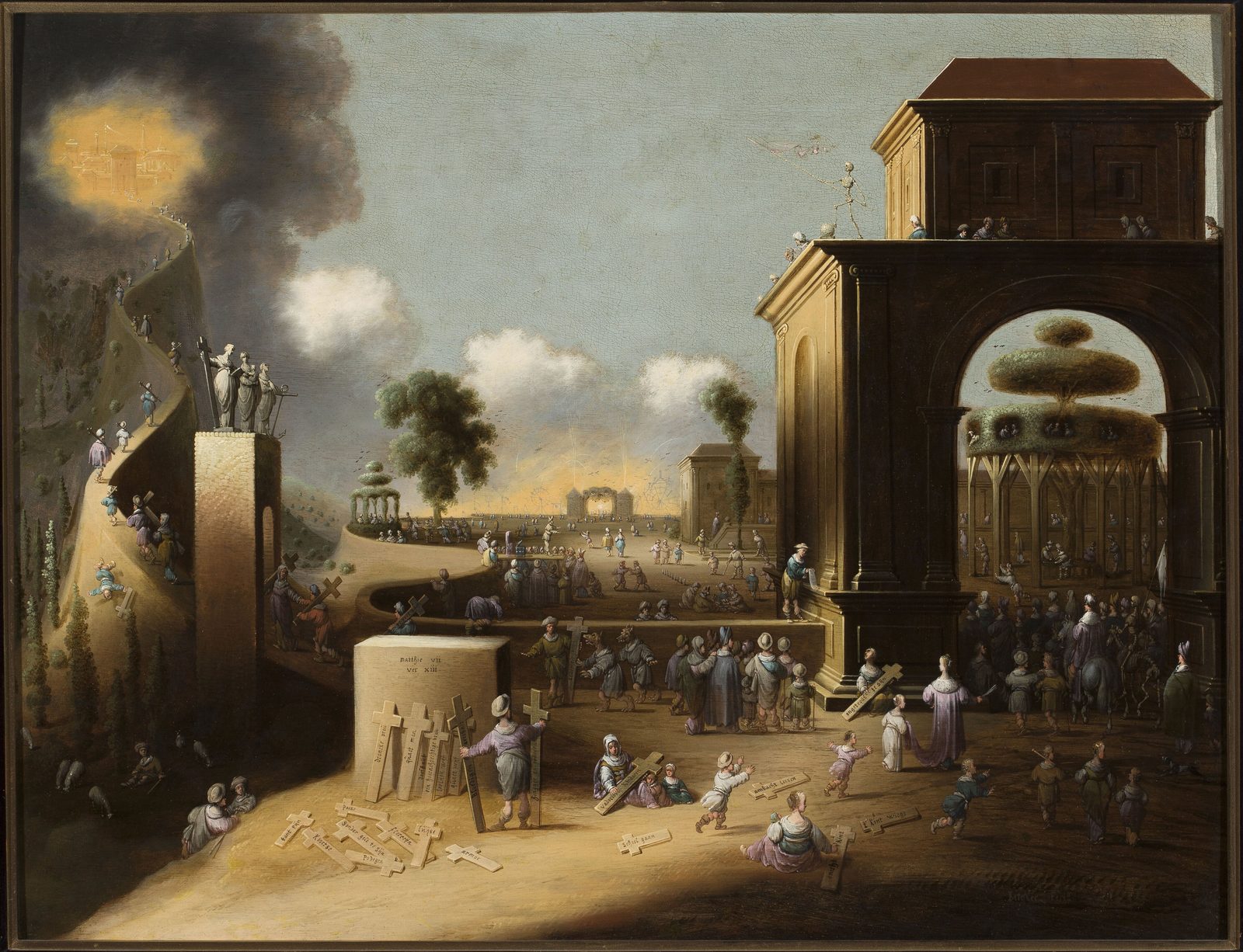
Narrow Road of Virtue and Wide Road of Sin. Jan Micker, not stated on the file page. National Museum in Warsaw. Public domain.