
Psalm 135
21 verses · Historical recital psalm
Your name, O LORD, endures forever, Your renown, O LORD, through all generations.
Introduction
Author unstated, the Servants' Hallelujah, Book 5: The return and the great Hallelujah, Poetry, Psalms Overview.
This psalm has no heading and no named writer, and it was written for the temple choir and the congregation standing in the courts. Much of it is made of lines the worshippers already knew from other psalms and from the books of Moses, so a crowd could join in at once. It praises God for choosing Israel, for ruling the weather, for bringing the nation out of Egypt and into its land. Listen for the long mockery of idols near the end, and for the four groups called by name to bless the LORD.
Context
- Who
- Israelites gathered for worship, standing in the same courts every week
- Where
- The courts of the temple, with the priests and Levites called out by name
- When
- Israel's temple worship after the return. The psalm carries no superscription at all, unlike the fourteen before it. Its use belongs to the worship of the second temple, after 516 BC, and nothing in the text fixes its writing
Historical context
This psalm has no heading and names no writer. It opens and closes on Hallelujah, and it is addressed to the temple staff on duty. It is stitched together out of lines that stand elsewhere in Scripture, the call to the servants, the mockery of idols, and the defeat of Sihon and Og. Reusing known material was normal for temple liturgy, since a congregation could join in without being taught anything new. Sihon ruled the Amorite territory east of the Jordan and Og ruled Bashan to its north, and those two names were shorthand for the moment the wandering ended. The idol passage repeats an argument Israel used constantly, that the things are silver and gold made by human hands. At the end four ranks are called to bless God: the nation, the priests, the temple staff, and the outsiders who had joined themselves to Israel's God.
Significance
A congregation living in a small province under Persian rule was told that its God does whatever He pleases in heaven, on earth, and in every sea and deep. The sting is at the centre. Those who make idols become like them, and so does everyone who trusts them.
This chapter in Jewish lifeWhat this chapter is in Jewish life and reading.
What is done
Psalm 135 stands after the Songs of Ascents and calls on the servants of the LORD who stand in the house of the LORD to praise Him. Ibn Ezra names who those are: "those are the priests who perform the sacrifices and those who play the trumpets" (Ibn Ezra on Psalms 135:2:1, Sefaria Community Translation, CC0). The site's page on the Hallel records that the Talmud preserves opinions extending the name Great Hallel to Psalms 135 and 136, or to 134 through 136, while the accepted opinion holds Psalm 136 alone, so this psalm stands at the edge of that set rather than inside it. Rashi reads one line of the psalm as a rule about who is being addressed: those who fear the LORD in the twentieth verse "are the proselytes" (Rashi on Psalms 135:20:1, the Judaica Press complete Tanach with Rashi, translated by A. J. Rosenberg, CC-BY).
How it is read
The corpus holds nine comments with English text on this chapter. Rashi glosses the lightning made for the rain as the flashes that come before it, and gives the Old French words for them. On the idols of the nations he reads the absence of breath closely, and notes that the psalm says there is no breath in their mouth at all, which makes any further denial about the nose unnecessary, and he marks the difference in vowel pointing from the similar line in Psalm 115. On the thirteenth verse he reads the eternity of the divine name as a claim about the present: the greatness and authority then are the greatness and authority now, and God has the power to judge and avenge. Radak reads the closing blessing from Zion as a claim about instruction as well as glory, saying that from Jerusalem instruction goes out to all (Radak on Psalms 135:21:1, translated by Rabbi Mike Feuer, Jerusalem Anthology, CC-BY). Ibn Ezra comments on twelve more verses and Radak on three, with no English version in the corpus, so they stand as citations at Ibn Ezra on Psalms 135:1:1 and Radak on Psalms 135:2:1.
What the rabbis say
The corpus records forty locators on this chapter, twenty-eight Midrash and twelve Talmud. The opening call to the servants is taken up at Midrash Tehillim 135:1 and Jerusalem Talmud Berakhot 8:8:4, and the standing in the house of the LORD at Pesachim 117a:22, Jerusalem Talmud Pesachim 5:7:2 and Jerusalem Talmud Taanit 3:11:5. The choice of Jacob as God's own treasure is taken up at Bamidbar Rabbah 3:2 and 14:10 and Bereshit Rabbah 76:1. The lightning made for the rain is taken up at Bereshit Rabbah 13:11, Berakhot 59a:13 and Jerusalem Talmud Taanit 3:3:5, and the closing call on the house of Aaron and the house of Levi at Bamidbar Rabbah 3:6, Shevuot 13b:14 and Shevuot 14a:2. Each is a locator without text in the corpus.
Sources: Ibn Ezra, Ibn Ezra on Psalms 135:2:1, Sefaria Community Translation, CC0; Ibn Ezra on Psalms 135:1:1, cited only; Rashi, Rashi on Psalms 135:7:1, 135:13:1, 135:17:1 and 135:20:1, the Judaica Press complete Tanach with Rashi, translated by A. J. Rosenberg, CC-BY; Radak, Radak on Psalms 135:21:1, translated by Rabbi Mike Feuer, Jerusalem Anthology, CC-BY; Midrash, Midrash Tehillim 135:1, Bamidbar Rabbah 3:2, 14:10 and 3:6, Bereshit Rabbah 76:1 and 13:11, Shemot Rabbah 12:3 and 25:1; Babylonian Talmud, Pesachim 117a:22, Berakhot 59a:13, Shevuot 13b:14 and 14a:2, Sotah 39b:11; Jerusalem Talmud, Berakhot 8:8:4, Pesachim 5:7:2, Taanit 3:11:5 and 3:3:5; MannaFest, the Hallel, at /featured/the-hallel, 2026.
Psalms 135:1-4
Praise the name of the LORD: Barnes reads Hallelujah as Praise Jah, the shortened name of Yahweh. The call goes to the servants of the LORD who stand in His house and courts, and the ground given is that He chose Jacob. Matthew Henry names them God's segullah, the word Exodus 19:5 uses of Israel.
Psalms 135:1
“Praise ye the Lord - Hebrew, Hallelu-jah. Literally, “Praise Jah,” an abridged name for Yahweh. See the notes at Psa 68:4. Praise ye the name of the Lord - The same as praising God himself. Praise him, O ye servants of the Lord - You who are especially designated or appointed to this service, Psa 134:1.”
in the courts of the house: Psalm 134:1 calls the servants on duty in the house by night, and this verse adds the courts of the house. The courts were the open yards round the temple, where the people came to pray and bring offerings. The call takes in all of them.
Psalms 135:2
“Ye that stand in the house of the Lord, in the courts of the house of our God. You are highly favoured; you are the domestics of the palace, nearest to the Father of the heavenly family, privileged to find your home in his house; therefore you must, beyond all others, abound in thanksgiving. You "stand; "or abide in the temple; you are constant occupants of its various courts; and therefore from you we expect unceasing praise. Should not ministers be celebrated for celebrating the praises of Jehovah?”
Charles Spurgeon · The Treasury of David, Vol. 7 (1885)Particular Baptist
sing praises to His name: Lovely translates naim, the word Psalm 133:1 sets beside good for brothers in harmony. Verse 3 puts the same two words side by side, good of the LORD and lovely in the praise of His name. Sing praises translates zamar, to make music.
Psalms 135:3
“Praise the Lord, for the Lord is good - See Psa 107:1. Sing praises unto his name, for it is pleasant - See Psa 33:1; Psa 92:1. The idea here is, that it is a source of happiness, and that it is proper in itself.”
Albert Barnes · Notes, Explanatory and Practical, on the Old and New Testaments (1832-1869)Presbyterian
2 more voices on this verse
Psalms 135:3
“What reason shall I give why you should praise Him? "Because the Lord is good" (ver. 3). Briefly in one word is here explained the praise of the Lord our God. "The Lord is good;" good, not in the same manner as the things which He here made are good. For God made all things very good; not only good, but also very good. He made the sky and earth, and all things which are in them good, and He made them very good. If He made all these things good, of what sort is He who made them?”
Augustine of Hippo · written before 430 · Exposition on Psalm 135patristic
Psalms 135:3
“The Lord is good - Here is the first reason why he should be praised; and a second is subjoined: For it is pleasant - It is becoming to acknowledge this infinite Being, and our dependence on him; and it is truly comfortable to an upright mind to be thus employed.”
Adam Clarke · Commentary on the Bible (1810-1826)evangelical
Israel as His treasured possession: Jacob and Israel are the one man's two names, joined at Genesis 32:28, and here both stand for his people. The choice follows Deuteronomy 7:6 to 8, where the LORD chose Israel as His treasured possession out of His love. Malachi 1:2 names the same choice of Jacob.
Psalms 135:4
“For the Lord hath chosen Jacob unto himself. Jehovah hath chosen Jacob. Should not the sons of Jacob praise him who has so singularly favoured them Election is one of the most forcible arguments for adoring love. Chosen! chosen unto himself!—who can be grateful enough for being concerned in this privilege "Jacob have I loved", said Jehovah, and he gave no reason for his love except that he chose to love. Jacob had then done neither good nor evil, yet thus the Lord determined, and thus he spake.”
Charles Spurgeon · The Treasury of David, Vol. 7 (1885)Particular Baptist
1 more voice on this verse
Psalms 135:4
“Israel is God's peculiar treasure above all people ( Exod. xix. 5 ); they are his Segullah, a people appropriated to him, and that he has a delight in, precious in his sight and honourable. For this distinguishing surprising favour, if the seed of Jacob do not praise him, they are the most unworthy ungrateful people under the sun.”
Matthew Henry · Commentary on the Whole Bible (1707-1721)puritan
Psalms 135:5-7
our Lord is above all gods: Spurgeon marked verse 5 as a certainty the psalmist knew. Verse 6 puts the LORD's pleasure over the heavens, the earth, the seas and their depths. Verse 7 stands word for word in the Berean at Jeremiah 10:13 and again at 51:16, clouds and lightning and wind from His storehouses.
Psalms 135:5
“For I know that the Lord is great, and that our Lord is above all gods. The greatness of God is as much a reason for adoration as his goodness, when we are once reconciled to him. God is great positively great comparatively, and great superlatively—"above all gods." Of this the Psalmist had an assured personal persuasion. He says positively, "I know." It is knowledge worth possessing. He knew by observation, inspiration, and realization; he was no agnostic, he was certain and clear upon the matter.”
Charles Spurgeon · The Treasury of David, Vol. 7 (1885)Particular Baptist
in all their depths: Verse 6 takes up Psalm 115:3, where the LORD does all that pleases Him, and spreads it over the heavens, earth, seas and depths. The Hebrew verb is chaphets, to delight in. Psalm 115 sets that line against the idols, as this psalm does at verses 15 to 18.
Psalms 135:6
“Whatsoever the Lord pleased, that did he in heaven, and in earth, in the seas, and all deep places. His will is carried out throughout all space. The king's warrant runs in every portion of the universe. The heathen divided the great domain; but Jupiter does not rule in heaven, nor Neptune on the sea, nor Pluto in the lower regions; Jehovah rules over all. His decree is not defeated, his purpose is not frustrated: in no one point is his good pleasure set aside.”
Charles Spurgeon · The Treasury of David, Vol. 7 (1885)Particular Baptist
1 more voice on this verse
Psalms 135:6
“Whatsoever the Lord pleased, that did he,.... In creation, producing into being what creatures he thought fit; in providence, doing according to his will in heaven and in earth; in grace, predestinating men to grace and glory, according to the good pleasure of his will, and calling by his grace whom he pleased: so Christ quickens whom he will; and the Spirit dispenses his gifts and grace severally to men as he pleases.”
brings forth the wind from His storehouses: Storehouses translates otsar, a treasury, the word Job 38:22 uses for the storehouses of snow and hail. In Canaan the storm and its rain were credited to Baal. Verse 7 gives the clouds, the lightning and the wind to the LORD, who is above all gods by verse 5.
Psalms 135:7
“He causeth the vapours to ascend from the ends of the earth. Here we are taught the power of God in creation. The process of evaporation is passed by unnoticed by the many, because they see it going on all around them; the usual ceases to be wonderful to the thoughtless, but it remains a marvel to the instructed. When we consider upon what an immense scale evaporation is continually going on, and how needful it is for the existence of all life, we may well admire the wisdom and the power which are displayed therein.”
Charles Spurgeon · The Treasury of David, Vol. 7 (1885)Particular Baptist
1 more voice on this verse
Psalms 135:7
“The chain of natural causes was not only framed by him at first, but is still preserved by him. (1.) It is by his power that exhalations are drawn up from the terraqueous globe. The heat of the sun raises them, but it has that power from God, and therefore it is given as an instance of the glory of God that nothing is hidden from the heat of the sun, Ps. xix.”
Matthew Henry · Commentary on the Whole Bible (1707-1721)puritan
Psalms 135:8-12
struck down the firstborn of Egypt: The recital runs from the firstborn of Egypt and the signs against Pharaoh to the kings struck down and their land given to Israel. John Gill reads Sihon and Og as named because they were the first slain and the most powerful. Psalm 136:19 to 22 names the same two.
Psalms 135:8
“Who smote the firstborn of Egypt, both of man and beast. Herein the Lord is to be praised; for this deadly smiting was an act of justice against Egypt, and of love to Israel. But what a blow it was! All the firstborn slain in a moment! How it must have horrified the nation, and cowed the boldest enemies of Israel! Beasts because of their relationship to man as domestic animals are in many ways made to suffer with him.”
Charles Spurgeon · The Treasury of David, Vol. 7 (1885)Particular Baptist
He sent signs and wonders: The psalm turns in the middle of the recital to speak to Egypt itself. Signs and wonders is the pairing of Exodus 7:3, where the LORD says He will multiply them, and of Deuteronomy 6:22. The Hebrew words are otot and mophetim.
Psalms 135:9
“Who sent tokens and wonders into the midst of thee, O Egypt, upon Pharaoh, and upon all his servants. The Lord is still seen by the Psalmist as sending judgments upon rebellious men; he keeps before us the personal action of God, "who sent tokens", etc. The more distinctly God is seen the better. Even in plagues he is to be seen, as truly as in mercies. The plagues were not only terrible wonders which astounded men, but forcible tokens or signs by which they were instructed.”
Charles Spurgeon · The Treasury of David, Vol. 7 (1885)Particular Baptist
slaughtered mighty kings: Verse 10 names the victory in general, and verse 11 gives the names. Deuteronomy 7:1 counts the nations of Canaan as seven, greater and stronger than Israel. Joshua 12 lists the kings struck down on both sides of the Jordan.
Psalms 135:10
“Who smote great nations, and slew mighty kings. The nations of Canaan joined in the desperate resistance offered by their monarchs, and so they were smitten; while their kings, the ringleaders of the fight, were slain. Those who resist the divine purpose will find it hard to kick against the pricks. The greatness of the nations and the might of the kings availed nothing against the Lord. He is prepared to mete out vengeance to those who oppose his designs: those who dream of him as too tender to come to blows have mistaken the God of Israel.”
Charles Spurgeon · The Treasury of David, Vol. 7 (1885)Particular Baptist
Og king of Bashan: Sihon king of the Amorites fell at Jahaz by Numbers 21:23 and 24, Og at Edrei by Numbers 21:33 to 35. Deuteronomy 3:11 marks Og as the last of the Rephaim, with a bed of iron nine cubits long. Canaan's kings fell after them, and Israel took their land.
Psalms 135:11
“Sihon king of the Amorites, and Og king of Bashan,.... These are particularly named, because they were the first that were slain, and were the most mighty and powerful; see Deu 3:11. These the Lord slew by the hand of Moses, a type of Christ; who has destroyed the god and prince of this world, that had the power of death, the devil; and has spoiled all his principalities and powers; and all the kingdoms of Canaan; thirty one of them.”
as a heritage to His people Israel: The land of Sihon and Og was the first land given as an inheritance, to Reuben, Gad and half of Manasseh at Numbers 32:33. Inheritance translates nachalah, land held by a people through the generations. The land of Canaan was given next, under Joshua.
Psalms 135:12
“And gave their land for an heritage, an heritage unto Israel his people. Jehovah is Lord Paramount, and permits men to hold their lands upon lease, terminable at his pleasure. The nations of Canaan had become loathsome with abominable vices, and they were condemned by the great Judge of all the earth to be cut off from the face of the country which they defiled. The twelve tribes were charged to act as their executioners, and as their fee they were to receive Canaan as a possession.”
Charles Spurgeon · The Treasury of David, Vol. 7 (1885)Particular Baptist
Psalms 135:13-14
Your name, O LORD, endures forever: Verse 13 puts the LORD's name and renown beyond every generation. Verse 14 stands almost word for word at Deuteronomy 32:36, where the LORD vindicates His people and has compassion on His servants. The Hebrew behind compassion is nacham, glossed to be sorry and to comfort.
Psalms 135:13
“Thy name, O Lord, endureth for ever. God's name is eternal, and will never be changed. His character is immutable; his fame and honour also shall remain to all eternity. There shall always be life in the name of Jesus, and sweetness and consolation. Those upon whom the Lord's name is named in verity and truth shall be preserved by it, and kept from all evil, world without end. Jehovah is a name which shall outlive the ages, and retain the fulness of its glory and might for ever. And thy memorial, O Lord, throughout all generations.”
Charles Spurgeon · The Treasury of David, Vol. 7 (1885)Particular Baptist
1 more voice on this verse
Psalms 135:13
“15 , where, when God had called himself the God of Abraham, Isaac, and Jacob, he adds, This is my name for ever and this is my memorial unto all generations. God is, and will be, always the same to his church, a gracious, faithful, wonder-working God; and his church is, and will be, the same to him, a thankful praising people; and thus his name endures for ever.”
Matthew Henry · Commentary on the Whole Bible (1707-1721)puritan
will vindicate His people: Vindicate translates din, to judge. The line comes from the Song of Moses at Deuteronomy 32:36, where the LORD judges for His people and servants once their strength is gone. The praise of what He did in Egypt and Canaan turns here to what He will do.
Psalms 135:14
“For the Lord will judge his people,.... Rule and govern, protect and defend them; plead their cause, and avenge them of their enemies; judge between them, distinguish them by his care and providence, make them visible, so that others shall see the difference between them; especially at the last day, when he will judge them, and, as the righteous Judge, give them the crown of righteousness.”
1 more voice on this verse
Psalms 135:14
“For the Lord will judge his people. He will exercise personal discipline over them, and not leave it to their foes to maltreat them at pleasure. When the correction is ended he will arise and avenge them of their oppressors, who for a while were used by him as his rod. He may seem to forget his people, but it is not so; he will undertake their cause and deliver them. The judges of Israel were also her deliverers, and such is the Lord of hosts: in this sense—as ruling, preserving, and delivering his chosen—Jehovah will judge his people.”
Charles Spurgeon · The Treasury of David, Vol. 7 (1885)Particular Baptist
Psalms 135:15-18
The idols of the nations: Spurgeon called the idols dead metal, silver and gold shaped by the hands that worship them. This list stops at the ears and adds that there is no breath, where Psalm 115:6 and 7 go to noses, hands, feet and throats. Breath here is ruach, the wind of verse 7.
Psalms 135:15
“The idols of the heathen are silver and gold, the work of men's hands. Their essential material is dead metal, their attributes are but the qualities of senseless substances, and what of form and fashion they exhibit they derive from the skill and labour of those who worship them. It is the height of insanity to worship metallic manufactures. Though silver and gold are useful to us when we rightly employ them, there is nothing about them which can entitle them to reverence and worship.”
Charles Spurgeon · The Treasury of David, Vol. 7 (1885)Particular Baptist
1 more voice on this verse
Psalms 135:15
"I am the Lord your God. You shall not make for yourselves idols fashioned by the hand, neither set up a graven image. Nor shall you set up a remarkable stone in your land [to worship it]: I am the Lord your God." These words indeed were first spoken by the Lord by the lips of Moses, being applicable certainly to whomsoever the Lord God of Israel may lead forth in like manner from the Egypt of a most superstitious world and from the place of human slavery.
Tertullian · written before 220 · SCORPIACE 2patristic
they have eyes, but cannot see: Jeremiah 10:5 says the idols cannot speak and must be carried, in the chapter verse 7 draws on at Jeremiah 10:13. Deuteronomy 4:28 warns of gods of wood and stone that neither see nor hear. The idols of verse 15 have both mouths and eyes.
Psalms 135:16
“They have mouths, but they speak not,.... Return no answer to the request and petition of their votaries; See Gill on Psa 115:5; eyes have they, but they see not; the same is observed in the above place, which see.”
they have ears, but cannot hear: Jeremiah 10:14 and Habakkuk 2:19 both say the idol has no breath in it. Habakkuk adds that it is overlaid with gold and silver. Ears that cannot hear leave every prayer made to them unanswered.
Psalms 135:17
“They have ears, but they hear not,.... See Gill on Psa 115:6; neither is there any breath in their mouths; they are lifeless statues, they have not so much as what the brute creatures have, breath; our Jehovah, as the living God, is rightly opposed to them, who gives life, and breath, and all things, unto man; and yet what amazing stupidity is it, that any of them should worship such as gods, who have not what they themselves have.”
Those who make them become like them: Verse 18 repeats Psalm 115:8. Jeremiah 2:5 and 2 Kings 17:15 give the same rule in Israel's history, where those who went after worthless idols became worthless themselves. Verses 19 to 21 set the other side, the houses who bless the LORD.
Psalms 135:19-21
house of Israel, bless the LORD: Four times the call is bless the LORD, to the house of Israel, house of Aaron, house of Levi, and those who fear the LORD. Psalm 115:9 to 11 calls Israel, Aaron's house and those who fear the LORD to trust. Hallelujah opens verse 1 and closes verse 21.
Psalms 135:19
“The more deplorable the condition of the Gentile nations that worship idols is the more are we bound to thank God that we know better. Let us set ourselves about the acts of devotion, and employ ourselves in them: Bless the Lord, and again and again, bless the Lord.”
Matthew Henry · Commentary on the Whole Bible (1707-1721)puritan
O house of Levi, bless the LORD: The house of Levi is the one call here that Psalm 115:9 to 11 and Psalm 118:2 to 4 leave out. Numbers 3:6 gives the Levites to Aaron to serve at the tabernacle. They are the servants who stand in the house in verse 2.
Psalms 135:20
“Bless the Lord, O house of Levi. These helped the priests in other things, let them aid them in this also. The house of Israel comprehends all the chosen seed; then we come down to the smaller but more central ring of the house of Aaron, and now we widen out to the whole tribe of Levi. Let reverence and adoration spread from man to man until the whole lump of humanity shall be leavened. The house of Levi had choice reasons for blessing God: read the Levite story and see.”
Charles Spurgeon · The Treasury of David, Vol. 7 (1885)Particular Baptist
He who dwells in Jerusalem: Psalm 134:3 asks the LORD to bless His people from Zion, and verse 21 turns it round, with the LORD blessed from Zion. Zion is the place of both blessings. Psalm 132:13 and 14 name it His chosen home.
Psalms 135:21
“Blessed be the Lord out of Zion - Who has once more restored our temple and city, and now condescends to dwell with us in Jerusalem.”
Adam Clarke · Commentary on the Bible (1810-1826)evangelical
How this psalm is built
The form: A historical psalm of praise, gathered out of the words of earlier Scripture, as Delitzsch classes it.
The patterns in this chapter
| Device | What it does | Where to see it |
|---|---|---|
| Hallelujah at both ends | The psalm opens on Hallelujah at verse 1 and closes on Hallelujah at verse 21. Albert Barnes reads the word as Praise Jah, the shortened form of the name Yahweh, so the psalm is bracketed by the name it spends twenty one verses praising.Albert Barnes, Notes, Explanatory and Practical, on the Old and New Testaments (1832 to 1869), on Psalm 135:1. | Psalm 135:1, Psalm 135:21 |
| The recital of what He did | Verses 8 to 12 run the history in order, the firstborn of Egypt, the signs against Pharaoh, the kings struck down, and the land given to Israel. John Gill reads Sihon and Og as named because they were the first slain and the most powerful of them.John Gill, Exposition of the Old Testament (1748 to 1763), on Psalm 135:11. | Psalm 135:8, Psalm 135:10, Psalm 135:11, Psalm 135:12 |
| The idols that cannot | Verses 16 and 17 list what the idols have and cannot use, mouths that cannot speak, eyes that cannot see, ears that cannot hear, and no breath in their mouths. The word for breath is ruach, the same word for the wind the LORD brings out of His storehouses at verse 7.Charles Spurgeon, The Treasury of David, Vol. 7, 1885, on Psalm 135:15. | Psalm 135:15, Psalm 135:16, Psalm 135:17, Psalm 135:18 |
| Four houses called to bless | Verses 19 and 20 say bless the LORD four times, to the house of Israel, the house of Aaron, the house of Levi, and those who fear the LORD. The whole nation is sorted into four and each part is named.Matthew Henry, Commentary on the Whole Bible, 1710, on Psalm 135:19. | Psalm 135:19, Psalm 135:20 |
The structure
10 more paragraphs on the patterns
The psalm is built in four movements. Verses 1 to 4 call the servants to praise and give the first ground, that the LORD chose Jacob. Verses 5 to 7 give the second, His pleasure done through creation. Verses 8 to 14 give the third, what He did to Egypt and Canaan and what He will do for His people. Verses 15 to 21 set the idols against Him and call four houses to bless Him.
Gathered out of earlier Scripture
This psalm is made largely of lines that stand elsewhere in the Bible, which is the clearest case of the practice in the Psalter.
Verse 7 stands word for word in the Berean at Jeremiah 10:13 and again at Jeremiah 51:16, clouds rising from the ends of the earth, lightning with the rain, and wind out of His storehouses. Verse 14 stands almost word for word at Deuteronomy 32:36, where the LORD vindicates His people and has compassion on His servants. The Hebrew behind compassion there is nacham, glossed to be sorry and to comfort.
Verses 15 to 18 are the idol passage of Psalm 115:4 to 8 in a shorter form. This list stops at the ears and adds that there is no breath in their mouths, where Psalm 115:6 and 7 go on to noses, hands, feet and throats. Verses 19 to 21 shorten Psalm 115:9 to 11 in the same way, and add the house of Levi, which Psalm 115 does not name.
Verse 4 takes the word segullah from Exodus 19:5, and verses 10 to 12 recite the same two kings that Psalm 136:19 to 22 recites.
In the New Testament
No New Testament writer quotes this psalm. Its idol argument is carried forward all the same. Revelation 9:20 describes idols of gold, silver, bronze, stone and wood which cannot see or hear or walk. That is the list of verses 16 and 17. 1 Corinthians 8:4 states that an idol is nothing at all in the world.
What is debated
Whether this psalm draws on Psalm 115 and Jeremiah or those passages draw on it is not settled, and it turns on the psalm's date, which nothing in the text fixes. The psalm carries no superscription and names no event later than the conquest, so the question is argued from the direction of borrowing rather than from evidence in the psalm itself.
Keep studying
Sources for this chapter
The summary
Jamieson, Fausset & Brown, Commentary Critical and Explanatory; John Calvin, Commentaries; John Wesley, Notes on the Old Testament and Matthew Henry, Complete Commentary.
The form and classifications
Charles Spurgeon, The Treasury of David, Vol. 7, 1885, on Psalm 135:6; Franz Delitzsch, Biblical Commentary on the Psalms, on Psalm 135:7 and Matthew Henry, Commentary on the Whole Bible, 1710, on Psalm 135:2.
The exposition
Albert Barnes, Notes on the Book of Psalms; Charles Spurgeon, The Treasury of David; Franz Delitzsch, Biblical Commentary on the Psalms; John Gill, Exposition of the Old Testament; John Wesley, Explanatory Notes upon the Old Testament; Keil and Delitzsch, Biblical Commentary on the Old Testament and Matthew Henry, Commentary on the Whole Bible.
The painting
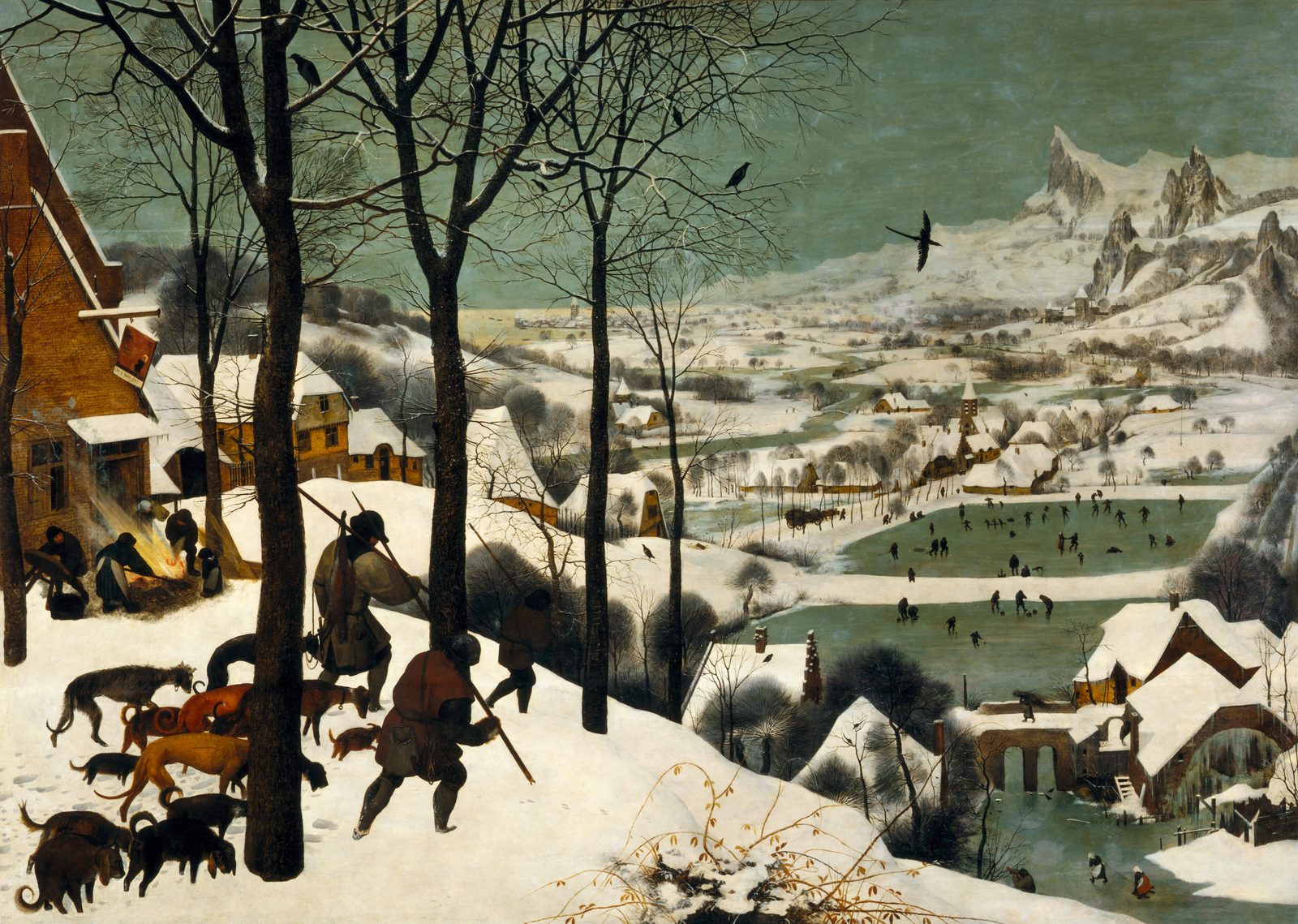
The Hunters in the Snow. Pieter Brueghel the Elder, 1565. Wikimedia Commons. Public domain.