
Psalm 104
35 verses · Creation hymn
He made the moon to mark the seasons; the sun knows when to set.
Introduction
Author unstated, the Creation Hymn, Book 4: The LORD reigns, Poetry, Psalms Overview.
This psalm carries no heading and names no writer. It is a hymn on the created world, sung by someone who watched the land closely: its springs and hills, its animals by day and by night, its crops and its sea. The order follows the days of creation in Genesis loosely, and every part of it is held in God's hand from moment to moment. Listen for how each creature is given its own place and its own food, and for the last word of the psalm, where the Psalter says Hallelujah for the first time.
Context
- Who
- Worshippers who farmed, kept livestock and lived by the rain
- What
- A hymn on the created world, from the heavens and the sea to the springs, the crops and the animals.
- Where
- The land of Israel and the sea beside it.
- When
- Undated; the psalm carries no heading and names no time.
- Why
- To teach Israel that every part of nature is made and fed by one God, who is to be praised for it.
Historical context
Almost every creature and crop in the psalm belonged to that country: the cedars of Lebanon that kings imported for timber, the wild goats on the high limestone, the rock badgers in the cliffs and the stork nesting in the cypresses. The wine, oil and bread of verse 15 were the three staples of Judah, so naming them together named the whole of what a household lived on. In a land with few rivers, a spring running in a valley decided where animals drank and where people settled. Lions still lived in the region and hunted at night, so verses 20 to 23 describe a real division of the day, the beasts abroad in the dark and the man at work from sunrise to evening. In the stories of the surrounding nations the great creature of the sea was a power to be fought, and the psalm says God formed Leviathan to play there.
Significance
The psalm told a farming people that their rain, grass, crops and daylight came from an open hand, and that the same hand could close. For people who lived among neighbours with a god for each part of nature, it handed the whole of it to one God, and made the singing of it an act of daily praise.
This chapter in Jewish lifeWhat this chapter is in Jewish life and reading.
What is done
Rashi reads verse 19 as the verse that governs the Jewish calendar. He glosses the making of the moon for the appointed seasons as making it "to count with it the times and the festivals", which is the reckoning by which the feasts are still dated (Rashi on Psalms 104:19:1, Rashi on Psalms, The Judaica Press complete Tanach with Rashi, translated by A. J. Rosenberg, CC-BY).
How it is read
The psalm is read verse by verse against the six days of Genesis 1, and Rashi makes the tie plain. The fleeing waters of verse 7 he reads as the waters obeying the word of Genesis 1:9, hastening away at that voice and gathering in the place founded for them, and the boundary of verse 9 he identifies as the sand around the shore (Rashi on Psalms 104:7:1 and 104:9:1, same edition).
Some of the psalm he reads of the world to come rather than of this one. The trees of verse 16 are "the Lord's trees in the Garden of Eden", and the birds nesting in them in verse 17 he reads of Israel dwelling there (Rashi on Psalms 104:16:1 and 104:17:1, same edition). The high mountains of verse 18 he leaves as they stand, created for the ibexes.
The night of verses 20 to 22 he reads as an ordinary and daily thing. God darkens and blocks out the sun every day, the beasts move about, and at sunrise they gather into the secret places and hide from the sons of men while every man goes out to his work (Rashi on Psalms 104:20:1 and 104:22:1, same edition). Ibn Ezra carries ten comments for which Sefaria holds no English version, and they are cited by reference (Ibn Ezra on Psalms 104:1:1 and the nine references beside it).
What the rabbis say
The corpus records forty places where the Midrash and the Talmud cite this psalm, thirty one under Midrash and nine under Talmud, and it carries the locator for each one with no text. Bereshit Rabbah, the Midrash on Genesis, reads this psalm eleven times, which follows from the way the psalm retells the creation. It takes up verse 2 at 1:6, verse 3 at 1:3, verse 5 at 12:16, verse 7 at 5:1, verse 8 at 5:3, verse 16 at 15:1, verse 18 at 12:9 and verse 19 at 6:1.
The Babylonian Talmud reads verse 6 at Chagigah 12b:2, verse 15 at Avodah Zarah 29a:5, verse 24 at Avodah Zarah 20a:10, verse 26 at Avodah Zarah 3b:8, and the night and morning of verses 20 and 22 on one page at Bava Metzia 83b:1 and 83b:3. The Jerusalem Talmud cites verse 32 at Berakhot 9:2:4. The site reports where the rabbis cite the verse and reports no saying, because the locator carries none.
Sources: Rashi, Rashi on Psalms 104, in The Judaica Press complete Tanach with Rashi, translated by A. J. Rosenberg, CC-BY; Ibn Ezra, Ibn Ezra on Psalms 104, cited by reference; Sefaria holds no English version; The Midrash and the Talmud, the forty locators on Psalms 104 in scripts/data/sources/sefaria/psalms/104.json.
Psalms 104:1-4
You are very great: God wears light as a garment. He stretches the heavens like a tent, and the light is named here before the sun and the moon, as at Genesis 1:3 and 1:14. Hebrews 1:7 takes verse 4 up for the angels: He makes His angels winds, His servants flames of fire.
Psalms 104:1
“Bless the Lord, O my soul. This psalm begins and ends like the Hundred and Third, and it could not do better: when the model is perfect it deserves to exist in duplicate. True praise begins at home. It is idle to stir up others to praise if we are ungratefully silent ourselves. We should call upon our inmost hearts to awake and bestir themselves, for we are apt to be sluggish, and if we are so when called upon to bless God, we shall have great cause to be ashamed.”
Charles Spurgeon · The Treasury of David, Vol. 5 (1878)Particular Baptist
ConnectionsPsalms 104:35
stretches out the heavens like a tent: Tent translates yeriah, the word for the curtains of the tabernacle at Exodus 26:1. Isaiah 40:22 uses the same picture of the heavens spread out like a tent to live in. First Timothy 6:16 says God dwells in unapproachable light.
Psalms 104:2
“Who coverest thyself with light as with a garment: wrapping the light about him as a monarch puts on his robe. The conception is sublime: but it makes us feel how altogether inconceivable the personal glory of the Lord must be; if light itself is but his garment and veil, what must be the blazing splendour of his own essential being! We are lost in astonishment, and dare not pry into the mystery lest we be blinded by its insufferable glory. Who stretchest out the heavens like a curtain—within which he might dwell.”
Charles Spurgeon · The Treasury of David, Vol. 5 (1878)Particular Baptist
the beams of His chambers: The waters above are those the expanse divided at Genesis 1:7. Psalm 18:10 also has the LORD soaring on the wings of the wind, and Isaiah 19:1 shows Him riding a swift cloud into Egypt. Chambers returns at verse 13.
Psalms 104:3
“Who layeth the beams of his chambers in the water's. His lofty halls are framed with the waters which are above the firmament. The upper rooms of God's great house, the secret stories far above our ken, the palatial chambers wherein he resides, are based upon the floods which form the upper ocean. To the unsubstantial he lends stability; he needs no joists and rafters, for his palace is sustained by his own power. We are not to interpret literally where the language is poetical, it would be simple absurdity to do so. Who maketh the clouds his chariot.”
Charles Spurgeon · The Treasury of David, Vol. 5 (1878)Particular Baptist
1 more voice on this verse
Psalms 104:3
“The scope of the passage is shortly this, that we need not pierce our way above the clouds for the purpose of finding God, since he meets us in the fabric of the world, and is everywhere exhibiting to our view scenes of the most vivid description.”
John Calvin · Commentaries (1554)reformed
He makes the winds His messengers: Messengers is malakh, the Hebrew word for angel, and winds is ruach, which also means spirit. The Greek of Hebrews 1:7 follows the reading that makes the angels into winds and fire. Psalm 148:8 has fire and stormy wind doing His word.
Psalms 104:4
“This is quoted by Paul (Heb 1:7) to denote the subordinate position of angels; that is, they are only messengers as other and material agencies. spirits--literally, "winds." flaming fire-- (Ps 105:32) being here so called.”
Jamieson, Fausset & Brown · Commentary Critical and Explanatory on the Whole Bible (1871)reformed
Cross references
Psalms 104:4
- Quoted inHebrews 1:7Now about the angels He says: “He makes His angels winds, His servants flames of fire.”
'Who maketh his angels spirits'
Psalms 104:5-9
He set the earth on its foundations: The waters once stood over the mountains. A rebuke and a peal of thunder drove them off, the mountains rose, the valleys sank, the sea was given a boundary it cannot cross. That boundary is the promise of Genesis 9:11, that no flood will cover the earth again.
Psalms 104:5
“Who laid the foundations of the earth. Thus the commencement of creation is described, in almost the very words employed by the Lord himself in Job 38:4. "Where wast thou when I laid the foundations of the earth? Whereupon are the foundations thereof fastened, and who laid the corner stone thereof?" And the words are found in the same connection too, for the Lord proceeds to say, "When the morning stars sang together and all the sons of God shouted for joy." That it should not be removed forever.”
Charles Spurgeon · The Treasury of David, Vol. 5 (1878)Particular Baptist
covered it with the deep: The deep is tehom, the word of Genesis 1:2, where darkness lay over its surface. God wears light as a garment in verse 2. Here the earth is given the deep for its covering.
Psalms 104:6
“Thou coveredst it with the deep as with a garment. The new born earth was wrapped in aqueous swaddling bands. In the first ages, ere man appeared, the proud waters ruled the whole earth. The waters stood above the mountains, no dry land was visible, vapour as from a steaming cauldron covered all. Geologists inform us of this as a discovery, but the Holy Spirit had revealed the fact long before.”
Charles Spurgeon · The Treasury of David, Vol. 5 (1878)Particular Baptist
At Your rebuke the waters fled: Genesis 1:9 tells the same moment as a command, the waters gathered into one place. Psalm 29:3 hears the voice of the LORD thundering over the waters. At Mark 4:39 Jesus rebuked the wind, and the sea fell calm.
Psalms 104:7
“At thy rebuke they fled,.... The depths of water that covered the earth fled, went off apace, when Christ, the essential Word, gave the word of command that they should; saying, "Let the waters under the heaven be gathered together unto one place, and let the dry land appear, and it was so", Gen 1:9 and this being called a "rebuke", suggests as if there was something amiss, irregular and disorderly, and to be amended; as if these waters were not in their proper place.”
1 more voice on this verse
Psalms 104:7
“Even those fluid bodies received the impression of God's terror. But was the Lord displeased against the rivers? No; it was for the salvation of his people, Hab. iii.”
Matthew Henry · Commentary on the Whole Bible (1707-1721)puritan
the mountains rose and the valleys sank: The Hebrew can also be read with the waters as subject, running up the mountains and down the valleys as they fled. Each part of the earth goes to its appointed place. That place answers the waters that stood above the mountains in verse 6.
Psalms 104:8
“They go up by the mountains, they go down by the valleys,.... The Targum is, "they ascend out of the deep to the mountains;'' that is, the waters, when they went off the earth at the divine orders, steered their course up the mountains, and then went down by the valleys to the place appointed for them; they went over hills and dales, nothing could stop them or retard their course till they came to their proper place; which is another instance of the almighty power of the Son of God.”
a boundary they cannot cross: Jeremiah 5:22 names the boundary, the sand the LORD placed for the sea, and at Job 38:11 the waves are told where they must stop. The waters of verse 6 once covered the mountains. A line of sand now holds them from the earth.
Psalms 104:9
“The waters are forbidden to pass over the limits set them; they may not, and therefore they do not, turn again to cover the earth. Once they did, in Noah's flood, because God bade them, but never since, because he forbids them, having promised not to drown the world again.”
Matthew Henry · Commentary on the Whole Bible (1707-1721)puritan
Psalms 104:10-13
He sends forth springs in the valleys: The springs run where no man dug them, and every beast of the field drinks. The wild donkey is named too, an animal that serves nobody and drinks all the same. Birds nest beside the springs and sing in the branches.
Psalms 104:10
“He sendeth the springs into the valleys,.... The Targum is, "who sendeth fountains into the rivers.'' Either from the waters of the sea, which being drained through the sand, become sweet and drinkable; or from the hills and mountains. This is an instance of divine goodness, that having removed the waters from the earth, and shut them up in the sea, and which, through the saltness of them, not being proper drink for men and beasts, he has been pleased to form and open springs, fountains, wells, and rivers of fresh water in the valleys, for the supply of both.”
1 more voice on this verse
Psalms 104:10
“There is water enough indeed in the sea, that is, enough to drown us, but not one drop to refresh us, be we ever so thirsty--it is all so salt; and therefore God has graciously provided water fit to drink.”
Matthew Henry · Commentary on the Whole Bible (1707-1721)puritan
the wild donkeys quench their thirst: Job 39:5 to 8 describes the wild donkey free in the wasteland, searching the mountains for green pasture. Jeremiah 14:6 shows the same beast gasping with thirst in a drought. Springs that flow between the mountains give it drink.
Psalms 104:11
“They give drink to every beast of the field. Who else would water them if the Lord did not? They are his cattle, and therefore he leads them forth to watering. Not one of them is forgotten of him. The wild asses quench their thirst. The good Lord gives them enough and to spare. They know their Master's crib. Though bit or bridle of man they will not brook, and man denounces them as unteachable, they learn of the Lord, and know better far than man where flows the cooling crystal of which they must drink or die.”
Charles Spurgeon · The Treasury of David, Vol. 5 (1878)Particular Baptist
nest beside the springs: Trees in a dry land grow along the watercourses, so the birds gather where the springs run. Jesus pointed to the birds of the air at Matthew 6:26, fed by the heavenly Father. Their song answers the singer of verse 33.
Psalms 104:12
Over them the birds of heaven shall dwell. Remember the parable of the mustard seed, and the birds that dwell in it. From the midst of the rocks they shall give voice. Each thing in its own tongue praises the Lord. In the Hebrew it has "of the trees."
Jerome · written before 420 · Homily 30, on Psalm 103patristic
He waters the mountains from His chambers: The chambers are the upper rooms of verse 3. Springs water the valleys and rain from those rooms waters the heights. Deuteronomy 11:11 describes the promised land as hills and valleys that drink the rain of heaven.
Psalms 104:13
“He watereth the hills from his chambers,.... The house of his superior treasures, as the Targum. The airy regions, Psa 104:3 with the clouds of heaven, by the rain which they drop down upon them; the usefulness of which blessings of nature is largely described in this and some following verses. "The hills", which are naturally dry and barren, and receive but little advantage from the springs, fountains, and rivers below, are supplied with water from above; and become fruitful, bear herbage, and are clothed with flocks.”
Psalms 104:14-15
He makes the grass grow: The heart is named twice in verse 15. Wine gladdens it and bread sustains it, and between them stands oil that makes the face shine. Before any of it, the grass grows for the livestock and the crops are given to man to work.
Psalms 104:14
That he may bring forth bread out of the earth. He speaks of the Lord, who deigned to become man, as it is written: "I am the living bread, who came down from heaven."
Jerome · written before 420 · Homily 30, on Psalm 103patristic
oil that makes his face to shine: Deuteronomy 11:14 names the same three crops of the land, grain, new wine and oil. Oil made the face shine in a dry climate, and Ruth washed and anointed herself at Ruth 3:3. Gladness and strength come from the same earth.
Psalms 104:15
“And wine that maketh glad the heart of man. By the aid of genial showers the earth produces not merely necessaries but luxuries, that which furnishes a feast as well as that which makes a meal. O that man were wise enough to know how to use this gladdening product of the vine; but, alas, he full often turns it to ill account, and debases himself therewith. Of this he must himself bear the blame; he deserves to be miserable who turns even blessings into curses. And oil to make his face to shine.”
Charles Spurgeon · The Treasury of David, Vol. 5 (1878)Particular Baptist
Psalms 104:16-18
The trees of the LORD have their fill: The cedars of Lebanon are the LORD's own trees, and He planted them. Each creature then gets ground of its own kind, birds in the cedars, the stork in the cypresses, and wild goats on the high mountains. The cliffs stand as a refuge for the rock badgers.
Psalms 104:16
“The watering of the hills not only produces the grass and the cultivated herbs, but also the nobler species of vegetation, which come not within the range of human culture: The trees of the Lord—the greatest, noblest, and most royal of trees; those too which are unowned of man, and untouched by his hand. Are full of sap, or are full, well supplied, richly watered, so that they become, as the cedars, full of resin, flowing with life, and verdant all the year round. The cedars of Lebanon, which he hath planted.”
Charles Spurgeon · The Treasury of David, Vol. 5 (1878)Particular Baptist
the stork makes her home: Stork translates chasidah, a name built on chesed, loving devotion, and older writers explained it by the bird's care for its young. Jeremiah 8:7 says the stork in the sky knows her appointed seasons. The tall cypresses give her a high nest.
a refuge for the rock badgers: The rock badger is the shaphan, a small animal that Proverbs 30:26 praises for making its home in the crags. The wild goats are the ibex of En-gedi, where Saul hunted David at 1 Samuel 24:1 to 2. Weak creatures are given strong ground.
Psalms 104:18
“The high mountains for the stags. This animal kills serpents and eats them. Therefore it fittingly dwells in the mountains, this one that slays the intelligible serpent — the one who was wiser in paradise than all the beasts, who deceived Eve. The rock is a refuge for the hedgehogs. He who is timid has the rock as his refuge: and the rock is Christ.”
Jerome · written before 420 · Homily 30, on Psalm 103patristic
Psalms 104:19-23
He made the moon to mark: The two lights keep time. The moon marks the seasons, the sun knows the hour it sets, and the night belongs to the lions, who seek their food from God. When the sun rises they go to their dens, and man goes out to work until evening.
Psalms 104:19
“He appointeth the moon for seasons,.... Or, "he made" (e); for the moon is the work of his hands, Psa 8:3 as is likewise the sun. From the rain the psalmist passes to the luminaries; for this reason, as Aben Ezra thinks, because they are the cause of rain: the moon is taken notice of in the first place, because, as Kimchi observes, the night was before the day; and in the night of the fourth day were the sun, moon, and stars; but the sun rose in the morning.”
all the beasts of the forest prowl: Genesis 1:5 names the darkness night, and here God brings it on each evening. Prowl translates ramas, the verb for creeping things at Genesis 1:26. Isaiah 45:7 says He forms the light and creates the darkness.
Psalms 104:20
“You have set darkness, and it became night: in it all the beasts of the forest shall pass through. And according to the letter it has its own order: for night was made for this reason, that men might rest from their works, and that the beasts might go out to their feeding. But according to the figurative interpretation, when the sun of righteousness has set upon us, all things are dark to us, and then the beasts pass through against us, and the roaring lion, wishing to seize and devour us.”
Jerome · written before 420 · Homily 30, on Psalm 103patristic
The young lions roar for their prey: The LORD asks Job at Job 38:39 who hunts prey for the lioness and fills the young lions. The roar is heard here as a request. Verse 27 gathers every creature into the same waiting on God.
Psalms 104:21
“The young lions roar after their prey, and seek their meat from God. This is the poetic interpretation of a roar. To whom do the lions roar? Certainly not to their prey, for the terrible sound tends to alarm their victims, and drive them away. They after their own fashion express their desires for food, and the expression of desire is a kind of prayer. Out of this fact comes the devout thought of the wild beast's appealing to its Maker for food.”
Charles Spurgeon · The Treasury of David, Vol. 5 (1878)Particular Baptist
The sun rises, and they withdraw: Withdraw translates a verb for gathering in, as a flock is brought home. The same sunrise that sends the lions to their dens sends man out in verse 23. The day and the night are shared out between them.
Psalms 104:22
“The beasts creep forth to spoil and do mischief; man goes forth to work and do good. There is the work of every day, which is to be done in its day, which man must apply to every morning (for the lights are set up for us to work by, not to play by) and which he must stick to till evening; it will be time enough to rest when the night comes, in which no man can work.”
Matthew Henry · Commentary on the Whole Bible (1707-1721)puritan
Man goes forth to his work: Man comes last in the order of the day. His labor runs until evening, the hour the beasts come out in verse 20. Jesus used the same order at John 9:4, work by day before night comes.
Psalms 104:24-26
How many are Your works: Wisdom is named as the means of it all. The sea gets its own verse, wide and full of creatures past counting, great and small. Leviathan is in it, and the verse says God formed him to frolic there.
Psalms 104:24
Doubtless the things that came to be through the Word, these are "founded in wisdom" and what are "founded in wisdom," these are all made by the Hand and came to be through the Son. And we have proof of this, not from external sources, but from the Scriptures; for God says by Isaiah the prophet, "My hand also has laid the foundation of the earth, and my right hand has spanned the heavens." And again, "And I will cover you in the shadow of my hand, by which I planted the heaven, and laid the foundations of the earth."
Athanasius of Alexandria · written before 373 · Defense of the Nicene Definition 4:17patristic
Here is the sea, vast and wide: Here points outward, as though the singer stands on the shore. Genesis 1:21 records the making of the great sea creatures and every living thing that teems in the waters. Great and small matches the sea to the land, which has its lions and its rock badgers.
Psalms 104:25
“So is this great and wide sea,.... One of the great and manifold works of God, made in his wisdom, and full of his riches and possessions, as the earth is; this is that collection of waters which God called seas, Gen 1:10 and is, as Kimchi observes, great in length, and wide and spacious in breadth; or "broad of hands" (i), as in the original; or spacious in borders, as the Targum; it washing the several parts of the continent, and encompassing and embracing the whole earth with both arms as it were.”
1 more voice on this verse
Psalms 104:25
“Let us, therefore, in the faith of the disciples, converse frequently with our Master. For the world is like the sea to us, my brothers, of which it is written, "This is the great and wide sea, there go the ships; the Leviathan, which you have created to play therein." We float on this sea, as with the wind, through our own free will, for everyone directs his course according to his will, and either, under the pilotage of the Word, he enters into rest, or, laid hold on by pleasure, he suffers shipwreck and is in peril by storm.”
Athanasius of Alexandria · written before 373 · Festal Letters 19:7patristic
formed to frolic there: Frolic translates sachaq, to play, the word of Job 41:5, where the LORD asks whether Job can play with Leviathan like a bird. Isaiah 27:1 names Leviathan as a sea serpent the LORD will punish. Here he is a creature at play.
Psalms 104:26
“This dragon which you formed to mock him. The Jews say: God made a great dragon, which is called Leviathan, and it is in the sea; and when, they say, the ocean recedes, the dragon turns. But let us say: This is the dragon who was cast out of paradise, who deceived Eve, and was given into this world to mock us. For how many monks and clerics has he cast down!”
Jerome · written before 420 · Homily 30, on Psalm 103patristic
Psalms 104:27-30
All creatures look to You: Everything in the psalm hangs on one hand. When it opens they eat; when the face turns away they are terrified; when the breath is taken they return to dust. The Spirit sent at verse 30 is the Spirit of Genesis 1:2, and He renews the face of the earth.
Psalms 104:27
“The entire dependence of this immense family on God is set forth. With Him, to kill or make alive is equally easy. To hide His face is to withdraw favor (Ps 13:1).”
Jamieson, Fausset & Brown · Commentary Critical and Explanatory on the Whole Bible (1871)reformed
they gather it up: Gather up translates laqat, the verb for gathering the manna each morning at Exodus 16:4. God gives and the creature collects. Psalm 145:16 repeats the open hand that satisfies every living thing.
Psalms 104:28
“THIS sentence describes the commissariat of creation. The problem is the feeding of the "creeping things innumerable, both small and great beasts," which swarm the sea, the armies of birds which fill the air and the vast hordes of animals which people the dry land! But in this sentence we have the problem solved, "What You give them they gather." The work is stupendous, but it is done with ease because the Worker is Infinite—if He were not at the head of it, the task would never be accomplished! Blessed be God for the great You of the text!”
Charles Spurgeon · written before 1892 · The Metropolitan Tabernacle Pulpit, Sermon No. 3149: “The Commissariat of the Universe” (lightly modernized text, CCEL edition)Particular Baptist
they die and return to dust: Job 34:14 to 15 says the same of all flesh, that if God withdrew His breath, man would return to dust. Genesis 3:19 first spoke the sentence. Breath here is ruach, the word translated Spirit in verse 30.
Psalms 104:29
So when the Spirit was moving on the water, the creation was without grace; but after this world being created underwent the operation of the Spirit, it gained all the beauty of that grace wherewith the world is illuminated. And that the grace of the universe cannot abide without the Holy Spirit the prophet declared when he said, "You will take away your Spirit, and they will fail and be turned again into their dust. Send forth your Spirit, and they shall be made, and you will renew all the face of the earth."
Ambrose of Milan · written before 397 · On the Holy Spirit 2.5.33patristic
When You send Your Spirit: Created is bara, the verb of Genesis 1:1, used here for every new generation of creatures. Creation continues each spring. Ezekiel 37:9 to 10 shows the same breath entering the slain so that they live.
Psalms 104:30
“Resurrection from the dead is accomplished by the operation of the Spirit: "You send forth your Spirit, and they are created; and you renew the face of the earth." If "creation" means the conversion of sinners to a better way of life (the Scripture often understands it this way; for example, the words of Paul: "If any one is in Christ, he is a new creation."), and the renewal of this earthly life and changing our earthly, passionate life into heavenly citizenship, then we should know that our souls attain such a high degree of exaltation through the Spirit.”
Basil of Caesarea · written before 379 · On the Holy Spirit 19:49patristic
Psalms 104:31-32
the glory of the LORD endure forever: The prayer is for a glory that endures, and for the LORD's own pleasure in what He made. Verse 32 gives the weight behind it: a look makes the earth tremble and a touch sets the mountains smoking. The same earth He waters He can also shake.
Psalms 104:31
“We often do that which, upon the review, we cannot rejoice in, but are displeased at, and wish undone again, blaming our own management. But God always rejoices in his works, because they are all done in wisdom. We regret our bounty and beneficence, but God never does; he rejoices in the works of his grace: his gifts and callings are without repentance.”
Matthew Henry · Commentary on the Whole Bible (1707-1721)puritan
He touches the mountains: Sinai smoked, and the whole mountain was made to tremble when the LORD came down on it at Exodus 19:18. Psalm 144:5 asks Him to touch the mountains so they smolder. The glory of verse 31 carries this weight.
Psalms 104:32
“He looketh on the earth, and it trembleth. The Lord who has graciously displayed his power in acts and works of goodness might, if he had seen fit, have overwhelmed us with the terrors of destruction, for even at a glance of his eye the solid earth rocks with fear. He toucheth the hills, and they smoke. Sinai was altogether on a smoke when the Lord descended upon it. It was but a touch, but it sufficed to make the mountain dissolve in flame. Even our God is a consuming fire.”
Charles Spurgeon · The Treasury of David, Vol. 5 (1878)Particular Baptist
Psalms 104:33-34
I will sing to the LORD: The vow is to sing for the whole of his life, and his meditation is offered to please the LORD. The word for rejoice in verse 34 is the same Hebrew word used of the wine at verse 15, samach. The gladness God gave comes back to Him in praise.
Psalms 104:33
“I will sing unto the Lord as long as I live, or, literally, in my lives. Here and hereafter the psalmist would continue to praise the Lord, for the theme is an endless one, and remains for ever fresh and new. The birds sang God's praises before men were created, but redeemed men will sing his glories when the birds are no more. Jehovah, who ever lives and makes us to live shall be for ever exalted, and extolled in the songs of redeemed men. I will sing praise to my God while I have my being.”
Charles Spurgeon · The Treasury of David, Vol. 5 (1878)Particular Baptist
May my meditation be pleasing: Psalm 19:14 makes the same request, that the words and the meditation of the heart be pleasing to the LORD. Meditation here is siach, a word that also covers musing and complaint, as in the title of Psalm 102. Here it is sung as praise.
Psalms 104:34
“Thus then, being before instructed and taught, they [the people of Israel] learned not to do service to any one but the Lord. They began to know how long the shadow would last and not to forget the time that was at hand, in which no longer should the bullock of the herd be a sacrifice to God, or the ram of the flock or the he-goat, but all these things should be fulfilled in a purely spiritual manner and by constant prayer and upright conversation, with godly words; as David sings, "May my meditation be pleasing to him.”
Athanasius of Alexandria · written before 373 · Festal Letters 19:4patristic
1 more voice on this verse
Psalms 104:34
“My meditation of him shall be sweet. Sweet both to him and to me. I shall be delighted thus to survey his works and think of his person, and he will graciously accept my notes of praise. Meditation is the soul of religion. It is the tree of life in the midst of the garden of piety, and very refreshing is its fruit to the soul which feeds thereon. And as it is good towards man, so is it towards God.”
Charles Spurgeon · The Treasury of David, Vol. 5 (1878)Particular Baptist
May sinners vanish from the earth: The hymn ends with a request that sinners vanish. Then it returns to the line it opened with, the soul told to bless the LORD. Hallelujah stands here for the first time in the Psalter, two Hebrew words that mean praise the LORD.
Psalms 104:35
“Let the sinners be consumed out of the earth, and let the wicked be no more. They are the only blot upon creation. In holy indignation the psalmist would fain rid the world of beings so base as not to love their gracious Creator, so blind as to rebel against their Benefactor. He does but ask for that which just men look forward to as the end of history: for the day is eminently to be desired when in all God's kingdom there shall not remain a single traitor or rebel.”
Charles Spurgeon · The Treasury of David, Vol. 5 (1878)Particular Baptist
1 more voice on this verse
Psalms 104:35
“Praise ye the Lord--The Psalm closes with an invocation of praise, the translation of a Hebrew phrase, which is used as an English word, "Hallelujah," and may have served the purpose of a chorus, as often in our psalmody, or to give fuller expression to the writer's emotions. It is peculiar to Psalms composed after the captivity, as "Selah" is to those of an earlier date.”
Jamieson, Fausset & Brown · Commentary Critical and Explanatory on the Whole Bible (1871)reformed
How this psalm is built
The form: A hymn of creation sung as a living household, where wisdom is named as the means of all of it, as Delitzsch classes it.
The patterns in this chapter
| Device | What it does | Where to see it |
|---|---|---|
| Bless the LORD, O my soul, at both ends | Verse 1 opens with the soul told to bless the LORD and verse 35 closes with the same line before the Hallelujah. The whole creation stands inside a frame made by one man speaking to himself, which is the frame Psalm 103 uses as well.Charles Spurgeon, The Treasury of David, Vol. 4, 1874, on Psalm 104:35. | Psalm 104:1, Psalm 104:35 |
| The creatures given their own ground | Verses 16 to 18 hand each kind the place that fits it: birds in the cedars, the stork in the cypresses, wild goats on the high mountains, rock badgers in the cliffs. The list is arranged by habitat rather than by rank, so the psalm is describing a fitted world.Albert Barnes, Notes, Explanatory and Practical, on the Old and New Testaments, 1832 to 1869, on Psalm 104:17. | Psalm 104:16, Psalm 104:17, Psalm 104:18 |
| The hand that opens and closes | Verses 27 to 30 hang the whole psalm on one hand and one face. When He gives, they gather. When He opens His hand, they are satisfied. When He hides His face, they are terrified. When He takes their breath, they return to dust. Four clauses, each with its own consequence, and the same subject in all four.Charles Spurgeon, The Treasury of David, Vol. 4, 1874, on Psalm 104:27. | Psalm 104:27, Psalm 104:28, Psalm 104:29, Psalm 104:30 |
| The word that returns | The Hebrew word behind rejoice at verse 34 is samach, the same word used of the wine that gladdens the heart of man at verse 15. The gladness God put into the world comes back to Him in the singer's meditation, and the psalm says so by repeating one verb.Matthew Henry, Commentary on the Whole Bible, 1710, on Psalm 104:34. | Psalm 104:15, Psalm 104:34 |
The order of creation
12 more paragraphs on the patterns
The psalm's sequence follows Genesis 1 closely enough to be read beside it. Light comes first at verse 2 as it does at Genesis 1:3, and the sun and moon are named later at verse 19 as they are at Genesis 1:14, which is the same order and not the order an observer would choose. The waters are separated at verses 5 to 9 as at Genesis 1:6 to 10, the plants at verse 14 as at Genesis 1:11, the creatures of the sea and air at verses 12 and 25 as at Genesis 1:20 and 21, the land animals and man at verses 20 to 23 as at Genesis 1:24 to 26. What the psalm adds to Genesis is the maintenance: Genesis says the world was made, and Psalm 104 says it is kept.
The boundary of verse 9 is the promise of Genesis 9:11, that no flood will cover the earth again, and the Spirit sent at verse 30 is the Spirit of Genesis 1:2 who moved over the waters. The site states the correspondence as a correspondence of order and subject, which is what can be shown from the two texts, and claims no more than that.
The New Testament's use
Hebrews 1:7 quotes verse 4 in the argument about the angels, that He makes His angels winds and His servants flames of fire. The verse is used to show what the angels are so that the Son can be shown to be more.
Its historical value
Verse 35 carries the first Hallelujah in the Psalter. Matthew Henry marks the place and the occasion together, that this is the first time the word is met and that it comes in at the destruction of the wicked, as it does again at the last place it stands. Jamieson, Fausset and Brown add a second fact about the word, that Hallelujah is peculiar to psalms composed after the captivity, as Selah is to the earlier ones, which is a dating observation rather than a devotional one.
The debated point
Whether the psalm's agreement with Genesis 1 is deliberate or is the common order of a shared tradition is not settled by either text, and the site does not settle it. What can be shown is the order itself, verse by verse, and the site shows that and stops. The dating question raised by the Hallelujah at verse 35 is carried the same way, as the observation of Jamieson, Fausset and Brown rather than as the site's own conclusion.
In the Psalter
Psalm 104 is the second half of a pair. Psalm 103 blesses God for what He does to a man and Psalm 104 for what He made, and both open and close on the same line. Psalm 105, which follows, does the same work for Israel's history that this psalm does for the created world.
The door
Creation week carries the order this psalm follows, and The groaning creation carries what the New Testament makes of a world that is kept and is still waiting.
Keep studying
Sources for this chapter
The summary
Jamieson, Fausset & Brown, Commentary Critical and Explanatory; John Calvin, Commentaries; John Wesley, Notes on the Old Testament and Matthew Henry, Complete Commentary.
The form and classifications
Franz Delitzsch, Biblical Commentary on the Psalms, 1871, on Psalm 104:24; John Gill, Exposition of the Old Testament, 1763, on Psalm 104:31 and Matthew Henry, Commentary on the Whole Bible, 1710, on Psalm 104:35.
The exposition
Adam Clarke, Commentary on the Bible; Albert Barnes, Notes on the Book of Psalms; Charles Spurgeon, The Treasury of David; Franz Delitzsch, Biblical Commentary on the Psalms; John Gill, Exposition of the Old Testament and Matthew Henry, Commentary on the Whole Bible.
The painting
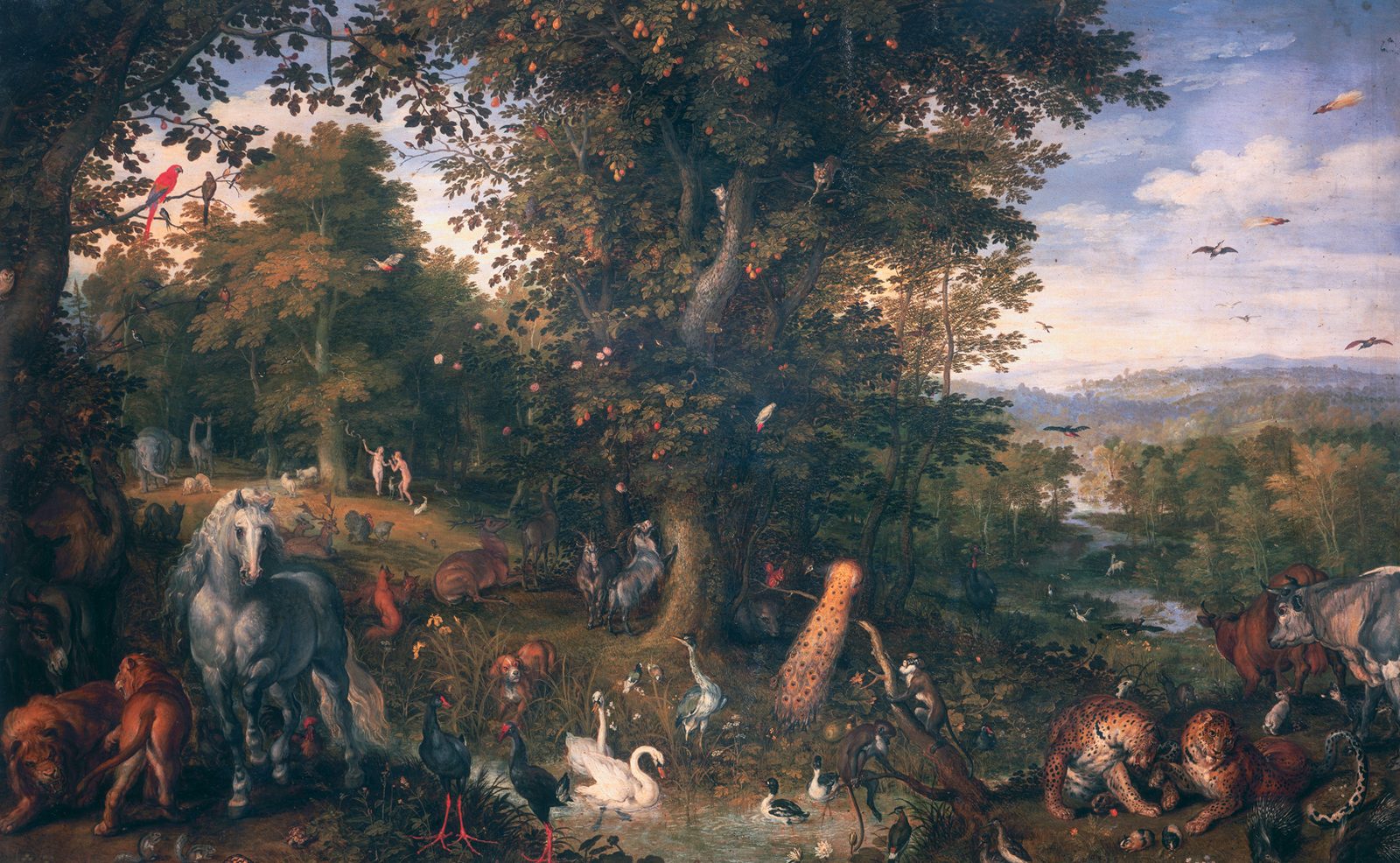
The Garden of Eden. Jan Brueghel the Elder, 1612. Wikimedia Commons. Public domain.