
Psalms 104:20
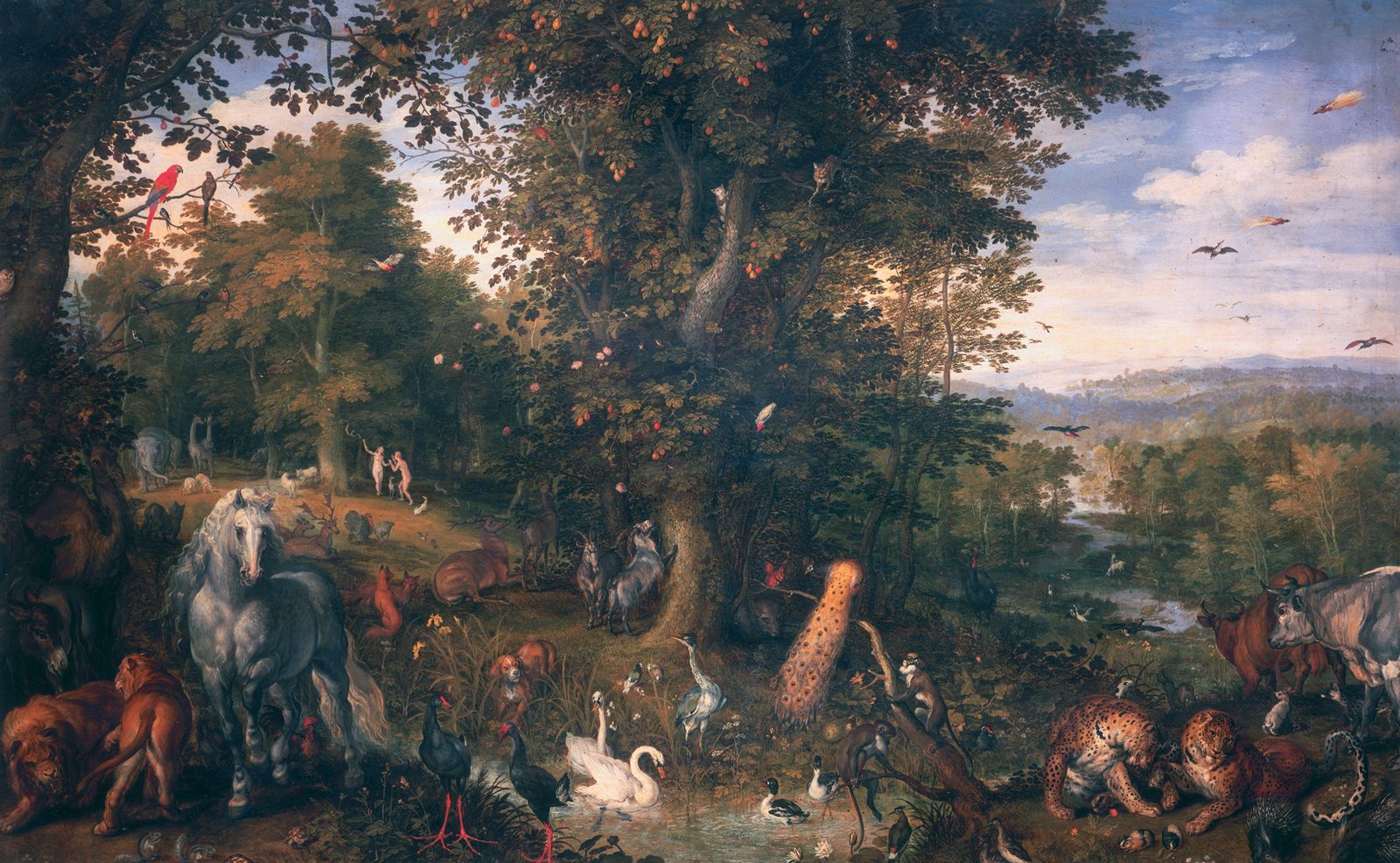
in Psalms 104You bring darkness, and it becomes night, when all the beasts of the forest prowl.
BSB
The same verse in ASV and KJV ▾
ASV
Thou makest darkness, and it is night, Wherein all the beasts of the forest creep forth.
KJV
Thou makest darkness, and it is night: wherein all the beasts of the forest do creep forth.
⋯
This verse in Psalms 104
Commentary
13 notes on this verseYou have set darkness, and it became night: in it all the beasts of the forest shall pass through. And according to the letter it has its own order: for night was made for this reason, that men might rest from their works, and that the beasts might go out to their feeding. But according to the figurative interpretation, when the sun of righteousness has set upon us, all things are dark to us, and then the beasts pass through against us, and the roaring lion, wishing to seize and devour us.
This site's exposition
He made the moon to mark
on Psalms 104:19-23
The two lights keep time. The moon marks the seasons, the sun knows the hour it sets, and the night belongs to the lions, who seek their food from God. When the sun rises they go to their dens, and man goes out to work until evening.
This site's exposition
all the beasts of the forest prowl
Genesis 1:5 names the darkness night, and here God brings it on each evening. Prowl translates ramas, the verb for creeping things at Genesis 1:26. Isaiah 45:7 says He forms the light and creates the darkness.
The record, by era
The Church Fathers3 voices
As you know, that psalm [104 (103 LXX)] contains the words "The sun knows the hour of its setting. You bring darkness, and it is night." What person, though unlettered, does not understand and know that when the sun reaches its setting, immediately night and …
Then, even if anger boils up, it is easily cooled. If passion flares forth, the flames are readily quenched. If envy consumes us, it is not difficult to drive it away. The same thing happens that the prophet says happens when the sun rises. What did he say? "You made the darkness, and it was night. In it all the wild beasts of the forest will go forth, even young lions roaring for prey and to seek meat for themselves from God. The sun arose, and they were gathered together and shall lie down in their dens." At sunrise, then, every wild beast is driven off and slinks away to its lair. So, too, when a prayer, like a ray of the sun, arises from our tongue and comes forth from our mouth, our mind is enlightened, all the savage passions that destroy our reason slink away and flee to their own lairs, if only our prayer is diligent, if only it comes from a watchful soul and sober mind. Should the devil be on hand when we pray, he is driven off; should a demon be there, he slinks away.
What then, when the sun went down, when our Lord suffered? There was a sort of darkness with the Apostles, hope failed, in those to whom He at first seemed great, and the Redeemer of all men. How so? "Thou didst make darkness, and it became night; wherein all the beasts of the forest shall move" (ver. 20). ...Here the beasts of the forest are used in different ways: for these things are always understood in varying senses; as our Lord Himself is at one time termed a lion, at another a lamb. What is so different as a lion and a lamb? But what sort of lamb? One that could overcome the wolf, overcome the lion. He is the Rock, He the Shepherd, He the Gate. The Shepherd entereth by the gate: and He saith, "I am the good Shepherd:" and, "I am the Door of the Sheep." ...Learn thus to understand, when these things are spoken figuratively; lest perchance when ye have read that the Rock signifieth Christ, ye may understand it to mean Him in every passage. In one place it meaneth one thing, another in another, just as we can only understand the meaning of a letter by seeing its position. "The lion's whelps roaring after their prey, do seek their meat from God" (ver. 21). Justly then our Lord, when nigh unto His going down, the very Sun of Righteousness recognising His going down, said to His disciples, as if darkness being about to come, the lion would roam about to seek whom he might devour, that that lion could devour no man, unless with leave: "Simon," said He, "this night Satan hath desired to have you, that he may sift you as wheat. But I have prayed for thee, that thy faith fail not." When Peter thrice denied, was he not already between the lion's teeth? ...
The Puritans and the Awakening2 voices
): Thou makes darkness and it is night, which, though black, contributes to the beauty of nature, and is as a foil to the light of the day; and under the protection of the night all the beasts of the forest creep forth to feed, which they are afraid to do in the day, God having put the fear and dread of man upon every beast of the earth ( Gen. ix.
quarantine:debris (2026-07-29) — leading-punctuation
Satisfied - By this means all the parts of the earth, are made fruitful. The fruit - With the effects of those sweet showers. Oil - He alludes to the custom of those times and places, which was upon festival occasions to anoint their faces with oil.
5 more voices on this verse
The Puritans and the Awakening1 voice
Thou makest darkness, and it is night,.... The darkness was before the light, and the night before the day, Gen 1:2 and now the darkness and night are made by the setting of the sun before mentioned; see Isa 45:
The Nineteenth Century4 voices
Thou, makest darkness, and it is night. Drawing down the blinds for us, he prepares our bedchamber that we may sleep. Were there no darkness we should sigh for it, since we should find repose so much more difficult, if the weary day were never calmed into night. Let us see God's hand in the veiling of the sun, and never fear either natural or providential darkness, since both are of the Lord's own making. Wherein all the beasts of the forest do creep forth. Then is the lion's day, his time to hunt his food.
Thou, makest darkness, and it is night. Drawing down the blinds for us, he prepares our bedchamber that we may sleep. Were there no darkness we should sigh for it, since we should find repose so much more difficult, if the weary day were never calmed into night. Let us see God's hand in the veiling of the sun, and never fear either natural or providential darkness, since both are of the Lord's own making. Wherein all the beasts of the forest do creep forth. Then is the lion's day, his time to hunt his food. Why should not the wild beast have his hour as well as man? He has a service to perform, should he not also have his food? Darkness is fitter for beasts than man; and those men are most brutish who love darkness rather than light. When the darkness of ignorance broods over a nation, then all sorts of superstitions, cruelties, and vices abound; the gospel, like the sunrising, soon clears the world of the open ravages of these monsters, and they seek more congenial abodes. We see here the value of true light, for we may depend upon it where there is night there will also be wild beasts to kill and to devour.
Thou makest darkness - It is not the design of God that there should be either constant darkness or constant light. That man may labor, he gives him, by means of the sun, the light of the day; and that he may rest from his labor, and get his strength recruited, he gives him night, and comparative darkness. And as it would not be convenient for man and the wild beasts of the forest to collect their food at the same time, he has given the night to them as the proper time to procure their prey, and the day to rest in. When Man labors, They rest; when Man rests, They labor.
A commentator
Albert Barnes1798–1870
Notes, Explanatory and Practical, on the Old and New Testaments (1832-1869)
proposed
Thou makest darkness, and it is night - Thou hast made arrangements for the return of night - for the alternations of day and night. The Hebrew word rendered “makest,” means “to place;” and the idea is, that God constitutes the darkness, or so disposes things that it occurs. Wherein all the beasts of the forest - The margin is, “the beasts thereof do trample on the forest.” The reference is to the beasts which seek their prey at night. Do creep forth - The Hebrew word used here means properly “to creep,” as the smaller animals do, which have feet, as mice, lizards, crabs, or as those do which glide or drag themselves upon the ground, having no feet, as worms and serpents. Gen 1:21, Gen 1:26, Gen 1:28, Gen 1:30; Gen 9:2. The allusion here is to the quiet and noiseless manner in which the animals come forth at night in search of their prey, or seem to crawl out of their hiding-places - the places where they conceal themselves in the day-time. The idea is, that the arrangements which God has made in regard to day and night are wisely adapted to the animals which he has placed on the earth. The earth is full of animated beings, accomplishing by day and night the purposes of their existence.
The words behind it
9 Hebrew wordsEvery Hebrew word of this verse in the order it stands, with what it means and the door to its own study. The last column counts the times a word stands in the whole Bible: the rarer the word, the more the places it appears belong together.
| Hebrew | Sound | Meaning | Word study | In the Bible |
|---|---|---|---|---|
| תָּֽשֶׁת־ | tashet- | you make | H7896 → | 83 times |
| חֹ֭שֶׁךְ | choshekh | darkness | H2822 → | 80 times |
| וִ֣יהִי | vihi | and it may be | H1961 → | 3559 times |
| לָ֑יְלָה | layelah | night | H3915 → | 233 times |
| בּֽוֹ־ | bov- | in it | ||
| תִ֝רְמֹ֗שׂ | tirmos | it moves about | H7430 → | |
| כָּל־ | kol- | every | H3605 → | 5413 times |
| חַיְתוֹ־ | chaytov- | animal of | H2416 → | 498 times |
| יָֽעַר׃ | yaar | [the] forest | H3293 → | 59 times |
תָּֽשֶׁת־you make
tashet-H7896 →83 times
חֹ֭שֶׁךְdarkness
choshekhH2822 →80 times
וִ֣יהִיand it may be
vihiH1961 →3559 times
לָ֑יְלָהnight
layelahH3915 →233 times
בּֽוֹ־in it
bov-
תִ֝רְמֹ֗שׂit moves about
tirmosH7430 →
כָּל־every
kol-H3605 →5413 times
חַיְתוֹ־animal of
chaytov-H2416 →498 times
יָֽעַר׃[the] forest
yaarH3293 →59 times
A shaded row is a word that stands 400 times or fewer in the Bible.
The walk
8 stopsEach card is a verse this one points to, and under it the verses that one points to in turn. Where several paths arrive at the same place, that place is listed first: the text keeps returning to it.
Through
Isaiah 45:7I form the light and create the darkness; I bring prosperity and create calamity. I, the LORD, do all these things.
it leads to
- Ecclesiastes 7:13–14
Consider the work of God: Who can straighten what He has bent?
- Amos 3:6
If a ram’s horn sounds in a city, do the people not tremble? If calamity comes to a city, has not the LORD caused it?
- Psalms 75:7
but it is God who judges; He brings down one and exalts another.
- Job 2:10
“You speak as a foolish woman speaks,” he told her. “Should we accept from God only good and not adversity?” In all this, Job did not sin in what he said.
- Isaiah 31:2
Yet He too is wise and brings disaster; He does not call back His words. He will rise up against the house of the wicked and against the allies of evildoers.
- Ecclesiastes 7:13–14
Through
Genesis 8:22As long as the earth endures, seedtime and harvest, cold and heat, summer and winter, day and night shall never cease.”
it leads to
- James 5:7
Be patient, then, brothers, until the Lord’s coming. See how the farmer awaits the precious fruit of the soil—how patient he is for the fall and spring rains.
- Psalms 74:16–17
The day is Yours, and also the night; You established the moon and the sun.
- Jeremiah 5:24
They have not said in their hearts, ‘Let us fear the LORD our God, who gives the rains, both autumn and spring, in season, who keeps for us the appointed weeks of harvest.’
- James 5:7
Where this verse is studied
On this page
About Psalms
This page draws on 13 works. Open the list of works
This page draws on Adam Clarke, Commentary on the Bible; Albert Barnes, Notes, Explanatory and Practical, on the Old and New Testaments (1832-1869); Augustine of Hippo, On the Psalms, Psalm 104; Caesarius of Arles, SERMON 136:2-3; Charles Spurgeon, The Treasury of David; Charles Spurgeon, The Treasury of David, Vol. 5; Franz Delitzsch, Biblical Commentary on the Psalms; Jerome, Homily 30, on Psalm 103; John Chrysostom, AGAINST THE ANOMOEANS 7:59; John Gill, Exposition of the Old Testament; John Gill, Exposition of the Old Testament (1748-1763); John Wesley, Explanatory Notes upon the Old Testament and Matthew Henry, Commentary on the Whole Bible.