
Psalms 104:10
in Psalms 104He sends forth springs in the valleys; they flow between the mountains.
BSB
The same verse in ASV and KJV ▾
ASV
He sendeth forth springs into the valleys; They run among the mountains;
KJV
He sendeth the springs into the valleys, which run among the hills.
⋯
This verse in Psalms 104
Commentary
10 notes on this verseHe sendeth the springs into the valleys,.... The Targum is, "who sendeth fountains into the rivers.'' Either from the waters of the sea, which being drained through the sand, become sweet and drinkable; or from the hills and mountains. This is an instance of divine goodness, that having removed the waters from the earth, and shut them up in the sea, and which, through the saltness of them, not being proper drink for men and beasts, he has been pleased to form and open springs, fountains, wells, and rivers of fresh water in the valleys, for the supply of both.
This site's exposition
He sends forth springs in the valleys
on Psalms 104:10-13
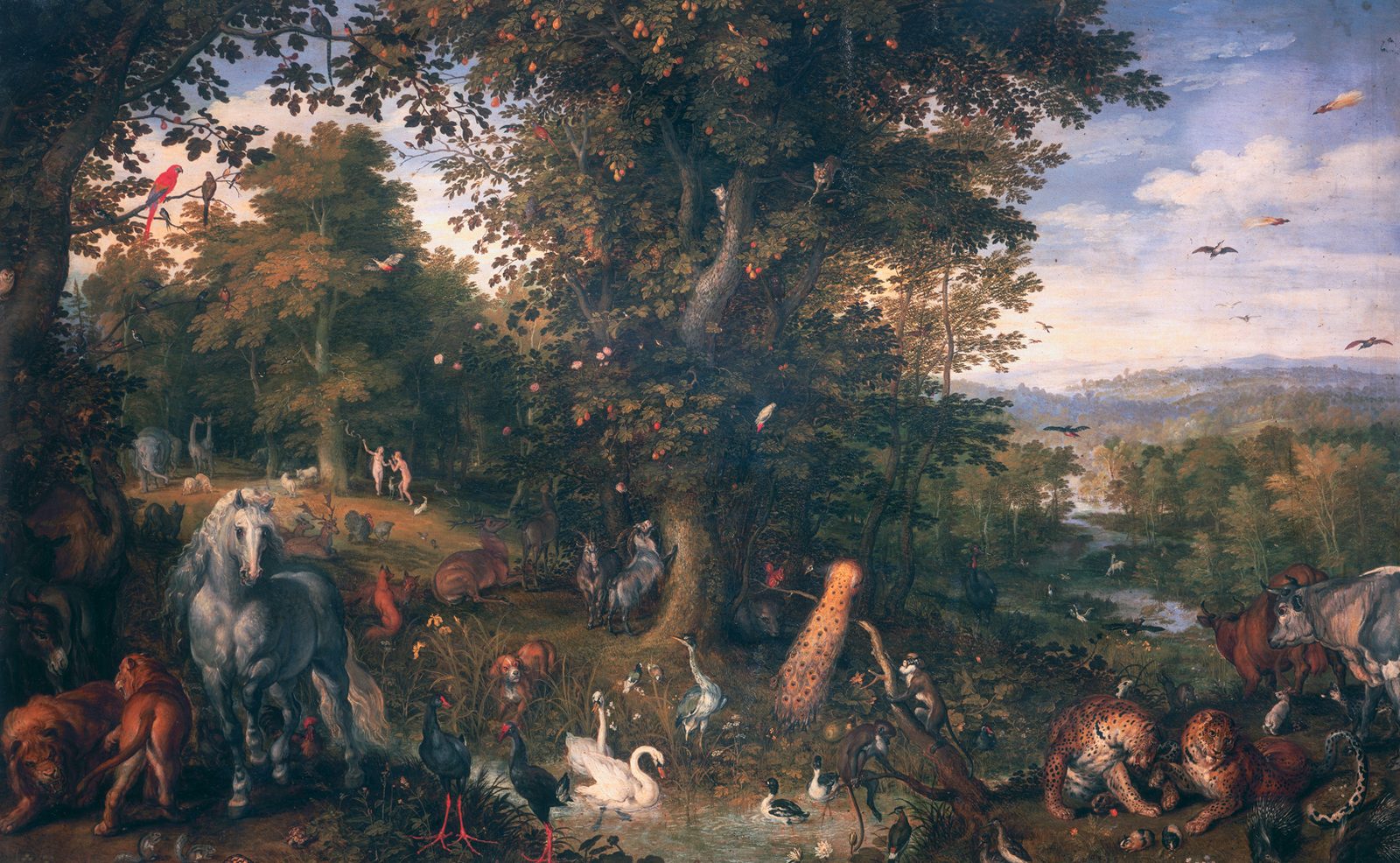
The springs run where no man dug them, and every beast of the field drinks. The wild donkey is named too, an animal that serves nobody and drinks all the same. Birds nest beside the springs and sing in the branches.
The record, by era
The Church Fathers2 voices
Hear. "Thou hast set a bound which they shall not pass over, neither shall they turn again to cover the earth." What then, because now the bitterest waves have received a measure, that we must be allowed to preach such things even with freedom; because they have had their due limit assigned, because they cannot pass over the bound that is set, nor shall they return to cover the earth; what is doing in the earth itself? What workings take place therein, now that the sea hath left it bare? Although at its beach slight waves do make their noise, although Pagans still murmur round; the sound of the shores I hear, a deluge I dread not. What then; what is doing in the earth? "Who sendeth out springs in the little valleys." "Thou sendest out," he saith, "springs in the little valleys." Ye know what little valleys are, lower places among the lands. For to hills and mountains, valleys and little valleys are opposed in contrary shape. Hills and mountains are swellings of the land: but valleys and little valleys, lownesses of the lands. Do not despise low places, thence flow springs. "Thou sendest out springs in the little valleys." Hear a mountain. The Apostle saith, "I laboured more than they all." A certain greatness is brought before us: yet immediately, that the waters may flow, he hath made himself a valley: "Yet not I, but the grace of God with me." It is no contradiction that they who are mountains be also valleys: for as they are called mountains because of their spiritual greatness, so also valleys because of the humility of their spirit. "Not I," he saith, "but the grace of God with me." ...
You who send forth springs in the valleys. Perhaps someone says: If all things were made for the service of man, what use is it that waters run in the desert? This too was done for our salvation and by God's providence, so that the four-footed beasts might have nourishment for our service. In another sense: because God made all things by his dispensation, and all things are his, and he feeds even the brute animals. The waters shall pass through the midst of the mountains.
The Puritans and the Awakening1 voice
There is water enough indeed in the sea, that is, enough to drown us, but not one drop to refresh us, be we ever so thirsty--it is all so salt; and therefore God has graciously provided water fit to drink.
The Nineteenth Century2 voices
A commentator
Jamieson, Fausset & Brown1802–1910
Commentary Critical and Explanatory on the Whole Bible (1871)
proposed
Once destructive, these waters are subjected to the service of God's creatures. In rain and dew from His chambers (compare Ps 104:3), and fountains and streams, they give drink to thirsting animals and fertilize the soil.
He sendeth the springs into the valleys, which run among the hills. This is a beautiful part of the Lord's arrangement of the subject waters: they find vents through which they leap into liberty where their presence will be beneficial in the highest degree. Depressions exist in the sides of the mountains, and down these the water brooks are made to flow, often taking their rise at bubbling fountains which issue from the bowels of the earth. It is God who sends these springs even as a gardener makes the water courses, and turns the current with his foot. When the waters are confined in the abyss the Lord sets their bound, and when they sport at liberty he sends them forth.
3 more voices on this verse
The Nineteenth Century3 voices
He sendeth the springs into the valleys, which run among the hills. This is a beautiful part of the Lord's arrangement of the subject waters: they find vents through which they leap into liberty where their presence will be beneficial in the highest degree. Depressions exist in the sides of the mountains, and down these the water brooks are made to flow, often taking their rise at bubbling fountains which issue from the bowels of the earth. It is God who sends these springs even as a gardener makes the water courses, and turns the current with his foot.
He sendeth the springs into the valleys - Evaporation is guided and regulated by Divine Providence. The sun has a certain power to raise a certain portion of vapours from a given space. God has apportioned the aqueous to the terrene surface, and the solar attraction to both. There is just as much aqueous surface as affords a sufficiency of vapours to be raised by the solar attraction to water the earthy surface. Experiments have been instituted which prove that it requires a given space of aqueous surface to provide vapours for a given space of terrene surface; and the proportion appears ordinarily to be seventeen of water to three of earth; and this is the proportion that the aqueous bears to the terrene surface of the globe. See Ray’s three Physico-theological Discourses.
A commentator
Albert Barnes1798–1870
Notes, Explanatory and Practical, on the Old and New Testaments (1832-1869)
proposed
He sendeth the springs into the valleys - Though the waters are gathered together into seas, yet God has taken care that the earth shall not be dry, parched, and barren. He has made provision for watering it, and by a most wise, wonderful, and benevolent arrangement, he has formed springs among the valleys and the hills. It is now animated nature which comes before the eye of the psalmist; and all this he traces to the fact that the earth is “watered,” and that it is not a waste of rocks and sands. The allusion in this part of the psalm (see the Introduction) is to the earth as covered with vegetation - or, to the third day of the week of creation Gen 1:9-13, which, in Genesis, is connected with the gathering of the waters into seas. This description continues in Psa 104:18. The literal rendering here would be, “sending springs into the valleys.” He conducts the waters from the great reservoirs - lakes and seas - in such a way that they form springs in the valleys. The way in which this is done is among the most wonderful and the most benevolent in nature - by that power, derived from heat, by which the waters of the ocean, contrary to the natural law of gravitation, are lifted up in small particles - in vapor - and carried by the clouds where they are needed, and let fall upon the earth, to water the plants, and to form fountains, rivulets, and streams - and borne thus to the highest mountains, to be filtered through the ground to form springs and streams below. Which run among the hills - Margin, “walk.” That is, they go between the hills. The streams of water flow along in the natural valleys which have been made for them.
The words behind it
6 Hebrew wordsEvery Hebrew word of this verse in the order it stands, with what it means and the door to its own study. The last column counts the times a word stands in the whole Bible: the rarer the word, the more the places it appears belong together.
| Hebrew | Sound | Meaning | Word study | In the Bible |
|---|---|---|---|---|
| הַֽמְשַׁלֵּ֣חַ | hamshaleach | the [one who] sends forth | H7971 → | 845 times |
| מַ֭עְיָנִים | ma'yanim | springs | H4599 → | 23 times |
| בַּנְּחָלִ֑ים | banechalim | in the wadis | H5158 → | 141 times |
| בֵּ֥ין | bein | between | H996 → | 407 times |
| הָ֝רִ֗ים | harim | [the] mountains | H2022 → | 546 times |
| יְהַלֵּכֽוּן׃ | yehalekhun | they go ! | H1980 → | 1546 times |
הַֽמְשַׁלֵּ֣חַthe [one who] sends forth
hamshaleachH7971 →845 times
מַ֭עְיָנִיםsprings
ma'yanimH4599 →23 times
בַּנְּחָלִ֑יםin the wadis
banechalimH5158 →141 times
בֵּ֥יןbetween
beinH996 →407 times
הָ֝רִ֗ים[the] mountains
harimH2022 →546 times
יְהַלֵּכֽוּן׃they go !
yehalekhunH1980 →1546 times
A shaded row is a word that stands 400 times or fewer in the Bible.
The walk
8 stopsEach card is a verse this one points to, and under it the verses that one points to in turn. Where several paths arrive at the same place, that place is listed first: the text keeps returning to it.
Through
Isaiah 41:18I will open rivers on the barren heights, and fountains in the middle of the valleys. I will turn the desert into a pool of water, and the dry land into flowing springs.
it leads to
- Isaiah 35:6–7
Then the lame will leap like a deer and the mute tongue will shout for joy. For waters will gush forth in the wilderness, and streams in the desert.
Reached by 2 separate paths from here.
- Psalms 107:35
He turns a desert into pools of water and a dry land into flowing springs.
- Isaiah 58:11
The LORD will always guide you; He will satisfy you in a sun-scorched land and strengthen your frame. You will be like a well-watered garden, like a spring whose waters never fail.
- Isaiah 30:25
And from every high mountain and every raised hill, streams of water will flow in the day of great slaughter, when the towers fall.
- Isaiah 35:6–7
Through
Psalms 107:35He turns a desert into pools of water and a dry land into flowing springs.
it leads to
- Psalms 114:8
who turned the rock into a pool, the flint into a fountain of water!
- Isaiah 41:17–19
The poor and needy seek water, but there is none; their tongues are parched with thirst. I, the LORD, will answer them; I, the God of Israel, will not forsake them.
- Isaiah 44:3–5
For I will pour water on the thirsty land, and currents on the dry ground. I will pour out My Spirit on your descendants, and My blessing on your offspring.
- Psalms 114:8
Through
Deuteronomy 8:7For the LORD your God is bringing you into a good land, a land of brooks and fountains and springs that flow through the valleys and hills;
it leads to
- Deuteronomy 11:9–12
and so that you may live long in the land that the LORD swore to your fathers to give them and their descendants, a land flowing with milk and honey.
- Deuteronomy 11:9–12
About Psalms
This page draws on 9 works. Open the list of works
This page draws on Adam Clarke, Commentary on the Bible; Albert Barnes, Notes, Explanatory and Practical, on the Old and New Testaments (1832-1869); Augustine of Hippo, Exposition on Psalm 104; Charles Spurgeon, The Treasury of David; Charles Spurgeon, The Treasury of David, Vol. 5; Jamieson, Fausset & Brown, Commentary Critical and Explanatory on the Whole Bible; Jerome, Homily 30, on Psalm 103; John Gill, Exposition of the Old Testament (1748-1763) and Matthew Henry, Commentary on the Whole Bible.