
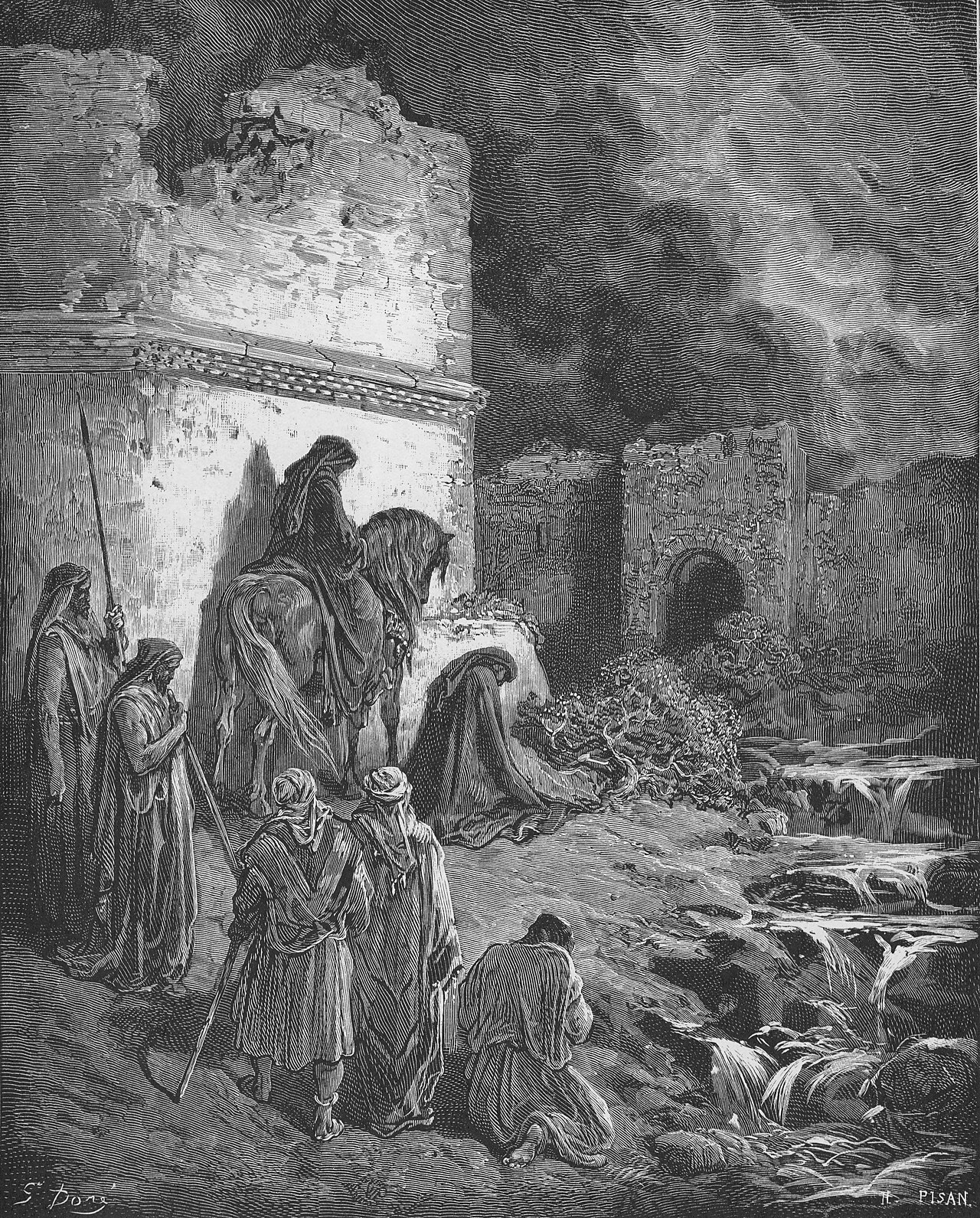
Nehemiahchapter 6
19 verses · Nehemiah · 5th century BC · History
When Sanballat, Tobiah, Geshem the Arab, and the rest of our enemies heard that I had rebuilt the wall and not a gap was left—though to that time I had not yet installed the doors in the gates—
Introduction
Nehemiah, History, Nehemiah Overview.
Nehemiah wrote this about the last days of the building, when the attacks turned from the city to himself. His hearers had watched their leader tested by invitations, rumours and false prophecy. The chapter is a series of traps, each one set for one man. Listen for how many times the same request comes and the same answer goes back, and for the one step Nehemiah refuses because it would have been a sin. The chapter ends with the wall finished and the enemies afraid. It also shows how deeply the opposition had reached inside Judah.
Context
- Who
- A leader being worked on personally now that the project could not be stopped
- What
- Four invitations to a meeting on the plain of Ono, an open letter charging rebellion, a hired prophet's warning, and the completion of the wall.
- Where
- Jerusalem, the house of Shemaiah, and the plain of Ono, a day's travel to the northwest near the coast.
- When
- The twenty-fifth day of Elul, 445 BC, fifty-two days after the work began.
- Why
- To show Nehemiah's steadiness under personal attack and to record that the work was finished with God's help.
Historical context
The attacks in this chapter are all aimed at one man. Four invitations to meet in a village on the plain of Ono, neutral ground a day's travel away, out of the city and away from his guards. Then an open letter, deliberately unsealed so anyone could read it, accusing him of building the wall in order to make himself king and hiring prophets to proclaim it. That charge, if it reached Artaxerxes, was the one that had stopped the work before.
Show the rest of the historical context, 2 more paragraphs
Then a hired prophet named Shemaiah tries to get him to hide in the temple with the doors shut. Nehemiah was a layman; entering the sanctuary would have been a public disqualification, which is exactly why he was offered the door. He names the tactic outright: they hired him so that Nehemiah would sin and they would have matter for an evil report.
The chapter also shows how deep the entanglement went. Tobiah had married into a leading Judean family and his son into another, and nobles in Jerusalem were writing to him and reporting Nehemiah's words back.
Significance
The answer he keeps giving to the invitations is the most quoted sentence in the book: "I am doing a great work, so that I cannot come down."
Show the rest of the significance, 1 more paragraph
The wall was finished in fifty-two days, and the effect on the neighbours is recorded precisely: they were cast down in their own eyes, for they perceived that this work was wrought of our God. A fast job is a testimony that a slow one is not.
This chapter in Jewish lifeWhat this chapter is in Jewish life and reading.
What is done
This chapter has no place in the synagogue year. The site's own table in src/lib/hebraic/readings.ts printed parashot total 0 and haftarah uses total 0 for Nehemiah, and no festival reading.
Its date is the one fact from the chapter that the tradition keeps in view. Rashi fixes the finishing of the wall to the twenty-fifth of Elul in the twentieth year of Darius (Rashi on Nehemiah 6:15:1). The corpus sets Esther Rabbah 7:11 under the same verse, with Sifrei Aggadah on Esther, Midrash Abba Guryon 3:10.
How it is read
Rashi is the one commentator on this chapter whose English the corpus carries, quoted here from The Judaica Press complete Tanach with Rashi, translated by A. J. Rosenberg, which Sefaria reports as CC-BY. The meeting in the plain of Ono he treats as geography. Kefirim is the name of a place, and Ono is the name of the valley (Rashi on Nehemiah 6:2:1 and 6:2:2). Nehemiah's reply that he is doing a great work Rashi reads as the work of the buildings, and he notes that other editions of his note read the buildings of dust (Rashi on Nehemiah 6:3:1).
The open letter he reads as the charge it carried, "that it is known to all the nations that you and all the Jews are plotting to rebel." (Rashi on Nehemiah 6:6:2).
The prophet Shemaiah is the centre of the chapter. Nehemiah's answer is a question, whether a man like him would flee into the Temple (Rashi on Nehemiah 6:11:1). Rashi then states what Nehemiah saw in the offer. "I discerned in his words that the Holy One, blessed be He, had not sent him on this mission, but that he wanted me to commit a transgression because of fear of death." (Rashi on Nehemiah 6:12:1). He was hired to say it (Rashi on Nehemiah 6:13:1). Noadiah and the other prophets are read the same way, as paid by Sanballat to frighten him with false prophecies (Rashi on Nehemiah 6:14:1).
The chapter closes on divided loyalty in Judah itself. Many who were great rulers in Judah were bound to Tobiah by a covenant and an oath, and his kinsmen praised him before Nehemiah (Rashi on Nehemiah 6:18:1 and 6:19:1).
The corpus carries one further note on this chapter without an English text, marked linked because Sefaria holds no English version of the ref. It stands cited and unquoted at Metzudat David on Nehemiah 6:4:1.
What the rabbis say
The corpus carries eight rabbinic locators on this chapter and the text of none, so each is cited and linked here rather than quoted. On the first verse it holds Pirkei DeRabbi Eliezer 38:24. On the second it holds Midrash Tanchuma, Vayeshev 2:14. On the tenth it holds Megillah 16b:18 and Otzar Midrashim, Midrash Shelosha v'Arba'ah 3:12.
On the fifteenth verse the corpus holds Esther Rabbah 7:11 and Sifrei Aggadah on Esther, Midrash Abba Guryon 3:10. On the eighteenth it holds Ein Yaakov, Kiddushin 4:2 and Kiddushin 70a:3. What each of them teaches is a saying of the rabbis, and is reported as theirs wherever this site quotes one. The quotations wait on a fetch that carries the text.
Sources: Rashi, Rashi on Nehemiah 6:1:1 to 6:19:1, The Judaica Press complete Tanach with Rashi, translated by A. J. Rosenberg, reported CC-BY; Metzudat David, Metzudat David on Nehemiah 6:4:1, cited by ref because the corpus carries no English text; The Sefaria corpus, scripts/data/sources/sefaria/nehemiah/6.json, the 8 Talmud and Midrash locators of this chapter; The site's own files, src/lib/hebraic/readings.ts, printing no portion, no Haftarah and no festival reading for this book.
The heads below are this chapter's scenes. The numbered points under each are its verses.
Come meet me in Ono: I am doing a great work and cannot come down
Nehemiah 6:1-2
Sanballat, Tobiah and Geshem hear that "not a gap was left" in the wall. The enemies switch to an invitation: "Come, let us meet together in one of the villages on the plain of Ono" (6:2). The narrator states the aim plainly: "they were planning to harm me."
Nehemiah 6:1
“Now it came to pass, when Sanballat and Tobiah, and Geshem the Arabian, and the rest of our enemies, heard that I had builded the wall,.... Quite finished it: and that there was no breach left therein; but all was made up firm and strong: though at that time I had not set up the doors upon the gates; not upon all of them, though some might by the particular builders of them; and they all of them might be ready made, though not as yet put upon the hinges.”
1 more voice on this verseWhat preachers and commentators have said about this verse, in their own words.
Nehemiah 6:1
“Upon the gates - Rather, “in the gates.” This work would naturally be delayed until the last phase.”
Clarke reads the invitation as a plan to draw Nehemiah out of Jerusalem, away from his friends, and there seize or kill him. Ono is listed with Lod and Hadid in Ezra 2:33.
Nehemiah 6:2
“Come, let us meet together in - the plain of Ono - They wished to get him out of Jerusalem from among his friends, that they might either carry him off, or murder him. Ono is supposed to have been in the tribe of Benjamin, near Jordan.”
Adam Clarke · Commentary on the Bible (1810-1826)evangelical
Nehemiah 6:3-4
Nehemiah answers with the line the chapter turns on: "I am doing a great work and cannot come down" (6:3). His question, "Why should the work stop while I leave it to go down to you?" stands as reason enough, with no accusation made.
Nehemiah 6:3
“I am doing a great work - Though he knew their design, he does not think it prudent to mention it. Had he done so, they would probably have gone to extremities, finding that they were discovered; and perhaps in a formidable body attacked Jerusalem, when ill provided to sustain such a shock. They wished to effect their purpose rather by treachery than by open violence.”
Adam Clarke · Commentary on the Bible (1810-1826)evangelical
Four times they sent me the same message: Clarke notes that Nehemiah gave the great work as his reason and kept silent about the plot, lest the enemies turn to open attack. The same reply went back four times. Gill observes that the fifth message came from Sanballat alone.
Nehemiah 6:4
“Yet they sent unto me four times after this sort,.... Being very desirous of getting him into their hands, and therefore were very pressing and importunate: and I answered them after the same manner; every time as before, he being as much bent on finishing the work as they were to divert him from it.”
1 more voice on this verse
Nehemiah 6:4
“Note, We must never suffer ourselves to be overcome by the greatest importunity to do any thing sinful or imprudent; but, when we are attacked with the same temptation, must still resist it with the same reason and resolution.”
Matthew Henry · Commentary on the Whole Bible (1707-1721)puritan
Nehemiah 6:5-7
an unsealed letter: The fifth approach drops the pretense of friendliness. Sanballat's servant carries "an unsealed letter," open for any hand to read. Jamieson, Fausset and Brown and Gill both note that an open letter was a form used for inferiors, so its missing seal was an insult.
Nehemiah 6:5
“Then sent Sanballat his servant unto me in like manner the fifth time,.... In his own name, neither Tobiah nor Geshem joining with him, he being more solicitous and anxious to get him into his hands than any of them; and it may be, as some think, pretending more friendship for him than the rest, and therefore writes alone, as if they knew nothing of his writing: with an open letter in his hand: which having in it an intimation of Nehemiah being guilty of treason, anyone that would might read it, and so spread the defamation.”
1 more voice on this verse
Nehemiah 6:5
“Letters were, and are still, sent to persons of distinction in a bag or purse, and even to equals they are enclosed--the tie being made with a colored ribbon. But to inferiors, or persons who are to be treated contemptuously, the letters were sent open--that is, not enclosed in a bag.”
Jamieson, Fausset & Brown · Commentary Critical and Explanatory on the Whole Bible (1871)reformed
The charge of revolt repeats the accusation of Ezra 4:12-16, which once halted the building of the walls of Jerusalem. Geshem is named as the witness. Jamieson, Fausset and Brown note that an unsealed letter was the form used for inferiors, so the delivery itself carried an insult.
Nehemiah 6:6
“And Gashmu saith it - You are accused of crimes against the state, and Geshem, the Arabian, is your accuser.”
Adam Clarke · Commentary on the Bible (1810-1826)evangelical
you have even appointed prophets in Jerusalem: Clarke pictures the charge as prophets set up to cry that Nehemiah reigns. The danger lay in the word king. Hired prophets do appear in this chapter, on the enemies' side, Shemaiah in verse 12 and Noadiah in verse 14.
Nehemiah 6:7
“Thou hast also appointed prophets - Persons who pretend to be commissioned to preach to the people, and say, Nehemiah reigneth! Come now therefore, and let us take counsel - Come and justify yourself before me. This was a trick to get Nehemiah into his power.”
Adam Clarke · Commentary on the Bible (1810-1826)evangelical
Nehemiah 6:8-9
Nehemiah answers the charge: "There is nothing to these rumors you are spreading; you are inventing them in your own mind" (6:8). He names the aim of the rumor, a fabrication meant to stop the work. Then the memoir turns report into prayer: "But now, my God, strengthen my hands."
Nehemiah 6:8
“Then I sent unto him,.... Whether a letter, or a messenger, is not said: saying there are no such things done as thou sayest; that there was any scheme formed to rebel, and make him king, or that prophets were appointed to declare him such: but thou feignest them out of thine own heart; in short, that they were no other than lies of his own inventing.”
1 more voice on this verse
Nehemiah 6:8
“There are no such things done - You well know that what you say is false: I shall not, therefore, trouble myself about a false charge.”
Adam Clarke · Commentary on the Bible (1810-1826)evangelical
But now, my God, strengthen my hands: The enemies wanted weakened hands and an unfinished work. Nehemiah answers with a one-line prayer that turns their word around, asking God to strengthen. Henry draws the comfort that God strengthens the hands that enemies try to weaken.
Nehemiah 6:9
“It is the great support and relief of good people that in all their straits and difficulties they have a good God to go to, from whom, by faith and prayer, they may fetch in grace to silence their fears and strengthen their hands when their enemies are endeavouring to fill them with fears and weaken their hands.”
Matthew Henry · Commentary on the Whole Bible (1707-1721)puritan
A hired prophet who would have made him sin by hiding
Nehemiah 6:10-12
who was confined to his house: Nehemiah visits Shemaiah, who urges: "Let us shut the temple doors because they are coming to kill you" (6:10). Only a priest could lawfully enter that part of the temple, and Nehemiah was not one. He sees "that God had not sent him," since "Tobiah and Sanballat had hired him."
Nehemiah 6:10
“Who was shut up - Lived in a sequestered, solitary state; pretending to sanctity, and to close intercourse with God. Let us meet together in the house of God - The meaning is, “Shut yourself up in the temple; appear to have taken sanctuary there, for in it alone can you find safety.” This he said to discourage and disgrace him, and to ruin the people; for, had Nehemiah taken his advice, the people would have been without a leader, their enemies would have come upon them at once, and they would have been an easy prey.”
Adam Clarke · Commentary on the Bible (1810-1826)evangelical
1 more voice on this verse
Nehemiah 6:10
“Afterward I came unto the house of Shemaiah, &c.--This man was the son of a priest, who was an intimate and confidential friend of Nehemiah. The young man claimed to be endowed with the gift of prophecy.”
Jamieson, Fausset & Brown · Commentary Critical and Explanatory on the Whole Bible (1871)reformed
Barnes renders the second question as whether a man could go into the temple and live, for any man who was no priest died. The first question refuses flight. The second refuses a sin against the house of God.
Nehemiah 6:11
“Would go into the temple to save his life - Rather “could go into the temple and live.” For a layman to enter the sanctuary was a capital offence (see Num 18:7).”
Tobiah and Sanballat had hired him: Barnes marks this as the first sign of a party among the Jews working for Sanballat, a thread that runs to verses 17 to 19. Henry notes that Nehemiah feared sin more than danger.
Nehemiah 6:12
“Two things Nehemiah says he dreaded in that which he was advised to:-- (1.) Offending God: That I should be afraid, and do so, and sin. Note, Sin is that which above any thing we should dread; and a good preservative it is against sin to be afraid of nothing but sin.”
Matthew Henry · Commentary on the Whole Bible (1707-1721)puritan
1 more voice on this verse
Nehemiah 6:12
“The existence of a party among the Jews who sided with Sanballat and lent themselves to his schemes, is here for the first time indicated. Compare Neh 6:14, Neh 6:17-19; Neh 13:4-5, Neh 13:28.”
Nehemiah 6:13-14
He had been hired to intimidate me: Shemaiah "had been hired to intimidate me so that I would sin by doing as he suggested," giving the enemies grounds "to discredit me" (6:13). Nehemiah answers, "O my God, remember Tobiah and Sanballat for what they have done," naming also "Noadiah the prophetess and the other prophets."
Nehemiah 6:13
“Therefore was he hired, that I should be afraid, and do so, and sin,.... By distrusting the power and providence of God to protect him, and by going into such a part of the temple, which he, being no priest, had no right to go into: and that they might have matter for an evil report, that they might reproach me; as a rebel and traitor against the king, which had been reported of him, and which would be strengthened by such a step.”
1 more voice on this verse
Nehemiah 6:13
“And sin - By going into a place forbidden to me, and that in such a manner, which would have been both sinful and shameful. Reproach - As a coward, and conscious of my own guilt, that they might make me contemptible and odious both to my own people, and to the king of Persia.”
John Wesley · Explanatory Notes upon the Old Testament (1765)evangelical
Noadiah the prophetess and the other prophets: Clarke notes that the ancient versions make Noadiah a male prophet, though the Hebrew reads prophetess. The judgment of these prophets is left to God. Gill reads the prayer as asking God to repay Tobiah and Sanballat for their works.
Nehemiah 6:14
“And on the prophetess Noadiah - Whether this was a prophet or prophetess, we cannot tell; the Hebrew text only makes her a prophetess; all the versions have Noadiah the prophet, except the Arabic which has Younadaa the prophet. I think the ה he at the end of נביאה nebiah is a mistake, and that we should read Noadiah the prophet.”
Adam Clarke · Commentary on the Bible (1810-1826)evangelical
Fifty-two days, and the nations lose their confidence
in fifty-two days: "So the wall was completed in fifty-two days, on the twenty-fifth of Elul," one sentence closing five chapters of siege and slander. Elul is the sixth month, in late summer. Keil notes that Josephus gives a much longer figure, while Nehemiah's own count is tied to a named month.
Nehemiah 6:15
“Elul - The sixth month, corresponding to the latter part of August and the beginning of September. In fifty and two days - Josephus states that the repairs of the wall occupied two years and four months. But Nehemiah’s narrative is thoroughly consistent with itself, and contains in it nothing that is improbable. The walls everywhere existed at the time that he commenced his task, and only needed repairs. The work was partitioned among at least 37 working parties, who labored simultaneously, with material ready at hand; and, notwithstanding all menaces, uninterruptedly.”
this task had been accomplished by our God: The enemies hear, and "all the surrounding nations were afraid and disheartened, for they realized that this task had been accomplished by our God" (6:16). The claim Ezra made of God's hand over caravans and grants now stands in stone where the watching nations can see it.
Nehemiah 6:16
“God fighteth for Israel and worketh with them. [2.] To believe that God's work would be perfect. When the perceived that the work was of God they expected no other than that it would go on and prosper. [3.] To conclude that, if it were of God, it was to no purpose to think of opposing it; it would certainly prevail and be victorious.”
Matthew Henry · Commentary on the Whole Bible (1707-1721)puritan
Nehemiah 6:17-19
the nobles of Judah sent many letters to Tobiah: The wall stands finished, yet "the nobles of Judah sent many letters to Tobiah, and Tobiah’s letters came back to them" (6:17). Tobiah had married into Judah's leadership, so the enemy held a family claim inside Jerusalem. The same nobles reported "Tobiah’s good deeds" to Nehemiah.
Nehemiah 6:17
“Moreover, in those days,.... While the wall was building: the nobles of Judah sent many letters to Tobiah, and the letters of Tobiah came unto them; letters passed between them frequently, they informing him how things went on at Jerusalem, and he advising them to what was detrimental to the true interest of their nation; such false friends had Nehemiah about him, and yet the work succeeded under him; which showed it the more to be of God.”
1 more voice on this verse
Nehemiah 6:17
“The nobles of Judah sent many letters - The circumstances marked in this and the following verses show still more clearly the difficulties which Nehemiah had to encounter; he had enemies without and false friends within. A treacherous correspondence was carried on between the nobles of Judah and the Ammonites; and had almost any other man been at the head of the Jewish affairs, Jerusalem had never been re-established.”
Adam Clarke · Commentary on the Bible (1810-1826)evangelical
bound by oath to him: Tobiah had married into the family of Shecaniah son of Arah, and Tobiah's son married into the family of Meshullam, a builder of the wall. Clarke sets these marriages beside those Ezra confronted (Ezra 9) and Nehemiah would meet again (13:23). The oath tied Judah's nobles to an Ammonite.
Nehemiah 6:18
“He was the son-in-law of Shechaniah - Previously to the coming of Nehemiah, the Jews seemed to be fast intermixing with the heathen, by intermarriages with Ashdodites, Ammonites, and Moabites; see Neh 13:23. Ezra had many evils of this kind to redress, (Ezr 9:3, etc.), chiefly among the common people, though there were both chiefs and priests in that trespass. But here we find the heathen and Jewish nobles interlinked; and the latter were so far imbued with the spirit of idolatry, that they forgot God, his service, their brethren, and their own souls.”
Adam Clarke · Commentary on the Bible (1810-1826)evangelical
these nobles kept reporting to me: The nobles carried praise of Tobiah to Nehemiah and carried Nehemiah's words back to Tobiah. His letters aimed to intimidate. Henry draws from the prayers of this chapter that those who are wronged should commit their cause to God, who judges righteously.
Nehemiah 6:19
"Thou knowest their hearts, and art the avenger of falsehood and wrong; take cognizance of this cause; judge between me and them, and take what way and time thou mayest please to call them to an account for it." Note, Whatever injuries are done us we must not avenge ourselves, but commit our cause to him that judgeth righteously.
Matthew Henry · Commentary on the Whole Bible (1707-1721)puritan
Keep studying
People and groups1
Places1
Sources for this chapter
The summary
Jamieson, Fausset & Brown, Commentary Critical and Explanatory; John Wesley, Notes on the Old Testament and Matthew Henry, Complete Commentary.
The exposition
Adam Clarke, Commentary on the Bible; Albert Barnes, Notes, Explanatory and Practical, on the Old and New Testaments (1832-1869); Jamieson Fausset and Brown, Commentary Critical and Explanatory on the Whole Bible; Jamieson, Fausset & Brown, Commentary Critical and Explanatory on the Whole Bible; John Gill; John Wesley, Explanatory Notes upon the Old Testament; Keil, The Books of Ezra, Nehemiah, and Esther and Matthew Henry, Commentary on the Whole Bible.