
Lukechapter 15
32 verses · Luke · about AD 62 · The Gospels
Now all the tax collectors and sinners were gathering around to listen to Jesus.
Introduction
Luke, The Gospels, Luke Overview.
Luke wrote this chapter to answer a complaint that followed Jesus and His church, that He welcomed sinners and ate with them. It is one reply given in three stories, told to the religious teachers who were grumbling. Each story is drawn from ordinary life in a Judean village, a flock on the hills, a woman's small house and a landowner's family. Listen for what each story counts, and for the joy that closes each one. Listen above all for the last figure in the chapter, who is still standing outside when the story ends.
Context
- Who
- A Greek reader hearing the movement's core defence of who it ate with
- What
- Three parables about something lost and found, told in answer to the complaint that Jesus welcomed sinners.
- Where
- On the road toward Jerusalem, among tax collectors and sinners, with Pharisees and scribes listening; no place is named.
- When
- On the road to Jerusalem, about AD 29 to 30.
- Why
- To show God's joy over one sinner who repents, and to call those who grumble to share that joy.
Historical context
The three parables answer a specific complaint stated at the top of the chapter: this man receives sinners and eats with them. Eating together declared association, so the objection was about the company he kept.
Show the rest of the historical context, 4 more paragraphs
The ten silver coins may be more than savings. Women in that region wore strings of coins as part of a headdress or as a dowry piece, so losing one from a set of ten could be losing part of an irreplaceable whole. A village house had one small window and a packed earth floor, which is why she has to light a lamp and sweep in daylight.
The younger son's request was close to unspeakable. Asking for the inheritance while the father lived amounted to wishing him dead, and in that culture the village would have expected the father to refuse and discipline him. Selling the share also meant liquidating family land, which was the household's honour as well as its income.
Feeding pigs put him at the absolute floor, an unclean animal, a Gentile employer, and no food of his own. And the father running to meet him is the detail an eastern reader would find most startling: an elder man of standing did not gather up his robes and run in public. He is absorbing the shame before the village can express it.
The robe, the ring, and the sandals are all restorations of status, the best robe was the father's own honour placed on him, a ring meant authority, and sandals meant a son rather than a slave. Killing the fattened calf meant a feast for the whole village, not a family dinner.
Significance
Every one of the three stories ends in a party, and Luke means the reader to notice. Rejoice with me, for I have found what was lost, three times.
Show the rest of the significance, 1 more paragraph
The last picture is left unfinished on purpose. The elder brother, who has done everything right and will not go in, stands outside arguing with a father who has come out to plead with him. The complaint that opened the chapter is still standing at the end of it, and the reader has to decide where he is in the story.
The heads below are this chapter's scenes. The numbered points under each are its verses.
The Shepherd Who Goes After One Sheep
Luke 15:1-2
all the tax collectors and sinners: Tax collectors and sinners gathered to listen to Jesus, while the Pharisees and scribes grumbled, This man welcomes sinners and eats with them. In that world a shared table declared acceptance, and Jesus answers with three parables spoken to both audiences at once.
Luke 15:1
“Publicans and sinners - Τελωναι και ἁμαρτωλοι, tax-gatherers and heathens; persons who neither believed in Christ nor in Moses. See the note on Luk 7:36. Concerning the tax-gatherers, see the note on Mat 5:46.”
Adam Clarke · Commentary on the Bible (1810-1826)evangelical
4 more voices on this verseWhat preachers and commentators have said about this verse, in their own words.
Luke 15:1
“Thou hadst learnt by what went before not to be occupied by the business of this world, not to prefer transitory things to eternal. But because the frailty of man can not keep a firm step in so slippery a world, the good Physician has shown thee a remedy even after falling; the merciful Judge has not denied the hope of pardon; hence it is added, Then drew near unto him all the publicans.”
Ambrose of Milan · written before 397 · Catena Aurea by Aquinaspatristic
Luke 15:1
“All the publicans - That is, all who were in that place. It seems our Lord was in some town of Galilee of the Gentiles, from whence he afterward went to Jerusalem, chap. xvii, 11.”
John Wesley · Explanatory Notes upon the New Testament (1755)evangelical
Luke 15:1
“SELF-RIGHTEOUSNESS always seeks to blame others and to whitewash itself. The group that stood nearest to Christ in preaching was composed of two classes of persons—the publicans, or tax-gatherers and the open sinners. Now the Pharisee, when he came to speak of these two classes, called them by one name, lumping them all under one description and calling them all sinners.”
Charles Spurgeon · written before 1892 · The Metropolitan Tabernacle Pulpit, Sermon No. 3410: “Christ and His Hearers” (lightly modernized text, CCEL edition)Particular Baptist
Luke 15:1
The chapter which begins with these verses, is as well known to Bible readers as any. Few chapters perhaps have done more good to the souls of men. Let us take heed that it does good to us. We should first observe in these verses — the striking testimony which was borne to our Lord by His enemies. We read that when "all the publicans and sinners drew near to hear Him, the Scribes and Pharisees murmured, saying: This man receives sinners, and eats with them!"
Adam Clarke notes that the Greek verb for welcomes means to receive sinners warmly. The Pharisees and scribes grumble, and Jesus answers them with all three parables of the chapter. Gregory the Great traced the grumbling to pride.
Luke 15:2
“But on the contrary, those who are accustomed to taking pride in false justice look down on all others, show no mercy in condescending to the weak; and because they do not believe themselves to be sinners, they become sinners all the more grievously. The Pharisees certainly belonged to this number, who, judging the Lord because he received sinners, with their dry hearts criticized the very fountain of mercy.”
Gregory the Dialogist · written before 604 · Forty Gospel Homilies, Homily 34patristic
3 more voices on this verse
Luke 15:2
“Receiveth sinners - Προσδεχεται. He receives them cordially, affectionately - takes them to his bosom; for so the word implies. What mercy! Jesus receives sinners in the most loving, affectionate manner, and saves them unto eternal life! Reader, give glory to God for ever!”
Adam Clarke · Commentary on the Bible (1810-1826)evangelical
Luke 15:2
“Something like it we had in Matt. xviii. There it was designed to show the care God takes for the preservation of saints, as a reason why we should not offend them; here it is designed to show the pleasure God takes in the conversion of sinners, as a reason why we should rejoice in it. We have here, (1.) The case of a sinner that goes on in sinful ways.”
Matthew Henry · Commentary on the Whole Bible (1707-1721)puritan
Luke 15:2
IT is not very unusual that the Pharisees could not understand the Savior's mode of action—not only because self-righteousness and bigotry had blinded their eyes and callousness of heart to the interest of others and had bound them up in the darkness of self-righteousness—but also because the Savior's mode of acting was contrary to the general current of the dispensation to which the Pharisee had been accustomed. The dispensation of the old Covenant was that of distance. When God appeared to His servant Moses, it was, "Draw not near here: put off your shoes from off your feet."
Luke 15:3-7
Jesus told them this parable: The shepherd leaves the ninety-nine to go after the one that is lost until he finds it, and carries it home on his shoulders. Heaven shares the joy over one sinner who repents, with Ezekiel 34's seeking shepherd behind the figure.
Luke 15:3
“The woman did not idly rejoice to find her coin. The coin, having the image of the emperor, is not ordinary. The image of the King is the register of the church. We are sheep. Let us pray that he would be pleased to place us beside the water of rest. We are sheep. Let us seek pastures. We are coins. Let us have a price. We are sons. Let us hurry to the Father. Let us not fear because we have squandered the inheritance of spiritual dignity that we received on earthly pleasures.”
Ambrose of Milan · written before 397 · Exposition of the Gospel of Lukepatristic
2 more voices on this verse
Luke 15:3
“Occurring again (Mt 18:12-14); but there to show how precious one of His sheep is to the Good Shepherd; here, to show that the shepherd, though the sheep stray never so widely, will seek it out, and when he hath found, will rejoice over it.”
Jamieson, Fausset & Brown · Commentary Critical and Explanatory on the Whole Bible (1871)reformed
Luke 15:3
“He spake - Three parables of the same import: for the sheep, the piece of silver, and the lost son, all declare (in direct contrariety to the Pharisees and scribes) in what manner God receiveth sinners.”
John Wesley · Explanatory Notes upon the New Testament (1755)evangelical
leave the ninety-nine in the pasture: Jesus asks the question of men who kept flocks, and the answer He expects is yes. John Wesley notes that the Jews called open grazing land wilderness, and the shepherd leaves the flock there. The search runs until the sheep is found.
Luke 15:4
“What man of you - Our Lord spoke this and the following parable to justify his conduct in receiving and conversing with sinners or heathens. A hundred sheep - Parables similar to this are frequent among the Jewish writers. The whole flock of mankind, both Jews and Gentiles, belongs unto this Divine Shepherd; and it is but reasonable to expect, that the gracious proprietor will look after those who have gone astray, and bring them back to the flock.”
Adam Clarke · Commentary on the Bible (1810-1826)evangelical
3 more voices on this verse
Luke 15:4
“Leave the ninety and nine in the wilderness - Where they used to feed: all uncultivated ground, like our commons, was by the Jews termed wilderness or desert. And go after - In recovering a lost soul, God as it were labours. May we not learn hence, that to let them alone who are in sin, is both unchristian and inhuman!”
John Wesley · Explanatory Notes upon the New Testament (1755)evangelical
Luke 15:4
“Blending in one the production of their own Aeons, and the straying and recovery of the sheep [spoken of in the Gospel], these persons endeavour to set forth things in a more mystical style, while they refer everything to numbers, maintaining that the universe has been formed out of a Monad and a Dyad. And then, reckoning from unity on to four, they thus generate the Decad. For when one, two, three, and four are added together, they give rise to the number of the ten Aeons.”
Irenaeus · written before 202 · Against Heresies Book Ipatristic
Luke 15:4
“THE love of Jesus, the Great Shepherd, is very practical and active. There is a sheep lost and the Lord regrets it. But His love does not spend itself in regrets. He arises and goes forth to seek and to save that which was lost. The love of Jesus Christ is love not in word only but in deed and in truth. The love of Jesus is prudent. He does not wait until the sheep is willing to return, or until it makes some attempt to come back.”
puts it on his shoulders: The shepherd carries the sheep the whole way home, and he does it with joy. Ambrose read the shoulders of Christ as the arms of the cross, where the sheep that strayed in Adam is lifted. Spurgeon calls this love practical and active.
Luke 15:5
Let us rejoice that the sheep that had strayed in Adam is lifted on Christ. The shoulders of Christ are the arms of the cross. There, I laid down my sins. I rested on the neck of that noble yoke. The sheep is one in kind, not in appearance, because "we are all one body" but many members. It is written, "You are the body of Christ, and members individually." "The Son of man came to seek and save what was lost."
Ambrose of Milan · written before 397 · Exposition of the Gospel of Lukepatristic
The shepherd calls in his neighbors to share the joy. Jamieson, Fausset and Brown note that a great joy is almost too much for one man to bear alone. Gregory the Great read the return home as Christ going back to heaven after restoring man.
Luke 15:6
“And coming home, he calls together his friends and neighbors, saying to them: "Rejoice with me, for I have found my sheep that was lost." Having found the sheep, he returns home because our Shepherd, having restored man, returned to the heavenly kingdom. There he finds friends and neighbors, namely those choirs of angels who are his friends because they continuously guard his will in their steadfastness. They are also his neighbors because they perpetually enjoy the brightness of his vision through their constant presence.”
Gregory the Dialogist · written before 604 · Forty Gospel Homilies, Homily 34patristic
1 more voice on this verse
Luke 15:6
“Rejoice with me, &c.--The principle here is, that one feels exuberant joy to be almost too much for himself to bear alone, and is positively relieved by having others to share it with him.”
Jamieson, Fausset & Brown · Commentary Critical and Explanatory on the Whole Bible (1871)reformed
more joy in heaven over one sinner who repents: Heaven's joy matches the shepherd's. John Wesley read the ninety-nine righteous as the outwardly blameless, and Jamieson, Fausset and Brown as those raised from childhood in the fear of God. Albert Barnes notes that a thing recovered brings more joy than many kept safe.
Luke 15:7
“Now the angels, inasmuch as they are intelligent beings, do not unreasonably rejoice at the redemption of men, as it follows, I say unto you, that likewise joy shall be in heaven over one sinner that repenteth, more than over ninety and nine just persons who need no repentance. Let this serve as an incentive to goodness, for a man to believe that his conversion will be pleasing to the assembled angels, whose favour he ought to court, or whose displeasure to fear.”
Ambrose of Milan · written before 397 · Catena Aurea by Aquinaspatristic
2 more voices on this verse
Luke 15:7
“Over one sinner - One gross, open, notorious sinner, that repenteth - That is, thoroughly changed in heart and life; more than over ninety and nine just persons - Comparatively just, outwardly blameless: that need not such a repentance - For they need not, cannot repent of the sins which they never committed.”
John Wesley · Explanatory Notes upon the New Testament (1755)evangelical
Luke 15:7
“In other words, such as have grown up from childhood in the fear of God and as the sheep of His pasture. Our Lord does not say "the Pharisees and scribes" were such; but as there was undoubtedly such a class, while "the publicans and sinners" were confessedly the strayed sheep and the prodigal children, He leaves them to fill up the place of the other class, if they could.”
Jamieson, Fausset & Brown · Commentary Critical and Explanatory on the Whole Bible (1871)reformed
The Woman Who Sweeps for One Coin
Luke 15:8-10
woman who has ten silver coins: The second parable moves indoors, where a woman loses one of ten silver coins, each a drachma worth about a day's wage. She searches until she finds it, and her call, Rejoice with me, repeats the shepherd's.
Luke 15:8
“The price of the soul is faith. Faith is the lost drachma that the woman in the Gospel seeks diligently. We read that she lit a candle and swept her house. After finding it, she calls together her friends and neighbors, inviting them to rejoice with her because she has found the drachma that she had lost. The damage to the soul is great if one has lost the faith or the grace that he has gained for himself at the price of faith. Light your lamp. "Your lamp is your eye," that is, the interior eye of the soul.”
Ambrose of Milan · written before 397 · Letter VII.2patristic
1 more voice on this verse
Luke 15:8
“Ten pieces of silver - Δραχμας δεκα, ten drachmas. I think it always best to retain the names of these ancient coins, and to state their value in English money. Every reader will naturally wish to know by what names such and such coins were called in the countries in which they were current. The Grecian drachma was worth about sevenpence three farthings of our money; being about the same value as the Roman denarius. The drachma that was lost is also a very expressive emblem of a sinner who is estranged from God, and enslaved to habits of iniquity.”
Adam Clarke · Commentary on the Bible (1810-1826)evangelical
The woman's call to her friends repeats the shepherd's almost word for word. The repetition ties the two parables to one point. Gregory of Nazianzus read the friends as the heavenly powers, made sharers in the joy of the finding.
Luke 15:9
"And when she has found it, she calls together her friends and neighbors, saying: Rejoice with me, because I have found the drachma which I had lost." Who are these friends or neighbors except those heavenly powers already mentioned above? They are so close to the supreme Wisdom because they approach Him through the grace of continual vision. But among these things we should by no means carelessly overlook why this woman, through whom the wisdom of God is figured, is said to have had ten drachmas, of which she lost one, which she found when she searched for it.
Gregory the Dialogist · written before 604 · Forty Gospel Homilies, Homily 34patristic
1 more voice on this verse
Luke 15:9
“Either they are friends as performing His will, but neighbours as being spiritual; or perhaps His friends are all the heavenly powers, but His neighbours those that come near to Him, as Thrones, Cherubims, and Seraphims.”
Theophylact of Ohrid · written before 1107 · Catena Aurea by Aquinaspatristic
joy in the presence of God’s angels: The second parable ends where the first did. Verse 7 placed the joy in heaven, and this verse places it before God's angels. Gregory the Great used the verse to teach the nine orders of angels named in Scripture.
Luke 15:10
We have said there are nine orders of angels, because we know from the testimony of sacred Scripture that there are angels, archangels, virtues, powers, principalities, dominations, thrones, cherubim, and seraphim. For nearly all pages of sacred Scripture testify that there are angels and archangels. The books of the prophets frequently speak, as is well known, of cherubim and seraphim. The apostle Paul also enumerates the names of four orders to the Ephesians, saying: "Above every principality, and power, and virtue, and domination." Writing again to the Colossians, he says: "Whether thrones, or powers, or principalities, or dominations."
Gregory the Dialogist · written before 604 · Forty Gospel Homilies, Homily 34patristic
The Lost Son and the Elder Brother
Luke 15:11-13
a man who had two sons: The younger son asks for his share of the estate while his father still lives, and the father grants it. He squanders it in wild living in a distant country, the conduct the word prodigal names.
Luke 15:11
“And he said - Jesus, to illustrate still farther the sentiment which he had uttered, and to show that it was proper to rejoice over repenting sinners, proceeds to show it by a most beautiful and instructive parable. We shall see its beauty and propriety by remembering that the “design” of it was simply to “justify his conduct in receiving sinners,” and to show that to rejoice over their return was proper. This he shows by the feelings of a “father” rejoicing over the “return” of an ungrateful and dissipated son.”
2 more voices on this verse
Luke 15:11
“You see that the divine inheritance is given to those who ask. You should not think that the Father was guilty because he gave to the younger son. There is no frail age in the kingdom of God nor is faith weighed down by years. He who made the request surely judged himself worthy. If only he had not departed from his Father, he would not have known the hindrance of age.”
Ambrose of Milan · written before 397 · Exposition of the Gospel of Lukepatristic
Luke 15:11
“They are sometimes ranked with harlots ( Matt. xxi. 32 ); here and elsewhere with sinners, such as were openly vicious, that traded with harlots, known rakes. Some think that the sinners here meant were heathen, and that Christ was now on the other side Jordan, or in Galilee of the Gentiles.”
Matthew Henry · Commentary on the Whole Bible (1707-1721)puritan
The father divides his property between both sons, so the elder also holds his share from this day, as the father says at verse 31. Adam Clarke found it strange that the father agreed. Matthew Henry saw in the request the first step of every sinner's departure from God.
Luke 15:12
“Give me the portion of goods - It may seem strange that such a demand should be made, and that the parent should have acceded to it, when he knew that it was to minister to his debauches that his profligate son made the demand here specified.”
Adam Clarke · Commentary on the Bible (1810-1826)evangelical
2 more voices on this verse
Luke 15:12
“Here is the original of the apostasy of sinners from God; they will not be tied up to the rules of God's government; they will themselves be as gods, knowing no other good and evil than what themselves please. [2.] He was willing to get from under his father's eye, for that was always a check upon him, and often gave a check to him.”
Matthew Henry · Commentary on the Whole Bible (1707-1721)puritan
Luke 15:12
“Luke carries the occasion of this parable still farther back, as having arisen from the murmurings of the Pharisees and scribes against our Lord, whom they saw conversing daily with sinners.”
John Calvin · Commentaries (1554)reformed
journeyed to a distant country: Albert Barnes notes that he turned his share into money before he left. John Wesley read the distant country as distance from God, and Ambrose as a man separated from himself by his habits. The money went on wild living.
Luke 15:13
“For it follows, And not many days after, the younger son gathered all together, and took his journey into a far country. For what is more afar off than to depart from one's self, to be separate not by country but by habits. For he who severs himself from Christ is an exile from his country, and a citizen of this world. Fitly then does he waste his patrimony who departs from the Church. Now there came to pass in that country a famine not of food but of good works and virtues, which is the more wretched fast.”
Ambrose of Milan · written before 397 · Catena Aurea by Aquinaspatristic
2 more voices on this verse
Luke 15:13
“Gathered all together - Collected his property. If he had received flocks or grain, he sold them and converted them into money. As soon as this arrangement had been made he left his father’s house. Took his journey - Went, or traveled. Into a far country - A country far off from his father’s house. He went probably to trade or to seek his fortune, and in his wanderings came at last to this dissipated place, where his property was soon expended. Wasted his substance - Spent his property.”
Luke 15:13
“He took a journey into a far country - Far from God: God was not in all his thoughts: And squandered away his substance - All the grace he had received.”
John Wesley · Explanatory Notes upon the New Testament (1755)evangelical
Luke 15:14-16
a severe famine swept through: In the famine he hired himself out to feed pigs, the lowest place for a Jewish hearer, serving unclean animals for a Gentile. He longed for the carob pods the pigs were eating, but no one would give him a thing.
Luke 15:14
“A mighty famine in that land - As he was of a profligate turn of mind himself, it is likely he sought out a place where riot and excess were the ruling characteristics of the inhabitants; and, as poverty is the sure consequence of prodigality, it is no wonder that famine preyed on the whole country.”
Adam Clarke · Commentary on the Bible (1810-1826)evangelical
2 more voices on this verse
Luke 15:14
“A sinful state is like a land where famine reigns, a mighty famine; for the heaven is as brass (the dews of God's favour and blessing are withheld, and we must needs want good things if God deny them to us), and the earth is as iron (the sinner's heart, that should bring forth good things, is dry and barren, and has no good in it).”
Matthew Henry · Commentary on the Whole Bible (1707-1721)puritan
Luke 15:14
“Thus, like Jonah, whom the storm did not overtake till on the mighty deep at the mercy of the waves, does the sinner feel as if "the stars in their courses were fighting against" him (Jud 5:20). in want--the first stage of his bitter experience, and preparation for a change.”
Jamieson, Fausset & Brown · Commentary Critical and Explanatory on the Whole Bible (1871)reformed
to feed the pigs: The son who left home now works for a citizen of that country, feeding his pigs. Albert Barnes notes that he hired himself out for work of the lowest kind, and John Wesley read the citizen as the devil. Ambrose linked the fields to the field of 14:18.
Luke 15:15
"He went and attached himself to one of the citizens." Whoever attaches himself is in a snare. That citizen is the prince of this world. He is sent to the farm bought by the man who excused himself from the kingdom. He feeds the swine, those into which the devil sought to enter, those he cast into the sea of the world as they lived in filth and foulness.
Ambrose of Milan · written before 397 · Exposition of the Gospel of Lukepatristic
2 more voices on this verse
Luke 15:15
“Joined himself - Entered the service of that citizen. Hired himself out to him. It would seem that he engaged to do any kind of work, even of the lowest kind. A citizen - One of the inhabitants of one of the cities or towns of that region, probably a man of property. Into the fields - Out of the city where the owner lived. To feed swine - This was a very low employment, and particularly so to a “Jew.” It was forbidden to the Jews to eat swine, and of course it was unlawful to keep them.”
Luke 15:15
“And he joined himself to a citizen of that country - Either the devil or one of his children, the genuine citizens of that country which is far from God. He sent him to feed swine - He employed him in the base drudgery of sin.”
John Wesley · Explanatory Notes upon the New Testament (1755)evangelical
the pods the pigs were eating: came from the carob tree, as John Gill and Adam Clarke both note. The Jews counted them food for beasts, and no one would give the son even that. Matthew Henry notes that sin always disappoints its servants.
Luke 15:16
“And he would fain have filled his belly with the husks,.... חרובא, the fruit of the "Charub" tree, as the Syriac version interprets it; and which the Jews (y) say is מאכל בהמה, "the food of beasts": though, according to what is elsewhere said of it, it should be the food of men also. It is said (z) of R.”
2 more voices on this verse
Luke 15:16
“With the husks - Κερατιων. Bochart, I think, has proved that κερατια does not mean husks: to signify which the Greek botanical writers use the word λοβοι; several examples of which he gives from Theophrastus. He shows, also, that the original word means the fruit of the ceratonia or charub tree, which grows plentifully in Syria. This kind of pulse, Columella observes, was made use of to feed swine. See Bochart, Hieroz. lib. ii. cap. lvi. col. 707-10.”
Adam Clarke · Commentary on the Bible (1810-1826)evangelical
Luke 15:16
“Note, That which sinners, when they depart from God, promise themselves satisfaction in, will certainly disappoint them; they are labouring for that which satisfieth not, Isa. lv. That which is the stumbling-block of their iniquity will never satisfy their souls, nor fill their bowels, Ezek. vii. Husks are food for swine, but not for men.”
Matthew Henry · Commentary on the Whole Bible (1707-1721)puritan
Luke 15:17-19
he came to his senses: and rehearsed a confession: Father, I have sinned against heaven and against you. It ends with a plan to earn a place: Make me like one of your hired servants.
Luke 15:17
“He came to himself - This is a very expressive phrase. It is commonly applied to one who has been “deranged,” and when he recovers we say he has “come to himself.” In this place it denotes that the folly of the young man was a kind of derangement - that he was insane. So it is of every sinner. Madness is in their hearts Ecc 9:3; they are estranged from God, and led, by the influence of evil passions, contrary to their better judgment and the decisions of a sound mind.”
3 more voices on this verse
Luke 15:17
“It was his affliction; when he was in want, then he came to himself. Note, Afflictions, when they are sanctified by divine grace, prove happy means of turning sinners from the error of their ways. By them the ear is opened to discipline and the heart disposed to receive instructions; and they are sensible proofs both of the vanity of the world and of the mischievousness of sin.”
Matthew Henry · Commentary on the Whole Bible (1707-1721)puritan
Luke 15:17
“He rightly returns to himself, because he departed from himself. For he who returns to God restores himself to himself, and he who departs from Christ rejects himself from himself.”
Ambrose of Milan · written before 397 · Catena Aurea by Aquinaspatristic
Luke 15:17
“And coming to himself - For till then he was beside himself, as all men are, so long as they are without God in the world.”
John Wesley · Explanatory Notes upon the New Testament (1755)evangelical
I have sinned against heaven: Adam Clarke notes that heaven stands for God here, a Jewish way of avoiding the divine name out of reverence. The son names God first and his father second. He rehearses the words before he walks a step.
Luke 15:18
“Then he shall get up, come to his father, and confess to him, "I have sinned against heaven and before you. I am no longer worthy to be called your son. Treat me like one of your hired servants."When he confesses like that, he will be considered worthy of more than that for which he prayed. His father neither takes him in like a hired servant nor treats him like a stranger. Oh no, he kisses him as a son. He accepts him as a dead man come back to life again.”
Athanasius of Alexandria · written before 373 · Festal Letter 7patristic
1 more voice on this verse
Luke 15:18
“Against heaven - Εις τον ουρανον; that is, against God. The Jews often make use of this periphrasis in order to avoid mentioning the name of God, which they have ever treated with the utmost reverence. But some contend that it should be translated, even unto heaven; a Hebraism for, I have sinned exceedingly - beyond all description.”
Adam Clarke · Commentary on the Bible (1810-1826)evangelical
The son plans to ask for a hired servant's place and a wage. Albert Barnes reads the plan as a plea to come back into his father's house on the lowest footing. Basil called the hired servant's obedience obedience for wages.
Luke 15:19
“No more worthy ... - “Such has been my conduct that I have been a disgrace to my father. I am not fit to be honored by being called the son of a man so kind and virtuous.” Make me as one ... - “Treat me as a servant. Let me come again into your family, but I do not ask to be treated as a son. I am willing to come in if you will give me only the support that you give to a servant.” This evinced, 1. Deep humility - such as a sinner should have.”
1 more voice on this verse
Luke 15:19
“There are three different distinct kinds of obedience. For either from fear of punishment we avoid evil and are servilely disposed; or looking to the gain of a reward we perform what is commanded, like to mercenaries; or we obey the law for the sake of good itself and our love to Him who gave it, and so savour of the mind of children.”
Basil of Caesarea · written before 379 · Catena Aurea by Aquinaspatristic
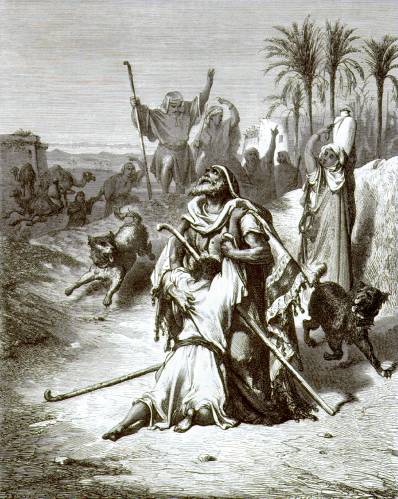
Luke 15:20-24
was filled with compassion: His father saw him far off and was filled with compassion, splanchnizomai, the verb Luke keeps for the deepest mercy. He ran to his son, which no dignified householder did, and the confession stops short of the hired-servant clause.
Luke 15:20
“Christ chooses those who stand. Rise and run to the church. Here is the Father, the Son and the Holy Spirit. He who hears you pondering in the secret places of the mind runs to you. When you are still far away, he sees you and runs to you. He sees in your heart. He runs, perhaps someone may hinder, and he embraces you. His foreknowledge is in the running, his mercy in the embrace and the disposition of fatherly love.”
Ambrose of Milan · written before 397 · Exposition of the Gospel of Lukepatristic
3 more voices on this verse
Luke 15:20
“And kissed him - Or, kissed him again and again; the proper import of καταεφιλησεν αυτον. The father thus showed his great tenderness towards him, and his great affection for him.”
Adam Clarke · Commentary on the Bible (1810-1826)evangelical
Luke 15:20
"Our Father who art in heaven," is this Thy portraiture? It is even so (Jer 31:20). And because it is so, I wonder not that such incomparable teaching hath made the world new.
Jamieson, Fausset & Brown · Commentary Critical and Explanatory on the Whole Bible (1871)reformed
Luke 15:20
“THIS SENTENCE EXPRESSES the true turning point in the prodigal’s life story. Many other matters led up to it, and before he came to it there was much in him that was very hopeful; but this was the point itself, and had he never reached it he would have remained a prodigal, but would never have been the prodigal restored, and his life would have been a warning rather than an instruction to us.”
The son says he has sinned only after his father's kiss, and he leaves out the plan to be made a hired servant. Adam Clarke notes that some manuscripts add it back and held that the shorter text keeps the beauty of the scene.
Luke 15:21
“And the son said unto him, father,.... Or "my father", as the Syriac version reads; and the Persic version adds, "pardon me": sin lay heavy on him, and he wanted a view and application of pardoning grace, though he seems to be prevented making this request by the kiss he received from his father: I have sinned against heaven, and in thy sight; this is what he determined to say, and was allowed to say, having a deep sense of his sin and vileness, and which was increased by the love and kindness his father had shown him.”
4 more voices on this verse
Luke 15:21
“But if any one returns, and shows forth the fruit of repentance, then do ye receive him to prayer, as the lost son, the prodigal, who had consumed his father's substance with harlots, who fed swine, and desired to be fed with husks, and could not obtain it.”
Apostolic Constitutions · written before 380 · Constitutions of the Holy Apostles Book 2patristic
Luke 15:21
“Make me as one of thy hired servants, is added here by several MSS. and versions; but it is evident this has been added, merely to make his conduct agree with his resolution, Luk 15:19. But by this a very great beauty is lost: for the design of the inspired penman is to show, not merely the depth of the profligate son’s repentance, and the sincerity of his conversion, but to show the great affection of the father, and his readiness to forgive his disobedient son.”
Adam Clarke · Commentary on the Bible (1810-1826)evangelical
Luke 15:21
“Father, I have sinned, &c.--"This confession is uttered after the kiss of reconciliation" (Eze 16:63) [TRENCH].”
Jamieson, Fausset & Brown · Commentary Critical and Explanatory on the Whole Bible (1871)reformed
Luke 15:21
“When he had received the kiss which sealed his pardon, yet he said, Father, I have sinned. Note, Even those that have received the pardon of their sins, and the comfortable sense of their pardon, must have in their hearts a sincere contrition for it, and with their mouths must make a penitent confession of it, even of those sins which they have reason to hope are pardoned.”
Matthew Henry · Commentary on the Whole Bible (1707-1721)puritan
Bring the best robe: The father answers the confession with orders to his servants. Albert Barnes notes that the son had likely come home in rags, and the robe was the best outer garment in the house. The ring and sandals complete a son's dress.
Bring the fattened calf and kill it: The father orders the fattened calf killed for the feast. Albert Barnes notes that the Greek joins eating with rejoicing. John Wesley took the word for a solid, heartfelt joy.
Luke 15:23
“The Father rejoices "because my son was dead and has come to life again. He was lost and is found." "He who was, is lost." He, who was not, cannot be lost. The Gentiles are not, the Christian is, according as it is written above that, "God has chosen things that are not, that he might bring to nothing things that are." It is also possible to understand here the likeness of the human race in one man. Adam was, and we were all in him. Adam was lost, and all were lost in him.”
Ambrose of Milan · written before 397 · Exposition of the Gospel of Lukepatristic
2 more voices on this verse
Luke 15:23
Be merry - Literally, “eating, let us rejoice.” The word “merry” does not quite express the meaning of the Greek. “Merriment” denotes a light, playful, jovial mirth. The Greek denotes simply “joy - let us be happy, or joyful.”
Luke 15:23
“Let us be merry - Both here, and wherever else this word occurs, whether in the Old or New Testament, it implies nothing of levity, but a solid, serious, religious, heartfelt joy: indeed this was the ordinary meaning of the word two hundred years ago, when our translation was made.”
John Wesley · Explanatory Notes upon the New Testament (1755)evangelical
was dead and is alive again!: The father gives the reason for the feast in two pairs, dead and alive, lost and found. The second pair ties it to the sheep and coin. Adam Clarke notes that Greek writers used dead in this figurative sense, for a man lost to all good.
Luke 15:24
“And they began to celebrate. These feasts and festivities are now celebrated, extended and spread throughout the world by the Church. For indeed that calf is offered in the body and blood of the Lord, both to the Father, and it feeds the whole household.”
Bede · written before 735 · On the Gospel of Lukepatristic
2 more voices on this verse
Luke 15:24
“Was dead - Lost to all good - given up to all evil. In this figurative sense the word is used by the best Greek writers. See many examples in Kypke.”
Adam Clarke · Commentary on the Bible (1810-1826)evangelical
Luke 15:24
“A sinner is not only dead in law, as he is under a sentence of death, but dead in state too, dead in trespasses and sins, destitute of spiritual life; no union with Christ, no spiritual senses exercised, no living to God, and therefore dead.”
Matthew Henry · Commentary on the Whole Bible (1707-1721)puritan
Luke 15:25-28
older son was in the field: The older son, hearing music and dancing, became angry and refused to go in to the feast. His father came out and pleaded with him, and the grumblers of verse 2 stand where this son stands.
Luke 15:25
“These verses form the conclusion of the parable of the prodigal son. They are far less well known than the verses which go before them. But they were spoken by the same lips which described the younger son's return to his father's house. Like everything which those lips spoke — they will be found deeply profitable. We are taught, firstly, in this passage — how unkind and mean-spirited are the feelings of self-righteous men towards sinners. This is a lesson which our Lord conveys to us by describing the conduct of the "elder brother" of the prodigal son.”
asked what was going on: The elder son hears the music from outside and asks a servant before going in. Ambrose read him as Israel, envying the younger brother who stands for the Gentiles. Bonaventure took the servant for the preachers who announce God's mercy.
The servant's report names the younger son as your brother, a relation the elder son will refuse in verse 30. It gives the father's reason in one phrase, safe and sound. Bonaventure read the return as the humility of penance.
refused to go in: The father who ran to meet one son now comes out to plead with the other. Adam Clarke reads the elder son's anger as the anger of the scribes and Pharisees at verses 1 and 2. His own share of the estate was already his.
Luke 15:28
“He was angry - This refers to the indignation of the scribes and Pharisees, mentioned Luk 15:1, Luk 15:2. In every point of view, the anger of the older son was improper and unreasonable. He had already received his part of the inheritance, see Luk 15:12, and his profligate brother had received no more than what was his just dividend.”
Adam Clarke · Commentary on the Bible (1810-1826)evangelical
Luke 15:29-30
these years I have served you: The older son's account of himself is a servant's ledger: all these years I have served you. He calls his brother this son of yours, refusing the word brother, and adds prostitutes to the charge beyond anything the story reported.
Luke 15:29
“A kid - A young goat. This was of less value than the calf; and he complains that while his father had never given “him” a thing of so little value as “a kid,” he had now given his other son the “fatted calf.” Make merry with - Entertain them give them a feast. This complaint was unreasonable, for his father had divided his property, and he “might” have had his portion, and his father had uniformly treated him with kindness. But it serves to illustrate the conduct of the scribes and Pharisees, and the folly of their complaint.”
this son of yours: The elder son says this son of yours, and Adam Clarke hears contempt in his refusal to call him brother. The prostitutes are his own charge. Jerome heard in the fattened calf a confession that Christ had come, joined to an envy unwilling to be saved.
Luke 15:30
“This thy son - This son of Thine - words expressive of supreme contempt: This son - he would not condescend to call him by his name, or to acknowledge him for his brother; and at the same time, bitterly reproaches his amiable father for his affectionate tenderness, and readiness to receive his once undutiful, but now penitent, child! For Him - I have marked those words in small capitals which should be strongly accented in the pronunciation: this last word shows how supremely he despised his poor unfortunate brother.”
Adam Clarke · Commentary on the Bible (1810-1826)evangelical
Luke 15:31-32
The father gives back the word the son refused: this brother of yours was dead and is alive again. The older son's answer goes unrecorded, leaving the door open to the grumbling scribes of verse 2.
Luke 15:31
“As the father's receiving the younger son did not cause him to disinherit the elder; so God's receiving notorious sinners will be no loss to those who have always served him; neither will he raise these to a state of glory equal to that of those who have always served him, if they have, upon the whole, made a greater progress in inward as well as outward holiness.”
John Wesley · Explanatory Notes upon the New Testament (1755)evangelical
2 more voices on this verse
Luke 15:31
“All I have is thine - The property was divided. What remained was in reality the older son’s. He was heir to it all, and had a right, if he chose, to use it. He had, therefore, no right to complain. This instructive and beautiful parable was designed to vindicate the conduct of Jesus to show that it was right to receive sinners, and that the conduct of the Pharisees was unreasonable. The older son represents the Pharisees; the younger, the returning sinner, whether Jew or Gentile; and the father, God, who is willing to receive them.”
Luke 15:31
“Note, God is a kind Father to all his children, and gives to them all life, and breath, and all things, even to the evil and unthankful, dieilen autois ton bion -- He divided to them life. God's giving us life is putting us in a capacity to serve and glorify him.”
Matthew Henry · Commentary on the Whole Bible (1707-1721)puritan
this brother of yours: The father answers with your brother, turning back the elder son's this son of yours. Adam Clarke notes that the father returns the unkind words in a very different spirit. The parable ends without the elder son's answer.
Luke 15:32
“This thy brother - Or, This brother of Thine. To awaken this ill-natured, angry, inhumane man to a proper sense of his duty, both to his parent and brother, this amiable father returns him his own unkind words, but in a widely different spirit.”
Adam Clarke · Commentary on the Bible (1810-1826)evangelical
How this psalm is built
The form: Three parables told as one answer to a single complaint, each ending in a feast of joy, as Henry classes it.
The patterns in this chapter
| Device | What it does | Where to see it |
|---|---|---|
| Rejoice with me | The shepherd at verse 6 and the woman at verse 9 call together their friends and neighbours with the same words, Rejoice with me, for I have found. The father at verse 24 and again at verse 32 closes the third story with the same pair, lost and found. Matthew Henry reads the three endings as one lesson, the joy in heaven over a sinner who repents.Matthew Henry, Commentary on the Whole Bible, 1710, on Luke 15. | Luke 15:6, Luke 15:9, Luke 15:24, Luke 15:32 |
How this chapter is built
1 more paragraph on the patterns
Verses 1 and 2 state the complaint and verse 3 introduces one parable that runs as three stories. The numbers narrow as they go, one sheep of a hundred, one coin of ten and one son of two. The first two stories end with the same call to rejoice and the same saying about joy in heaven. The third story doubles the ending, with the father's words to the servants at verse 24 and his words to the elder son at verse 32. That second ending answers the grumbling of verse 2, and the chapter closes without saying whether the elder son went in.
Keep studying
Studies8
Words12
Subjects1
Sources for this chapter
The summary
Jamieson, Fausset & Brown, Commentary Critical and Explanatory; John Calvin, Commentaries; John Wesley, Explanatory Notes Upon the New Testament and Matthew Henry, Complete Commentary.
The form and classifications
Matthew Henry, Commentary on the Whole Bible, 1710, on Luke 15:1 to 10.
The exposition
Adam Clarke, Commentary on the Bible; Albert Barnes, Notes, Explanatory and Practical, on the Old and New Testaments (1832-1869); Alexander Maclaren, Expositions of Holy Scripture, Luke; Ambrose of Milan; Basil of Caesarea, Catena Aurea by Aquinas; Bonaventure, Commentary on Luke, Chapter 15; Charles Spurgeon, The Metropolitan Tabernacle Pulpit, Sermon No. 2065: “Our Great Shepherd Finding the Sheep” (lightly modernized text, CCEL edition); Gregory of Nazianzus, Catena Aurea by Aquinas; Gregory the Dialogist, Forty Gospel Homilies, Homily 34; J. C. Ryle, Expository Thoughts on the Gospels, Luke; Jamieson, Fausset & Brown, Commentary Critical and Explanatory on the Whole Bible; Jerome, Catena Aurea by Aquinas; John Gill; John Wesley, Explanatory Notes upon the New Testament and Matthew Henry, Commentary on the Whole Bible.
The painting
The Return of the Prodigal Son, Gustave Doré (engraving), public domain