
Luke 15:11
in Luke 15Then Jesus said, “There was a man who had two sons.
BSB
The same verse in ASV and KJV ▾
ASV
And he said, A certain man had two sons:
KJV
And he said, A certain man had two sons:
⋯
This verse in Luke 15
Commentary
22 notes on this verseYou see that the divine inheritance is given to those who ask. You should not think that the Father was guilty because he gave to the younger son. There is no frail age in the kingdom of God nor is faith weighed down by years. He who made the request surely judged himself worthy. If only he had not departed from his Father, he would not have known the hindrance of age.
This site's exposition
a man who had two sons
on Luke 15:11-13
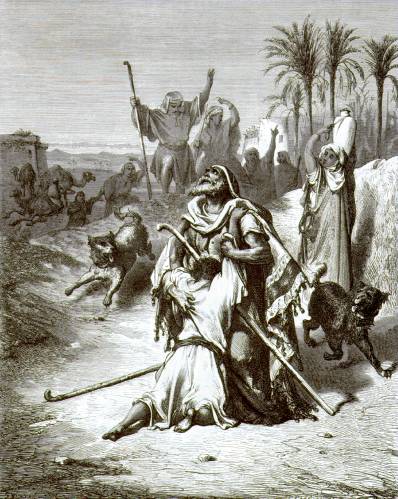
The younger son asks for his share of the estate while his father still lives, and the father grants it. He squanders it in wild living in a distant country, the conduct the word prodigal names.
The record, by era
The Church Fathers5 voices
St. Luke has given three parables successively; the sheep which was lost and found, the piece of silver which was lost and found, the son who was dead and came to life again, in order that invited by a threefold remedy, we might heal our wounds. Christ as the Shepherd bears thee on His own body, the Church as the woman seeks for thee, God as the Father receives thee, the first, pity, the second, intercession, the third, reconciliation. Now you see that the Divine patrimony is given to them that seek; nor think it wrong in the father that he gave it to the younger, for no age is weak in the kingdom of God; faith is not weighed down by years. He at least counted himself sufficient who asked, And I wish he had not departed from his father, nor had had the hindrance of age.
"He had two sons," that is, two peoples, the Jews and the Gentiles. Prudent knowledge of the law made the Jewish people his older son, and the folly of paganism made the Gentile world his younger son. Just as surely as wisdom brings distinguished gray …
(de Quæst. Ev. l. ii. qu. 33.) This man then having two sons is understood to be God having two nations, as if they were two roots of the human race; and the one composed of those who have remained in the worship of God, the other, of those who have ever deserted God to worship idols. From the very beginning then of the creation of mankind the elder son has reference to the worship of the one God, but the younger seeks that the part of the substance which fell to him should be given him by his father. Hence it follows, And the younger of them said unto his father, Give me the portion of goods which falleth to me; just as the soul delighted with its own power seeks that which belongs to it, to live, to understand, to remember, to excel in quickness of intellect, all which are the gifts of God, but it has received them in its own power by free will. Hence it follows, And he divided unto them his substance. (in Ps. 70.) Whoever wishes to be so like to God as to ascribe his strength to Him, (Ps. 59:9.) let him not depart from Him, but rather cleave to Him that he may preserve the likeness and image in which he was made. But if he perversely wishes to imitate God, that as God has no one by whom He is governed, so should he desire to exercise his own power as to live under no rules, what remains for him but that having lost all heat he should grow cold and senseless, and, departing from truth, vanish away.
And not alone by what has been stated, but also by the parable of the two sons, the younger of whom consumed his substance by living luxuriously with harlots, did the Lord teach one and the same Father, who did not even allow a kid to his elder son; but for him who had been lost, [namely] his younger son, he ordered the fatted calf to be killed, and he gave him the best robe.
That most gentle father, likewise, I will not pass over in silence, who calls his prodigal son home, and willingly receives him repentant after his indigence, slays his best fatted calf, and graces his joy with a banquet. Why not? He had found the son whom he had lost; he had felt him to be all the dearer of whom he had made a gain.
15 more voices on this verse
The Church Fathers6 voices
That prodigal son also the father's patience receives, and clothes, and feeds, and makes excuses for, in the presence of the angry brother's impatience. He, therefore, who "had perished" is saved, because he entered on the way of repentance. Repentance perishes not, because it finds Patience (to welcome it).
But some say that by the elder son is signified Israel according to the flesh, but by the other who left his father, the multitude of the Gentiles. But since the Jews are frequently reproved in holy Scripture for their many crimes, how agree with this people the words of the elder son, saying, Lo, these many years do I serve thee, neither transgressed I at any time thy commandment. (Jer. 2:5, Isa. 29:13.) This then is the meaning of the parable. The Pharisees and Scribes reproved Him because He received sinners; He set forth the parable in which He calls God the man who is the father of the two sons, (that is, the righteous and the sinners,) of whom the first degree is of the righteous who follow righteousness from the beginning, the second is of those men who are brought back by repentance to righteousness.
What is the object of the parable? Let us examine the occasion that led to it so we will learn the truth. The blessed Luke had said a little before of Christ the Savior of us all.… The Pharisees and scribes made this outcry at his gentleness and love to people. They wickedly and impiously blamed him for receiving and teaching people whose lives were impure. Christ very necessarily set before them the present parable. He clearly shows them that the God of all requires even him who is thoroughly steadfast, firm, holy, and has attained to the highest praise for sobriety of conduct to be earnest in following his will. When any are called to repentance, even if they have a bad reputation, he must rejoice rather and not give way to an unloving irritation because of them.
It is the opinion of some that the two sons signify the holy angels and us earth dwellers. The elder one, who lived soberly, represents the company of the holy angels, while the younger and prodigal son is the human race. Some among us give it a different explanation, arguing that the older and well-behaved son signifies Israel after the flesh. The other son, who chose to live in the lust of pleasures and moved far away from his father, depicts the company of the Gentiles.
(Hom. de Patre et duobus Filiis.) There is also in the above-mentioned parable a rule of distinction with reference to the characters or dispositions of the sinners. The father receives his penitent son, exercising the freedom of his will, so as to know from whence he had fallen; and the shepherd seeks for the sheep that wanders and knows not how to return, and carries it on his shoulders, comparing to an irrational animal the foolish man, who, taken by another's guile, had wandered like a sheep. This parable is then set forth as follows; But he said, A certain man had two sons. There are some who say of these two sons, that the elder is the angels, but the younger, man, who departed on a long journey, when he fell from heaven and paradise to earth; and they adapt what follows with reference to the fall or condition of Adam. This interpretation seems indeed a lenient one, but I know not if it be true. For the younger son came to repentance of his own accord, remembering the past plenty of his father's house, but the Lord coming called the race of man to repentance, because he saw that to return of their own accord to whence they had fallen had never been in their thoughts; and the elder son is vexed at the return and safety of his brother, whereas the Lord says, There is joy in heaven over one sinner repenting.
For it were not seemly that we, after the fashion of the rich man's son in the Gospel, should, as prodigals, abuse the Father's gifts; but we should use them, without undue attachment to them, as having command over ourselves. For we are enjoined to reign and rule over meats, not to be slaves to them.
The Medieval Church3 voices
And this parable is similar to the preceding ones. It too, under the image of a man, presents God as truly loving of mankind; under the two sons, two classes of people, that is, the righteous and sinners.
And he said: A certain man had two sons. After the parable of the shepherd and his sheep and of the woman and the drachmas, there is here subjoined a third parable, of the father and sons, so that, since the piety of a father …
A commentator
Symeon the New TheologianCommentary (church-history corpus) · Written before 1022.
proposed
Now, if someone does not wish, whether like the sinful woman to embrace the feet of Christ [Luke 7:38], or like the prodigal son to run back to Him with burning repentance (Luke 15:11ff), or like the woman with a hemorrhage and bowed with infirmity …
The Reformation1 voice
So it is not the will of your Father who is in heaven, that one of those little ones should perish. And all the publicans and sinners drew near to him to hear him. And the Pharisees and scribes murmured, saying, This man receiveth sinners, and eateth with them.
The Puritans and the Awakening2 voices
They are sometimes ranked with harlots ( Matt. xxi. 32 ); here and elsewhere with sinners, such as were openly vicious, that traded with harlots, known rakes. Some think that the sinners here meant were heathen, and that Christ was now on the other side Jordan, or in Galilee of the Gentiles.
And he said,....
The Nineteenth Century3 voices
A commentator
Albert Barnes1798–1870
Notes, Explanatory and Practical, on the Old and New Testaments (1832-1869)
And he said - Jesus, to illustrate still farther the sentiment which he had uttered, and to show that it was proper to rejoice over repenting sinners, proceeds to show it by a most beautiful and instructive parable. We shall see its beauty and propriety by remembering that the “design” of it was simply to “justify his conduct in receiving sinners,” and to show that to rejoice over their return was proper. This he shows by the feelings of a “father” rejoicing over the “return” of an ungrateful and dissipated son.
A commentator
J.C. Ryle1816–1900
Expository Thoughts on the Gospels: Luke (lightly modernized text, Grace Gems edition) (1858)
proposed
The parable before us is commonly known as the parable of "the prodigal son." It may be truly called a mighty spiritual picture. Unlike some of our Lord's parables, it does not convey to us one great lesson only, but many. Every part of it is particularly rich in instruction. We see, firstly, in this parable — a man following the natural bent of his own heart. Our Lord shows us a "younger son" making haste to go far away from a kind father's house, and "wasting his substance in riotous living."
A commentator
J.C. Ryle1816–1900
Expository Thoughts on the Gospels: Luke (lightly modernized text, Grace Gems edition) (1858)
proposed
The parable before us is commonly known as the parable of "the prodigal son." It may be truly called a mighty spiritual picture. Unlike some of our Lord's parables, it does not convey to us one great lesson only, but many. Every part of it is particularly rich in instruction. We see, firstly, in this parable — a man following the natural bent of his own heart. Our Lord shows us a "younger son" making haste to go far away from a kind father's house, and "wasting his substance in riotous living." We have in these words, a faithful portrait of the mind with which we are all born. This is our likeness. We are all naturally proud and self-willed. We have no pleasure in fellowship with God. We long to depart, and go afar away from Him. We spend our time, and strength, and faculties, and affections — on things that cannot profit. The covetous man does it in one way; the slave of lusts and passions in another way; and the lover of pleasure in another way. In one point alone are all agreed. Like sheep, we all naturally "go astray, and turn every one to his own way." (Isaiah 53:6.) In the younger son's initial conduct, we see the natural heart of every man. He who knows nothing of these things, has yet much to learn. He is spiritually blind. The eyes of his understanding need to be opened. The worst ignorance in the world, is not to know ourselves. Happy is he who has been delivered from the kingdom of darkness — and been made acquainted with himself! Of too many it may be said, "They know not, neither will they understand. They walk on in darkness." (Psalm 82:5.) We see, secondly, in this parable — man finding out by bitter experience, that the ways of sin are hard.
The words behind it
7 Greek wordsEvery Greek word of this verse in the order it stands, with what it means and the door to its own study. The last column counts the times a word stands in the whole Bible: the rarer the word, the more the places it appears belong together.
| Greek | Sound | Meaning | Word study | In the Bible |
|---|---|---|---|---|
| Εἶπεν | eipen | He said | G2036 → | 925 times |
| δέ· | de | then; | G1161 → | 2765 times |
| ἄνθρωπός | anthropos | A man | G444 → | 549 times |
| τις | tis | certain | G5100 → | 528 times |
| εἶχεν | eichen | had | G2192 → | 707 times |
| δύο | duo | two | G1417 → | 133 times |
| υἱούς. | huious | sons. | G5207 → | 377 times |
ΕἶπενHe said
eipenG2036 →925 times
δέ·then;
deG1161 →2765 times
ἄνθρωπόςA man
anthroposG444 →549 times
τιςcertain
tisG5100 →528 times
εἶχενhad
eichenG2192 →707 times
δύοtwo
duoG1417 →133 times
υἱούς.sons.
huiousG5207 →377 times
A shaded row is a word that stands 400 times or fewer in the Bible.
Where this verse is studied
On this page
About Luke
This page draws on 20 works. Open the list of works
This page draws on Albert Barnes, Notes, Explanatory and Practical, on the Old and New Testaments (1832-1869); Alexander Maclaren, Expositions of Holy Scripture, Luke; Ambrose of Milan, Exposition of the Gospel of Luke; Ambrose of Milan, Catena Aurea by Aquinas; Augustine of Hippo, Catena Aurea by Aquinas; Bonaventure, Commentary on Luke, Chapter 15; Clement of Alexandria, The Instructor Book 2; Cyril of Alexandria, Catena Aurea by Aquinas; Cyril of Alexandria, COMMENTARY ON LUKE, HOMILY 107; Irenaeus, Against Heresies Book IV; J.C. Ryle, Expository Thoughts on the Gospels: Luke (lightly modernized text, Grace Gems edition); John Calvin, Commentaries; John Chrysostom, Catena Aurea by Aquinas; John Gill, Exposition of the New Testament (1746-1748); Matthew Henry, Commentary on the Whole Bible; Peter Chrysologus, SERMON 5; Symeon the New Theologian, Commentary (church-history corpus); Tertullian, On Repentance; Tertullian, Of Patience and Theophylact of Ohrid, Commentary on Luke.