
Luke 15:18
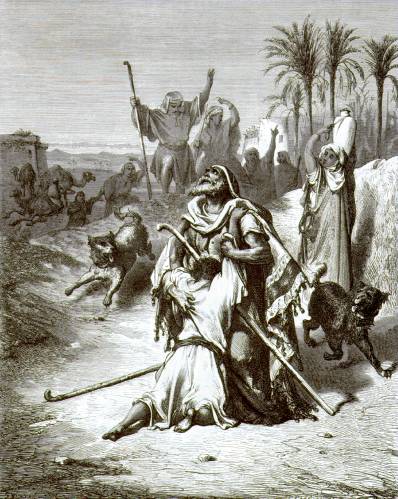
in Luke 15I will get up and go back to my father and say to him, “Father, I have sinned against heaven and against you.
BSB
The same verse in ASV and KJV ▾
ASV
I will arise and go to my father, and will say unto him, Father, I have sinned against heaven, and in thy sight:
KJV
I will arise and go to my father, and will say unto him, Father, I have sinned against heaven, and before thee,
⋯
This verse in Luke 15
Commentary
25 notes on this verseThen he shall get up, come to his father, and confess to him, "I have sinned against heaven and before you. I am no longer worthy to be called your son. Treat me like one of your hired servants."When he confesses like that, he will be considered worthy of more than that for which he prayed. His father neither takes him in like a hired servant nor treats him like a stranger. Oh no, he kisses him as a son. He accepts him as a dead man come back to life again.
This site's exposition
he came to his senses
on Luke 15:17-19
He came to his senses and rehearsed a confession: Father, I have sinned against heaven and against you. It ends with a plan to earn a place: Make me like one of your hired servants.
This site's exposition
I have sinned against heaven
Adam Clarke notes that heaven stands for God here, a Jewish way of avoiding the divine name out of reverence. The son names God first and his father second. He rehearses the words before he walks a step.
The record, by era
The Church Fathers5 voices
"I am no more worthy to be called your son." Cast down, he should not exalt himself that the merit of his humility may raise him. "Make me as one of your hired servants." He knows there is a difference between sons, friends, hired servants and slaves. You are a son through baptism, friend through virtue, hired servant through labor, and slave through fear. Friends can even come from slaves and hired servants, as it is written, "You are my friends, if you do the things that I command you. I do not now call you servants."
(ubi sup.) For he was lying down. And I will go, for he was a long way off. To my father, because he was under a master of swine. But the other words are those of one meditating repentance in confession of sin, but not yet working it. For he does not now speak to his father, but promises that he will speak when he shall come. You must understand then that this "coming to the father" must now be taken for being established in the Church by faith, where there may yet be a lawful and effectual confession of sins. He says then that he will say to his father, Father. (de Quæst. Evan. l. ii. qu. 33.) But whether was this sin against heaven, the same as that which is before thee; so that he described by the name of heaven his father's supremacy. I have sinned against heaven, i. e. before the souls of the saints; but before thee in the very sanctuary of my conscience.
(ubi sup.) But he returned not to his former happiness before that coming to himself he had experienced the presence of overpowering bitterness, and resolved the words of repentance, which are added, I will arise.
A commentator
Philoxenus of MabbugON THE INDWELLING OF THE HOLY SPIRIT 1 · Written before 523.
proposed
It was the same with the younger son who squandered his property and wasted his father's property living among prostitutes. Despite all this, he did not lose his honorable title of son. In the land of captivity, having rejected his father, he rather remembered, "How …
Jacob led out his sheep And brought them to his father's home; A symbol for those with discernment, A parable for those with perception Is to be found in this homecoming: Let us too return to our Father's house, My brothers, and do not become …
17 more voices on this verse
The Church Fathers7 voices
What is the object of the parable? Let us examine the occasion that led to it so we will learn the truth. The blessed Luke had said a little before of Christ the Savior of us all.… The Pharisees and scribes made this outcry at his gentleness and love to people. They wickedly and impiously blamed him for receiving and teaching people whose lives were impure. Christ very necessarily set before them the present parable. He clearly shows them that the God of all requires even him who is thoroughly steadfast, firm, holy, and has attained to the highest praise for sobriety of conduct to be earnest in following his will. When any are called to repentance, even if they have a bad reputation, he must rejoice rather and not give way to an unloving irritation because of them.
It is the opinion of some that the two sons signify the holy angels and us earth dwellers. The elder one, who lived soberly, represents the company of the holy angels, while the younger and prodigal son is the human race. Some among us give it a different explanation, arguing that the older and well-behaved son signifies Israel after the flesh. The other son, who chose to live in the lust of pleasures and moved far away from his father, depicts the company of the Gentiles.
(ubi sup.) When he says, Before thee, he shows that this father must be understood as God. For God alone beholds all things, from Whom neither the simple thoughts of the heart can be hidden.
(ut sup.) Or by heaven in this place may be understood Christ. For he who sins against heaven, which although above us is yet a visible element, is the same as he who sins against man, whom the Son of God took into Himself for our salvation.
(ubi sup.) Now this prodigal son, the Holy Spirit has engraved upon our hearts, that we may be instructed how we ought to deplore the sins of our soul.
For the son who has the pledge of the Holy Spirit in his heart seeks not the gain of an earthly reward, but preserves the right of an heir. These are also good husbandmen, to whom the vineyard is let out. (Matt. 21:41.) They abound not in husks, but bread. How merciful! He, though offended, disdains not to hear the name of Father. I have sinned; this is the first confession of sin to the Author of nature, the Ruler of mercy, the Judge of faith. But though God knows all things, He yet waits for the voice of thy confession. For with the mouth confession is made to salvation, since he lightens the load of error, who himself throweth the weight upon himself, and shuts out the hatred of accusation, who anticipates the accuser by confessing. In vain would you hide from Him whom nothing escapes; and you may safely discover what you know to be already known. Confess the rather that Christ may intercede for thee, the Church plead for thee, the people weep over thee: nor fear that thou wilt not obtain; thy Advocate promises pardon, thy Patron favour, thy Deliverer promises thee the reconciliation of thy Father's affection. But he adds, Against heaven and before thee. Or by these words are signified the heavenly gifts of the Spirit impaired by the sin of the soul, or because from the bosom of his mother Jerusalem which is in heaven, he ought never to depart. But being cast down, he must by no means exalt himself. Hence he adds, I am no more worthy to be called thy son. And that he might be raised up by the merit of his humility, he adds, Make me as one of thy hired servants.
"Father," it says, "I have sinned against heaven, and before you." This is the first confession before the Creator of nature, the Patron of mercy, and the Judge of guilt. Although God knows all things, he awaits the words of your confession.… Confess, so that Christ may rather intercede for you, he whom we have as an advocate with the Father. Confess, so that the church may pray for you and that the people may weep for you. Do not fear that perhaps you might not receive. The advocate promises pardon. The patron offers grace. The defender promises the reconciliation with the Father's good will to you. Believe because it is the truth. Consent because it is a virtue. He has a reason to intercede for you, unless he died for you in vain. The Father also has a reason for forgiveness, because the Father wants what the Son wants.
The Medieval Church3 voices
Secondly, as regards the humility of confession, he adds: I will arise and go to my father and say to him: Father, I have sinned against heaven, in which he confesses that he has sinned against ecclesiastical unity, which is understood by the name of …
That is, from the fall of sin. Having left the heavenly, I sinned against it, preferring to it a contemptible pleasure, and instead of heaven, my homeland, choosing rather a land of famine. For just as one, so to speak, sins against gold who prefers …
I will arise and go to my father and say to him: Father, I have sinned against heaven and before you. How merciful and compassionate a father he knew, who, not offended by his son, does not disdain to hear the word "father." I will …
The Puritans and the Awakening2 voices
They are sometimes ranked with harlots ( Matt. xxi. 32 ); here and elsewhere with sinners, such as were openly vicious, that traded with harlots, known rakes. Some think that the sinners here meant were heathen, and that Christ was now on the other side Jordan, or in Galilee of the Gentiles.
I will arise,....
The Nineteenth Century5 voices
Against heaven - Εις τον ουρανον; that is, against God. The Jews often make use of this periphrasis in order to avoid mentioning the name of God, which they have ever treated with the utmost reverence. But some contend that it should be translated, even unto heaven; a Hebraism for, I have sinned exceedingly - beyond all description.
A commentator
Jamieson, Fausset & Brown1802–1910
Commentary Critical and Explanatory on the Whole Bible (1871)
proposed
Though "no more worthy to be called his son," the prodigal sinner is taught to claim the degraded and defiled, but still existing relationship, asking not to be made a servant, but remaining a son to be made "as a servant," willing to take the lowest place and do the meanest work. Ah! and is it come to this? Once it was, "Any place rather than home." Now, "Oh, that home!
quarantine:debris (2026-07-29) — odd-straight-quotes
A commentator
J.C. Ryle1816–1900
Expository Thoughts on the Gospels: Luke (lightly modernized text, Grace Gems edition) (1858)
proposed
The parable before us is commonly known as the parable of "the prodigal son." It may be truly called a mighty spiritual picture. Unlike some of our Lord's parables, it does not convey to us one great lesson only, but many. Every part of it is particularly rich in instruction. We see, firstly, in this parable — a man following the natural bent of his own heart. Our Lord shows us a "younger son" making haste to go far away from a kind father's house, and "wasting his substance in riotous living."
A commentator
J.C. Ryle1816–1900
Expository Thoughts on the Gospels: Luke (lightly modernized text, Grace Gems edition) (1858)
proposed
The parable before us is commonly known as the parable of "the prodigal son." It may be truly called a mighty spiritual picture. Unlike some of our Lord's parables, it does not convey to us one great lesson only, but many. Every part of it is particularly rich in instruction. We see, firstly, in this parable — a man following the natural bent of his own heart. Our Lord shows us a "younger son" making haste to go far away from a kind father's house, and "wasting his substance in riotous living." We have in these words, a faithful portrait of the mind with which we are all born. This is our likeness. We are all naturally proud and self-willed. We have no pleasure in fellowship with God. We long to depart, and go afar away from Him. We spend our time, and strength, and faculties, and affections — on things that cannot profit. The covetous man does it in one way; the slave of lusts and passions in another way; and the lover of pleasure in another way. In one point alone are all agreed. Like sheep, we all naturally "go astray, and turn every one to his own way." (Isaiah 53:6.) In the younger son's initial conduct, we see the natural heart of every man. He who knows nothing of these things, has yet much to learn. He is spiritually blind. The eyes of his understanding need to be opened. The worst ignorance in the world, is not to know ourselves. Happy is he who has been delivered from the kingdom of darkness — and been made acquainted with himself! Of too many it may be said, "They know not, neither will they understand. They walk on in darkness." (Psalm 82:5.) We see, secondly, in this parable — man finding out by bitter experience, that the ways of sin are hard.
A commentator
Albert Barnes1798–1870
Notes, Explanatory and Practical, on the Old and New Testaments (1832-1869)
proposed
I will arise - This is a common expression among the Hebrews to denote “entering on a piece of business.” It does not imply that he was “sitting,” but that he meant immediately to return. This should be the feeling of every sinner who is conscious of his guilt and danger. To My father - To his father, although he had offended him, and treated him unkindly, and had provoked him, and dishonored him by his course of conduct. So the sinner. He has nowhere else to go but to “God.” He has offended him, but he may trust in his kindness. If “God” does not save him he cannot be saved. There is no other being that has an arm strong enough to deliver from sin; and though it is painful for a man to go to one whom he has offended - though he cannot go but with shame and confusion of face - yet, unless the sinner is willing to go to “God” and confess his faults, he can never be saved. I have sinned - I have been wicked, dissipated, ungrateful, and rebellious. Against heaven - The word “heaven” here, as it is often elsewhere, is put for God. I have sinned against “God.” See Mat 21:25. It is also to be observed that one evidence of the genuineness of repentance is the feeling that our sins have been committed chiefly against “God.” Commonly we think most of our offences as committed against “man;” but when the sinner sees the true character of his sins, he sees that they have been aimed chiefly against “God,” and that the sins against “man” are of little consequence compared with those against God. So David, even after committing the crimes of adultery and murder after having inflicted the deepest injury on “man” - yet felt that the sin as committed against “God” shut every other consideration out of view: “Against thee, thee only, have I sinned,” etc., Psa 2:4. Before thee - This means the same as “against” thee. […]
The words behind it
17 Greek wordsEvery Greek word of this verse in the order it stands, with what it means and the door to its own study. The last column counts the times a word stands in the whole Bible: the rarer the word, the more the places it appears belong together.
| Greek | Sound | Meaning | Word study | In the Bible |
|---|---|---|---|---|
| ἀναστὰς | anastas | Having risen up | G450 → | 107 times |
| πορεύσομαι | poreusomai | I will go | G4198 → | 147 times |
| πρὸς | pros | to | G4314 → | 700 times |
| τὸν | ton | the | G3588 → | 19766 times |
| πατέρα | patera | father | G3962 → | 410 times |
| μου | mou | of mine | G3165 → | 1936 times |
| καὶ | kai | and | G2532 → | 9120 times |
| ἐρῶ | ero | I will say | G4483 → | 46 times |
| αὐτῷ· | auto | to him; | G846 → | 5565 times |
| πάτερ, | pater | Father, | G3962 → | 410 times |
| ἥμαρτον | hemarton | I have sinned | G264 → | 42 times |
| εἰς | eis | against | G1519 → | 1755 times |
| τὸν | ton | <the> | G3588 → | 19766 times |
| οὐρανὸν | ouranon | heaven | G3772 → | 272 times |
| καὶ | kai | and | G2532 → | 9120 times |
| ἐνώπιόν | enopion | before | G1799 → | 94 times |
| σου· | sou | you; | G4771 → | 2973 times |
ἀναστὰςHaving risen up
anastasG450 →107 times
πορεύσομαιI will go
poreusomaiG4198 →147 times
πρὸςto
prosG4314 →700 times
τὸνthe
tonG3588 →19766 times
πατέραfather
pateraG3962 →410 times
μουof mine
mouG3165 →1936 times
καὶand
kaiG2532 →9120 times
ἐρῶI will say
eroG4483 →46 times
αὐτῷ·to him;
autoG846 →5565 times
πάτερ,Father,
paterG3962 →410 times
ἥμαρτονI have sinned
hemartonG264 →42 times
εἰςagainst
eisG1519 →1755 times
τὸν<the>
tonG3588 →19766 times
οὐρανὸνheaven
ouranonG3772 →272 times
καὶand
kaiG2532 →9120 times
ἐνώπιόνbefore
enopionG1799 →94 times
σου·you;
souG4771 →2973 times
A shaded row is a word that stands 400 times or fewer in the Bible.
The walk
8 stopsEach card is a verse this one points to, and under it the verses that one points to in turn. Where several paths arrive at the same place, that place is listed first: the text keeps returning to it.
Through
Lamentations 3:40Let us examine and test our ways, and turn back to the LORD.
it leads to
- 2 Corinthians 13:5
Examine yourselves to see whether you are in the faith; test yourselves. Can’t you see for yourselves that Jesus Christ is in you—unless you actually fail the test?
- Psalms 139:23–24
Search me, O God, and know my heart; test me and know my concerns.
- Joel 2:12–13
“Yet even now,” declares the LORD, “return to Me with all your heart, with fasting, weeping, and mourning.”
- Psalms 4:4
Be angry, yet do not sin; on your bed, search your heart and be still. Selah
- Isaiah 55:7
Let the wicked man forsake his own way and the unrighteous man his own thoughts; let him return to the LORD, that He may have compassion, and to our God, for He will freely…
- 2 Corinthians 13:5
Through
Luke 18:13But the tax collector stood at a distance, unwilling even to lift up his eyes to heaven. Instead, he beat his breast and said, ‘God, have mercy on me, a sinner!’
it leads to
- 1 John 1:8–10
If we say we have no sin, we deceive ourselves, and the truth is not in us.
- Ezra 9:6
and said: “O my God, I am ashamed and embarrassed to lift up my face to You, my God, because our iniquities are higher than our heads, and our guilt has reached the heavens.
- 1 Timothy 1:15
This is a trustworthy saying, worthy of full acceptance: Christ Jesus came into the world to save sinners, of whom I am the worst.
- 1 John 1:8–10
Where this verse is studied
On this page
About Luke
This page draws on 19 works. Open the list of works
This page draws on Adam Clarke, Commentary on the Bible; Albert Barnes, Notes, Explanatory and Practical, on the Old and New Testaments (1832-1869); Ambrose of Milan, Exposition of the Gospel of Luke; Ambrose of Milan, Catena Aurea by Aquinas; Athanasius of Alexandria, FESTAL LETTER 7; Augustine of Hippo, Catena Aurea by Aquinas; Bede, On the Gospel of Luke; Bonaventure, Commentary on Luke, Chapter 15; Cyril of Alexandria, COMMENTARY ON LUKE, HOMILY 107; Ephrem the Syrian, HYMNS ON PARADISE 14.7; Gregory of Nyssa, Catena Aurea by Aquinas; J. C. Ryle, Expository Thoughts on the Gospels, Luke; J.C. Ryle, Expository Thoughts on the Gospels: Luke (lightly modernized text, Grace Gems edition); Jamieson, Fausset & Brown, Commentary Critical and Explanatory on the Whole Bible; John Chrysostom, Catena Aurea by Aquinas; John Gill, Exposition of the New Testament (1746-1748); Matthew Henry, Commentary on the Whole Bible; Philoxenus of Mabbug, ON THE INDWELLING OF THE HOLY SPIRIT 1 and Theophylact of Ohrid, Commentary on Luke.