
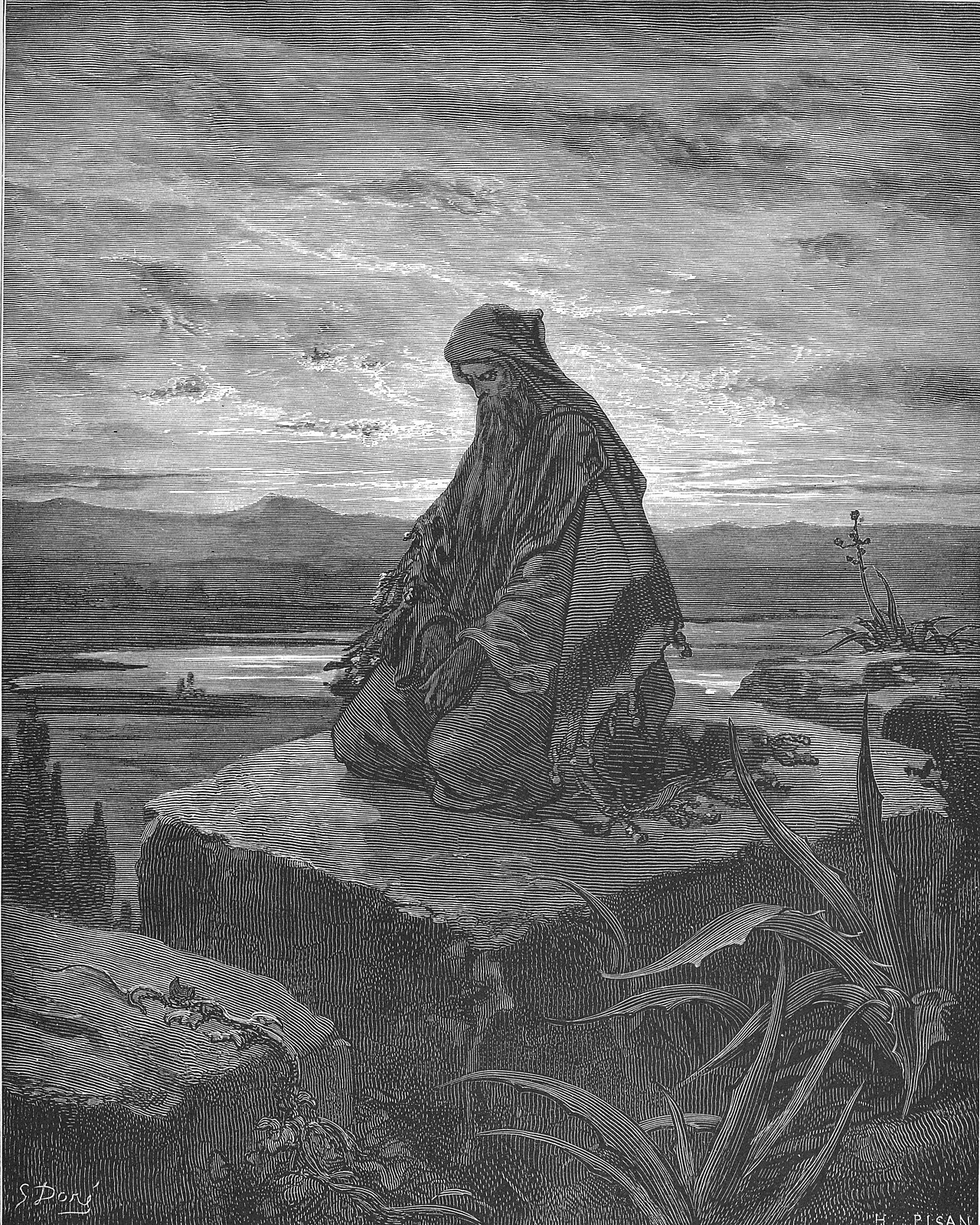
Isaiahchapter 46
13 verses · Isaiah · 8th century BC · The Prophets
Bel crouches; Nebo cowers. Their idols weigh down beasts and cattle. The images you carry are burdensome, a load to the weary animal.
Introduction
Isaiah, The Prophets, Isaiah Overview.
Isaiah wrote this short chapter for exiles who had watched the gods of Babylon carried through the city at the New Year festival. It takes that procession and turns it into a picture of defeat. The chapter sets two kinds of carrying side by side, the gods that must be carried and the God who carries His people. Listen for the words for lifting and bearing that come back again and again. It closes with a call to remember and a promise that God's purpose will stand.
Context
- Who
- Exiles who had watched Babylon's gods paraded every New Year
- What
- A contrast between the idols of Babylon, which must be carried, and the LORD, who carries His people.
- Where
- The processional avenue of Babylon and the roads on which captured images were carried away.
- When
- Spoken about 700 to 690 BC by the book's own reading, looking ahead to the fall of Babylon in 539 BC.
- Why
- To show the exiles that the gods of Babylon could not save even themselves, while the LORD would bear Israel into old age.
Historical context
Bel and Nebo are named because they were the two great images of Babylon. Bel is the title of Marduk, the city's chief god; Nebo, his son, was the god of writing and destiny, the name is inside Nebuchadnezzar's own. Each New Year their statues were carried in procession along the paved Processional Way and through the great gate, on carts and on the shoulders of priests, with the whole city watching. It was the most impressive religious event in the world.
Show the rest of the historical context, 3 more paragraphs
Isaiah takes that exact scene and runs it backwards. Bel bows down, Nebo stoops; their images are loaded on animals and cattle; the things you carried about are a burden, a load for the weary beast. They stoop, they bow down together, they could not save the load, and they themselves have gone into captivity. Conquerors did carry off the gods of a defeated city, which was the ultimate proof of whose god had won, and it happened to Babylon's own.
The contrast is stated as a straight comparison of logistics. Those gods have to be carried. Israel's God says: you have been carried by me from birth, from the womb; and even to your old age I am he, and to gray hairs I will carry you. I have made, and I will bear; I will carry, and will deliver.
The commissioning of an idol is described as a business transaction. They lavish gold out of the bag and weigh silver on the scales, and hire a goldsmith, and he makes it a god; then they fall down and worship. They carry it on the shoulder, they set it in its place and it stands; from its place it does not move. One will cry to it, and it cannot answer or save him out of his trouble.
Significance
For exiles asking which God had actually won, this chapter answered by pointing at the parade route. The gods being celebrated could not walk to their own festival.
Show the rest of the significance, 1 more paragraph
And the claim that follows is the one that had to be true for any of the rest to matter: I am God, and there is none like me, declaring the end from the beginning, and from ancient times the things that are not yet done.
This chapter in Jewish lifeWhat this chapter is in Jewish life and reading.
What is done
The site's own table in src/lib/hebraic/readings.ts, probed for this lane, printed no weekly portion and no Haftarah from this chapter, and no festival reading for the book. That table carries the Haftarah of each of the fifty-four weekly portions and the books read whole at the feasts, and it carries nothing for the special Sabbaths or the fast days. This card therefore names no public reading of the chapter and leaves that question to a source that holds those readings.
The corpus joins the chapter to the weeks of the Torah portions through the works arranged by portion. Under the third verse it carries Midrash Tanchuma Buber, Bamidbar 23:1. Under the fourth verse it carries Bereshit Rabbati, Parashat Bereshit 81.
How it is read
Two commentators on this chapter carry English in the corpus. Rashi is quoted from The Judaica Press complete Tanach with Rashi, translated by A. J. Rosenberg, which Sefaria reports as CC-BY, and every quotation of it is held to fifty words or fewer because the translation is modern. Ibn Ezra is quoted from the version Sefaria titles Commentary of Ibn Ezra on Isaiah - trans. by M. Friedlander, 1873, which it reports as Public Domain.
Rashi reads the fall of Bel and Nebo with open scorn. The gods of Babylon "squatted and soiled themselves", and he names the figure as "an expression of ridicule of the idols". He gives the Old French for the two verbs and names his source: "So I heard in the name of Rabbenu Gershom, the Light of the Diaspora" (Rashi on Isaiah 46:1:1 and 46:1:2).
The chapter's contrast Ibn Ezra puts in one sentence. "The idols of Babylon are carried by their worshippers, but I, the God of Israel, carry the Israelites". Rashi takes the carrying back to Jacob's birth in the house of Laban. From then on God bore Israel on His arms (Ibn Ezra on Isaiah 46:3:1; Rashi on Isaiah 46:3:1). At old age, when Israel has no merit left, Rashi hears God say "I am the same with My mercy and with My trait of goodness to save you" (Rashi on Isaiah 46:4:1).
The tenth and eleventh verses are read as history. Ibn Ezra reads the declaring of the end from the beginning plainly, as "declaring the event before it happens". Rashi reads it as the Egyptian exile and its redemption, announced in the Covenant between the Segments (Ibn Ezra on Isaiah 46:10:1; Rashi on Isaiah 46:10:1). The bird of prey from the east he reads as Abraham, called from Aram. He also allows the plain reading of a bird, and reports Genesis Rabbah 44:17 on the four exiles shown to Abraham between the parts (Rashi on Isaiah 46:11:1 and 46:11:2).
What the rabbis say
The corpus carries forty rabbinic locators on this chapter and the text of none, so each is cited and linked here rather than quoted. On the first verse it holds Ein Yaakov, Sanhedrin 7:15, Jerusalem Talmud Bava Batra 9:6:4, Megillah 25b:17 and Mekhilta DeRabbi Yishmael, Tractate Nezikin 18:1. It holds Sanhedrin 63b:9 there as well. On the second verse it holds Sanhedrin 63b:11. On the third verse it holds Aggadat Bereshit 29:1, Bamidbar Rabbah 4:2, Bamidbar Rabbah 9:33 and Devarim Rabbah 1:10. It holds Midrash Tanchuma Buber, Bamidbar 23:1 there as well.
On the fourth verse it holds Aggadat Bereshit 35:1, Bereshit Rabbah 90:2, Bereshit Rabbati, Parashat Bereshit 81 and Devarim Rabbah 7:12. It holds Ein Yaakov (Glick Edition), Sanhedrin 4:16 there as well. On the sixth verse it holds Bava Batra 25a:13, Bava Batra 25b:5, Ein Yaakov (Glick Edition), Bava Batra 2:5 and Ein Yaakov, Bava Batra 2:5. It holds Jerusalem Talmud Kiddushin 3:5:6 there as well. On the seventh verse it holds Devarim Rabbah 2:10, Devarim Rabbah 2:20, Jerusalem Talmud Berakhot 9:1:13 and Mekhilta DeRabbi Yishmael, Tractate Bachodesh 6:8. On the eighth verse it holds Ein Yaakov (Glick Edition), Taanit 1:22.
On the ninth verse it holds Tanna DeBei Eliyahu Rabbah 26:1. On the tenth verse it holds Bamidbar Rabbah 16:16, Bamidbar Rabbah 5:5, Bereshit Rabbah 16:2 and Bereshit Rabbah 16:3. On the eleventh verse it holds Aggadat Bereshit 21:1, Aggadat Bereshit 56:1, Aggadat Bereshit 81:1 and Bereshit Rabbah 15:4. On the twelfth verse it holds Berakhot 17b:1, Berakhot 17b:2, Ein Yaakov (Glick Edition), Berakhot 2:13 and Ein Yaakov, Berakhot 2:22. On the nineteenth verse it holds Ein Yaakov (Glick Edition), Megillah 1:17. What each of them teaches is a saying of the rabbis, and is reported as theirs wherever this site quotes one. The quotations wait on a fetch that carries the text.
Sources: Rashi, Rashi on Isaiah 46:1:1 to 46:13:1, The Judaica Press complete Tanach with Rashi, translated by A. J. Rosenberg, reported CC-BY; Ibn Ezra, Ibn Ezra on Isaiah 46:3:1 to 46:10:1, Commentary of Ibn Ezra on Isaiah - trans. by M. Friedlander, 1873, reported Public Domain; The Sefaria corpus, scripts/data/sources/sefaria/isaiah/46.json, the 40 Talmud and Midrash locators of this chapter; The site's own files, src/lib/hebraic/readings.ts, printing no portion and no Haftarah for this chapter and no festival reading for this book.
The heads below are this chapter's scenes. The numbered points under each are its verses.
Bel Bows Down: Gods Carried, or a God Who Carries
Isaiah 46:1-4
Bel crouches; Nebo cowers: Babylon’s gods, Bel and Nebo, appear as cargo, “Their idols weigh down beasts and cattle”, and verse 2 says the gods themselves “go into captivity”. In verse 4 the LORD turns the verb around, “I have made you, and I will carry you”. This contrast runs through the chapter.
Isaiah 46:1
THE confidence of Babylon is buried among her heaps of rubbish for her gods have fallen from their thrones. "Bel bows down, Nebo stoops." As for us, Beloved, our trust is in the living God who lives to bear and carry His chosen, even in Jehovah, the only true Lord. We begin our spiritual life by faith in Him, for till faith comes we have no power to become the sons of God. Our spiritual life will have to be continued in the same way of trust in the Lord, "for the just shall live by faith."
1 more voice on this verseWhat preachers and commentators have said about this verse, in their own words.
Isaiah 46:1
“Bel boweth down - Bel or Belus (בל bēl, from בעל be‛ēl, the same as בעל ba‛al was the chief domestic god of the Babylonians, and was worshipped in the celebrated tower of Babylon (compare Jer 50:2; Jer 51:44). It was usual to compound names of the titles of the divinities that were worshipped, and hence, we often meet with this name, as in Bel-shazzar, Bel-teshazzar, Baal-Peor, Baal-zebub, Baal-Gad, Baal-Berith. The Greek and Roman writers compare Bel with Jupiter, and the common name which they give to this idol is Jupiter Belus (Pliny, Nat. Hist. xxxvii. 10; Cic. De Nat.”
unable to relieve the burden: Clarke reads the burden as the idols' own charge, the worshipers they were supposed to carry. The Chaldee and Syriac versions render it the same way. The gods cannot relieve their people, and in the end the gods themselves go into captivity with them.
Isaiah 46:2
“They could not deliver the burden “They could not deliver their own charge” - That is, their worshippers, who ought to have been borne by them. See the two next verses. The Chaldee and Syriac Versions render it in effect to the same purpose, those that bear them, meaning their worshippers; but how they can render משא massa in an active sense, I do not understand. For לא lo, not, ולא velo, and they could not, is the reading of twenty-four of Kennicott’s, sixteen of De Rossi’s, and two of my own MSS.”
Adam Clarke · Commentary on the Bible (1810-1826)evangelical
sustained from the womb: Barnes marks the turn to the house of Jacob, called to listen with words of tenderness meant to win their trust in God as Father. The remnant are the people left alive and carried into captivity. Jerome gives the Septuagint as Israel taught from birth to old age.
Isaiah 46:3
“Hearken unto me - From this view of the captive gods, the address is now turned to the Jews. The utter vanity of the idols had been set before them; and in view of that, God now addresses his own people, and entreats them to put their trust in him. The address he commences with words of great tenderness and endearment, designed to lead them to confide in him as their Father and friend. And all the remnant - All who were left from slaughter, and all who were borne into captivity to Babylon.”
when you turn gray: Barnes reads the promise as a pledge that God stays unchanged in his care from birth to old age. Here God surpasses a parent. A father's care lessens as the child grows, and he is usually dead before the son turns gray, while God still carries and sustains him.
Isaiah 46:4
“And even to your old age, I am he - Or rather, I am the same. I remain, unchangeably, with the same tenderness, the same affection, the same care. In this the care of God for his people surpasses that of the most tender parent, and the most kind nourisher of the young. The care of the parent naturally dies away as the child reaches manhood, and he is usually removed by death before the son or daughter that excited so much solicitude in infancy and childhood, reaches old age. But not so with God.”
Isaiah 46:5-7
To whom will you liken Me: Verse 5 asks, “To whom will you compare Me, that we should be alike”, and the answer is the idol workshop. They “pour out their bags of gold and weigh out silver on scales”. A god men make and carry stands against the God who makes and carries his people.
They pour out their bags of gold: Barnes notes that the verb to pour out is used elsewhere of squandering, as of the glutton in Proverbs 23:21. They pour out gold as if it were worthless. Gill sets beside the goldsmith's god the golden image of Nebuchadnezzar in Daniel 3, and the calf in Exodus 32.
Isaiah 46:6
“And despite my exhortation you delayed in expelling such blasphemy and ungodliness, daring to compare me with those who lack being and in no way have my divinity. You esteemed me as equal to soulless wood that you shaped. You added gold and silver from contributions and made a statue from human hands, and you were not ashamed to worship it. These idols were not able to walk, let alone move, but they needed to be carried on your shoulders or dragged around by others. They are unable to hear prayers or to save.”
Eusebius of Caesarea · written before 339 · Commentary on Isaiah 2:31patristic
1 more voice on this verse
Isaiah 46:6
“They lavish gold - The word used here means properly to shake out; and then to pour out abundantly, or in a lavish manner. It is used in connection with the idea of squandering in Deu 21:20; Pro 23:21; Pro 28:7. Here the idea is, that they spared no expense; they poured out gold as if it were vile and worthless, in order to make an idol.”
They lift it to their shoulder: Matthew Henry sees two follies in one act. The worshipers raise themselves too high when they claim to make a god, and then sink too low when they bow to a thing. Barnes pictures the idol carried on the shoulder, the burden the LORD reverses in verse 4.
Isaiah 46:7
“They bear him upon the shoulder - They carry the idol which they have made on their shoulder to the temple, or place where it is to be fixed. This circumstance, with the others, is doubtless introduced to show how ridiculous and absurd it was to offer divine homage to a god whom they could thus carry about on the shoulder. And set him in his place - Fix the idol on its basis or pedestal, in its proper niche, or place in the temple. The whole design of this verse is to contrast the idol with Yahweh.”
1 more voice on this verse
Isaiah 46:7
“When the goldsmith has made it that which they please to call a god they fall down, yea, they worship it. If they magnified themselves too much in pretending to make a god, as if they would atone for that, they vilified themselves as much in prostrating themselves to a god that they knew the original of.”
Matthew Henry · Commentary on the Whole Bible (1707-1721)puritan
Declaring the End from the Beginning
Isaiah 46:8-11
Remember this and be brave: “Remember this and be brave” opens the chapter’s second argument, a trial of prediction. The LORD names “a bird of prey from the east, a man for My purpose from a far-off land”. The traditional identification is Cyrus, named at 44:28; “My purpose will stand” rests the claim on fulfilment.
Isaiah 46:8
“In order to be manly we must be godly; for man was made "in the image of God," and only rises to his true dignity when joined to God; virtue is derived from the Latin vir, "a man." bring . . . to mind--rather, "lay it to heart." transgressors--addressed to the idolaters among the Jews.”
Jamieson, Fausset & Brown · Commentary Critical and Explanatory on the Whole Bible (1871)reformed
1 more voice on this verse
Isaiah 46:8
“Show yourselves men - התאששו hithoshashu. This word is rather of doubtful derivation and signification. It occurs only in this place: and some of the ancient interpreters seem to have had something different in their copies. The Vulgate read התבששו hithbosheshu, take shame to yourselves; the Syriac התבוננו hithbonenu, consider with yourselves; the Septuagint στεναξετε· perhaps התאבלו hithabbelu, groan or mourn, within yourselves. Several MSS. read התאוששו hithosheshu, but without any help to the sense.”
Adam Clarke · Commentary on the Bible (1810-1826)evangelical
Remember what happened long ago: Barnes names two kinds of proof to remember. God had foretold events long ago before they happened, and he had come again and again to deliver his people. The claim that there is none like God repeats Isaiah 44:6.
Isaiah 46:9
“Remember the former things ... - Bear in mind the repeated and constant proofs that have been given that Yahweh is the true God - the proofs derived from the prediction of future events, and from the frequent interpositions of his providence in your behalf as a nation. For I am God - (See the notes at Isa 44:6).”
I declare the end from the beginning: Gill gives two examples of an end declared from the beginning. Moses foresaw the end of the Jewish state in Deuteronomy 32:29, and Enoch spoke of the end of the world, as Jude 14 records. Barnes takes the purpose that will stand to mean a purpose settled and fixed.
Isaiah 46:10
“Declaring the end from the beginning - Foretelling accurately the course of future events. This is an argument to which God often appeals in proof that he is the only true God (see Isa 41:22-23; Isa 43:12; Isa 44:26). My counsel shall stand - My purpose, my design, my will. The phrase ‘shall stand’ means that it shall be stable, settled, fixed, established. This proves: 1. That God has a purpose or plan in regard to human affairs.”
a bird of prey from the east: Readings of the bird of prey differ. Cyril of Alexandria takes it to be the Babylonian king who took Jerusalem, and Eusebius reads the man from a far land as Christ. Barnes notes the Hebrew word names the birds that came down on the sacrifice of Abram in Genesis 15:11.
Isaiah 46:11
“For he says "I am the one possessing knowledge of all, and whatever happens, I give notice of it beforehand." That which is announced, I execute … for what the holy God wills, who will thwart it? And who will avert his hand when it is raised?… We take the bird that is called from the east and from a far land to be the Babylonian, who scorched all the territory of the Jews, took Jerusalem and ruined the temple. They removed both ordinary flock and the leading birds among them and forced them into the region of the Persians.”
Cyril of Alexandria · written before 444 · Commentary on Isaiah 4:3.46:8-13patristic
3 more voices on this verse
Isaiah 46:11
“Calling a ravenous bird from the east - There can be no doubt that Cyrus is intended here (see the notes at Isa 41:2, Isa 41:25). The east here means Persia. The word rendered ‘ravenous bird’ (עיט ‛ayiṭ) is rendered ‘fowl’ in Job 28:7; ‘bird’ or ‘birds’ in Jer 12:9; ‘fowls’ in Gen 15:11; Isa 18:6; and ‘ravenous birds’ in Eze 39:4. It does not occur elsewhere in the Bible.”
Isaiah 46:11
“And, if God give him a call, he will give him success. He is the man that shall execute God's counsel, though he comes from a far country and knows nothing of the matter. Note, Even those that know not, and mind not, God's revealed will, are made use of to fulfil the counsels of his secret will, which shall all be punctually accomplished in their season by what hand he pleases.”
Matthew Henry · Commentary on the Whole Bible (1707-1721)puritan
Isaiah 46:11
“Who other can this be than his Christ, who, it says, has been called from a distant land, that is, from the innermost part of Hades? All the things I have announced before him, I will bring into action through him.”
Eusebius of Caesarea · written before 339 · Commentary on Isaiah 2:31patristic
Isaiah 46:12-13
Listen to Me, you stubborn people: Verse 12 addresses “you stubborn people, far removed from righteousness”, and the chapter turns to comfort. The answer is a promise already approaching, “I am bringing My righteousness near”. The last line keeps Zion as the promise’s address, “I will grant salvation to Zion and adorn Israel with My splendor.”
Isaiah 46:12
“Hearken unto me, ye stout hearted,.... This is not an address to the Chaldeans, as Kimchi and others think, who were merciless and cruel to the Jews, and far from doing that which was right unto them, but oppressed them, and would not let them go; but to the Jews themselves, at least to the wicked and profligate among them, who were always a stouthearted, stiffnecked, and a rebellious people; and even those who made more presences to religion were only self-righteous, and were far from true righteousness.”
2 more voices on this verse
Isaiah 46:12
“Hearken unto me, ye stout-hearted - This is an address to the Babylonians, stubbornly bent on the practice of injustice towards the Israelites.”
Adam Clarke · Commentary on the Bible (1810-1826)evangelical
Isaiah 46:12
“This is applicable to the Jewish nation when they rejected the gospel of Christ; though they followed after the law of righteousness, they attained not to righteousness, because they sought it not by faith, Rom. ix. They perished far from righteousness; and it was because they were stout-hearted, Rom. x.”
Matthew Henry · Commentary on the Whole Bible (1707-1721)puritan
I am bringing My righteousness near: Barnes takes righteousness here as God's faithfulness to his promises. Wesley ties the promise to the seventy years of captivity, kept for a stubborn people far removed from righteousness. Aquinas reads salvation brought near on two levels, deliverance through Cyrus and the righteousness of Christ still to come.
Isaiah 46:13
“I bring near my righteousness - The word ‘righteousness’ here evidently denotes his truth; the fulfillment of his promises. His righteous and true character would be manifested to them so plainly and clearly that they would be able no longer to doubt. It would not be remote in time, or in place, but it would be so near that they could see it, and so plain that they could no longer doubt or misunderstand it. And my salvation shall not tarry - The people shall be delivered from their bondage at the exact time which has been predicted.”
1 more voice on this verse
Isaiah 46:13
“I bring - Tho' you are unrighteous, I will shew myself a righteous and faithful God, making good my promise of delivering you out of Babylon after seventy years.”
John Wesley · Explanatory Notes upon the Old Testament (1765)evangelical
Keep studying
Sources for this chapter
The summary
Jamieson, Fausset & Brown, Commentary Critical and Explanatory; John Calvin, Commentaries; John Wesley, Notes on the Old Testament and Matthew Henry, Complete Commentary.
The exposition
Adam Clarke, Commentary on the Bible; Albert Barnes; Cyril of Alexandria, COMMENTARY ON ISAIAH 4:3.46:8-13; Eusebius of Caesarea, COMMENTARY ON ISAIAH 2:31; Franz Delitzsch, Biblical Commentary on the Prophecies of Isaiah; Jerome, Commentary on Isaiah; John Calvin, Commentary on the Book of the Prophet Isaiah; John Gill; John Wesley, Explanatory Notes upon the Old Testament; Matthew Henry, Commentary on the Whole Bible and Thomas Aquinas, Commentary on Isaiah.