
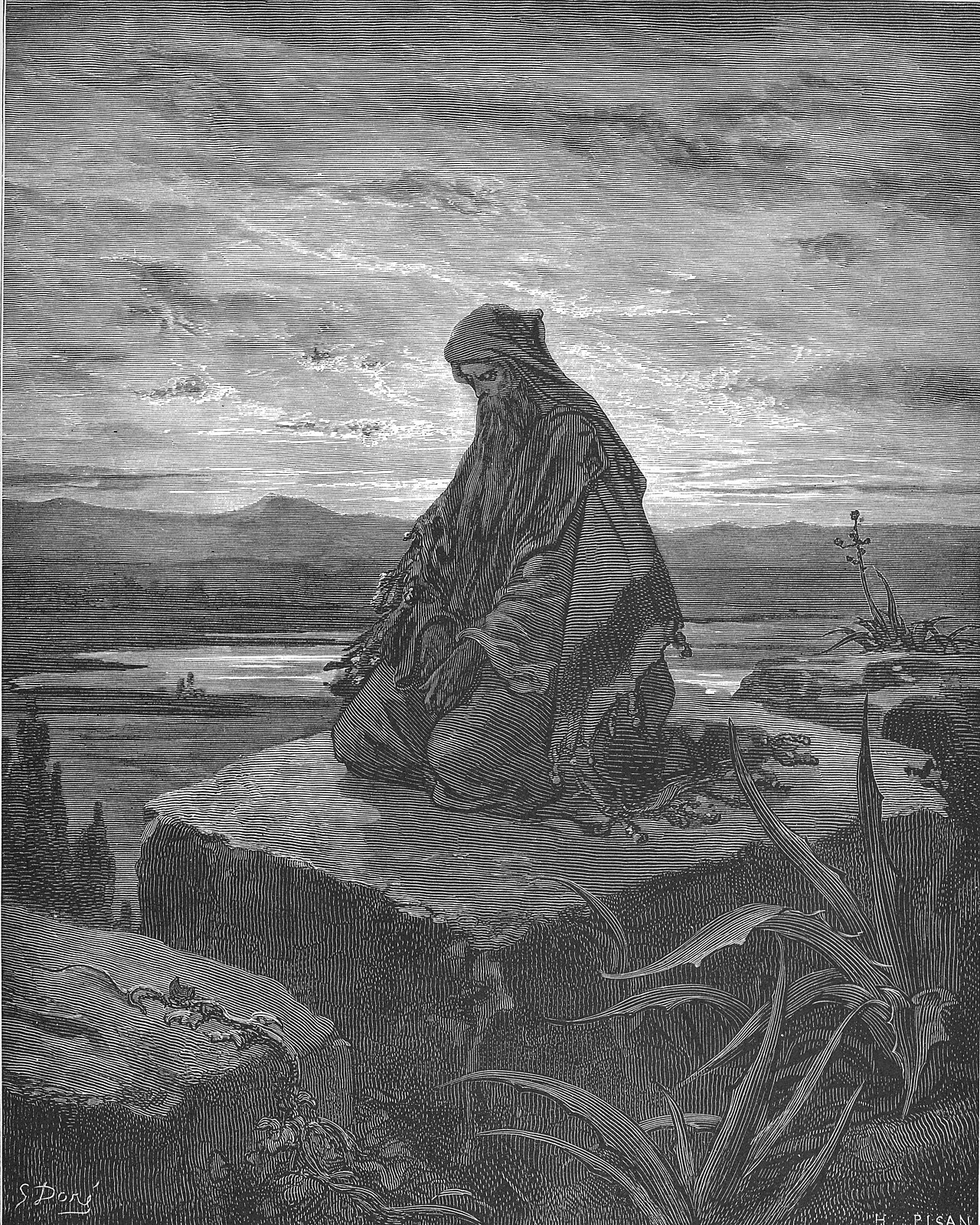
Isaiahchapter 25
12 verses · Isaiah · 8th century BC · The Prophets
For You have been a refuge for the poor, a stronghold for the needy in distress, a refuge from the storm, a shade from the heat. For the breath of the ruthless is like rain against a wall,
Introduction
Isaiah, The Prophets, Isaiah Overview.
This chapter is a song of thanks set in the middle of the judgment of chapters 24 to 27. It was sung for people who had waited a long time for God to act and had buried their dead while they waited. It moves from praise for a city brought down, to a feast prepared for all peoples, to the voice of those who waited. Listen for the line about death, which Paul quotes when he writes of the resurrection. The chapter closes with a hard word against Moab, a reminder that the song is sung in a world still under judgment.
Context
- Who
- Judeans who buried their dead and knew there was no cure for it
- What
- A song praising God for His judgments and His care for the poor, with the promise of a feast for all peoples on Mount Zion and the end of death.
- Where
- Mount Zion, where the feast is spread for all nations, with an unnamed fortified city and Moab set against it.
- When
- Spoken most likely between about 715 and 700 BC, and sung from the far side of the day of the LORD.
- Why
- To give those who wait for God the assurance that He will swallow up death, wipe away tears and save His people.
Historical context
The feast is described by a wine steward. A banquet of fat things, the rich cuts, which ordinary people ate only at festivals, and of wine on the lees, well refined. Wine was left to mature on its own sediment, which deepened it, and then strained clear before serving. Saying aged and strained is saying the best in the cellar, held back for the occasion.
Show the rest of the historical context, 3 more paragraphs
The covering that gets destroyed is a real cloth. Mourners veiled their heads, and the same word covers the shroud spread over a corpse and the pall over a grieving face. Isaiah says God will swallow up on this mountain the covering cast over all peoples and the veil spread over all nations, and then swallow up death itself, and wipe the tears off every face.
The city being flattened in the middle of the song is an unnamed fortified city turned into a heap, its palace of strangers gone, never rebuilt. Against it stands what God is to the poor: a stronghold to the needy in his distress, a shelter from the storm, a shade from the heat. In a land where the summer sun and the sudden downpour both killed, those two were the standard measures of safety.
The final image of Moab is a farmyard one, and deliberately undignified: trodden down as straw is trodden into the dung heap. Straw was mixed with dung and dried for fuel, and it was worked in by foot. Moab's proud swimmer spreads his hands, and this is the water he is swimming in.
Significance
The line that would have stopped a Judean cold is the one about death being swallowed up forever. Israel's Scriptures said far less about life beyond the grave than the nations around them assumed; here it is stated flat, with no hedging.
Show the rest of the significance, 1 more paragraph
And the response written into the song is a sentence for people who have waited a long time: this is our God, we have waited for him, and he will save us. The waiting is part of the testimony, not an embarrassment to it.
This chapter in Jewish lifeWhat this chapter is in Jewish life and reading.
What is done
No part of this chapter is read aloud in the synagogue. The site's own table in src/lib/hebraic/readings.ts printed parashot 0 and haftarah uses 0 for Isaiah 25, and no festival reading for the book. The table records Isaiah only as a source of Haftarot, and none of the Haftarot it records reaches this chapter.
The chapter is met instead in the study of the weekly portions, and the corpus names the doors. Under the seventh verse it carries Midrash Tanchuma Buber, Bechukotai 5:1 and Midrash Tanchuma, Bechukotai 3:1. Under the ninth verse it carries Midrash Tanchuma Buber, Bamidbar 20:1. Each of those locators is named for the Torah portion whose study it belongs to.
How it is read
Rashi is quoted here from The Judaica Press complete Tanach with Rashi, translated by A. J. Rosenberg, which Sefaria reports as CC-BY, and Ibn Ezra from the Commentary of Ibn Ezra on Isaiah translated by M. Friedlander in 1873, which Sefaria reports as public domain. Rashi hears the song of the first verse as thanks for a promise kept. The counsels from long ago are the counsels given to Abraham "in the Covenant between the Parts" (Rashi on Isaiah 25:1:1). The city made a heap is Mount Seir (Rashi on Isaiah 25:2:1). The storm against the wall is "A spirit of tyrants", which floods a wall until it falls (Rashi on Isaiah 25:4:1). Ibn Ezra reads the same verse historically: the fortified towns were taken, while the city of the poor, Jerusalem, escaped (Ibn Ezra on Isaiah 25:4:1).
The feast on the mountain is read against the nations that come up against Jerusalem. What they expect to be smooth and soft, like fat, is turned into a feast of dregs (Rashi on Isaiah 25:6:1 and 25:6:2). The eighth verse draws two readings a Christian reader should weigh together. Rashi reads it of Israel, that God "will cover it and hide it forever from Israel" (Rashi on Isaiah 25:8:1). Ibn Ezra reads the Hebrew with death as the subject, "Death will destroy" them, and the translator's note names the nations of the verse before as those it destroys (Ibn Ezra on Isaiah 25:8:1). Both commentators read the walls of the last verse as the walls of Moab (Rashi and Ibn Ezra on Isaiah 25:12:1).
The corpus carries one further note on this chapter without an English text, marked linked because Sefaria holds no English version of the ref. It stands cited and unquoted at Radak on Isaiah 25:3:1.
What the rabbis say
The corpus carries forty rabbinic locators on this chapter and the text of none, so each is cited by ref here and none is quoted or paraphrased. On the first verse it holds Aggadat Bereshit 80:1, Mekhilta DeRabbi Shimon Ben Yochai 14:8, Mekhilta DeRabbi Yishmael, Tractate Vayehi Beshalach 2:34 and Mekhilta DeRabbi Yishmael, Tractate Vayehi Beshalach 3:30. The same verse also carries Midrash Sekhel Tov, Bereshit 20:12:1, Midrash Tehillim 118:2 and Midrash Tehillim 145:1. On the third verse it holds Tanna DeBei Eliyahu Rabbah 18:3. On the fifth verse it holds Jerusalem Talmud Moed Katan 3:9:1, Midrash Aggadah, Numbers 25:14:2 and Midrash Sekhel Tov, Bereshit 31:40:2. On the sixth verse it holds Midrash Lekach Tov, Deuteronomy 32:34:1, Midrash Tannaim on Deuteronomy 32:34:5, Sifrei Devarim 324:1 and Yalkut Shimoni on Torah 946:9. On the seventh verse it holds Midrash Sekhel Tov, Bereshit 36:20:4, Midrash Tanchuma Buber, Bechukotai 5:1 and Midrash Tanchuma, Bechukotai 3:1.
On the eighth verse it holds Aggadat Bereshit 38:2, Bereshit Rabbah 26:2, Bereshit Rabbati, Parashat Bereshit 17, Bereshit Rabbati, Parashat Bereshit 39, Eikhah Rabbah 1:41 and Ein Yaakov (Glick Edition), Sanhedrin 11:12. The same verse also carries Ein Yaakov, Pesakhim 6:3. On the ninth verse it holds Eikhah Rabbah 1:57, Ein Yaakov (Glick Edition), Taanit 4:17, Ein Yaakov, Taanit 4:20, Midrash Lekach Tov, Genesis 15:18:1 and Midrash Lekach Tov, Genesis 25:29:3. The same verse also carries Midrash Sekhel Tov, Shemot 15:2:2 and Midrash Tanchuma Buber, Bamidbar 20:1. On the eleventh verse it holds Jerusalem Talmud Shekalim 6:2:3. On the twelfth verse it holds Shemot Rabbah 40:4.
The corpus files six further locators under a verse number this chapter does not reach. The site's table in src/data/bible/chapter-verse-counts.json counts the chapter at 12 verses in the Berean Standard Bible. The corpus files Midrash Tanchuma Buber, Tzav 16:1 at the number 15, Midrash Aggadah, Deuteronomy 21:7:2 at the number 18 and Ein Yaakov (Glick Edition), Ketubot 13:14 at the number 20. It also files Midrash Lekach Tov, Exodus 12:22:7 at the number 20, Midrash Sekhel Tov, Shemot 12:22:7 at the number 20 and Devarim Rabbah 2:30 at the number 30. They are cited as the corpus files them, and the anchor is left for a check against the source. What each of them teaches is a saying of the rabbis, and it is reported as theirs wherever this site quotes one. The quotations wait on a fetch that carries the text.
Sources: Rashi, Rashi on Isaiah 25:1:1 to 25:12:1, The Judaica Press complete Tanach with Rashi, translated by A. J. Rosenberg, reported CC-BY; Ibn Ezra, Ibn Ezra on Isaiah 25:3:1 to 25:12:1, Commentary of Ibn Ezra on Isaiah, translated by M. Friedlander, 1873, reported public domain; Radak, Radak on Isaiah 25:3:1, cited by ref because the corpus carries no English text; The Sefaria corpus, scripts/data/sources/sefaria/isaiah/25.json, the 40 Talmud and Midrash locators of this chapter; The site's own files, src/lib/hebraic/readings.ts, printing no portion, no Haftarah and no festival reading for this chapter, and src/data/bible/chapter-verse-counts.json for the verse count.
The heads below are this chapter's scenes. The numbered points under each are its verses.
A Refuge for the Poor, a Shade from the Heat
Isaiah 25:1-3
O LORD, You are my God!: The oracles against the nations give way to a song, "O LORD, You are my God". The singer praises "plans formed long ago" carried out "in perfect faithfulness", which ties the song to the oracles. The fortified town is "a ruin", and "The cities of ruthless nations will revere You".
Isaiah 25:1
“O Lord, thou art my God - The prophet speaks, not in his own name, but in the name of the people that would be delivered from bondage. The sense is, that Yahweh had manifested himself as their covenant-keeping God; and that in view of his faithfulness in keeping his promises, they now had demonstration that he was their God.”
1 more voice on this verseWhat preachers and commentators have said about this verse, in their own words.
Isaiah 25:1
“These wonderful things, which are new and surprising to us, and altogether unthought of, are according to his counsels of old, devised by his wisdom and designed for his own glory and the comfort of his people.”
Matthew Henry · Commentary on the Whole Bible (1707-1721)puritan
You have made the city a heap of rubble: The city is left unnamed, and Clarke lists Nineveh, Babylon and Ar of Moab among the candidates. Henry draws from its ruin the lesson of Hebrews 13:14, that here there is no lasting city. The people of God look for one to come.
Isaiah 25:2
“A city “The city” - Nineveh, Babylon, Ar, Moab, or any other strong fortress possessed by the enemies of the people of God. For the first מעיר meir, of a city, the Syriac and Vulgate read העיר hair, the city; the Septuagint and Chaldee read ערים arim, cities, in the plural, transposing the letters. After the second מעיר meir, a MS. adds לגל lagol, for a heap. A palace of strangers “The palace of the proud ones” - For זרים zarim, strangers, MS.”
Adam Clarke · Commentary on the Bible (1810-1826)evangelical
2 more voices on this verse
Isaiah 25:2
“How many of the cities of Israel have long since been heaps and ruins! God hereby teaches us that here we have no continuing city and must therefore seek one to come which will never be a ruin or go to decay.”
Matthew Henry · Commentary on the Whole Bible (1707-1721)puritan
Isaiah 25:2
“A city - Which is put for cities: or of enemies of God and his people. And under the name cities he comprehends their countries and kingdoms. Strangers - The royal cities, in which were the palaces of strangers, of Gentiles.”
John Wesley · Explanatory Notes upon the Old Testament (1765)evangelical
a strong people will honor You: The ruthless nations are brought to revere the LORD by the fall of the fortress in verse 2. Jamieson, Fausset and Brown name them as the peoples Babylon had crushed. Fear turns into honor.
Isaiah 25:3
“The strong people - The reference here is not probably to the Babylonians, but to the surrounding nations. The deliverance of the Jews, and the destruction of Babylon, would be such striking events that they would lead the surrounding nations to acknowledge that it was the hand of God. The city of the terrible nations - The word ‘city’ here is taken probably in a collective sense, to denote the cities or the strong places of the surrounding nations which would be brought thus to tremble before God.”
2 more voices on this verse
Isaiah 25:3
“Of those people that have been strong and terrible against God. Those that have been enemies to God's kingdom, and have fought against the interests of it with a great deal of strength and terror, shall either be converted, and glorify God by joining with his people in his service, or at least convinced, so as to own themselves conquered.”
Matthew Henry · Commentary on the Whole Bible (1707-1721)puritan
Isaiah 25:3
“Israel was called to the knowledge of God through the tutoring of the law and was richly endowed with the things of God. It was delivered [from Egypt] and inherited the Promised Land. Although there were many other peoples living in other parts of the world, all were alien to spiritual matters and heavenly things. They had not tasted the gifts that come from God.”
Cyril of Alexandria · written before 444 · Commentary on Isaiah 3:1.25patristic
Isaiah 25:4-5
a refuge for the poor: The song turns to what God is to the poor, "a refuge for the poor, a stronghold for the needy in distress". The ruthless come on like "rain against a wall". Barnes takes the poor and needy here as all who have nowhere else to turn.
Isaiah 25:4
“As a storm against the wall “Like a winter-storm” - For קיר kir, read קור kor: or, as עיר ir from ערר arar, so קיר kir from קרר karar. - Capellus.”
Adam Clarke · Commentary on the Bible (1810-1826)evangelical
1 more voice on this verse
Isaiah 25:4
“He is a refuge from the storm of rain or hail, and a shadow from the scorching heat of the sun in summer. God is a sufficient protection to his people in all weathers, hot and cold, wet and dry. The armour of righteousness serves both on the right hand and on the left, 2 Cor. vi.”
Matthew Henry · Commentary on the Whole Bible (1707-1721)puritan
You subdue the uproar of foreigners: The uproar of foreigners is their shout in battle or triumph, as Barnes explains, and the LORD silences it as cloud shade cools the heat. Clarke reads the proud in place of foreigners, set beside the ruthless as in Psalm 86:14. Both fall silent.
Isaiah 25:5
“Translate, "As the heat in a dry land (is brought down by the shadow of a cloud, so) thou shalt bring down the tumult (the shout of triumph over their enemies) of strangers (foreigners); and as the heat by the shadow of the cloud (is brought low), so the branch (the offspring) of the terrible ones shall be brought low." PARKHURST translates the Hebrew for "branch," the exulting song.”
Jamieson, Fausset & Brown · Commentary Critical and Explanatory on the Whole Bible (1871)reformed
1 more voice on this verse
Isaiah 25:5
“Thou shalt bring down the noise - The tumult; the sound which they make in entering into battle; or the note of triumph, and the sound of revelry. The phrase may refer either to their shout of exultation over their vanquished foes; or to the usual sound of revelry; or to the hum of business in a vast city. Of strangers - Of foreigners (see the note at Isa 25:2).”
The Feast of Fat Things and Death Swallowed Up
Isaiah 25:6-7
the LORD of Hosts will prepare a banquet: The feast is set "On this mountain", the Zion of 24:23, and its guests are "all the peoples", served "a feast of aged wine". The aged wine is wine left on its lees until fully refined. The LORD will "swallow up the shroud that enfolds all peoples".
Isaiah 25:6
“In this mountain - Zion, at Jerusalem. In his Church. Shall the Lord of hosts make unto all people a feast - Salvation by Jesus Christ. A feast is a proper and usual expression of joy in consequence of victory, or any other great success. The feast here spoken of is to be celebrated on Mount Sion; and all people, without distinction, are to be invited to it.”
Adam Clarke · Commentary on the Bible (1810-1826)evangelical
1 more voice on this verse
Isaiah 25:6
“All people - Both Jews and Gentiles. A feast - A feast made up of the most delicate provisions, which is manifestly meant of the ordinances, graces, and comforts given by God in his church. Of wines - Which have continued upon the lees a competent time, whereby they gain strength, and are afterwards drawn off, and refined.”
John Wesley · Explanatory Notes upon the Old Testament (1765)evangelical
the shroud that enfolds all peoples: The verb is swallow up. On this same mountain the LORD swallows up death in verse 8, as Barnes notes, so shroud and death go down together. Henry sets the sheet over the nations beside the veil over the heart in 2 Corinthians 3.
Isaiah 25:7
“And he will destroy - Hebrew, ‘He will swallow up,’ that is, he will abolish, remove, or take away. In this mountain the face of the covering - In mount Zion, or in Jerusalem. This would be done in Jerusalem, or on the mountains of which Jerusalem was a part, where the great transactions of the plan of redemption would be accomplished. The word ‘face’ here is used as it is frequently among the Hebrews, where the face of a thing denotes its aspect. or appearance, and then the thing itself.”
1 more voice on this verse
Isaiah 25:7
“There is a veil spread over all nations, for they all sit in darkness; and no marvel, when the Jews themselves, among whom God was known, had a veil upon their hearts, 2 Cor. iii. But this veil the Lord will destroy, by the light of his gospel shining in the world, and the power of his Spirit opening men's eyes to receive it.”
Matthew Henry · Commentary on the Whole Bible (1707-1721)puritan
Isaiah 25:8-9
He will swallow up death forever: The feast reaches its height, "He will swallow up death forever", words Paul quotes at 1 Corinthians 15:54. "The Lord GOD will wipe away the tears from every face", a promise John carries at Revelation 21:4. Verse 9 gives the answer of those who waited: "Surely this is our God".
Isaiah 25:8
“He will swallow up death - He, by the grace of God, will taste death for every man. Heb 2:9. Probably, swallow up death, and taste death, in both these verses, refer to the same thing: Jesus dying instead of a guilty world. These forms of speech may refer to the punishment of certain criminals; they were obliged to drink a cup of poison. That cup which every criminal in the world must have drunk, Jesus Christ drank for them; and thus he swallowed up death: but as he rose again from the dead, complete victory was gained.”
Adam Clarke · Commentary on the Bible (1810-1826)evangelical
2 more voices on this verse
Isaiah 25:8
“He - Christ will by his death destroy the power of death, take away the sting of the first death, and prevent the second. In victory - Hebrew. unto victory; so as to overcome it perfectly; which complete victory Christ hath already purchased for, and will in due time actually confer upon his people.”
John Wesley · Explanatory Notes upon the Old Testament (1765)evangelical
Isaiah 25:8
In the Old Testament the jaw of death is bitter, since it is said, "Strong death is all devouring." In the New Testament the jaw of death is sweet, for it has swallowed death, as the apostle says: "Death is swallowed up in victory! O death, where is your victory? O death, where is your sting?"
Ambrose of Milan · written before 397 · Letter 44.9patristic
Cross references
Isaiah 25:8
- Quoted in1 Corinthians 15:54When the perishable has been clothed with the imperishable and the mortal with immortality, then the saying that is written will come to pass: “Death has been swallowed up in victory.”
'Death is swallowed up in victory' ('the saying that is written')
Lo, This Is Our God: and Moab Trodden Down
In that day those who waited for their God rejoice and are glad in His salvation, and Wesley hears the welcome of the promised Messiah. Jamieson, Fausset and Brown set this waiting with Genesis 49:18 and Titus 2:13. The LORD has saved them.
Isaiah 25:9
“The Jews, however, have a special share in the words, This is our God (see on Isa 25:6). we have waited--"Waited" is characteristic of God's people in all ages (Ge 49:18; Tit 2:13). we will be glad and rejoice in his salvation--compare Ps 118:24, which refers to the second coming of Jesus (compare Ps 118:26, with Lu 13:35).”
Jamieson, Fausset & Brown · Commentary Critical and Explanatory on the Whole Bible (1871)reformed
2 more voices on this verse
Isaiah 25:9
“Our God - Our Messiah, long since promised, and for whom we have waited long, is come into the world, bringing salvation with him.”
John Wesley · Explanatory Notes upon the Old Testament (1765)evangelical
Isaiah 25:9
“And it shall be said in that day - By the people of God. This shall be the language of exultation and joy which they shall use. Lo, this is our God - This is the language of those who now see and hail their Deliverer. It implies that such deliverance, and such mercy could be bestowed only by God, and that the fact that such mercies had been bestowed was proof that he was their God.”
Isaiah 25:10-12
the hand of the LORD will rest: Beside the feast on Zion stands one judgment named at last, "Moab will be trampled", the nation the oracles have addressed since chapter 15. Moab spends his strength for nothing, "as a swimmer spreads his arms to swim". The oracles close as "The high-walled fortress will be brought down".
Isaiah 25:10
“Shall the hand of the Lord rest “The hand of Jehovah shall give rest” - Hebrews תנוח tenuach, quiescet. Annon תניח taniach, quietem dabit, shall rest; shall give rest, ut Graeci, αναπαυσιν δωσει, et Copt.? - Mr. Woide. That is, “shall give peace and quiet to Sion, by destroying the enemy; “as it follows.” As straw is trodden down “As the straw is threshed” - Hoc junta ritum loquitur Palastinae et multarum Orientis provinciarum, quae ob pratorum et foeni penuriam paleas preparant esui animantium.”
Adam Clarke · Commentary on the Bible (1810-1826)evangelical
1 more voice on this verse
Isaiah 25:10
“It is foretold, particularly, what he shall do for them. (1.) He shall bring down the pride of their enemies (and Moab was notoriously guilty of pride, ch. xvi. 6 ) by one humbling judgment after another, stripping them of that which they are proud of.”
Matthew Henry · Commentary on the Whole Bible (1707-1721)puritan
as a swimmer spreads his arms to swim: The swimmer may be Moab or the LORD. Lowth, followed by Jamieson, Fausset and Brown, sees Moab spreading his hands to keep from sinking. Barnes sees the LORD spreading His hands through the land to bring down pride.
Isaiah 25:11
“And he shall spread forth his hands - The sense is, that Yahweh would stretch out his hands everywhere, prostrating his enemies, and the enemies of his people. Lowth, however, applies this to Moab, and supposes that it is designed to represent the action of one who is in danger of sinking, and who, in swimming, stretches out his hands to sustain himself. In order to this, he supposes that there should be a slight alteration of a single letter in the Hebrew.”
1 more voice on this verse
Isaiah 25:11
“LOWTH takes "he" as Moab, who, in danger of sinking, shall strain every nerve to save himself; but Jehovah (and "he") shall cause him to sink ("bring down the pride" of Moab, Isa 16:6). with the spoils of . . . hands--literally, "the craftily acquired spoils" of his (Moab's) hands [BARNES].”
Jamieson, Fausset & Brown · Commentary Critical and Explanatory on the Whole Bible (1871)reformed
The high-walled fortress will be brought down: Barnes reads the walls of Moab as a picture of every enemy of the people of God. Henry sees in their fall a type of the victory of Christ over death, the victory verse 8 has already announced. The LORD overtops every wall.
Isaiah 25:12
“And the fortress of the high fort of thy walls shall he bring down,.... That is, their high and, fenced walls, which were about their cities, the fortifications of them; these should be destroyed by the Lord, be battered and brought down, not being able to stand against his mighty power.”
1 more voice on this verse
Isaiah 25:12
“And the fortress ... - Thy strong defenses shall be destroyed. This is spoken of Moab (compare the notes at Isa 15:1-9;Isa 16:1-14), and is designed to be emblematic of the enemies of the people of God (compare the notes at Isa. 34) The repetition of the expressions ‘bring down,’ ‘lay low,’ and ‘bring to the ground,’ is designed to make the sentence emphatic, and to indicate that it would certainly be accomplished.”
Keep studying
Sources for this chapter
The summary
Jamieson, Fausset & Brown, Commentary Critical and Explanatory; John Calvin, Commentaries; John Wesley, Notes on the Old Testament and Matthew Henry, Complete Commentary.
The exposition
Adam Clarke, Commentary on the Bible; Albert Barnes; Franz Delitzsch, Biblical Commentary on the Prophecies of Isaiah; Jamieson, Fausset & Brown, Commentary Critical and Explanatory on the Whole Bible; John Gill, Exposition of the Old Testament; John Wesley, Explanatory Notes upon the Old Testament and Matthew Henry, Commentary on the Whole Bible.