
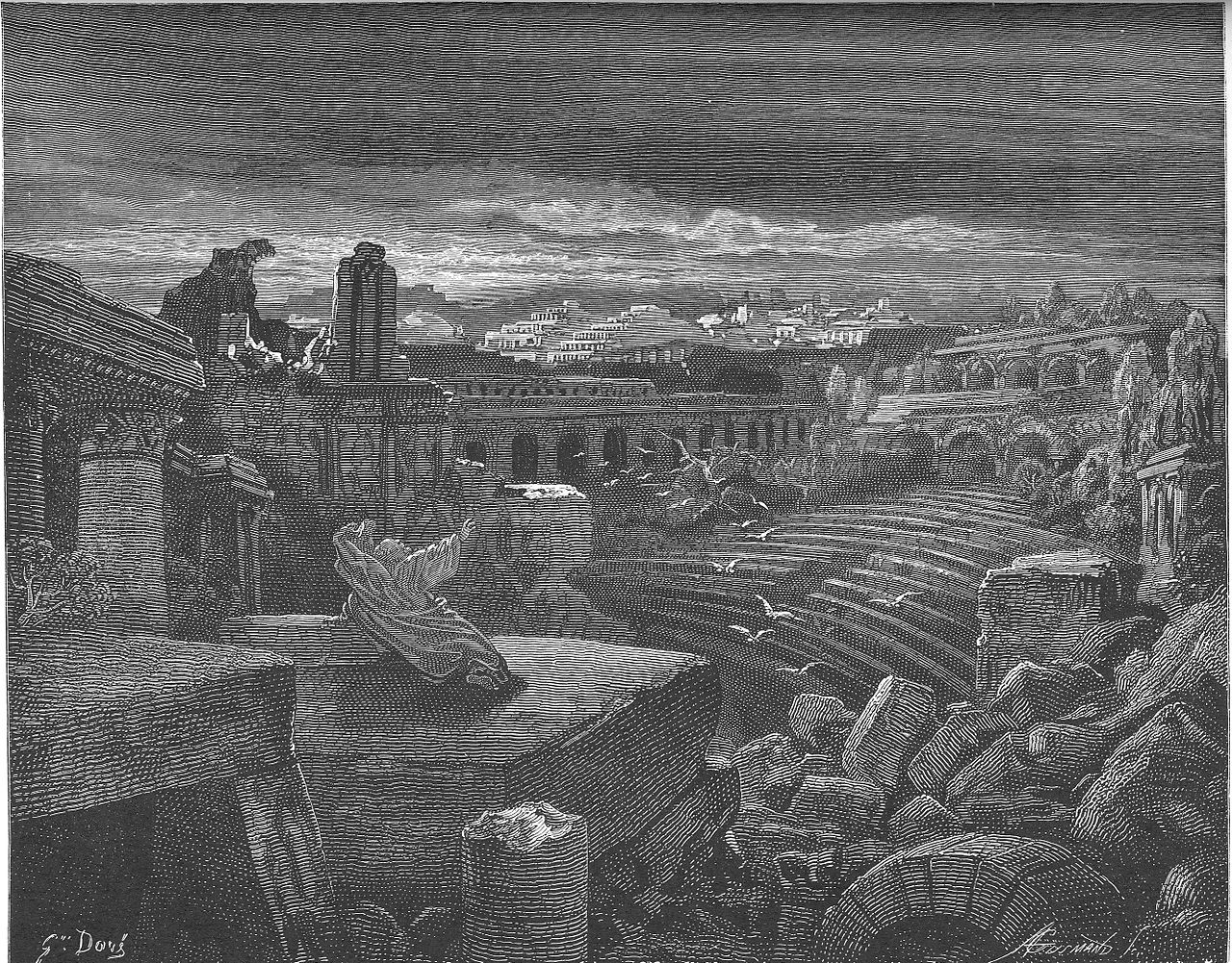
Isaiahchapter 13
22 verses · Isaiah · 8th century BC · The Prophets
And Babylon, the jewel of the kingdoms, the glory of the pride of the Chaldeans, will be overthrown by God like Sodom and Gomorrah.
Introduction
Isaiah, The Prophets, Isaiah Overview.
Isaiah son of Amoz received this oracle, and it opens the part of his book that speaks to the nations around Israel. Its first hearers thought of Assyria as the great danger, while Babylon was an old city under Assyrian control. It describes an army gathered by God and a day of reckoning that reaches the whole world. Listen for who musters the army and for whom it is gathered. Notice the signs in the heavens and the fear on human faces. Mark the named attackers and the fate of the city at the close. The chapter teaches that every empire answers to the LORD.
Context
- Who
- Judeans who thought of Assyria, not Babylon, as the danger
- What
- An oracle announcing the day of the LORD against Babylon, the gathering of armies, cosmic signs, and the overthrow of the city by the Medes.
- Where
- Babylon on the plain of the Euphrates, with armies coming from the highlands and a reckoning over all the earth.
- When
- Spoken about 720 to 700 BC, and Babylon fell to the Medes and Persians under Cyrus in 539 BC.
- Why
- To show that the pride of the proudest empire would be brought down and that the day of the LORD reaches the whole world.
Historical context
In Isaiah's lifetime Babylon was not an empire. It was an ancient, proud city under Assyrian control, forever revolting and being put down. That is exactly why critics argue this oracle was written much later, after Babylon actually ruled; the traditional view, held here, is that naming a future destroyer generations in advance is the entire point of a prophecy, and Isaiah's God will make that argument himself in chapter 41.
Show the rest of the historical context, 3 more paragraphs
The mustering scene is an army being raised the ordinary way: a banner lifted on a bare hill so units could see where to gather, a shout, a hand waved to bring them through the gates. The Medes named as the attackers were a highland people north-east of Babylon, and in 539 BC it was a Medo-Persian force under Cyrus that took the city.
The end of Babylon in history was slow, not sudden. Cyrus took it largely intact, and it stayed a working city for centuries before silting up and emptying out. Travelers in later ages found a field of broken brick with jackals in it, which is what the closing verses describe: no Arab pitching a tent there, no shepherd folding a flock, only desert creatures and screech owls in the rubble.
The middle of the chapter is bigger than one city. Stars withholding their light, the sun dark at its rising, the heavens shaken and the earth moved out of its place, that language reaches past any siege. Read in a premillennial frame, the oracle telescopes: the historical fall of a real city stands in the foreground, and behind it the day of the LORD that ends the age.
Significance
For a nation fixated on Assyria, this said the empire in front of you is not the last one, and none of them get to keep what they take.
Show the rest of the significance, 1 more paragraph
The phrase that governs the section is the day of the LORD. Judeans used it as a comfort, the day God settles accounts with our enemies. Isaiah keeps insisting it is a day that settles accounts with the world, and that the world includes them.
This chapter in Jewish lifeWhat this chapter is in Jewish life and reading.
What is done
No part of this chapter is read in the synagogue. Probed for this lane, the site's own table in src/lib/hebraic/readings.ts printed parashot 0 and haftarah uses 0 for Isaiah 13, and no festival reading for the book. Across chapters 1 to 22 of Isaiah the same probe found a Haftarah only in chapters 1, 6, 7 and 9.
How it is read
Rashi is the main commentator on this chapter in the corpus, quoted here from The Judaica Press complete Tanach with Rashi, translated by A. J. Rosenberg, which Sefaria reports as CC-BY. Ibn Ezra is quoted from the Commentary of Ibn Ezra on Isaiah, translated by M. Friedlander in 1873, which Sefaria reports as Public Domain.
This chapter opens the run of oracles against the nations, and Babylon comes first. Ibn Ezra gives the order a reason: "The fall of Babylon is recorded after the ruin of Assyria, because it was Babylon that conquered Assyria" (Ibn Ezra on Isaiah 13:1:1). Rashi calls the heading "The prophecy of the retribution which [will fall] upon Babylon" (Rashi on Isaiah 13:1:1).
Rashi names the armies God musters. The appointed ones "are Persia and Media, the men of Cyrus and Darius" (Rashi on Isaiah 13:3:1). He reads the fall through the book of Daniel. The mortal man made dearer than fine gold is Daniel, honoured on the night he read the writing on the wall (Rashi on Isaiah 13:12:1). The stirring of Media is the night Darius the Mede killed Belshazzar, with Daniel 5:30 cited beside it (Rashi on Isaiah 13:17:1).
On the twentieth verse Rashi reads the ruin as total: even Arabs, who move their tents from place to place, will not pitch a tent there (Rashi on Isaiah 13:20:1).
What the rabbis say
The corpus carries 40 rabbinic locators on the verses of this chapter, 8 in the Talmud and 32 in the Midrash. It carries the text of none, so each is cited by ref here and never quoted or paraphrased. The verse numbers are the Hebrew ones the corpus prints.
On verse 2 it holds Midrash Sekhel Tov, Shemot 17:15:1. On verse 3 it holds Berakhot 8b:15 and Berakhot 8b:16. On verse 5 it holds Jerusalem Talmud Taanit 2:1:14, Midrash Tanchuma Buber, Tazria 11:1 and Midrash Tanchuma, Tazria 9:1. It also holds Midrash Tehillim 5:5, Midrash Tehillim 86:6 and Pesikta DeRav Kahana 24:11. On verse 6 it holds Pesikta Rabbati 41:1. On verse 7 it holds Yalkut Shimoni on Torah 207:1.
On verse 9 it holds Mekhilta DeRabbi Yishmael, Tractate Pischa 11:18, Mekhilta DeRabbi Yishmael, Tractate Pischa 7:5 and Midrash Lekach Tov, Exodus 12:12:2. It also holds Midrash Sekhel Tov, Shemot 12:20:35, Midrash Sekhel Tov, Shemot 12:24:5 and Midrash Tehillim 2:7. On verse 10 it holds Mekhilta DeRabbi Shimon Ben Yochai 15:5, Mekhilta DeRabbi Yishmael, Tractate Shirah 5:2 and Midrash Sekhel Tov, Shemot 15:5:2. It also holds Midrash Tanchuma Buber, Bereshit 18:1 and Midrash Tanchuma, Bereshit 6:2. On verse 11 it holds Yalkut Shimoni on Torah 246:6. On verse 13 it holds Jerusalem Talmud Berakhot 9:2:4. On verse 15 it holds Otzar Midrashim, Midrashim of Rabbi Shimon bar Yochai, Prayer of Rabbi Shimon Bar Yochai 7.
On verse 16 it holds Bereshit Rabbah 18:2, Otzar Midrashim, Keri & K'tiv, Introduction 4 and Tractate Soferim 9:8. On verse 17 it holds Bereshit Rabbati, Parashat Chayei Sarah 12, Esther Rabbah 5:3 and Kiddushin 12a:12. It also holds Midrash Lekach Tov on Esther, Introduction 2. On verse 19 it holds Seder Olam Rabbah 28:1. On verse 21 it holds Berakhot 3b:9, Bereshit Rabbah 36:1 and Bereshit Rabbah 65:15. It also holds Chullin 64b:5 and Midrash Aggadah, Genesis 27:11:2. On verse 22 it holds Midrash Lekach Tov, Exodus 9:17:1 and Midrash Sekhel Tov, Shemot 9:17:3.
What each of them teaches is a saying of the rabbis, and is reported as theirs wherever this site quotes one. The quotations wait on a fetch that carries the text.
Sources: Ibn Ezra, Ibn Ezra on Isaiah 13:1:1 to 13:4:1, Commentary of Ibn Ezra on Isaiah - trans. by M. Friedlander, 1873, reported Public Domain; Rashi, Rashi on Isaiah 13:1:1 to 13:22:1, The Judaica Press complete Tanach with Rashi, translated by A. J. Rosenberg, reported CC-BY; The Sefaria corpus, scripts/data/sources/sefaria/isaiah/13.json, the 40 Talmud and Midrash locators on the verses of this chapter; The site's own files, src/lib/hebraic/readings.ts, probed for Isaiah 13: parashot 0, haftarah uses 0, and no festival reading for the book.
The heads below are this chapter's scenes. The numbered points under each are its verses.
Mustering an Army for the Day of the LORD
Isaiah 13:1-3
This is the burden against Babylon: The burden against Babylon opens the first and longest of the oracles against the nations. Babylon is named while Assyria still ruled, and the "sanctified ones" and "warriors" of verse 3 are a pagan army the Lord calls His own. The banner and the waved hand are a muster call.
Isaiah 13:1
“The burden of Babylon - Or, the burden “respecting,” or “concerning” Babylon. This prophecy is introduced in a different manner from those which have preceded. The terms which Isaiah employed in the commencement of his previous prophecies, were vision (see the note at Isa 1:1), or word Isa 2:1. There has been considerable diversity of opinion in regard to the meaning of the word ‘burden,’ which is here employed. The Vulgate renders it, Onus - ‘Burden,’ in the sense of load.”
Raise a banner on a barren hilltop: The banner of 5:26 and 11:12 is raised once more, now to summon the armies against Babylon. Gill read the barren hilltop as a height in Media or Persia where a standard could be seen. The gates of the nobles are the gates of Babylon.
Isaiah 13:2
“Hence it is often said to sinners: give glory to God! But Babylon and the entire region of the Chaldeans are called dark or gloomy mountains, as in the beginning of Isaiah, where we find written against Babylon: "Raise the signal on a dark mountain," which in Hebrew is called nishpeh.”
Jerome · written before 420 · Six Books on Jeremiah 3:17.2-3patristic
1 more voice on this verse
Isaiah 13:2
“Exalt the voice - The word להם lahem, “to them,” which is of no use, and rather weakens the sentence, is omitted by an ancient MS., and the Vulgate.”
Adam Clarke · Commentary on the Bible (1810-1826)evangelical
I have commanded My sanctified ones: The sanctified ones are the Medes and Persians, set apart for this work, as Wesley and Clarke explained. Matthew Henry pointed to Cyrus, whom 45:1 calls the LORD's anointed. Their holiness lies in the task God gives them.
Isaiah 13:3
“Cyrus, the person principally concerned, was justly called a sanctified one, for he was God's anointed ( ch. xlv. 1 ) and a figure of him that was to come. It is a pity but all soldiers, especially those that fight the Lord's battles, should be in the strictest sense sanctified ones; and it is a wonder that those dare be profane ones who carry their lives in their hands.”
Matthew Henry · Commentary on the Whole Bible (1707-1721)puritan
1 more voice on this verse
Isaiah 13:3
“I have commanded - This is the language of God in reference to those who were about to destroy Babylon. “He” claimed the control and direction of all their movements; and though the command was not understood by “them” as coming from him, yet it was by his direction, and in accordance with his plan (compare the notes at Isa 10:7; Isa 45:5-6). The “command” was not given by the prophets, or by an audible voice; but it was his secret purpose and direction that led them to this enterprise.”
Isaiah 13:4-8
Listen, a tumult on the mountains: The tumult on the mountains gathers many nations under one command, the LORD of Hosts mobilizing an army. The prophet cries that "the Day of the LORD is near," coming as destruction from the Almighty. Writhing "like a woman in labor" is one of the oldest figures for sudden dread.
Isaiah 13:4
“Of the battle “For the battle” - The Bodleian MS. has למלחמה lemilchamah. Cyrus’s army was made up of many different nations. Jeremiah calls it an “assembly of great nations from the north country,” Jer 50:9. And afterwards mentions the kingdoms of “Ararat, Minni, and Ashchenaz, (i.e. Armenia, Corduene, Pontus or Phrygia, Vitring.), with the kings of the Medes,” Jer 51:27, Jer 51:28. See Xenophon. Cyrop.”
Adam Clarke · Commentary on the Bible (1810-1826)evangelical
Clarke cited Kimchi, who took the far end as Media. Barnes saw the LORD Himself at the head of the gathered armies. Matthew Henry called great princes and armies tools in God's hand, as Assyria was the rod of 10:5.
Isaiah 13:5
“They--namely, "Jehovah," and the armies which are "the weapons of His indignation." far country--Media and Persia, stretching to the far north and east. end of heaven--the far east (Ps 19:6). destroy--rather, "to seize" [HORSLEY].”
Jamieson, Fausset & Brown · Commentary Critical and Explanatory on the Whole Bible (1871)reformed
the Day of the LORD is near: The Day of the LORD is the day He acts in judgment, here against Babylon, as Barnes and Jerome both read it. The Hebrew sets shod, destruction, beside Shaddai, the Almighty, and Joel 1:15 repeats the line. The call to wail goes to the Chaldeans.
Isaiah 13:6
“Howl ye - Ye inhabitants of Babylon, in view of the approaching destruction. The day of the Lord - The time when Yahweh will inflict vengeance on you draws near (see the note at Isa 2:12; compare Isa 13:9). As a destruction from the Almighty - Not as a desolation from man, but as destruction sent from him who has all power in heaven and on earth. Destruction meditated by man might be resisted; but destruction that should come from the Almighty must be final and irresistible.”
all hands will fall limp: Barnes read the hands that fall limp and the hearts that melt as terror too great for any man of Babylon to defend himself. Ezekiel 21:7 joins the same two pictures for the news of judgment on Jerusalem. Babylon, once the conqueror, loses heart.
Isaiah 13:7
“Therefore shall all hands be faint - This is designed to denote the consternation and alarm of the people. They would be so terrified and alarmed that they would have no courage, no hope, and no power to make resistance. They would abandon their plans of defense, and give themselves up to despair (compare Jer 50:43: ‘The king of Babylon hath heard the report of them, and his hands waxed feeble; anguish took hold of him, and pangs as of a Women in travail;’ Eze 7:17; Zep 3:16).”
they will writhe like a woman in labor: Labor pains are the prophets' picture of sudden anguish no one can escape, used again of Babylon in 21:3 and Jeremiah 50:43. Matthew Henry weighed the flushed faces as pale with fear or red with shame at their cowardice. Clarke joined the first words to verse 7.
Isaiah 13:8
“Their faces shall be as flames, pale as flames, through fear (so some), or red as flames sometimes are, blushing at their own cowardice; or their faces shall be as faces scorched with the flame, or as theirs that labour in the fire, their visage blacker than a coal, or like a bottle in the smoke, Ps. cxix.”
Matthew Henry · Commentary on the Whole Bible (1707-1721)puritan
1 more voice on this verse
Isaiah 13:8
“And they shall be afraid “And they shall be terrified” - I join this verb, ונבהלו venibhalu, to the preceding verse, with the Syriac and Vulgate. Pangs and sorrows shall take hold on them “Pangs shall seize them” - The Septuagint, Syriac, and Chaldee read יאחזום yochezum, instead of יאחזון yochezun, which does not express the pronoun then, necessary to the sense.”
Adam Clarke · Commentary on the Bible (1810-1826)evangelical
Sun, Moon, and Stars Withhold Their Light
Isaiah 13:9-13
The oracle is headed against Babylon, and a darkened sun is the prophets' figure for a ruling power's fall. The punishment of "the world for its evil" reaches wider, toward the final Day of the LORD the prophets name, and the text allows both.
Isaiah 13:9
“The day of the Lord cometh - See Isa 13:6. Cruel - (אכזרי 'akezārı̂y). This does not mean that “God” is cruel, but that the ‘day of Yahweh’ that was coming should be unsparing and destructive to them. It would be the exhibition of “justice,” but not of “cruelty;” and the word stands opposed here to mercy, and means that God would not spare them. The effect would be that the inhabitants of Babylon would be destroyed.”
the stars of heaven and their constellations: Clarke explained that the Hebrew poets pictured the rise and fall of kingdoms by the lights of heaven. Jesus uses the same picture of the sun, moon and stars in Matthew 24:29. The dark sky marks the Day of the LORD.
Isaiah 13:10
“For the stars of heaven “Yea, the stars of heaven” - The Hebrew poets, to express happiness, prosperity, the instauration and advancement of states, kingdoms, and potentates, make use of images taken from the most striking parts of nature, from the heavenly bodies, from the sun, moon, and stars: which they describe as shining with increased splendor, and never setting. The moon becomes like the meridian sun, and the sun’s light is augmented sevenfold; (see Isa 30:26); new heavens and a new earth are created, and a brighter age commences.”
Adam Clarke · Commentary on the Bible (1810-1826)evangelical
Cross references
Isaiah 13:10
- Quoted inMatthew 24:29“Immediately after the tribulation of those days: ‘The sun will be darkened, and the moon will not give its light; the stars will fall from the sky, and the powers of the heavens will be shaken.’”
'the sun shall be darkened' (Olivet Discourse cosmic imagery)
I will punish the world for its evil: Barnes, Clarke and Wesley took the world as the Babylonian empire, as all the world means the Roman world in Luke 2:1. The pride of the arrogant and the haughtiness of the ruthless recall 2:11 and 2:17, where the proud look is humbled. Clement of Rome prayed the line.
Isaiah 13:11
“And I will punish the world - By the ‘world’ here is evidently meant the Babylonian empire, in the same way as ‘all the world’ in Luk 2:1, means Judea; and in Act 11:28, means the Roman empire. Babylonia, or Chaldea, was the most mighty empire then on earth, and might be said to comprehend the whole world. And I will cause the arrogancy - This was the prevailing sin of Babylon, and it was on account of this pride mainly that it was overthrown (see the notes at Isa. 14; notes at Isa 47:1-7; compare Dan 4:22, Dan 4:30).”
the gold of Ophir: Ophir was the source of Solomon's finest gold in 1 Kings 9:28. Barnes read the verse as so many men of Babylon cut off that one defender would be worth more than gold. Clarke tied it to verse 17, where the Medes have no regard for silver.
Isaiah 13:12
“I will make a man more precious than fine gold-wedge of Ophir - The Medes and Persians will not be satisfied with the spoils of the Babylonians. They seek either to destroy or enslave them; and they will accept no ransom for any man - either for אנוש enosh, the poor man, or for אדם adam, the more honorable person. All must fall by the sword, or go into captivity together; for the Medes, (Isa 13:17), regard not silver, and delight not in gold.”
Adam Clarke · Commentary on the Bible (1810-1826)evangelical
I will make the heavens tremble: Barnes called the shaking of heaven and earth a common figure in Scripture for great judgments and the overthrow of kingdoms. Haggai 2:6 and Hebrews 12:26 use the same figure. The burning anger closes the stanza begun in verse 9.
Isaiah 13:14-16
Like a hunted gazelle: The hunted gazelle pictures the foreign residents and hired soldiers within Babylon scattering for their homelands. What follows is siege warfare at its worst: infants are dashed to pieces. Scripture records this cruelty without approving it, and the prophets use the same words of Israel's suffering under Assyria and Babylon.
Isaiah 13:14
“And the remnant” - Here is plainly a defect in this sentence, as it stands in the Hebrew text; the subject of the proposition is lost. What is it that shall be like a roe chased? The Septuagint happily supply it, οἱ καταλελειμμενοι, שאר shear, the remnant. A MS. here supplies the word יושב yosheb, the inhabitant; which makes a tolerably good sense; but I much prefer the reading of the Septuagint.
Adam Clarke · Commentary on the Bible (1810-1826)evangelical
1 more voice on this verse
Isaiah 13:14
“Babylon was taken when Belshazzar was in his revels; and, though Cyrus and Darius did not demolish it, yet by degrees it wasted away and in process of time it went all to ruin.”
Matthew Henry · Commentary on the Whole Bible (1707-1721)puritan
Whoever is caught will be stabbed: Barnes read whoever is caught and whoever is captured as the slaughter at the fall of Babylon, in the city and in flight. Clarke saw the scattered and the grouped caught alike. Verse 14 shows the foreigners of Babylon fleeing to their own people and native land.
Isaiah 13:15
“Every one that is found shall be thrust through,.... With a sword, spear, or lance, and be slain; that is, everyone that is found in the city of Babylon; and so the Targum adds, "and everyone that is found in it shall be slain;'' so Kimchi, in the midst of it, or without; in the street, as Jarchi.”
Their infants will be dashed to pieces: This is the fate Babylon had dealt to others, and Psalm 137:8-9 calls for the same repayment. Jerome joined the verse to that psalm. Matthew Henry held that God was righteous in permitting what cruel men did before their eyes.
Isaiah 13:16
“Their children also shall be dashed to pieces - This is a description of the horrors of the capture of Babylon; and there can be none more frightful and appalling than that which is here presented. That this is done in barbarous nations in the time of war, there can be no doubt. Nothing was more common among American savages, than to dash out the brains of infants against a rock or a tree, and it was often done before the eyes of the afflicted and heartbroken parents.”
2 more voices on this verse
Isaiah 13:16
“Second, in the pillaging of goods: their houses shall be pillaged: our inheritance is turned to aliens: our houses to strangers (Lam 5:2); third, as to the violation of women: their wives shall be ravished: they humiliated the women in Zion (Lam 5:11).”
Thomas Aquinas · written before 1274 · Commentary on Isaiahpatristic
Isaiah 13:16
“How cruel soever and unjust those were that did it, God was righteous who suffered it to be done, and to be done before their eyes, to their greater terror and vexation. It was just also that the houses which they had filled with the spoil of Israel should be spoiled and plundered. What is got by rapine is often lost in the same manner.”
Matthew Henry · Commentary on the Whole Bible (1707-1721)puritan
Babylon Overthrown, Never to Be Inhabited
Isaiah 13:17-18
I will stir up against them: m the Medes" names the coming empire two centuries before Cyrus the Persian led the Medo-Persian coalition that took Babylon. The note that the Medes "have no regard for silver and no desire for gold" fits what ancient historians record of early Median culture.
Isaiah 13:17
“Behold, I will stir up - I will cause them to engage in this enterprise. This is an instance of the control which God claims over the nations, and of his power to excite and direct them as he pleases. The Medes - This is one of the places in which the prophet specified, “by name,” the instrument of the wrath of God. Cyrus himself is subsequently mentioned Isa 44:28; Isa 45:1 as the agent by which God would accomplish his purposes.”
1 more voice on this verse
Isaiah 13:17
“The heathen XENOPHON (Cyropædia, 5,1,10) represents Cyrus as attributing this characteristic to the Medes, disregard of riches. A curious confirmation of this prophecy.”
Jamieson, Fausset & Brown · Commentary Critical and Explanatory on the Whole Bible (1871)reformed
Their bows will dash young men to pieces: The Persians were known for large bows, and Clarke and Barnes cited Herodotus and Xenophon on them. Wesley noted the Chaldee reading, that the bows pierce the young men through. The fruit of the womb recalls the infants of verse 16.
Isaiah 13:18
“Their bows also shall dash “Their bows shall dash” - Both Herodotus, 1:61, and Xenophon, Anab. iii., mention, that the Persians used large bows τοξα μεγαλα: and the latter says particularly that their bows were three cubits long, Anab. 4. They were celebrated for their archers, see Isa 22:6; Jer 49:35. Probably their neighbours and allies, the Medes, dealt much in the same sort of arms.”
Adam Clarke · Commentary on the Bible (1810-1826)evangelical
Isaiah 13:19-22
Babylon, the jewel of the kingdoms: s," is measured against Sodom and Gomorrah, the standard of total ruin fixed in Israel's memory from Genesis. Desert creatures in the palaces are the Hebrew picture of a place abandoned, which Revelation later borrows for the fall of the final Babylon.
Isaiah 13:19
“And Babylon, the glory of kingdoms - That is, the capital or chief ornament of many nations. Appellations of this kind, applied to Babylon, abound in the Scriptures. In Dan 4:30, it is called ‘great Babylon;’ in Isa 14:4, it is called ‘the golden city;’ in Isa 47:5, ‘the lady of kingdoms;’ in Jer 51:13, it is, spoken of as ‘abundant in treasures;’ and, in Jer 51:41, as ‘the praise of the whole earth.’ All these expressions are designed to indicate its immense wealth and magnificence.”
no shepherd will rest his flock there: Babylon was overthrown by the Medes, as Daniel 5:30-31 records, and over many generations it ceased to be inhabited or settled. Barnes held the verse fulfilled, citing a traveller of the sixteenth century who saw no house there. Jeremiah 50:39-40 repeats the sentence.
Isaiah 13:20
“It shall never be inhabited - This has been completely fulfilled. It is now, and has been for centuries, a scene of wide desolation, and is a heap of ruins, and there is every indication that it will continue so to be. From Rauwolff’s testimony it appears, that in the sixteenth century ‘there was not a house to be seen;’ and now the ‘eye wanders over a barren desert, in which the ruins are nearly the only indication that it had ever been inhabited.”
wild goats will leap about: Barnes derived the Hebrew for desert creatures, tsiyim, from a word for a waste, and the Septuagint sometimes rendered it demons. Clarke recorded a rabbi's reading of the wild goats as a kind of ape. Revelation 18:2 pictures Babylon fallen, and unclean creatures dwell in her houses.
Isaiah 13:21
“But wild beasts of the desert shall lie there,.... What sort of creatures are meant is not certain. The Targum renders it by a word which signifies monstrous, astonishing creatures; the Latin interpreter of it calls them apes. Jarchi and Kimchi say such are intended as are called martens or sables, a creature of the weasel kind. The Hebrew word does not much differ from the Arabic one used for "wild cats": and their houses shall be full of doleful creatures; whose voices are very mournful and unpleasant.”
her days will not be prolonged: Isaiah spoke of the days of Babylon while Assyria still ruled. Barnes linked the name of the hyenas to the word for islands or coasts, and Clarke corrected the word for luxurious palaces from the manuscripts. Her time is at hand, and chapter 14 turns to her king.
Isaiah 13:22
“Fable gave them wings, because they stand with much of the body elevated and then dart swiftly. MAURER understands here another species of jackal. her time . . . near--though one hundred seventy-four years distant, yet "near" to Isaiah, who is supposed to be speaking to the Jews as if now captives in Babylon (Isa 14:1, 2).”
Jamieson, Fausset & Brown · Commentary Critical and Explanatory on the Whole Bible (1871)reformed
Keep studying
Words12
Subjects1
Sources for this chapter
The summary
Jamieson, Fausset & Brown, Commentary Critical and Explanatory; John Calvin, Commentaries; John Wesley, Notes on the Old Testament and Matthew Henry, Complete Commentary.
The exposition
Adam Clarke, Commentary on the Bible; Albert Barnes; Clement of Rome, 1 CLEMENT 59:3; Franz Delitzsch, Biblical Commentary on the Prophecies of Isaiah; George Adam Smith, The Book of Isaiah, Expositor's Bible; Jerome, Commentary on Isaiah; John Calvin, Commentary on the Book of the Prophet Isaiah; John Gill; John Wesley, Explanatory Notes upon the Old Testament; Joseph Addison Alexander, Commentary on the Prophecies of Isaiah and Matthew Henry, Commentary on the Whole Bible.