
Ecclesiasteschapter 8
17 verses · Solomon, by tradition · 10th century BC · Wisdom and poetry
There is a futility that is done on the earth: There are righteous men who get what the actions of the wicked deserve, and there are wicked men who get what the actions of the righteous deserve. I say that this too is futile.
Introduction
Solomon, by tradition, Wisdom and poetry, Ecclesiastes Overview.
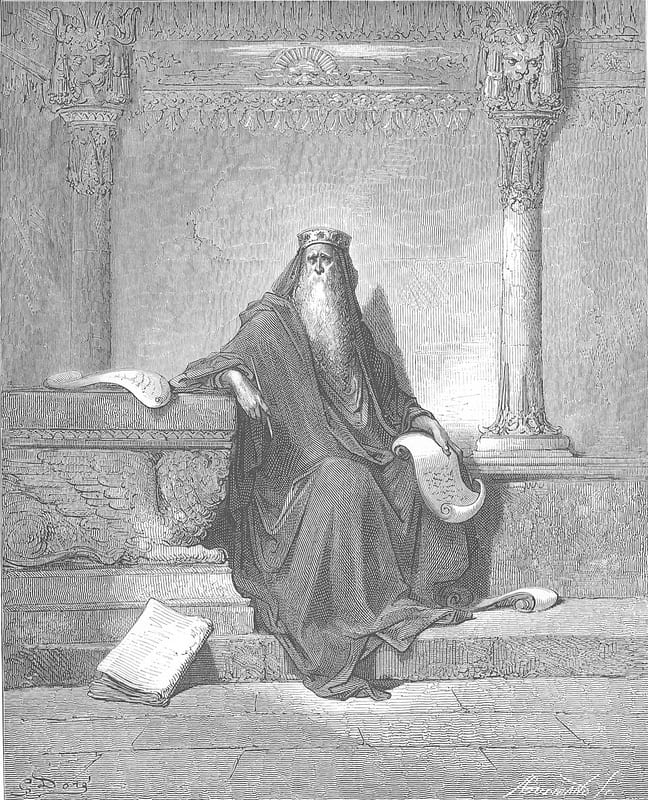
This chapter belongs to the book of wisdom that tradition gives to Solomon, and it speaks from inside a royal court. It was heard by subjects and officials who lived under a king whose word could not be appealed. The chapter gives a courtier's counsel on the king's command and then turns to injustice that goes unpunished. Listen for the conviction the Teacher holds about those who fear God, set beside the cases that seem to deny it. It ends by admitting how little of God's work any person can trace.
Context
- Who
- Subjects and officials living under absolute royal power
- What
- Counsel on living under royal authority, reflections on delayed justice, and an admission of the limits of human understanding.
- Where
- The royal court in Jerusalem, and the towns where the wicked were buried with honour.
- When
- Late in the reign of Solomon, about 940 BC, on the traditional reading; many date the book's Hebrew to the Persian period, so the date is held with less certainty than the setting.
- Why
- To hold together the fear of God and honest grief over injustice, and to commend joy in the work God gives.
Historical context
"I counsel thee to keep the king's commandment, and that in regard of the oath of God." Officials and subjects swore loyalty to the throne with an oath sworn in God's name. Breaking it was not merely disloyalty; it was perjury before God. That is why the chapter grounds obedience to a king in an oath rather than in the king's virtue.
Show the rest of the historical context, 3 more paragraphs
"Where the word of a king is, there is power: and who may say unto him, What doest thou?" There was no appeal above the throne and no constitution behind it. "Go not out of his sight; stand not in an evil thing" is advice for a courtier: do not storm out of the room, and do not join a conspiracy.
"There is no discharge in that war" uses conscription language. Armies were raised by levy, and while the Law listed a few exemptions, a new house, a new vineyard, a new wife, once you were in the field there was no leaving. The writer applies it to the day of death, from which no exemption exists at all.
"Because sentence against an evil work is not executed speedily, therefore the heart of the sons of men is fully set in them to do evil." Ancient justice was slow and personal, dependent on witnesses coming forward and elders convening. Delay was the standard experience of anyone waiting for a wrong to be righted.
Significance
The chapter names out loud the thing that most troubled devout hearers: there are just men who receive what the wicked deserve, and wicked men who receive what the just deserve. It does not explain it away.
Show the rest of the significance, 1 more paragraph
What it offers instead is a stubborn confidence, "it shall be well with them that fear God", held alongside an admission that a man cannot find out the work that is done under the sun, however hard he labours to seek it.
This chapter in Jewish lifeWhat this chapter is in Jewish life and reading.
What is done
This chapter is heard aloud once a year, when the whole book is read at Sukkot on the Sabbath that falls in the festival week. The site's own table in src/lib/hebraic/readings.ts records that reading and sources it to Tractate Soferim 14:3; it printed parashot total 0 and haftarah uses total 0 for this book.
The corpus ties no further custom to this chapter, and none is supplied here.
How it is read
Rashi is the one commentator on this chapter whose English the corpus carries, quoted here from The Metsudah Five Megillot, Lakewood, N.J., 2001, which Sefaria reports as CC-BY. Every quotation is held to fifty words or fewer because the translation is modern, and the edition's own notes are never quoted as his.
The wise man and the interpreter of the first verse are Daniel and Moses. Daniel was wise in the fear of Heaven and secret solutions were revealed to him. "Who is like Moshe, who brought about compromises between Yisroel and their Father in Heaven?" (Rashi on Ecclesiastes 8:1:2).
The king of the second verse Rashi reads as God. The command to keep is "the commandment of the King of the Universe, which is the best of them all" (Rashi on Ecclesiastes 8:2:1). The oath is the one "we swore to Him at Choreiv, to keep His commandments" (Rashi on Ecclesiastes 8:2:2). No one should think to flee from His presence "to a place where He does not reign, for He reigns everywhere" (Rashi on Ecclesiastes 8:3:1). The Metsudah edition notes beside the fourth verse that Metsudas Dovid reads these verses of a mortal king, so the two readings stand side by side in the edition.
Much of the chapter Rashi reads as the delay of judgment. The wise man knows there is a set time for the punishment of the wicked (Rashi on Ecclesiastes 8:5:1). When a man's evil overflows its measure, "then his punishment arrives" (Rashi on Ecclesiastes 8:6:2). The spirit no man can hold back is his own spirit against the angel of death (Rashi on Ecclesiastes 8:8:1). Because God "does not rush to mete out retribution upon the evildoers", they think there is no judgment and grow bold (Rashi on Ecclesiastes 8:11:1). The sinner does evil many times over, and God grants him an extension (Rashi on Ecclesiastes 8:12:1).
The joy of the fifteenth verse is the joy of the man content with his lot who keeps the upright commands, which "cause the heart to rejoice", and Rashi sets it against greed. The contented man should not be "immersed in increasing his wealth by means of usury, interest and robbery" (Rashi on Ecclesiastes 8:15:1). The one who is not content with his lot comes at last to robbery, fraud and usury, and the one not content with his wife comes to sinful thoughts (Rashi on Ecclesiastes 8:15:1). The sixteenth verse draws a note on grammar, that the word there marks a time and not a comparison (Rashi on Ecclesiastes 8:16:1).
The corpus carries two further notes on this chapter without an English text, each marked linked because Sefaria holds no English version of the ref. They stand cited and unquoted at Ibn Ezra on Ecclesiastes 8:4:1 and 8:5:1.
What the rabbis say
The corpus carries forty rabbinic locators on this chapter and the text of none, so each is cited and linked here rather than quoted. On the first verse, the wise man's face, it holds Bamidbar Rabbah 19:4, Berakhot 10a:26 and Bereshit Rabbati, Parashat Vayishlach 57. On the second, the king's command and the oath, it holds Aggadat Bereshit 7:1 with Bamidbar Rabbah 14:6 and 14:7. On the third it holds Kohelet Rabbah 8:3:1 and Midrash Lekach Tov on Ecclesiastes 8:3:1. On the fourth, the king's word, it holds Bereshit Rabbah 55:3, Ein Yaakov (Glick Edition), Shabbat 6:4 and Kohelet Rabbah 8:4:1. On the fifth it holds Ein Yaakov, Shabbat 6:13, Kohelet Rabbah 8:5:1 and Midrash Aggadah, Leviticus 9:1:1.
The time of judgment carries the next run. On the sixth verse the corpus holds Aggadat Bereshit 1:1 and 77:2 with Bereshit Rabbati, Parashat Bereshit 93. On the seventh it holds Midrash Lekach Tov on Ecclesiastes 8:7:1. On the eighth, the day of death, it holds Aggadat Bereshit 35:1 with Bamidbar Rabbah 15:15 and 9:9. On the ninth it holds Kohelet Rabbah 8:9:1 and Midrash Lekach Tov on Ecclesiastes 8:9:1. On the tenth, the wicked buried, it holds Avot DeRabbi Natan, Recension B 7:1, Ein Yaakov (Glick Edition), Gittin 5:8 and Ein Yaakov, Gittin 5:11.
The rest follow the chapter to its end. On the eleventh verse the corpus holds Kohelet Rabbah 8:11:1 and Midrash Lekach Tov on Ecclesiastes 8:11:1, and on the twelfth Midrash Lekach Tov on Ecclesiastes 8:12:1. On the thirteenth it holds Bamidbar Rabbah 15:17 and Ein Yaakov (Glick Edition), Kiddushin 1:24. On the fourteenth, the righteous treated as the wicked, it holds Bamidbar Rabbah 19:11 and Ein Yaakov (Glick Edition), Horayot 3:2. On the fifteenth, the praise of joy, it holds Ein Yaakov (Glick Edition), Shabbat 2:11 and Ein Yaakov, Shabbat 2:21. On the sixteenth and the seventeenth it holds Kohelet Rabbah 8:16:1 and 8:17:1 with Midrash Lekach Tov on Ecclesiastes 8:16:1 and 8:17:1. The corpus also files Yalkut Shimoni on Torah 946:13 under a nineteenth verse, a number this chapter does not reach, and it is cited here as the corpus prints it. What each of them teaches is a saying of the rabbis, and is reported as theirs wherever this site quotes one. The quotations wait on a fetch that carries the text.
Sources: Rashi, Rashi on Ecclesiastes 8:1:1 to 8:17:1, The Metsudah Five Megillot, Lakewood, N.J., 2001, reported CC-BY; Ibn Ezra, Ibn Ezra on Ecclesiastes 8:4:1 and 8:5:1, cited by ref because the corpus carries no English text; The Sefaria corpus, scripts/data/sources/sefaria/ecclesiastes/8.json, the 40 Talmud and Midrash locators of this chapter; The site's own files, src/lib/hebraic/readings.ts, probed for this book and printing parashot total 0, haftarah uses total 0, and the festival reading at Sukkot on the Sabbath that falls in the festival week, sourced there to Tractate Soferim 14:3.
The heads below are this chapter's scenes. The numbered points under each are its verses.
Who Is as the Wise Man? Keep the King's Command
Who is like the wise man?: The questions Who is like the wise man and Who knows the interpretation of a matter set the chapter's subject. A man’s wisdom brightens his face, and Gill and Henry both note the physical language for wisdom's inward light. The verse heads the chapter, whose wisdom is tested against kings.
Ecclesiastes 8:1
"Who is like the wise man? And who knows what things mean? A man's wisdom lights up his face, and the boldness of his face is transformed. "He had taught above that it is hard to find a good man, and he had answered the question to the contrary, saying that men are made good by God, but that they fall into sin because of their own free will.
Jerome · written before 420 · Commentary on Ecclesiastespatristic
2 more voices on this verseWhat preachers and commentators have said about this verse, in their own words.
Ecclesiastes 8:1
“Who is as the wise man?.... Who is as the first man, that was made upright, and was a wise man? not one of his sons. Or who is as the wise man, meaning himself? no man; he was the wisest of men; and yet he could not find out wisdom, and the reason of things, and the wickedness of folly, Ecc 7:25; how therefore should any other man? what can the man do that comes after the king?”
Ecclesiastes 8:1
“And who - Rather, and as he who knoweth. The possessor of wisdom excels other people: it imparts serenity to his countenance, and removes the expression of gloom or fierceness (see the marginal reference).”
Ecclesiastes 8:2-5
Keep the king’s command: assumes a king whose word is power, since the king’s word is supreme. Leaving his presence in haste and persisting in a bad cause are matters of court prudence. The counsel closes on timing, for a wise heart knows the right time and procedure.
Ecclesiastes 8:2
“To keep the king’s commandment - This sentence would be better translated, I keep the mouth of the king; I take good heed not to meddle with state secrets; and if I know, to hide them. Or, I am obedient to the commands of the laws; I feel myself bound by whatever the king has decreed. In regard of the oath of God - You have sworn obedience to him; keep your oath, for the engagement was made in the presence of God. It appears that the Jewish princes and chiefs took an oath of fidelity to their kings.”
Adam Clarke · Commentary on the Bible (1810-1826)evangelical
1 more voice on this verse
Ecclesiastes 8:2
“David made a covenant, or contract, with the elders of Israel, though he was king by divine designation, 1 Chron. xi. 3 . " Keep the king's commandments, for he has sworn to rule thee in the fear of God, and thou hast sworn, in that fear, to be faithful to him." It is called the oath of God because he is a witness to it and will avenge the violation of it.”
Matthew Henry · Commentary on the Whole Bible (1707-1721)puritan
Do not hasten to leave: Clarke reads the verse as counsel to the king's servants. A man who has done wrong gains nothing by pleading before a king who does whatever he pleases. Wesley takes leaving his presence as leaving the king's service in discontent, and Gill applies the verse to the King of kings.
Ecclesiastes 8:3
“Be not hasty - I consider the first five verses here as directions to courtiers, and the more immediate servants of kings. Be steadily faithful to your sovereign. Do not stand in an evil thing. If you have done wrong, do not endeavor to vindicate yourself before him; it is of no use; his power is absolute, and he will do what he pleases. He will take his own view of the subject, and he will retain it. The language of a despotic sovereign was ever this, Sic volo sic jubeo, stat pro ratione voluntas; “I will this.”
Adam Clarke · Commentary on the Bible (1810-1826)evangelical
1 more voice on this verse
Ecclesiastes 8:3
“Be not hasty to go out of his sight,.... But of the sight of the King of kings.”
who can say to him: Gill renders the supreme word as dominion, with lesser officials ready to carry out the king's will. Spurgeon notes that such power was a great blessing when the king was wise and good, and a yoke of iron when he was hard. Bonaventure reads the supreme word as God's.
Ecclesiastes 8:4
“Where the word of a king is, there is power,.... Or "dominion" (z). Authority goes along with his word of command; and there is an inferior magistracy, a subordinate power under him, ready to execute his will upon the rebellious and disobedient.”
1 more voice on this verse
Ecclesiastes 8:4
AT THE OPENING OF A NEW BAPTIST CHAPEL, TRINITY ROAD, UPPER TOOTING. "Where the word of a king is, there is power." Ecclesiastes 8:4. KINGS in Solomon's day had a vast amount of power, for their word was absolute. They did according to their own will and none could check them, for, as Solomon said, "the king's wrath is as the roaring of a lion: whoever provokes him to anger sins against his own soul."
Whoever keeps his command: Barnes renders the verb as know: the man who keeps the king's command knows no part in rebellion. A wise heart also knows that a wrong command will meet correction in God's time. Jerome ties the phrase to Christ, who knew no sin.
Ecclesiastes 8:5
“Feel - literally, know. The meaning is, “He who obeys the commandment (i. e., the word of the king, Ecc 8:4), will not be an accomplice in any act of rebellion; and if he be a wise man he discerns (literally knows) that the king’s commandment or action is liable to correction, if it be wrong, in God’s time and by God’s judgment.” Compare Ecc 3:11, Ecc 3:17.”
1 more voice on this verse
Ecclesiastes 8:5
“And you find in another passage, "For he that keeps the commandment does not know the wicked word" when it is altogether clear that knowledge of wickedness is not culpable, but association with it is.”
Ambrose of Milan · written before 397 · Interrogation of Job and David 2.7.27patristic
Ecclesiastes 8:6-7
For there is a right time and procedure: The line there is a right time and procedure to every purpose carries the theme of chapter 3 into the court. The discernment of verse 5 meets its limit. Verse 7 names the root of much human anxiety, action taken without certainty of outcome or hour.
Ecclesiastes 8:6
“Because to every purpose there is time and judgment,.... There is a fit season, and a right and proper manner of doing everything that is to be done; see Ecc 3:1; which a wise man discerns; and which when a man hits upon, it prevents a great deal of mischief, which for want of it comes upon men, as the following clause shows; some refer this to the punishment of the wicked, and to a future judgment.”
2 more voices on this verse
Ecclesiastes 8:6
“To every purpose there is time - חפץ chaphets, every volition, every thing that depends on the will of man. He has generally the opportunity to do whatever he purposes; and as his purposes are frequently evil, his acts are so too: and in consequence his misery is great.”
Adam Clarke · Commentary on the Bible (1810-1826)evangelical
Ecclesiastes 8:6
"For everything has its time and justice, for man's evil overwhelms him. Indeed he does not know what will happen, for when it happens , who will tell him? "Many good and bad things can befall a man, but even a righteous man is not able to know what will befall him, or know the causes and reasons for each thing, (for no one can know what will happen), but he does know that all things are done by God to the advantage of man, and nothing is done without His will.
Jerome · written before 420 · Commentary on Ecclesiastespatristic
no one knows what will happen: Henry observes that most human miseries could be avoided if they were foreseen, and death remains unavoidable for all. Jerome holds that the righteous also lack foreknowledge, yet know God orders all things for their good. Jamieson, Fausset and Brown apply it to the day of judgment.
As no man has power over the wind: to contain it, so no one has authority over his day of death. The Hebrew word behind wind, ruach, also means spirit. As no one can be discharged in wartime, so wickedness will not release those who practice it.
Ecclesiastes 8:8
“There is no man that hath power over the spirit to retain the spirit - The Chaldee has, “There is no man who can rule over the spirit of the breath, so as to prevent the animal life from leaving the body of man.” Others translate to this sense: “No man hath power over the wind to restrain the wind; and none has power over death to restrain him; and when a man engages as a soldier, he cannot be discharged from the war till it is ended; and by wickedness no man shall be delivered from any evil.””
Adam Clarke · Commentary on the Bible (1810-1826)evangelical
2 more voices on this verse
Ecclesiastes 8:8
"Man is powerless over the spirit-to restrain the spirit; nor is there authority over the day of death; nor discharge in war; and wickedness cannot save the wrong-doer. "Our mind does not have the power to prevent the spirit from being taken from us, and when the spirit leaves to the realm of God, it helps nothing to shut out mouth and hold in our fleeting life. And when we are dead, the enemy of our life will come and we are not able to take any rest.
Jerome · written before 420 · Commentary on Ecclesiastespatristic
Ecclesiastes 8:8
“But in that war (death) there is no exemption. those . . . given to--literally, the master of it. Wickedness can get money for the sinner, but cannot deliver him from the death, temporal and eternal, which is its penalty (Isa 28:15, 18).”
Jamieson, Fausset & Brown · Commentary Critical and Explanatory on the Whole Bible (1871)reformed
Ecclesiastes 8:9-10
All this I have seen: The Teacher turns to what he has watched: there is a time when one man lords it over another to his own detriment. He reports the burial of the wicked who used to go in and out of the holy place, and closes, This too is futile.
Ecclesiastes 8:9
“To his own hurt - Or, “to the hurt of the subject.” The case is still that of an unwise king whose command is obeyed Ecc 8:2 even to the hurt of the wise man who obeys him.”
1 more voice on this verse
Ecclesiastes 8:9
“It is sad with a people when those that should protect their religion and rights aim at the destruction of both. (2.) To the hurt of the rulers (so we render it), to their own hurt, to the feeling of their pride and covetousness, the gratifying of their passion and revenge, and so to the filling up of the measure of their sins and the hastening and aggravating of their ruin.”
Matthew Henry · Commentary on the Whole Bible (1707-1721)puritan
Sentence Not Executed Speedily: and God's Work Past Finding Out
the burial of the wicked: Henry and Wesley read the holy place as the seat of judgment, holy because judgment belongs to the LORD. Wicked rulers used it in splendor and were praised at their burial in the same city. Wesley finds the futility in glory so soon gone.
Ecclesiastes 8:10
“The holy - The throne or tribunal seems to be so called here, to aggravate their wickedness, who being advanced by God into so high and sacred a place, betrayed so great a trust. Where - They lived in great splendour, and were buried with great magnificence. This - That men should so earnestly thirst after glory, which is so soon extinct.”
John Wesley · Explanatory Notes upon the Old Testament (1765)evangelical
1 more voice on this verse
Ecclesiastes 8:10
“Who had come and gone from the place of the holy - The place of the holy is the sacred office which they held, anointed either as kings or priests to God; and, not having fulfilled the holy office in a holy way, have been carried to their graves without lamentation, and lie among the dead without remembrance.”
Adam Clarke · Commentary on the Bible (1810-1826)evangelical
When the sentence for a crime is not speedily executed: , the hearts of men become fully set on doing evil. Delay in judgment emboldens sin, slow justice breeding presumption rather than repentance. The verse is one side of a tension the chapter holds open, set against the assurance that follows.
Ecclesiastes 8:11
“Because sentence - פתגם pithgam, a Divine decree or declaration. This is no Hebrew, but a mere Chaldee word, and occurs only in the later books of the Bible - Esther, Ezra and Daniel, and nowhere else but in this place. Because God does not immediately punish every delinquency, men think he disregards evil acts; and therefore they are emboldened to sin on. So this longsuffering of God, which leadeth to repentance, is abused so as to lead to farther crimes! When men sin against the remedy of their salvation, how can they escape perdition?”
Adam Clarke · Commentary on the Bible (1810-1826)evangelical
1 more voice on this verse
Ecclesiastes 8:11
“Let them rest assured that punishment shall be inflicted on the wicked, and rewards shall be bestowed upon the righteous, by him who deals with everyone as each deserves, and who will proportion his rewards to the good that each has done, and to the account of himself that he is able to give. And let all know that the good shall be advanced to a higher state, and that the wicked shall be delivered over to sufferings and torments, in punishment of their licentiousness and depravity, their cowardice, timidity, and all their follies.”
Origen of Alexandria · written before 253 · Against Celsus 8:52patristic
Ecclesiastes 8:12-13
Although a sinner does evil a hundred times: The Teacher answers verse 11: Although a sinner does evil and still lives long, he knows it will go well with those who fear God. The wicked do not fear God, and their days will not lengthen like a shadow. The two verses hold both truths without resolving them.
Ecclesiastes 8:12
"Because a sinner does what is wrong an hundred times and He is patient with him, yet nevertheless I am aware that it will be well with those who fear God that they may fear Him. "Because a sinner has done many wicked deeds, this is what is meant by, 'an hundred times': God gives a time for repentance, and does not punish him immediately for his crime, but he waits so that he is converted by his wickedness. I understand how good-willing and forgiving God will be to those who fear Him and tremble at His word.
Jerome · written before 420 · Commentary on Ecclesiastespatristic
1 more voice on this verse
Ecclesiastes 8:12
“He says this, lest the sinner should abuse the statement (Ec 7:15), "A wicked man prolongeth his life." before him--literally, "at His presence"; reverently serve Him, realizing His continual presence.”
Jamieson, Fausset & Brown · Commentary Critical and Explanatory on the Whole Bible (1871)reformed
the wicked do not fear God: Clarke warns the long-spared sinner against reading slow sentence as God's forgetting. Jamieson, Fausset and Brown place the delay in man's short sight: it gives the sinner room to repent and the saints room for patience. The shadow image returns from 6:12.
Ecclesiastes 8:13
“But it shall not be well with the wicked - Let not the long-spared sinner presume that, because sentence is not speedily executed on his evil works, and he is suffered to go on to his hundredth transgression, God has forgotten to punish. No, he feareth not before Good; and therefore he shall not ultimately escape.”
Adam Clarke · Commentary on the Bible (1810-1826)evangelical
There is a futility that is done on the earth: There are righteous men who get what the actions of the wicked deserve, and wicked men who get what the righteous deserve. He calls this too futile and leaves the pattern standing under the sun. Henry and Clarke both note that Job and several Psalms carry the same problem.
Ecclesiastes 8:14
“Which is done upon the earth - The instance of vanity, to which these words are applied, is the seeming inequality of God’s justice; but if they are considered in connection with the profession of personal faith in God’s absolute justice Ecc 8:12, the conclusion is irresistible, that, whatever reason the Preacher had for reserve in declaring his belief, he certainly looked forward to final judgment in a future state of existence (compare Ecc 3:17; Ecc 12:14).”
1 more voice on this verse
Ecclesiastes 8:14
“He saw just men to whom it happened according to the work of the wicked, who, notwithstanding their righteousness, suffered very hard things, and continued long to do so, as if they were to be punished for some great wickedness.”
Matthew Henry · Commentary on the Whole Bible (1707-1721)puritan
So I commended the enjoyment of life: There is nothing better for a man under the sun than to eat and drink and be merry, the refrain of 2:24, 3:13 and 5:18. The joy is the portion God gives for labor. It answers the reversals of verse 14 by pointing to what is given him to enjoy.
Ecclesiastes 8:15
“Mirth - Better, Gladness, or “joy” (as in Ecc 2:10). The Hebrew word is applied not only to the pleasures arising from the physical senses, but also frequently to religious joy. The sentiment of this verse is a frequent conclusion of the writer’s personal experience (compare marginal references), and is unfairly charged with Epicureanism. The Preacher is careful to set forth pleasure as a gift from God, to be earned by labor, and received with thankfulness to the Giver, and to be accounted for to Him. His estimate of the pleasures of the senses is recorded in Ecc 7:2-6.”
1 more voice on this verse
Ecclesiastes 8:15
“This present life must be reckoned by days; this life is given us, and the days of it are allotted to us, by the counsel of God, and therefore while it does last we must accommodate ourselves to the will of God and study to answer the ends of life.”
Matthew Henry · Commentary on the Whole Bible (1707-1721)puritan
Ecclesiastes 8:16-17
When I applied my mind to know wisdom: The Teacher describes his most strenuous inquiry, to know wisdom and to observe the task that one performs on the earth. A man is unable to comprehend the work that is done under the sun. Even if the wise man claims to know, he is unable to comprehend.
Ecclesiastes 8:16
“When I applied mine heart to know wisdom - This is the reply of the wise man: “I have also considered these seeming contradictions. God governs the world; but we cannot see the reasons of his conduct, nor know why he does this, omits that, or permits a third thing. We may study night and day, and deprive ourselves of rest and sleep, but we shall never fathom the depths that are in the Divine government; but all is right and just.”
Adam Clarke · Commentary on the Bible (1810-1826)evangelical
1 more voice on this verse
Ecclesiastes 8:16
“To see - To observe mens various designs and employments, and their unwearied labours about worldly things. For there is - Having now mentioned the business which is done, or which man doth, upon earth, he further adds, as an evidence of man's eagerness in pursuing his business, for even by day and by night he (the busy man) seeth not sleep with his eyes.”
John Wesley · Explanatory Notes upon the Old Testament (1765)evangelical
every work of God: Clarke sets out three steps: the work is beyond finding, effort to search it out fails, and the wise man's claim to know fails too. Wesley counsels submission to God's providence and enjoyment of His blessing over endless inquiry. Henry calls God's judgments a great deep.
Ecclesiastes 8:17
“Then I beheld all the work of God, that a man cannot find out the work that is done under the sun - I saw it to be of such a nature - 1. That a man cannot find it out. 2. That if he labor to find it out, he shall not succeed. 3. That though he be wise - the most instructed among men, and think to find it out, he shall find he is not able. It is beyond the wisdom and power of man. How vain then are all your cavils about Providence.”
Adam Clarke · Commentary on the Bible (1810-1826)evangelical
2 more voices on this verse
Ecclesiastes 8:17
“Find out - No man, though ever so wise, is able fully and perfectly to understand these things. And therefore it is best for man not to perplex himself with endless enquiries, but quietly to submit to God's will and providence, and to live in the fear of God, and the comfortable enjoyment of his blessing.”
John Wesley · Explanatory Notes upon the Old Testament (1765)evangelical
Ecclesiastes 8:17
“Nay, [3.] Though he be very confident of success, though he think to know it, yet he shall not; he cannot find it out. God's ways are above ours, nor is he tied to his own former ways, but his judgments are a great deep.”
Matthew Henry · Commentary on the Whole Bible (1707-1721)puritan
Keep studying
Sources for this chapter
The summary
Jamieson, Fausset & Brown, Commentary Critical and Explanatory; John Wesley, Notes on the Old Testament and Matthew Henry, Complete Commentary.
The exposition
Adam Clarke, Commentary on the Bible; Albert Barnes, Notes, Explanatory and Practical, on the Old and New Testaments (1832-1869); Bonaventure, Commentary on Ecclesiastes, Chapter 8; Charles Bridges, An Exposition of the Book of Ecclesiastes; Charles Spurgeon, The Metropolitan Tabernacle Pulpit, Sermon No. 1697: “The Word of a King” (lightly modernized text, CCEL edition); Franz Delitzsch, Commentary on the Song of Songs and Ecclesiastes; Jamieson, Fausset & Brown, Commentary Critical and Explanatory on the Whole Bible; Jerome, Commentary on Ecclesiastes; John Gill; John Wesley, Explanatory Notes upon the Old Testament and Matthew Henry, Commentary on the Whole Bible.