
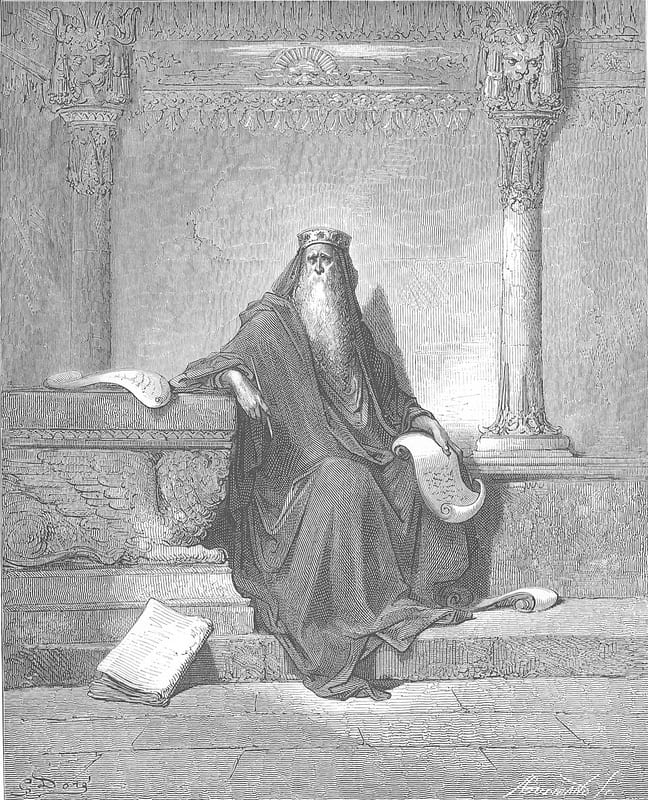
Ecclesiasteschapter 3
22 verses · Solomon, by tradition · 10th century BC · Wisdom and poetry
To everything there is a season, and a time for every purpose under heaven:
Introduction
Solomon, by tradition, Wisdom and poetry, Ecclesiastes Overview.
This chapter comes from the same book of wisdom that tradition gives to Solomon, and it moves from the king's own experiment to the pattern of every human life. It was heard by farming people whose year ran on a fixed calendar of sowing, harvest and mourning. The chapter holds up that calendar and asks who set it. Listen for the pairs of opposites and for the moment the Teacher names what God has placed in the human heart. Listen also for the courtroom he visits and what he finds there. It ends with an honest question about what follows death.
Context
- Who
- People whose lives ran on a fixed calendar of seasons and rites
- What
- A poem of appointed times, followed by reflections on God's work, human limits, injustice and death.
- Where
- The farms and villages of Israel, and the court held at the city gate.
- When
- Late in the reign of Solomon, about 940 BC, on the traditional reading; many date the book's Hebrew to the Persian period, so the date is held with less certainty than the setting.
- Why
- To teach that God has set the times of life and that a person receives each day as a gift while knowing he cannot see the whole.
Historical context
The poem of times is built out of the actual rhythm of that world. "A time to plant, and a time to pluck up that which is planted" follows the agricultural year exactly: sowing after the early rains, harvest in spring and early summer, and the uprooting of a failed or finished crop.
Show the rest of the historical context, 3 more paragraphs
"A time to cast away stones, and a time to gather stones together" has two likely referents, both concrete. Clearing stones off a terrace to make it workable and gathering them to build the retaining wall is one. The other is warfare: an invading army ruined a field by covering it with stones, which is exactly what Israel is recorded doing to Moab.
"A time to rend, and a time to sew; a time to keep silence, and a time to speak" describes mourning customs. A bereaved person tore his outer garment at the news, sat in silence, visitors were expected to say nothing until the mourner spoke first, and the tear was later stitched up when the mourning period ended.
"I saw under the sun the place of judgment, that wickedness was there." The place of judgment is the bench at the city gate. The complaint is not abstract: the writer is saying he went to the courthouse and found the corruption sitting in the judge's seat.
Significance
"He hath made every thing beautiful in his time: also he hath set the world in their heart, so that no man can find out the work that God maketh." The word rendered "world" carries the sense of the long stretch of time, eternity. Hearers bound to a seasonal calendar were being told they had been given a sense of something far larger than the calendar, and no way to see the whole of it.
Show the rest of the significance, 1 more paragraph
The chapter's honest ending was startling in a culture full of confident afterlife machinery next door in Egypt: who knows whether the spirit of man goes upward? The writer does not pretend to more certainty than he has, and lands on doing your work and eating your bread as a gift from God.
This chapter in Jewish lifeWhat this chapter is in Jewish life and reading.
What is done
The list of seasons is heard aloud once a year, when the whole book is read at Sukkot. The site's own table in src/lib/hebraic/readings.ts records that reading on the Sabbath that falls in the festival week and sources it to Tractate Soferim 14:3. The same table printed parashot total 0 and haftarah uses total 0 for this book, so no weekly portion and no Haftarah comes from it.
Rashi ties two lines of the list to the Jewish calendar. The time to weep is "On the ninth of [Menachem] Av" (Rashi on Ecclesiastes 3:4:1). The time to cast away stones is the scattering of Israel's youths in the destruction of the Temple, which he reads through Lamentations 4:1 (Rashi on Ecclesiastes 3:5:1).
How it is read
Rashi is the one commentator on this chapter whose English the corpus carries, quoted here from The Metsudah Five Megillot, Lakewood, N.J., 2001, which Sefaria reports as CC-BY. Every quotation is held to fifty words or fewer because the translation is modern, and the edition's own notes are never quoted as his.
Rashi opens the list with a warning to the proud. The one who gathers goods out of vanity should not rejoice, for they will pass to the righteous, "only the time has not yet arrived" (Rashi on Ecclesiastes 3:1:1). He notes that the word for matter here is the word the Mishnah uses for every thing (Rashi on Ecclesiastes 3:1:2).
He then reads the seasons as the history of Israel. The time to be born is "At nine months", and the time to die is the limit of each generation's years (Rashi on Ecclesiastes 3:2:1 and 3:2:2). The time to kill is the day a whole nation is visited, read through Isaiah 14:30 (Rashi on Ecclesiastes 3:3:1). The time to seek is the gathering of Israel's scattered, read through Ezekiel 34:16 (Rashi on Ecclesiastes 3:6:1). The time to tear is the tearing of the kingship of the house of David, read through 1 Kings 14:8 (Rashi on Ecclesiastes 3:7:1). The time to love he reads through Deuteronomy 7:13 (Rashi on Ecclesiastes 3:8:1).
The eleventh verse he reads of reward and punishment, each in its hour. "In its proper time, it is beautiful that reward be given for good deeds" (Rashi on Ecclesiastes 3:11:1). What God does in creation is fit to last and cannot be changed by adding or taking away, and where it was changed, it was changed so that men would fear Him. His examples are the sea that flooded a third of the world in the days of Enosh and the sun that went back ten degrees for Hezekiah (Rashi on Ecclesiastes 3:14:1). At the fifteenth verse he states the rule history shows him, "that the Holy One, Blessed Is He, seeks the pursued". He names Jacob against Esau and Israel against Egypt (Rashi on Ecclesiastes 3:15:1).
The place of justice where wickedness sat he names as a room. It is the Chamber of Hewn Stone in Jerusalem, which he says he saw with the Holy Spirit, where judges took bribes (Rashi on Ecclesiastes 3:16:1). Judgment is delayed and never cancelled, "for there is a time for everything, even for retribution" (Rashi on Ecclesiastes 3:17:1).
The spirit of man and the spirit of the beast he reads as knowledge rather than doubt. "Who knows" is the phrase of Joel 2:14, used of the one who understands. That one knows that the spirit of man goes up and stands in judgment, while the spirit of the beast goes down and gives no reckoning. "[Therefore,] one must not behave like a beast which does not [have to] care about its deeds" (Rashi on Ecclesiastes 3:21:1).
The corpus carries one further note on this chapter without an English text, marked linked because Sefaria holds no English version of the ref. It stands cited and unquoted at Ibn Ezra on Ecclesiastes 3:20:1.
What the rabbis say
The corpus carries forty rabbinic locators on this chapter and the text of none, so each is cited and linked here rather than quoted. On the first verse, a season for everything, it holds Bereshit Rabbah 34:6 and 46:2. On the second, the time to be born, it holds Bereshit Rabbati, Parashat Bereshit 1 and 2. On the third it holds Kiddushin 72b:2 and Kohelet Rabbah 3:3:1. On the fifth, the stones cast away, it holds Devarim Rabbah 3:13 and Kohelet Rabbah 3:5:1. On the seventh it holds Ein Yaakov, Zevakhim 14:2 and Kohelet Rabbah 3:7:1. On the eighth, the time to love, it holds Kohelet Rabbah 3:8:1 and 3:8:2.
The Midrash on this book runs through the middle of the list. Kohelet Rabbah and Midrash Lekach Tov on Ecclesiastes stand together under the fourth, sixth, ninth, tenth, twelfth, sixteenth and seventeenth verses, at 3:4:1, 3:6:1, 3:9:1, 3:10:1, 3:12:1, 3:16:1 and 3:17:1. Kohelet Rabbah stands alone at 3:19:1 and 3:22:1.
The rest reach into the Torah and the Talmud. On the eleventh verse, everything beautiful in its time, the corpus holds Berakhot 43b:5 and Bereshit Rabbah 9:2. On the thirteenth it holds Bereshit Rabbah 65:12 and Midrash Lekach Tov on Ecclesiastes 3:13:1. On the fourteenth, what God does lasts for ever, it holds Bamidbar Rabbah 14:6 and Berakhot 55a:15. On the fifteenth it holds Bereshit Rabbati, Parashat Vayetze 73 and Kohelet Rabbah 3:15:1. On the eighteenth it holds Bereshit Rabbah 28:9, on the twentieth Avot DeRabbi Natan 37:9, and on the twenty-first Bereshit Rabbah 14:9. The corpus also files Kiddushin 80b:11 under a thirty-ninth verse, a number this chapter does not reach, and it is cited here as the corpus prints it. What each of them teaches is a saying of the rabbis, and is reported as theirs wherever this site quotes one. The quotations wait on a fetch that carries the text.
Sources: Rashi, Rashi on Ecclesiastes 3:1:1 to 3:22:1, The Metsudah Five Megillot, Lakewood, N.J., 2001, reported CC-BY; Ibn Ezra, Ibn Ezra on Ecclesiastes 3:20:1, cited by ref because the corpus carries no English text; The Sefaria corpus, scripts/data/sources/sefaria/ecclesiastes/3.json, the 40 Talmud and Midrash locators of this chapter; The site's own files, src/lib/hebraic/readings.ts, probed for this book and printing parashot total 0, haftarah uses total 0, and the festival reading at Sukkot on the Sabbath that falls in the festival week, sourced there to Tractate Soferim 14:3.
The heads below are this chapter's scenes. The numbered points under each are its verses.
To Everything There Is a Season
Ecclesiastes 3:1-8
To everything there is a season: The poem lays out fourteen paired times in verses 2 to 8, from a time to be born to a time for war. Each pair names its appointed hour, and together they cover the circle of human life. The poem waits for verse 11 to say what the times mean.
Ecclesiastes 3:1
“Everything - More particularly, the actions of people (e. g. his own, Ecc 2:1-8) and events which happen to people, the world of Providence rather than the world of creation. It would seem that most of his own works described in Ecc 2:1-8 were present to his mind. The rare word translated “season” means emphatically “fitting time” (compare Neh 2:6; Est 9:27, Est 9:31).”
1 more voice on this verseWhat preachers and commentators have said about this verse, in their own words.
Ecclesiastes 3:1
“Man has his appointed cycle of seasons and vicissitudes, as the sun, wind, and water (Ec 1:5-7). purpose--as there is a fixed "season" in God's "purposes" (for example, He has fixed the "time" when man is "to be born," and "to die," Ec 3:2), so there is a lawful "time" for man to carry out his "purposes" and inclinations.”
Jamieson, Fausset & Brown · Commentary Critical and Explanatory on the Whole Bible (1871)reformed
a time to be born: Gregory of Nyssa sees the list begin by binding the time to be born to the time to die. Jamieson, Fausset and Brown add that a man can no more change the time to plant than the time of his birth and death. Athanasius says each man's time is hidden.
Ecclesiastes 3:2
“This is written in the Scriptures and is manifest to all. For although it be hidden and unknown to all, what period of time is allotted to each, and how it is allotted; yet every one knows this, that as there is a time for spring and for summer, and for autumn and for winter, so, as it is written, there is a time to die, and a time to live.”
Athanasius of Alexandria · written before 373 · Defense of His Flight 14patristic
a time to kill: Gill reads a time to kill as violent death, beside the natural time to die, and cites the Targum: a time to kill in war. Jamieson, Fausset and Brown call it murder to kill outside the time God orders. To Jerome, God kills and heals, as in Deuteronomy 32:39.
Ecclesiastes 3:3
"A time for killing and a time for healing." It is both the time for killing and the time for healing, he says: "I will kill, and I will revive" [Deut. 32, 39.]. He cures, provoking one to repentance. 'I killed' has the same meaning as "in the morning I murdered all the sinners of the Earth." [Ps. 100.8.] "A time for destroying and a time for building. "We are not able to build anything good unless we have first destroyed what is bad.
Jerome · written before 420 · Commentary on Ecclesiastespatristic
1 more voice on this verse
Ecclesiastes 3:3
“A time to kill, and a time to heal,.... A time to kill may be meant of a violent death, as a time to die is of a natural one; so the Targum, "a time to kill in war;'' or else, by the hand of the civil magistrate, such who deserve death.”
a time to weep: Gregory of Nyssa says the time to weep is now and the time to laugh is in hope. To mourn, he says, is deep grief, and to dance is strong joy, as when David danced before the ark. Dionysius of Alexandria places the time to laugh at the resurrection.
Ecclesiastes 3:4
"A time for weeping and a time for laughter." Now is the time for weeping and in the future it will be the time for laughter: for "the blessed weep, since they themselves will laugh." [Luc. 6, 21.] "A time for bewailing and a time for dancing. "For this reason they are seized in the Gospel, those to whom God says " I have lamented for you and you have not moaned; I sang and you did not dance." [Luc.
Jerome · written before 420 · Commentary on Ecclesiastespatristic
a time to cast away stones: The stones have drawn several readings. Bonaventure takes them as stones scattered in peace and gathered in war, and Gregory of Nyssa reports a reading tied to stoning under the law. Augustine and Gregory the Dialogist place the present age in the time of gathering.
Ecclesiastes 3:5
“A time to embrace a friend when we find him faithful, but a time to refrain from embracing when we find he is unfair or unfaithful, and that we have cause to suspect him; it is then our prudence to be shy and keep at a distance. It is commonly applied to conjugal embraces, and explained by 1 Cor. vii.”
Matthew Henry · Commentary on the Whole Bible (1707-1721)puritan
2 more voices on this verse
Ecclesiastes 3:5
"A time for dispersing stones and a time for collecting stones." I marvel how an learned man could have said this ridiculous note about this passage: "this passage speaks about the destruction and killing of Solomon's houses, because men first destroy, then build". Some amass stones to construct buildings, others destroy those buildings which have been erected, according to Horace's lines "he demolished, he builds, exchanges squares with wheels, he fluctuates and disagrees with the whole order of life itself." [Horat. Epist. I. I.
Jerome · written before 420 · Commentary on Ecclesiastespatristic
Ecclesiastes 3:5
“Stones may be regarded either as materials for building, or as impediments to the fertility of land (see 2Ki 3:19, 2Ki 3:25; Isa 5:2).”
a time to search: Barnes renders it: seek, and give up for lost. Jamieson, Fausset and Brown counsel contentment when God wills a loss, and read the time to discard as giving in charity. Gregory of Nyssa gives the search for God every season of life.
Ecclesiastes 3:6
“A time to get, - to lose, - to keep, - to cast away - - “Commerce produces wealth, Whilst time of gaining lasts; from every point Blow prosperous gales. Now heaven begins to lower, And all our hopes are blasted. Prudence bids, One while, our treasure to reserve, and then With liberal hand to scatter wide. How oft In raging storms, the owner wisely casts Into the deep his precious merchandise, To save the foundering bark!”
Adam Clarke · Commentary on the Bible (1810-1826)evangelical
2 more voices on this verse
Ecclesiastes 3:6
“Do you wish to learn the opportune time for seeking the Lord? Let me briefly state that your entire life is the only time to carry this out. Seeking the Lord is not defined by limit or time; rather, the truly opportune time for this consists in never putting an end to our search.”
Gregory of Nyssa · written before 395 · Homilies on Ecclesiastes 7patristic
Ecclesiastes 3:6
"A time to acquire and a time to lose. A time to keep and a time to throw away. "As is in many verses before the meaning is the same here too, which is apparent before and following this verse, in that he says: "A time to destroy and a time to build. " And then "A time to rend and a time to mend.
Jerome · written before 420 · Commentary on Ecclesiastespatristic
a time to be silent: Ambrose warns that a man will give account for an idle silence as well as an idle word, and he praises the silence of Susanna. Gregory of Nyssa is silent about the being of God and speaks of His works. Jerome traces Pythagorean silence to this line.
Ecclesiastes 3:7
"A time for silence and a time for speaking." I think that the Pythagoreans, whose discipline is to remain silent for five years and afterwards to speak to learned men, took the origin of their decree from this. Let us learn therefore and so remain silent first, so that afterwards we open our mouths only to speak. Let us be silent for a set period and depend on the utterances of our teacher. Nothing seems right to us unless we learn that after much silence we are made into teachers by our pupils.
Jerome · written before 420 · Commentary on Ecclesiastespatristic
a time to love: Gregory of Nyssa takes the time to love as love of God with the heart, and to hate as hatred of the author of evil. Jamieson, Fausset and Brown read the hate through Luke 14:26. Bonaventure would hate a thing once it turns to wickedness.
Ecclesiastes 3:8
"A time for loving and a time for hating." The time for loving God, children, wife, and relatives is afterwards, and the time for hating those in martyrdom since hostile piety attacks those steadfast men for the sake of the confession of Christ. Or maybe there is a time for loving the law, and those things that the law decrees- that is circumcision, sacrifices, the Sabbath, Neumania [The Jewish feast of the New Moon.], and a time for hating them when the grace of the Gospel has been lost.
Jerome · written before 420 · Commentary on Ecclesiastespatristic
He Hath Set Eternity in Their Heart
Ecclesiastes 3:9-10
What does the worker gain from his toil?: The question of 1:3 returns, What does the worker gain from his toil, asked against the ordered times. Verse 10 names the toil the burden that God has laid upon the sons of men, echoing 1:13. The labor is a burden to creatures living inside times they did not set.
Ecclesiastes 3:9
“But these earthly pursuits, while lawful in their season, are "unprofitable" when made by man, what God never intended them to be, the chief good. Solomon had tried to create an artificial forced joy, at times when he ought rather to have been serious; the result, therefore, of his labor to be happy, out of God's order, was disappointment.”
Jamieson, Fausset & Brown · Commentary Critical and Explanatory on the Whole Bible (1871)reformed
the burden that God has laid: Bonaventure reads God has laid as permission: God allows the burden to be given, as in Romans 1. To Clarke, man suffers because he is a sinner. Gill applies the verse to the labor of getting wisdom and wealth, which men sometimes gain and seldom keep for long.
He has made everything beautiful in its time: The verse carries two claims, He has made everything beautiful in its time and He has also set eternity in the hearts of men. The Hebrew olam can mean the world or age, a mind ranging past its moment, or eternity, which Delitzsch and Gill both take here.
Ecclesiastes 3:11
“Rather, He hath made all (the travail, Ecc 3:10) beautiful (fit, in harmony with the whole work of God) in its time; also He hath set eternity in their heart (i. e., the heart of the sons of men, Ecc 3:10). The word, translated “world” in the text, and “eternity” in this note, is used seven times in Ecclesiastes. The interpretation “eternity,” is conceived in the sense of a long indefinite period of time, in accordance with the use of the word throughout this book, and the rest of the Old Testament.”
3 more voices on this verse
Ecclesiastes 3:11
“He hath set - It is true, God hath put the world into mens hearts, or made them capable of observing all the dispensations of God in the world; but this is to be understood with a limitation, because there are some more mysterious works of God, which no man can fully, understand, because he cannot search them out from the beginning to the end.”
John Wesley · Explanatory Notes upon the Old Testament (1765)evangelical
Ecclesiastes 3:11
“We see but the middle of God's works, not from the beginning of them (then we should see how admirably the plan was laid in the divine counsels), nor to the end of them, which crowns the action (then we should see the product to be glorious), but we must wait till the veil be rent, and not arraign God's proceedings nor pretend to pass judgment on them.”
Matthew Henry · Commentary on the Whole Bible (1707-1721)puritan
Ecclesiastes 3:11
“This incapacity for "finding out" (comprehending) God's work is chiefly the fruit of the fall. The worldling ever since, not knowing God's time and order, labors in vain, because out of time and place.”
Jamieson, Fausset & Brown · Commentary Critical and Explanatory on the Whole Bible (1871)reformed
Ecclesiastes 3:12-13
I know that there is nothing better for them: The Teacher draws his working conclusion from the poem: there is nothing better for them than to rejoice and do good while they live. Verse 13 restates the refrain first heard at 2:24, every man should eat and drink and find satisfaction, and names it the gift of God.
Ecclesiastes 3:12
“What have we our beings, capacities, and estates for, but to be some way serviceable to our generation? We mistake if we think we were born for ourselves. No; it is our business to do good; it is in doing good that there is the truest pleasure, and what is so laid out is best laid up and will turn to the best account.”
Matthew Henry · Commentary on the Whole Bible (1707-1721)puritan
Jamieson, Fausset and Brown observe that the good things are enjoyed in their time when received as gifts of God and used for His glory. Didymus the Blind sets the limit. A man whose god is his stomach finds ungodliness at the table.
Ecclesiastes 3:13
Whoever eats in a way that he takes his stomach to be God does not find anything good in eating and drinking, but rather ungodliness: "Such people do not serve our Lord Christ but their own stomach."
Didymus the Blind · written before 398 · Commentary on Ecclesiastes 86:2patristic
I know that everything God does endures forever: Everything God does endures forever; nothing can be added to it or taken from it. The stated purpose is reverence: God does it so that they should fear Him. The verse is one link in the fear of God the book returns to at 5:7, 7:18, 8:12 and 12:13.
Ecclesiastes 3:14
“Man's part, therefore, is to do and enjoy every earthly thing in its proper season (Ec 3:12, 13), not setting aside God's order, but observing deep reverence towards God; for the mysteriousness and unchangeableness of God's purposes are designed to lead "man to fear before Him." Man knows not the event of each act: otherwise he would think himself independent of God.”
Jamieson, Fausset & Brown · Commentary Critical and Explanatory on the Whole Bible (1871)reformed
2 more voices on this verse
Ecclesiastes 3:14
“He is in one mind, and who can turn him? His measures are never broken, nor is he ever put upon new counsels, but what he has purposed shall be effected, and all the world cannot defeat nor disannul it. It behoves us therefore to say, "Let it be as God wills," for, how cross soever it may be to our designs and interests, God's will is his wisdom.”
Matthew Henry · Commentary on the Whole Bible (1707-1721)puritan
Ecclesiastes 3:14
“I know that whatsoever God doeth, it shall be for ever - לעולם leolam, for eternity; in reference to that grand consummation of men and things intimated in Ecc 3:11. God has produced no being that he intends ultimately to destroy. He made every thing in reference to eternity; and, however matter may be changed and refined, animal and intellectual beings shall not be deprived of their existence. The brute creation shall be restored, and all human spirits shall live for ever; the pure in a state of supreme and endless blessedness, the impure in a state of indestructible misery.”
Adam Clarke · Commentary on the Bible (1810-1826)evangelical
Ecclesiastes 3:15-17
What exists has already been: , and what will be has already been, and God will call to account what has passed. The Teacher then names a grief seen under the sun: in the place of judgment there is wickedness. Verse 17 answers, God will judge the righteous and the wicked.
Ecclesiastes 3:15
“That which hath seen is now; and that which is to be hath already been,.... That which has been from the beginning now is; that which cometh, and what shall be in the end of days, has been already, as the Targum. Jarchi interprets this of God and his attributes, which are always the same; he is the "I am that I am", Exo 3:14; the immutable and eternal Jehovah, which is, and was, and is to come, invariably the same.”
1 more voice on this verse
Ecclesiastes 3:15
“Rather, What has been - what was before, and what shall be has been before. The word “is” in our the King James Version is erroneously printed in Roman letters: it does not exist in the Hebrew (it should have been italicized); and the word there translated “now” is the same which is translated as “already.” Requireth - i. e., requireth for judgment, as the word specially means in 2Sa 4:11; Eze 3:18...It is obvious from the context of the last clause of Ecc 3:14, and Ecc 3:16-17, that this is the meaning here.”
Man and Beast Go Unto One Place
in the place of judgment: Gill names the place of judgment as the courts where judges sit, and the Midrash and Jarchi apply it to the Sanhedrin. Jamieson, Fausset and Brown ask with Jeremiah 12:1 why the wicked do wickedness in the very place of judgment. Henry sees men wronged in the courts of justice.
Ecclesiastes 3:16
“And moreover I saw under the sun the place of judgment,.... Courts of judicature, where judges sit, and, causes are brought before them, and are heard and tried; such as were the Jewish sanhedrim, of which the Midrash and Jarchi interpret it; that wickedness was there, wicked judges sat there, and wickedness was committed by them; instead of doing justice they perverted it; condemned the righteous, and acquitted the wicked; and oppressed the widow, fatherless, and stranger, whose cause, being just, they should have defended.”
1 more voice on this verse
Ecclesiastes 3:16
“Here a difficulty is suggested. If God "requires" events to move in their perpetual cycle, why are the wicked allowed to deal unrighteously in the place where injustice ought least of all to be; namely, "the place of judgment" (Jer 12:1)?”
Jamieson, Fausset & Brown · Commentary Critical and Explanatory on the Whole Bible (1871)reformed
Jerome's rendering closes with the word there, and Wesley reads it as the judgment seat of God. Jamieson, Fausset and Brown set the sinner's short time against the time God keeps for judgment. Henry says God will plead the cause of the righteous.
Ecclesiastes 3:17
The Divine Wisdom has pointed out in Ecclesiastes that for everything, i.e., for all things happy or those which are considered unfortunate and unhappy, there is a right time: saying: "For all things there is a time, and a time for everything under the heaven." … and below: "For there is a time," it says, "for everything and for every deed."
John Cassian · written before 435 · CONFERENCE 21:12patristic
1 more voice on this verse
Ecclesiastes 3:17
“There is a coming judgment in which God will vindicate His righteous ways. The sinner's "time" of his unrighteous "work" is short. God also has His "time" and "work" of judgment; and, meanwhile, is overruling, for good at last, what seems now dark.”
Jamieson, Fausset & Brown · Commentary Critical and Explanatory on the Whole Bible (1871)reformed
Ecclesiastes 3:18-19
The Teacher states God tests them so that they may see for themselves that they are but beasts. The ground is what death shows from ground level: As one dies, so dies the other, for they all have the same breath. Verse 21 goes on to ask about the spirit.
Ecclesiastes 3:18
“That they might see that they themselves are beasts - The author of Choheleth has given a correct view of this difficult verse, by a proper translation: “I said in my heart, reflecting on the state of the sons of men, O that God would enlighten them, and make them see that even they themselves are like beasts.” These words are to be referred to those in authority who abused their power; particularly to the corrupt magistrates mentioned above.”
Adam Clarke · Commentary on the Bible (1810-1826)evangelical
1 more voice on this verse
Ecclesiastes 3:18
“The oppressed share in death, but the comparison to "beasts" applies especially to the ungodly oppressors (Ps 49:12, 20). They too need to be "manifested" ("proved"), whether, considering that they must soon die as the "beasts," and fearing the judgment to come, they will repent (Da 4:27).”
Jamieson, Fausset & Brown · Commentary Critical and Explanatory on the Whole Bible (1871)reformed
no advantage over the animals: Jamieson, Fausset and Brown render the opening, men are a mere chance, and hear the wicked, whose unbelief God's delay in judgment brings to light. Didymus the Blind answers with a definition. Man dies like the animals and reasons like the angels.
Ecclesiastes 3:19
“That which befals the sons of men is no other than that which befals beasts; a great deal of knowledge of human bodies is gained by the anatomy of the bodies of brutes. When the deluge swept away the old world the beasts perished with mankind. Horses and men are killed in battle with the same weapons of war.”
Matthew Henry · Commentary on the Whole Bible (1707-1721)puritan
Ecclesiastes 3:20-22
All go to one place: ; all come from dust, and all return to dust states what the eye sees at any grave. The Teacher then asks Who knows if the spirit of man rises upward and the spirit of the animal descends into the earth.
Ecclesiastes 3:20
“All go unto one place,.... The earth (w) from whence they came; all are of the dust, and all turn to dust again; Adam's body was made of the dust of the earth, and so all his posterity, all of them; in which they agree with beasts, who are made of the dust also; and, when they die, return to it; see Gen 2:7. (w) "Magna parens terra est", Ovid. Metamorph. l. 1. Fab. 7.”
1 more voice on this verse
Ecclesiastes 3:20
“The resurrection as a fact is not to be rejected because of an exceptional situation. Yet, since all things earthly return and crumble into the earth, I wonder how there can be any doubt even concerning the instances noted. For the most part, the sea itself also casts up on neighboring shores whatever human bodies it has swallowed. And if this were not so, it surely would not be difficult for God to join what has been scattered and to unite again what has been dispersed.”
Ambrose of Milan · written before 397 · On the Death of Satyrus 2.58patristic
Who knows if the spirit: Jamieson, Fausset and Brown read the question as how few perceive the difference between man and beast, and point to 12:7 where the spirit goes. Henry holds that the spirit of man ascends to the Father of spirits. Wesley adds that good men know it.
Ecclesiastes 3:21
"Who perceives that the spirit of man is the one that ascends on high while the spirit of the beast is the one that descends down into the earth?" But this seems to be blasphemy: for who knows if the spirit of the sons of man ascends upwards, or if the spirit of beasts goes downwards into the earth? He does not contend that there is no difference between animals and men in reference to the dignity of the soul, but in adding "who?" he wants to show the difficulty of the matter.
Jerome · written before 420 · Commentary on Ecclesiastespatristic
2 more voices on this verse
Ecclesiastes 3:21
“Who knoweth--Not doubt of the destination of man's spirit (Ec 12:7); but "how few, by reason of the outward mortality to which man is as liable as the beast and which is the ground of the skeptic's argument, comprehend the wide difference between man and the beast" (Isa 53:1).”
Jamieson, Fausset & Brown · Commentary Critical and Explanatory on the Whole Bible (1871)reformed
Ecclesiastes 3:21
“It is certain that the spirit of the sons of men at death is ascending; it goes upwards to the Father of spirits, who made it, to the world of spirits to which it is allied; it dies not with the body, but is redeemed from the power of the grave, Ps. xlix.”
Matthew Henry · Commentary on the Whole Bible (1707-1721)puritan
because that is his lot: Jamieson, Fausset and Brown read lot as his portion in the present life, which becomes futile if a man makes it his chief portion. Wesley reads the last question: once dead, a man never returns to see who holds his estate. Jamieson, Fausset and Brown call the future God's time.
Ecclesiastes 3:22
"I therefore observed that there is nothing better for man than to be happy in what he is doing, for that is his lot. For who can enable him to see what will be after him? " Instead of that which we have as "to see what will be after him", Symmachus interprets it more clearly saying, "so that he sees those things which will be after these ones". Therefore nothing is good in life, unless a man is happy in his work, doing acts of sympathy, and obtaining his future reward in the realm of heaven.
Jerome · written before 420 · Commentary on Ecclesiastespatristic
How this psalm is built
The form: A poem of fourteen paired opposites, followed by reflections on God's work and human limits, as Jerome classes it.
The patterns in this chapter
| Device | What it does | Where to see it |
|---|---|---|
| The fourteen pairs | Verses 2 to 8 hold fourteen pairs of opposite times, two pairs to a verse across seven verses, running from birth and death to war and peace. Jerome reads the list as showing that all things under heaven stand opposed to one another and none of them lasts. Jamieson, Fausset and Brown compare the cycle with the sun, the wind and the rivers of the first chapter.Jerome, Commentary on Ecclesiastes, on Ecclesiastes 3:1. | Ecclesiastes 3:2, Ecclesiastes 3:8 |
How this chapter is built
1 more paragraph on the patterns
The chapter opens with a poem of fourteen paired times in verses 2 to 8, two pairs to each verse, and every pair sets one act against its opposite. Jerome reads the pairs as the changing state of everything under heaven. Adam Clarke reads them as God's providence, which has fixed each act to its own season. The prose that follows turns from the list to the One who set it, and then to the courtroom and the grave.
Keep studying
Studies5
Words12
Subjects1
Sources for this chapter
The summary
Jamieson, Fausset & Brown, Commentary Critical and Explanatory; John Wesley, Notes on the Old Testament and Matthew Henry, Complete Commentary.
The form and classifications
Adam Clarke, Commentary on the Bible, 1832, on Ecclesiastes 3:1 and Jerome, Commentary on Ecclesiastes, on Ecclesiastes 3:1.
The exposition
Adam Clarke, Commentary on the Bible; Albert Barnes, Notes, Explanatory and Practical, on the Old and New Testaments (1832-1869); Ambrose of Milan, On the Duties of the Clergy 1.3.9; Athanasius of Alexandria, DEFENSE OF HIS FLIGHT 14; Augustine of Hippo, ON THE GOOD OF WIDOWHOOD 11; Bonaventure, Commentary on Ecclesiastes, Chapter 3; Charles Bridges, An Exposition of the Book of Ecclesiastes; Didymus the Blind; Dionysius of Alexandria, A Commentary on the Beginning of Ecclesiastes - Chapter III; Franz Delitzsch, Commentary on the Song of Songs and Ecclesiastes; Gregory of Nyssa; Gregory the Dialogist, Dialogues, Book 3, Chapter 37; Jamieson, Fausset & Brown, Commentary Critical and Explanatory on the Whole Bible; Jerome, Commentary on Ecclesiastes; John Gill; John Wesley, Explanatory Notes upon the Old Testament and Matthew Henry, Commentary on the Whole Bible.