
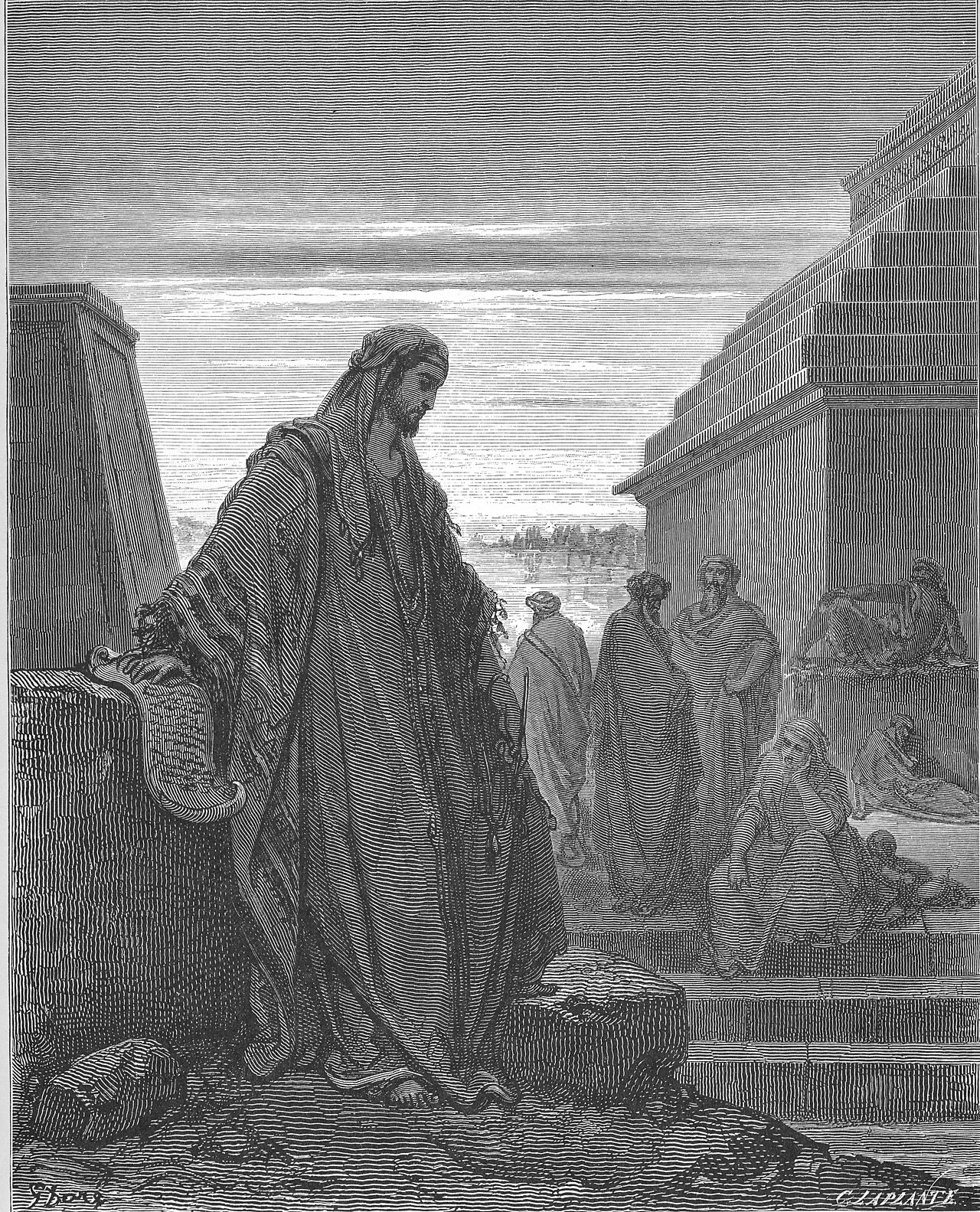
Danielchapter 10
21 verses · Daniel, by tradition · 6th century BC · The Prophets
However, the prince of the kingdom of Persia opposed me for twenty-one days. Then Michael, one of the chief princes, came to help me, for I had been left there with the kings of Persia.
Introduction
Daniel, by tradition, The Prophets, Daniel Overview.
This chapter opens the last and longest vision of the book, which runs to its final verse. It is set in the third year of Cyrus, when the first exiles had gone home and their work on the temple had stalled. It was kept for a people whose return had begun in hope and then slowed almost to a stop. Daniel is now an old man, and he is mourning. Listen for why the answer to his prayer took three weeks to arrive, and for what that says about struggles no one on earth can see.
Context
- Who
- An old man in his eighties whose people had gone home and hit a wall
- What
- The narrative that opens the final vision, in which a heavenly messenger comes to Daniel after three weeks of mourning and explains his delay.
- Where
- The bank of the Tigris River, called the great river.
- When
- The third year of Cyrus king of Persia, about 536 BC.
- Why
- To show that the struggles of God's people on earth are tied to a conflict in the unseen world, and that God hears prayer from the first day.
Historical context
By this year the first caravan of returnees had been back in Judah for a couple of seasons. They had rebuilt the altar and laid the temple foundation, and then the work stopped, jammed by local opposition and official complaints. It would stay stopped for about sixteen years.
Show the rest of the historical context, 3 more paragraphs
Daniel is roughly eighty-five and did not go with them. He mourns for three full weeks, taking no rich food, no meat, no wine, and no oil for his skin. In that climate, going without oil was a visible mark of grief that anyone would notice.
The vision he receives pulls the curtain back on why prayers can seem to go unanswered. A messenger tells him his words were heard on the first day, and that he was delayed twenty-one days by "the prince of the kingdom of Persia" until Michael came to help. The empire had a power behind it that could resist a messenger from God.
That is the chapter's contribution to the whole Bible: a look at conflict in the unseen realm running parallel to politics. Daniel's fast and the delay lasted exactly the same three weeks.
Significance
For readers whose national comeback had stalled at the foundation stage, this said the delay was not silence. The answer left heaven the first day; the holdup was a fight, not a refusal.
Show the rest of the significance, 1 more paragraph
It also told them their small struggle in Judah was tied to something much bigger. What looked like a permit dispute with provincial officials had princes and archangels involved. Prayer, in this chapter, is not a wish. It is participation.
This chapter in Jewish lifeWhat this chapter is in Jewish life and reading.
What is done
The vision by the Tigris has no reading in the synagogue. Probed for this lane, the site's own table in src/lib/hebraic/readings.ts printed parashot total 0 and haftarah uses total 0 for Daniel, and no festival reading. The site's book dossier records that Daniel stands among the Writings in the Hebrew Bible rather than among the Prophets, so no weekly portion is drawn from it and no Haftarah either.
Daniel's three weeks of mourning are met in the Talmud. The corpus carries Jerusalem Talmud Taanit 3:1:2 under the eleventh verse and Berakhot 4b:25 under the thirteenth. The man clothed in linen is met at Chullin 91b:10 under the sixth verse and the trembling of the seer at Bekhorot 45a:21 under the sixteenth.
How it is read
Rashi is the one commentator on this chapter with English in the corpus, quoted from The Judaica Press complete Tanach with Rashi, translated by A. J. Rosenberg, which Sefaria reports as CC-BY at fifty words or fewer.
Rashi gives Daniel's mourning a cause in the history of the return. He mourned when he saw that Cyrus had halted the building of the Temple after the letter of the adversaries recorded in Ezra (Rashi on Daniel 10:2:1). He reads the three weeks as twenty-one years, running from the first year of Darius the Mede to the building of the Temple, and he says plainly where his count falls short: "As for the three extra years, I do not know whether he started to fast before them or whether the duration of the acceptance of the vow of his fasts terminated three years after the building" (Rashi on Daniel 10:2:2).
The men with Daniel who fled without seeing the vision are named from the Sages: "Our Sages of blessed memory said that they were Haggai, Zechariah, and Malachi" (Rashi on Daniel 10:7:1). The size of the man in linen he takes from Chullin 91b (Rashi on Daniel 10:6:1), and the angel's coming from Yoma 77a (Rashi on Daniel 10:12:1). The prince of Persia who stood against the angel for twenty-one days was pleading in heaven for more time for Persia's rule over Israel (Rashi on Daniel 10:13:1).
Rashi reads the angel's last words as a contrast between two empires. Under Persia, "they exacted a light tribute from them, and they did not burden them heavily because the Holy One, blessed be He, caused them to have mercy on them." Under the Greeks the yoke grew heavy (Rashi on Daniel 10:20:1).
The corpus carries five further notes on this chapter without an English text, each marked linked because Sefaria holds no English version of the ref. They stand cited and unquoted: Rashi on Daniel 10:3:2, Ibn Ezra on Daniel 10:4:1 and Metzudat David on Daniel 10:15:1, Daniel 10:18:1 and Daniel 10:19:1.
What the rabbis say
The corpus carries forty rabbinic locators on this chapter. Seven of them stand in the Talmud and its minor tractates and the rest in the Midrash. The corpus carries the text of none, so each is cited by ref here and never quoted.
On the first verse it holds Bereshit Rabbati, Parashat Miketz 31, Jerusalem Talmud Rosh Hashanah 1:1:2, Jerusalem Talmud Sanhedrin 1:1:11 and Midrash Lekach Tov on Esther, Introduction 3. On the second verse it holds Mishnat Rabbi Eliezer 6:19. On the third verse it holds Devarim Rabbah 2:17, Midrash Lekach Tov, Genesis 27:15:1, Midrash Sekhel Tov, Bereshit 27:15:2 and Midrash Shmuel 19:1. On the fourth verse it holds Bereshit Rabbah 16:3, Mekhilta DeRabbi Shimon Ben Yochai 12:1, Mekhilta DeRabbi Yishmael, Tractate Pischa 1:13 and Midrash Tanchuma, Bo 10:1. On the fifth verse it holds Bereshit Rabbah 21:5, Jerusalem Talmud Yoma 4:4:5 and Yalkut Shimoni on Torah 34:7. On the sixth verse it holds Bamidbar Rabbah 12:8, Bereshit Rabbah 68:12 and Chullin 91b:10.
On the seventh verse it holds Ein Yaakov (Glick Edition), Megillah 1:3, Ein Yaakov (Glick Edition), Sanhedrin 11:23 and Ein Yaakov, Megillah 1:3. On the eleventh verse it holds Jerusalem Talmud Taanit 3:1:2, Kohelet Rabbah 9:7:1 and Midrash Sekhel Tov, Shemot 15:15:4. On the twelfth verse it holds Ein Yaakov (Glick Edition), Megillah 1:23, Ein Yaakov (Glick Edition), Taanit 1:34 and Ein Yaakov, Taanit 1:33. On the thirteenth verse it holds Berakhot 4b:25, Ein Yaakov (Glick Edition), Berakhot 1:13 and Ein Yaakov, Berakhot 1:19. On the fourteenth verse it holds Midrash Tehillim 31:4. On the sixteenth verse it holds Bekhorot 45a:21.
On the twentieth verse it holds Midrash Lekach Tov, Genesis 9:19:4, Midrash Tannaim on Deuteronomy 23:6:1 and Midrash Tannaim on Deuteronomy 32:12:2. On the twenty-first verse it holds Bereshit Rabbah 81:2, Ein Yaakov (Glick Edition), Yevamot 12:1 and Ein Yaakov, Yevamot 12:5. Under the anchor the corpus prints as Daniel 10:23 it holds Midrash Lekach Tov, Exodus 14:3:6.
What each locator teaches is a saying of the rabbis, and it is reported as theirs wherever this site quotes one. The quotations wait on a fetch that carries the text.
Sources: Rashi, Rashi on Daniel 10:1:1 to Daniel 10:21:1, The Judaica Press complete Tanach with Rashi, translated by A. J. Rosenberg, reported CC-BY; Rashi, Rashi on Daniel 10:3:2, cited by ref because the corpus carries no English text; Ibn Ezra, Ibn Ezra on Daniel 10:4:1, cited by ref because the corpus carries no English text; Metzudat David, Metzudat David on Daniel 10:15:1, Daniel 10:18:1 and Daniel 10:19:1, cited by ref because the corpus carries no English text; The Sefaria corpus, scripts/data/sources/sefaria/daniel/10.json, the 40 Talmud and Midrash locators of this chapter; The site's own files, src/lib/hebraic/readings.ts, probed for this book and printing daniel parashot total 0 and haftarah uses total 0, and src/components/book/dossier-content/daniel.ts on the place of Daniel among the Writings.
The heads below are this chapter's scenes. The numbered points under each are its verses.
Three weeks of mourning, then a man clothed in linen
Daniel 10:1-3
In the third year of Cyrus king of Persia: The last vision is dated to the third year of Cyrus, and its message is called true and concerned “a great conflict”. Daniel mourns “for three full weeks,” taking no rich food, meat, wine or oil, while Ezra 4 records opposition to the rebuilding.
Daniel 10:1
“In the third year of Cyrus, king of Persia - In regard to Cyrus, see the notes at Isa 41:2. In Dan 1:21, it is said that “Daniel continued even unto the first year of king Cyrus.” But it is not necessarily implied in that passage that he “died” then. It may mean only that he continued in authority, and was employed, in various ways, as a public officer, until that time. See the note at that passage.”
mourning for three full weeks: Theodoret traced Daniel's mourning to the people who stayed in Babylon, though Cyrus king of Persia had let them return. Ephrem and Jamieson, Fausset and Brown take the mourning as fasting, as in the Lord's reply in Matthew 9. Barnes dates it two years after the decree.
Daniel 10:2
“Compare Mt 9:14, "fast," answering to "mourn" (Da 10:15). 1Ti 4:3, which prove that "fasting" is not an indispensable Christian obligation; but merely an outward expression of sorrow, and separation from ordinary worldly enjoyments, in order to give one's self to prayer (Ac 13:2).”
Jamieson, Fausset & Brown · Commentary Critical and Explanatory on the Whole Bible (1871)reformed
I ate no rich food: The Hebrew for rich food is bread of desires, which Barnes takes as ordinary food Daniel set aside. Barnes thinks chapter 1 shows Daniel commonly drank no wine. Tertullian held that Daniel fasted to humble himself before God, and Ammonius tied such fasting to being given visions.
Daniel 10:3
“I ate no pleasant bread - Margin, “bread of desires.” So the Hebrew. The meaning is, that he abstained from ordinary food, and partook of that only which was coarse and disagreeable. Neither came flesh nor wine in my mouth - That is, he lived on bread or vegetables. It is not to be inferred from this that Daniel ordinarily made use of wine, for it would seem from Dan. 1: that that was not his custom. What would appear from this passage would be, that he practiced on this occasion the most rigid abstinence.”
1 more voice on this verse
Daniel 10:3
“This abstinence Daniel used in order to please God by humiliation, and not for the purpose of producing a sensibility and wisdom for his soul previous to receiving communication by dreams and visions, as if it were not rather to effect such action in an ecstatic state. This "sobriety" … will have nothing to do with exciting ecstasy but will rather serve to recommend its being wrought by God.”
Tertullian · written before 220 · On the Soul 48patristic
Daniel 10:4-6
the great river, the Tigris: By the Tigris, Daniel sees “a certain man dressed in linen,” his face “like the brilliance of lightning” and eyes “like flaming torches”. Calvin and Keil identify him as Gabriel from chapters 8 and 9. Revelation 1:14-15 gives the risen Christ the same fiery eyes and bronze feet.
Daniel 10:4
“By the side of - Hiddekel - The same as the Tigris. the great river of Assyria; as the Euphrates of Syria, and the Nile of Egypt.”
Adam Clarke · Commentary on the Bible (1810-1826)evangelical
2 more voices on this verse
Daniel 10:4
“His dress was priestly, for he is the high priest of our profession, clothed in linen, as the high priest himself was on the day of atonement, that great day; his loins were girded (in St. John's vision his paps were girded) with a golden girdle of the finest gold, that of Uphaz, for every thing about Christ is the best in its kind.”
Matthew Henry · Commentary on the Whole Bible (1707-1721)puritan
Daniel 10:4
“I was by . . . the . . . river--in waking reality, not a trance (Da 10:7); when younger, he saw the future in images, but now when old, he receives revelations from angels in common language, that is, in the apocalyptic mode. In the patriarchal period God often appeared visibly, that is, theophany.”
Jamieson, Fausset & Brown · Commentary Critical and Explanatory on the Whole Bible (1871)reformed
a certain man dressed in linen: Jerome records how the old versions gave the Hebrew word for linen: Aquila as linen, the Septuagint as fine byssus, and Symmachus as choice garments. Adam Clarke takes Uphaz as another name for Ophir, a land of fine gold. Hippolytus saw here the Lord in the likeness of a man.
Daniel 10:5
“Then I lifted up mine eyes, and looked ... - While he was engaged in devotion. What is here said would lead us to suppose that he had been occupied in deep thought and meditation, perhaps with his eyes fixed on the ground. Behold, a certain man clothed in linen - One who had the form and appearance of a man. The subsequent disclosures showed that he was an angel, but when angels have appeared on earth they have commonly assumed the human form.”
His body was like beryl: The Hebrew word behind beryl is tarshish, which Jamieson, Fausset and Brown explain as a gem from Tarshish. Jerome gave chrysolite, a stone of the high priest’s breastplate, and in the Septuagint it became the sea. Theodoret heard fine gold from Tarshish.
Daniel 10:6
“His body also was like the beryl,.... That is, that part of it which was not covered with the linen garment, and was seen, was like such a precious stone, said to be of an azure and sky colour, signifying he was the Lord from heaven; though, according to its name, it should be of a sea colour, greenish; and so, according to some, the beryl is.”
1 more voice on this verse
Daniel 10:6
“His body also was like the beryl - There is a very striking resemblance between the description here given and that of the Saviour as he appeared to John in Patmos, Rev 1:13-16. See the notes at that passage. It contains, however, no description of the appearance of the body. “Beryl” is “a mineral of great hardness, occurring in green and bluish-green six-sided prisms. It is identical with the emerald, except that the latter has a purer and richer color. “ - Dana, in Webster’s Dictionary.”
Daniel 10:7-9
Only I, Daniel, saw the vision: Daniel alone sees the vision, while the men with him see nothing, yet “a great terror fell upon them, and they ran and hid themselves”. Left alone, Daniel loses his strength, his face grows “deathly pale,” and he falls into “a deep sleep” with his face to the ground.
So I was left alone: Daniel stays, “gazing at this great vision,” while the men who saw nothing have run and hidden. Then he writes, “No strength remained in me; my face grew deathly pale, and I was powerless”. The strength he lacks is given by the messenger's touch in verses 10, 16 and 18.
Daniel 10:8
"And I," he says, "was the only one left and I fell on my face upon the earth, and behold, with the hand of a man he touched me." [Daniel 10:8] He says, "the hand of a man," not yet a man, but indicating the coming of the economy through grace.
Hippolytus of Rome · written before 235 · Commentary on Daniel 4.38.4patristic
1 more voice on this verse
Daniel 10:8
“Note, the greatest and best of men cannot bear the immediate discoveries of the divine glory; no man can see it and live; it is next to death to see a glimpse of it, as Daniel here; but glorified saints see Christ as he is and can bear the sight. But, though Daniel was thus dispirited with the vision of Christ, yet he heard the voice of his words and knew what he said.”
Matthew Henry · Commentary on the Whole Bible (1707-1721)puritan
I fell into a deep sleep: Adam Clarke reads the deep sleep as a swoon. Albert Barnes links the sound of his words to the voice like a multitude, and thinks the companions heard that sound and fled in alarm. Matthew Henry notes that Daniel, though overcome, still heard and knew what was said.
Daniel 10:9
“Was I in a deep sleep - I fell into a swoon.”
Adam Clarke · Commentary on the Bible (1810-1826)evangelical
1 more voice on this verse
Daniel 10:9
“Yet heard I the voice of his words - What the angel said when he appeared to him Daniel has not recorded. He says Dan 10:6 that the voice of his words was “like the voice of a multitude.” It is probable that those who were with him had heard that voice, and hearing it, and being struck with the remarkable character of the vision, they had suddenly fled in alarm. Daniel heard more distinctly what he said, though it does not yet appear that he had heard anything more than the sound of his voice.”
The prince of Persia withstood me twenty-one days
a hand touched me: The Hebrew verb, Albert Barnes explains, means to move to and fro, so Daniel is raised only partly and trembling. Matthew Henry saw strength returning to the downcast by degrees. Jerome held the angel touched him in human form, so that a shape like his own would calm his terror.
Daniel 10:10-14
The delay is explained: “the prince of the kingdom of Persia opposed me for twenty-one days” until Michael came to help. Keil and Barnes name these princes as the text does; Michael Heiser reads them as a heavenly host set over the nations.
Daniel 10:10
“A hand touched me - Nothing was apparent or palpable but a hand. A hand had written Belshazzar’s fate upon the wall; and the hand is frequently mentioned when the power or majesty of God is intended. Perhaps by hand God himself may be meant.”
Adam Clarke · Commentary on the Bible (1810-1826)evangelical
a man who is highly precious: Barnes gives the Hebrew for highly precious as man of desires, and Symmachus gave desirable man. Jerome thought the words fit a man who sought God with prayer and fasting, and Augustine saw in the desires a longing to understand. Knowing he was precious did Daniel no harm, Spurgeon held.
Daniel 10:11
“IT did not do Daniel any harm to know that he was greatly beloved of God, or else he would not have received that information from Heaven. Some people are always afraid that if Christian people obtain full assurance and receive a sweet sense of Divine love, they will grow proud, and be carried away with conceit. Do not have any such fear for other people and especially do not be afraid of it for yourselves!”
Charles Spurgeon · written before 1892 · The Metropolitan Tabernacle Pulpit, Sermon No. 2256: “Daniel's Band” (lightly modernized text, CCEL edition)Particular Baptist
your words were heard: For Ephrem, the first day was when Daniel began to fast. Jamieson, Fausset and Brown drew the lesson that words of prayer are heard at once before God, though the response may come later. Adam Clarke reads the man as sent in response to Daniel’s prayers.
Daniel 10:12
“As unusual as it sounds, the angel sent to answer Daniel’s prayers had been delayed for 21 days by the demonic resistance in the spiritual realm.”
1 more voice on this verse
Daniel 10:12
“In Daniel 10 we see Daniel's prayers fueling a heavenly battle in which Gabriel is sent with a prophetic message but is delayed until Michael, the archangel, comes and fights this Persian principality.”
Jane Hamon · Resisting the Prince Of Persia (2026)Charismatic
the kingdom of Persia opposed me: Readers divide over this prince. Jerome took him as the angel given charge of Persia under Deuteronomy 32:8, and John Cassian as a hostile power befriending Persia against God's people. Adam Clarke held he was Cyrus himself, and John Wesley saw the counsels of Cambyses.
Daniel 10:13
“Withstood me - God suffered the wicked counsels of Cambyses to take place awhile; but Daniel by his prayers, and the angel by his power, overcame him at last: and this very thing laid a foundation of the ruin of the Persian monarchies. Michael - Michael here is commonly supposed to mean Christ.”
John Wesley · Explanatory Notes upon the Old Testament (1765)evangelical
in the latter days: Readers weigh how far the latter days reach. Jerome took those days as the end of the world, while Matthew Henry placed the chief events under Antiochus. Jamieson, Fausset and Brown hold both, with Antiochus a type of what will happen to your people at the end.
Daniel 10:14
“Daniel must be made to know what shall befal his people in the latter days of the church, after the cessation of prophecy, and when the time drew nigh for the Messiah to appear, for yet the vision is for many days; the principal things that this vision was intended to give the church the foresight of would come to pass in the days of Antiochus, nearly 300 years after this.”
Matthew Henry · Commentary on the Whole Bible (1707-1721)puritan
Strengthened to hear the scripture of truth
Daniel 10:15-17
and became speechless: Daniel sets his face toward the ground and becomes speechless, and “one with the likeness of a man” touches his lips before he can speak. He says, “I am overcome with anguish, and I have no strength,” and asks how a servant can speak with such a lord.
Daniel 10:15
“I set my face toward the ground - He was standing upright, Dan 10:11, and he now bent his body in reverence, and looked down upon the ground. And became dumb - Found himself unable to speak.”
Adam Clarke · Commentary on the Bible (1810-1826)evangelical
1 more voice on this verse
Daniel 10:15
“And when he had spoken such words ... - Daniel was naturally overcome by the communication which had been made to him. The manner in which the prayer was answered seems to have been entirely different from what he had expected. The presence of a heavenly being; the majesty of his appearance; the assurance that he gave that he had come to answer his prayer; and the fact that he had important revelations to make respecting the future, overcame him, and he laid his face upon the ground in silence.”
the likeness of a man: Albert Barnes and Adam Clarke read Gabriel. Hippolytus read a growing disclosure of the Word, first a man's hand and now a whole human likeness. John Chrysostom turned Daniel's collapse against the Anomoeans, who pried into the essence of the Lord of angels, since a fellow servant's presence undid him.
Daniel 10:16
“Like the similitude of the sons of men - I think Gabriel is here meant, who appeared to Daniel in a human form; and so in Dan 10:18, and see also Dan 9:21. Touched my lips - Before this he was unable to speak. By the vision - The vision that I have already had, and of which I have not a proper knowledge has greatly afflicted me, because I see it intimates grievous calamities to my people. See Dan 9:26.”
Adam Clarke · Commentary on the Bible (1810-1826)evangelical
How can I, your servant: Jamieson, Fausset and Brown, following Maurer, set the weak servant against the great lord as the cause of Daniel's anguish. Theodoret warned against reading lord as a sign of God, since this man later swears by the living God. Adam Clarke says Daniel had no breath left.
Daniel 10:18-19
the likeness of a man: Again “the one with the likeness of a man” touches and strengthens Daniel, and he is called “highly precious” a third time. The charge “Be strong now; be very strong” follows the greeting of peace. The strengthening comes twice, first by the hand and then by the voice.
Daniel 10:18
"And he came close," he says, "and he touched me as an appearance of a man and he strengthened me and he said to me, 'Do not fear cherished man. Peace to you, be strong like a man.'" [Daniel 10:18-19] For when all the strength and glory of our life is ended, then we are empowered by the outstretched hand of Christ, who also raises us as the living from the dead and as from Hades to the resurrection of life.
Hippolytus of Rome · written before 235 · Commentary on Daniel 4.39.7patristic
Jamieson, Fausset and Brown read the words Peace be with you as God's favor toward Daniel and his people, and compare Judges 13:21 and 22. Jerome held that without this Daniel could not have heard. Matthew Henry likens the man to a mother quieting a child.
Daniel 10:19
"And when he spoke with me I was strengthened and I said, 'Let my Lord speak because you have strengthened me.'" [Daniel 10:19] For when the Word makes us hope in the coming things, we are also easily able to hear his voice.
Hippolytus of Rome · written before 235 · Commentary on Daniel 4.40.1-2patristic
3 more voices on this verse
Daniel 10:19
“O man, greatly beloved - איש חמדות ish chamudoth, man of delights; the most amiable of men. Let my lord speak - I am now so strengthened and encouraged, that I shall be able to bear any revelation that thou mayest make.”
Adam Clarke · Commentary on the Bible (1810-1826)evangelical
Daniel 10:19
“I ANTICIPATE an objection to my preaching from this text and using it in reference to any persons in this congregation. "The words were spoken to Daniel and we are not Daniels"—that is probably the shape which the objection will take in certain minds. And my reply is, If we are not Daniels, at least we should desire to be and we should remember that there are possibilities of our being such. In many parts of Daniel's character we can, by Divine Grace, tread in his steps.”
Daniel 10:19
“And said, O man greatly beloved - See the notes at Dan 9:23. Fear not - Neither at my presence, nor at what I have to say. There was nothing in the visitation of an angel that could be a ground of dread to a good man; there was nothing in what he had to communicate that could be a reasonable cause of alarm. Be strong, yea, be strong - These are words of encouragement such as we address to those who are timid and fearful.”
Daniel 10:20-21
fight against the prince of Persia: The messenger will return to fight the prince of Persia. Then “the prince of Greece will come,” the order of empires the goat and its horns showed in chapter 8. No one stands with him against these “except Michael your prince,” the helper who ended the delay in verse 13.
Daniel 10:20
“Knowest thou wherefore I come - So high art thou in the favor of God, that he hath sent me unto thee to give thee farther satisfaction; though I was elsewhere employed upon a most important mission, and I must speedily return to accomplish it, viz.: - To fight with the king of Persia - To remove all the scruples of Cyrus, and to excite him to do all that God designs him to do for the restoration of my people, and the rebuilding of the city and temple of Jerusalem.”
Adam Clarke · Commentary on the Bible (1810-1826)evangelical
1 more voice on this verse
Daniel 10:20
“The Grecian monarchy, though favourable to the Jews at first, as the Persian was, will yet come to be vexatious to them. Such is the state of the church-militant; when it has got clear of one enemy it has another to encounter: and such a hydra's head is that of the old serpent; when one storm has blown over it is not long before another rises.”
Matthew Henry · Commentary on the Whole Bible (1707-1721)puritan
the Book of Truth: Albert Barnes takes the Book of Truth as God's recorded decrees, while Adam Clarke thought it might be Daniel's earlier visions. Readers divide over Michael your prince. Clarke and Hippolytus name him the angel guarding Israel, and Matthew Henry takes the prince of the church to be Christ.
Daniel 10:21
“But I will show thee what is noted in, the scripture of truth - The word noted here means “written, or recorded.” The scripture of truth means the true writing, and the reference is doubtless to the Divine purposes or decrees in this matter - for (a) there is no other writing where these things were then found; (b) the angel came to make known what could be known in no other way, and therefore what was not yet found in any book to which man had access; (c) this language accords with common representations in the Scriptures respecting future…”
1 more voice on this verse
Daniel 10:21
“Christ is the church's prince; angels are not, Heb. ii. He presides in the affairs of the church and effectually provides for its good. He is said to hold with the angels, for it is he that makes them serviceable to the heirs of salvation; and, if he were not on the church's side, its case were bad.”
Matthew Henry · Commentary on the Whole Bible (1707-1721)puritan
Keep studying
Studies10
People and groups1
Sources for this chapter
The summary
Jamieson, Fausset & Brown, Commentary Critical and Explanatory; John Calvin, Commentaries; John Wesley, Notes on the Old Testament and Matthew Henry, Complete Commentary.
The exposition
Adam Clarke, Commentary on the Bible; Albert Barnes; Ammonius of Alexandria; Augustine of Hippo, SERMON 391:5; Carl Friedrich Keil, Biblical Commentary on the Book of Daniel; Charles Spurgeon, The Metropolitan Tabernacle Pulpit, Sermon No. 2256: “Daniel's Band” (lightly modernized text, CCEL edition); Ephrem the Syrian; Hippolytus of Rome; Jamieson, Fausset & Brown, Commentary Critical and Explanatory on the Whole Bible; Jerome; John Calvin, Commentary on the Prophet Daniel; John Cassian, CONFERENCE 8:13; John Chrysostom, AGAINST THE ANOMOEANS 3:23; John Gill, Exposition of the Old Testament; John Wesley, Explanatory Notes upon the Old Testament; Matthew Henry, Commentary on the Whole Bible; Michael Heiser, The Unseen Realm; Origen of Alexandria, ON FIRST PRINCIPLES 3:3.2; Tertullian, ON THE SOUL 48 and Theodoret of Cyrus.