
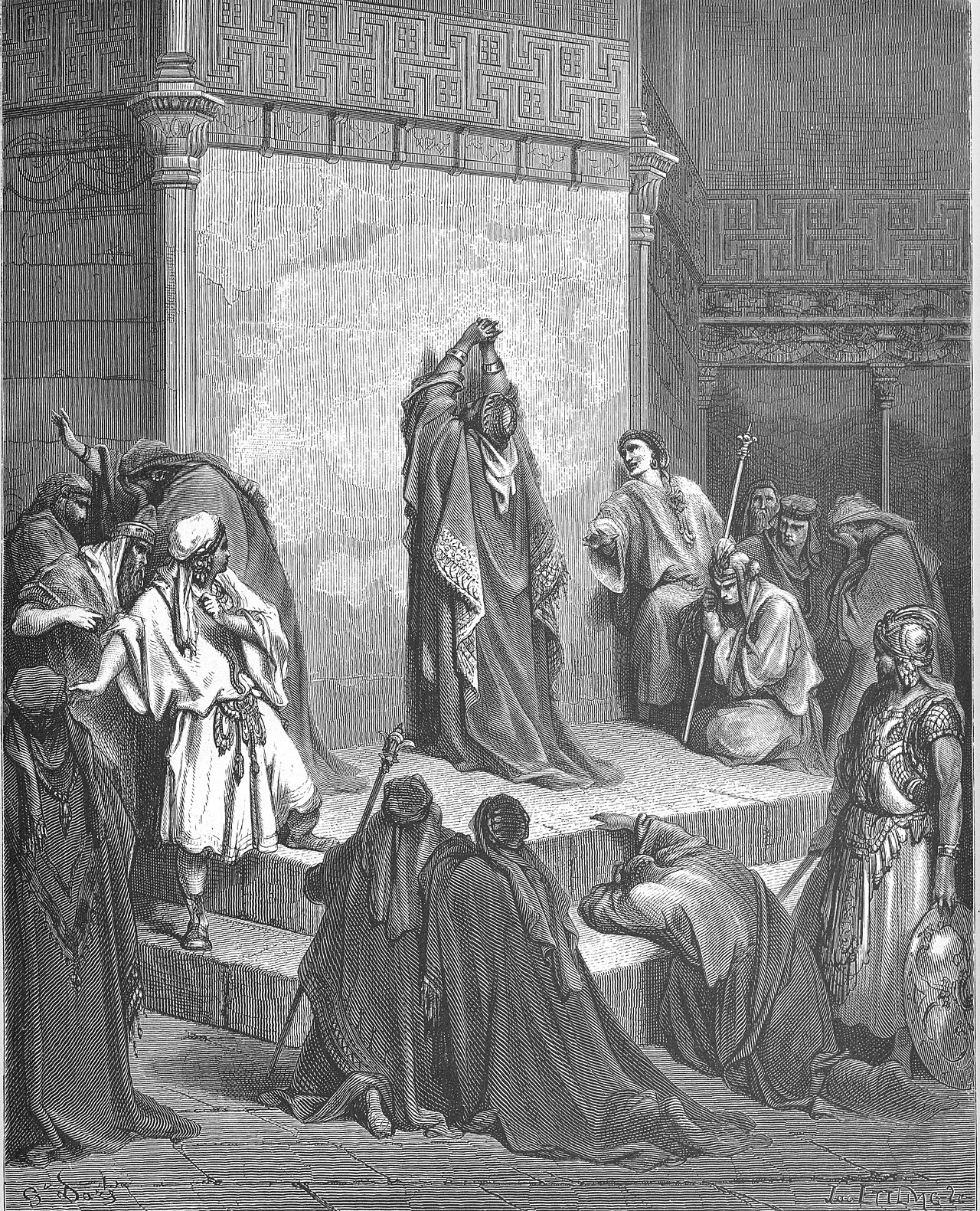
2 Samuelchapter 8
18 verses · Samuel, Nathan and Gad, by tradition · 10th century BC · History
David also defeated the Moabites, made them lie down on the ground, and measured them off with a cord. He measured off with two lengths those to be put to death, and with one length those to be spared. So the Moabites became subject to David and brought him tribute.
Introduction
Samuel, Nathan and Gad, by tradition, History, 2 Samuel Overview.
This chapter reads like the record a king's court kept of his victories and his officials. Its first hearers had lived under Philistine garrisons in their own hill country for a generation. Here the borders move outward in every direction, and the chapter lists the nations one after another. It summarises years of war in a few lines. Listen for the sentence that is said twice, which tells the reader who won these battles. Notice what happens to the silver and gold, and read the list of names at the end as the shape of a new kingdom.
Context
- Who
- Israelites whose borders had just moved outward in every direction
- What
- A summary of David's victories over Philistia, Moab, the Aramean kingdoms and Edom, and a list of his chief officials.
- Where
- Philistia, Moab east of the Dead Sea, the Aramean states north to the Euphrates, and Edom in the south.
- When
- About 1000 to 995 BC, a span of years, since the chapter summarises campaigns rather than one battle.
- Why
- To show the LORD giving David victory wherever he went and to record the order of the kingdom He had established.
Historical context
2 Samuel names no author, and Samuel himself is dead before the book opens. The oldest internal lead is 1 Chronicles 29:29, which names the histories of Samuel the seer, Nathan the prophet and Gad the seer behind the acts of David. This chapter summarises campaigns rather than one day, so its date is a span of roughly 1000 to 995 BC and no single year can be fixed for it. The ground runs from Philistia and Moab to the Aramean states as far north as the Euphrates, and south to Edom. A first hearer would have recognised the form, a royal annal laid out as Egyptian and Assyrian kings laid out theirs, with enemies listed, tribute recorded, garrisons noted and officials named. He knew that measuring prisoners with a cord decided how many of a defeated force were executed and how many kept, and the survivors became tribute-paying subjects. He knew hamstringing captured chariot horses was standard for an army that fought on foot, since cutting the tendon made a horse useless for war without wasting food on it. He knew Zobah was the strongest Aramean kingdom of the day, north of Damascus, and that beating it opened the road to the Euphrates. He knew the Cherethites and Pelethites were almost certainly Aegean-descended mercenaries from the Philistine coast, loyal to the king in person rather than to any Israelite tribe. The figure of seventeen hundred horsemen at verse 4 stands as seven thousand at 1 Chronicles 18:4, the kind of difference that arises when numbers written with strokes are copied.
Significance
The first hearers had lived under Philistine garrisons in their own hill country. Now the garrisons are Israelite and stand in Damascus and Edom. The refrain does the interpreting, since the chapter says twice that the LORD made David victorious wherever he went, at verse 6 and again at verse 14. The bronze carried off from Zobah's towns is noted for a reason, since it is the metal Solomon's builders would later use.
This chapter in Jewish lifeWhat this chapter is in Jewish life and reading.
How it is read
The corpus for this chapter holds twenty-four commentary entries and forty rabbinic locators. Thirteen entries carry English text under a licence that permits quotation, and all thirteen are Rashi in the Metsudah translation, Lakewood, N.J., CC-BY, cited below by ref alone. Radak stands at eight further places, Metzudat David at two and Malbim at one, with no English version, so those eleven are cited and never quoted.
A chapter of wars and officers draws mostly factual, geographic and legal comment, and that is what the corpus holds here. Rashi identifies the place taken from the Philistines with Gath, reasoning from the royal title: the other Philistine cities have rulers, and only Gath has a king named in Scripture (Rashi on II Samuel 8:1:1). On the measuring out of the Moabites he gives a reason drawn from the earlier book. They had killed David's father, mother and brothers, who had been left in their keeping (Rashi on II Samuel 8:2:1). On the houghing of the captured horses he points to the law that a king of Israel must not multiply horses. He adds that a chariot in Scripture means four horses, worked out from the prices given in Chronicles (Rashi on II Samuel 8:4:1 and 8:4:2).
Two comments read the chapter as a whole rather than a verse. Rashi says the war chapters were set next to the chapter about the house of God because David gathered from these wars the consecrated things the house would need (Rashi on II Samuel 8:7:1). Of the officer list he reads the order of the names as an argument: David judged and Joab enforced, so each made the other able to do his work (Rashi on II Samuel 8:15:1). The last office in the list he gives twice over, once as the Targum reads it, archers and slingers, and once as the Rabbis read it, the Urim and Thummim (Rashi on II Samuel 8:18:1). On the name David made for himself, he takes it as the burial of the Edomite dead, and calls burying an enemy a good name for Israel (Rashi on II Samuel 8:13:1).
What the rabbis say
Forty locators stand on this chapter in the corpus, thirty-four from the Midrash and six from the Talmud, every one of them a locator without text. The war with Hadadezer and the reading of the verse about the river draw Nedarim 37b:9, Ein Yaakov, Nedarim 4:4 and Tractate Soferim 6:8. Three entries in Otzar Midrashim stand at the same verse, on words read differently from the way they are written. The Moabite campaign draws Sanhedrin 39b:16, Ein Yaakov, Sanhedrin 4:34 and Yalkut Shimoni on Torah 785:25. The houghing of the horses draws Jerusalem Talmud Sanhedrin 2:6:3, Midrash Lekach Tov, Deuteronomy 17:16:1 and Midrash Tannaim on Deuteronomy 17:16:1, all at the law about a king's horses. The garrisons in Edom draw Bereshit Rabbah 83:2, Devarim Rabbah 1:16 and Midrash Aggadah, Numbers 24:18:1. The verse on judgment and justice draws Avot DeRabbi Natan 33:1, Devarim Rabbah 5:3 and Ein Yaakov, Sanhedrin 1:5. The officer list draws Bamidbar Rabbah 14:18, Jerusalem Talmud Horayot 3:2:27 and Mekhilta DeRabbi Yishmael, Tractate Amalek 3:11.
Sources: Rashi, Rashi on II Samuel 8:1:1, 8:2:1, 8:4:1, 8:4:2, 8:7:1, 8:13:1, 8:15:1 and 8:18:1, The Metsudah Tanach series, Lakewood, N.J., CC-BY; Radak, Radak on II Samuel 8:2:1, 8:7:1, 8:11:1 and five further places, cited only, no English version in the corpus; Metzudat David, Metzudat David on II Samuel 8:6:1 and 8:10:1, cited only; Malbim, Malbim on II Samuel 8:8:1, cited only; The Midrash and the Talmud on this chapter, Nedarim 37b:9; Tractate Soferim 6:8; Sanhedrin 39b:16; Jerusalem Talmud Sanhedrin 2:6:3; Midrash Tannaim on Deuteronomy 17:16:1; Bereshit Rabbah 83:2; Avot DeRabbi Natan 33:1; Bamidbar Rabbah 14:18, as the corpus records them.
The heads below are this chapter's scenes. The numbered points under each are its verses.
Philistia, Moab, and Zobah brought under
2 Samuel 8:1-2
David defeated the Philistines, subdued them: David defeats the Philistines and takes Metheg-ammah, which 1 Chronicles 18:1 gives as Gath and its villages. Moab is measured with a cord, “two lengths those to be put to death, and with one length those to be spared”. John Wesley sets the war beside Balaam's oracle at Numbers 24:17.
2 Samuel 8:1
“David took Metheg-ammah out of the hand of the Philistines--that is, Gath and her suburban towns (1Ch 18:1). That town had been "a bridle" by which the Philistines kept the people of Judah in check.”
Jamieson, Fausset & Brown · Commentary Critical and Explanatory on the Whole Bible (1871)reformed
2 more voices on this verseWhat preachers and commentators have said about this verse, in their own words.
2 Samuel 8:1
“Metheg-ammah was Gath (the chief and royal city of the Philistines) and the towns belonging to it, among which there was a constant garrison kept by the Philistines on the hill Ammah ( 2 Sam. ii. 24 ), which was Metheg, a bridle (so it signifies) or curb upon the people of Israel; this David took out of their hand and used it as a curb upon them.”
Matthew Henry · Commentary on the Whole Bible (1707-1721)puritan
2 Samuel 8:1
“And David took - Gath and her towns, as it is expressed in the parallel place, 1 Chron. xviii, 1. Which are called Metheg-ammah, or the bridle of Ammah, Gath was situate in the mountain of Ammah; and because this being the chief city of the Philistines, and having a king, which none of the rest had, was the bridle which had hitherto kept the Israelites in subjection.”
John Wesley · Explanatory Notes upon the Old Testament (1765)evangelical
measured them off with a cord: The Septuagint and Vulgate make the spared share of Moab one half, as Jamieson, Fausset and Brown note. Barnes takes the tone of Psalm 60 to mean Moab and Edom struck while David suffered a reverse in the war with Aram. Jerome saw Orpah and Ruth in the two lengths.
2 Samuel 8:2
In the second book of Kings [Samuel], where David defeated the Moabites, Scripture records the measuring out of two separate lines for life and two for death. The significance of setting aside some Moabites for life and others for death is made clear by the story of Orpah and Ruth. Orpah, who turned back to idolatry and her ancient country, was destined for death; Ruth, following her mother-in-law, whose name means "pleasant," says, "Your people shall be my people, and your God my God."
Jerome · written before 420 · Homilies on the Psalms, Alternate Series 61 (Ps 15)patristic
2 more voices on this verse
2 Samuel 8:2
“And measured them with a line - even with two lines - It has been generally conjectured that David, after he had conquered Moab, consigned two-thirds of the inhabitants to the sword; but I think the text will bear a meaning much more reputable to that king. The first clause of the verse seems to determine the sense; he measured them with a line, casting them down to the ground - to put to death, and with one line to keep alive.”
Adam Clarke · Commentary on the Bible (1810-1826)evangelical
2 Samuel 8:2
“The Septuagint and Vulgate make one-half. This war usage was not, perhaps, usually practised by the people of God; but Jewish writers assert that the cause of this particular severity against this people was their having massacred David's parents and family, whom he had, during his exile, committed to the king of Moab.”
Jamieson, Fausset & Brown · Commentary Critical and Explanatory on the Whole Bible (1871)reformed
2 Samuel 8:3-6
David also defeated Hadadezer son of Rehob, king of Zobah: Zobah was the leading Aramean power, and David's campaign reaches the Euphrates, the border named to Abraham at Genesis 15:18. He hamstrings the chariot horses, all but a hundred, in keeping with the king's law against many horses at Deuteronomy 17:16. Damascus falls when it comes to Hadadezer's aid.
2 Samuel 8:3
“Hadadezer - Not (see the margin) Hadarezer. Hadadezer, is the true form, as seen in the names Benhadad, Hadad (1Ki 15:18, etc.; 1Ki 11:14, etc.). Hadad was the chief idol, or sun-god, of the Syrians. To recover his border - literally, to cause his hand to return. The phrase is used sometimes literally, as e. g. Exo 4:7; 1Ki 13:4; Pro 19:24; and sometimes figuratively, as Isa 1:25; Isa 14:27; Amo 1:8; Psa 74:11. The exact force of the metaphor must in each case be decided by the context.”
a thousand chariots, seven thousand charioteers: Barnes notes that the older text reads seven hundred horsemen for the seven thousand charioteers David captured. He follows the seven thousand of 1 Chronicles 18:4. Wesley and Henry count seven hundred companies of ten, seven thousand men in all.
2 Samuel 8:4
“A thousand chariots - It is strange that there were a thousand chariots, and only seven hundred horsemen taken, and twenty thousand foot. But as the discomfiture appears complete, we may suppose that the chariots, being less manageable, might be more easily taken, while the horsemen might, in general, make their escape. The infantry also seem to have been surrounded, when twenty thousand of them were taken prisoners.”
Adam Clarke · Commentary on the Bible (1810-1826)evangelical
2 more voices on this verse
2 Samuel 8:4
“Seven hundred - Or, seven hundred companies of horsemen, that is, in all seven thousand; as it is 1 Chron. xviii, 4, there being ten in each company, and each ten having a ruler or captain. Houghed - That is, cut the sinews of their legs, that they might be useless for war.”
John Wesley · Explanatory Notes upon the Old Testament (1765)evangelical
2 Samuel 8:4
“4 they are said to be 7000. If they divided their horse by ten in a company, as it is probable they did, the captains and companies were 700, but the horsemen were 7000. David houghed the horses, cut the sinews of their hams, and so lamed them, and made them unserviceable, at least in war, God having forbidden them to multiply horses, Deut. xvii.”
Matthew Henry · Commentary on the Whole Bible (1707-1721)puritan
the Arameans of Damascus came to help: Damascus was the capital of the strongest Aramean kingdom, and Albert Barnes notes that Scripture first names it at Genesis 15:2. Nicolaus of Damascus, as Josephus cites him, names its king Hadad.
2 Samuel 8:5
“Syrians of Damascus - The Syrians (Aram), whose capital was Damascus, were the best known and most powerful. Damascus (written Darmesek in marginal references, according to the late Aramean orthography) is first mentioned in Gen 15:2. According to Nicolaus of Damascus, cited by Josephus, the Syrian king’s name was Hadad.”
he placed garrisons in Aram of Damascus: The word for garrisons means officers at 1 Kings 4:5, and Albert Barnes notes that some read it so here. He keeps the military sense of 1 Samuel 13:3. Matthew Henry gathers that David led these wars in person.
2 Samuel 8:6
“Garrisons - The word is used for officers in 1Ki 4:5, 1Ki 4:19, and some think that that is its meaning here. Perhaps, however, it is best to take it with the King James Version in the same sense as in 1Sa 10:5; 1Sa 13:3. Brought gifts - Rather, “tribute” (and in 2Sa 8:2); meaning they became subject and tributary.”
2 more voices on this verse
2 Samuel 8:6
“Then David put garrisons in Syria of Damascus,.... Which was Coele-Syria, and lay between Libanus and Antilibanus, the chief city of which was Damascus; which Curtius (q) calls Damascus of Syria, being the head of it, Isa 7:8; in the principal places of which he put garrisons of soldiers to keep the country in subjection to him; or he put commanders or governors, as the Targum, in the, chief cities, and so Ben Gersom and R.”
2 Samuel 8:6
“Associate yourselves, and you shall be broken in pieces, Isa. viii. David was protected: The Lord preserved him whithersoever he went. It seems, he went in person, and, in the cause of God and Israel, jeoparded his own life in the high places of the field; but God covered his head in the day of battle, which he often speaks of, in his psalms, to the glory of God.”
Matthew Henry · Commentary on the Whole Bible (1707-1721)puritan
2 Samuel 8:7-12
David took the gold shields that belonged to the officers of Hadadezer: The gold shields are dedicated to the LORD. Jamieson, Fausset and Brown note that David kept this practice, saving the spoil toward the temple his son would build. The same act keeps the law of Deuteronomy 17:17 against a king gathering silver and gold for himself, as John Gill notes.
2 Samuel 8:7
“And David took the shields of gold that were on the servants of Hadadezer,.... That were found with them, which they had in their hands; these must be supposed to be with the principal officers of his army; or golden chains, as Aquila, or golden bracelets on their arms, as the Septuagint; the Syriac version is "quivers of gold", such as they put arrows into, and so Jarchi and R.”
1 more voice on this verse
2 Samuel 8:7
“David took the shields of gold - We know not what these were. Some translate arms, others quivers, others bracelets, others collars, and others shields. They were probably costly ornaments by which the Syrian soldiers were decked and distinguished. And those who are called servants here, were probably the choice troops or body-guard of Hadadezer, as the argyraspides were of Alexander the Great. See Quintus Curtius.”
Adam Clarke · Commentary on the Bible (1810-1826)evangelical
from Betah and Berothai: Wesley notes that 1 Chronicles 18:8 gives other names for these cities, and he reads them as the same cities under a second name. The Chronicler adds that Solomon made the bronze Sea, the pillars and the vessels from this bronze. Barnes notes that the Septuagint carries it here too.
2 Samuel 8:8
“Betah and Berothai - These names (see also margin) have not been identified with certainty. Exceeding much brass - “Wherewith Solomon made the brazen sea, and the pillars, and the vessels of brass” 1Ch 18:8. The Septuagint and Vulgate both add these words here, so that perhaps they have fallen out of the Hebrew text. For the existence of metals in Lebanon or Antilebanon, see Deu 8:9.”
Tribute out of Hamath; garrisons in Edom
King Toi of Hamath heard: Hamath stood on the Orontes River, as Jamieson, Fausset and Brown note. Barnes notes that it was still a kingdom of its own in the days of Sennacherib, at Isaiah 37:13. With Hadadezer defeated, King Toi was free of a dangerous neighbour.
2 Samuel 8:9
“Hamath - This appears as an independent kingdom so late as the time of Senacherib Isa 37:13. But in the time of Nebuchadnezzar, both Hamath and Arpad appear to have been incorporated in the kingdom of Damascus Jer 49:23.”
he sent his son Joram to greet King David: First Chronicles 18:10 calls Joram Hadoram, and Barnes takes that name as the more likely one. Henry reads the visit of Joram as thanks to David for defeating Hadadezer and a request for his friendship. Jamieson, Fausset and Brown add that Toi sought David's protection.
2 Samuel 8:10
“Joram - Or, more probably, Hadoram. See the margin.”
King David dedicated these to the LORD: The gifts of King Toi joined the silver and gold David took from the nations. Henry sets this dedication to the LORD above the victories of Alexander and Caesar. They fought for their own glory, and David for the LORD's.
2 Samuel 8:11
“This is the first instance of a practice uniformly followed by David of reserving, after defraying expenses and bestowing suitable rewards upon his soldiers, the remainder of the spoil taken in war, to accumulate for the grand project of his life--the erection of a national temple at Jerusalem.”
Jamieson, Fausset & Brown · Commentary Critical and Explanatory on the Whole Bible (1871)reformed
1 more voice on this verse
2 Samuel 8:11
“This crowned all his victories, and made them far to out-shine Alexander's or Caesar's, that they sought their own glory, but he aimed at the glory of God.”
Matthew Henry · Commentary on the Whole Bible (1707-1721)puritan
from Edom and Moab: The Hebrew here reads Aram, and 1 Chronicles 18:11 reads Edom, which the Berean follows. Barnes notes that Aram and Edom differ by one letter in Hebrew, and that the spoil of Aram is already named with Hadadezer. Barnes adds that Edom, Moab and the Ammonites often stand together.
2 Samuel 8:12
“Syria - Rather, as in 1Ch 18:11, Edom, which is manifestly the right reading, both because Edom, Moab, and Ammon are so frequently joined together, and because David’s Syrian spoil is expressly mentioned at the end of the verse. (The Hebrew letters for Aram (Syria) and Edom are very similar.)”
2 Samuel 8:13-14
David made a name for himself when he returned: The traditional Hebrew text names Aram here and the Septuagint names Edom, and the Berean text reads Edom. The Valley of Salt lies south of the Dead Sea. 1 Kings 11:15-16 remembers this war as a campaign under Joab that struck down every male in Edom.
2 Samuel 8:13
“David gat him a name when he returned from smiting of the Syrians--Instead of Syrians, the Septuagint version reads "Edomites," which is the true reading, as is evident from 2Sa 8:14. This conquest, made by the army of David, was due to the skilful generalship and gallantry of Abishai and Joab.”
Jamieson, Fausset & Brown · Commentary Critical and Explanatory on the Whole Bible (1871)reformed
1 more voice on this verse
2 Samuel 8:13
“The Syrians - Read the Edomites, as in marginal references (compare Psa 60:1-12 title), and as the context 2Sa 8:14 requires. For a further account of this war of extermination with Edom, see 1Ki 11:15-16. The war with Edom was of some duration, not without serious reverses and dangers to the Israelites (2Sa 8:2 note). The different accounts probably relate to different parts of the campaign.”
He placed garrisons throughout Edom: Gill follows the Targum, which reads governors, men of Israel set over the chief cities of Edom. Clarke has David repair and garrison the strongholds. Henry reads these victories as a picture of the gospel under the Son of David.
2 Samuel 8:14
“And he put garrisons in Edom,.... To keep the inhabitants in subjection to him; as their forts and strong holds came into his hands, he placed companies of soldiers in them for the said purpose; or governors, as the Targum, men of his own nation, into whose hands he put their principal cities, who governed them for him, and under him.”
Justice unto all his people: David's cabinet
administered justice and righteousness for all his people: The war record turns to the throne at home: David “administered justice and righteousness for all his people”. David's last words at 23:3 name the same mark of a ruler. Henry sets the line beside Revelation 19:11, where the one called Faithful and True judges and wages war in righteousness.
2 Samuel 8:15
“Herein he was a type of Christ, who was faithful and true, and who doth in righteousness both judge and make war, Rev. xix. He kept good order and good officers in his court. David being the first king that had an established government (for Saul's reign was short and unsettled) he had the modelling of the administration.”
Matthew Henry · Commentary on the Whole Bible (1707-1721)puritan
2 Samuel 8:16-18
Joab son of Zeruiah was over the army: The chapter lists the first court: Joab over the army, Jehoshaphat as recorder, Zadok and Ahimelech as priests, and Benaiah over the Cherethites and Pelethites. Adam Clarke gives the Targum's rendering of those two names, archers and slingers. The same list of offices returns at 20:23-26, framing the chapters between.
2 Samuel 8:16
“Joab - was over the host - General and commander-in-chief over all the army. Ahilud - recorder - מזכיר mazkir, remembrancer; one who kept a strict journal of all the proceedings of the king and operations of his army; a chronicler. Or, remembrancer, or, writer of chronicles.”
Adam Clarke · Commentary on the Bible (1810-1826)evangelical
Zadok son of Ahitub and Ahimelech son of Abiathar were priests: First Samuel 22:20 makes Abiathar the son of Ahimelech, and Abiathar served as priest through the reign of David. Albert Barnes holds that the text here carries an error. Adam Clarke takes Seraiah the scribe as the private secretary of the king.
David’s sons were priestly leaders: Priestly leaders renders kohen, the usual Hebrew word for a priest. Barnes holds that in David's early kingdom it still kept its root sense of one who ministers or manages affairs. Jamieson, Fausset and Brown link the Cherethites to the Philistines through Zephaniah 2:5.
2 Samuel 8:18
“Benaiah - The chief of the second class of David’s worthies. We shall meet with him again. The Cherethites and the Pelethites - The former supposed to be those who accompanied David when he fled from Saul; the latter, those who came to him at Ziklag. But the Targum translates these two names thus, the archers and the slingers; and this is by far the most likely. It is not at all probable that David was without a company both of archers and slingers.”
Adam Clarke · Commentary on the Bible (1810-1826)evangelical
1 more voice on this verse
2 Samuel 8:18
“Cherethites--that is, Philistines (Zep 2:5). Pelethites--from Pelet (1Ch 12:3). They were the valiant men who, having accompanied David during his exile among the Philistines, were made his bodyguard.”
Jamieson, Fausset & Brown · Commentary Critical and Explanatory on the Whole Bible (1871)reformed
How this psalm is built
The form: A summary of wars followed by a list of officers, written in larger units than a narrative chapter, as chapter classes it.
The patterns in this chapter
| Device | What it does | Where to see it |
|---|---|---|
| The LORD made David victorious wherever he went | The line stands at verse 6 and again at verse 14, opening and closing the war record. The site's published exposition calls it the summary's own theology rather than the historian's flattery, since the chapter credits the wins past David's generalship in its own voice. | 2 Samuel 8:6, 2 Samuel 8:14 |
| The nations taken in order | Verses 1 to 14 name Philistia, Moab, Zobah, Damascus and Edom in turn, each with what was taken and what was left. The form is a register rather than a story, and no single battle is described. Toi of Hamath sends gifts rather than an army, so the list carries a submission as well as five defeats. | 2 Samuel 8:1, 2 Samuel 8:2, 2 Samuel 8:3, 2 Samuel 8:5, 2 Samuel 8:9, 2 Samuel 8:14 |
| The officers of the first cabinet | Verses 16 to 18 name the army, the recorder, the two priests, the scribe and the royal guard. Adam Clarke reads the Cherethites and Pelethites by the Targum's rendering as archers and slingers rather than as a tribal name. The same offices, largely the same men, close the court narrative again at 20:23 to 26, so the two lists bracket the chapters between them.Adam Clarke, Commentary on the Bible, 1832, on 2 Samuel 8:18. | 2 Samuel 8:16, 2 Samuel 8:17, 2 Samuel 8:18 |
The two textual questions
11 more paragraphs on the patterns
The first is at verse 13, where the Berean text reads eighteen thousand Edomites. The Hebrew of the Masoretic Text names Aram, which older English versions render Syria, and the Septuagint names Edom. Albert Barnes and Jamieson, Fausset and Brown both take Edom as the true reading, since verse 14 goes on to speak only of garrisons through all Edom. The site's judgment file for this chapter records the crux as one that three commentators resolve three different ways, so the row names the question rather than settling it.
The second is the identity of Metheg-ammah at verse 1. The reading carried in the site's published exposition is that it means Gath and its towns, the bridle that had held Israel under the Philistines since Saul's day. On that reading the Philistine question closes at Goliath's own city, where Joshua 11:22 records that Anakim remained after the conquest.
The record outside the Bible
The site's published dossier for this book carries four finds, and the two that bear on a chapter of conquest are the Tel Dan Stele and the Mesha Stele. The Tel Dan Stele is a ninth-century Aramaic victory inscription found at Tel Dan. Avraham Biran and Joseph Naveh published it in 1993 and 1995, and on the standard reading it names the house of David as the dynastic name of the southern kingdom. On that reading it is the earliest reference to David outside the Bible, written by a hostile neighbour within about a century and a half of his reign.
The Mesha Stele, found at Dhiban in 1868, carries a damaged line 31 that André Lemaire read in 1994 as the house of David. The reading is contested. Israel Finkelstein, Nadav Na'aman and Thomas Römer argued in 2019 for a Moabite royal name instead. Michael Langlois argued the same year that the house of David reading stands, working from Reflectance Transformation Imaging of the stone and the nineteenth-century squeeze. The line is genuinely broken and both readings are live. The stele matters here because this chapter is where Moab is subdued.
The law standing behind two acts
Verse 4 has David hamstring the captured chariot horses rather than keep them. Deuteronomy 17:16 forbids a king of Israel to multiply horses, and the site's published exposition reads the act as obedience to it. Verse 11 has him dedicate the captured metal, which John Gill reads against Deuteronomy 17:17 on silver and gold. A chapter that reads as a conquest register is also a record of a king keeping the law written for kings.
The campaign to the Euphrates at verse 3 reaches the border God named to Abraham at Genesis 15:18. The site's published exposition states the reach without calling it a fulfilment beyond what the text carries.
The hard measure on Moab
Verse 2 has David measure Moab with a line and put two lengths to death and spare one. The commentators divide over why. Adam Clarke reads two parts destroyed to one spared. Jamieson, Fausset and Brown carry a Jewish tradition that the harsh measure answered a massacre of David's parents, who had been left in Moab's keeping during his exile at 1 Samuel 22:3 and 22:4. Wesley and Matthew Henry read the war as Balaam's oracle landing, a sceptre out of Israel crushing the corners of Moab at Numbers 24:17. Bede reads the verse hyperbolically. The row names the readings and settles none of them.
Jerome reads the two lines a different way again. In his homily on Psalm 15 he takes the measuring out of separate lines for life and for death as significant rather than merely military. The site's judgment file records him reading the two lines of Moab back through Orpah and Ruth.
Keep studying
Studies6
Sources for this chapter
The summary
Jamieson, Fausset & Brown, Commentary Critical and Explanatory; John Wesley, Notes on the Old Testament and Matthew Henry, Complete Commentary.
The form and classifications
This site's published book guide, src/components/book/guides/2-samuel/Book2SamuelGuide.tsx, act "The Triumphs: a United Kingdom", beat at chapter 8; This site's published book sections table, src/lib/bible/book-sections.ts, the entry "2 Samuel": "history" and This site's published exposition of the chapter, data/commentary/2-samuel-8-exposition.json, which calls it a restraint chapter, a war summary and an officer list, and gives it six notes across eighteen verses.
The exposition
Adam Clarke, Commentary on the Bible; Albert Barnes; Jamieson Fausset and Brown, Commentary Critical and Explanatory on the Whole Bible; Jamieson, Fausset & Brown, Commentary Critical and Explanatory on the Whole Bible; Jerome, Homilies on the Psalms, Alternate Series 61 (Ps 15); John Gill; John Wesley, Explanatory Notes upon the Old Testament; Keil and Delitzsch, Biblical Commentary on the Books of Samuel and Matthew Henry, Commentary on the Whole Bible.