
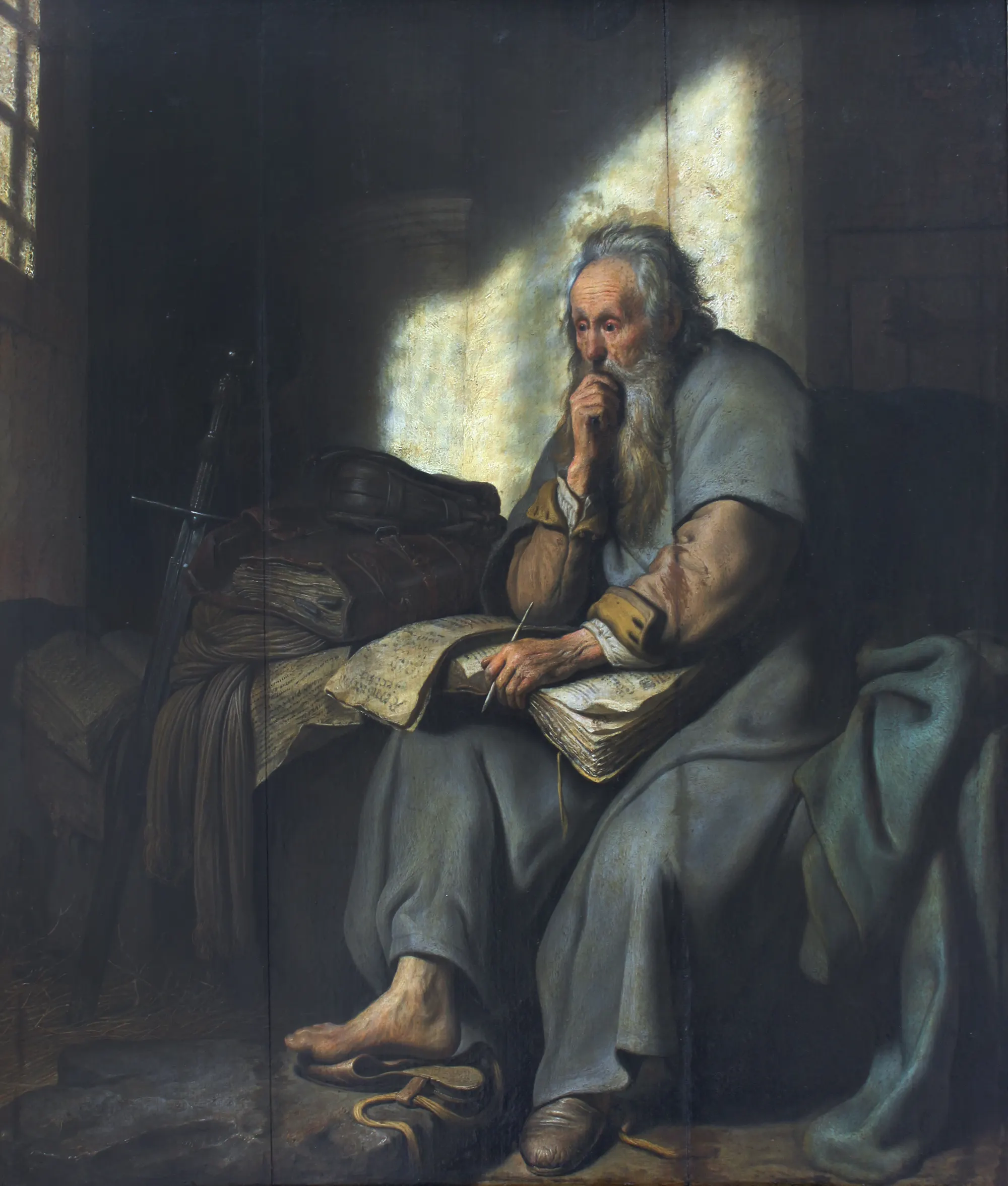
2 Corinthianschapter 4
18 verses · Paul · about AD 56 · Paul's letters
For God, who said, “Let light shine out of darkness,” made His light shine in our hearts to give us the light of the knowledge of the glory of God in the face of Jesus Christ.
Introduction
Paul, Paul's letters, 2 Corinthians Overview.
This chapter continues Paul's letter, with Timothy named beside him, to the church in Corinth. It follows his picture of the unveiled face and carries the thought of light and glory further. Paul explains why some still do not see the gospel and why his own weakness does not disprove it. Listen for the words we do not lose heart, which open the chapter and return near its end. Listen also for the list of hardships, each one paired with a limit it cannot pass. Hear it as encouragement for anyone who is wearing out.
Context
- Who
- Corinthians embarrassed by an apostle who looked beaten down rather than successful.
- What
- Part of Paul's letter to Corinth on the open preaching of the gospel, the treasure carried in jars of clay, and the hope that keeps him from losing heart.
- Where
- Written from Macedonia to believers in Corinth who prized polish and were drawn to more impressive teachers.
- When
- About AD 55 to 56, not long after Paul came through the danger of death he describes in chapter 1.
- Why
- To show a church embarrassed by an afflicted apostle that his weakness displays God's power and that his sufferings are producing glory.
Historical context
The "jars of clay" were the cheapest containers in the ancient world, plain unglazed pottery, mass produced, used for grain, oil, water, and household storage, and thrown away when cracked. Broken potsherds litter every excavation in the Near East because nobody bothered to repair them.
Show the rest of the historical context, 3 more paragraphs
Some readers hear a second picture: a small clay lamp, worthless in itself, holding a flame. Either way the point is the mismatch between the container and what is inside it, so that the surpassing power belongs to God and not to us.
The hardship list, afflicted but not crushed, perplexed but not driven to despair, struck down but not destroyed, was a recognizable literary form. Philosophers published catalogues of hardships to prove the sage's inner strength. Paul uses the form and inverts its purpose: what it proves is not his toughness but that the life of Jesus is being made visible in a dying body.
The reference to the god of this age blinding minds addresses a real question in a culture of competing revelations: why do intelligent people not see it?
Significance
For a church that valued polish, Paul's insistence that he refused underhanded ways, cunning, and tampering with God's word drew the contrast he wanted with whoever had been impressing them.
Show the rest of the significance, 1 more paragraph
And for anyone wearing out, the chapter offered a measurement: the outer self wasting away while the inner self is renewed day by day, and present troubles weighed as light and momentary against an eternal weight of glory.
The heads below are this chapter's scenes. The numbered points under each are its verses.
Light Out of Darkness Against a Blinded World
2 Corinthians 4:1-2
God in His mercy has given us: Paul grounds his endurance in mercy, since God in His mercy has given us this ministry. Verse 2 names his method: by open proclamation of the truth, we commend ourselves to every man’s conscience in the sight of God.
2 Corinthians 4:1
“Therefore - Διὰ τοῦτο Dia touto. On account of this. That is, because the light of the gospel is so clear; because it reveals so glorious truths, and all obscurity is taken away, and we are permitted to behold as in a mirror the glory of the Lord, 2Co 3:18. Since the glories of the gospel dispensation are so great, and its effects on the heart are so transforming and purifying. The object is, to show the “effect” of being entrusted with such a ministry, on the character of his preaching.”
1 more voice on this verseWhat preachers and commentators have said about this verse, in their own words.
2 Corinthians 4:1
“Therefore--Greek, "For this cause": Because we have the liberty-giving Spirit of the Lord, and with unveiled face behold His glory (2Co 3:17, 18). seeing we have this ministry--"The ministration of the Spirit" (2Co 3:8, 9): the ministry of such a spiritual, liberty-giving Gospel: resuming 2Co 3:6, 8. received mercy--from God, in having had this ministry conferred on us (2Co 3:5).”
Jamieson, Fausset & Brown · Commentary Critical and Explanatory on the Whole Bible (1871)reformed
we have renounced secret and shameful ways: Paul describes his rivals by naming what he refuses. John Chrysostom reads the shameful ways as promising great things and doing others, where Paul is what he appears to be. John Calvin compares the pure gospel to natural beauty and the disguised gospel of others to paint laid on.
2 Corinthians 4:2
“But have renounced - Απειπαμεθα· We have disclaimed the hidden things of dishonesty; τα κρυπτα της αισχυνης, the hidden things of shame; those things which wicked men do; and which they are ashamed to have known, and ashamed to own. Dr. Whitby thinks that the apostle refers to carnal abominations, of which the Jews and their rabbins were notoriously guilty. And it does appear from the first epistle that there were persons in Corinth who taught that fornication was no sin; and it appears also that several had taken the part of the incestuous person.”
Adam Clarke · Commentary on the Bible (1810-1826)evangelical
2 more voices on this verse
2 Corinthians 4:2
“Knowing Christ as the "true light," "inaccessible" to falsehood, we learn this, namely, that it is necessary for our lives also to be illuminated by the rays of the true light. But virtues are the rays of "the Sun of Justice," streaming forth for our illumination, through which we "lay aside the works of darkness," so that we "walk becomingly as in the day," and "we renounce those things which shame conceals." By doing all things in the light, we become the light itself, so that it "shines" before others, which is the peculiar quality of light.”
Gregory of Nyssa · written before 395 · On Perfectionpatristic
2 Corinthians 4:2
“For as chaste and virtuous women, satisfied with the gracefulness of natural beauty, do not resort to artificial adornings, while harlots never think themselves sufficiently adorned, unless they have corrupted nature, so Paul glories in having set forth the pure gospel, while others set forth one that was disguised, and covered over with unseemly additions.”
John Calvin · Commentaries (1554)reformed
even if our gospel is veiled: , Paul writes, it is veiled to those who are perishing. The failure lies with the hearers, and verse 4 names its cause.
2 Corinthians 4:3
"Veiled," of a thing within reach of the eye, but covered over so as not to be seen. So it was in the case of Moses' face. to them--in the case only of them: for in itself the Gospel is quite plain. that are lost--rather, "that are perishing" (1Co 1:18).
Jamieson, Fausset & Brown · Commentary Critical and Explanatory on the Whole Bible (1871)reformed
2 more voices on this verse
2 Corinthians 4:3
“But if our Gospel be hid,.... When the Gospel is called ours, the meaning is, not that ministers are the authors or subject of it; but it is so styled, because they are intrusted with it; it is preached by them; and is in opposition to another Gospel, the Gospel of the false apostles.”
2 Corinthians 4:3
“But if our gospel be hid - Paul here calls it his gospel, because it was that which he preached, or the message which he bore; see note, Rom 16:25. The sense here is, “if the gospel which I preach is not understood; if its meaning is obscure or hidden; if its glory is not seen.” It is “implied” here, that to many the beauty and glory of the gospel was not perceived. This was undeniable, notwithstanding the plainness and fullness with which its truths were made known.”
The god of this age has blinded: the minds of unbelievers: Paul names Satan by this title as a real spiritual adversary. The blinding has one aim, that they cannot see the light of the gospel of the glory of Christ.
2 Corinthians 4:4
“For one and the same God [that blesses others] inflicts blindness upon those who do not believe, but who set Him at naught; just as the sun, which is a creature of His, [acts with regard] to those who, by reason of any weakness of the eyes cannot behold his light; but to those who believe in Him and follow Him, He grants a fuller and greater illumination of mind.”
Irenaeus · written before 202 · Against Heresies Book IVpatristic
2 more voices on this verse
2 Corinthians 4:4
“In whom the god of this world, etc. - We see here that those whose minds are blinded, are they who believe not; and because they believe not, their minds continue in darkness, and are proper subjects for Satan to work on; and he deepens the darkness, and increases the hardness. But who is meant by the god of this world? It is generally answered, the same who is called the prince of this world, Joh 16:11. But the question recurs, who is the prince of this world? and the answer to both is, Satan.”
Adam Clarke · Commentary on the Bible (1810-1826)evangelical
2 Corinthians 4:4
“THE practice of blinding men is a horrible process, too horrible for us to say another word about it, but there is also a spiritual blindness which comes upon some men. These are, to begin with, unbelievers. The god of this world does not blind Believers—but he blinds the minds of them which believe not. It is, therefore, a very dangerous thing not to believe on the Son of God.”
Charles Spurgeon · written before 1892 · The Metropolitan Tabernacle Pulpit, Sermon No. 2304: “Blinded By Satan” (lightly modernized text, CCEL edition)Particular Baptist
we do not proclaim ourselves: Paul states the content of his preaching as Jesus Christ as Lord, against every charge of self-promotion. His relation to Corinth is servanthood, doulos: ourselves as your servants for Jesus’ sake.
2 Corinthians 4:5
“And the apostle: "For we preach not ourselves but Jesus Christ as Lord, and ourselves merely as your servants in Jesus." Knowing, then, the fruits of humility and the penalty of conceit, imitate the Master by loving one another and do not shrink from death or any other punishment for the good of each other. But the way which God entered upon for you, do you enter upon for him, proceeding with one body and one soul to the invitation from above, loving God and each other.”
Gregory of Nyssa · written before 395 · On the Christian Mode of Lifepatristic
2 more voices on this verse
2 Corinthians 4:5
For--Their blindness is not our fault, as if we had self-seeking aims in our preaching. preach . . . Christ . . . the Lord--rather, "Christ as Lord," and ourselves as your servants, &c. "Lord," or "Master," is the correlative term to "servants."
Jamieson, Fausset & Brown · Commentary Critical and Explanatory on the Whole Bible (1871)reformed
2 Corinthians 4:5
“For we preach not ourselves,.... These words contain a reason why the apostles behaved themselves in the manner described, 2Co 4:2 and serve to explain in what sense this inspired writer is to be understood, when he calls the Gospel our Gospel, 2Co 4:3 and most clearly proves the Gospel to be a glorious one, which he had asserted, 2Co 4:4 since Christ, and not themselves, is the subject of it, "for we preach not ourselves".”
God, who said, Let light shine out of darkness, is the God of Genesis 1:3. Paul takes that first word as the pattern for every heart brought from unbelief to faith: He made His light shine in our hearts.
2 Corinthians 4:6
“But does anyone deny that the Godhead of the eternal Trinity is to be adored, when the Scriptures also set forth the inexplicable majesty of the divine Trinity, as the apostle says elsewhere: "For the God who commanded the light to shine out of darkness has shined in our hearts, to give the light of the knowledge of the glory of God, in the face of Christ Jesus?" … Who is it, then, who shined that we might know God in the face of Christ Jesus?”
Ambrose of Milan · written before 397 · On the Holy Spirit 3.12.86. 88patristic
3 more voices on this verse
2 Corinthians 4:6
“The physical world answers to the spiritual. in our hearts--in themselves dark. to give the light--that is, to propagate to others the light, &c., which is in us (compare Note, see on 2Co 4:4). the glory of God--answering to "the glory of Christ" (see on 2Co 4:4). in the face of Jesus Christ--Some of the oldest manuscripts retain "Jesus." Others omit it.”
Jamieson, Fausset & Brown · Commentary Critical and Explanatory on the Whole Bible (1871)reformed
2 Corinthians 4:6
“God who is himself our light; not only the author of light, but also the fountain of it. To enlighten us with the knowledge of the glory of God - Of his glorious love, and of his glorious image. In the face of Jesus Christ - Which reflects his glory in another manner than the face of Moses did.”
John Wesley · Explanatory Notes upon the New Testament (1755)evangelical
2 Corinthians 4:6
“For God, who commanded the light to shine out of darkness - The apostle refers here to Gen 1:3. For when God created the heavens and the earth Darkness was on the face of the deep; and God said, Let There Be Light; and there was light. Thus he caused the light to shine out of darkness. Hath shined in our hearts - He has given our hearts the glorious light of the Gospel, as he has given the world the glorious light of the sun.”
Adam Clarke · Commentary on the Bible (1810-1826)evangelical
ConnectionsGenesis 1:2, Genesis 1:3
Treasure in Clay Jars: Struck Down, Not Destroyed
this treasure in jars of clay: The gospel's light is carried as this treasure in jars of clay, common pottery, and the mismatch is the point. The weakness of the messenger shows that this surpassingly great power is from God.
2 Corinthians 4:7
“The treasure or "the light of the knowledge of the glory of God." The fragile "earthen vessel" is the body, the "outward man" (2Co 4:16; compare 2Co 4:10), liable to afflictions and death. So the light in Gideon's pitchers, the type (Jud 7:16-20, 22).”
Jamieson, Fausset & Brown · Commentary Critical and Explanatory on the Whole Bible (1871)reformed
3 more voices on this verse
2 Corinthians 4:7
“Have this treasure - Of divine light, love, glory. In earthen vessels - In frail, feeble, perishing bodies. He proceeds to show, that afflictions, yea, death itself, are so far from hindering the ministration of the Spirit, that they even further it, sharpen the ministers, and increase the fruit.”
John Wesley · Explanatory Notes upon the New Testament (1755)evangelical
2 Corinthians 4:7
“But we have, this treasure in earthen vessels,.... This is a further commendation of the Gospel; and by which the apostle removes an objection against it, taken from the cross and persecutions that attend it, and the outward meanness of the ministers of it.”
2 Corinthians 4:7
“But we have this treasure - The treasure of the gospel; the rich and invaluable truths which they were called to preach to others. The word “treasure” is applied to those truths on account of their inestimable worth. Paul in the previous verses had spoken of the gospel, the knowledge of Jesus Christ, as full of glory, and infinitely precious. This rich blessing had been committed to him and his fellow-laborers, to dispense it to others, and to diffuse it abroad.”
2 Corinthians 4:8-9
hard pressed on all sides: The jar of clay of verse 7 now stands under real pressure, set out in four pairs. Each pair sets a real pressure beside a limit it cannot cross, from hard pressed on all sides to struck down.
2 Corinthians 4:8
“We are troubled, &c. - The four articles in this verse respect inward, the four in the next outward, afflictions. In each clause the former part shows the "earthen vessels;" the latter, "the excellence of the power." Not crushed - Not swallowed up in care and anxiety.”
John Wesley · Explanatory Notes upon the New Testament (1755)evangelical
2 more voices on this verse
2 Corinthians 4:8
“He also says, in verses occurring in a previous part of the epistle: "Our condition is such, that we are troubled on every side, yet not distressed; and are in need, but not in utter want; since we are harassed by persecutions, but not forsaken; it is such that we are east down, but not destroyed; always bearing about in our body the dying of Christ." "But though," says he, "our outward man perisheth"-the flesh doubtless, by the violence of persecutions-"yet the inward man is renewed day by day"-the soul, doubtless, by hope in the promises.”
Tertullian · written before 220 · Scorpiacepatristic
2 Corinthians 4:8
“We are troubled on every side - We have already seen, in the notes on the ninth chapter of the preceding epistle, that St. Paul has made several allusions to those public games which were celebrated every fifth year at the Isthmus of Corinth; and those games have been in that place particularly described. In this and the three following verses the apostle makes allusion to the contests at those games; and the terms which he employs in these verses cannot be understood but in reference to those agonistical exercises to which he alludes.”
Adam Clarke · Commentary on the Bible (1810-1826)evangelical
struck down, but not destroyed: Each pair sets a limit on the pressure. Matthew Henry notes that the children of God always have a but not to comfort them.
2 Corinthians 4:9
“Persecuted - Often persecuted, persecuted in all places. The Book of Acts shows how true this was. But not forsaken - Not deserted; nor left by God Though persecuted by people, yet they experi enced the fulfillment of the divine promise that he would never leave nor forsake them. God always interposed to aid them; always saved them from the power of their enemies; always sustained them in the time of persecution. It is still true. His people have been often persecuted.”
1 more voice on this verse
2 Corinthians 4:9
The Greek "always" in this verse means, "throughout the whole time"; in 2Co 4:11 the Greek is different, and means, "at every time," "in every case when the occasion occurs."
Jamieson, Fausset & Brown · Commentary Critical and Explanatory on the Whole Bible (1871)reformed
2 Corinthians 4:10-11
carry around in our body the death: The death of Jesus that Paul carries in his body is nekrosis, a continual dying, so that the life of Jesus may show there. Paul's own body is where the Corinthians see both the cross and the resurrection.
2 Corinthians 4:10
That he uses these words with respect to the body of flesh, and to none other, he declares to the Corinthians manifestly, indubitably, and free from all ambiguity: "Always bearing about in our body the dying of Jesus, that also the life of Jesus Christ might be manifested in our body. For if we who live are delivered unto death for Jesus' sake, it is that the life of Jesus may also be manifested in our mortal flesh."
Irenaeus · written before 202 · Against Heresies Book Vpatristic
2 more voices on this verse
2 Corinthians 4:10
“Always bearing about in the body, etc. - Being every moment in danger of losing our lives in the cause of truth, as Jesus Christ was. We, in a word, bear his cross, and are ready to offer up our lives for him. There is probably an allusion here to the marks, wounds, and bruises which the contenders in those games got, and continued to carry throughout life.”
Adam Clarke · Commentary on the Bible (1810-1826)evangelical
2 Corinthians 4:10
“The fact of a dying, corpse-like body being sustained amidst such trials, manifests that "the (resurrection) life also," as well as the dying, "of Jesus," exerts its power in us. I thus bear about in my own person an image of the risen and living, as well as of the suffering, Saviour. The "our" is added here to "body," though not in the beginning of the verse.”
Jamieson, Fausset & Brown · Commentary Critical and Explanatory on the Whole Bible (1871)reformed
our mortal body: The verse restates verse 10 in plainer words. Albert Barnes notes that James the brother of John had been put to death (Acts 12:2), so the words we who are alive carried weight.
2 Corinthians 4:11
“For we which live - Those of us, the apostles and ministers of the Redeemer who still survive. James the brother of John had been put to death Act 12:2; and it is probable also that some other of the apostles had been also. This verse is merely explanatory of the previous verse. Are alway delivered unto death - Exposed constantly to death. This shows what is meant in 2Co 4:10, by bearing about in the body the dying the Lord Jesus; see the note on 1Co 15:31. In our mortal flesh - In our body.”
1 more voice on this verse
2 Corinthians 4:11
For we who yet live - Who are not yet killed for the testimony of Jesus. Are always delivered unto death - Are perpetually in the very jaws of destruction; which we willingly submit to, that we may "obtain a better resurrection."
John Wesley · Explanatory Notes upon the New Testament (1755)evangelical
death is at work in us: So then, death is at work in us, but life is at work in you: Paul's suffering becomes the channel through which life reaches Corinth. The exchange echoes the sentence of death in 1:9, an apostle spent for a church he serves.
2 Corinthians 4:12
“The "death" of Christ manifested in the continual "perishing of our outward man" (2Co 4:16), works peculiarly in us, and is the means of working spiritual "life" in you. The life whereof we witness in our bodily dying, extends beyond ourselves, and is brought by our very dying to you.”
Jamieson, Fausset & Brown · Commentary Critical and Explanatory on the Whole Bible (1871)reformed
The Outward Man Perishes, the Inward Is Renewed
the same spirit of faith: Paul quotes Psalm 116:10, I believed, therefore I have spoken, and joins his voice to the psalmist's. The psalm's setting is a man delivered from death giving thanks, which matches Paul's own brush with death in chapter 1.
2 Corinthians 4:13
“Having the same spirit of faith - Which animated the saints of old; David, in particular, when he said, I believed, and therefore have I spoken - That is, I trusted in God, and therefore he hath put this song of praise in my mouth.”
John Wesley · Explanatory Notes upon the New Testament (1755)evangelical
2 more voices on this verse
2 Corinthians 4:13
“Translate as Greek, "BUT having," &c., that is, not withstanding the trials just mentioned, we having, &c. the same spirit of faith, according as it, &c.--Compare Ro 8:15, on the usage of "spirit of faith." The Holy Spirit acting on our spirit.”
Jamieson, Fausset & Brown · Commentary Critical and Explanatory on the Whole Bible (1871)reformed
2 Corinthians 4:13
“We having the same Spirit of faith,.... By faith here is meant, not the doctrine, but the grace of faith; a believing in the doctrines of the Gospel, and in the person of Christ; an exercise of that grace upon the death and resurrection of Christ; and particularly a looking by faith in full expectation of the saints' resurrection from the dead, and eternal glory, together with a reliance on the power, faithfulness, and promises of God to support under the afflictions of this life.”
Cross references
2 Corinthians 4:13
- QuotingPsalms 116:10I believed, therefore I said, “I am greatly afflicted.”
'I believed, and therefore have I spoken' ('as it is written')
2 Corinthians 4:14-15
the One who raised the Lord Jesus: The life shown in a dying body now receives its guarantee: the One who raised the Lord Jesus will also raise us with Jesus. The chapter turns here from present suffering to the certain future that makes it bearable.
2 Corinthians 4:14
“Knowing that he which raised up the Lord Jesus,.... Besides having the same spirit of faith, mentioned in the preceding verse as a support under tribulation, the apostle proceeds in this, and some following verses, to take notice of other things which gave them relief under their pressures; such as the resurrection from the dead, all their afflictions being for the good of the churches and glory of God, the inward and comfortable experiences of the love and grace of God in the midst of them, and the end and issue of them, eternal glory.”
2 more voices on this verse
2 Corinthians 4:14
“Now of what life of Christ does he here speak? Of that which we are now living? Then how is it, that in the words which follow he exhorts us not to the things which are seen and are temporal, but to those which are not seen and are eternal -in other words, not to the present, but to the future? But if it be of the future life of Christ that he speaks, intimating that it is to be made manifest in our body, then he has clearly predicted the resurrection of the flesh.”
Tertullian · written before 220 · Against Marcion Book Vpatristic
2 Corinthians 4:14
“They knew that Christ was raised, and that his resurrection was an earnest and assurance of theirs. This he had treated of largely in his former epistle to these Corinthians, ch. xv . And therefore their hope was firm, being well grounded, that he who raised up Christ the head will also raise up all his members.”
Matthew Henry · Commentary on the Whole Bible (1707-1721)puritan
overflow in thanksgiving: Grace reaches more people, more people give thanks, and God receives the glory. John Wesley puts the chain briefly, that thanksgiving invites more grace. John Gill widens the words all this to take in everything Christ and His servants did and suffered for the church.
2 Corinthians 4:15
“Are for your sakes - For the profit of all that believe, as well as all that preach. That the overflowing grace - Which continues you alive both in soul and body. Might abound yet more through the thanksgiving of many - For thanksgiving invites more: abundant grace.”
John Wesley · Explanatory Notes upon the New Testament (1755)evangelical
1 more voice on this verse
2 Corinthians 4:15
“The Greek is susceptible also of this translation, "That grace, being made the greater (multiplied) on account of the thanksgiving of the greater number (for grace already received), may abound (abundantly redound) to," &c. Thus the Greek for "abound" has not to be taken in an active sense, but in its ordinary neuter sense, and so the other Greek words.”
Jamieson, Fausset & Brown · Commentary Critical and Explanatory on the Whole Bible (1871)reformed
Therefore we do not lose heart: repeats the words of verse 1, framing everything between as the reason he endures. Our outer self is wasting away under the hardships just listed, while our inner self is being renewed day by day.
2 Corinthians 4:16
“For which cause we faint not - Ουκ εκκα κουμεν. See on 2Co 4:1 (note). Here we have the same various reading; εγκακουμεν, we do no wickedness; and it is supported by BDEFG, and some others: but it is remarkable that Mr. Wakefield follows the common reading here, though the various-reading is at least as well supported in this verse as in verse first. The common reading, faint not, appears to agree best with the apostle’s meaning.”
Adam Clarke · Commentary on the Bible (1810-1826)evangelical
2 Corinthians 4:17-18
our light and momentary affliction: Paul calls the hardships just listed our light and momentary affliction, since it is producing for us an eternal weight of glory. The phrase far beyond comparison piles superlative upon superlative in the Greek.
2 Corinthians 4:17
You may learn this, too, from the following passage, where the apostle says: "For our light affliction, which is but for a moment, worketh for as a far more exceeding and eternal weight of glory; while we look not at the things which are seen," that is, our sufferings, "but at the things which are not seen," that is, our rewards: "for the things which are seen are temporal, but the things which are not seen are eternal."
Tertullian · written before 220 · On the Resurrection of the Fleshpatristic
2 more voices on this verse
2 Corinthians 4:17
“On the other hand, the worth and weight of the crown of glory, as they are exceedingly great in themselves, so they are esteemed to be by the believing soul--far exceeding all his expressions and thoughts; and it will be a special support in our sufferings when we can perceive them appointed as the way and preparing us for the enjoyment of the future glory.”
Matthew Henry · Commentary on the Whole Bible (1707-1721)puritan
2 Corinthians 4:17
“PERHAPS someone here thoughtlessly says, "Well, whoever calls affliction, 'light,' must have been a person who knew very little about what affliction really is! If he had suffered as I have done, he would not have written about 'our light affliction.' He must have been in robust health and known nothing of sickness and pain." "Just so," says another, "and if he had been as poor as I am and had to work as hard as I do to maintain a sickly wife, and a large family, he would not have written about 'our light affliction.'”
Charles Spurgeon · written before 1892 · The Metropolitan Tabernacle Pulpit, Sermon No. 3244: “'Our Light Affliction'” (lightly modernized text, CCEL edition)Particular Baptist
what is unseen is eternal: Adam Clarke renders the verb as aiming at, and reads the verse as refusing to make seen things one's object or pursuit. John Wesley names the two lists plainly. The seen are men, money and the things of earth, and the unseen are God, grace and heaven.
2 Corinthians 4:18
“While we look not at the things which are seen - Μη σκοπουντων. While we aim not at the things which are seen; do not make them our object; are not striving to obtain them; for they are not worthy the pursuit of an immortal spirit, because they are seen; they are objects to which the natural eye can reach; and they are προσκαιρα, temporary; they are to have a short duration, and must have an end.”
Adam Clarke · Commentary on the Bible (1810-1826)evangelical
4 more voices on this verse
2 Corinthians 4:18
“It is by faith that we see God, who is invisible ( Heb. xi. 27 ), and by this we look to an unseen heaven and hell, and faith is the evidence of things not seen.”
Matthew Henry · Commentary on the Whole Bible (1707-1721)puritan
2 Corinthians 4:18
“While we look not at the things which are seen,.... These are the things of this world, such as riches, honours, pleasures, profits, &c. which are visible to, and strike the senses of a natural man, and are temporal, endure but for a time, are transitory, fleeting, and quickly gone.”
2 Corinthians 4:18
English Version uses "temporal" for temporary. The Greek is rightly translated in the similar passage, "the pleasures of sin for a season."
Jamieson, Fausset & Brown · Commentary Critical and Explanatory on the Whole Bible (1871)reformed
2 Corinthians 4:18
“The things that are seen - Men, money, things of earth. The things that are not seen - God, grace, heaven.”
John Wesley · Explanatory Notes upon the New Testament (1755)evangelical
How this psalm is built
The form: A demonstration that afflictions, and death itself, further the ministry of the Spirit and sharpen its ministers, as Wesley classes it.
The patterns in this chapter
| Device | What it does | Where to see it |
|---|---|---|
| We do not lose heart, at both ends | Verse 1 says we do not lose heart, and verse 16 says it again, the only two places the words stand in the chapter. Everything between gives the reasons: the open preaching of the gospel, the light God shines in hearts, the treasure in jars of clay and the hope of resurrection. The site's published exposition of verse 16 records the return of the phrase of verse 1.This site's published exposition of 2 Corinthians 4:16, The exposition_notes row on 2 Corinthians 4:16, citing Matthew Henry, Commentary on the Whole Bible, and John Wesley, Explanatory Notes upon the New Testament. | 2 Corinthians 4:1, 2 Corinthians 4:16 |
| But not, four times | The words but not stand four times in verses 8 and 9, each setting a limit to a hardship. Pressure stops short of crushing, perplexity short of despair, persecution short of being forsaken, and being struck down short of being destroyed. Matthew Henry notes that the children of God always have a but not to comfort themselves with.Matthew Henry, Commentary on the Whole Bible, on 2 Corinthians 4:9. | 2 Corinthians 4:8, 2 Corinthians 4:9 |
| Two sayings of Scripture | Verse 6 recalls the first word of creation, and verse 13 cites a psalm. Adam Clarke refers verse 6 to Genesis 1:3, and Albert Barnes finds the saying of verse 13 in Psalm 116. Paul uses the first for the new creation of light in the heart and the second for the faith that keeps speaking under trial.Adam Clarke, Commentary on the Bible, on 2 Corinthians 4:6. | 2 Corinthians 4:6, 2 Corinthians 4:13 |
| Seen and unseen | Verses 16 to 18 set pair against pair: the outer self and the inner self, light affliction and a weight of glory, the momentary and the eternal, the seen and the unseen. Seen and unseen stand four times in verse 18. John Chrysostom notes that Paul sets the present beside the future, the momentary beside the eternal, the light beside the weighty and affliction beside glory.John Chrysostom, Homily 9 on 2 Corinthians, on 2 Corinthians 4:17. | 2 Corinthians 4:16, 2 Corinthians 4:17, 2 Corinthians 4:18 |
How the chapter is built
7 more paragraphs on the patterns
Verses 1 to 6 describe the open preaching of the gospel, the blindness of those who do not believe, and the light God shines in hearts. Verses 7 to 12 set the treasure in jars of clay and list the hardships of the ministry. Verses 13 to 15 give the faith that keeps Paul speaking and the resurrection hope behind it. Verses 16 to 18 weigh the outer self against the inner self and the seen against the unseen.
Where it stands in the letter
The chapter opens with therefore, drawing on the ministry of the Spirit and the unveiled face of chapter 3, and the veil of 3:14 to 16 returns in verse 3 as a gospel veiled to those who are perishing. Its closing verses lead into 5:1 to 10, where the earthly tent is set against a building from God. The hardships of verses 8 and 9 are the first of the lists of suffering the letter gives, with more at 6:4 to 10 and 11:23 to 29.
The debated reading: the god of this age
Adam Clarke answers that the god of this world in verse 4 is Satan, the prince of this world of John 16:11 (Commentary on the Bible, on 2 Corinthians 4:4). Irenaeus, answering teachers who used the verse to set a second god over this world, proposes reading the sentence with a pause after the word God, following Paul's habit of transposing words (Against Heresies Book III, on 2 Corinthians 4:4). In Book IV he says the one God inflicts blindness on those who set Him at naught, as the sun is to eyes too weak to behold its light (Against Heresies Book IV, on 2 Corinthians 4:4). The site's published exposition of the verse takes the title as naming Satan.
The debated reading: lose heart or do wickedly
Adam Clarke reports that some manuscripts at verses 1 and 16 read we do not act wickedly in place of we do not lose heart. He grants that the variant makes good sense at verse 1 and judges the common reading best at verse 16 (Commentary on the Bible, on 2 Corinthians 4:1 and 4:16).
Keep studying
Studies12
Words12
Subjects1
Sources for this chapter
The summary
Jamieson, Fausset & Brown, Commentary Critical and Explanatory; John Calvin, Commentaries; John Wesley, Explanatory Notes Upon the New Testament and Matthew Henry, Complete Commentary.
The context
Charles Hodge, An Exposition of 2 Corinthians and Charles Spurgeon, My Grace Is Sufficient (sermon).
The form and classifications
Adam Clarke, Commentary on the Bible, on 2 Corinthians 4:8; John Chrysostom, Homily 9 on 2 Corinthians, on 2 Corinthians 4:17 and John Wesley, Explanatory Notes upon the New Testament, on 2 Corinthians 4:7.
The exposition
Adam Clarke, Commentary on the Bible; Albert Barnes; Charles Hodge, An Exposition of the Second Epistle to the Corinthians; Frederic Godet, Commentary on the Epistles to the Corinthians; James Denney, The Second Epistle to the Corinthians, Expositor's Bible; Jamieson, Fausset & Brown, Commentary Critical and Explanatory on the Whole Bible; John Calvin; John Chrysostom; John Gill; John Wesley, Explanatory Notes upon the New Testament; Matthew Henry, Commentary on the Whole Bible and Tertullian, Against Marcion Book V.