
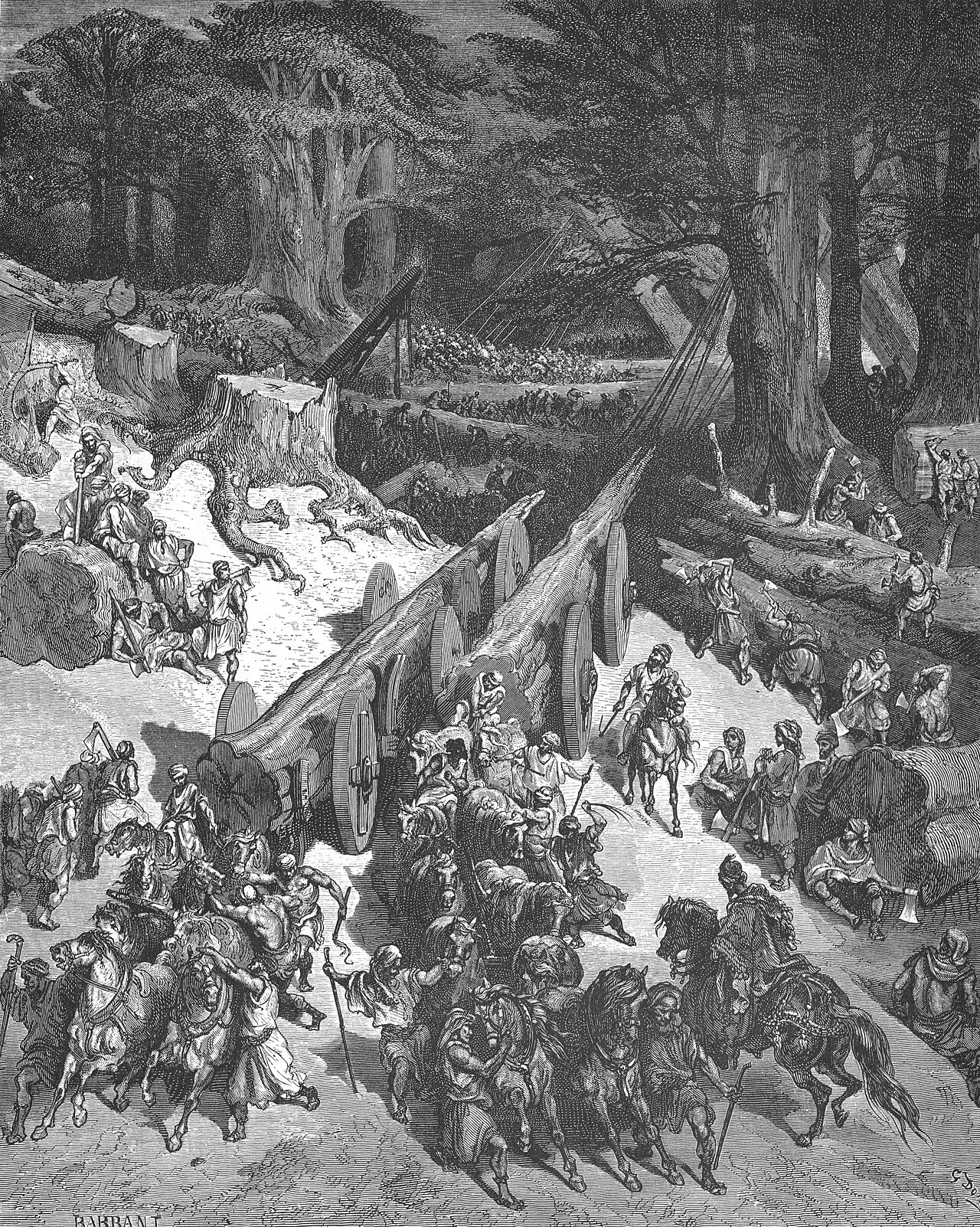
1 Kingschapter 5
18 verses · Jeremiah, by tradition · 6th century BC · History
And the king commanded, and they brought great stones, costly stones, and hewed stones, to lay the foundation of the house.
Introduction
Jeremiah, by tradition, History, 1 Kings Overview.
The historian writes this chapter from the records of two courts, the palace in Jerusalem and the palace in Tyre. It is a chapter of letters, contracts and workmen, and it opens the long account of the house built for the LORD. Its first hearers had seen that house burned, and they read of its beginning with that loss behind them. Listen for the reason the king gives for starting now. Count the bodies of workmen before a single stone is set. Notice who supplies what, and what is paid for it.
Context
- Who
- Israelites who had never seen their nation buy the labour of another for a house of worship
- What
- The agreement between Solomon and Hiram king of Tyre for cedar and cypress, and the levy of workmen and stonecutters for the temple.
- Where
- Tyre on the Phoenician coast, the forests of Lebanon, the sea route south along the coast, and Jerusalem.
- When
- The years leading to Solomon's fourth year, about 967 BC.
- Why
- To show Solomon beginning the house David was told his son would build, in the rest the LORD had given, by the wisdom given at Gibeon.
Historical context
The chapter belongs to two kings at once, Solomon in Jerusalem and Hiram in Tyre, and it moves by letters between them.
Show the rest of the historical context, 4 more paragraphs
The time is the run up to the fourth year of the reign, about 967 BC. The places are Tyre, the cedar forests of Lebanon, the coast down which the timber was floated, and Jerusalem about forty miles inland from the nearest port.
The occasion is the building of the house that David was told he could not build. Solomon opens the exchange by saying that the wars are over, which is the reason he gives a foreign king for beginning now.
A first hearer knew what a reader today has to be told. Hiram of Tyre is a king known outside Scripture, and Josephus reports the correspondence between the two courts and cites the Greek historian Menander, who worked from records once kept in Tyre.
Phoenician timber travelled by sea lashed into rafts and was hauled inland from a port, the same route Ezra 3:7 uses for the second temple's cedar. Gebal, which the Greeks called Byblos, supplied the most skilled masons on that coast. A levy of men for royal works was an ordinary demand of a crown in that world, and Solomon's rotation of one month away and two at home was a light form of it.
Significance
The first hearers would have measured the house by what it cost to raise. Four bodies of workmen are counted before a stone is laid, and two of them are foreign.
Show the rest of the significance, 2 more paragraphs
They would also have heard the promise being kept. A son of David was building the house his father was refused, and the chapter credits the whole arrangement to the wisdom given at Gibeon.
The levy in verse 13 is the first laid on free Israelites in the record, and the memory of it reaches Rehoboam a generation later.
This chapter in Jewish lifeWhat this chapter is in Jewish life and reading.
What is done
This chapter is heard once a year, and both rites read it. It stands in the reading from the Prophets that follows the Torah portion of the command to build the tabernacle and its furnishings, the portion called Terumah. The reading begins inside this chapter and carries on into the next. A congregation hears God tell Moses to take an offering and make a sanctuary in the morning, and then hears Solomon send to Hiram for cedar and raise the levy for the house. That the pairing sets the making of the tent beside the making of the house is the writer's reading of src/lib/hebraic/readings.ts, and it is marked as the writer's reading. The corpus and a Jewish Bible number this chapter from the verse an English Bible prints as 4:21, so the reading begins further into the chapter than an English numbering suggests.
How it is read
Rashi is quoted here from the Metsudah Tanach series of Lakewood, New Jersey, which Sefaria reports as CC-BY. The number of Solomon's stalls is the question this chapter opens with in the tradition, and the classical answer is a harmony rather than a correction. The corpus's own note sets the forty thousand of Kings beside the four thousand of Chronicles, and reports the Rabbis' two ways of holding both. Either there were forty thousand stalls with four thousand partitions in each, or four thousand stalls with forty thousand partitions in each (Rashi on I Kings 5:6:1). The provisioning is read as complete to the point of season. Nothing was lacking, Rashi says, down to the fruits of summer served in winter (Rashi on I Kings 5:7:1).
Solomon's wisdom is measured against named rivals. The wisdom of the children of the East, Rashi glosses from the Pesikta as learning in the stars. He adds that the whole passage is expounded there in its plain sense (Rashi on I Kings 5:10:1). On the line that he was wiser than any man, Rashi takes the plain reading. The translation records a second reading beside it, drawn from the saying in Avot that the wise man is the one who learns from every man (Rashi on I Kings 5:11:1). The three thousand parables he counts as three books of them, and points to the three headings in Proverbs that carry Solomon's name (Rashi on I Kings 5:12:1).
The verse about trees and beasts is where the classical reading opens widest. Rashi first takes it as practical knowledge. Solomon knew which remedy came from which tree, which timber suited which building and which ground, and the cure and the feeding of each animal. Then he sets the Midrash Aggadah beside it, which reads the same verse as a set of questions about the law. Why is a leper made clean by the tallest of trees and the lowest, the cedar and the hyssop? Why is a bird made fit by the cutting of one organ, cattle by two, and fish and locusts by none at all (Rashi on I Kings 5:13:1)?
The refusal to let David build is read from the law. Rashi says David was not permitted while the wars stood, because the Torah set rest from enemies first and the chosen place after it (Rashi on I Kings 5:17:1). The Sidonians are read as the men with the skill because they lived beside the forest and under Hiram (Rashi on I Kings 5:20:1). The floats Rashi explains as a method rather than a vessel. Logs were bound together, floated on the water and steered as a ship is steered. He gives the word for them in the German and the Old French of his own day (Rashi on I Kings 5:23:1). Thirteen further notes stand in the corpus without an English text and are cited and unquoted. Radak stands at Radak on I Kings 5:1:1, 5:4:1, 5:9:1, 5:14:1, 5:15:1, 5:16:1 and 5:18:1. Metzudat David stands at 5:2:1, 5:5:1, 5:21:1 and 5:22:1, and Malbim at 5:19:1 and 5:24:1.
What the rabbis say
The corpus carries forty rabbinic locators on this chapter and the text of none, so each is cited and linked here rather than quoted. Solomon's rule over the kingdoms draws three on the first verse. The corpus holds Esther Rabbah 1:5, Otzar Midrashim, Midrash on the Ten Kings 1:7, and Otzar Midrashim, Midrash Shelosha v'Arba'ah 4:5. The daily provision draws Bava Metzia 86b:2 and Ein Yaakov, Bava Metzia 7:19 on the second verse, with Bamidbar Rabbah 21:19. On the third it holds Jerusalem Talmud Bava Metzia 7:1:1 and Kohelet Rabbah 2:7:1, and on the fourth Bamidbar Rabbah 1:2 and Bereshit Rabbah 34:12.
The stalls and the officers draw their own set. On the fifth verse the corpus holds Ein Yaakov (Glick Edition), Sanhedrin 11:99 and Midrash Tanchuma, Vayeshev 1:1. On the sixth, the verse of the disputed number, it holds Aggadat Bereshit 76:2 and Bamidbar Rabbah 11:7. On the seventh it holds Devarim Rabbah 1:5, and on the eighth Ein Yaakov, Pesakhim 1:9 with Midrash Tannaim on Deuteronomy 17:16:3.
The wisdom verses draw the heaviest weight. On the ninth the corpus holds Midrash Tanchuma Buber, Chukat 10:1 and Pesikta Rabbati 14:1. On the tenth it holds Bamidbar Rabbah 19:3 and Kohelet Rabbah 7:23:1. On the eleventh it holds Bava Batra 15a:10 and Bamidbar Rabbah 13:14. On the twelfth, the parables and the songs, it holds Bereshit Rabbati, Parashat Bereshit 61 and Ein Yaakov (Glick Edition), Eiruvin 2:8. On the thirteenth, the trees and the beasts, it holds Bereshit Rabbati at Parashat Bereshit 13 and Parashat Vayetze 33. On the fourteenth it holds Kohelet Rabbah 1:1:2.
Hiram and the levy close the chapter. On the fifteenth verse the corpus holds Bereshit Rabbah 85:4 and Midrash Aggadah, Genesis 38:1:3, and on the sixteenth Shir HaShirim Rabbah 3:10:4. On the eighteenth it holds Shemot Rabbah 15:26. On the twenty-fifth, the wheat and the oil sent to Hiram, it holds Bamidbar Rabbah 16:25 with a passage of the Introductions to Amoraic Literature on Bava Batra, at 164. The levy itself draws Midrash Sekhel Tov at Bereshit 49:15:5 and Shemot 1:11:2 on the twenty-seventh verse. On the twenty-eighth it holds Ein Yaakov, Ketubbot 5:7 and Jerusalem Talmud Ketubot 5:7:3, and on the twenty-ninth Ein Yaakov, Yevamot 8:9 with the Glick Edition at Yevamot 8:7. What each of them teaches is a saying of the rabbis, and this site reports it as theirs. The quotations wait on a fetch that carries the text.
Sources: Rashi, Rashi on I Kings 5:3:1 to 5:23:1, the Metsudah Tanach series, Lakewood, N.J, reported CC-BY; Radak, Radak on I Kings 5:1:1 to 5:18:1, cited by ref because Sefaria holds no English version; Metzudat David, Metzudat David on I Kings 5:2:1 to 5:22:1, cited by ref because Sefaria holds no English version; Malbim, Malbim on I Kings 5:19:1 and 5:24:1, cited by ref because Sefaria holds no English version; The Pesikta, cited by Rashi at Rashi on I Kings 5:10:1 for the wisdom of the children of the East; The Midrash Aggadah, cited by Rashi at Rashi on I Kings 5:13:1 for the cedar and the hyssop; The Sefaria corpus on disk, scripts/data/sources/sefaria/1-kings/5.json, fetched 2026-09-19, the forty Midrash and Talmud locators cited above, 2026; MannaFest, src/lib/hebraic/readings.ts, the Haftarah use and its rite, printed in this lane, 2026.
The heads below are this chapter's scenes. The numbered points under each are its verses.
Hiram of Tyre, ever a lover of David
1 Kings 5:1-2
ever a lover of David: Hiram opens relations the way ancient kings normally did at a succession, sending an embassy of congratulation rather than testing the new king's strength. The clause naming him ever a lover of David explains what follows: the alliance passes to Solomon as a personal loyalty, not merely a treaty renewed by custom. Josephus and the Greek historian Menander both record a Hiram of Tyre corresponding with Solomon and cite documents once held in the Tyrian archives, outside testimony to a friendship the text states in one line.
1 Kings 5:1
“Hiram, king of Tyre - Menander of Ephesus, who wrote a history of Tyre in Greek, founded upon native Tyrian documents, about 300 B.C., mentioned this Hiram as the son of Abibaal king of Tyre, and said that he ascended the throne when he was nineteen; that he reigned thirty-four years, and, dying at the age of fifty-three, was succeeded by his son Baleazar. Menander spoke at some length of the dealings of Hiram with Solomon. Sent his servants - This appears to have been an embassy of congratulation.”
Solomon’s message answers the envoys King Hiram of Tyre had sent. John Gill has it carried by those envoys on their return or by envoys of Solomon’s own, and he notes that Eupolemus gives the letters of both kings. Adam Clarke doubts that Tyre kept them in its archives, as Josephus claimed.
1 Kings 5:2
“And Solomon sent to Hiram,.... A letter, either by the hand of his ambassadors when they returned, as Kimchi thinks, or by ambassadors Solomon sent on purpose. Josephus (w) appeals to the Tyrian archives for the genuineness of these letters that passed between Hiram and Solomon; and Eupolemus, an Heathen writer (x) has both this which Solomon sent to Hiram, and that which Hiram sent in answer to it, which agree with those in the sacred records: saying: as follows. (w) Antiqu. l. 8. c. 2. sect. 8. (x) Ut Supra. (Apud Euseb. Praepar. Evangel. l. 9. c. 32, 34.)”
1 more voice on this verse
1 Kings 5:2
“Solomon sent to Hiram - Made an interchange of ambassadors and friendly greetings. Josephus tells us that the correspondence between Hiram and Solomon was preserved in the archives of the Tyrians even in his time. But this, like many other assertions of the same author, is worthy of little credit.”
Adam Clarke · Commentary on the Bible (1810-1826)evangelical
1 Kings 5:3-5
could not build an house: Solomon gives Hiram the reason 1 Chronicles 22:8 states in full, that David's wars and the blood he shed kept the building for his son, and sets it beside the promise Nathan carried at 2 Samuel 7:12-13, thy son whom I will set upon thy throne, he shall build an house unto my name. The rest on every side is itself Solomon's proof that the promised hour has come; a king who can say the wars are over is a king free to keep his father's unfulfilled vow. The phrase an house unto the name of the Lord, rather than simply unto the Lord, opens the naming theology the chapter after next will carry to its full statement.
1 Kings 5:3
“Solomon’s presumption that Hiram knew David’s design has not appeared in the previous history, but it is in accordance with 1Ch 22:4.”
The Hebrew word for adversary is satan, as Adam Clarke notes, the ordinary word for an opponent. John Gill reads the rest as peace at home as well as abroad, with Adonijah and Joab already cut off in chapter 2. Albert Barnes sets this peace against David's wars.
1 Kings 5:4
“But now the Lord my God hath given me rest on every side,.... From foreign enemies; for Solomon had no wars with any: so that there is neither adversary; or Satan, no internal enemy in his kingdom, as well as no external ones, Adonijah, Joab, and other ill-designing persons, being cut off: nor evil occurrent; nothing that rose up, and met him, to discourage or hinder the prosecution of the good work he had in view.”
1 more voice on this verse
1 Kings 5:4
“There is neither adversary - אין שטן eyn satan, there is no satan - no opposer, nor any kind of evil; all is peace and quiet, both without and within. God has given me this quiet that I may build his temple. Deus nobis haec otia fecit.”
Adam Clarke · Commentary on the Bible (1810-1826)evangelical
Adam Clarke reads the Name of the LORD as God himself. John Gill sees Solomon here as a type of Christ, who builds his temple, the church, as Zechariah 6:12 foretells. Matthew Henry notes that the promise to David gave Solomon courage for the work.
1 Kings 5:5
“And, behold, I purpose to build an house unto the name of the Lord my God,.... For his worship, and for his honour and glory: as the Lord spake unto David my father; by the prophet Nathan, 2Sa 7:12; saying, thy son whom I will set upon thy throne in thy room, he shall build an house unto my name; which was no small encouragement to Solomon to go about this work; in which he was a type of Christ, the builder of his temple, the church, see Zec 6:12.”
1 more voice on this verse
1 Kings 5:5
“A house unto the name of the Lord - The name of God is God himself. I purpose to build a house to that infinite and eternal Being called Jehovah.”
Adam Clarke · Commentary on the Bible (1810-1826)evangelical
1 Kings 5:6-7
can skill to hew timber: Solomon's admission that no one in Israel can skill to hew timber like the Sidonians sends the temple's timber outside the covenant people from the first plank; Wesley reads the Gentile labor as a type of the nations later built into Christ's own temple, a reading he names as his own rather than as the text's claim. Hiram answers with a blessing on the Lord who gave David so wise a son, language Adam Clarke takes as evidence of a genuine worshipper of Israel's God, while Jamieson, Fausset and Brown read it more cautiously, as a foreign king honoring another nation's deity by custom. The text itself gives only the blessing and leaves the man behind it for the reader to weigh.
1 Kings 5:6
“They - That is, thy servants. And this assistance which these Gentiles gave to the building of Solomon's temple, was a type of the calling of the Gentiles, and that they should be instrumental in building and constituting Christ's spiritual temple.”
John Wesley · Explanatory Notes upon the Old Testament (1765)evangelical
Cedar and fir for wheat and oil: a league between kings
Blessed be the Lord this day: Ishodad of Merv held that Hiram, a friend of David, had come to worship God through that friendship. John Wesley judged the king of Tyre an unlikely proselyte who still held the God of Israel in honour. Matthew Henry gives God the glory for David’s wise son.
1 Kings 5:7
“Blessed be the Lord this day - From this, and indeed from every part of Hiram’s conduct, it is evident that he was a worshipper of the true God; unless, as was the case with many of the heathens, he supposed that every country had its own god, and every god his own country, and he thanked the God of Israel that he had given so wise a prince to govern those whom he considered his friends and allies: but the first opinion seems to be the most correct.”
Adam Clarke · Commentary on the Bible (1810-1826)evangelical
1 more voice on this verse
1 Kings 5:7
“Blessed be the Lord--This language is no decisive evidence that Hiram was a worshipper of the true God, as he might use it only on the polytheistic principle of acknowledging Jehovah as the God of the Hebrews (see on 2Ch 2:11).”
Jamieson, Fausset & Brown · Commentary Critical and Explanatory on the Whole Bible (1871)reformed
1 Kings 5:8-9
I have considered the things: Hiram's answer is a formal acceptance, I have considered the things which thou sentest to me for, which the commentators read as a written compact rather than a verbal nod, with 2 Chronicles 2:11 preserving the letter's fuller text. The timber travels down the coast lashed into floats to the nearest port, almost certainly Joppa, for the roughly forty mile land haul up to Jerusalem, the same route Ezra 3:7 uses for the second temple's cedar a generation after the exile. A king's desire for food and a nation's need for timber trade cleanly against one another; the arrangement runs on ordinary commerce, not tribute.
1 Kings 5:8
“And Hiram sent to Solomon,.... A letter to him, to the following purpose: saying, I have considered the things which thou sentest to me for; whether he could, and whether it was fitting he should grant his request; which was acting like a wise and prudent prince: and I will do all thy desire concerning timber of cedar, and concerning timber of fir; or of cypress, as in Josephus's copy of this letter, and which grew on Lebanon (c); these were odorous, sound, and durable timber, especially the cedar, and therefore chosen by Solomon for building. (c) Diodor. Sic. l.”
Adam Clarke has Hiram’s servants cut the timber to fit its place in the temple before it left Lebanon. The logs then needed no further axe or saw. Clarke puts the landing at Joppa, some twenty-five miles from the temple site, where Albert Barnes counts about forty.
1 Kings 5:10-12
cedar trees and fir trees: The exchange is precisely reciprocal, Hiram's cedar and fir for Solomon's wheat and beaten oil year by year, and the narrator credits the whole favorable arrangement to the wisdom the Lord gave Solomon, as he promised him, the promise of 3:12 already bearing fruit in statecraft and not only in judgment. Gill notes that a league with Tyre broke no command, since the Phoenicians stood outside the seven nations Israel was forbidden to covenant with. Peace between the two kings frames the whole building project: the temple rises inside an alliance with a neighboring people, not apart from them.
1 Kings 5:10
“It is here said of Hiram their king that he was ever a lover of David; and we have reason to think he was a worshipper of the true God, and had himself renounced, though he could not reform, the idolatry of his city.”
Matthew Henry · Commentary on the Whole Bible (1707-1721)puritan
The Hebrew text reads twenty cors of pure olive oil, and the Berean’s 20,000 baths agrees with the Septuagint, the Syriac and 2 Chronicles 2:10, as Adam Clarke and John Wesley note. Albert Barnes defends the smaller figure as beaten oil. Jamieson, Fausset and Brown take this wheat and oil as food for Hiram’s household year by year, apart from the workmen’s wages.
1 Kings 5:11
“The number of measures of wheat was considerably less than Solomon’s own annual consumption, which exceeded 32,000 cors 1Ki 4:22; but the small amount of twenty cors of oil, which seems at first sight scarcely to match with the 20,000 cors of wheat, will not appear improbable, if we consider that the oil was to be” pure” - literally “beaten” - i. e., oil extracted from the olives by pounding, and not by means of the press. Year by year - i. e., during all the years that Solomon was engaged in building and was helped by Hiram.”
1 more voice on this verse
1 Kings 5:11
“Thus let justice be followed (as the expression is, Deut. xvi. 20 ), justice on both sides, in every bargain. The confirmation of the friendship that was between them hereby.”
Matthew Henry · Commentary on the Whole Bible (1707-1721)puritan
God's gift of wisdom won Hiram's love, in Matthew Henry's reading. The two kings then ripened that friendship into a treaty so that it would last. Peace came first.
1 Kings 5:12
“And the Lord gave Solomon wisdom, as he promised him,.... Which, among other things, appeared in his preparations for building the temple, and in his agreements with Hiram for timber and workmen for that purpose and by continuing and confirming friendship between himself and Hiram, who was so serviceable to him: and there was peace between Hiram and Solomon, and they two made a league together; in order to continue and establish peace and friendship between them, which Solomon might lawfully do, the Tyrians being no part of the seven nations with whom alliances were forbidden.”
Thirty thousand levied; great stones hewn in the mountain
1 Kings 5:13-14
king Solomon raised a levy: Barnes notes what the text does not say outright, that this is apparently the first time Israelites themselves are put under a forced levy, the very thing Samuel warned of at 1 Samuel 8:11-17 when the people asked for a king. Solomon rotates the thirty thousand a month in Lebanon and two months at home under Adoniram, a real mercy in the terms, yet it is Israelite men, not only the conquered peoples of 9:20-22, standing in the muster for the first time. The northern elders will name this same levy by memory at 12:4, asking Rehoboam to lighten the grievous service his father laid on them; the seed is planted here, chapters and a generation before it splits the kingdom.
1 Kings 5:13
“A levy out of all Israel - This was, apparently, the first time that the Israelites had been called upon to perform forced labor, though it had been prophesied 1Sa 8:16. David had bound to forced service “the strangers” 1Ch 22:2; but hitherto the Israelites had escaped. Solomon now, in connection with his proposed work of building the temple, with the honor of God as an excuse, laid this burden upon them.”
2 more voices on this verse
1 Kings 5:13
“If it seem strange, that so many thousands should be employed about so small a building as the temple was; it must be considered, 1. that the temple, all its parts being considered, was far larger than men imagine; 2. that it is probable, they were employed by turns, as the thirty thousand were, ver. 14, else they had been oppressed with hard and uninterrupted labours.”
John Wesley · Explanatory Notes upon the Old Testament (1765)evangelical
1 Kings 5:13
“It was temple service, yet Solomon takes care that they shall not be over-worked. Great men ought to consider that their servants must rest as well as they.”
Matthew Henry · Commentary on the Whole Bible (1707-1721)puritan
two months at home: Charles Spurgeon saw the one month in Lebanon and two at home as care for the men's own fields and affairs, so that none left his land to lie waste. Spurgeon drew the lesson that God's work should be glad service.
1 Kings 5:14
“IT was right that when a Te a levy was made and a certain number of men were chosen to work in Lebanon. It was, however, most fitting that work for a gracious God should be joyful work—not the bondage of slaves, but the delight of sons. Solomon did not demand that any Israelite should toil in the mountains and queries for years together and leave his own fields to lie waste, but he decreed that the workers should have one month in Lebanon at work on the Temple and two months at home for their own affairs.”
Charles Spurgeon · written before 1892 · The Metropolitan Tabernacle Pulpit, Sermon No. 3313: “A Practical Discourse” (lightly modernized text, CCEL edition)Particular Baptist
1 Kings 5:15-16
threescore and ten thousand: A second and larger workforce stands behind the thirty thousand: threescore and ten thousand bearers of burdens and fourscore thousand hewers in the mountains, and Barnes reads these as the Amorite, Hittite, Perizzite, Hivite and Jebusite remnant David had already put to permanent tribute service at 1 Chronicles 22:2, the same class of workers 1 Kings 9:20-22 later says Solomon never made bondmen of Israel. The distinction matters: verses 13-14 conscript free Israelites on rotation, verses 15-16 describe a standing labor force drawn from the conquered peoples, and the text keeps the two groups named apart even while counting both. The officer total of three thousand three hundred is given as thirty six hundred at 2 Chronicles 2:18, a variant the commentators leave as a copying difference rather than a contradiction to settle.
1 Kings 5:15
“That bare burdens ... - Compare the marginal references. These laborers, whose services were continuous, consisted of “strangers” - “the people that were left of the Amorites, Hittites, Perizzites, Hivites, and Jebusites” - whom Solomon, following the example of his father 1Ch 22:2, condemned to slavery, and employed in this way.”
1 more voice on this verse
1 Kings 5:15
“Listen to even greater mysteries. At the time when Solomon built the temple, it was our peacemaker who says, "Peace I leave with you, my peace I give to you," "for he himself is our peace," "the peace of God that surpasses all understanding," who himself built the temple for God. Observe what Scripture says about the building of the temple by Solomon: "And there were seventy thousand quarrymen and eighty thousand carriers." Mark the number.”
Jerome · written before 420 · HOMILIES ON THE PSALMS 19 (PS 89 [90])patristic
Solomon’s 3,300 foremen supervised the porters and stonecutters of verse 15. Albert Barnes finds the foremen of both books total 3,850 once the officers of 9:23 are added, with the counts grouped by nation or by rank. John Wesley sets each of the foremen over fifty workers.
1 Kings 5:16
“Besides - three thousand and three hundred which ruled over the people - In the parallel place, 2Ch 2:18, it is three thousand six hundred. The Septuagint has here the same number.”
Adam Clarke · Commentary on the Bible (1810-1826)evangelical
1 Kings 5:17-18
brought great stones, costly stones: The great, costly, hewed stones for a foundation no worshipper will ever see are, Wesley writes, magnificence for its own sake unless meant as a type of Christ, the foundation stone of Isaiah 28:16, a reading he offers and does not press as the text's own statement. Barnes points to stones of comparable size still visible at the southwest corner of Jerusalem's Haram wall in his own century, one measured near thirty nine feet long and near a hundred tons, physical scale that matches what the verse describes. The Giblites of Gebal, Hiram's most skilled masons by Joshua 13:5, close the chapter's roster of nations at work on Israel's house: Sidonian fellers, Tyrian and Israelite builders, and now Phoenician stonesquarers, all named before a single stone is set inside the walls.
1 Kings 5:17
“Great and costly - Marble and porphyry, or other stones of great size and value. The foundation - Where they could not afterward be seen: and therefore that this was done, is mentioned only as a point of magnificence, except it was intended for a type, or mystical signification of the preciousness of Christ, who is the foundation of the true temple, the church of God.”
John Wesley · Explanatory Notes upon the Old Testament (1765)evangelical
3 more voices on this verse
1 Kings 5:17
“Some of these “great, hewed (no and) stones,” are probably still to be seen in the place where they were set by Solomon’s builders, at the southwestern angle of the wall of the Haram area in the modern Jerusalem. The largest found so far is 38 ft. 9 in. long, and weighs about 100 tons.”
1 Kings 5:17
“Work done without the Lord's command may be nothing more than mere will-worship, unacceptable with the Lord. Where the word of a king is, there is power. And you may expect that power to go forth with you when you go forth under the guidance and authority of the Divine command. Solomon began to build the temple at the foundation. You smile and wonder how he could have begun anywhere else. Ah, dear Friends! I wish common sense ruled people in religion as well as in building temples. For many Brethren begin their building at the top.”
1 Kings 5:17
“Christ, who is laid for a foundation, is an elect and precious stone ( Isa. xxviii. 16 ), and the foundations of the church are said to be laid with sapphires, Isa. liv. That sincerity which is our gospel perfection obliges us to lay our foundation firm and to bestow most pains on that part of our religion which lies out of the sight of men.”
Matthew Henry · Commentary on the Whole Bible (1707-1721)puritan
The Gebalites who quarried stone and prepared timber came from Gebal, a coastal city between Beirut and Tripoli that the Greeks called Byblus, as Albert Barnes notes. Adam Clarke and Bede cite Ezekiel 27:9, where its skilled men work on the ships of Tyre. Here the same skill serves the temple.
1 Kings 5:18
These great bevelled or grooved stones, measuring some twenty, others thirty feet in length, and from five to six feet in breadth, are still seen in the substructures about the ancient site of the temple; and, in the judgment of the most competent observers, were those originally employed "to lay the foundation of the house."
Jamieson, Fausset & Brown · Commentary Critical and Explanatory on the Whole Bible (1871)reformed
1 more voice on this verse
1 Kings 5:18
“And the stone-squarers - Instead of stone-squarers the margin very properly reads Giblites, הגבלים haggiblim; and refers to Eze 27:9, where we find the inhabitants of Gebal celebrated for their knowledge in ship-building. Some suppose that these Giblites were the inhabitants of Biblos, at the foot of Mount Libanus, northward of Sidon, on the coast of the Mediterranean Sea; famous for its wines; and now called Gaeta. Both Ptolemy and Stephanus Byzantinus speak of a town called Gebala, to the east of Tyre: but this was different from Gebal, or Biblos.”
Adam Clarke · Commentary on the Bible (1810-1826)evangelical
How this psalm is built
The form: Narrative with a treaty inside it, the preparation and the labour for the temple, as Barnes classes it.
The patterns in this chapter
| Device | What it does | Where to see it |
|---|---|---|
| The four workforces, counted and kept apart | The chapter counts thirty thousand conscripted from Israel at verse 13, seventy thousand porters and eighty thousand stonecutters at verse 15, and three thousand three hundred foremen at verse 16, alongside the Sidonian fellers of verse 6 and the Gebalites of verse 18. Albert Barnes reads the two large bodies as the remnant of the conquered peoples already set to tribute service, and the text keeps them named apart from the Israelite levy.Albert Barnes, Notes, Explanatory and Practical, on the Old and New Testaments, 1832 to 1869, on 1 Kings 5:15. | 1 Kings 5:6, 1 Kings 5:13, 1 Kings 5:14, 1 Kings 5:15, 1 Kings 5:16, 1 Kings 5:18 |
| You know, and I will give | Solomon's message at verses 3 to 6 and Hiram's reply at verses 8 and 9 are built as a matched pair, a statement of the case, a request and a settled term of payment on each side. Verse 11 gives the annual return in wheat and pressed oil against the cedar and cypress of verse 10. Adam Clarke and the older commentators read the exchange as a written compact, and 2 Chronicles 2:11 preserves a fuller text of the reply.Adam Clarke, Commentary on the Bible, 1832, on 1 Kings 5:8. | 1 Kings 5:3, 1 Kings 5:6, 1 Kings 5:8, 1 Kings 5:9, 1 Kings 5:10, 1 Kings 5:11 |
| A house for the Name | The building is named three times in the chapter as a house for the LORD's Name, at verses 3 and 5, counted in the Berean text in the store, with verse 5 carrying the phrase twice. The wording is the language the dedication prayer of chapter 8 works out at length, where the Name dwells in the house while the LORD fills heaven. John Gill reads verse 5 as Solomon's claim that the promise carried by Nathan at 2 Samuel 7:13 names him.John Gill, Exposition of the Old Testament, 1748 to 1763, on 1 Kings 5:5. | 1 Kings 5:3, 1 Kings 5:5 |
| Rest on every side, and no adversary | Verse 4 is the hinge of Solomon's message to Hiram. David could not build because of the wars around him, and Solomon can build because the wars are over, which is the reason he gives a foreign king for opening the work now. 1 Chronicles 22:8 states the same reason in David's own mouth. The rest is therefore presented as the permission rather than as a benefit of the reign.John Wesley, Explanatory Notes upon the Old Testament, 1765, on 1 Kings 5:4. | 1 Kings 5:3, 1 Kings 5:4 |
Where the chapter stands in the book
9 more paragraphs on the patterns
Chapter 5 opens the building account, and it stands at the foot of the climb the book page describes, rising to the dedication in chapter 8. Everything the reign has gathered in chapter 4 is spent here. The chapter also plants the grievance the kingdom splits over, since the elders of the north name the service of this reign when they meet Rehoboam at 12:4.
The historical value
Hiram of Tyre is attested outside Scripture. Josephus reports correspondence between Hiram and Solomon and cites the Greek historian Menander, who drew on records once kept in Tyre, so a king of that name in that place at that time stands on testimony beyond the biblical text. Albert Barnes records the point at verse 1.
The freight route of verse 9 is ordinary Phoenician practice, timber floated down the coast in rafts to a port and hauled inland. Ezra 3:7 uses the same route for the cedar of the second temple, which gives the arrangement a second attestation inside Scripture at a distance of centuries.
The foundation stones of verse 17 are described as large and costly. Albert Barnes reports stones of comparable size still visible in his own century at the southwest corner of the Haram wall in Jerusalem, one of them measured near thirty nine feet long. The site states the comparison as the scale the verse describes and makes no claim that the visible stones are Solomon's own.
The debated concept
Whether Hiram worshipped the God of Israel is contested. Adam Clarke reads the blessing of verse 7 as the language of a genuine worshipper. Jamieson, Fausset and Brown read it as the courtesy of a foreign king honouring another nation's God by custom. Ishodad of Merv reports a tradition that Hiram had been turned to the worship of God through his dealings with David. The text gives the blessing and says nothing about the man behind it.
The labour is the second question. Verses 13 and 14 conscript free Israelites on a rotation, and 9:22 later says Solomon made no Israelite a slave. Albert Barnes notes that this is the first Israelite levy in the record and sets it against the warning Samuel gave at 1 Samuel 8:11 to 17. One reading holds the rotation to be a light and temporary service that breaks no promise. Another holds that the distinction was thin to the men who served, and the elders at 12:4 are cited for it. The text keeps the Israelite levy and the standing force of the conquered peoples named apart while counting both.
The officer count is a third and smaller question. Verse 16 gives three thousand three hundred foremen and 2 Chronicles 2:18 gives three thousand six hundred. The commentators treat the difference as a copying difference rather than a contradiction to settle, and the site states both figures.
Keep studying
Studies1
Places1
Sources for this chapter
The summary
Jamieson, Fausset & Brown, Commentary Critical and Explanatory; John Wesley, Notes on the Old Testament and Matthew Henry, Complete Commentary.
The form and classifications
Adam Clarke, Commentary on the Bible, 1832, on 1 Kings 5:9; Albert Barnes, Notes, Explanatory and Practical, on the Old and New Testaments, 1832 to 1869, on 1 Kings 5:1; Bede, On the Temple of Solomon 1.2.4 and 1.2.5; John Gill, Exposition of the Old Testament, 1748 to 1763, on 1 Kings 5:5 and Prudentius, The Spiritual Combat, lines 804 to 822.
The exposition
Adam Clarke, Commentary on the Bible; Albert Barnes; Bede, Of the Temple of Solomon 1.4.3; Charles Spurgeon, The Metropolitan Tabernacle Pulpit, Sermon No. 3313: “A Practical Discourse” (lightly modernized text, CCEL edition); Ishodad of Merv, BOOKS OF SESSIONS 1 KINGS 5:7; Jamieson, Fausset & Brown, Commentary Critical and Explanatory on the Whole Bible; Jamieson, Fausset and Brown, Commentary Critical and Explanatory on the Whole Bible; John Gill; John Wesley, Explanatory Notes upon the Old Testament and Matthew Henry, Commentary on the Whole Bible.