
1 Kings 5:17
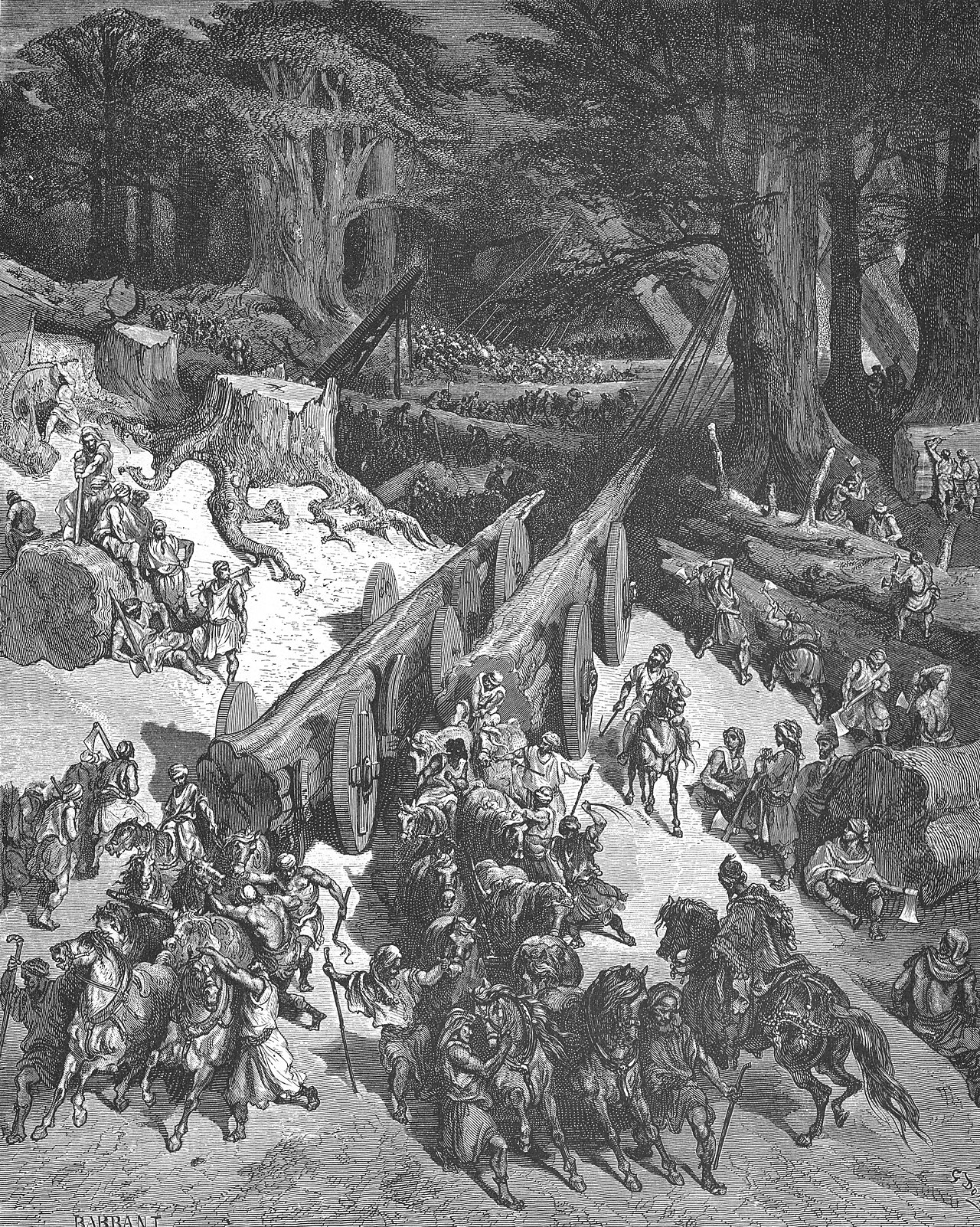
in 1 Kings 5And the king commanded them to quarry large, costly stones to lay the foundation of the temple with dressed stones.
BSB
The same verse in ASV and KJV ▾
ASV
And the king commanded, and they hewed out great stones, costly stones, to lay the foundation of the house with wrought stone.
KJV
And the king commanded, and they brought great stones, costly stones, and hewed stones, to lay the foundation of the house.
⋯
This verse in 1 Kings 5
Commentary
11 notes on this verseA commentator
Albert Barnes1798–1870
Notes, Explanatory and Practical, on the Old and New Testaments (1832-1869)
Some of these “great, hewed (no and) stones,” are probably still to be seen in the place where they were set by Solomon’s builders, at the southwestern angle of the wall of the Haram area in the modern Jerusalem. The largest found so far is 38 ft. 9 in. long, and weighs about 100 tons.
This site's exposition
quarry large, costly stones
on 1 Kings 5:17-18
The king orders “large, costly stones to lay the foundation of the temple with dressed stones”, for a foundation that lies out of sight. Albert Barnes points to stones of comparable size in the southwest corner of the Haram wall in his own century, one near thirty-nine feet long.
The record, by era
The Medieval Church1 voice
But it seems to be in accord with the solemn celebration that we are observing to recall something about the building of the temple and to search out how appropriately its adornment suits the significance of the church. Scripture tells how Solomon ordered that "they …
The Puritans and the Awakening4 voices
Great and costly - Marble and porphyry, or other stones of great size and value. The foundation - Where they could not afterward be seen: and therefore that this was done, is mentioned only as a point of magnificence, except it was intended for a type, or mystical signification of the preciousness of Christ, who is the foundation of the true temple, the church of God.
It is here said of Hiram their king that he was ever a lover of David; and we have reason to think he was a worshipper of the true God, and had himself renounced, though he could not reform, the idolatry of his city.
Christ, who is laid for a foundation, is an elect and precious stone ( Isa. xxviii. 16 ), and the foundations of the church are said to be laid with sapphires, Isa. liv. That sincerity which is our gospel perfection obliges us to lay our foundation firm and to bestow most pains on that part of our religion which lies out of the sight of men.
And the king commanded, and they brought great stones,....
4 more voices on this verse
The Nineteenth Century4 voices
Work done without the Lord's command may be nothing more than mere will-worship, unacceptable with the Lord. Where the word of a king is, there is power. And you may expect that power to go forth with you when you go forth under the guidance and authority of the Divine command. Solomon began to build the temple at the foundation. You smile and wonder how he could have begun anywhere else. Ah, dear Friends! I wish common sense ruled people in religion as well as in building temples. For many Brethren begin their building at the top.
A commentator
Jamieson, Fausset & Brown1802–1910
Commentary Critical and Explanatory on the Whole Bible (1871)
proposed
brought great stones--The stone of Lebanon is "hard, calcareous, whitish and sonorous, like free stone" [SHAW]. The same white and beautiful stone can be obtained in every part of Syria and Palestine. hewed stones--or neatly polished, as the Hebrew word signifies (Ex 20:25).
quarantine:debris (2026-07-29) — starts-lowercase
Work done without the Lord's command may be nothing more than mere will-worship, unacceptable with the Lord. Where the word of a king is, there is power. And you may expect that power to go forth with you when you go forth under the guidance and authority of the Divine command. Solomon began to build the temple at the foundation. You smile and wonder how he could have begun anywhere else. Ah, dear Friends! I wish common sense ruled people in religion as well as in building temples. For many Brethren begin their building at the top. To baptize an unbeliever on the ground of a faith which does not yet exist is laying the topstone before the foundation. To gather into Church fellowship those who are not gathered to Christ is attempting to pile on the roof before there are any walls. For any of you to make a profession of religion without being born again is building the third story before there is any basement. How much we have in this world of hanging up houses in the air!—I mean making professions without having anything upon which to base them. Begin with the foundation. The foundation, in this case, had to be carried to a great height, because the area upon which the temple stood was high above the valley. As there was not space enough on the mount, it was necessary to build up from the depth of the valley scores of feet in perpendicular height, to form a foundation upon which there would be sufficient space for the temple and its surroundings. Portions of the massive masonry which formed the foundation of the enlarged area remain, to be wondered at by all who gaze upon them. Solomon paid special care to the foundation. Very much of foundation work is out of sight and the temptation is to pay but small attention to its finish. It was not so with Solomon.
Great stones - Stones of very large dimensions. Costly stones - Stones that cost much labor and time to cut them out of the rock. Hewed stones - Everywhere squared and polished.
The words behind it
11 Hebrew wordsEvery Hebrew word of this verse in the order it stands, with what it means and the door to its own study. The last column counts the times a word stands in the whole Bible: the rarer the word, the more the places it appears belong together.
| Hebrew | Sound | Meaning | Word study | In the Bible |
|---|---|---|---|---|
| וַיְצַ֣ו | vaytzav | and he commanded | H6680 → | 494 times |
| הַמֶּ֡לֶךְ | hamelekh | the king | H4428 → | 2525 times |
| וַיַּסִּעוּ֩ | vaiyasiu | and they quarried | H5265 → | |
| אֲבָנִ֨ים | ʾavanim | stones | H68 → | 273 times |
| גְּדֹל֜וֹת | gedolot | large | H1419 → | 526 times |
| אֲבָנִ֧ים | ʾavanim | stones | H68 → | 273 times |
| יְקָר֛וֹת | yekarot | costly | H3368 → | 36 times |
| לְיַסֵּ֥ד | leyased | to found | H3245 → | 43 times |
| הַבָּ֖יִת | habayit | the house | H1004 → | 2046 times |
| אַבְנֵ֥י | ʾavnei | stones of | H68 → | 273 times |
| גָזִֽית׃ | gazit | hewn [stone] | H1496 → | 11 times |
וַיְצַ֣וand he commanded
vaytzavH6680 →494 times
הַמֶּ֡לֶךְthe king
hamelekhH4428 →2525 times
וַיַּסִּעוּ֩and they quarried
vaiyasiuH5265 →
אֲבָנִ֨יםstones
ʾavanimH68 →273 times
גְּדֹל֜וֹתlarge
gedolotH1419 →526 times
אֲבָנִ֧יםstones
ʾavanimH68 →273 times
יְקָר֛וֹתcostly
yekarotH3368 →36 times
לְיַסֵּ֥דto found
leyasedH3245 →43 times
הַבָּ֖יִתthe house
habayitH1004 →2046 times
אַבְנֵ֥יstones of
ʾavneiH68 →273 times
גָזִֽית׃hewn [stone]
gazitH1496 →11 times
A shaded row is a word that stands 400 times or fewer in the Bible.
The walk
8 stopsEach card is a verse this one points to, and under it the verses that one points to in turn. Where several paths arrive at the same place, that place is listed first: the text keeps returning to it.
Through
1 Kings 6:7The temple was constructed using finished stones cut at the quarry, so that no hammer or chisel or any other iron tool was heard in the temple while it was being built.
it leads to
- Deuteronomy 27:5–6
Moreover, you are to build there an altar to the LORD your God, an altar of stones. You must not use any iron tool on them.
- 1 Peter 2:5
you also, like living stones, are being built into a spiritual house to be a holy priesthood, offering spiritual sacrifices acceptable to God through Jesus Christ.
- Exodus 20:25
Now if you make an altar of stones for Me, you must not build it with stones shaped by tools; for if you use a chisel on it, you will defile it.
- Proverbs 24:27
Complete your outdoor work and prepare your field; after that, you may build your house.
- Deuteronomy 27:5–6
Through
1 Chronicles 22:2So David gave orders to gather the foreigners in the land of Israel, from whom he appointed stonecutters to prepare finished stones for building the house of God.
it leads to
- 1 Kings 5:17–18
And the king commanded them to quarry large, costly stones to lay the foundation of the temple with dressed stones.
Reached by 2 separate paths from here.
- 2 Chronicles 2:17
Solomon numbered all the foreign men in the land of Israel following the census his father David had conducted, and there were found to be 153,600 in all.
- 1 Kings 9:20–21
As for all the people who remained of the Amorites, Hittites, Perizzites, Hivites, and Jebusites (the people who were not Israelites)—
- 1 Kings 7:9–12
All these buildings were constructed with costly stones, cut to size and trimmed with saws inside and out from the foundation to the eaves, and from the outside to the great courtyard.
- 1 Kings 5:17–18
Where this verse is studied
On this page
Studies1
About 1 Kings
This page draws on 9 works. Open the list of works
This page draws on Adam Clarke, Commentary on the Bible; Albert Barnes, Notes, Explanatory and Practical, on the Old and New Testaments (1832-1869); Albert Barnes, Notes on the Old Testament; Bede, Homilies on the Gospels 2.25; Charles Spurgeon, The Metropolitan Tabernacle Pulpit, Sermon No. 2094: “Foundation Work” (lightly modernized text, CCEL edition); Jamieson, Fausset & Brown, Commentary Critical and Explanatory on the Whole Bible; John Gill, Exposition of the Old Testament (1748-1763); John Wesley, Explanatory Notes upon the Old Testament and Matthew Henry, Commentary on the Whole Bible.