
1 Kings 5:11
in 1 Kings 5and year after year Solomon would provide Hiram with 20,000 cors of wheat as food for his household, as well as 20,000 baths of pure olive oil.
BSB
The same verse in ASV and KJV ▾
ASV
And Solomon gave Hiram twenty thousand measures of wheat for food to his household, and twenty measures of pure oil: thus gave Solomon to Hiram year by year.
KJV
And Solomon gave Hiram twenty thousand measures of wheat for food to his household, and twenty measures of pure oil: thus gave Solomon to Hiram year by year.
⋯
This verse in 1 Kings 5
Commentary
9 notes on this verseA commentator
Albert Barnes1798–1870
Notes, Explanatory and Practical, on the Old and New Testaments (1832-1869)
The number of measures of wheat was considerably less than Solomon’s own annual consumption, which exceeded 32,000 cors 1Ki 4:22; but the small amount of twenty cors of oil, which seems at first sight scarcely to match with the 20,000 cors of wheat, will not appear improbable, if we consider that the oil was to be” pure” - literally “beaten” - i. e., oil extracted from the olives by pounding, and not by means of the press. Year by year - i. e., during all the years that Solomon was engaged in building and was helped by Hiram.
This site's exposition
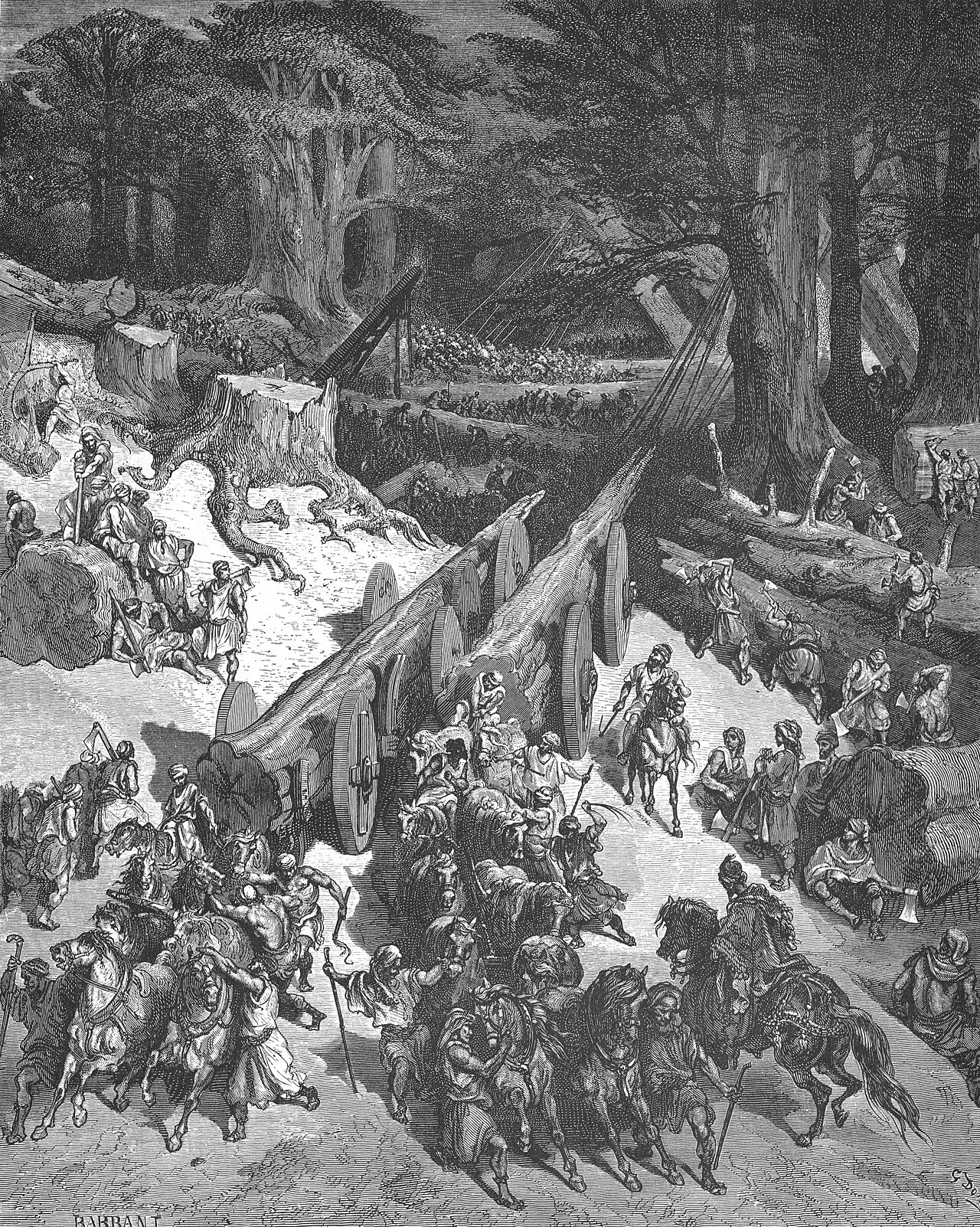
cedar trees and fir trees
on 1 Kings 5:10-12
The exchange is precisely reciprocal, Hiram's cedar and fir for Solomon's wheat and beaten oil year by year, and the narrator credits the whole favorable arrangement to the wisdom the Lord gave Solomon, as he promised him, the promise of 3:12 already bearing fruit in statecraft and not only in judgment. Gill notes that a league with Tyre broke no command, since the Phoenicians stood outside the seven nations Israel was forbidden to covenant with. Peace between the two kings frames the whole building project: the temple rises inside an alliance with a neighboring people, not apart from them.
This site's exposition
20,000 baths of pure olive oil
The Hebrew text reads twenty cors of pure olive oil, and the Berean’s 20,000 baths agrees with the Septuagint, the Syriac and 2 Chronicles 2:10, as Adam Clarke and John Wesley note. Albert Barnes defends the smaller figure as beaten oil. Jamieson, Fausset and Brown take this wheat and oil as food for Hiram’s household year by year, apart from the workmen’s wages.
The record, by era
The Puritans and the Awakening4 voices
Measures - Hebrew. twenty cors pure oil; but in 2Chr ii, 10, it is twenty thousand baths of oil. To which there is added twenty thousand measures of barley, and twenty thousand baths of wine.
It is here said of Hiram their king that he was ever a lover of David; and we have reason to think he was a worshipper of the true God, and had himself renounced, though he could not reform, the idolatry of his city.
Thus let justice be followed (as the expression is, Deut. xvi. 20 ), justice on both sides, in every bargain. The confirmation of the friendship that was between them hereby.
And Solomon gave Hiram twenty thousand measures of wheat for food to his household,....
The Nineteenth Century1 voice
A commentator
Jamieson, Fausset & Brown1802–1910
Commentary Critical and Explanatory on the Whole Bible (1871)
proposed
food to his household--This was an annual supply for the palace, different from that mentioned in 2Ch 2:10, which was for the workmen in the forests.
quarantine:debris (2026-07-29) — starts-lowercase
1 more voice on this verse
The Nineteenth Century1 voice
And Solomon gave Hiram, etc. - The information in this verse of the annual stipend paid to Hiram, is deficient, and must be supplied out of 2Ch 2:10. Here twenty thousand measures of wheat, and twenty measures of pure oil, is all that is promised: there, twenty thousand measures of beaten wheat, twenty thousand measures of barley, twenty thousand baths of wine, and twenty thousand baths of oil, is the stipulation; unless we suppose the first to be for Hiram’s own family, the latter for his workmen. Instead of twenty measures of oil, the Syriac, Arabic, and Septuagint, have twenty thousand measures, as in Chronicles. In 2 Chron., instead of cors of oil, it is baths. The bath was a measure much less than the cor.
How the passage was read
What the Jewish commentators add
He was wiser than any man. [To be understood] according to its plain meaning. 4 Alternatively, “he gained wisdom from every man,” as the Mishmah in Avos:1 states, “Who is wise? He who learns from every man.”
2 more on this passage, in their own words ▾
Than the wisdom of all the Eastern people. What was the wisdom of the children of the East? They were learned in the field of astronomy, etc. as it is [stated] in the Pesikta of Parah Adumah, and this entire chapter is expounded there according to its plain meaning.
Three thousand parables. Three parabolical studies [=אלפים]. It is written three times, “the proverbs of Shlomo,” in the book of Mishlei.
This section is reception history: how the passage was read and kept in the Jewish tradition. Where a reading parts from an essential of the Christian faith, the section says so at that point.
Texts and citation data: Sefaria; each excerpt follows its version’s licence. 4 further sources are cited on this chapter that carry no English text this site may quote or only restate the verse.
The words behind it
19 Hebrew wordsEvery Hebrew word of this verse in the order it stands, with what it means and the door to its own study. The last column counts the times a word stands in the whole Bible: the rarer the word, the more the places it appears belong together.
| Hebrew | Sound | Meaning | Word study | In the Bible |
|---|---|---|---|---|
| וּשְׁלֹמֹה֩ | ushelomoh | and Solomon | H8010 → | 291 times |
| נָתַ֨ן | natan | he gave | H5414 → | 2011 times |
| לְחִירָ֜ם | lechiram | to Hiram | H2438 → | 22 times |
| עֶשְׂרִים֩ | ʾesrim | twenty | H6242 → | 315 times |
| אֶ֨לֶף | ʾelef | thousand | H505 → | 505 times |
| כֹּ֤ר | kor | cor[s] of | H3734 → | 9 times |
| חִטִּים֙ | chitim | wheat<s> | H2406 → | |
| מַכֹּ֣לֶת | makolet | food | H4361 → | |
| לְבֵית֔וֹ | leveito | for household his | H1004 → | 2046 times |
| וְעֶשְׂרִ֥ים | veesrim | and twenty | H6242 → | 315 times |
| כֹּ֖ר | kor | cor[s] of | H3734 → | 9 times |
| שֶׁ֣מֶן | shemen | oil | H8081 → | 193 times |
| כָּתִ֑ית | katit | pressed | H3795 → | |
| כֹּֽה־ | koh- | thus | H3541 → | 577 times |
| יִתֵּ֧ן | yiten | he gave | H5414 → | 2011 times |
| שְׁלֹמֹ֛ה | shelomoh | Solomon | H8010 → | 291 times |
| לְחִירָ֖ם | lechiram | to Hiram | H2438 → | 22 times |
| שָׁנָ֥ה | shanah | a year | H8141 → | 877 times |
| בְשָׁנָֽה׃ פ | veshanah | in a year | H8141 → | 877 times |
וּשְׁלֹמֹה֩and Solomon
ushelomohH8010 →291 times
נָתַ֨ןhe gave
natanH5414 →2011 times
לְחִירָ֜םto Hiram
lechiramH2438 →22 times
עֶשְׂרִים֩twenty
ʾesrimH6242 →315 times
אֶ֨לֶףthousand
ʾelefH505 →505 times
כֹּ֤רcor[s] of
korH3734 →9 times
חִטִּים֙wheat<s>
chitimH2406 →
מַכֹּ֣לֶתfood
makoletH4361 →
לְבֵית֔וֹfor household his
leveitoH1004 →2046 times
וְעֶשְׂרִ֥יםand twenty
veesrimH6242 →315 times
כֹּ֖רcor[s] of
korH3734 →9 times
שֶׁ֣מֶןoil
shemenH8081 →193 times
כָּתִ֑יתpressed
katitH3795 →
כֹּֽה־thus
koh-H3541 →577 times
יִתֵּ֧ןhe gave
yitenH5414 →2011 times
שְׁלֹמֹ֛הSolomon
shelomohH8010 →291 times
לְחִירָ֖םto Hiram
lechiramH2438 →22 times
שָׁנָ֥הa year
shanahH8141 →877 times
בְשָׁנָֽה׃ פin a year
veshanahH8141 →877 times
A shaded row is a word that stands 400 times or fewer in the Bible.
The walk
5 stopsEach card is a verse this one points to, and under it the verses that one points to in turn. Where several paths arrive at the same place, that place is listed first: the text keeps returning to it.
Through
2 Chronicles 2:10I will pay your servants, the woodcutters, 20,000 cors of ground wheat, 20,000 cors of barley, 20,000 baths of wine, and 20,000 baths of olive oil.”
it leads to
- Luke 10:7
Stay at the same house, eating and drinking whatever you are offered. For the worker is worthy of his wages. Do not move around from house to house.
- 1 Kings 7:26
It was a handbreadth thick, and its rim was fashioned like the brim of a cup, like a lily blossom. It could hold two thousand baths.
- 1 Kings 7:38
He also made ten bronze basins, each holding forty baths and measuring four cubits across, one basin for each of the ten stands.
- Ezra 7:22
up to a hundred talents of silver, a hundred cors of wheat, a hundred baths of wine, a hundred baths of olive oil, and salt without limit.
- Romans 13:7–8
Pay everyone what you owe him: taxes to whom taxes are due, revenue to whom revenue is due, respect to whom respect is due, honor to whom honor is due.
- Luke 10:7
About 1 Kings
Who and where
1 name in this verse with a page on the site.
This page draws on Adam Clarke, Commentary on the Bible; Albert Barnes, Notes, Explanatory and Practical, on the Old and New Testaments (1832-1869); Albert Barnes, Notes on the Old Testament; Jamieson, Fausset & Brown, Commentary Critical and Explanatory on the Whole Bible; John Gill, Exposition of the Old Testament; John Gill, Exposition of the Old Testament (1748-1763); John Wesley, Explanatory Notes upon the Old Testament and Matthew Henry, Commentary on the Whole Bible.