
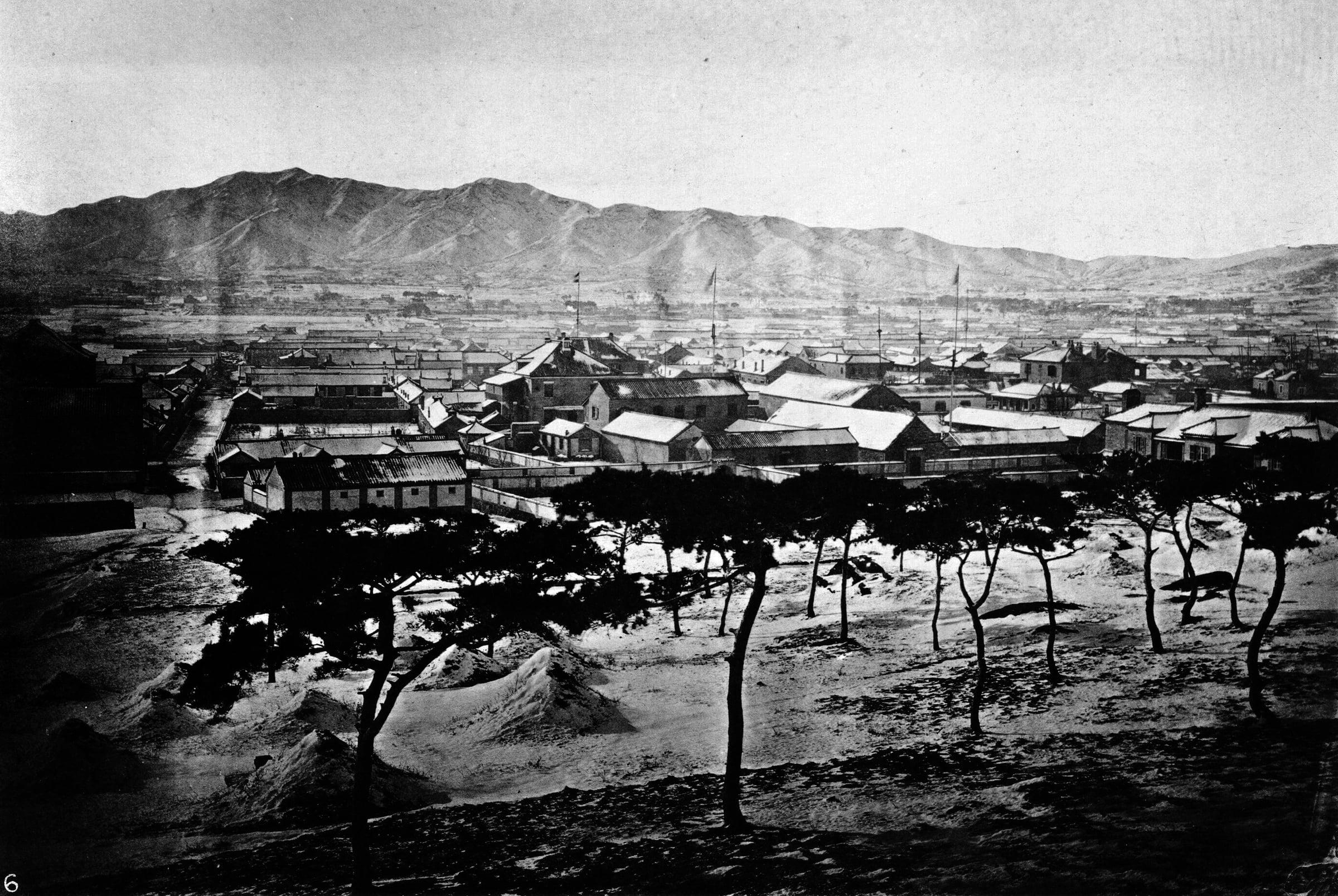
Chefoo, John Thomson, before 1898. Public domain.
Shandong, China, from Chefoo to Pingtu · Story · Featured Study
The Shandong Revival
Missionaries wrote down the meetings in this province of north China, with the testimonies of Chinese Christians, and the harm that came with some of them.
- Where
- Chefoo, Hwanghsien, Tsinan, Laiyang, Pingtu, Feihsien
- Who
- Marie Monsen, Mary K. Crawford, C. L. Culpepper, I. V. Larson, Rev. Ma of Nanking
- When
- 1927 to about 1934 (probable)
In the fall of 1930 Marie Monsen stood at a door in Tsinan and asked each person she met, “Have you been born again?”
Jesus replied, “Truly, truly, I tell you, no one can see the kingdom of God unless he is born again.”
Summary
The Protestant churches of Shandong had a revival from the late 1920s to the middle 1930s. Two streams ran through it.
- Southern Baptists date their stream from Marie Monsen's meetings at Hwanghsien.
- Presbyterian districts met the Ling En Hwei, begun by a Chinese pastor.
- No total of baptisms for the province is known.
- The Recorder printed a beating and a severed hand, and Baptist stations admitted excesses.
The Texts of the Revival
The compiler of the mission's letters headed her first chapter with the words of Jesus to Nicodemus.
Mary Crawford wrote in February 1933 that the major note of the revival was the preaching of sin and of John 3:3. Her book names three more texts.
And when He comes, He will convict the world in regard to sin and righteousness and judgment:
Crawford says Monsen rested on this promise when she spoke of sin.
John 16:8BSB
Do not fear, for I am with you; do not be afraid, for I am your God. I will strengthen you; I will surely help you; I will uphold you with My right hand of righteousness.
Monsen held to this word when pirates captured her.
Isaiah 41:10BSB
Is any one of you sick? He should call the elders of the church to pray over him and anoint him with oil in the name of the Lord.
The letter on the healing at Pingtu says the prayer was made according to this chapter.
James 5:14BSB
So if you who are evil know how to give good gifts to your children, how much more will your Father in heaven give the Holy Spirit to those who ask Him!”
I. V. Larson and his colleagues claimed this promise at the meeting at Laiyang.
Luke 11:13BSB
Isaiah 41:10, James 5:14, Luke 11:13
The Years of the Revival
Each row names the witness who dates it.
The Baptist reports move from one meeting at Hwanghsien to the whole field, while a separate stream began at Feihsien.
- 1925TsinanWomen began a prayer group whose place cards were prayer pledgesCrawford, 1933
- 1927ChefooMissionaries called to the ports heard Monsen's testimonyCulpepper, 1968
- September 1929HwanghsienMonsen's meetings on the new birthField report, printed 1931
- About 1930FeihsienRev. Ma of Nanking began the movement later called the Ling En HweiChinese Recorder, December 1931
- Fall of 1930TsinanMonsen's meetings, one sin at each sessionCrawford, 1933
- 2 December 1931LaiyangThe meetings at Laiyang beginLarson's letter, 1 January 1932
- February 1932HwanghsienTwo weeks of meetings in the schools and the churchesA letter of 24 March 1932
- 1933Pingtu countyOne thousand baptized since the last conferenceChinese Recorder, December 1933, from the mission's conference
- 1934HwanghsienThree churches still untouched by the revivalField report, printed 1935
Crawford, the field reports and the Recorder give these dates between them.
February 1932, 1933, 1934
From Chefoo to Pingtu
The Baptist stream, as the mission's letters and one memoir tell it.
In 1927 the American consul called the missionaries to the ports of Chefoo and Tsingtao. C. L. Culpepper, a Southern Baptist, wrote in 1968 that Marie Monsen, a Norwegian Lutheran, sheltered at Chefoo too. She gave her testimony there and asked him whether he had been filled with the Holy Spirit.
He tells of prayer and anointing for his wife Ola's painful eyes, and of two Chinese cooks who made peace in the same meeting. These stories rest on his memory four decades later.
In the last days of April 1929 pirates captured Monsen on her way from Tientsin to Hwanghsien and held her twenty-three days, by Crawford's account. Paul Hattaway, a later writer, dates the capture to July. Her own letter on it went out in circular reprints.
The field report dates the start at Hwanghsien to her meetings of that September, and D. F. Stamps wrote that she brought “a new note” on the new birth. A student rebellion closed that field's middle school in 1930.
A teacher at Tsinan dated her own new birth to 11 October. Monsen was also reported to put her question to the missionaries themselves. A pastor's wife at Tsinan said her knowledge of the Bible “could not wipe away the sin of hating my first baby because I wanted a diploma more than a baby.”
Wang Mingdao preached at Hwanghsien in May 1931, and John Sung led meetings there from 28 November to 3 December. On 2 December Larson began nine days of meetings at Laiyang, with the evangelist Li beside him.
Korean Presbyterian missionaries were holding their autumn Bible class at Laiyang that month, and their class confessed sins as well. Crawford writes that one missionary had received the baptism in the Holy Spirit early that fall. She counts at least twenty-four missionaries who reported that experience between September 1931 and the next June.
On 10 December Mrs. Loa of Pingtu, a paralytic of eighteen years, was prayed for, and Crawford says missionaries attested her healing. Pingtu had prayed three years for Monsen to come. Larson went on to Hwanghsien, and a letter from there tells of confession in the girls' school.
Marie Monsen2 paragraphs
Bays gives her dates as 1878 to 1962 and records “an apparently disastrous first trip to China soon after 1900.”
A WCIU Journal page, quoting the Norwegian Journal of Gender Research, gives 1872 for her birth. Her own books were not available, so she speaks here through others and through one letter.
The women of the revival2 paragraphs
The letters name women who carried the work. Miss Hou of Pingtu taught the county's Bible class, and Miss Liu, aged twenty-four, travelled with Pastor Peter Wang. Girls at Tsinan organized their own preaching band.
A convert of seventy-three learned to read, and a church of her district invited her to be its pastor. The Recorder noted in August 1933 that women occasionally served as leaders.
The Second Stream: the Ling En Hwei
The Recorder says it spread without any direct organizational planning.
The Recorder says Rev. Ma of Nanking began the movement in the Feihsien district, and it says its information came mainly from Presbyterian churches. Six pastors rode two hundred miles on their bicycles to see it, and about two thirds of the pastors in Weihsien Presbytery took it up.
The Recorder calls it mainly rural, with city churches holding back. It adds that no figures had come to hand for the churches or persons it touched. Ichowfu reported that accessions rose by half over the year before.
Rev. Ma Chiu-ju of Tengchow claimed to be “entrusted with the gospel for the last times” and split from the church, and his group later reported a “revelation” permitting its return.
Daniel Bays, writing in 1998, joins Monsen to this movement. The Recorder's article names no Monsen, and the Baptist reports that could be opened name no Rev. Ma, so the link stands on Bays alone.
What the Stations Counted
The mission's own stations gave these numbers, year by year and field by field.
The largest counts came from Pingtu, and even there the reports differ by a hundred.
| Field | Year | What the station reported | Where it was printed |
|---|---|---|---|
| Hwanghsien | 1930 | Ninety baptisms | Convention Annual, 1931 |
| Pingtu | 1932 | About nine hundred at one report, no less than one thousand at another | Letters in Crawford, 1933 |
| Hwanghsien | 1932 | More than two hundred and fifty | Convention Annual, 1933 |
| Laichow and Laiyang | 1932 | Thirty-five and fifty-six | Convention Annual, 1933 |
| Laiyang | 1933 | One hundred and thirty-five | Convention Annual, 1934 |
| Hwanghsien | 1934 | One hundred and seventy, in a membership of 2,640 | Convention Annual, 1935 |
| Pingtu | 1934 | More than six hundred | Convention Annual, 1935 |
A letter from Pingtu gives a “general estimate” of three thousand saved in one year, and another gives two to three thousand, and neither states a method. The letters came from a mission in a time of cuts, and one of them asks readers not to let its funds be reduced.
The Harm Reported, and What Lasted
Reports of harm came through the Recorder and through the stations that favoured the revival.
A correspondent of the Recorder wrote in October 1932 that he had “reports from reliable sources” of young people who beat an old woman to cast out a devil. They beat her so severely that the civil authorities stepped in. He also wrote of a former student's wife, by his account mentally unbalanced. She cut off her own hand, reading the Lord's word about a hand that offends as a command. He names neither person nor place, and he writes of the Ling En stream.
The Recorder's editor, writing in August 1933 of revivals across China, said that “sexual excesses have been confessed as having been practised under the guidance of the Holy Spirit,” and named no case. People without the exhilaration in the Ling En meetings, the Recorder had reported earlier, were told they were still in their sins.
Baptists at Kaifeng in Honan, where the revival had spread from Shandong, reported “dangerous excesses” in 1934. That year the Lutheran Church of China warned its churches in the north and centre of the country against “unauthenticated revivalist speakers.”
Of the Ling En stream, one missionary found evangelism harder afterward, and the Recorder had heard of no “verified attack on social evil.”
The Annual of 1934 says the Baptist seminary at Hwanghsien had six students when the revival began. It had one hundred in the year reported, sixty men and forty women. Mrs. Culpepper in an earlier Annual says five, and Culpepper in his book says four.
J. A. Abernathy recalled a memorial service before the missionaries left in 1948 for fifty-one Baptist leaders killed for refusing to give up their faith. The historian Norman Cliff, as Hattaway quotes him, wrote that after the Ling En meetings a Spiritual Gifts movement grew outside the mission churches. Its influence, he says, could still be felt in Shandong after fifty years of Communist rule. Culpepper adds that “it was reported” that the preacher Chiang Ki Yao stayed faithful under the Communists. No witness found ties a named rural church of those years to the revival.
How the Key Verse Was Taught
Three teachers of three eras on being born again.
Justin Martyr (died 165)
The First Apology, Chapter LXI, on John 3:3
Justin Martyr set the new birth against the first, in which no one chooses.
“Since at our birth we were born without our own knowledge or choice, by our parents coming together, and were brought up in bad habits and wicked training”
Early Church
Matthew Henry (1662 to 1714)
Commentary on the Whole Bible, on John 3:3
Matthew Henry read the verse as a rebuke to a man who admired miracles and stopped there.
“It was not enough for him to admire Christ's miracles, and acknowledge his mission, but he must be born again.”
Puritan
Smith Wigglesworth (1859 to 1947)
Ever Increasing Faith, Chapter 2: "Deliverance to the Captives"
Smith Wigglesworth, of the Pentecostal line, called the new birth a miracle in every man who sees the kingdom.
“Nicodemus was impressed by the miracles wrought and Jesus pointed out the necessity of a miracle being wrought with every man who would see the kingdom. When the man is born of God, is brought from darkness to light, a mighty miracle is wrought.”
on John 3:3British Pentecostal
In Their Own Words
These words come from Monsen, three Southern Baptist missionaries and a Chinese preacher, as the mission printed them in those years.
Marie Monsen (1878 to 1962)
The Shantung Revival (1933), chapter 1, her letter
Among the pirates
“I was immediately reminded of the word that I had been using much in years gone by, in Isaiah 41 : 10”
Norwegian Lutheran missionary in China
About this saying1 paragraph
Monsen wrote this in her letter on the capture of 1929, which Crawford reprints.
Mary K. Crawford
The Shantung Revival (1933), the Tsinan chapter
The quietest speaker
“Miss M. herself is one of the quietest speakers I ever heard”
Southern Baptist missionary at Tsinan
About this saying1 paragraph
Crawford wrote this in 1933 of the Monsen she had heard at Tsinan.
I. V. Larson
Annual of the Southern Baptist Convention (1933), report of the Foreign Mission Board, North China Mission
That night at Laiyang
“On that night there began the most wonderful revival ever witnessed in that little church.”
Southern Baptist missionary in Shandong
About this saying1 paragraph
Larson wrote this in the Convention's Annual of 1933, of the meeting of December 1931.
Jane W. Lide
Annual of the Southern Baptist Convention (1932), report of the Foreign Mission Board, North China Mission, Hwanghsien
The fuel and the fire
“Mr. Wong had piled up the fuel and Dr. Soong and Mr. Lee set it on fire.”
Southern Baptist missionary at Hwanghsien
About this saying1 paragraph
Jane Lide, a Southern Baptist teacher at Hwanghsien, wrote this in her station's report for 1931, of the preaching of Wang Mingdao, John Sung and Philip Lee.
Mr. Chiang
The Shantung Revival (1933), his testimony, printed by Crawford
The bandits and the preacher
“The bandits that are so dreadful here cause the death of only a few people, but I am the cause of the spiritual death of many.”
Chinese preacher
About this saying1 paragraph
Mr. Chiang, a Chinese preacher, said this of his own earlier preaching, as Crawford's book of 1933 reports him.
Mary K. Crawford
The Shantung Revival (1933), the closing chapter
Opposition
“There has been opposition from some missionaries because of lack of understanding”
Southern Baptist missionary at Tsinan
About this saying1 paragraph
Crawford admitted this in 1933, in a book that asks its readers not to read it in a critical spirit.
Who Began It, and How Orderly It Was
The sources differ on its start, on its order and on its numbers.
Bays calls Monsen “a catalyst” for the revival, and the mission's field report says as much of the Hwanghsien field. Crawford, who was in the Tsinan prayer group, wrote that Monsen's coming “was not the beginning of our spiritual hunger.” The Recorder gives its Presbyterian stream a Chinese start.
Crawford answered the question of emotion with a flat “No.” Bays writes that the meetings “were emotional if not disorderly.”
Crawford's own book prints a worker struck down in a courtyard, before her answer, and Larson thrown down for two hours, after it. Her answer speaks of the first meetings in Shantung, and neither of these letters supports it.
Culpepper wrote in 1968 that all six hundred girls and nine hundred of a thousand boys made professions at Hwanghsien. A letter written at the time counts over a hundred in the girls' school, and no paper of that year that was found holds his figures.
Culpepper also reports that the Foreign Mission Board's secretary came in 1935 because word of extremes had reached America. He is the only witness read for that visit, and the Board's minutes were not available.
Books to Read Next
The Shantung Revival
Mary K. Crawford · 1933
Crawford gathered letters and testimonies from the revival into a book.
Read Crawford free at Oral Roberts UniversityIndigenous Revival in Shantung
The Chinese Recorder, volume 62, number 12 · 1931
This article reports the Presbyterian stream and its critics in the year it spread.
Read the Recorder free at the Internet ArchiveAnnual of the Southern Baptist Convention
Southern Baptist Convention · 1933
The Foreign Mission Board's report gives each North China station's counts in its missionaries' words.
Read the Annual free at the Southern Baptist archivesWhat the Revival Left
Crawford set the words of Jesus to Nicodemus over Monsen's question. One missionary whom Monsen asked to put it to the Chinese wrote that it choked her.
Sources
Scripture is the Berean Standard Bible.
- The Holy Bible, Berean Standard Bible (read 2026)
- Mary K. Crawford, The Shantung Revival (Shanghai: China Baptist Publication Society, 1933)
- Annual of the Southern Baptist Convention, 1931 to 1935, the reports of the Foreign Mission Board on the North China and Interior China missions.
- Mary Crawford, "Some Fruits of Prayer", Home and Foreign Fields, February 1933.
- The Chinese Recorder: "Indigenous Revival in Shantung", volume 62, number 12 (December 1931); volume 63, number 4 (April 1932); "The New Spiritual Movement in Shantung", volume 63, number 10 (October 1932); volume 64, numbers 8 and 12 (1933); volume 65, number 9 (1934)
- C. L. Culpepper, The Shantung Revival (foreword 1968), read in a transcript and not compared with the print.
- Daniel H. Bays, Monsen, Marie, in Gerald H. Anderson, ed., Biographical Dictionary of Christian Missions (Macmillan Reference USA, 1998)
- Paul Hattaway, Shandong: The Revival Province, extracts that print no year, quoting Norman Cliff, "Building the Protestant Church in Shandong"; Cliff's own work was not opened.
- J. A. Abernathy, The Shantung Revival, an excerpt; the extract prints no year.
- "Marie Monsen", WCIU Journal, quoting the Norwegian Journal of Gender Research.
- Marie Monsen, The Awakening (1961), and her account in We are Escaped (1931), were not opened.
- Justin Martyr, The First Apology, chapter 61.
- Matthew Henry, Commentary on the Whole Bible, on John 3:3.
- Smith Wigglesworth, Ever Increasing Faith (1924), chapter 2.
Keep Studying
People and groups9
Church history7