
Philippians · Doctrine · Featured Study
Joy in Suffering
What Philippians teaches about rejoicing in the Lord under trial, with the texts that teach it elsewhere in Scripture.
A prisoner who might soon be executed told a church to rejoice in the Lord always.
- First taught
- Habakkuk 3:18
- Fullest statement
- Philippians 4:4
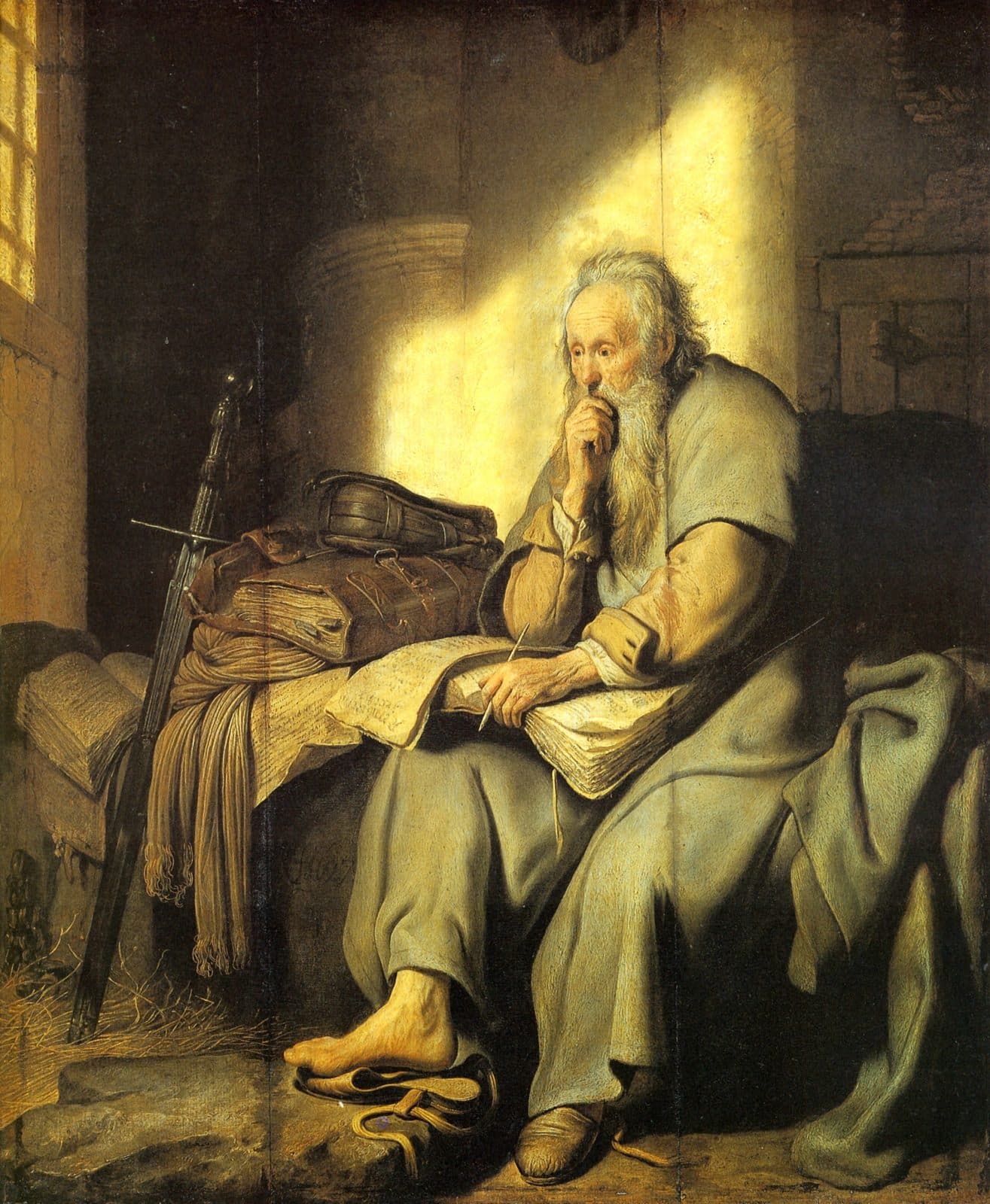
Rembrandt van Rijn, The Apostle Paul in Prison, 1627, Staatsgalerie Stuttgart. Public domain, via Wikimedia Commons.
THE ARTWORKRembrandt painted Paul in a cell, his pen stopped over the pages of a letter while daylight comes through the bars.
Summary
Philippians speaks of joy or rejoicing in each of its four chapters.
- Philippians names its grounds: Christ preached, the faith and care of the church, and the Lord himself.
- In the same letter Paul writes of sorrow, anxiety and tears.
- Readers differ on whether chairete also means farewell, and on the city where Paul was held.
The First Text and the Fullest
Habakkuk 3:18 and Philippians 4:4, written more than six centuries apart.
Habakkuk trembled as he waited for the day of distress to come on the people who would invade Judah.
Though the fig tree does not bud and no fruit is on the vines, though the olive crop fails and the fields produce no food, though the sheep are cut off from the fold and no cattle are in the stalls, yet I will exult in the LORD; I will rejoice in the God of my salvation!Habakkuk's joy stands when every outward support has gone, so it rests on God alone.
Rejoice in the Lord always. I will say it again: Rejoice!Habakkuk resolves to rejoice for himself, and Paul makes it a command to a whole church.
Joy in Trial Across Scripture
Each text with its trial and the ground of its joy.
- The trial in view
- a people weeping as the Law is read
- What the joy rests on
- the joy of the LORD as strength
- The trial in view
- a failed harvest and empty stalls
- What the joy rests on
- the God of salvation
- The trial in view
- insult and persecution for Jesus' sake
- What the joy rests on
- a great reward in heaven
- The trial in view
- disgrace before the Sanhedrin
- What the joy rests on
- being counted worthy to suffer for the Name
- The trial in view
- many blows and a night in prison
- What the joy rests on
- God, to whom they sang hymns at midnight
- The trial in view
- sufferings
- What the joy rests on
- the perseverance, character and hope they produce
- The trial in view
- sorrow and poverty
- What the joy rests on
- possessing everything while having nothing
- The trial in view
- sufferings in Paul's flesh
- What the joy rests on
- suffering borne for the church, the body of Christ
- The trial in view
- the cross and its shame
- What the joy rests on
- the joy set before Jesus
- The trial in view
- trials of many kinds
- What the joy rests on
- the testing of faith that develops perseverance
- The trial in view
- a fiery trial
- What the joy rests on
- sharing the sufferings of Christ before his glory is revealed
Eleven texts in canon order. Their grounds of joy fall under four heads: God himself, Christ, the reward to come, and what the trial produces.
What the Joy of the Letter Rests On
Paul's joy and the church's, verse by verse, in all four chapters.
| Verse | Greek word | In the Berean text | What the joy rests on |
|---|---|---|---|
| Philippians 1:4 | chara | joy | prayer for partners in the gospel |
| Philippians 1:18 | chairo, twice | rejoice, twice | Christ preached, even by rivals who hope to add to his distress |
| Philippians 1:25 | chara | joy | their progress in the faith |
| Philippians 2:2 | chara | joy | a church of one mind and one love |
| Philippians 2:17 | chairo; synchairo | glad; rejoice | his life poured out as a drink offering on their faith |
| Philippians 2:18 | chairo; synchairo | glad; rejoice | the same gladness shared by the church |
| Philippians 2:28 | chairo | rejoice | Epaphroditus seen again |
| Philippians 2:29 | chara | joy | the welcome Epaphroditus is owed |
| Philippians 3:1 | chairo | rejoice | the Lord |
| Philippians 4:1 | chara | joy | the church itself, his joy and crown |
| Philippians 4:4 | chairo, twice | rejoice, twice | the Lord, always |
| Philippians 4:10 | chairo | rejoice | their care for him revived in a gift |
- Verse
- Philippians 1:4
- Greek word
- chara
- In the Berean text
- joy
- What the joy rests on
- prayer for partners in the gospel
- Verse
- Philippians 1:18
- Greek word
- chairo, twice
- In the Berean text
- rejoice, twice
- What the joy rests on
- Christ preached, even by rivals who hope to add to his distress
- Verse
- Philippians 1:25
- Greek word
- chara
- In the Berean text
- joy
- What the joy rests on
- their progress in the faith
- Verse
- Philippians 2:2
- Greek word
- chara
- In the Berean text
- joy
- What the joy rests on
- a church of one mind and one love
- Verse
- Philippians 2:17
- Greek word
- chairo; synchairo
- In the Berean text
- glad; rejoice
- What the joy rests on
- his life poured out as a drink offering on their faith
- Verse
- Philippians 2:18
- Greek word
- chairo; synchairo
- In the Berean text
- glad; rejoice
- What the joy rests on
- the same gladness shared by the church
- Verse
- Philippians 2:28
- Greek word
- chairo
- In the Berean text
- rejoice
- What the joy rests on
- Epaphroditus seen again
- Verse
- Philippians 2:29
- Greek word
- chara
- In the Berean text
- joy
- What the joy rests on
- the welcome Epaphroditus is owed
- Verse
- Philippians 3:1
- Greek word
- chairo
- In the Berean text
- rejoice
- What the joy rests on
- the Lord
- Verse
- Philippians 4:1
- Greek word
- chara
- In the Berean text
- joy
- What the joy rests on
- the church itself, his joy and crown
- Verse
- Philippians 4:4
- Greek word
- chairo, twice
- In the Berean text
- rejoice, twice
- What the joy rests on
- the Lord, always
- Verse
- Philippians 4:10
- Greek word
- chairo
- In the Berean text
- rejoice
- What the joy rests on
- their care for him revived in a gift
Autarkes, the word for contentPhilippians 4:11 to 13
Abbott-Smith's lexicon of 1922 defines autarkes as self-sufficient. Paul places the source of that sufficiency outside himself, in Christ.
I am not saying this out of need, for I have learned to be content regardless of my circumstances. I know how to live humbly, and I know how to abound. I am accustomed to any and every situation—to being filled and being hungry, to having plenty and having need. I can do all things through Christ who gives me strength.Suffering for ChristPhilippians 1:29
For it has been granted to you on behalf of Christ not only to believe in Him, but also to suffer for Him,Paul counts suffering for Christ as a gift, which is why he can rejoice in it.
Joy Beside Grief
Three verses of the letter that name grief, and one line from 2 Corinthians.
In Philippians 2:28 Paul sends Epaphroditus home partly so that he himself may be less anxious.
He was sick indeed, nearly unto death. But God had mercy on him, and not only on him but also on me, to spare me sorrow upon sorrow.Paul feared a second sorrow at his friend's sickness, so his joy left room for fear.
For as I have often told you before, and now say again even with tears: Many live as enemies of the cross of Christ.Paul weeps here for others, and grief for the lost keeps its place beside his joy.
In 2 Corinthians Paul sets the two side by side in a single line.
sorrowful, yet always rejoicing; poor, yet making many rich; having nothing, and yet possessing everything.The City of Philippi and Its Church
Philippi was a Roman colony, and Paul wrote to it from custody.
Augustus gave the city the name Colonia Augusta Julia Philippensis. He granted it the jus Italicum, the legal standing of land in Italy.
Its first converts included a jailer, after Paul and Silas were beaten and fastened in the stocks of his inner cell.
At Rome, Lightfoot writes, a prisoner in Paul's custody was chained by the hand to the soldier who guarded him, day and night, and the guards relieved one another in turn.
About midnight Paul and Silas were praying and singing hymns to God, and the other prisoners were listening to them.The church at Philippi had seen this joy in Paul before he commanded it in his letter.
As a result, it has become clear throughout the whole palace guard and to everyone else that I am in chains for Christ.Paul's chains served to advance the gospel, and that advance is the joy he names five verses later.
What the Text Leaves Unsaid
Questions Philippians and Acts leave open.
Philippians never names the city where Paul was held, and it does not record the verdict.
Acts does not give the words of the hymns sung in the Philippian jail.
Joy That Rests on Christ
The reason under every ground of joy in the letter.
Philippians 2:8 to 9 sets the pattern Paul's suffering follows: Christ went down to death on a cross, and God exalted him to the highest place.
For to me, to live is Christ, and to die is gain.Either verdict leaves Paul with Christ, so the outcome of his trial holds his joy safe.
I want to know Christ and the power of His resurrection and the fellowship of His sufferings, being conformed to Him in His death,Paul seeks a share in Christ's sufferings on the way to his resurrection, so each trial draws him nearer to Christ.
Three Voices on Joy in Trial
They span the fourth century to the eighteenth.
“‘For unto you it is given in the behalf of Christ, not only to believe on Him, but also to suffer in his behalf.’ Again does he teach them moderation of spirit by referring all to God, and saying that sufferings in behalf of Christ are of grace, the gift of grace, a free gift. Be not then ashamed of the gift of grace, for it is more wonderful than the power of raising the dead, or working miracles; for there I am a debtor, but here I have Christ for my debtor. Wherefore ought we not only not to be ashamed, but even to rejoice, in that we have this gift. Virtues he calls gifts, yet not in like sort as other things, for those are entirely of God, but in these we have a share. But since even here the greatest part is of God, he ascribes it entirely to Him, not to overturn our free will, but to make us humble and rightly disposed.”
John Chrysostom · Homily on Philippians 4 · on Philippians 1:29Patristic
“Note, The preaching of Christ is the joy of all who wish well to his kingdom among men. Since it may tend to the good of many, we ought to rejoice in it, though it be done in pretence, and not in reality. It is God's prerogative to judge of the principles men act upon; this is out of our line.”
Matthew Henry · Commentary on the Whole Bible · on Philippians 1:18Puritan
“To me to live is Christ - To know, to love, to follow Christ, is my life, my glory, my joy.”
John Wesley · Explanatory Notes upon the New Testament · on Philippians 1:21Evangelical
Where Readers Differ
Two questions, each with two readings and their holders.
Rejoice, or rejoice and farewell, at Philippians 3:1 and 4:4John Calvin; J. B. Lightfoot
The Greek verb chairete means rejoice, and it was also the common word of greeting and farewell.
John Calvin, in his Commentary on Philippians (1548), reads the doubled command as a word suited to a persecuted church. He says the repetition gives it force, so that their joy in the Lord lasts.
J. B. Lightfoot, in Saint Paul's Epistle to the Philippians (1868), renders the word at Philippians 3:1 as a farewell that also carries the command to rejoice. Where the command is doubled, he holds that it is neither farewell alone nor rejoice alone.
Against Calvin's reading, Lightfoot notes that Philippians 3:1 opens the close of the letter, where a farewell belongs. Against Lightfoot's, the word always and the repeated command read as an order, as Calvin takes them.
Rome or Ephesus as the place of the chainsJ. B. Lightfoot; George S. Duncan
J. B. Lightfoot (1868) places all four letters of the captivity in Rome, after Paul's years held at Caesarea. He reads the palace guard of Philippians 1:13 as the praetorian guard at Rome.
George S. Duncan, in St. Paul's Ephesian Ministry (1929), argues that Paul wrote Philippians from a prison at Ephesus, before 1 Corinthians.
Against Rome, Duncan presses the many trips between Philippi and the prison that Philippians 2:19 to 30 implies. Against Ephesus, Duncan himself grants that before 2 Corinthians Acts records only one imprisonment, at Philippi.
Books to Read Next
Four works on Philippians and on Paul's imprisonment, each free to read online.
Homilies on Philippians
John Chrysostom · about 400
Chrysostom preached the whole letter in fifteen homilies.
Read at New AdventCommentary on Philippians
John Calvin · 1548
Calvin takes the letter verse by verse, in John Pringle's translation of 1851.
Read at CCELSaint Paul's Epistle to the Philippians
J. B. Lightfoot · 1868
Lightfoot adds dissertations on the Christian ministry and on Paul and Seneca.
Read at the Internet ArchiveSt. Paul's Ephesian Ministry
George S. Duncan · 1929
Duncan reconstructs Paul's years at Ephesus from Acts and the letters.
Read at the Internet ArchiveJoy No One Takes Away
So also you have sorrow now, but I will see you again and your hearts will rejoice, and no one will take away your joy.Jesus promised this joy to grieving disciples, and Paul's joy in chains is the same joy.
Philippians asks the reader to rejoice in the Lord in every circumstance, to grieve honestly where grief is due, and to learn contentment in want and in plenty.
Keep studying
Read it1