
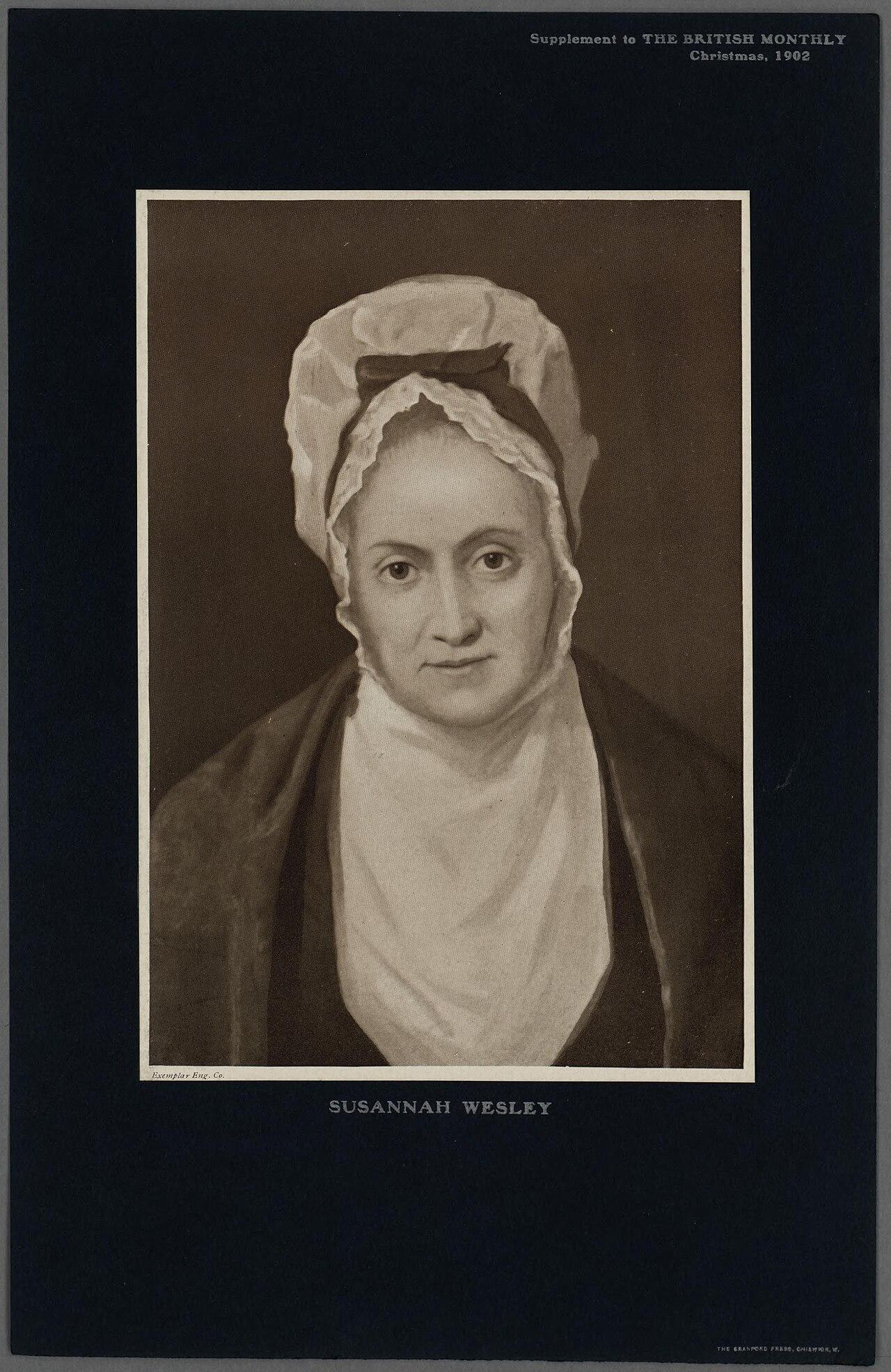
Susannah Wesley, photomechanical print, 1902. Public domain.
Epworth and London, 1669 to 1742 · Person · Featured Study
Susanna Wesley
She was the mother of John and Charles Wesley, and she taught her children at home in the rectory at Epworth.
While her husband was away, a rector's wife read sermons in her house on Sunday evenings, and above two hundred neighbours came.
Fathers, do not provoke your children to wrath; instead, bring them up in the discipline and instruction of the Lord.
Fathers, do not provoke your children to wrath; instead, bring them up in the discipline and instruction of the Lord.
- Born
- 20 January 1669 or 1670, by Adam Clarke (probable)
- Died
- 23 July 1742, in London, by her son's Journal (probable)
- Family
- father: Samuel Annesley; husband: Samuel Wesley; son: John Wesley; son: Charles Wesley
- Places
- Epworth, London
Summary
Susanna Wesley was the youngest daughter of the Nonconformist minister Samuel Annesley. Before she was thirteen she chose the Church of England, and about 1689 she married Samuel Wesley, later rector of Epworth. Her son John printed two of her letters in his Journal when she died in 1742.
- Clarke counts nineteen children, ten of whom grew up.
- Two fires struck the rectory at Epworth, in 1702 and 1709.
- In her letters she held herself answerable to God for every soul in her house.
Teach Them Diligently
Deuteronomy 6 tells parents to teach God's words at home, and Ephesians 6 tells them how to bring up their children.
No verse of Scripture names Susanna Wesley.
The question of this life is what she did at Epworth that her son thought worth printing, and in what words. Her own letters, in two printings, answer it.
And you shall teach them diligently to your children and speak of them when you sit at home and when you walk along the road, when you lie down and when you get up.Her letter of 1732 shows how she kept this command in her own house.
The Life in Order
Adam Clarke gives the early years and the fires, and her son's Journal gives her letters and her death.
Most of the record comes from her own letters.
- 1669 or 1670BirthClarke
- Before she was thirteenA choice of churchClarke
- About 1689MarriageClarke
- About 1690Move to South OrmsbyClarke
- 1702First fireClarke
- 1709Second fireClarke
- 1712The readings at their heightHer letter
- 1732Her rules set downHer letter
- 1739Assurance at the SupperWesley
- 1742Death and burialWesley
Each step of the life stands with its witness.
1712, 1732, 1739, 1742
From Annesley's House to Epworth
She chose her own church as a girl and kept school for her children in the rectory.
Susanna was the youngest daughter of Dr Samuel Annesley, a Nonconformist minister. Clarke writes that before she was thirteen she examined the whole dispute between the Church of England and the Dissenters, and chose the Church. She wrote later that her account of that choice was lost with her other papers when the rectory burned.
Her husband, Samuel Wesley, had made the same choice. Her children came in quick succession, at times two at a birth. The family lived on a narrow income, and the schooling of the children fell to her.
She kept school in the house from nine to twelve and from two to five. Each child but one began to read at five, and most learned the letters in a single day. Her son Samuel, the first she taught, began reading at the first chapter of Genesis the day after his fifth birthday.
On a winter night the house burned to the ground. She wrote that she tried three times to force her way through the street door and was driven back by the flames. The family escaped. While the house was rebuilt, the children were sent to other families, and she wrote that they came home with rude ways she had to correct.
Some winters later her husband was away in London. She had begun by reading to her own household on Sunday evenings, and when a serving boy told his parents, they asked to come. The company grew to about thirty. After she read an account of the Danish missionaries she spoke to them with more warmth, and by February 1712 above two hundred came. Her husband suggested that some other person read, and she answered that no man among them could read a sermon without spelling out much of it.
She outlived her husband by some years. John came to her in her last days, and she died with her children about her.
The Letters Her Son Printed
John chose which of her words to keep in print.
On 1 August, nine days after her death, John Wesley buried his mother. In his Journal for that day he set down the words on her stone and then two letters of hers.
The first was written to his father about the Sunday meetings. John printed part of it to show that she too had been "in her measure and degree, a preacher of righteousness". The second, of 24 July 1732, he printed "for the benefit of those who are entrusted, as she was, with the care of a numerous family".
Adam Clarke printed more of her letters in 1824, among them her account of the second fire and a letter to her son Samuel written that autumn.
if He did not spare the ancient world when He brought the flood on its ungodly people, but preserved Noah, a preacher of righteousness, among the eight;John borrowed these words for his mother.
And I saw the dead, great and small, standing before the throne. And there were open books, and one of them was the Book of Life. And the dead were judged according to their deeds, as recorded in the books.John preached at her burial from Revelation 20:11 to 12.
In Their Own Words
Two letters her son printed, her words to him in 1739, and her last request.
Susanna Wesley (1669 to 1742)
A letter to Samuel Wesley, 6 February 1711 to 1712, in John Wesley's Journal for 1 August 1742, page 261
A talent committed to me
“As I am a woman, so I am also mistress of a large family. And though the superior charge of the souls contained in it, lies upon you; yet, in your absence, I cannot but look upon every soul you leave under my care, as a talent committed to me under a trust, by the great Lord of all the families, both of heaven and earth.”
Anglican
About this saying1 paragraph
She wrote this to her husband in London on 6 February 1711 to 1712, about the Sunday evening meetings.
Susanna Wesley
A letter to John Wesley, 24 July 1732, in his Journal for 1 August 1742, page 263
The first thing to be done
“In order to form the minds of children, the first thing to be done is to conquer their will, and bring them to an obedient temper. To inform the understanding is a work of time, and must with children proceed by slow degrees as they are able to bear it; but the subjecting the will, is a thing which must be done at once; and the sooner the better.”
Anglican
About this saying1 paragraph
She wrote her rules for John on 24 July 1732, and this is the rule she put first in forming a child's mind.
Susanna Wesley
Her words to John Wesley, in his Journal for 3 September 1739, page 152
The words struck through my heart
“I never durst ask for it myself. But two or three weeks ago, while my son Hall was pronouncing those words, in delivering the cup to me, 'The blood of our Lord Jesus Christ, which was given for thee;' the words struck through my heart, and I knew God for Christ's sake had forgiven me all my sins.”
Anglican
About this saying1 paragraph
She told John on 3 September 1739 what had happened at the Lord's Supper a few weeks before, and he wrote down her words.
Susanna Wesley
Her last request, in John Wesley's Journal for 23 July 1742, page 260
Sing a psalm of praise
“Children, as soon as I am released, sing a psalm of praise to God.”
Anglican
About this saying1 paragraph
This was her last request to her children, a little before she lost her speech in July 1742, as John recorded it.
The People Around Her
Her letters name her father, her husband and her children.
Her household was her congregation and her school.
| Person | Tie to Susanna Wesley | The witness |
|---|---|---|
| Samuel Annesley | Her father, who she said had the assurance of faith. | Wesley |
| Samuel Wesley | Her husband, the rector of Epworth. | Clarke |
| Samuel Wesley the younger | Her eldest son, a quick reader. | Her letter |
| John Wesley | Her son, who buried her. | Wesley |
| Charles Wesley | One of the eight children she talked with alone each week. | Her letter |
| Kezia Wesley | The exception to her rule, slower than the rest. | Her letter |
| Mr Hall | The son-in-law who administered the Supper to her. | Wesley |
In her letter on the Sunday meetings she named a night of the week for each child, when she talked with that child alone.
The Places of Her Life
Her married life centred on the rectory at Epworth in Lincolnshire.
She spent most of her married life in one house, rebuilt after fire.
| Place | What the witnesses say | The witness |
|---|---|---|
| South Ormsby, Lincolnshire | Her husband's living before Epworth. | Clarke |
| Epworth, Lincolnshire | Her husband's parish, where the family lived. | Clarke |
| St Margaret's Church-Yard, Westminster | Where her letter on the meetings was sent. | Wesley |
| London | The city of her last days and her grave. | Wesley |
A Preacher of Righteousness
Her letter to her husband and her son's Journal judge her part in the meetings.
Writing to her husband about the meetings, she said she did not think it proper, because of her sex, to present the prayers of the people to God. She had tried to dismiss the neighbours before prayers, and they begged to stay.
She defended the meetings themselves to her husband. She wrote that she valued no censure on that account and had "long since shook hands with the world". In his Journal John counted her among the preachers of her family, beside her father, her grandfather, her husband and her three sons.
How the Key Verse Was Taught
Cyprian, the Apostolic Constitutions and Theophylact of Ohrid read the charge to parents.
Cyprian (died 258)
Treatise XII Three Books of Testimonies Against the Jews
Cyprian set the verse among the testimonies that fathers should not be harsh.
“And that fathers also should not be harsh in respect of their children.”
on Ephesians 6:4Patristic
The rest1 more paragraph
Also in the same place: "And, ye fathers, drive not your children to wrath: but nourish them in the discipline and rebuke of the Lord."
Apostolic Constitutions (died 380)
CONSTITUTIONS OF THE HOLY APOSTLES
The Apostolic Constitutions, a church order of the fourth century, put the same charge among a teacher's duties.
“I have taught the poor to rejoice in their own poverty; I have taught fathers to teach their children instruction in the fear of the Lord, children to obey their parents in wholesome admonition;”
on Ephesians 6:4Patristic
What the Witnesses Leave Open
The record leaves open her birth year, the story of her faith and the worth of her method.
The year of her birthAdam Clarke
Clarke gives her birthday as 20 January and the year as "1669 or 1670".
When she knew her sins forgivenHer words to John, 1739; the stone on her grave, 1742
She told John in 1739 that until a short time before she had scarce heard of having forgiveness of sins now, and that she knew it at the cup. The verse on her stone, which John printed, speaks of "a legal night of seventy years" before the Father revealed His Son. Clarke and her own letters show a woman of strict and lifelong devotion.
Whether her method should be copiedSusanna Wesley; Adam Clarke
Her rule was to conquer a child's will early and to teach for six hours a day. Clarke asked whether her method of teaching to read should be generally recommended, and he answered, "I think not". Her own letter says the children lost much of their order when they were scattered after the fire, and she had to begin again.
Books to Read Next
The Works of the Rev. John Wesley, volume III
John Wesley, edited by John Emory · 1831
The full Journal holds her two letters, her words of 1739 and her death.
Read the volume free at the Internet ArchiveMemoirs of the Wesley Family
Adam Clarke · 1824
Clarke gives her life, her letters on the fire and his judgement of her method.
Read Clarke free at the Internet ArchiveWhat Susanna Wesley Left
Susanna Wesley left letters that her son printed for other parents and a household she had taught herself. John wrote that her funeral was one of the most solemn assemblies he ever saw.
Sources
Scripture is the Berean Standard Bible.
- The Holy Bible, Berean Standard Bible (read 2026)
- John Wesley, Journal, 3 September 1739 and 18 July to 1 August 1742, with her letters of 6 February 1711 to 1712 and 24 July 1732, in The Works of the Rev. John Wesley, volume III (New York: J. Emory and B. Waugh, 1831)
- Adam Clarke, Memoirs of the Wesley Family (New York, 1824), the chapter on Mrs Susannah Wesley, with her letters of August and 11 October 1709.
- Cyprian, Three Books of Testimonies Against the Jews, on Ephesians 6:4.
- The Constitutions of the Holy Apostles, on Ephesians 6:4.
- Theophylact of Ohrid, Commentary on Ephesians, on Ephesians 6:4.
Keep Studying
People and groups5
Go further1
Church history5
Trials of life1