
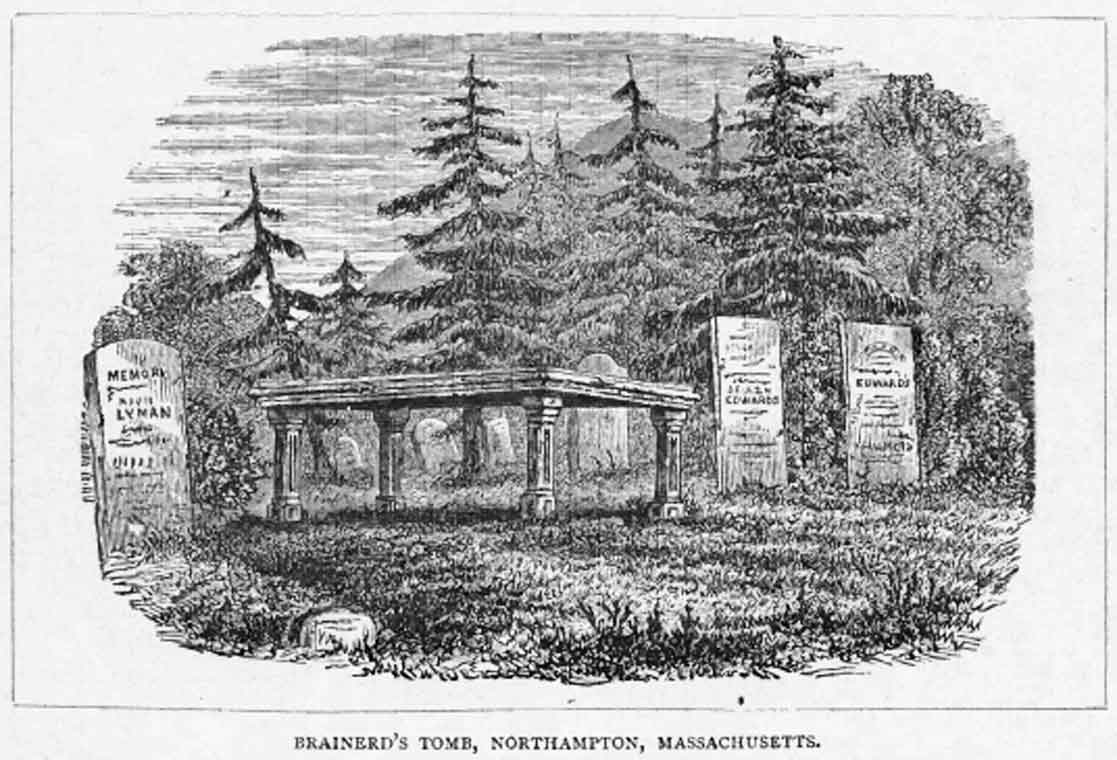
Illustrator unknown, Brainerd’s Tomb, Northampton, Massachusetts, 1891. Public domain.
Connecticut to the Susquehanna, to 1747 · Person · Featured Study
David Brainerd
He preached to the Indians of three colonies and died at Northampton in 1747, aged twenty-nine.
- Born
- 20 April 1718 at Haddam, Connecticut
- Died
- 9 October 1747 at Northampton, Massachusetts
- Family
- father: Hezekiah Brainerd; brother: John Brainerd
- Places
- Haddam, New Haven, Kaunaumeek, the Forks of Delaware, Crossweeksung, Northampton
A student thrown out of Yale for one remark about a tutor rode into the woods to preach, and the diary he wanted kept private was printed in 1749.
So the master told his servant, ‘Go out to the highways and hedges and compel them to come in, so that my house will be full.
Summary
David Brainerd was born in Connecticut in 1718. Yale expelled him in his third year. In 1743 a Scottish society sent him to preach to the Indians at Kaunaumeek. Two years later the Indians at Crossweeksung began to turn to God under his preaching. He died of a lung disease in the house of Jonathan Edwards. Edwards then made a book of his diary.
- His journal of the awakening was printed while he lived as Mirabilia Dei inter Indicos.
- Edwards says the Life is taken mostly from a diary Brainerd wrote for himself alone.
- William Carey named him in his Enquiry of 1792.
The Text at Crossweeksung
Luke 14:23 and 2 Corinthians 5:8 frame his work and his death.
On 8 August 1745 Brainerd preached at Crossweeksung on the parable of the great supper, from Luke 14:16 to 23. His journal counts about sixty-five hearers, men, women and children.
He wrote that the power of God came upon the assembly like a rushing mighty wind. The question of this life is how a sick young man with no college degree came to write that sentence. Most of what is known of him comes from his own journals.
We are confident, then, and would prefer to be away from the body and at home with the Lord.Edwards preached his funeral sermon on this verse on 12 October 1747.
The Life in Order
Edwards's Life gives the years from his birth to his death, most of them in Brainerd's own words.
His whole ministry fits inside five years.
- 20 April 1718Born at Haddam, ConnecticutEdwards's Life, part one
- 12 July 1739An evening in a dark groveDiary, in Edwards
- September 1739Began at YaleDiary, in Edwards
- Winter 1742Expelled in his third yearEdwards's own narrative
- 1742Licensed by an association of Fairfield CountyEdwards's Life, part two
- 1 April 1743First ride to KaunaumeekDiary, 1743
- June 1744Ordained by the Presbytery at NewarkDiary, 11 and 12 June
- 19 June 1745First visit to CrossweeksungDiary, 1745
- 8 August 1745The meeting he likened to a mighty windMirabilia, page 21
- 28 May 1747Arrival at Northampton in his last illnessEdwards, May 1747
- 9 October 1747Death at about six in the morningEdwards's account of the end
- 1749The Life printed at BostonTitle page, 1749
Each step of the life stands with its witness.
June 1744, 19 June 1745, 8 August 1745, 28 May 1747, 9 October 1747, 1749
From Haddam to Northampton
He tells most of it himself in his diary, and Edwards tells the end.
David Brainerd was a Presbyterian missionary to the Indians of New York, New Jersey and Pennsylvania during the First Great Awakening. His father, Hezekiah Brainerd, was one of his Majesty's council for Connecticut.
On a Sunday evening in July 1739 he walked in a dark grove and wrote that unspeakable glory seemed to open to his soul. That September he entered the college at New Haven.
He was expelled from Yale for saying a tutor had no more grace than a chair. The ministers of the eastern district of Fairfield County licensed him to preach, and the Society in Scotland for Propagating Christian Knowledge sent him out.
In April 1743 he rode to Kaunaumeek, in the woods of New York, and worked there into 1744. In 1744 he moved to the Forks of Delaware in Pennsylvania, and the Presbytery at Newark ordained him in June. He also travelled to the Susquehanna that autumn with an interpreter.
In June 1745 he rode to Crossweeksung in New Jersey and found few at home. By August he was recording the meeting his journal tells at length. Edwards later called him the pastor of a church of Christian Indians there.
He came to Northampton on 28 May in a confirmed, incurable consumption, and Edwards's daughter Jerusha nursed him for nineteen weeks. He died of tuberculosis at age 29 in Jonathan Edwards's Northampton parsonage. Edwards gives Friday 9 October 1747, and the heading of his funeral sermon gives the same day.
In 1749 Edwards published his life of Brainerd, drawn chiefly from Brainerd's private diary, under the title An Account of the Life of the Late Reverend Mr. David Brainerd. William Carey and Henry Martyn were among his later readers.
The Chair at Yale
One sentence spoken among friends in the college hall ended his degree.
Edwards tells the story. After a tutor named Whittelsey had prayed in the hall, a friend asked Brainerd what he thought of him. Brainerd answered, "He has no more grace than this chair." A freshman outside the door overheard and told a woman of the town, who told the rector.
The rector made his friends say whom he meant. He then required Brainerd to confess before the whole college, as if he had committed a public crime. Brainerd refused. He had also gone once to a separate meeting in New Haven when the rector forbade it.
Edwards would not judge the college. He wrote that he meant only to do justice to Brainerd's memory, and that Brainerd thought himself ill used as long as he lived.
In Their Own Words
Four sayings from his diary and his public journal, from 1739 to the awakening.
David Brainerd (1718 to 1747)
The Life and Diary of David Brainerd (ed. Jonathan Edwards), conviction narrative, Chapter I
God's pleasure to save
“I could not bear that it should be wholly at God's pleasure, to save or damn me, just as he would.”
on Romans 9:21Colonial American Presbyterian
About this saying1 paragraph
He wrote this of the months before July 1739, when he fought against the sovereignty of God.
David Brainerd
The Life and Diary of David Brainerd (ed. Jonathan Edwards), conviction narrative, Chapter I
Faith as a gift
“I found that faith was the sovereign gift of God; that I could not get it as of myself; and could not oblige God to bestow it upon me by any of my performances.”
on Ephesians 2:1 to 8Colonial American Presbyterian
About this saying1 paragraph
The same account of 1739 tells what he learned before the grove.
David Brainerd
An Account of the Life of the Late Reverend Mr. David Brainerd, part 1, the account of 12 July 1739
The grove
“Then, as I was walking in a dark thick grove, unspeakable glory seemed to open to the view and apprehension of my soul. I do not mean any external brightness, for I saw no such thing; nor do I intend any imagination of a body of light, somewhere in the third heavens, or any thing of that nature; but it was a new inward apprehension or view that I had of God, such as I never had before.”
Colonial American Presbyterian
About this saying1 paragraph
He wrote this of a Sunday evening in July 1739, in the account Edwards printed.
David Brainerd
Mirabilia Dei inter Indicos, the journal for 8 August 1745, page 21, as printed at Philadelphia
Crossweeksung
“There was much visible Concern among them while I was discoursing publickly; but afterwards when I spoke to one and another more particularly, whom I perceiv'd under much concern, the Power of God seem'd to descend upon the Assembly like a rushing mighty Wind, and with an astonishing Energy bore down all before it.”
Colonial American Presbyterian
About this saying1 paragraph
This comes from his public journal for 8 August 1745, printed at Philadelphia in 1746.
The People Around Him
The witnesses name his family, his teachers, the college that expelled him and the household that nursed him.
The Edwards household cared for him at the end.
| Person | Tie to Brainerd | The witness |
|---|---|---|
| Hezekiah Brainerd | His father, a member of the colony's council. | Edwards, opening page |
| Mr. Whittelsey | The college instructor whose prayer in the hall began the trouble. | Edwards, part 1 |
| Jedidiah Mills of Ripton | He took Brainerd into his house to study after Yale. | Edwards, part 2 |
| The Scottish society's correspondents | Ministers at New York who examined him and sent him out. | Edwards's note 359 |
| Jonathan Edwards | He met Brainerd at New Haven, took him in and edited his diary. | The Life and its Preface |
| Jerusha Edwards | She nursed him and died on 14 February 1748. | Edwards's note on his daughter |
| John Brainerd | His brother reached Northampton two days before the end. | Life, the last week |
The Places of His Life
His mission moved south and west, from the New York woods to the Susquehanna.
His stations lay in three colonies.
| Place | What the witnesses say | The witness |
|---|---|---|
| Haddam | His birthplace in Hartford County, and his father's home. | Edwards, first page |
| New Haven | The college town where he studied from 1739. | Diary, September 1739 |
| Kaunaumeek | A place in the woods of New York, his first station. | Edwards's note on the place |
| The Forks of Delaware | His Pennsylvania station from 1744. | Diary, May 1744 |
| The Susquehanna | He rode there in October 1744 and again later. | Diary, October 1744 |
| Crossweeksung | The New Jersey place of the awakening of 1745. | Mirabilia, 1746 |
| Northampton | He died in Edwards's house and lies in the town's burying ground. | Page's engraving, 1891 |
The Diary and Its Readers
Edwards printed a private diary, and later missionaries read it.
Edwards says in his Preface that Brainerd wrote the diary only for his own private use. He was almost invincibly averse to its being printed, and at Boston he gave strict orders against it. Friends there persuaded him to leave his papers in Edwards's hands.
A few days before he died he ordered part of the diary destroyed. Edwards left out other parts for brevity, and he left out the days already printed in the public journal.
Carey's Enquiry of 1792 names him beside John Eliot as a missionary to the Indians. Henry Martyn wrote in his journal, "Read Brainerd. I feel my heart knit to this dear man."
How the Key Verse Was Taught
Ambrose, John Bunyan and Catherine Booth read the master's call to fill his house.
Ambrose of Milan (died 397)
Catena Aurea by Aquinas
Ambrose of Milan said why the master sends to the highways and hedges.
“Or, He sends to the highways and about the hedges, because they are fit for the kingdom of God, who, not absorbed in the desire for present goods, are hastening on to the future, set in a certain fixed path of good will. And who like a hedge which separates the cultivated ground from the uncultivated, and keeps off the incursion of the cattle, know how to distinguish good and evil, and to hold up the shield of faith against the temptations of spiritual wickedness.”
on Luke 14:23Patristic
John Bunyan (died 1688)
Grace Abounding to the Chief of Sinners
John Bunyan took comfort from the servant's report that there was still room.
“These words, but especially those, And yet there is room, were sweet words to me; for truly I thought that by them I saw there was place enough in heaven for me.”
on Luke 14:22 to 23English Puritan
Catherine Booth (1829 to 1890)
Papers on Aggressive Christianity (1891), page 13
Catherine Booth read the command as a call for a determined spirit in bringing people in.
“I will have guests, and if you can't get them in by civil measures, use military measures. Go and compel them to come in. It seems to me that we want more of this determined aggressive spirit.”
Salvation Army
What the Witnesses Leave Open
Readers differ on his expulsion, his diary and his melancholy.
Was the college right?the rector of Yale; Brainerd; Jonathan Edwards
The college required a public confession and expelled him when he refused. Edwards declined to judge the severity.
Should the diary have been printed?David Brainerd; Jonathan Edwards
Brainerd forbade it at Boston and yielded only so far as to leave his papers with Edwards. Edwards judged that printing them served God's glory, and he says he cut and left out parts.
His melancholyJonathan Edwards
Edwards writes of a natural disposition to dejection mixed with Brainerd's godly sorrow. He says Brainerd himself could tell the natural from the spiritual, and the page gives no diagnosis beyond Edwards's words.
Books to Read Next
An Account of the Life of the Late Reverend Mr. David Brainerd
Jonathan Edwards · 1749
This is Edwards's edition of the diary, as printed in his Works of 1834.
Read Edwards's Works, volume 2, free at CCELMirabilia Dei inter Indicos
David Brainerd · 1746
This is his public journal of the work at Crossweeksung.
Read Mirabilia free at the Internet ArchiveWhat Brainerd Left
He left a church of Christian Indians in New Jersey and a diary that later missionaries read.
Sources
Scripture is the Berean Standard Bible.
- The Holy Bible, Berean Standard Bible (read 2026)
- Jonathan Edwards, An Account of the Life of the Late Reverend Mr. David Brainerd (Boston, 1749), in The Works of Jonathan Edwards, volume 2, ed. Edward Hickman (London, 1834)
- David Brainerd, Mirabilia Dei inter Indicos (Philadelphia: William Bradford, 1746)
- William Carey, An Enquiry into the Obligations of Christians, to use Means for the Conversion of the Heathens (Leicester, 1792)
- John Sargent, Memoir of the Rev. Henry Martyn (Boston, 1818 printing)
- Ambrose of Milan, as Aquinas gathers him in the Catena Aurea, on Luke 14:23.
- John Bunyan, Grace Abounding to the Chief of Sinners (1666), on Luke 14:22 to 23.
- Catherine Booth, Papers on Aggressive Christianity (1891), page 13, on Luke 14:23.
Keep Studying
Studies1
People and groups6