
Psalms 23:2
in Psalms 23He makes me lie down in green pastures; He leads me beside quiet waters.
BSB
The same verse in ASV and KJV ▾
ASV
He maketh me to lie down in green pastures; He leadeth me beside still waters.
KJV
He maketh me to lie down in green pastures: he leadeth me beside the still waters.
⋯
This verse in Psalms 23
Commentary
15 notes on this verseHe hints at the water of rebirth, in which the baptized person longs for grace and sheds the old age of sin and is made young instead of being old.
This site's exposition
The LORD is my shepherd
on Psalms 23:1-2
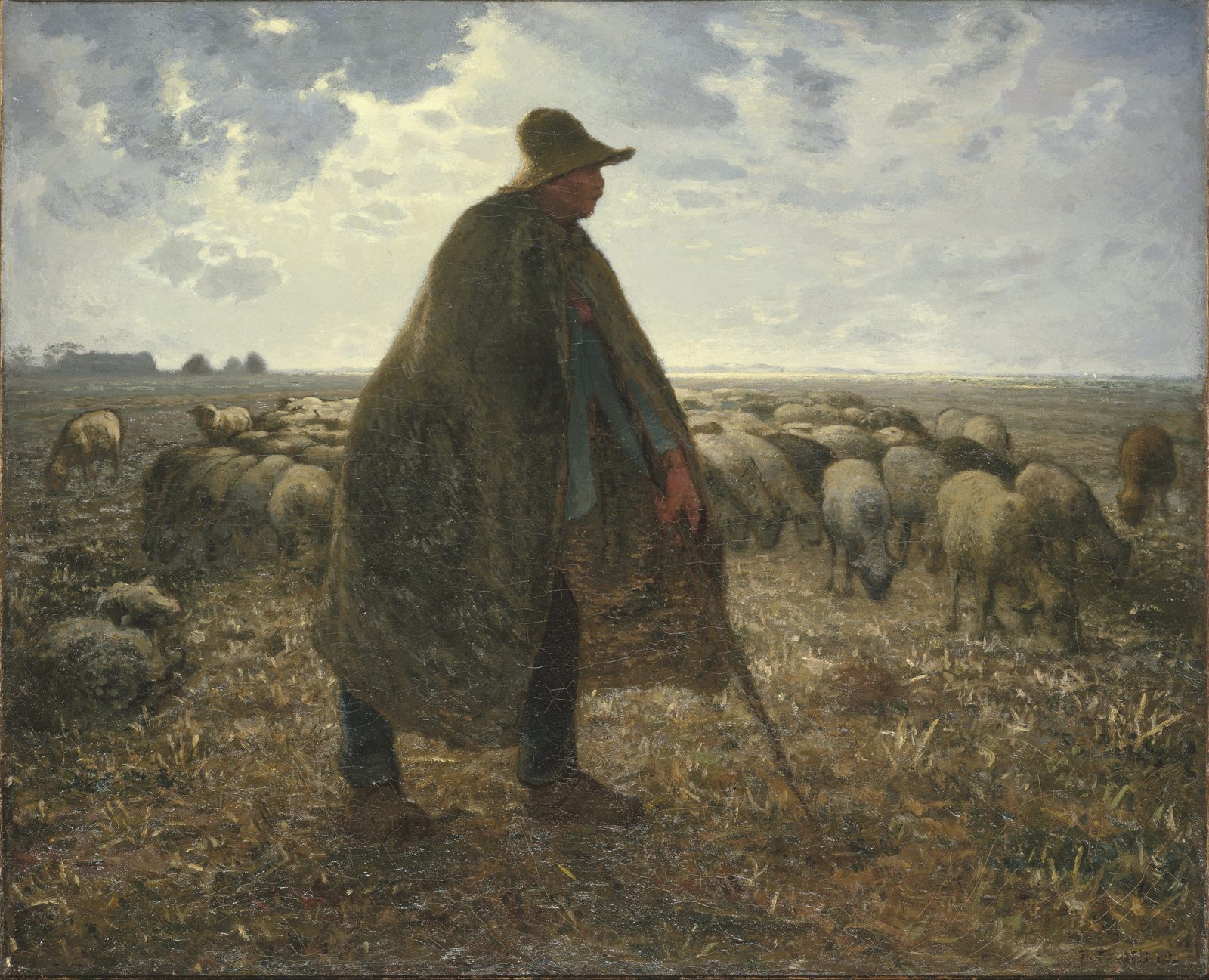
Israel called God the Shepherd of Israel at Psalm 80:1; here one man says the LORD is my shepherd. Green pastures and quiet waters are a shepherd's provision, food and water calm enough for a sheep to drink. The line closes on a settled thing, I shall not want.
This site's exposition
green pastures
Both verbs have the shepherd as their subject. Charles Spurgeon read lying down as the believer's rest and being led as his active life, and he found both provided for. Matthew Henry took the green pastures as God's word, a pasture never eaten bare.
The record, by era
The Church Fathers4 voices
"In a place of pasture there has He placed me" [Psalm 23:2]. In a place of fresh pasture, leading me to faith, there has He placed me to be nourished. "By the water of refreshing has He brought me up." By the water of baptism, whereby they are refreshed who have lost health and strength, has He brought me up.
The pastures that this good shepherd has prepared for you, in which he has settled you for you to take your fill, are not various kinds of grasses and green things, among which some are sweet to the taste, some extremely bitter, which as the seasons succeed one another are sometimes there and sometimes not. Your pastures are the words of God and his commandments, and they have all been sown as sweet grasses. These pastures had been tasted by that man who said to God, "How sweet are your words to my palate, more so than honey and the honeycomb in my mouth!"
"The water of refreshment" is the baptismal font through which the soul, barren because of the dryness of sin, is watered by divine gifts in order that it may produce good fruits.
The Lord leads me. That is the word of the one who the church, settled in a place of pasture and drawn from the water of reflection, has received, the one who is made complete from the suffering of the Lord. When the stream flows, …
The Medieval Church1 voice
He designates all abundance metaphorically through the abundance of food and drink. For if He feeds us, He stands in relation to us as a shepherd to his sheep, which are nourished by two things, namely grass and water. With regard to the first he …
7 more voices on this verse
The Puritans and the Awakening2 voices
God's ordinances are the green pastures in which food is provided for all believers; the word of life is the nourishment of the new man. It is milk for babes, pasture for sheep, never barren, never eaten bare, never parched, but always a green pasture for faith to feed in.
He maketh me to lie down in green pastures,....
The Nineteenth Century5 voices
"He maketh me to lie down in green pastures: he leadeth me beside the still waters." The Christian life has two elements in it, the contemplative and the active, and both of these are richly provided for. First, the contemplative. "He maketh me to lie down in green pastures." What are these "green pastures" but the Scriptures of truth—always fresh, always rich, and never exhausted? There is no fear of biting the bare ground where the grass is long enough for the flock to lie down in it.
A commentator
Jamieson, Fausset & Brown1802–1910
Commentary Critical and Explanatory on the Whole Bible (1871)
proposed
green pastures--or, "pastures of tender grass," are mentioned, not in respect to food, but as places of cool and refreshing rest. the still waters--are, literally, "waters of "stillness," whose quiet flow invites to repose. They are contrasted with boisterous streams on the one hand, and stagnant, offensive pools on the other.
quarantine:debris (2026-07-29) — starts-lowercase+odd-straight-quotes
"He maketh me to lie down in green pastures: he leadeth me beside the still waters." The Christian life has two elements in it, the contemplative and the active, and both of these are richly provided for. First, the contemplative. "He maketh me to lie down in green pastures." What are these "green pastures" but the Scriptures of truth—always fresh, always rich, and never exhausted? There is no fear of biting the bare ground where the grass is long enough for the flock to lie down in it. Sweet and full are the doctrines of the gospel; fit food for souls, as tender grass is natural nutriment for sheep. When by faith we are enabled to find rest in the promises, we are like the sheep that lie down in the midst of the pasture; we find at the same moment both provender and peace, rest and refreshment, serenity and satisfaction. But observe: " He maketh me to lie down." It is the Lord who graciously enables us to perceive the preciousness of his truth, and to feed upon it. How grateful ought we to be for the power to appropriate the promises! There are some distracted souls who would give worlds if they could but do this. They know the blessedness of it, but they cannot say that this blessedness is theirs. They know the "green pastures," but they are not made to "lie down" in them. Those believers who have for years enjoyed a "full assurance of faith" should greatly bless their gracious God. The second part of a vigorous Christian's life consists in gracious activity. We not only think, but we act. We are not always lying down to feed, but are journeying onward toward perfection; hence we read, "he leadeth me beside the still waters." What are these "still waters" but the influences and graces of his blessed Spirit? His Spirit attends us in various operations, like waters—in the plural—to cleanse, to refresh, to fertilise, to cherish.
He maketh me to lie down in green pastures - בנאות דשא binoth deshe, not green pastures, but cottages of turf or sods, such as the shepherds had in open champaign countries; places in which themselves could repose safely; and pens thus constructed where the flock might be safe all the night. They were enclosures, and enclosures where they had grass or provender to eat. Beside the still waters - Deep waters, that the strongest heat could not exhale; not by a rippling current, which argues a shallow stream. Or perhaps he may here refer to the waters of Siloam, or Shiloah, that go sof tly, Isa 8:6, compared with the strong current of the Euphrates. Thou hast brought us from the land of our captivity, from beyond this mighty and turbulent river, to our own country streams, wells, and fountains, where we enjoy peace, tranquillity, and rest. The old Psalter gives this a beautiful turn: On the water of rehetyng forth he me broght. On the water of grace er we broght forth, that makes to recover our strengthe that we lost in syn. And reheteis (strengthens) us to do gude workes. My saule he turned, that es, of a synful wreche, he made it ryghtwis, and waxyng of luf in mekeness. First he turnes our sautes til hym; and then he ledes and fedes it. Ten graces he telles in this psalme, the qwilk God gyfs til his lufers, (i.e., them that love him).
A commentator
Albert Barnes1798–1870
Notes, Explanatory and Practical, on the Old and New Testaments (1832-1869)
proposed
He maketh me to lie down in green pastures - Margin, “Pastures of tender grass.” The Hebrew word rendered “pastures” means usually “dwellings,” or “habitations.” It is applied here properly to “pastures,” as places where flocks and herds lie down for repose. The word rendered in the margin “tender grass” - דשׁא deshe' - refers to the first shoots of vegetation from the earth - young herbage - tender grass - as clothing the meadows, and as delicate food for cattle, Job 6:5. It differs from ripe grass ready for mowing, which is expressed by a different word - חציר châtsı̂yr. The idea is that of calmness and repose, as suggested by the image of flocks “lying down on the grass.” But this is not the only idea. It is that of flocks that lie down on the grass “fully fed” or “satisfied,” their wants being completely supplied. The exact point of contemplation in the mind of the poet, I apprehend, is that of a flock in young and luxuriant grass, surrounded by abundance, and, having satisfied their wants, lying down amidst this luxuriance with calm contentment. It is not merely a flock enjoying repose; it is a flock whose wants are supplied, lying down in the midst of abundance. Applied to the psalmist himself, or to the people of God generally, the idea is, that the wants of the soul are met and satisfied, and that, in the full enjoyment of this, there is the conviction of abundance - the repose of the soul at present satisfied, and feeling that in such abundance want will always be unknown.
How the passage was read
What the Jewish commentators add
in green pasture In grassy pastures. Since he commences to compare his sustenance to the pasture of an animal by saying, “The Lord is my shepherd,” “green pastures” is appropriate for the expression, “the Lord is my shepherd.” David recited this psalm in the forest of Hereth (I Sam.:5).
2 more on this passage, in their own words ▾
A song of David The Rabbis said: Wherever it says: “A song of David,” he would play [his musical instrument] and afterwards the Shechinah would rest on him. It is a song to bring the holy spirit upon David.
He restores my soul My spirit, which has been weakened by troubles and haste, He will restore to its previous status.
This section is reception history: how the passage was read and kept in the Jewish tradition. Where a reading parts from an essential of the Christian faith, the section says so at that point.
Texts and citation data: Sefaria; each excerpt follows its version’s licence. 4 further sources are cited on this chapter that carry no English text this site may quote or only restate the verse.
The words behind it
7 Hebrew wordsEvery Hebrew word of this verse in the order it stands, with what it means and the door to its own study. The last column counts the times a word stands in the whole Bible: the rarer the word, the more the places it appears belong together.
| Hebrew | Sound | Meaning | Word study | In the Bible |
|---|---|---|---|---|
| בִּנְא֣וֹת | binot | in pastures of | H4999 → | 12 times |
| דֶּ֭שֶׁא | deshe' | grass | H1877 → | |
| יַרְבִּיצֵ֑נִי | yarbitzeni | he makes lie down me | H7257 → | |
| עַל־ | ʾal- | at | H5921 → | 5755 times |
| מֵ֖י | mei | waters of | H4325 → | 581 times |
| מְנֻח֣וֹת | menuchot | rest<s> | H4496 → | 22 times |
| יְנַהֲלֵֽנִי׃ | yenahaleni | he leads me | H5095 → |
בִּנְא֣וֹתin pastures of
binotH4999 →12 times
דֶּ֭שֶׁאgrass
deshe'H1877 →
יַרְבִּיצֵ֑נִיhe makes lie down me
yarbitzeniH7257 →
עַל־at
ʾal-H5921 →5755 times
מֵ֖יwaters of
meiH4325 →581 times
מְנֻח֣וֹתrest<s>
menuchotH4496 →22 times
יְנַהֲלֵֽנִי׃he leads me
yenahaleniH5095 →
A shaded row is a word that stands 400 times or fewer in the Bible.
The walk
8 stopsEach card is a verse this one points to, and under it the verses that one points to in turn. Where several paths arrive at the same place, that place is listed first: the text keeps returning to it.
Through
Revelation 22:1Then the angel showed me a river of the water of life, as clear as crystal, flowing from the throne of God and of the Lamb
it leads to
- John 4:14
But whoever drinks the water I give him will never thirst. Indeed, the water I give him will become in him a fount of water springing up to eternal life.”
Reached by 3 separate paths from here.
- Psalms 36:8–9
They feast on the abundance of Your house, and You give them drink from Your river of delights.
Reached by 3 separate paths from here.
- Revelation 7:17
For the Lamb in the center of the throne will be their shepherd. ‘He will lead them to springs of living water,’ and ‘God will wipe away every tear from their eyes.’”
Reached by 2 separate paths from here.
- John 7:38–39
Whoever believes in Me, as the Scripture has said: ‘Streams of living water will flow from within him.’”
- John 4:10–11
Jesus answered, “If you knew the gift of God and who is asking you for a drink, you would have asked Him, and He would have given you living water.”
- John 4:14
Through
Revelation 7:17For the Lamb in the center of the throne will be their shepherd. ‘He will lead them to springs of living water,’ and ‘God will wipe away every tear from their eyes.’”
it leads to
- John 7:37–38
On the last and greatest day of the feast, Jesus stood up and called out in a loud voice, “If anyone is thirsty, let him come to Me and drink.
Reached by 2 separate paths from here.
- Psalms 23:1–2
The LORD is my shepherd; I shall not want.
- John 7:37–38
Through
Revelation 21:6And He told me, “It is done! I am the Alpha and the Omega, the Beginning and the End. To the thirsty I will give freely from the spring of the water of life.
it leads to
- John 4:10
Jesus answered, “If you knew the gift of God and who is asking you for a drink, you would have asked Him, and He would have given you living water.”
- John 4:10
Where this verse is studied
On this page
Studies8
On this verse
On this chapter
About Psalms
This page draws on 13 works. Open the list of works
This page draws on Adam Clarke, Commentary on the Bible; Albert Barnes, Notes, Explanatory and Practical, on the Old and New Testaments (1832-1869); Arnobius the Younger, COMMENTARY ON THE PSALMS 23; Augustine of Hippo, Exposition on Psalm 23; Augustine of Hippo, SERMON 366:3; Cassiodorus, EXPLANATION OF THE PSALMS 23:2; Charles Spurgeon, The Treasury of David; Charles Spurgeon, The Treasury of David, Vol. 1; Jamieson, Fausset & Brown, Commentary Critical and Explanatory on the Whole Bible; John Gill, Exposition of the Old Testament (1748-1763); Matthew Henry, Commentary on the Whole Bible; Theodoret of Cyrus, COMMENTARY ON THE PSALMS 23:2 and Thomas Aquinas, Exposition on the Psalms of David.