
Matthew 15:10
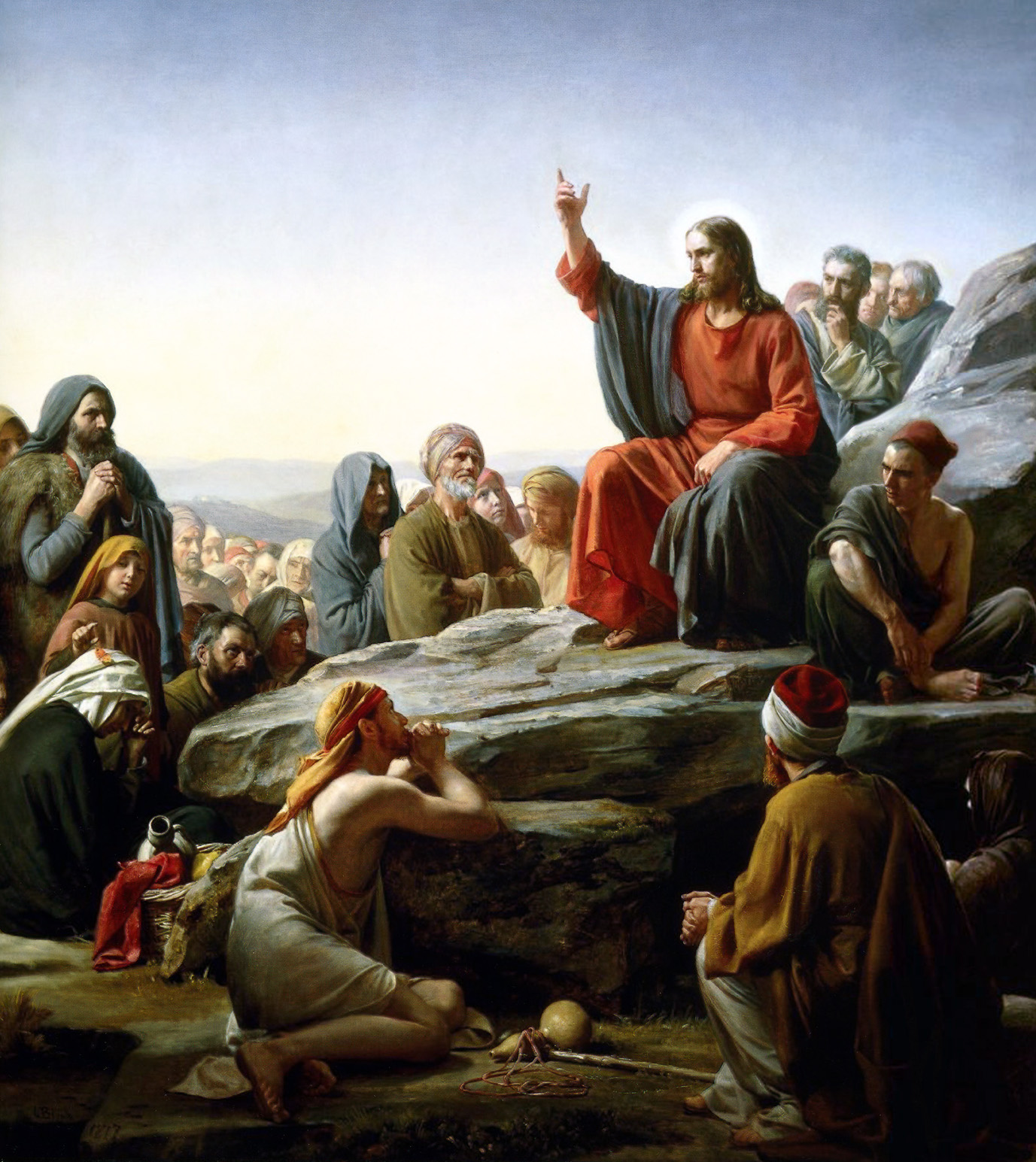
in Matthew 15Jesus called the crowd to Him and said, “Listen and understand.
BSB
The same verse in ASV and KJV ▾
ASV
And he called to him the multitude, and said unto them, Hear, and understand:
KJV
And he called the multitude, and said unto them, Hear, and understand:
⋯
This verse in Matthew 15
Commentary
14 notes on this verseBut what reason is there in going to prayer with hands indeed washed, but the spirit foul?-inasmuch as to our hands themselves spiritual purities are necessary, that they may be "lifted up pure" from falsehood, from murder, from cruelty, from poisonings, from idolatry, and all the other blemishes which, conceived by the spirit, are effected by the operation of the hands. These are the true purities; not those which most are superstitiously careful about, taking water at every prayer, even when they are coming from a bath of the whole body.
This site's exposition
Listen and understand
on Matthew 15:10-11
Jesus called the crowd to Him and said, Listen and understand. He stated the principle: A man is not defiled by what enters his mouth, but by what comes out of it. Barnes reads the saying as moving clean and unclean from the hand and the food to the heart.
The record, by era
The Church Fathers2 voices
(Verse 4 onwards) For God said, 'Honor your father and mother, and whoever curses his father or mother, let him be put to death.' But you say, 'Whoever says to his father or mother, Whatever help you would have received from me is given to God,' and does not honor his father or mother, you have made void the commandment of God because of your tradition. Hypocrites, well did Isaiah prophesy of you, saying, 'This people honors me with their lips, but their heart is far from me' (Exodus 20, Leviticus 20). But they worship me without cause, teaching doctrines and commandments of men. And, calling the multitude to him, he said to them: Hear and understand. Honor in the Scriptures is not only felt in greetings and deference to offices, but also in acts of charity and the offering of gifts (Exodus 20:12, 21 and Leviticus 20). The Apostle says, 'Honor widows who are truly widows' (1 Timothy 5:3); here honor is understood as a gift. And in another place: Elders are to be honored with double honor, especially those who labor in the word and doctrine of God (ibid., 17). And by this command we are commanded not to close the mouth of the ox that is treading out the corn (Deut. XXV) . And may the worker be worthy of his wage (Luke X) . The Lord had commanded, considering the weaknesses, ages, and hardships of parents, that children should honor their parents even in providing for their basic needs. […]
Having, you see, given them their mortal blow; and from the facts first, then from their own suffrage, then from the prophet having aggravated the charge, with them indeed He discourses not at all, incorrigibly disposed as they are now come to be, but directs His speech to the multitudes, so as to introduce His doctrine, great and high, and full of much strictness; and taking occasion from the former topic, He proceeds to insert that which is greater, casting out also the observance of meats. But see when. When He had cleansed the leper, when He had repealed the Sabbath, when He had shown Himself King of earth and sea, when He had made laws, when He had remitted sins, when He had raised dead men, when He had afforded them many proofs of His Godhead, then He discourses of meats. For indeed all the religion of the Jews is comprised in this; if thou take this away, thou hast even taken away all. For hereby He signifies, that circumcision too must be abrogated. But of Himself He doth not prominently introduce this (forasmuch as that was older than the other commandments, and had higher estimation), but He enacts it by His disciples. For so great a thing was it, that even the disciples after so long a time being minded to do it away, first practise it, and so put it down. But see how He introduces His law: how "He called the multitude, and said unto them, Hear and understand." Thus He doth by no means simply reveal it to them, but by respect and courtesy, first, He makes His saying acceptable (for this the evangelist declares by saying, "He called them unto Him"): and secondly, by the time also; in that after their refutation, and His victory over them, and the accusation by the prophet, then He begins His legislation, when they too would more easily receive His sayings. And He doth not merely call them unto Him, but also makes them more attentive. […]
The Medieval Church2 voices
He no longer converses with the Pharisees, as they were incurable, but with the multitude. Christ sees fit to honor the multitude by calling them to Himself so that they might accept His word, and He says, "Hear and understand," urging them to be attentive. …
And having called together the crowds to him, he said to them etc. Above, the Lord showed the Pharisees who were making accusations to be unworthy of reprehending the disciples, because they were involved in greater sins; but now, passing over them, he instructs others, …
The Puritans and the Awakening1 voice
Christ must favour them at their pleasure with a discourse in private. But Christ had a regard to the multitude; he soon despatched the scribes and Pharisees, and then turned them off, invited the mob, the multitude, to be his hearers: thus the poor are evangelized; and the foolish things of the world, and things that are despised hath Christ chosen.
7 more voices on this verse
The Puritans and the Awakening2 voices
Though Christ rejects the wilfully ignorant who care not to be taught, he can have compassion on the ignorant who are willing to learn, Heb. v. 2 . If the Pharisees, who made void the law, be offended, let them be offended: but this great peace have they who love the law, that nothing shall offend them, but, some way or other, the offence shall be taken off, Ps. cxix.
And he called the multitude,....
The Nineteenth Century5 voices
A commentator
Jamieson, Fausset & Brown1802–1910
Commentary Critical and Explanatory on the Whole Bible (1871)
proposed
And he called the multitude, and said unto them--The foregoing dialogue, though in the people's hearing, was between Jesus and the pharisaic cavillers, whose object was to disparage Him with the people.
There are two striking sayings of the Lord Jesus in this passage. One respects false doctrine: the other respects the human heart. Both of them deserve the closest attention. Respecting false doctrine, our Lord declares that it is a duty to oppose it, that its final destruction is sure, and that its teachers ought to be forsaken. He says, “Every plant that my heavenly Father has not planted shall be rooted up. Let them alone.” It is clear, from examination of the passage, that the disciples were surprised at our Lord’s strong language about the Pharisees and their traditions.
There are two striking sayings of the Lord Jesus in this passage. One respects false doctrine: the other respects the human heart. Both of them deserve the closest attention. Respecting false doctrine, our Lord declares that it is a duty to oppose it, that its final destruction is sure, and that its teachers ought to be forsaken. He says, “Every plant that my heavenly Father has not planted shall be rooted up. Let them alone.” It is clear, from examination of the passage, that the disciples were surprised at our Lord’s strong language about the Pharisees and their traditions. They had probably been accustomed from their youth to regard the Pharisees as the wisest and best of men. They were startled to hear their Master denouncing them as hypocrites, and charging them with transgressing the commandment of God. “Knowest thou,” they said, “that the Pharisees were offended?” To this question we are indebted for our Lord’s explanatory declaration, a declaration which perhaps has never received the notice it deserves. The plain meaning of our Lord’s words is that false doctrine like that of the Pharisees was a plant to which no mercy should be shown. It was a “plant which his heavenly Father had not planted,” and a plant which it was a duty to “root up,” whatever offense it might cause. To spare it was no charity, because it was injurious to the souls of men. It mattered nothing that those who planted it were high in office, or learned: if it contradicted the Word of God it ought to be opposed, refuted and rejected. His disciples must therefore understand that it was right to resist all teaching that was unscriptural, and to “let alone” and forsake all instructors who persisted in it. Sooner or later they would find that all false doctrine will be completely overthrown and put to shame, and that nothing shall stand but that which is built on the Word of God.
Hear and understand - A most important command. Hear - make it a point of conscience to attend to the ministry of the word. Understand - be not satisfied with attending places of public worship merely; see that the teaching be of God, and that you lay it to heart.
A commentator
Albert Barnes1798–1870
Notes, Explanatory and Practical, on the Old and New Testaments (1832-1869)
proposed
See also Mar 7:15-17. And he called the multitude - In opposition to the doctrines of the Pharisees, the Saviour took occasion to show them that the great source of pollution was the heart. They supposed that external things chiefly defiled a man. On this all their doctrines about purification were founded. This opinion of the Jews it was of great importance to correct. The Saviour took occasion, therefore, to direct the people to the true source of defilement - their own hearts. He particularly directed them to it as of importance - “Hear and understand.” Mat 15:11 Not that which goeth into the mouth ... - The disciples were charged with being sinners for transgressing the tradition of the elders in eating with unwashed hands. Christ replies that what they should eat could not render them sinners. The man, the moral agent, the soul, could not be polluted by anything that was eaten. What proceeds from the man himself, from his heart, would defile him. Defileth - Pollutes, corrupts, or renders sinful. Mat 15:12 The Pharisees were offended - They were so zealous of their traditions that they could not endure that their absurdities should be exposed. Mat 15:13 Every plant ... - Religious doctrine is not inaptly compared to a plant. See 1Co 3:6-8. It is planted in the mind for the purpose of producing fruit in the life, or right conduct. Jesus here says that all those doctrines of which his Father was not the author must be rooted up or corrected. The false doctrines of the Pharisees, therefore, must be attacked, and it was no wonder if they were indignant. It could not be helped. It was his duty to attack them. He was not surprised that they were enraged; but, notwithstanding their opposition, their doctrine should be destroyed. Mat 15:14 Let them alone - That is, do not be troubled at their rage. Be not anxious about it. This result is to be expected. […]
How the passage was read
On Matthew 15:1-20On Matthew 15:1-20
Handwashing, korban, and which tradition weighs more
“Why do thy disciples transgress the tradition of the elders? for they wash not their hands when they eat bread.” The washing in question is netilat yadayim, a ritual pouring of water over the hands before eating bread. It was never about hygiene: it extends to the ordinary table the purity washing the Torah requires of priests before they eat holy food, one more piece of the Pharisaic program to make every table an altar. The Mishnah devotes a whole tractate to it (Yadayim 1:1 opens with the required quantity of water), and observant homes keep the practice before bread to this day.
Jesus answers with a harder case from the same tradition: korban. Property declared korban (“an offering”) was barred from ordinary use as if dedicated to God, and the vow formula could be used to lock a son's goods away from his own parents; the Mishnah records the substitute formulas people spoke (Nedarim 1:2). Jesus weighs that vow against the commandment “honor thy father and mother” and rules that no vow can cancel it. The tradition itself wrestled with the same tension: its vow-release discussions include a debated question about opening a release by appeal to the parents' honor (Nedarim 9:1 records the rabbis divided over exactly that move). Jesus' ruling cuts where the tradition circled.
This section is reception history: how the passage was read and kept in the Jewish tradition. Where a reading parts from an essential of the Christian faith, the section says so at that point.
Sources: Mishnah Yadayim 1:1 (the handwashing rite) · Mishnah Nedarim 1:2 (the korban formulas) · Mishnah Nedarim 9:1 (release of vows and the parents' honor, a recorded dispute)
The words behind it
9 Greek wordsEvery Greek word of this verse in the order it stands, with what it means and the door to its own study. The last column counts the times a word stands in the whole Bible: the rarer the word, the more the places it appears belong together.
| Greek | Sound | Meaning | Word study | In the Bible |
|---|---|---|---|---|
| Καὶ | kai | And | G2532 → | 9120 times |
| προσκαλεσάμενος | proskalesamenos | having called to [Him] | G4341 → | 28 times |
| τὸν | ton | the | G3588 → | 19766 times |
| ὄχλον | ochlon | crowd | G3793 → | 175 times |
| εἶπεν | eipen | He said | G2036 → | 925 times |
| αὐτοῖς· | autois | to them; | G846 → | 5565 times |
| ἀκούετε | akouete | do hear | G191 → | 425 times |
| καὶ | kai | and | G2532 → | 9120 times |
| συνίετε· | suniete | do understand: | G4920 → | 26 times |
ΚαὶAnd
kaiG2532 →9120 times
προσκαλεσάμενοςhaving called to [Him]
proskalesamenosG4341 →28 times
τὸνthe
tonG3588 →19766 times
ὄχλονcrowd
ochlonG3793 →175 times
εἶπενHe said
eipenG2036 →925 times
αὐτοῖς·to them;
autoisG846 →5565 times
ἀκούετεdo hear
akoueteG191 →425 times
καὶand
kaiG2532 →9120 times
συνίετε·do understand:
sunieteG4920 →26 times
A shaded row is a word that stands 400 times or fewer in the Bible.
The walk
8 stopsEach card is a verse this one points to, and under it the verses that one points to in turn. Where several paths arrive at the same place, that place is listed first: the text keeps returning to it.
Through
Colossians 1:9For this reason, since the day we heard about you, we have not stopped praying for you and asking God to fill you with the knowledge of His will in all spiritual wisdom and…
it leads to
- James 3:17
But the wisdom from above is first of all pure, then peace-loving, gentle, accommodating, full of mercy and good fruit, impartial, and sincere.
- Philippians 1:9–11
And this is my prayer: that your love may abound more and more in knowledge and depth of insight,
- James 1:5
Now if any of you lacks wisdom, he should ask God, who gives generously to all without finding fault, and it will be given to him.
- Ephesians 1:15–20
For this reason, ever since I heard about your faith in the Lord Jesus and your love for all the saints,
- James 3:17
Through
Luke 24:45Then He opened their minds to understand the Scriptures.
it leads to
- Acts 16:14
Among those listening was a woman named Lydia, a dealer in purple cloth from the city of Thyatira, who was a worshiper of God. The Lord opened her heart to respond to Paul’s message.
- 1 John 5:20
And we know that the Son of God has come and has given us understanding, so that we may know Him who is true; and we are in Him who is true—in His Son…
- Psalms 119:18
Open my eyes that I may see wondrous things from Your law.
- 2 Corinthians 3:14–18
But their minds were closed. For to this day the same veil remains at the reading of the old covenant. It has not been lifted, because only in Christ can it be removed.
- Acts 16:14
Where this verse is studied
On this page
About Matthew
This page draws on 13 works. Open the list of works
This page draws on Adam Clarke, Commentary on the Bible; Albert Barnes, Notes, Explanatory and Practical, on the Gospels; Albert Barnes, Notes, Explanatory and Practical, on the Old and New Testaments (1832-1869); J.C. Ryle, Expository Thoughts on the Gospels: Matthew; Jamieson, Fausset & Brown, Commentary Critical and Explanatory on the Whole Bible; Jerome, Commentary on Matthew; John Chrysostom, Homily on the Gospel of Matthew 51; John Gill, Exposition of the New Testament (1746-1748); John Wesley, Explanatory Notes upon the New Testament; Matthew Henry, Commentary on the Whole Bible; Tertullian, On Prayer; Theophylact of Ohrid, Commentary on Matthew and Thomas Aquinas, Commentary on Matthew.