
Psalm 92
15 verses · Song of thanksgiving for the Sabbath
The righteous will flourish like a palm tree, and grow like a cedar in Lebanon.
Introduction
Author unstated, the Sabbath Song, Book 4: The LORD reigns, Poetry, Psalms Overview.
This is the one psalm in the Psalter whose title gives it a day of the week, the Sabbath. Its writer is not named. It was sung by people who stopped their work every seventh day and gathered to give thanks, and it gives them their reason. The writer has watched wicked men prosper and has thought about how long their success lasts. Listen for the contrast between quick growth and slow growth, drawn from the fields and trees every hearer knew, and for the last years of a life set at the close as proof of God's faithfulness.
Context
- Who
- Worshippers keeping the seventh day, who had watched both grass and cedars grow
- What
- A song of thanksgiving for the Sabbath that weighs the brief success of the wicked against the long life of the righteous.
- Where
- The sanctuary, with a ten-stringed harp and a lyre named in the psalm itself
- When
- Undated; its title assigns it to the Sabbath day, and it was sung in the temple service.
- Why
- To give the seventh day its work of praise and to settle a worshipper troubled by the success of evil men.
Historical context
This is the only psalm in the Psalter whose title assigns it to a day of the week, the Sabbath. Verse 3 names the instruments, a ten-stringed harp and a lyre, which were the temple's own instruments. The two trees of verse 12 were the two most valuable timbers a hearer knew: the date palm was a long-lived tree that bore fruit late into its age, and the cedar of Lebanon was the timber kings imported for building, prized for lasting without rotting. Against those trees the psalm sets grass, which in Judah came up fast after the rains and was gone in the dry season.
Significance
For a people who could see the wicked prospering in front of them, the psalm agreed that the wicked sprout, and then said how long the sprouting lasts. The promise of verse 14, that the righteous still bear fruit in old age, was heard by people whose old age was usually poor and short. It made the last years of a life the evidence of God's faithfulness.
This chapter in Jewish lifeWhat this chapter is in Jewish life and reading.
What is done
This is the one psalm whose title names a day, and the Jewish traditions preserved in the Mishnah record it as the psalm the Levites sang in the temple on the seventh day (Mishnah Tamid 7:4, Danby translation, as this site records it at scripts/data/historical-context/ch3-psalms-b.mjs). The Levites stood on the step platform between the court of Israel and the altar while the offering was made.
Rashi reports the same use of it. On the title he writes that it is the psalm "for the Sabbath day that they would recite on Sabbaths, and it deals with the world to come, which is entirely Sabbath" (Rashi on Psalms 92:1:2, Rashi on Psalms, The Judaica Press complete Tanach with Rashi, translated by A. J. Rosenberg, CC-BY).
How it is read
Radak reads the psalm as praise fitted to the day it names. He holds that "the Sabbath Day is better for praising the Name than the other days of the week", because a man is free of the business of the world on it and his spirit rests, and the spirit then occupies itself in wisdom and the service of God (Radak on Psalms 92:2:1, Radak on Psalms, Sefaria Community Translation, CC0).
Rashi reads the two halves of verse 3 as two times rather than two hours. The kindness declared in the morning is declared "at the time of the Redemption", and the faithfulness of the night is the believing done "during the distress of the exile" that God will keep His promise (Rashi on Psalms 92:3:1 and 92:3:2, same edition). The flourishing of the wicked in verse 8 is read the same way, as a growth allowed only so that it may be cut down (Rashi on Psalms 92:8:1).
Ibn Ezra comments on eight verses of this chapter and Radak on two more, and Sefaria holds no English version of those ten, so they are cited by reference and read at the link (Ibn Ezra on Psalms 92:2:1 and Radak on Psalms 92:5:1, with the eight references beside them).
What the rabbis say
The corpus records forty places where the Midrash and the Talmud cite this psalm, thirty four under Midrash and six under Talmud, and it carries the locator for each one with no text. The Babylonian Talmud cites verse 3 at Berakhot 12a:23 and verse 4 at Arakhin 13b:12, and Avot DeRabbi Natan takes up the title at 1:8 and verse 4 at 25:1. The Jerusalem Talmud cites verse 5 at Berakhot 9:5:2 and verse 9 at Kiddushin 4:11:1.
Midrash Tehillim treats the psalm at 92:10, and Pirkei DeRabbi Eliezer cites it three times, at 19:7, 19:9 and 19:10. Bereshit Rabbah reads the first verse at 22:13 and the palm and the cedar of verses 13 to 15 at 26:2 and 61:2. The site reports where the rabbis cite the verse and reports no saying, because the locator carries none.
Sources: The Mishnah, Tamid 7:4, Danby translation, as recorded at scripts/data/historical-context/ch3-psalms-b.mjs, about AD 200; Rashi, Rashi on Psalms 92, in The Judaica Press complete Tanach with Rashi, translated by A. J. Rosenberg, CC-BY; Radak, Radak on Psalms 92, Sefaria Community Translation, CC0; Ibn Ezra, Ibn Ezra on Psalms 92, cited by reference; Sefaria holds no English version; The Midrash and the Talmud, the forty locators on Psalms 92 in scripts/data/sources/sefaria/psalms/92.json.
Psalms 92:1-3
It is good to praise the LORD: The call runs across the whole day, loving devotion in the morning and faithfulness at night. Verse 3 names the instruments, a ten-stringed harp and a lyre. The good thing is the praise itself, offered to the Most High by name.
Psalms 92:1
“It is good to give praise to the Lord, and to sing to your name, O Most High. He did not say, it is good to sing, and afterwards to give praise; but see the order: It is good to give praise, and it is good to sing. First do penance and wipe away your sins with tears, and afterwards sing to the Lord. It is good to give praise to the Lord: not to men, but to God: confess your sins to him who is able to heal. And to sing to your name, O Most High.”
Jerome · written before 420 · Homily 21, on Psalm 91patristic
1 more voice on this verseWhat preachers and commentators have said about this verse, in their own words.
Psalms 92:1
“It is a good thing to give thanks unto the Lord, or Jehovah. It is good ethically, for it is the Lord's right; it is good emotionally, for it is pleasant to the heart; it is good practically, for it leads others to render the same homage. When duty and pleasure combine, who will be backward? To give thanks to God is but a small return for the great benefits wherewith he daily loadeth us; yet as he by his Spirit calls it a good thing we must not despise it, or neglect it.”
Charles Spurgeon · The Treasury of David, Vol. 4 (1874)Particular Baptist
Your faithfulness at night: Morning and night mark the two ends of the day, and each is given its own subject. Loving devotion is declared as the day begins, and faithfulness when the day's events have proved it. The Sabbath title sets that rhythm for the whole day.
Psalms 92:2
“To proclaim your mercy in the morning, and your truth throughout the night. Understand carefully what is said: To proclaim your mercy in the morning and your truth throughout the night. Each little verse refers to a corresponding one. It is good to give praise to the Lord — to proclaim your mercy in the morning. If you give praise to the Lord, you proclaim in the morning the mercies of the Lord. And to sing to your name, O Most High. Refer this verse to the one that follows: And your truth throughout the night.”
Jerome · written before 420 · Homily 21, on Psalm 91patristic
1 more voice on this verse
Psalms 92:2
“To shew forth thy loving kindness in the morning. The day should begin with praise: no hour is too early for holy song. Loving kindness is a most appropriate theme for those dewy hours when morn is sowing all the earth with orient pearl. Eagerly and promptly should we magnify the Lord; we leave unpleasant tasks as long as we can, but our hearts are so engrossed with the adoration of God that we would rise betimes to attend to it.”
Charles Spurgeon · The Treasury of David, Vol. 4 (1874)Particular Baptist
the melody of the lyre: The ten-stringed harp and the lyre carry the praise of verse 1. The Hebrew word behind melody, higgayon, is a musical direction at Psalm 9:16. The praise to the LORD is given a sound.
Psalms 92:3
“On the ten-stringed psaltery, with a song upon the harp. I say it plainly: as often as we lift up our hands without wandering thoughts and disputings, we sing to the Lord on the ten-stringed instrument. On the ten-stringed psaltery, with a song upon the harp. Our harp is body and soul and spirit: they are composed of all the strings.”
Jerome · written before 420 · Homily 21, on Psalm 91patristic
2 more voices on this verse
Psalms 92:3
“Upon an instrument of ten strings; with the fullest range of music, uttering before God with the full compass of melody the richest emotions of his soul. And upon the psaltery; thus giving variety to praise: the Psalmist felt that every sweet-sounding instrument should be consecrated to God. George Herbert and Martin Luther aided their private devotions by instrumental music; and whatever may have been the differences of opinion in the Christian church, as to the performance of instrumental music in public, we have met with no objection to its personal and private use.”
Charles Spurgeon · The Treasury of David, Vol. 4 (1874)Particular Baptist
Psalms 92:3
“In such a work all proper aid must be used. with a . . . sound--or, on Higgaion (see on Ps 9:16), perhaps an instrument of that name, from its sound resembling the muttered sound of meditation, as expressed also by the word. This is joined with the harp.”
Jamieson, Fausset & Brown · Commentary Critical and Explanatory on the Whole Bible (1871)reformed
Psalms 92:4-6
made me glad by Your deeds: Gladness here comes from God's own deeds and the works of His hands. Verse 5 puts His works and His thoughts side by side, and calls the thoughts deep. The senseless man and the fool miss both.
Psalms 92:4
“For thou, Lord, hast made me glad through thy work. It was natural for the psalmist to sing, because he was glad, and to sing unto the Lord, because his gladness was caused by a contemplation of the divine work. If we consider either creation or providence, we shall find overflowing reasons for joy; but when we come to review the work of redemption, gladness knows no bounds, but feels that she must praise the Lord with all her might.”
Charles Spurgeon · The Treasury of David, Vol. 4 (1874)Particular Baptist
1 more voice on this verse
Psalms 92:4
“Let us then make his praises glorious. Has God made us glad through the works of his providence for us, and of his grace in us, and both through the great work of redemption? (1.) Let us thence fetch encouragement for our faith and hope; so the psalmist does: I will triumph in the works of thy hands.”
Matthew Henry · Commentary on the Whole Bible (1707-1721)puritan
how deep are Your thoughts!: Great works and deep thoughts are the two things the singer cannot measure. The works can be seen, and the purposes behind them lie below sight like deep water. Verse 6 names who misses them.
Psalms 92:5
“O Lord, how great are thy works!.... Of nature, providence, and grace, both for quantity and for quality, for number, excellency, and glory, as they are a display of God's wisdom, power, and goodness; see Psa 104:24, and thy thoughts are very deep; his counsels, purposes, and designs, they are unfathomable and unsearchable; see 1Co 2:10.”
2 more voices on this verse
Psalms 92:5
“O Lord, how great are thy works! He is lost in wonder. He utters an exclamation of amazement. How vast! How stupendous are the doings of Jehovah! Great for number, extent, and glory and design are all the creations of the Infinite One. And thy thoughts are very deep. The Lord's plans are as marvellous as his acts; his designs are as profound as his doings are vast. Creation is immeasurable, and the wisdom displayed in it unsearchable.”
Charles Spurgeon · The Treasury of David, Vol. 4 (1874)Particular Baptist
Psalms 92:5
“Your thoughts have been made exceedingly deep. Whatever I may think, I cannot find it out. "Your judgments are an abyss." "O the depth of the riches of the wisdom and knowledge of God." I too will say with Ecclesiastes: "I said, I will become wise: and it was made far from me, much farther than it was; and it is deep — who can find it out?" What Ecclesiastes says is this: Before I put my thought to the work, I did not see the magnificence of God.”
Jerome · written before 420 · Homily 21, on Psalm 91patristic
A senseless man does not know: The Hebrew for the senseless man is a brutish man, one who lives by appetite like an animal. The fool is the self-confident man who will not be taught. Neither sees what verse 7 says about the end of the wicked.
Psalms 92:6
“The foolish man does not know, and the stupid man does not understand these things. Whoever is not a Christian, and in the works does not understand the creator, that man is foolish.”
Jerome · written before 420 · Homily 21, on Psalm 91patristic
2 more voices on this verse
Psalms 92:6
“A brutish man knoweth not; neither doth a fool understand this. In this and the following verses the effect of the psalm is heightened by contrast; the shadows are thrown in to bring out the lights more prominently. What a stoop from the preceding verse; from the saint to the brute, from the worshipper to the boor, from the psalmist to the fool! Yet, alas, the character described here is no uncommon one.”
Charles Spurgeon · The Treasury of David, Vol. 4 (1874)Particular Baptist
Psalms 92:6
“A brutish man knoweth not--that is, God's works, so the Psalmist describes himself (Ps 73:22) when amazed by the prosperity of the wicked, now understood and explained.”
Jamieson, Fausset & Brown · Commentary Critical and Explanatory on the Whole Bible (1871)reformed
Psalms 92:7-9
the wicked sprout like grass: and flourish, and the same verse ends with their destruction. Verse 8 stands between two verses about them with one line about the LORD, exalted forever. Verse 9 says surely Your enemies twice over.
Psalms 92:7
“When the wicked spring as the grass, in abundance, and apparent strength, hastening on their progress like verdant plants, which come to perfection in a day, and when all the workers of iniquity do flourish; flowering in their prime and pride, their pomp and their prosperity; it is that they shall be destroyed for ever. They grow to die, they blossom to be blasted. They flower for a short space to wither without end. Greatness and glory are to them but the prelude of their overthrow.”
Charles Spurgeon · The Treasury of David, Vol. 4 (1874)Particular Baptist
1 more voice on this verse
Psalms 92:7
“When sinners spring up like grass. You have seen emperors, you have seen prefects, you have seen armies, you have seen victories and triumphs. Yesterday it was, and today it is not. And all who work iniquity have appeared, that they may perish forever and ever. Yesterday it appeared like a flower, today the flower itself does not appear. Yesterday the grass was green, today it is dried up. Where is that beauty? Nothing is good except what is eternal: nothing is good except what is everlasting. Whatever has an end is not even to be counted among good things.”
Jerome · written before 420 · Homily 21, on Psalm 91patristic
You, O LORD, are exalted forever!: This is the shortest verse of the psalm, and it stands at the centre of its fifteen. The wicked are destroyed forever in verse 7, and the LORD is exalted forever here. One forever is an ending and the other has none.
Psalms 92:8
“But you, O Lord, are the Most High for evermore. For behold your enemies, O Lord, for behold your enemies shall perish, and all who work iniquity shall be scattered. If they perish, how shall they be scattered? For he who has once perished cannot be scattered. He ought to have said: Behold, they shall be scattered, and they shall perish.”
Jerome · written before 420 · Homily 21, on Psalm 91patristic
1 more voice on this verse
Psalms 92:8
“But thou, Lord, art most high for evermore. This is the middle verse of the Psalm, and the great fact which this Sabbath song is meant to illustrate. God is at once the highest and most enduring of all beings. Others rise to fall, but he is the Most High to eternity. Glory be to his name! How great a God we worship! Who would not fear thee, O thou High Eternal One! The ungodly are destroyed for ever, and God is most high for ever; evil is cast down, and the Holy One reigns supreme eternally.”
Charles Spurgeon · The Treasury of David, Vol. 4 (1874)Particular Baptist
surely Your enemies will perish: Surely Your enemies is said twice, the repetition of a man certain of the outcome. The wicked of verse 7 are now called God's enemies, so their end is His concern first. Scattered means a company broken apart.
Psalms 92:9
“For, lo, thine enemies, O Lord. It is a wonder full of instruction and warning, observe it, O ye sons of men; for, lo, thine enemies shall parish; they shall cease from among men, they shall be known no more. In that the thing is spoken twice it is confirmed by the Lord, it shall surely be, and that speedily. All the workers of iniquity shall be scattered; their forces shall be dispersed, their hopes broken, and themselves driven hither and thither like chaff before the tempest.”
Charles Spurgeon · The Treasury of David, Vol. 4 (1874)Particular Baptist
1 more voice on this verse
Psalms 92:9
“The workers of iniquity are now associated, and closely linked together, in a combination against God and religion; but they shall be scattered, and disabled to help one another against the just judgment of God. In the world to come they shall be separated from the congregation of the righteous; so the Chaldee, Ps. i.”
Matthew Henry · Commentary on the Whole Bible (1707-1721)puritan
Psalms 92:10-11
have exalted my horn: The horn lifted here is the horn of a wild ox, the strength of a fighting animal held high. The Hebrew verb behind anointed means to be drenched in oil. Verse 11 gives the eyes and the ears, both taking in the enemies' downfall.
Psalms 92:10
“But my horn shalt thou exalt like the horn of an unicorn. The believer rejoices that he shall not be suffered to perish, but shall be strengthened and enabled to triumph over his enemies, by the divine aid. The unicorn may have been some gigantic ox or buffalo now unknown, and perhaps extinct—among the ancients it was the favourite symbol of unconquerable power; the psalmist adopts it as his emblem. Faith takes delight in foreseeing the mercy of the Lord, and sings of what he will do as well as of what he has done.”
Charles Spurgeon · The Treasury of David, Vol. 4 (1874)Particular Baptist
1 more voice on this verse
Psalms 92:10
“Grace is the anointing of the Spirit; when this is given to help in the time of need, and is received, as there is occasion, from the fulness that is in Christ Jesus, we are then anointed with fresh oil. Some read it, When I grow old thou shalt anoint me with fresh oil. My old age shalt thou exalt with rich mercy; so the LXX.”
Matthew Henry · Commentary on the Whole Bible (1707-1721)puritan
My eyes see the downfall of my enemies: The singer says what his eyes and ears take in, and he names no act of his own against his foes. They fall by God's hand, and he is a witness. The verse answers verse 7, where the wicked flourished in plain view.
Psalms 92:11
“Mine eye also shall see my desire on mine enemies. The words, "my desire", inserted by the translators, had far better have been left out. He does not say what he should see concerning his enemies, he leaves that blank, and we have no right to fill in the vacant space with words which look vindictive. He would see that which would be for God's glory, and that which would be eminently right and just. And mine ears shall hear my desire of the wicked that rise up against me.”
Charles Spurgeon · The Treasury of David, Vol. 4 (1874)Particular Baptist
1 more voice on this verse
Psalms 92:11
“This perhaps has reference to Christ, to his victory over Satan, death, and hell, the destruction of those that persecuted and crucified him, and opposed his gospel, and to the final ruin of the impenitent at the last day. Those that rise up against Christ will fall before him and be made his footstool. He triumphs in God, and his glory and grace.”
Matthew Henry · Commentary on the Whole Bible (1707-1721)puritan
Psalms 92:12-15
flourish like a palm tree: Two trees answer the grass of verse 7, a palm and a cedar of Lebanon. Verse 13 has them planted in the house of the LORD, and verse 14 keeps them fruitful in old age, healthy and green. The last words call the LORD upright, and a Rock.
Psalms 92:12
“The song now contrasts the condition of the righteous with that of the graceless. The wicked "spring as the grass", but The righteous shall flourish like a palm tree, whose growth may not be so rapid, but whose endurance for centuries is in fine contrast with the transitory verdure of the meadow.”
Charles Spurgeon · The Treasury of David, Vol. 4 (1874)Particular Baptist
1 more voice on this verse
Psalms 92:12
“Where God gives true grace he will give more grace. God's trees shall grow higher, like the cedars, the tall cedars in Lebanon; they shall grow nearer heaven, and with a holy ambition shall aspire towards the upper world; they shall grow stronger, like the cedars, and fitter for use.”
Matthew Henry · Commentary on the Whole Bible (1707-1721)puritan
Planted in the house of the LORD: , the righteous flourish in the courts of our God. Their growth comes from where they stand, near Him. Psalm 52:8 uses the same picture of a green olive tree in the house of God.
Psalms 92:13
Planted in the house of the Lord, in the courts of our God they shall flourish. In one place we are planted, in another we flourish: here we are planted, in the kingdom of heaven we shall flourish. "I," he says, "planted, Apollos watered, but the Lord gave the increase."
Jerome · written before 420 · Homily 21, on Psalm 91patristic
2 more voices on this verse
Psalms 92:13
“Those that be planted in the house of the Lord shall flourish in the courts of our God. In the courtyards of Oriental houses trees were planted, and being thoroughly screened, they would be likely to bring forth their fruit to perfection in trying seasons; even so, those who by grace are brought into communion with the Lord, shall be likened to trees planted in the Lord's house, and shall find it good to their souls. No heart has so much joy as that which abides in the Lord Jesus. Fellowship with the stem begets fertility in the branches.”
Charles Spurgeon · The Treasury of David, Vol. 4 (1874)Particular Baptist
Psalms 92:13
“The trees of righteousness do not grow of themselves; they are planted, not in common soil, but in paradise, in the house of the Lord. Trees are not usually planted in a house; but God's trees are said to be planted in his house because it is from his grace, by his word and Spirit, that they receive all the sap and virtue that keep them alive and make them fruitful.”
Matthew Henry · Commentary on the Whole Bible (1707-1721)puritan
In old age they will still bear fruit: The date palm was known for bearing fruit late into its life, which gives the promise its point. Healthy and green is literally fat and fresh, words for sap and vigour. Age leaves the righteous man useful.
Psalms 92:14
“They shall still bring forth fruit in old age. Nature decays but grace thrives. Fruit, as far as nature is concerned, belongs to days of vigour; but in the garden of grace, when plants are weak in themselves, they become strong in the Lord, and abound in fruit acceptable with God.”
Charles Spurgeon · The Treasury of David, Vol. 4 (1874)Particular Baptist
He is my Rock: The fruit of verse 14 turns out to be speech, the righteous in old age proclaiming: The LORD is upright. Rock names a God who stays where He is. In Him there is no unrighteousness, and the whole psalm has argued it.
Psalms 92:15
“This mercy to the aged proves the faithfulness of their God, and leads them to shew that the Lord is upright, by their cheerful testimony to his ceaseless goodness. We do not serve a Master who will run back from his promise. Whoever else may defraud us, he never will. Every aged Christian is a letter of commendation to the immutable fidelity of Jehovah. He is my rock, and there is no unrighteousness in him.”
Charles Spurgeon · The Treasury of David, Vol. 4 (1874)Particular Baptist
How this psalm is built
The form: The psalm of the Sabbath day, whose proper work is praise, as Henry classes it.
A The wicked sprout like grass and are destroyed forever
Psalm 92:7
X But You, O LORD, are exalted forever
Psalm 92:8
A′ The enemies of the LORD perish and all evildoers are scattered
Psalm 92:9
The patterns in this chapter
| Device | What it does | Where to see it |
|---|---|---|
| The grass against the two trees | The wicked sprout like grass at verse 7 and the righteous grow like a palm and a cedar at verse 12, and the two pictures are set to answer one another. Spurgeon reads the growth of the palm as slower than the meadow's and lasting for centuries, which is the whole point of the pairing.Charles Spurgeon, The Treasury of David, Vol. 4, 1874, on Psalm 92:12. | Psalm 92:7, Psalm 92:12 |
| The morning and the night | Verse 2 pairs loving devotion in the morning with faithfulness at night, one mercy for each end of the day. Adam Clarke reads the pair as a plan for morning and evening prayer, the mercy that carried a man through the night and the faithfulness that kept the promise through the day.Adam Clarke, Commentary on the Bible, 1832, on Psalm 92:2. | Psalm 92:2 |
| The one line about God between two about His enemies | Verse 7 names the wicked and their end, verse 9 names the enemies twice over, and verse 8 stands alone between them with one clause about the LORD, exalted forever. The psalm's turn is that single line, and the verses on either side of it answer each other.Jamieson, Fausset and Brown, Commentary Critical and Explanatory on the Whole Bible, 1871, on Psalm 92:8. | Psalm 92:7, Psalm 92:8, Psalm 92:9 |
| The instruments named one by one | Verse 3 lists the ten-stringed harp and the melody of the lyre rather than calling for music in one word. Matthew Henry notes that the sound asked for is grave rather than gay, meant to fix the spirits rather than scatter them.Matthew Henry, Commentary on the Whole Bible, 1710, on Psalm 92:3. | Psalm 92:3 |
The structure
9 more paragraphs on the patterns
The psalm is built on paired opposites, and the pairs are the argument. Morning is set against night at verse 2, the works of God against the thoughts of God at verse 5, the senseless man against the worshipper at verse 6, grass against timber at verses 7 and 12, and the horn of a wild ox against the downfall of enemies at verses 10 and 11. Jamieson, Fausset and Brown read the contrast at verse 8 as the hinge, where the ruin of the wicked is stated against God's own exaltation and eternity.
In the Psalter
The psalm stands between Psalm 91, which promises safety to the man who dwells with God, and Psalm 93, which opens the run of psalms that begin the LORD reigns. Its own answer to the prosperity of the wicked is the answer Psalm 37 and Psalm 73 give at greater length, that the flourishing is real and short.
The debated point
The title raises a question the psalm does not settle, which is what the Sabbath assignment means. Spurgeon reports a rabbinic notion that Adam sang this psalm in Paradise and rejects it, on the ground that Adam could not have sung about the wicked springing as grass while he was the only man and unfallen. Matthew Henry reports a Jewish writer who refers the psalm to the kingdom of the Messiah and calls it a song for the age to come, which shall be all Sabbath. Both readings are reported by the English commentators at second hand, so the site carries them as reports rather than as settled positions.
The last pair
The grass is gone when the wind passes, and the tree planted in the courts is still bearing in old age. Spurgeon puts the difference in one line, that nature decays while grace thrives.
The door
Sabbath rest carries what the day itself is in Scripture, which this psalm assumes and does not explain.
Keep studying
Sources for this chapter
The summary
Jamieson, Fausset & Brown, Commentary Critical and Explanatory; John Calvin, Commentaries; John Wesley, Notes on the Old Testament and Matthew Henry, Complete Commentary.
The form and classifications
Adam Clarke, Commentary on the Bible, 1832, on Psalm 92:2; Charles Spurgeon, The Treasury of David, Vol. 4, 1874, on Psalm 92:6 and Matthew Henry, Commentary on the Whole Bible, 1710, on Psalm 92:12.
The exposition
Albert Barnes, Notes on the Book of Psalms; Charles Spurgeon, The Treasury of David; Franz Delitzsch, Biblical Commentary on the Psalms; John Gill, Exposition of the Old Testament and Matthew Henry, Commentary on the Whole Bible.
The painting
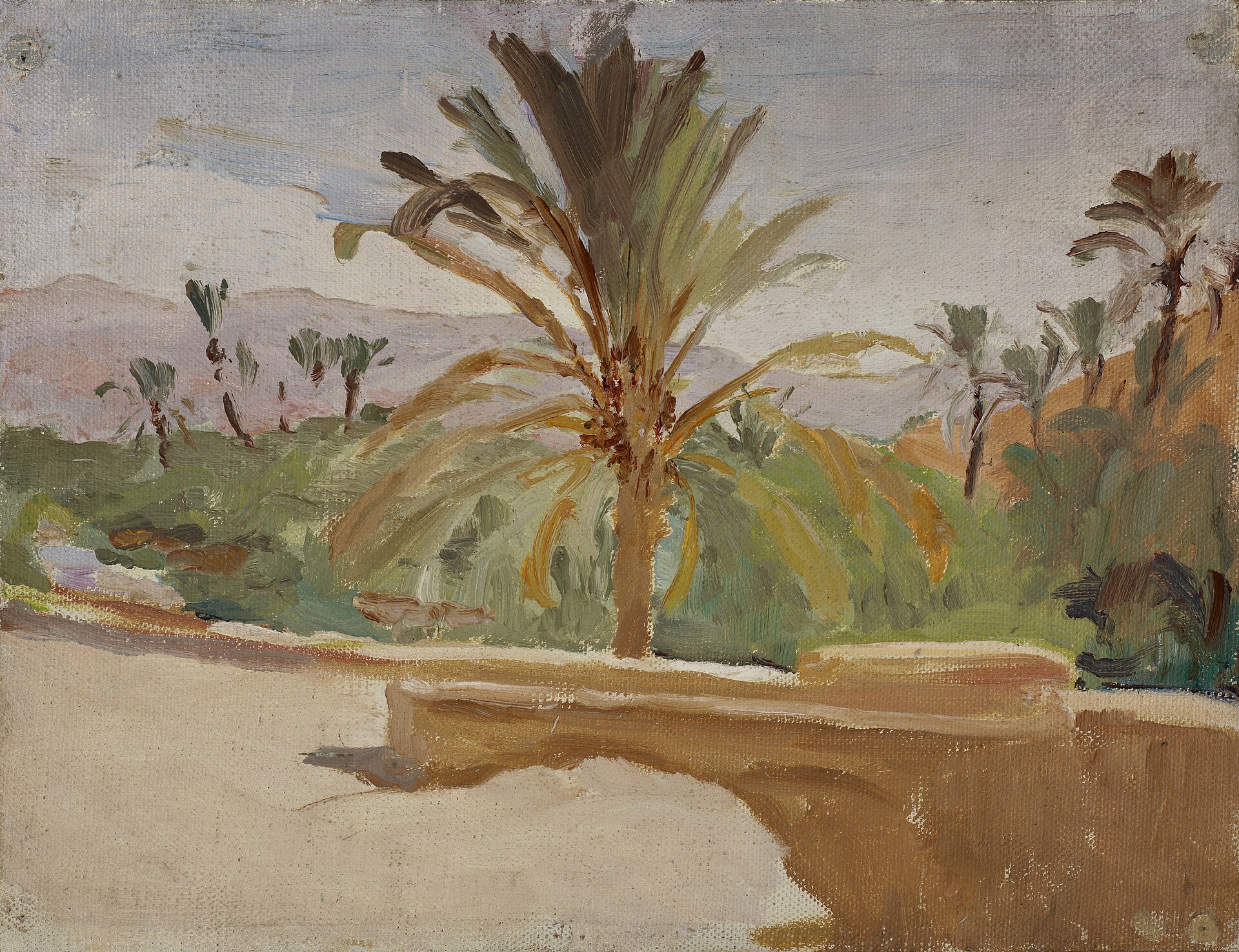
Biskra (Oasis with Palm Trees). Jan Ciągliński, 1909. Wikimedia Commons. Public domain.