
Psalm 86
17 verses · Individual lament
Incline Your ear, O LORD, and answer me, for I am poor and needy.
Introduction
David, the Undivided Heart, Book 3: The crisis of the throne, Poetry, Psalms Overview.
This is a prayer of David, the only psalm of his in this part of the book. It names no enemy, no place and no occasion, and that plainness is likely why the temple kept it for anyone in need to pray. The man who prays it brings no claim of his own, only his need and what God has said about His own character. Listen for how often he rests his request on who God is, and for the one thing he asks to have changed inside himself. Read it as a pattern for praying when you have nothing to offer.
Context
- Who
- Ordinary worshippers who could pray this without changing a word
- What
- A personal prayer for help that rests every request on the character God declared to Moses.
- Where
- The sanctuary's worship, where the prayer was kept for anyone to pray.
- When
- About 1000 BC on the traditional reading of its heading as a prayer of David, and no event is named.
- Why
- To give any worshipper in need the words to ask God to act as He has said He is.
Historical context
The heading calls this a prayer of David, and only a handful of psalms carry the word prayer in their title. It is the one psalm of David inside the third section of the book, which otherwise belongs to the Asaph and Korah collections, and the book does not explain its placement. No date, event or enemy is named beyond arrogant men and a band of ruthless men seeking the speaker's life. Almost every line is a sentence that stands somewhere else in Scripture, and the central one is God's own description of Himself to Moses on the mountain, compassionate and gracious, slow to anger, abounding in loving devotion and faithfulness, which Israel quoted back to God more often than any other. Calling himself poor and needy is how a petitioner addressed a king, and letters from subjects to rulers across the ancient Near East open with the same self-lowering, so a first hearer understood a relationship in the phrase: the speaker has no claim and only the goodwill of the one he asks. Asking for an undivided heart is a request for one thing to be made out of many, which was Israel's standing problem.
Significance
There are no enemies named, no date and no event in this psalm, only need and God's character, and that is very likely why the temple kept it, since anybody could pray it on any day. What it asks for at the end is a sign of God's goodness to point at, which is what a worried person wants.
This chapter in Jewish lifeWhat this chapter is in Jewish life and reading.
How it is read
The psalm calls its speaker pious, and Rashi asks how a man says that of himself. His first answer is from the Midrash, that David heard his insults and could have taken revenge and stayed silent (Rashi on Psalms 86:2:1, citing Midrash Tehillim 86:1). His second answer is a saying of the Sages at Berakhot 4a. There David asks whether he is not pious, since the kings of the east and the west sit in their glory while his own hands are dirtied. The blood and the afterbirth on them come from the cases brought to him for ruling (Rashi on Psalms 86:2:1). The picture is of a king doing the unglamorous work of a judge rather than sitting in glory. The day of trouble in verse 3 Rashi reads as all the days of the exile, "which is day for the wicked and night for the righteous". He takes that from the Midrash again (Rashi on Psalms 86:3:1, citing Midrash Tehillim 86:2). The depths of the grave in verse 13 he ties to David's own history, with Nathan's word at 2 Samuel 12:13 that the LORD has taken away the sin (Rashi on Psalms 86:13:1). The proud men of verse 14 he names as Doeg and Ahithophel (Rashi on Psalms 86:14:1). The son of the maidservant in verse 16 he explains by the household. Such a son humbles himself before his master more than a bought slave does, because he was born in the house and raised in his master's arms (Rashi on Psalms 86:16:1). Ibn Ezra and Radak stand in the corpus here by reference alone. Rashi is quoted here from the Judaica Press complete Tanach with Rashi, translated by A. J. Rosenberg, under CC-BY.
What the rabbis say
The corpus records forty places where the Midrash and the Talmud draw on this psalm, cited here by reference. Midrash Tehillim treats it at 86:1 to 86:7, and cites its verses again at 2:7, 5:4, 16:9, 66:1, 84:5, 117:1 and 142:2. Verse 2, on the pious man, is drawn into the Babylonian Talmud at Berakhot 4a:8 and into Midrash Shmuel 26:6. Verse 8, that there is none like God among the gods, stands at Bereshit Rabbah 7:1 and in the Mekhilta DeRabbi Shimon Ben Yochai 15:1. Verse 10, on the God who alone does wonders, is read at Bereshit Rabbah 1:3 and in the Mekhilta DeRabbi Yishmael, Tractate Shirah 1:22. Verse 15, on the God slow to anger, is carried into Shemot Rabbah 2:1.
Sources: Rashi, Rashi on Psalms 86:2 to 86:17, the Judaica Press complete Tanach with Rashi, translated by A. J. Rosenberg, CC-BY, 1040 to 1105; Midrash Tehillim, 86:1 to 86:7, cited by Rashi and by reference; Babylonian Talmud, Berakhot 4a, cited by Rashi, and Berakhot 4a:8, cited by reference; Bereshit Rabbah, 1:3 and 7:1, cited by reference; The Sefaria corpus, scripts/data/sources/sefaria/psalms/86.json, fetched 2026-09-19, 2026.
Psalms 86:1-2
Incline Your ear, O LORD: Incline Your ear pictures God stooping low to a man who calls himself poor and needy. The claim he brings is his own want. The word behind godly in verse 2 is chasid, glossed pious and kind, and the plea rests on loyalty to God.
Psalms 86:1
“Bow down thine ear, O Lord, hear me. In condescension to my littleness, and in pity to my weakness, "bow down thine ear, O Lord." When our prayers are lowly by reason of our humility, or feeble by reason of our sickness, or without wing by reason of our despondency, the Lord will bow down to them, the infinitely exalted Jehovah will have respect unto them. Faith, when she has the loftiest name of God on her tongue, and calls him Jehovah, yet dares to ask from him the most tender and condescending acts of love.”
Charles Spurgeon · The Treasury of David, Vol. 4 (1874)Particular Baptist
2 more voices on this verseWhat preachers and commentators have said about this verse, in their own words.
Psalms 86:1
“He pleads his distress: " Hear me, for I am poor and needy, therefore I want thy help, therefore none else will hear me." God is the poor man's King, whose glory it is to save the souls of the needy; those who are poor in spirit, who see themselves empty and necessitous, are most welcome to the God of all grace.”
Matthew Henry · Commentary on the Whole Bible (1707-1721)puritan
Psalms 86:1
“He does not without cause allege before God the oppressions which he endured as a plea for obtaining the divine favor; for nothing is more suitable to the nature of God than to succor the afflicted: and the more severely any one is oppressed, and the more destitute he is of the resources of human aid, the more inclined is God graciously to help him.”
John Calvin · Commentaries (1554)reformed
Preserve my soul: Albert Barnes read soul here as life, so Preserve my soul asks God to keep David alive. That is the life verse 14 says ruthless men seek. Adam Clarke heard in Your servant a man who had long taken God as his Master and Lord.
Psalms 86:2
Therefore, the Word is our educator who heals the unnatural passions of our soul with his counsel. The art of healing, strictly speaking, is the relief of the ills of the body, an art learned through human wisdom. Yet, the only true divine healer of human sickness, the holy comforter of the soul when it is ill, is the Word of the Father. Scripture says, "Save your servant, O my God, who puts his trust in you. Have mercy on me, O Lord, because I have cried to you the whole day through."
Clement of Alexandria · written before 215 · The Instructor Book 1patristic
2 more voices on this verse
Psalms 86:2
“Since God then has avowed himself to be the defender both of good causes and of those who follow after righteousness, David, not without good reason, testifies that he had endeavored to exercise kindness and gentleness; that from this it may appear that he was basely requited by his enemies, when they gratuitously acted with cruelty towards a merciful man.”
John Calvin · Commentaries (1554)reformed
Psalms 86:2
“If God has begun a good work of grace in us, we must own that the time was a time of love. Then was I in his eyes as one that found favour, and whom God hath taken into his favour he will take under his protection. All his saints are in thy hand, Deut. xxxiii.”
Matthew Henry · Commentary on the Whole Bible (1707-1721)puritan
Psalms 86:3-5
Be merciful to me, O Lord: The prayer moves from mercy in verse 3 to joy in verse 4, and the servant lifts up his soul as he asks. Verse 5 gives the ground as settled fact. Forgiving there is one Hebrew adjective, sallach, glossed placable, so pardon stands in God's character before the asking.
Psalms 86:3
“Be merciful unto me, O Lord,.... In my distressed and miserable condition, being an object of mercy, pity, and compassion; this petition is used by Christ in Psa 41:10. for I cry unto thee daily; or "all the day"; every day, and several times in a day, Psa 55:17 constant and importunate prayer is the duty of saints, and available with God, 1Th 5:17. Christ was much in the exercise of it, Luk 6:12.”
1 more voice on this verse
Psalms 86:3
“Be merciful unto me, O Lord. The best of men need mercy, and appeal to mercy, yea to nothing else but mercy; they need it for themselves, and crave it eagerly of their God as a personal requisite. For I cry unto thee daily. Is there not a promise that importunity shall prevail? May we not, then, plead our importunity as an argument with God? He who prays every day, and all the day, for so the word may mean, may rest assured that the Lord will hear him in the day of his need.”
Charles Spurgeon · The Treasury of David, Vol. 4 (1874)Particular Baptist
I lift up my soul: The second half repeats Psalm 25, as Matthew Henry noted. Albert Barnes took lifting up the soul as effort, a man bending his whole powers to seek God. Augustine joined the two halves: the soul lifted from the bitterness of earth is the soul God makes glad.
Psalms 86:4
“Rejoice the soul of thy servant. Make my heart glad, O my Maker, for I count it my honour to call myself again and again thy servant, and I reckon thy favour to be all the wages I could desire. I look for all my happiness in thee only, and therefore unto thee, O Lord, do I lift up my soul. As the heliotrope looks to the sun for its smile, so turn I my heart to thee.”
Charles Spurgeon · The Treasury of David, Vol. 4 (1874)Particular Baptist
to all who call on You: Charles Spurgeon put kind and forgiving as good at giving and forgiving. The last clause widens the ground. David has called all day, and the loving devotion reaches all who call, so Albert Barnes held the plea open to every class of person.
Psalms 86:5
“For thou, Lord, art good, and ready to forgive. Good at giving and forgiving; supplying us with his good, and removing our evil. Here was the great reason why the Psalmist looked to the Lord alone for his joy, because every joy creating attribute is to be found in perfection in Jehovah alone.”
Charles Spurgeon · The Treasury of David, Vol. 4 (1874)Particular Baptist
1 more voice on this verse
Psalms 86:5
“I said, I will confess, and thou forgavest, Ps. xxxii. (2.) He is a prayer-hearing God; he is plenteous in mercy, very full, and very free, both rich and liberal unto all those that call upon him; he has wherewithal to supply all their needs and is openhanded in granting that supply.”
Matthew Henry · Commentary on the Whole Bible (1707-1721)puritan
Psalms 86:6-7
Hear my prayer, O LORD: Verse 6 asks twice for one thing, that God hear. The second request repeats the first in other words, which is how Hebrew poetry presses a plea. Verse 7 gives the reason he calls in the day of distress: God answers him.
Psalms 86:6
“Give ear, O Lord, unto my prayer. Even the glory which his spirit had beheld did not withdraw him from his prayer, but rather urged him to be more fervent in it; hence he implores the Lord to hear his requests. Attend to the voice of my supplications. Here are repetitions, but not vain repetitions. When a child cries it repeats the same note, but it is equally in earnest every time, and so was it with the suppliant here.”
Charles Spurgeon · The Treasury of David, Vol. 4 (1874)Particular Baptist
In the day of my distress: Albert Barnes read the verse as a settled habit of calling on God in every trouble, and that habit was the ground of David's confidence. Charles Spurgeon gave the logic plainly. It is useless to cry to one who cannot hear.
Psalms 86:7
“In the day of my trouble I will call upon thee: for thou wilt answer me. A pious resolve backed by a judicious reason. It is useless to cry to those who cannot or will not hear; once convince men that prayer has no effect upon God, and they will have no more of it. In these busy days and especially in troublous times, men cannot afford to waste time in entreaties which must be unavailing.”
Charles Spurgeon · The Treasury of David, Vol. 4 (1874)Particular Baptist
Psalms 86:8-10
there is none like You among the gods: Moses sang the same question at the sea, who among the gods is like You, O LORD, at Exodus 15:11. Verse 9 widens the psalm past Israel to all the nations God made, coming to bow and glorify His name. Verse 10 closes on one claim: You alone are God.
Psalms 86:8
“Among the gods there is none like unto thee, O Lord. There are gods by delegated office, such as kings and magistrates, but they are as nothing in the presence of Jehovah; there are also gods by the nomination of superstition, but these are vanity itself, and cannot be compared with the living and true God. Even if the heathen idols were gods, none of them in power or even in character, could be likened unto the self existent, all creating God of Israel.”
Charles Spurgeon · The Treasury of David, Vol. 4 (1874)Particular Baptist
All the nations You have made: The nations You have made gives the reason they will come. Augustine and Charles Spurgeon both traced every nation to Adam, so no people stands outside its Maker's claim. Augustine noted the words were sung when only a few in one people worshiped God.
Psalms 86:9
“All nations whom thou hast made, and these include all mankind, since they all come of the first Adam—thy creature, and their lives are all distinct creations of thine omnipotence. All these shall come with penitent hearts, in thine own way, to thine own self, and worship before thee, O Lord. Because thou art thus above all gods, the people who have been so long deceived shall at last discover thy greatness, and shall render thee the worship which is thy due: thou hast created them all, and unto thee shall they all yield homage.”
Charles Spurgeon · The Treasury of David, Vol. 4 (1874)Particular Baptist
1 more voice on this verse
Psalms 86:9
“It was by Christ that God made all nations, for without him was not any thing made that was made, and therefore through Christ, and by the power of his gospel and grace, all nations shall be brought to worship before God, Isa. lxvi.”
Matthew Henry · Commentary on the Whole Bible (1707-1721)puritan
For You are great: Verse 5 called God kind, and this verse calls Him great. Charles Spurgeon saw the two joined, since a great king who was not good might be a tyrant. Albert Barnes drew the plea from it: a God who does wonders can do what David asks.
Psalms 86:10
“For thou art great. He had before said, "thou art good"; it is a grand thing when greatness and goodness are united; it is only in the Divine Being that either of them exists absolutely, and essentially. Happy is it for us that they both exist in the Lord to an equal degree.”
Charles Spurgeon · The Treasury of David, Vol. 4 (1874)Particular Baptist
Psalms 86:11-13
Teach me Your way, O LORD: Verse 11 asks for an undivided heart. The Hebrew verb is yachad, to become one, so the request is for a heart made single toward the fear of God's name. Verse 13 looks back on a rescue already given, from the depths of Sheol, which the Hebrew calls the lowermost.
Psalms 86:11
“Teach me thy way, O Lord. Instruct me thus at all times, let me live in thy school; but teach me now especially since I am in trouble and perplexity. Be pleased to shew me the way which thy wisdom and mercy have prepared for my escape; behold I lay aside all wilfulness, and only desire to be informed as to thy holy and gracious mind. Not my way give me, but thy way teach me, I would follow thee and not be wilful. I will walk in thy truth.”
Charles Spurgeon · The Treasury of David, Vol. 4 (1874)Particular Baptist
1 more voice on this verse
Psalms 86:11
“I will walk in thy truth. One would think it should be, Teach me thy truth, and I will walk in thy way; but it comes all to one; it is the way of truth that God teaches and that we must choose to walk in, Ps. cxix. Christ is the way and the truth, and we must both learn Christ and walk in him.”
Matthew Henry · Commentary on the Whole Bible (1707-1721)puritan
with all my heart: answers verse 11. Charles Spurgeon put it plainly: when the heart is one, all of it can be given. He also noted that David says my God for the second time here, first in prayer at verse 2 and now in praise.
Psalms 86:12
“I will praise thee, O Lord my God, with all my heart. When my heart is one, I will give thee all of it. Praise should never be rendered with less than all our heart, and soul, and strength, or it will be both unreal and unacceptable. This is the second time in the psalm that David calls the Lord "my God", the first time he was in an agony of prayer (Ps 86:2), and now he is in an ecstacy of praise.”
Charles Spurgeon · The Treasury of David, Vol. 4 (1874)Particular Baptist
the depths of Sheol: Albert Barnes read the depths of Sheol as death narrowly escaped, David kept alive in danger. Adam Clarke took it further, to a place of ruin for the soul beyond the grave. The rescue here is already done.
Psalms 86:13
“For great is thy mercy toward me. Personal experience is ever the master singer. Whatever thou art to others, to me thy mercy is most notable. The psalmist claims to sing among the loudest, because his debt to divine mercy is among the greatest. And thou hast delivered my soul from the lowest hell. From the direst death and the deepest dishonour David had been kept by God, for his enemies would have done more than send him to hell had they been able.”
Charles Spurgeon · The Treasury of David, Vol. 4 (1874)Particular Baptist
1 more voice on this verse
Psalms 86:13
“The fountain of mercy is inexhaustibly full; the streams of mercy are inestimably rich. When we speak of God's mercy to us, it becomes us thus to magnify it: Great is thy mercy towards me.”
Matthew Henry · Commentary on the Whole Bible (1707-1721)puritan
Psalms 86:14-15
The arrogant rise against me: The trouble behind the whole prayer is named here: arrogant men, and a band of ruthless men after his life. The verse says they have no regard for God. Verse 15 answers them with the LORD's own words to Moses at Exodus 34:6, compassionate and gracious, slow to anger.
Psalms 86:14
“O God, the proud are risen against me. They could not let God's poor servant alone, his walk with God was as smoke to their eyes, and therefore they determined to destroy him. None hate good men so fiercely as do the high minded and domineering. And the assemblies of violent men have sought after my soul. Unitedly oppressors sought the good man's life; they hunted in packs, with keen scent, and eager foot. In persecuting times many a saint has used these words in reference to Papal bishops and inquisitors. And have not set thee before them.”
Charles Spurgeon · The Treasury of David, Vol. 4 (1874)Particular Baptist
slow to anger: Adam Clarke set out the Hebrew behind each title, from rachum, tenderly compassionate, to emeth, faithful and true. Albert Barnes took slow to anger as delay. God bears with sinners long before He acts, and that patience was the psalmist's hope though he knew himself a sinner.
Psalms 86:15
“Men are barbarous, but God is gracious; men are false, but God is faithful. God is not only compassionate, but full of compassion, and in him mercy rejoiceth against judgment. He is long-suffering towards us, though we forfeit his favour and provoke him to anger, and he is plenteous in mercy and truth, as faithful in performing as he was free in promising.”
Matthew Henry · Commentary on the Whole Bible (1707-1721)puritan
1 more voice on this verse
Psalms 86:15
“But thou, O Lord. What a contrast! We get away from the hectorings and blusterings of proud but puny men to the glory and goodness of the Lord. We turn from the boisterous foam of chafing waves to the sea of glass mingled with fire, calm and serene. "Art a God full of compassion, and gracious, long suffering, and plenteous in mercy and truth." A truly glorious doxology, in which there is not one redundant word. As we have before observed, it is mainly transcribed from Ex 34:6.”
Charles Spurgeon · The Treasury of David, Vol. 4 (1874)Particular Baptist
Psalms 86:16-17
save the son of Your maidservant: The son of Your maidservant names him by his mother's household, the same low ground as the poor and needy of verse 1. Verse 17 asks for a sign his enemies can see, so the shame falls where the threat came from. The last clause names help already given.
Psalms 86:16
“O turn unto me. As though the face of God had been before averted in anger, the suppliant pleads for a return of conscious favour. One turn of God's face will turn all our darkness into day. And have mercy upon me, that is all he asks, for he is lowly in heart; that is all he wants, for mercy answereth all a sinner's needs. Give thy strength unto thy servant. Gird me with it that I may serve thee, guard me with it that I may not be overcome.”
Charles Spurgeon · The Treasury of David, Vol. 4 (1874)Particular Baptist
Show me a sign of Your goodness: Albert Barnes gave the Hebrew as make me a sign for good, and held that any rescue plain enough for others to see would serve. Adam Clarke heard the mark set on a servant to show whose he was. Charles Spurgeon noted that God comforts those He helps.
Psalms 86:17
“Shew to me a token for good. Let me be assured of thy mercy by being delivered out of trouble. That they which hate me may see it, and be ashamed. What bodes good to me shall make them quail and blush. Disappointed and defeated, the foes of the good man would feel ashamed of what they had designed. "Because thou, Lord, hast holpen me, and comforted me." God doth nothing by halves, those whom he helps he also consoles, and so makes them not merely safe but joyful.”
Charles Spurgeon · The Treasury of David, Vol. 4 (1874)Particular Baptist
How this psalm is built
The form: A prayer bowed low, which the exalted God stoops to hear because it is low, as Spurgeon classes it.
The patterns in this chapter
| Device | What it does | Where to see it |
|---|---|---|
| The name of the Lord in nearly every verse | The psalm speaks to God directly in fourteen of its seventeen verses and names Him in most of them. It carries no report of anyone else's words and no description of anything the speaker is looking at. Spurgeon reads the effect as the psalm's method: the prayer is bowed low and the exalted God stoops to it.Charles Spurgeon, The Treasury of David, Vol. 4, 1874, on Psalm 86:1. | Psalm 86:1, Psalm 86:3, Psalm 86:12 |
| The reasons given with the word for | Almost every petition in the first half carries its ground in the same clause. Answer me, for I am poor and needy. Preserve my soul, for I am godly. Be merciful, for I call to You all day long. Bring joy, for to You I lift up my soul. The psalm never asks without stating why. | Psalm 86:1, Psalm 86:2, Psalm 86:3, Psalm 86:4 |
| The character of God stated at the centre and again near the end | Verse 5 says that the Lord is kind and forgiving, rich in loving devotion to all who call on Him. Verse 15 says that He is compassionate and gracious, slow to anger, abounding in loving devotion and faithfulness. The same description stands twice, once before the trouble is named and once after it. | Psalm 86:5, Psalm 86:15 |
| The undivided heart | Verse 11 asks for a heart made one so that the speaker may fear God's name. Adam Clarke reads the Hebrew as a request to join all the purposes, resolutions and affections of the heart together, and calls a divided heart a great curse and scattered affections a miserable plague.Adam Clarke, Commentary on the Bible, 1832, on Psalm 86:11. | Psalm 86:11 |
The psalm stands inside the second Korah collection but carries a different heading from the psalms around it, and it is the only psalm in the third book of the Psalter headed for David. That placement puts a plain individual prayer in the middle of a run of national psalms, and the contrast is part of how the book reads.
8 more paragraphs on the patterns
Verse 15 is the psalm's chief link to the rest of Scripture. The description of God as compassionate and gracious, slow to anger, abounding in loving devotion and faithfulness is the sentence God speaks of Himself at Exodus 34:6, and it is repeated at Numbers 14:18, Nehemiah 9:17, Joel 2:13 and Jonah 4:2. Psalm 86 is one of the places where a praying man puts that sentence back to God as the ground of a request.
Inside the psalm the pattern is a prayer answering itself. Every petition in verses 1 to 4 supplies its own reason, and the reason is always the speaker's condition. Then at verse 5 and again at verse 15 the ground shifts from the speaker's condition to God's character, and the second of those two statements comes immediately after the only verse that names the enemy. The psalm meets the worst news it has with the oldest thing it knows.
The New Testament's use
Verse 9 stands behind Revelation 15:4. The psalm says that all the nations God has made will come and bow before Him and glorify His name; Revelation says that all nations will come and worship before Him because His righteous acts have been revealed. The song of Moses and of the Lamb takes up the psalm's sentence, and the verbal agreement in the Berean text is close enough to read the two side by side. The New Testament nowhere quotes the psalm with a citation formula.
The debated point
The psalm's heading assigns it to David, and it stands alone in that among the psalms of the third book. Whether the heading records authorship or dedication is the standing dispute over the psalm titles as a class, and it is not peculiar to this psalm. The traditional view, which the older commentators the site cites all hold, treats the headings as early and reliable, so that the psalm is David's own. The psalm itself contains nothing that fixes a date, and its language of the poor and needy man is the language many psalms use.
Where to go deeper
The sentence of verse 15 is set out at great is Thy faithfulness, and the undivided heart of verse 11 at the heart and the divided self. The nations of verse 9 are set out at the great commission.
Keep studying
Sources for this chapter
The summary
Jamieson, Fausset & Brown, Commentary Critical and Explanatory; John Calvin, Commentaries; John Wesley, Notes on the Old Testament and Matthew Henry, Complete Commentary.
The form and classifications
Adam Clarke, Commentary on the Bible, 1832, on Psalm 86:11; Charles Spurgeon, The Treasury of David, Vol. 4, 1874, on Psalm 86:1 and Matthew Henry, Commentary on the Whole Bible, 1710, on Psalm 86:15.
The exposition
Adam Clarke, Commentary on the Bible; Albert Barnes, Notes on the Book of Psalms; Augustine of Hippo, Exposition on Psalm 86; Charles Spurgeon, The Treasury of David; Franz Delitzsch, Biblical Commentary on the Psalms; John Calvin, Commentary on the Book of Psalms; John Gill, Exposition of the Old Testament and Matthew Henry, Commentary on the Whole Bible.
The painting
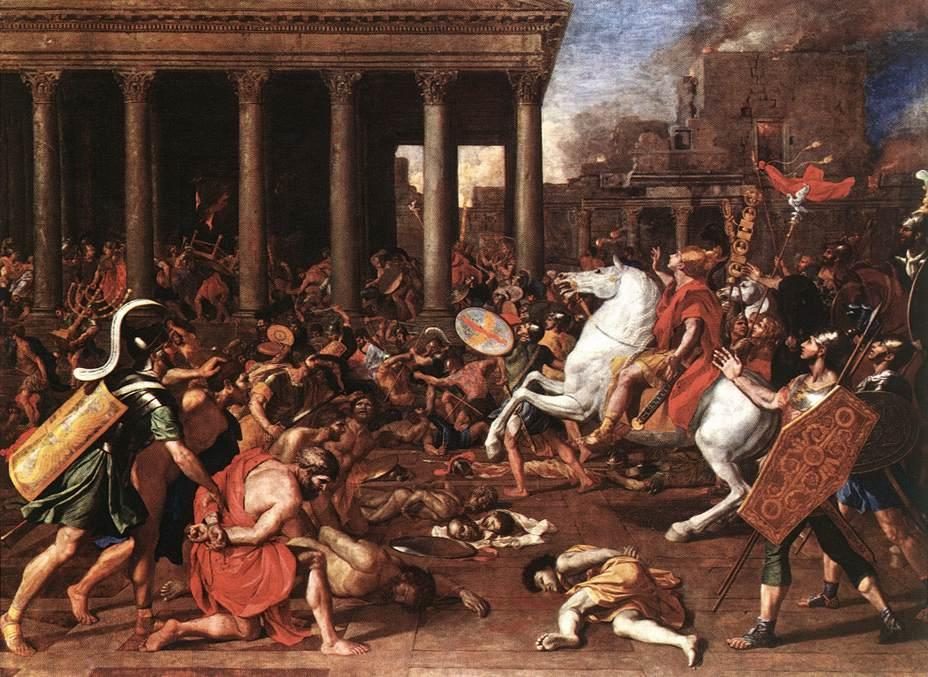
The Destruction of the Temple at Jerusalem. Nicolas Poussin, 1637. Wikimedia Commons. Public domain.