
Psalm 83
18 verses · Imprecatory psalm
With cunning they scheme against Your people and conspire against those You cherish,
Introduction
Asaph, the Ring of Nations, Book 3: The crisis of the throne, Poetry, Psalms Overview.
This is the last of the psalms headed for Asaph, written for the whole congregation to pray aloud. It comes from a small nation surrounded by neighbours who had agreed together to wipe it out. The prayer names those neighbours one by one, and then reaches back to battles from the days of the judges, when God won against heavier armies. Listen for the roll of names and for the old victories, and then for the turn at the close, where the prayer asks for more than the enemy's defeat. Read it as a war prayer that ends by asking that the enemy come to know God.
Context
- Who
- A small nation ringed by an alliance that had stated its goal
- What
- A national prayer against an alliance of ten peoples formed to destroy Israel.
- Where
- The sanctuary, with a roll call of enemy nations read out in prayer
- When
- The monarchy, perhaps the alliance Jehoshaphat faced about 853 BC, though the psalm names no date or king.
- Why
- To ask God to act as He did in Israel's old battles, so that the nations would come to know Him.
Historical context
The psalm is the last of the twelve headed for Asaph, so it belongs to the temple singers and was written for public use. It gives no year, and the nearest match in the histories is the alliance of Moab, Ammon and others that came against Jehoshaphat about 853 BC, while other readers take its list as a gathering of Israel's enemies from across its history into one prayer. On a map the ten peoples named form a ring: Edom, the Ishmaelites, Moab and the Hagrites to the south and east, Gebal, Ammon and Amalek inland, Philistia on the coastal plain, Tyre to the north, and Assyria behind them all. The psalm answers that coalition with two old battles a first hearer knew by heart, Gideon's night attack on Midian and the flooding of the Kishon that bogged down Sisera's chariots on the Jezreel plain. Two of its images come straight off the land: the tumbleweed is the region's rolling thistle, which snaps off at the root and travels for miles, and the chaff blew off threshing floors set on hilltops to catch the afternoon wind.
Significance
A congregation read its enemies' names out loud in the temple and asked God to do at their border what He had done at the Kishon. The goal stated at the end reaches further than their destruction, since the psalm asks that they may seek God's name and know that He alone is Most High over all the earth. Even the war prayer ends with the enemy knowing who God is.
This chapter in Jewish lifeWhat this chapter is in Jewish life and reading.
How it is read
Psalm 83 closes the Asaph collection that opened at Psalm 73. Rashi reads the alliance of verse 6 as aimed past Israel at God. The pact is made "to cause Your name to be forgotten", because God is called the God of Israel, so a forgotten Israel means a forgotten name (Rashi on Psalms 83:6:1). On Assyria in verse 9 he carries a tradition from Bereshit Rabbah 37:4. Asshur had gone out from the land in Genesis 10:11, which the midrash reads as leaving the counsel of the generation that built the tower. Here he joined the alliance and helped it (Rashi on Psalms 83:9:1). The prayer of verse 10 he reads against the book of Judges, asking God to do to these enemies what He did to Midian through Gideon (Rashi on Psalms 83:10:1). On the next verse Rashi does something worth seeing, which is to say he does not know. Of the defeat at En-dor he writes, "I do not know which of the wars took place in En-Dor, that of Gideon or that of Barak" (Rashi on Psalms 83:11:1). The thistles of verse 14 he explains from the field, as the tips of thorns that break off in winter and roll before the wind (Rashi on Psalms 83:14:1). Ibn Ezra, Radak and Malbim stand in the corpus on this psalm sixteen times between them, cited by reference alone. Rashi is quoted here from the Judaica Press complete Tanach with Rashi, translated by A. J. Rosenberg, under CC-BY.
What the rabbis say
The corpus records thirty-three places where the Midrash and the Talmud draw on this psalm, cited here by reference. Midrash Tehillim treats it at 83:1, 83:2 and 83:3, and cites its verses again at 9:18, 67:1, 74:3, 109:1 and 121:1. Verse 9, on Assyria joining the alliance, is drawn into Bereshit Rabbah 37:4 and into the Jerusalem Talmud at Peah 1:1:40. The roll of enemy nations in verses 7 to 13 is read at Bereshit Rabbah 45:9 and 62:4, and at Pirkei DeRabbi Eliezer 44:12. Verse 14, the thistle before the wind, stands at Bamidbar Rabbah 1:4 and Shir HaShirim Rabbah 2:1:3. Verse 3, on the enemies who lift their heads, is carried into the Mekhilta DeRabbi Yishmael, Tractate Shirah 6:2 and Sifrei Bamidbar 84:4.
Sources: Rashi, Rashi on Psalms 83:2 to 83:16, the Judaica Press complete Tanach with Rashi, translated by A. J. Rosenberg, CC-BY, 1040 to 1105; Bereshit Rabbah, 37:4, cited by Rashi, and 45:9 and 62:4, cited by reference; Midrash Tehillim, 83:1 to 83:3 and 9:18, cited by reference; Jerusalem Talmud, Peah 1:1:40, cited by reference; The Sefaria corpus, scripts/data/sources/sefaria/psalms/83.json, fetched 2026-09-19, 2026; MannaFest, the shape of the Psalter, src/components/book/dossier-content/psalms-structure.ts, 2026.
Psalms 83:1-2
O God, be not silent: Verse 1 asks three times for God to break His silence. The trouble is already moving: His enemies rage and His foes have raised their heads. The psalm calls them God's enemies first and Israel's second, so the attack is on Him.
Psalms 83:1
“Keep not thou silence, O God. Man is clamorous, be not thou speechless. He rails and reviles, wilt not thou reply? On word of thine can deliver thy people; therefore, O Lord, break thy quiet and let thy voice be heard. Hold not thy peace, and be not still, O God. Here the appeal is to El., the Mighty One. He is entreated to act and speak, because his nation suffers and is in great jeopardy.”
Charles Spurgeon · The Treasury of David, Vol. 4 (1874)Particular Baptist
1 more voice on this verseWhat preachers and commentators have said about this verse, in their own words.
Psalms 83:1
"Lord," says he, "they are thy enemies, and they hate thee." All wicked people are God's enemies (the carnal mind is enmity against God ), but especially wicked persecutors; they hated the religious worshippers of God, because they hated God's holy religion and the worship of him.
Matthew Henry · Commentary on the Whole Bible (1707-1721)puritan
how Your enemies rage: Albert Barnes tied the verb to Psalm 2:1, where the same word describes the nations in uproar. Reared their heads is the posture of men sure of victory. Charles Spurgeon saw them carrying themselves as if the conquest were already won.
Psalms 83:2
“For behold, your enemies have made a din. The heretics speak out, and the men of the Church keep silent; they make a noise, and we are quiet; they blaspheme, and we do not bark back. For behold, your enemies have made a din. Beautifully did he say, they have made a din: for it is not speech adorned for building up, but only a disordered clamor for tearing down. And those who hate you have lifted up their head. So great is the multitude of the heretics, and so small the number of those who believe in you.”
Jerome · written before 420 · Homily 62, on Psalm 82 (Alternate Series)patristic
1 more voice on this verse
Psalms 83:2
“For, lo, thine enemies make a tumult. They are by no means sparing of their words, they are like a hungry pack of dogs, all giving tongue at once. So sure are they of devouring thy people that they already shout over the feast. And they that hate thee have lifted up the head. Confident of conquest, they carry themselves proudly and exalt themselves as if their anticipated victories were already obtained. These enemies of Israel were also God's enemies, and are here described as such by way of adding intensity to the argument of the intercession.”
Charles Spurgeon · The Treasury of David, Vol. 4 (1874)Particular Baptist
Psalms 83:3-4
With cunning they scheme: The plot is quoted in its own words: erase them as a nation, and let the name of Israel be forgotten. They want the nation and its memory gone. The word behind those You cherish is tsaphan, to treasure a thing up and to hide it away.
Psalms 83:3
"Lord," says the psalmist, "they are thy enemies, for they consult against thy hidden ones." Note, God's people are his hidden ones, hidden, (1.) In respect of secresy. Their life is hid with Christ in God; the world knows them not; if they knew them, they would not hate them as they do.
Matthew Henry · Commentary on the Whole Bible (1707-1721)puritan
2 more voices on this verse
Psalms 83:3
“IT was the desire of Asaph to obtain for his nation help from God. Israel was exposed to great danger—ten confederate nations had conspired, with desperate hate, to assail the chosen people. They were determined to root out the very name of Israel from among the nations! They joined together in a wicked league for this purpose and they came from all quarters—north, south, east and west—in order to utterly devour the little insignificant people whom God had called His own.”
Charles Spurgeon · written before 1892 · The Metropolitan Tabernacle Pulpit, Sermon No. 2367: “God's Hidden Ones” (lightly modernized text, CCEL edition)Particular Baptist
Psalms 83:3
“Hidden ones - Thy people of Israel, who are called God's hidden or secret ones, to intimate the respect which God has to them, as to his peculiar treasure.”
John Wesley · Explanatory Notes upon the Old Testament (1765)evangelical
erase them as a nation: Albert Barnes saw a plan to divide Israel's land among the allies, the greed voiced in verse 12. Adam Clarke placed the plot in the reign of Jehoshaphat. The allies kept it so secret that the king heard only when they were camped at En-gedi, as 2 Chronicles 20:2 records.
Psalms 83:4
“They have said, Come, let us destroy them out of the nation. I see a strange thing. So great is the multitude of the heretics, and such the diversity of their teachings, that their opinions differ among themselves, and yet they agree in this alone — in their hatred of us. For just as Herod and Pilate were enemies, and, acting against Christ, they made peace, and their concord was worse than their enmity had been; so these too fall out wickedly and league together yet more wickedly.”
Jerome · written before 420 · Homily 62, on Psalm 82 (Alternate Series)patristic
Psalms 83:5-8
with one mind they plot together: Ten peoples are named, and they ring Israel on every side. The sons of Lot are Moab and Ammon, born to him at Genesis 19:37 and 38, and Assyria comes in behind them. The psalm says the alliance is made against God.
Psalms 83:5
“For they have consulted together with one consent. They are hearty and unanimous in their designs. They seem to have but one heart, and that a fierce one, against the chosen people and their God. They are confederate against thee. At the Lord himself they aim through the sides of his saints. They make a covenant, and ratify it with blood, resolutely banding themselves together to war with the Mighty God.”
Charles Spurgeon · The Treasury of David, Vol. 4 (1874)Particular Baptist
the tents of Edom: Charles Spurgeon noted that the list opens with Israel's own kin. Edom came from Esau, and the Ishmaelites from Abraham's son by Hagar. John Wesley thought the Hagrites were another branch of Ishmael's line, named after Hagar herself.
Psalms 83:6
“The tabernacles of Edom. Nearest of kin, yet first in enmity. Their sire despised the birthright, and they despise the possessors of it. Leaving their rock built mansions for the tents of war, the Edomites invaded the land of Israel. And the Ishmaelites. A persecuting spirit ran in their blood, they perpetuated the old grudge between the child of the bondwoman and the son of the freewoman. Of Moab. Born of incest, but yet a near kinsman, the feud of Moab against Israel was very bitter.”
Charles Spurgeon · The Treasury of David, Vol. 4 (1874)Particular Baptist
2 more voices on this verse
Psalms 83:6
The tents of the Edomites and the Ishmaelites. Since once we have begun, leaving behind the lowliness of the literal history, to raise our understanding to a higher manner of the spiritual meaning's exposition... For the history is a simple one, in which the Jewish people speaks against the other nations that were fighting against it. But whatever was done, was done as a type of us. Israel was attacked, and its victory profited us. Let us see, then, who they are that fight against the Church. The tents of the Edomites. The Edomites are interpreted as "earthly."
Jerome · written before 420 · Homily 62, on Psalm 82 (Alternate Series)patristic
Psalms 83:6
“The tabernacles - The people dwelling in them. Ishmaelites - Some of the posterity of Ishmael, called by their father's name, as others of them are supposed to be called Hagarens from their grandmother Hagar.”
John Wesley · Explanatory Notes upon the Old Testament (1765)evangelical
of Gebal, Ammon, and Amalek: Gebal is placed two ways. Albert Barnes took it as the mountain country of Edom south of the Dead Sea, since the word means mountain. John Gill and Adam Clarke took it as the Phoenician city near Tyre, whose builders helped Hiram prepare stone for the temple.
Psalms 83:7
Gebal, which is interpreted "empty valley." They are not of the mountains, but of the valley: for they have no taste for the things above, but for the things below; they are not of heaven, but wholly of the earth. Therefore he said, empty valley, because there is also a valley that is not empty: for whoever is humble, and casts himself down for Christ's sake, that one is a valley and a plain — not empty, but good. Ammon, and Amalek. Ammon indeed is interpreted "a false people."
Jerome · written before 420 · Homily 62, on Psalm 82 (Alternate Series)patristic
1 more voice on this verse
Psalms 83:7
“Gebal was probably a near neighbour of Edom, though there was a Gebal in the region of Tyre and Sidon. And Ammon, and Amalek. Two other hereditary foes of Israel, fierce and remorseless as ravening wolves. In the roll of infamy let these names remain detestably immortalised. How thick they stand. Their name is legion, for they are many. Alas, poor Israel, how art thou to stand against such a Bloody League? Nor is this all.”
Charles Spurgeon · The Treasury of David, Vol. 4 (1874)Particular Baptist
Even Assyria has joined them: Lending strength is literally being an arm to the sons of Lot, as Albert Barnes noted. Assyria lay far to the northeast. Charles Spurgeon called it a rising power, and Adam Clarke recalled that Ammon had drawn help from beyond the Euphrates against David too.
Psalms 83:8
“For Assur also came with them. They went before, and he follows. Let us see who this is that follows. Assur indeed is interpreted "the devil": truly so, because he is both the enemy and the avenger, as is written in the eighth psalm, "That you may destroy the enemy and the defender." He himself makes us sin, and he himself accuses us for punishment. For Assur came together with them. They have the devil as their prince, they have him as their emperor: not Josiah the righteous king rules over them, but the Assyrian.”
Jerome · written before 420 · Homily 62, on Psalm 82 (Alternate Series)patristic
1 more voice on this verse
Psalms 83:8
“We have the story 2 Chron. xx. 1 , where it is said, The children of Moab and Ammon, and others besides them, invaded the land. Others think it was penned with reference to all the confederacies of the neighbouring nations against Israel, from first to last.”
Matthew Henry · Commentary on the Whole Bible (1707-1721)puritan
Psalms 83:9-12
as You did to Midian: The prayer asks God to repeat two victories, Midian under Gideon and Sisera and Jabin at the Kishon. Oreb and Zeeb fell at Judges 7:25, Zebah and Zalmunna at Judges 8:21, all four in the same Midianite war. The enemy wanted God's own pastures.
Psalms 83:9
“Since, therefore, they came against your people, let us see what the psalmist imprecates upon them. Do to them as to Midian and Sisera. You have read the book of Judges: this is that Midian whom Gideon assailed. And Sisera, and Jabin. Jabin and Sisera are those whom Deborah and Barak assailed. At the torrent of Kishon, they perished at Endor. Deborah and Barak slew Sisera, the commander of the army. Therefore what he says, see what it means.”
Jerome · written before 420 · Homily 15, on Psalm 82patristic
2 more voices on this verse
Psalms 83:9
“Do unto them as unto the Midianites. Faith delights to light upon precedents, and quote them before the Lord; in the present instance, Asaph found a very appropriate one, for the nations in both cases were very much the same, and the plight of the Israelites very similar. Yet Midian perished, and the psalmist trusted that Israel's present foes would meet with the like overthrow from the hand of the Lord. As to Sisera, as to Jabin, at the brook of Kison.”
Charles Spurgeon · The Treasury of David, Vol. 4 (1874)Particular Baptist
Psalms 83:9
“This, in the singing of it, we may apply to the enemies of the gospel-church, all anti-christian powers and factions, representing to God their confederacies against Christ and his kingdom, and rejoicing in the hope that all their projects will be baffled and the gates of hell shall not prevail against the church.”
Matthew Henry · Commentary on the Whole Bible (1707-1721)puritan
who perished at Endor: Judges does not name Endor in its account of the battle. Albert Barnes and Matthew Henry placed Sisera's defeat near it, since Endor lay close to Mount Tabor and the Kishon. Adam Clarke tied it to Gideon's rout of Midian in Jezreel, where the dead were left to rot.
Psalms 83:10
“Which perished at Endor. There was the centre of the carnage, where the heaps of the slain lay thickest. They became as dung for the earth, manuring it with man; making the earth, like Saturn, feed on its own children. War is cruel, butt in this case it avengements were most just, —those who would not give Israel a place above ground are themselves denied a hiding place under the ground; they counted God's people to be as dung, and they became dung themselves.”
Charles Spurgeon · The Treasury of David, Vol. 4 (1874)Particular Baptist
like Oreb and Zeeb: The prayer aims at the leaders. Charles Spurgeon read the names Oreb and Zeeb as raven and wolf, titles these leaders took in boast. Albert Barnes observed that the word for princes means anointed, a title also given to kings and prophets.
Psalms 83:11
“Make their nobles like Oreb, and like Zeeb,.... Two princes of Midian, who were slain, the one at the rock Oreb, and the other at the winepress of Zeeb, so called after their names, Jdg 7:25, yea, all their princes as Zebah, and as Zalmunna; kings of Midian, slain by Gideon, Jdg 8:21.”
1 more voice on this verse
Psalms 83:11
“Make their nobles like Oreb, and like Zeeb. Smite the great ones as well as the common ruck. Suffer not the ringleaders to escape. As Oreb fell at the rock and Zeeb at the winepress, so do thou mete out vengeance to Zion's foes wherever thou mayest overtake them. They boastfully compare themselves to ravens and wolves; let them receive the fate which is due to such wild beasts. Yea, all their princes as Zebah, and as Zalmunnua. These were captured and slain by Gideon, despite their claiming to have been anointed to the kingdom.”
Charles Spurgeon · The Treasury of David, Vol. 4 (1874)Particular Baptist
Matthew Henry gave the word as the pleasant places of God, meaning the land of Canaan or the temple. Adam Clarke heard this in Jehoshaphat's prayer. At 2 Chronicles 20:11 the king said the invaders came to drive Israel out of the possession God had given.
Psalms 83:12
“Who said: Let us possess the sanctuary of God by inheritance. They said it, but they did not accomplish it: for the Lord was fighting for his people.”
Jerome · written before 420 · Homily 15, on Psalm 82patristic
1 more voice on this verse
Psalms 83:12
“Who said, Let us take to ourselves the houses of God in possession. Viewing the temple, and also the dwellings of the tribes, as all belonging to God, these greedy plunderers determined to push out the inhabitants, slay them, and become themselves landlords and tenants of the whole. These were large words and dark designs, but God could bring them all to nothing. It is in vain for men to say "Let us take, "if God does not give.”
Charles Spurgeon · The Treasury of David, Vol. 4 (1874)Particular Baptist
Psalms 83:13-16
Make them like tumbleweed: The word behind tumbleweed is galgal, a wheel, used of dust whirled along by a wind. Fire in a forest and flame on the mountains give the picture of the pursuit asked for. The shame is asked for so that they seek His name.
Psalms 83:13
“O my God, make them as a wheel. See the clemency of the prophet: he does not pray against them, but for them. See what he says. O my God — you who are the God of all, but properly my God: O my God, make them as a wheel. Those who have, as it were, a foundation in malice, let them have no foundation, but let them totter, and not stand firm in malice. As stubble before the face of the wind. As stubble: not as wheat, but as stubble.”
Jerome · written before 420 · Homily 15, on Psalm 82patristic
1 more voice on this verse
Psalms 83:13
“Or, as some think, that they might be broken by the judgments of God, as the corn is broken, or beaten out, by the wheel which was then used in threshing. Thus, when a wise king scatters the wicked, he is said to bring the wheel over them, Prov. xx.”
Matthew Henry · Commentary on the Whole Bible (1707-1721)puritan
As fire consumes a forest: The fire picks up the chaff of verse 13. Matthew Henry noted that chaff blown by the wind may settle under a hedge, so the psalm asks that it be burned. Adam Clarke linked the burning mountains to threshing floors on the hills, where chaff was set alight after winnowing.
Psalms 83:14
“As fire that burns up a forest. He did not say "fruitful trees," but "forest," which has no fruit. If anyone, then, is stubble, and has no wheat; if anyone is a forest, and has no fruit — let this perish. As a flame burning up the mountains: let the pride in them perish.”
Jerome · written before 420 · Homily 15, on Psalm 82patristic
1 more voice on this verse
Psalms 83:14
“When the stubble is driven by the wind it will rest, at last, under some hedge, in some ditch or other; but he prays that they might not only be driven away as stubble, but burnt up as stubble.”
Matthew Henry · Commentary on the Whole Bible (1707-1721)puritan
pursue them with Your tempest: Albert Barnes took the verb simply as pursue, to follow an enemy up. The storm is meant to send them fleeing. Jerome read the terror as a kindness, meant to trouble them so that they might be saved, which verse 16 goes on to state.
Psalms 83:15
“So persecute them with thy tempest,.... Pursue them with thy fury, follow them with thy vengeance; cause it to fall upon them like a mighty tempest: and make them afraid with thy storm; God has his storms and tempests of wrath and vengeance, which he sometimes causes to fall upon wicked men in this life, to their inexpressible terror, and with which he takes them out of this world; and he has still more horrible ones to rain upon them hereafter: see Job 27:20.”
1 more voice on this verse
Psalms 83:15
“So shall you pursue them in your tempest, and in your wrath... What? will you kill them? No: you will trouble them, that they may be saved.”
Jerome · written before 420 · Homily 15, on Psalm 82patristic
that they may seek Your name: The shame has a purpose beyond defeat. Matthew Henry wrote that it would give the enemy leisure to pause and consider whom they were fighting. Jerome went further and read the verse as a prayer for their salvation.
Psalms 83:16
“Fill their faces with shame, that they may be confounded. Why this? And they shall seek your name, O Lord. You see, then, that he prays not against them, but for their salvation.”
Jerome · written before 420 · Homily 15, on Psalm 82patristic
1 more voice on this verse
Psalms 83:16
“Let them be put to a stand, that they may have both leisure and reason to pause a little, and consider who it is that they are fighting against and what an unequal match they are for him, and may therefore humble and submit themselves and desire conditions of peace.”
Matthew Henry · Commentary on the Whole Bible (1707-1721)puritan
Psalms 83:17-18
May they be ever ashamed: The last request is that they perish in disgrace. Verse 18 states what the whole prayer is for, that they know the LORD alone is Most High over all the earth. Both the ruin and the knowledge are asked for together.
Psalms 83:17
“Finally, in what follows also, see what he says. Let them be ashamed and troubled for ever and ever, and let them be confounded and perish. Let them perish according to that which is evil in them, and let that which is good be saved. Finally, see that "perdition" here does not signify abolition, but salvation.”
Jerome · written before 420 · Homily 15, on Psalm 82patristic
2 more voices on this verse
Psalms 83:17
“Let them be confounded and troubled for ever,.... As long as they are in this world, and to all eternity in another; a dreadful portion this: yea, let them be put to shame, and perish; wholly and eternally, in soul and body, for evermore.”
Psalms 83:17
“Where no good result followed, and the men remained as fierce and obstinate as ever, justice was invoked to carry out the capital sentence. Let them be confounded and troubled for ever; yea, let them be put to shame, and perish. What else could be done with them? It was better that they perished than that Israel should be rooted up.”
Charles Spurgeon · The Treasury of David, Vol. 4 (1874)Particular Baptist
whose name is the LORD: The LORD in capitals stands for the name Jehovah, which Albert Barnes noted belongs to God alone. Charles Spurgeon saw the prayer answered in Jehoshaphat's day. In 2 Chronicles 20 the fear of God fell on the surrounding kingdoms when they heard that the LORD had fought Israel's enemies.
Psalms 83:18
“That men may know that thou, whose name alone is Jehovah, art the most high over all the earth. Hearing of the Lord's marvellous deeds in defeating such a numerous confederacy, the very heathen would be compelled to acknowledge the greatness of Jehovah. We read in 2Ch 20:30, that the fear of God was on all the neighbouring kingdoms when they heard that Jehovah fought against the enemies of Israel. Jehovah is essentially the Most High. He who is self existent is infinitely above all creatures, all the earth is but his footstool.”
Charles Spurgeon · The Treasury of David, Vol. 4 (1874)Particular Baptist
How this psalm is built
The form: A prayer against a confederacy that has proposed to divide the land among itself, as Barnes classes it.
The patterns in this chapter
| Device | What it does | Where to see it |
|---|---|---|
| The ten nations counted by name | Verses 6 to 8 list the confederates in order: Edom, the Ishmaelites, Moab, the Hagrites, Gebal, Ammon, Amalek, Philistia, Tyre and Assyria. The psalm gives no description of any of them. The naming is the weapon, since a nation that wanted Israel's name forgotten is put on record by name. | Psalm 83:6, Psalm 83:7, Psalm 83:8 |
| The four defeats recalled by their commanders | Verses 9 to 11 ask for the precedent of Midian, Sisera and Jabin at Kishon, and then name Oreb, Zeeb, Zebah and Zalmunna. Adam Clarke reads verse 12 alongside the words of the confederates who came against Jehoshaphat, who said that they came to cast Israel out of the possession God had given them to inherit.Adam Clarke, Commentary on the Bible, 1832, on Psalm 83:12. | Psalm 83:9, Psalm 83:11, Psalm 83:12 |
| Three commands in the first verse | Verse 1 asks God three times over to break silence, and each of the three uses a different word for keeping still. The psalm opens by stating that its whole trouble is that God has said nothing, and the closing verse asks that the nations be made to know His name, which is the silence broken. | Psalm 83:1, Psalm 83:18 |
| Tumbleweed, chaff, fire and storm | Verses 13 to 15 pair four pictures of things that cannot hold their ground: tumbleweed with chaff before the wind, and fire in a forest with a flame on the mountains. The pairs answer one another, the light things driven and the standing things burned, and verse 15 asks for both at once. | Psalm 83:13, Psalm 83:14, Psalm 83:15 |
The precedents the psalm names are all from the book of Judges. Midian, Oreb and Zeeb, Zebah and Zalmunna belong to Gideon's campaign in Judges 7 and 8, and Sisera and Jabin at the River Kishon belong to Deborah and Barak in Judges 4 and 5. The psalm is praying the history of Judges back at a later crisis.
9 more paragraphs on the patterns
The list of ten in verses 6 to 8 is the widest catalogue of Israel's neighbours anywhere in the Psalter, and it reaches from Edom and Moab and Ammon, the kin nations east and south, to Philistia and Tyre on the coast, with Assyria named last as the one lending strength to the others.
Inside the psalm the pattern is a proposal answered in kind. The enemies say in verse 4 that the name of Israel should be remembered no more, and verse 18 asks that they may know the name of the LORD. Verse 12 has them claiming the pastures of God for themselves, and verse 13 asks that they be made into the chaff those pastures blow away. Every request in the second half answers a sentence from the first.
The New Testament's use
No verse of Psalm 83 is quoted in the New Testament. Albert Barnes reads verse 5 against Luke 23:12, where Pilate and Herod were made friends against Christ, as an instance of the rule the psalm states rather than as a citation of it (Notes, Explanatory and Practical, on the Old and New Testaments, 1832 to 1869, on Psalm 83:5). The psalm is not quoted anywhere in the New Testament.
The debated point
The occasion is contested. Adam Clarke sets verse 12 beside the words of the alliance that came against Jehoshaphat in Chronicles, who said they came to cast Israel out of the possession God had given them to inherit, and reads the psalm against that campaign (Commentary on the Bible, 1832, on Psalm 83:12). Others hold that no single event in the record gathers all ten of the nations named at verses 6 to 8, and read the list as a gathering of Israel's enemies across its history into one prayer. The psalm names the nations and no king and no year.
The second dispute is the one Psalm 79 carries: whether verses 13 to 17 may be prayed. Verse 16 is the psalm's own answer, since the shame asked for is asked for so that they may seek God's name, and Matthew Henry and Spurgeon both read the last three verses as the object of the whole prayer.
Where to go deeper
The curse psalms as a class are set out at the imprecatory psalms and how to pray them at praying the hard psalms. The campaigns the psalm cites are set out at the judges cycle. The nations named are set out at Egypt, Assyria and Babylon where each has a page.
Keep studying
Studies1
People and groups1
Sources for this chapter
The summary
Jamieson, Fausset & Brown, Commentary Critical and Explanatory; John Calvin, Commentaries; John Wesley, Notes on the Old Testament and Matthew Henry, Complete Commentary.
The form and classifications
Adam Clarke, Commentary on the Bible, 1832, on Psalm 83:12 and Albert Barnes.
The exposition
Adam Clarke, Commentary on the Bible; Albert Barnes, Notes on the Book of Psalms; Charles Spurgeon, The Treasury of David; Franz Delitzsch, Biblical Commentary on the Psalms; Jerome, Homilies on the Psalms; John Gill, Exposition of the Old Testament; John Wesley, Explanatory Notes upon the Old Testament and Matthew Henry, Commentary on the Whole Bible.
The painting
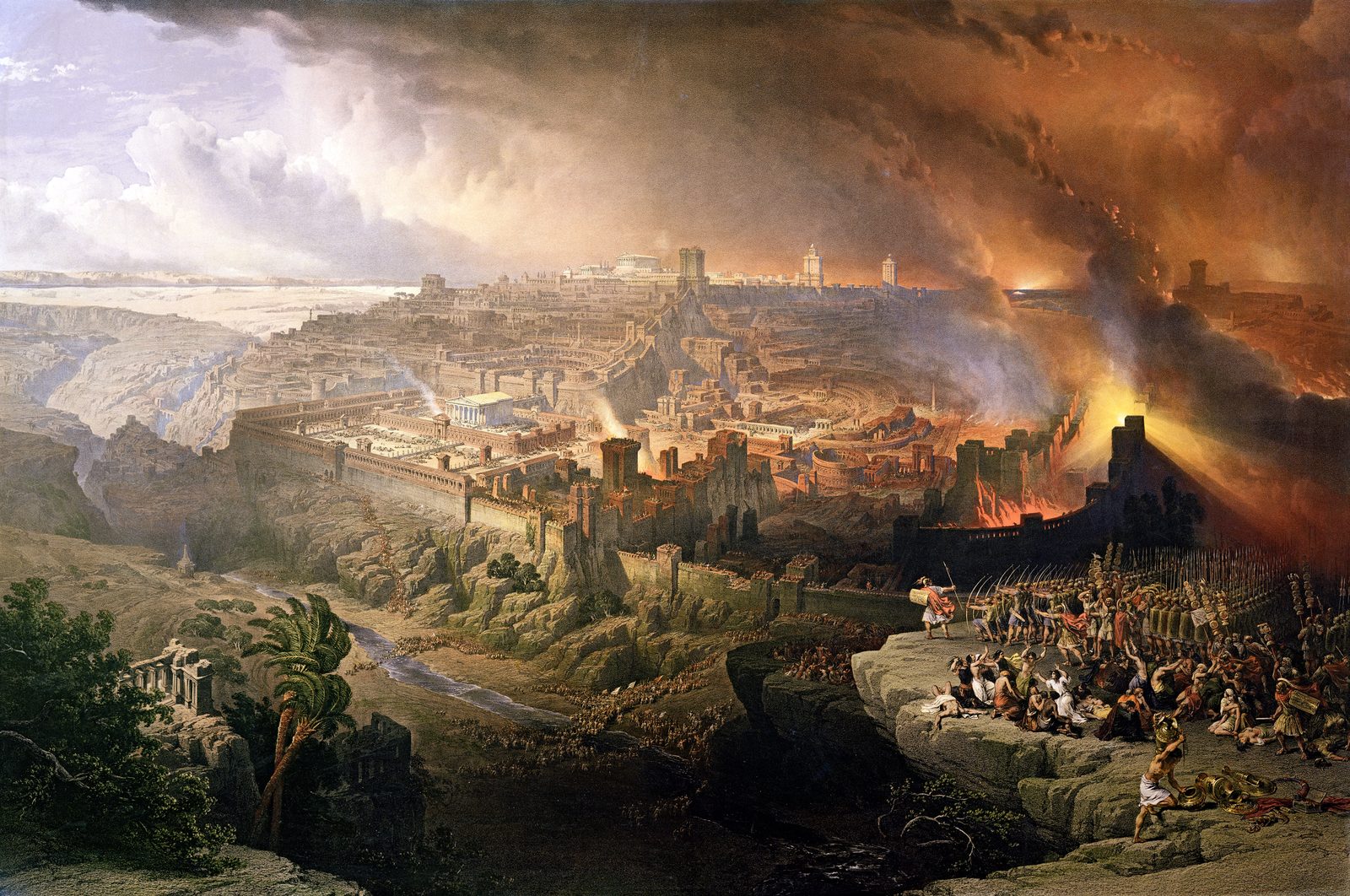
The Siege and Destruction of Jerusalem by the Romans Under the Command of Titus, A.D. 70. David Roberts, 1850. Wikimedia Commons. Public domain.