
Psalm 27
14 verses · Psalm of trust
Wait patiently for the LORD; be strong and courageous. Wait patiently for the LORD!
Introduction
David, the One Request, Book 1: The book of David, Poetry, Psalms Overview.
David is named in the heading of this psalm, and he wrote it with enemies close enough to be seen. It opens in settled confidence and then becomes an urgent prayer, so that some readers have asked whether it was once two psalms. Keep both moods together as you read, since they belong to one man on one day. Listen for the single thing he asks for above all others, which is a place near God, and for the closing command, which he gives to himself as much as to anyone listening, and repeats.
Context
- Who
- Israelites who worshipped at a tent, before there was a temple
- What
- A psalm of trust that turns to urgent prayer, spoken with an enemy army close at hand.
- Where
- A war camp pitched against the singer, and the tent that housed the ark on Zion
- When
- The reign of David, about 1010 to 970 BC by the superscription.
- Why
- To teach a threatened person to seek God's presence first and to wait for Him.
Historical context
The army encamping in verse 3 describes a siege in its first stage, an army pitched in view of the walls and settled in to starve or storm the place. The house the psalm longs for was a tent. In David's day the ark stood under curtains on Zion and Solomon's temple was a generation away, and a host who received a man into his tent owed him protection with his own life. In terrain of ridges and ravines height was safety, since a man on a crag could see, could be held by a few and could not be rushed. The father and mother who forsake him, in verse 10, name the worst case in a clan society, where a man's family was his legal standing, his insurance and his defence.
Significance
With an army camped outside, the one thing the singer asks for is to dwell in the house of the LORD all the days of his life and to gaze on his beauty. The psalm ends before the outcome does. Its closing call to wait patiently for the LORD and be strong was sung by people who were still waiting, and it says it twice.
This chapter in Jewish lifeWhat this chapter is in Jewish life and reading.
How it is read
This is the one chapter of the first thirty where the corpus carries a later Jewish voice in English beside the medieval ones. The difference between the two kinds of reading can be seen on one page. Rashi is quoted here from the Judaica Press Tanach with Rashi, and Malbim and Metzudat David from the Sefaria Community Translation.
Rashi reads the psalm out of the record of the kings. The hiding in God's tabernacle, in the fifth verse, he refers to Joash the son of Ahaziah. His sister Jehosheba hid him in the attic of the Holy of Holies for six years while Athaliah reigned. He names the source he is following, and the corpus carries that same locator on this chapter at Seder Olam Rabbah 18:2 (Rashi on Psalms 27:5:1). At the fourth verse he reads the visiting of the Temple as appearing there every morning, and records that Dunash and Menachem differed over the word (Rashi on Psalms 27:4:1). At the eighth verse he has the heart speak as God's messenger, so that "in Your stead, my heart comes to me to say this" (Rashi on Psalms 27:8:2).
Two of Rashi's notes here are the sort a Christian reader will remember. At the tenth verse the psalm says that father and mother have forsaken him, and Rashi takes it back to conception. He holds that the parents sought their own pleasure and turned away from each other once it was over, while God "guards the droplet and forms the fetus" (Rashi on Psalms 27:10:1 and 27:10:2). At the thirteenth verse he reports a homily the Sages drew from an unusual mark in the Hebrew text. David says, in their reading, "I know that You give reward to the righteous in the world to come". He adds that he does not know whether he has a share with them (Rashi on Psalms 27:13:1). His own reading of the verse is that the false witnesses would have destroyed David already if he had not believed. Rashi's last note in the chapter is a rule for a reader whose prayer goes unanswered: "if your prayer is not accepted, reinforce your hope" (Rashi on Psalms 27:14:1).
Where the modern reading differs. Malbim wrote in the nineteenth century, and he reads the psalm as a treatise on one idea rather than as a scene from a king's life. His heading states the thesis, that God's watching over a man "results from cleaving to Hashem", and that the man who cleaves is kept from all harm except when he "severs the thread of dvekut". He names his authority for that, the Guide of the Perplexed, at its third part (Malbim on Psalms 27:1:1). He then builds the first verse out of a distinction between two kinds of fear, one of a danger a man can see and one of a danger he cannot. God as light answers the enemy who comes at night, and God as salvation answers the enemy who is stronger. God as the stronghold of life answers the enemy who plots unseen (Malbim on Psalms 27:1:2). Rashi anchors the psalm in an event; Malbim anchors it in a doctrine of providence and of the soul's attachment to God. Metzudat David keeps to the plain sense. He reads the fourth verse as a simple wish, "When I shall sit in the house of the Lord it will be good for me" (Metzudat David on Psalms 27:4:1). Ibn Ezra and Radak also comment here, and the corpus carries their refs without English text. They stand cited and unquoted at Ibn Ezra on Psalms 27:2:1, 27:6:1, 27:7:1, 27:9:1 and 27:11:1, and at Radak on Psalms 27:2:1 and 27:7:1.
What the rabbis say
The corpus carries forty locators on this psalm and the text of none, so each is cited and linked here rather than quoted. Four are Talmudic. They stand at Berakhot 4a:14 on the thirteenth verse, Berakhot 32b:10 on the fourteenth, Yevamot 117a:17 later in the chapter, and an entry of the Introductions to Amoraic Literature on the fourth verse.
Aggadat Bereshit carries six, which is the largest share on this chapter. They stand at 12:1 and 15:1 on the first verse, 38:2 and 72:1 on the fourth, and 69:1 and 74:1 on the twelfth. Midrash Tehillim carries eight, at 4:3 and 55:1 on the third verse, 25:3 on the fourth, 27:6 on the fifth, 9:21 on the tenth, and 119:5 with 86:5 on the eleventh.
The second verse, where the enemies stumble, draws the Exodus midrashim. On it the corpus carries Mekhilta DeRabbi Shimon Ben Yochai 14:23, Mekhilta DeRabbi Yishmael, Vayehi Beshalach 6:20, Vayikra Rabbah 21:2 and Yalkut Shimoni on Torah 235:5. On the first verse it carries Bamidbar Rabbah 11:3 and Midrash Aggadah on Exodus 27:20:3. On the third it carries Bamidbar Rabbah 13:4 and Midrash Lekach Tov on Genesis 32:9:1.
The rest are scattered. On the fifth verse stand Seder Olam Rabbah 18:2 and Yalkut Shimoni on Torah 653:2. On the sixth stand Midrash Aggadah on Leviticus 22:27:10 and two entries of Midrash Tanchuma on Emor, at 16:1 and at 22:1 in the Buber recension. On the tenth stands Vayikra Rabbah 14:5, and on the eleventh an entry of Otzar Midrashim on Psalm 118. On the twelfth stand Midrash Lekach Tov on Exodus 1:8:2 and Pesikta Rabbati 27:1. The chapter closes with Bereshit Rabbah 74:12 and Bereshit Rabbati on Vayishlach 3 on the thirteenth verse. Beside them stand Devarim Rabbah 2:12 and Vayikra Rabbah 18:2 on the fourteenth, and two entries of Ein Yaakov in the Glick Edition at Berakhot 1:9 and 5:6. What each of them teaches is a saying of the rabbis, and is reported as theirs wherever this site quotes one. The quotations wait on a fetch that carries the text.
Sources: Rashi, Rashi on Psalms 27:3:1 to 27:14:1, the Judaica Press complete Tanach with Rashi, translated by A. J. Rosenberg; Malbim, Malbim on Psalms 27:1:1, 27:1:2 and 27:3:1, the Sefaria Community Translation; Metzudat David, Metzudat David on Psalms 27:4:1, the Sefaria Community Translation; Ibn Ezra, Ibn Ezra on Psalms 27:2:1, 27:6:1, 27:7:1, 27:9:1 and 27:11:1, cited by ref because the corpus carries no English text; Radak, Radak on Psalms 27:2:1 and 27:7:1, cited by ref because the corpus carries no English text; The Sefaria corpus, scripts/data/sources/sefaria/psalms/27.json, the 4 Talmud and 36 Midrash locators of this chapter.
my light and my salvation—: Light, salvation and stronghold are three words for the LORD in one verse, and each answers the question whom shall I fear. The wicked came to devour his flesh, and his enemies and foes stumbled and fell. An army encamped and a war begun leave the heart unafraid.
Psalms 27:1
“The Lord is my light and my salvation. Here is personal interest, "my light, ""my salvation; " the soul is assured of it, and therefore, declaring it boldly. "My light; " —into the soul at the new birth divine light is poured as the precursor of salvation; where there is not enough light to see our own darkness and to long for the Lord Jesus, there is no evidence of salvation. Salvation finds us in the dark, but it does not leave us there; it gives light to those who sit in the valley of the shadow of death.”
Charles Spurgeon · The Treasury of David, Vol. 2 (1870)Particular Baptist
1 more voice on this verseWhat preachers and commentators have said about this verse, in their own words.
Psalms 27:1
“Christians have nothing to fear, even if demons should not be well-disposed to them; for they are protected by the supreme God, who is well pleased with their piety and who sets his divine angels to watch over those who are worthy of such guardianship, so that they can suffer nothing from demons.”
Origen of Alexandria · written before 253 · Against Celsus 8:27patristic
Psalms 27:2
“This verse records a past deliverance, and is an instance of the way in which experience should be employed to reassure our faith in times of trial. Each word is instructive. When the wicked. It is a hopeful sign for us when the wicked hate us; if our foes were godly men it would be a sore sorrow, but as for the wicked their hatred is better than their love. Even mine enemies and my foes. There were many of them, they were of different sorts, but they were unanimous in mischief and hearty in hatred.”
Charles Spurgeon · The Treasury of David, Vol. 2 (1870)Particular Baptist
1 more voice on this verse
Psalms 27:2
“David says that he does not fear, because the enemy were eating up his flesh but not his soul.”
Ambrose of Milan · written before 397 · Concerning Repentance 1.14.77patristic
Psalms 27:3
“It may be that these words are spoken by the prophet of no one else but the Savior, who feared no one because of the light and salvation given from the Father and who was afraid of no one because of the protection with which God shielded him. And his heart was not at all fearful when the entire host of Satan encamped against him. His heart, filled with sacred teachings, hoped in God when war rose up against him.”
Origen of Alexandria · written before 253 · Exhortation to Martydom 29patristic
1 more voice on this verse
Psalms 27:3
Though an host should encamp against me, my heart shall not fear. Before the actual conflict, while as yet the battle is untried, the warrior's heart, being held in suspense, is very liable to become fluttered. The encamping host often inspires greater dread than the same host in actual affray. Young tells us of some—"Who feel a thousand deaths in fearing one."
Charles Spurgeon · The Treasury of David, Vol. 2 (1870)Particular Baptist
One thing I have asked: David narrows every want to one request, and three verbs carry it: to dwell, to gaze, to seek. The word rendered temple is used of the tabernacle at 1 Samuel 1:9 and 3:3, so David's tent stands behind it. The gazing is what he wants the dwelling for.
Psalms 27:4
“He knew something of the beauty of the Lord, the infinite and transcendent amiableness of the divine being and perfections; his holiness is his beauty ( Ps. cx. 3 ), his goodness is his beauty, Zech. ix. The harmony of all his attributes is the beauty of his nature.”
Matthew Henry · Commentary on the Whole Bible (1707-1721)puritan
1 more voice on this verse
Psalms 27:4
“The primary quest in my life is to learn how to host the Presence of God. There is no greater privilege than being a host to God Himself. Neither is there a greater responsibility.”
hide me in His shelter: The shelter and the tent are the house David asked to live in at verse 4, now a hiding place in the day of trouble. The rock lifts his head above his enemies. Sheltered, he offers sacrifices at the tabernacle with shouts of joy and sings to the LORD.
Psalms 27:5
“This verse gives an excellent reason for the psalmist's desire after communion with God, namely, that he was thus secured in the hour of peril. For in the time of trouble, that needy time, that time when others forsake me, he shall hide me in his pavilion: he shall give me the best of shelter in the worst of danger.”
Charles Spurgeon · The Treasury of David, Vol. 2 (1870)Particular Baptist
Psalms 27:6
“And now shall mine head be lifted up above mine enemies round about me. He is quite sure of it. Godly men of old prayed in faith, nothing wavering, and spoke of their answer to their prayers as a certainty. David was by faith so sure of a glorious victory over all those who beset him, that he arranged in his own heart what he would do when his foes lay all prostrate before him; that arrangement was such as gratitude suggested. Therefore will I offer in his tabernacle sacrifices of joy.”
Charles Spurgeon · The Treasury of David, Vol. 2 (1870)Particular Baptist
1 more voice on this verse
Psalms 27:6
“There he would sing, yea, he would sing praises to the Lord. Note, Whatever is the matter of our joy ought to be the matter of our praise; and, when we attend upon God in holy ordinances, we ought to be much in joy and praise. It is for the glory of our God that we should sing in his ways; and, whenever God lifts us up above our enemies, we ought to exalt him in our praises.”
Matthew Henry · Commentary on the Whole Bible (1707-1721)puritan
Hear, O LORD, my voice: David asks the LORD to hear him and answer. In verse 8 his own heart tells him to seek God's face, and he answers that he will. Verse 10 takes the hardest case, and the LORD receives the son his father and mother forsake.
Psalms 27:7
“Hear, O Lord, when I cry with my voice. The pendulum of spirituality swings from prayer to praise. The voice which in the last verse was tuned to music is here turned to crying. As a good soldier, David knew how to handle his weapons, and found himself much at home with the weapon of "all prayer." Note his anxiety to be heard. Pharisees care not a fig for the Lord's hearing them, so long as they are heard of men, or charm their own pride with their sounding devotions; but with a genuine man, the Lord's ear is everything.”
Charles Spurgeon · The Treasury of David, Vol. 2 (1870)Particular Baptist
1 more voice on this verse
Psalms 27:7
“Still pressing need extorts prayer for help. cry with my voice--denotes earnestness. Other things equal, Christians in earnest pray audibly, even in secret.”
Jamieson, Fausset & Brown · Commentary Critical and Explanatory on the Whole Bible (1871)reformed
Psalms 27:8
“In this verse we are taught that if we would have the Lord hear our voice, we must be careful to respond to his voice. The true heart should echo the will of God as the rocks among the Alps repeat in sweetest music the notes of the peasant's horn. Observe, that the command was in the plural, to all the saints, Seek ye; but the man of God turned it into the singular by a personal application, Thy face, Lord, will I seek. The voice of the Lord is very effectual where all other voices fail.”
Charles Spurgeon · The Treasury of David, Vol. 2 (1870)Particular Baptist
1 more voice on this verse
Psalms 27:8
“The meaning is clear, though the construction in a literal translation is obscure. The English Version supplies the implied clause. To seek God's face is to seek His favor (Ps 105:4).”
Jamieson, Fausset & Brown · Commentary Critical and Explanatory on the Whole Bible (1871)reformed
Psalms 27:9
“Hide not thy face far from me. The word "far" is not in the original, and is a very superfluous addition of the translators, since even the least hiding of the Lord's face is a great affliction to a believer. The command to seek the Lord's face would be a painful one if the Lord, by withdrawing himself, rendered it impossible for the seeker to meet with him. A smile from the Lord is the greatest of comforts, his frown the worst of ills. Put not thy servant away in anger.”
Charles Spurgeon · The Treasury of David, Vol. 2 (1870)Particular Baptist
Psalms 27:10
“When my father and my mother forsake me. These dear relations will be the last to desert me, but if the milk of human kindness should dry up even from their breasts, there is a Father who never forgets. Some of the greatest of the saints have been cast out by their families, and persecuted for righteousness' sake. Then the Lord will take me up. Will espouse my cause, will uplift me from my woes, will carry me in his arms, will elevate me above my enemies, will at last receive me to his eternal dwelling place.”
Charles Spurgeon · The Treasury of David, Vol. 2 (1870)Particular Baptist
1 more voice on this verse
Psalms 27:10
“This promise has often been fulfilled in the letter of it. Forsaken orphans have been taken under the special care of the divine Providence, which has raised up relief and friends for them in a way that one would not have expected. God is a surer and better friend than our earthly parents are or can be.”
Matthew Henry · Commentary on the Whole Bible (1707-1721)puritan
Teach me Your way: David asks for teaching and for a level path, and the verse gives the reason, his oppressors. A level path is a road cleared of the traps an enemy sets on it. Verse 12 names them, false witnesses breathing out violence.
Psalms 27:11
“Teach me thy way, O Lord. He does not pray to be indulged with his own way, but to be informed as to the path in which the righteous Jehovah would have him walk. This prayer evinces an humble sense of personal ignorance, great teachableness of spirit, and cheerful obedience of heart. Lead me in a plain path. Help is here sought as well as direction; we not only need a map of the way, but a guide to assist us in the journey.”
Charles Spurgeon · The Treasury of David, Vol. 2 (1870)Particular Baptist
Psalms 27:12
“Deliver me not over unto the will of mine enemies; or I should be like a victim cast to the lions, to be rent in pieces and utterly devoured. God be thanked that our foes cannot have their way with us, or Smithfield would soon be on a blaze again. For false witnesses are risen up against me. Slander is an old fashioned weapon out of the armoury of hell, and is still in plentiful use; and no matter how holy a man may be, there will be some who will defame him.”
Charles Spurgeon · The Treasury of David, Vol. 2 (1870)Particular Baptist
see the goodness of the LORD: The goodness David expects to see is in the land of the living, this present life. Verse 14 says wait for the LORD twice, with be strong and courageous set between. God gave Joshua the same charge at Joshua 1:6 and 1:9.
Psalms 27:13
“Faintness of heart is a common infirmity; even he who slew Goliath was subject to its attacks. Faith puts its bottle of cordial to the lip of the soul, and so prevents fainting. Hope is heaven's balm for present sorrow. In this land of the dying, it is our blessedness to be looking and longing for our fair portion in the land of the living, whence the goodness of God has banished the wickedness of man, and where holy spirits charm with their society those persecuted saints who were vilified and despised among men.”
Charles Spurgeon · The Treasury of David, Vol. 2 (1870)Particular Baptist
2 more voices on this verse
Psalms 27:13
“The living - David was thus earnestly desirous of this mercy in this life, not because he placed his portion in these things; but because the truth and glory of God, were highly concerned in making good the promise of the kingdom to him.”
John Wesley · Explanatory Notes upon the Old Testament (1765)evangelical
Psalms 27:13
“The strong emotion is indicated by the incomplete sentence, for which the English Version supplies a proper clause; or, omitting that, and rendering, "yet I believed," &c., the contrast of his faith and his danger is expressed. to see--is to experience (Ps 22:17).”
Jamieson, Fausset & Brown · Commentary Critical and Explanatory on the Whole Bible (1871)reformed
Psalms 27:14
Great and distinguished successes are brought to completion not without labors. No doubt it is necessary that for every good thing sweat must be caused first. And no wonder if we see that such occurs in great matters, since common and inferior ones are full of care and come to pass through labors. But even in labor we have learned to say, "Be strong, and be of stout heart and wait for the Lord."
Cyril of Alexandria · written before 444 · LETTER 25:1patristic
2 more voices on this verse
Psalms 27:14
“Wait on the Lord. Wait at his door with prayer; wait at his foot with humility; wait at his table with service; wait at his window with expectancy. Suitors often win nothing but the cold shoulder from earthly patrons after long and obsequious waiting; he speeds best whose patron is in the skies. Be of good courage. A soldier's motto. Be it mine. Courage we shall need, and for the exercise of it we have as much reason as necessity, if we are soldiers of King Jesus. And he shall strengthen thine heart.”
Charles Spurgeon · The Treasury of David, Vol. 2 (1870)Particular Baptist
Psalms 27:14
“In that strength, (1.) Keep close to God and to your duty. Wait on the Lord by faith, and prayer, and a humble resignation to his will; wait, I say, on the Lord; whatever you do, grow not remiss in your attendance upon God.”
Matthew Henry · Commentary on the Whole Bible (1707-1721)puritan
How this psalm is built
The form: A confidence resting on past deliverance, followed by prayer that a returning sense of danger prompted, as Barnes classes it.
The patterns in this chapter
| Device | What it does | Where to see it |
|---|---|---|
| The two questions of the first verse | Verse 1 makes two statements about the LORD and answers each with a question of the same shape, whom shall I fear and whom shall I dread. Spurgeon points to the word my in both halves, since the claim is personal before it is general. Cassiodorus reads the question as its own answer, because the fear of the LORD has brought the man to the point where he can fear no one else.Charles Spurgeon, The Treasury of David, Vol. 2, 1870, on Psalm 27:1. | Psalm 27:1 |
| The one request and the shelters it names | One request is made at verse 4 and then named again and again in the verses after it: the house of the LORD, His temple, His shelter, the cover of His tent, a rock, His tabernacle. Adam Clarke takes the shelter of verse 5 as the innermost room itself, where an enemy would not dare to come. Spurgeon reads the run as the reason for the request, since the man who asks to stay near God is asking for the best of cover in the worst of danger.Adam Clarke, Commentary on the Bible, 1832, on Psalm 27:5. | Psalm 27:4, Psalm 27:5, Psalm 27:6 |
| The turn from speaking about God to speaking to God | Verses 1 to 6 speak of the LORD in the third person and describe what He is and what He does. Verse 7 turns and speaks to Him: hear my voice, be merciful, answer me. Spurgeon marks the turn by the voice itself, which was tuned to music at verse 6 and is turned to crying at verse 7. Albert Barnes reads the change as a returning sense of danger in a man who had already been assured of God's favour.Charles Spurgeon, The Treasury of David, Vol. 2, 1870, on Psalm 27:7. | Psalm 27:6, Psalm 27:7, Psalm 27:8 |
| The command to wait, given twice in one verse | Verse 14 opens and closes with the same command to wait patiently for the LORD, and puts the call to be strong and courageous between them. Augustine treats the repetition as the answer to the question the waiting man asks, which is when, and tells him to hold out rather than take silence for refusal. Adam Clarke reads the verse as the psalmist turning to everyone else in distress and offering his own waiting as the example.Augustine of Hippo, On the Psalms, Psalm 27, 430, on Psalm 27:14. | Psalm 27:14 |
The structure
The psalm is held together by four things the devices above set out: the two answering questions of verse 1, the one request of verse 4 and the run of shelters that answer it, the turn from speaking about God to speaking to Him at verse 7, and the command to wait given twice inside verse 14. The one request and the shelters are the centre of the first half, and the repeated command is the last word of the second.
3 more paragraphs on the patterns
Where it stands in the Psalter
Albert Barnes sends the reader from the prayer of verse 11 to Psalm 25:4 and 5, where the same request to be taught God's way is made in the same words. Jamieson, Fausset and Brown explain the seeking of God's face at verse 8 by Psalm 105:4, and take seeking the face to mean seeking the favour. They compare the seeing of verse 13 with Psalm 22:17, where seeing means experiencing. The level path asked for at verse 11 is the ground the previous psalm already stands on at Psalm 26:12.
The comparison with the New Testament
Albert Barnes sets the men who breathe out violence at verse 12 beside Saul of Tarsus at Acts 9:1, who breathed out threats and murder against the disciples, and compares the phrase about the will of the enemies with Psalm 35:25. Matthew Henry reads the hiding of verse 5 against Jeremiah 36:26, where God hid the prophet and his scribe, and against Psalm 32, where God Himself is the hiding place.
The pattern inside the psalm
The two halves answer each other. The man who says at verse 3 that his heart will not fear asks at verse 9 that God not leave him. The house he asks for at verse 4 is the shelter he is given at verse 5. The rock he is set upon at verse 5 is the height his head is lifted to at verse 6, and the waiting commanded at verse 14 is what the whole psalm has been doing since verse 7.
Keep studying
Sources for this chapter
The summary
Jamieson, Fausset & Brown, Commentary Critical and Explanatory; John Calvin, Commentaries; John Wesley, Notes on the Old Testament and Matthew Henry, Complete Commentary.
The form and classifications
Adam Clarke, Commentary on the Bible, 1832, on Psalm 27:4; Albert Barnes, Notes, Explanatory and Practical, on the Old and New Testaments, 1832 to 1869, on Psalm 27:7 and Augustine of Hippo, Exposition on Psalm 27, 430, on Psalm 27:1.
The exposition
Albert Barnes, Notes on the Book of Psalms; Charles Spurgeon, The Treasury of David; Franz Delitzsch, Biblical Commentary on the Psalms; John Calvin, Commentary on the Book of Psalms; John Gill, Exposition of the Old Testament and Matthew Henry, Commentary on the Whole Bible.
The painting
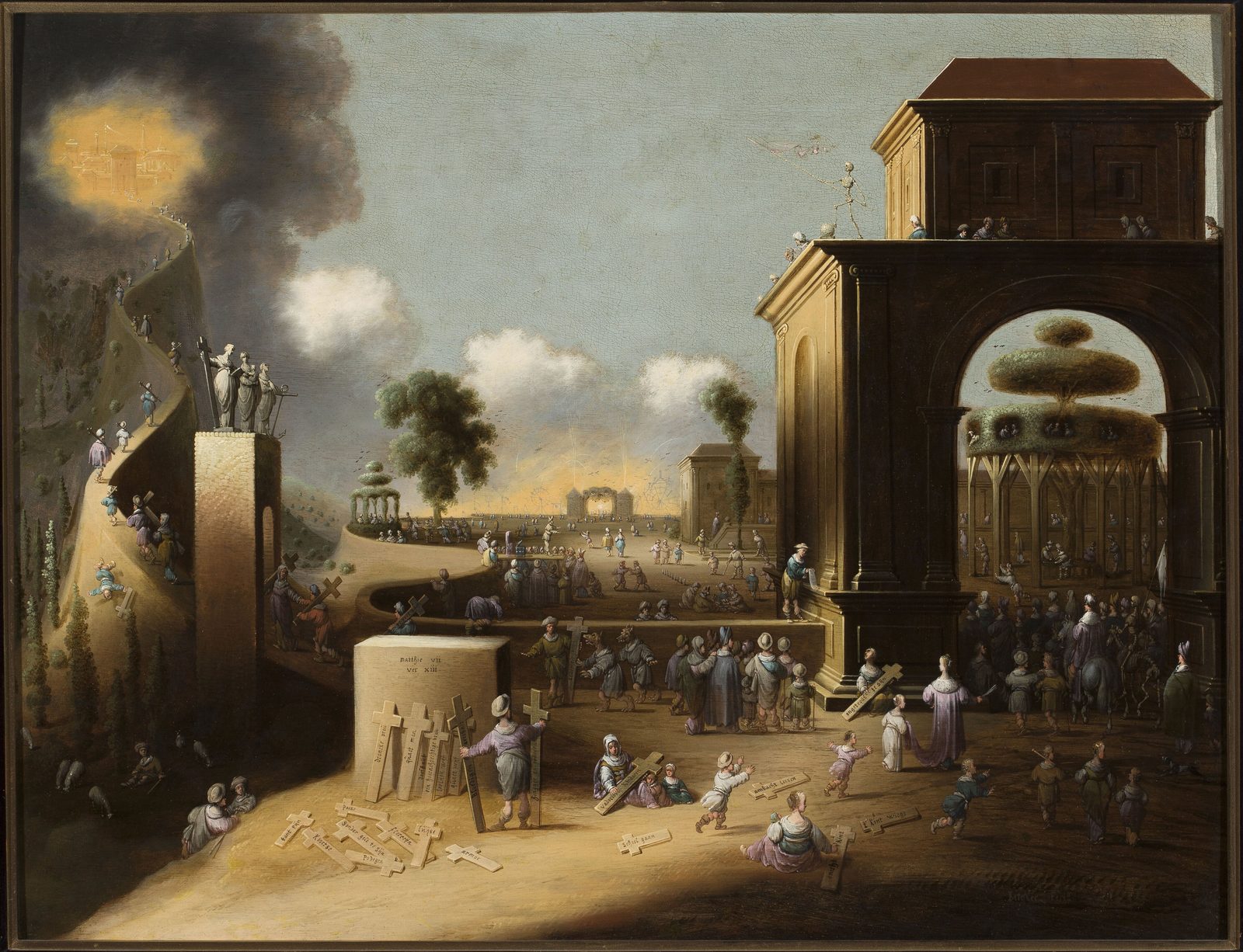
Narrow Road of Virtue and Wide Road of Sin. Jan Micker, not stated on the file page. National Museum in Warsaw. Public domain.