
Psalm 17
15 verses · Individual lament
Keep me as the apple of Your eye; hide me in the shadow of Your wings
Introduction
David, the Plea of the Innocent, Book 1: The book of David, Poetry, Psalms Overview.
David wrote this prayer as a man hunted by enemies stronger than he was. It is shaped like a case brought before a judge, with the plea, the evidence of an honest life, the request for protection and the charge against the accusers. The psalm asks God to act as both judge and guardian. Listen for the pictures of protection it uses, drawn from the human body and from a bird sheltering its young. Listen also for the contrast at the close between men content with what this life gives and a man who waits to be satisfied by God.
Context
- Who
- Israelites hunted by people with more power than they had
- What
- A prayer for justice and protection, set out like a plea before a judge.
- Where
- The Judean country where David was hunted, with his appeal carried to God's presence.
- When
- The reign of David, about 1010 to 970 BC by the superscription.
- Why
- To give a person wrongly pursued a way to bring his case to God and wait for God's verdict.
Historical context
The psalm is headed a prayer of David, and it is built as a plea entered before a court. It asks for a verdict to come from God's own presence, and verse 3 offers the evidence an ancient trial by oath expected: God has visited him in the night, tested him and found nothing. The apple of the eye renders a Hebrew phrase for the little man of the eye, the small reflection of yourself you see in another person's pupil, the part of the body a man guards without deciding to. The shadow of God's wings is a bird spreading its wings over its young, and it is also the carved cherubim whose outstretched wings covered the ark. A closed and callous heart is a heart sealed off and past feeling, and the lion lurking in ambush was an animal still living in the Jordan thickets in that era.
Significance
The contrast in the last verses carries the psalm. The enemies are men of the world whose portion is in this life, who take their payment now and leave the rest to their children. The singer takes a different settlement, to behold God's face in righteousness and to be satisfied when he awakes, staking his account on God's face while his enemies count full barns.
This chapter in Jewish lifeWhat this chapter is in Jewish life and reading.
How it is read
Rashi reads this prayer as the prayer of a guilty man, and says so without softening it. He is quoted here from the Judaica Press Tanach with Rashi. The request of the second verse he takes as a request that the sins deserving punishment should go out from before God rather than come into judgment (Rashi on Psalms 17:2:1). At the third verse he has David concede the case in advance. "I know that I am guilty of a transgression, and, if the judgment of its punishment comes before You, I will not be declared innocent" (Rashi on Psalms 17:3:1). He then names the sin. The visiting at night in the same verse he ties to the evening when David rose and saw Bathsheba (Rashi on Psalms 17:3:2).
Rashi also dates the psalm, and the dating is worth having. He holds that David prayed it after the death of Uriah, while Israel was besieging Rabbah in the land of the Ammonites. David feared that the army would be defeated there because of his own sin, and that the Philistines, Moab, Edom and the other hostile neighbours would hear of it and march (Rashi on Psalms 17:11:1). On that reading the psalm is a king's fear that his people will pay for what he did. Rashi reads the fourth verse in the same key. It is a man who watched himself afterwards because of the word of God's lips, and kept away from the ways of the profligate (Rashi on Psalms 17:4:1).
Radak, quoted from the Finch translation of 1919, which is public domain, reads the first verse as a claim of integrity rather than of innocence. The prayer is heard "for my mouth and heart are at one", and that agreement is what the verse calls righteousness (Radak on Psalms 17:1:1). He then takes the psalm's word for a cry and sorts its uses, which run from singing and rejoicing to public announcement, prayer and groaning, each distinct by its context.
The eighth verse gives both commentators their best observation, and it is an observation about the body. Radak explains that the Hebrew for the pupil of the eye means a little man, "because the image of a man is seen in it". The diminutive ending marks how small the image is (Radak on Psalms 17:8:1). Rashi notes that the pupil is called by a word for darkness because it is black. God "prepared a guard for it, viz. the eyelids, which constantly cover it" (Rashi on Psalms 17:8:1). The psalm asks to be kept the way the eyelid keeps the eye, without being told to, all day long. At the tenth verse Rashi reads the enemies' fat as a closing of the heart and the eyes against the fear of God (Rashi on Psalms 17:10:1). At the fourteenth he takes the dying by God's hand as a choice. David chooses to be among "those who die by Your hand on their bed" rather than by an enemy (Rashi on Psalms 17:14:1). The last verse he reads of the age to come, when the judgment is set aside and the righteous deeds are grasped (Rashi on Psalms 17:15:1). Ibn Ezra comments on the first verse, and the corpus carries his ref without English text, so he stands cited and unquoted at Ibn Ezra on Psalms 17:1:1.
What the rabbis say
The corpus carries forty locators on this psalm and the text of none, so each is cited and linked here rather than quoted. Eight are Talmudic. They stand at Sanhedrin 107a:6 on the third verse, Tractate Kallah Rabbati 7:5 on the twelfth, Berakhot 5b:23 and 61b:10 on the fourteenth, and Bava Batra 10a:13 on the fifteenth. Three more stand in the Jerusalem Talmud, at Rosh Hashanah 4:8:3 on the first verse, Sanhedrin 2:3:3 on the second, and Peah 7:3:7 later in the chapter.
Midrash Tehillim carries nine, at 17:1 on the first verse, 17:3 on the second, 17:6 on the third, and 116:3 on the sixth. It continues at 17:7 and 51:2 on the seventh verse, 16:1 on the eighth, and 17:8 and 17:9 on the thirteenth. Five entries of Midrash Tanchuma stand across the chapter. They are Kedoshim 6:1 in both the standard and the Buber recension on the fourth verse, and Eikev 4:1 on the eighth. Three more are Chukat 4:1 on the twelfth verse with Chukat 7:1 in Buber, and Vaetchanan 5:1 in Buber on the first.
Bereshit Rabbah carries four, at 88:5 on the fifth verse, 75:1 on the thirteenth, and 21:7 and 44:12 on the fifteenth. Two entries of Aggadat Bereshit stand on the first and second verses, at 6:1 and 9:1. Two entries of Learning to Read Midrash stand on the third verse, in a chapter on David's heart after his sin. Three entries of Ein Yaakov stand in the Glick Edition, at Berakhot 1:20 and 9:13 on the fourteenth verse and Bava Batra 1:19 on the fifteenth. The rest are single. They are Devarim Rabbah 5:8 on the second verse, Midrash Sekhel Tov on Exodus 17:12:3 on the fifth, and Bamidbar Rabbah 19:2 on the twelfth. Two stand on the thirteenth, at Midrash Lekach Tov on Lamentations 3:1:1 and Yalkut Shimoni on Torah 130:17. What each of them teaches is a saying of the rabbis, and is reported as theirs wherever this site quotes one. The quotations wait on a fetch that carries the text.
Sources: Rashi, Rashi on Psalms 17:2:1 to 17:15:1, the Judaica Press complete Tanach with Rashi, translated by A. J. Rosenberg; Radak, Radak on Psalms 17:1:1 to 17:9:1, R. David Kimhi on the first book of Psalms, translated by R. G. Finch, London, 1919; Ibn Ezra, Ibn Ezra on Psalms 17:1:1, cited by ref because the corpus carries no English text; The Sefaria corpus, scripts/data/sources/sefaria/psalms/17.json, the 8 Talmud and 32 Midrash locators of this chapter.
Psalms 17:1-2
my righteous plea: asks God to hear a case and give a ruling on it, and it comes from lips free of deceit. Verse 2 asks that the vindication come from God's own presence. The psalmist wants God's eyes on what is right.
Psalms 17:1
“We speak fully and clearly when we use words taken from divine Scripture.… The righteous person alone cleanses his tongue, lips and the voice itself from using more common words, as one acquainted with that verse: "You will give an account of every careless word on the day of judgment." The ears of God do not hear words offered from lying lips, but they receive any word offered from a cleansed tongue accustomed to meditating on divine words.”
Eusebius of Caesarea · written before 339 · Commentary on Psalms 17:1patristic
1 more voice on this verseWhat preachers and commentators have said about this verse, in their own words.
Psalms 17:1
" Hear the right, O Lord." He that has the worst cause makes the most noise; hence the oppressed soul is apprehensive that its voice may be drowned, and therefore pleads in this one verse for a hearing no less than three times. The troubled heart craves for the ear of the great Judge, persuaded that with him to hear is to redress.
Charles Spurgeon · The Treasury of David, Vol. 1 (1869)Particular Baptist
May my vindication come from Your presence: Albert Barnes heard a court here, the vindication a sentence that comes from God's presence and God's eyes set to see the case. Matthew Henry said those eyes are the joy of the upright and the terror of hypocrites. A righteous plea from lips free of deceit fears no scrutiny.
Psalms 17:3-5
You have tried my heart: is a test already finished. God tested him in the night and found no evil, and he has resolved not to sin with his mouth. The word of Your lips kept him off the ways of the violent, and his feet have not slipped.
Psalms 17:3
Who can with confidence say, "I am pure from sins"? Christ alone is truly and properly able to say these words.… When gold is tested by fire, it remains pure and shining. According to Isaiah, out of all people since the beginning of the age, Christ alone "did not sin, nor was there any deceit found in his mouth."
Eusebius of Caesarea · written before 339 · Commentary on Psalms 17:3patristic
1 more voice on this verse
Psalms 17:3
"Thou hast proved mine heart." Like Peter, David uses the argument, "Thou knowest all things, thou knowest that I love thee." It is a most assuring thing to be able to appeal at once to the Lord, and call upon our Judge to be a witness for our defence. "Beloved, if our heart condemn us not, then have we confidence toward God." "Thou hast visited me in the night."
Charles Spurgeon · The Treasury of David, Vol. 1 (1869)Particular Baptist
by the word of Your lips: Albert Barnes took the deeds of men as the common conduct of mankind, which is so often wicked. Charles Spurgeon said the word of God's lips kept the psalmist on the highway of Scripture and off the ways of the violent. Grace uses that word as a guard against evil.
Psalms 17:4
"Concerning the works of men." While we are in the midst of men we shall have their works thrust under our notice, and we shall be compelled to keep a corner of our diary headed "concerning the works of men." To be quite clear from the dead works of carnal humanity is the devout desire of souls who are quickened by the Holy Spirit. "By the word of thy lips I have kept me from the paths of the destroyer." He had kept the highway of Scripture, and not chosen the bye-paths of malice.
Charles Spurgeon · The Treasury of David, Vol. 1 (1869)Particular Baptist
My steps have held to Your paths: Older English versions make this verse a prayer. Matthew Henry joined it to verse 4, the man kept from the ways of the violent asking to be held in God's paths. Spurgeon pictured a careful driver holding up his horse on a downhill road, so the feet keep from slipping.
Psalms 17:5
“Never by our sole diligence or zeal or by our most tireless efforts can we reach perfection. Human zeal is not enough to win the sublime rewards of blessedness. The Lord must be there to help us and to guide our hearts toward what is good.”
John Cassian · written before 435 · CONFERENCES 3:12patristic
1 more voice on this verse
Psalms 17:5
“Under trial it is not easy to behave ourselves aright; a candle is not easily kept alight when many envious mouths are puffing at it. In evil times prayer is peculiarly needful, and wise men resort to it at once. Plato said to one of his disciples, "When men speak ill of thee, live so that no one will believe them;" good enough advice, but he did not tell us how to carry it out.”
Charles Spurgeon · The Treasury of David, Vol. 1 (1869)Particular Baptist
Psalms 17:6-7
I call on You, O God: is prayer made in the certainty that God will answer. The wonders asked for are His loving devotion made visible, and He saves by His right hand those who take refuge from their foes.
Psalms 17:6
"I have called upon thee, for thou wilt hear me, O God." Thou hast always heard me, O my Lord, and therefore I have the utmost confidence in again approaching thine altar. Experience is a blessed teacher. He who has tried the faithfulness of God in hours of need, has great boldness in laying his case before the throne. The well of Bethlehem, from which we drew such cooling draughts in years gone by, our souls long for still; nor will we leave it for the broken cisterns of earth. "Incline thine ear unto me, and hear my speech."
Charles Spurgeon · The Treasury of David, Vol. 1 (1869)Particular Baptist
Show the wonders of Your loving devotion: Charles Spurgeon said loving devotion is sometimes hidden, so the prayer asks God to show it. Augustine asked for wonders, lest mercy be loved too little. Matthew Henry made the prayer a pattern for Christians, who seek refuge by committing their souls to God.
Psalms 17:7
It becomes Christians to pray for peace and quiet but not to abandon steadfast faith and truth even at the peril of death. For the Lord is our Leader, "who will save them that put their hope in him."
Ambrose of Milan · written before 397 · LETTER 20:14patristic
2 more voices on this verse
Psalms 17:7
"Shew thy marvellous lovingkindness." Marvellous in its antiquity, its distinguishing character, its faithfulness, its immutability, and above all, marvellous in the wonders which it works. That marvellous grace which has redeemed us with the precious blood of God's only begotten, is here invoked to come to the rescue. That grace is sometimes hidden; the text says, "Shew it." Present enjoyments of divine love are matchless cordials to support fainting hearts. Believer, what a prayer is this! Consider it well.
Charles Spurgeon · The Treasury of David, Vol. 1 (1869)Particular Baptist
Psalms 17:7
“This prayer is both a prediction of the preservation of Christ through all the hardships and difficulties of his humiliation, to the glories and joys of his exalted state, and a pattern to Christians to commit the keeping of their souls to God, trusting him to preserve them to his heavenly kingdom.”
Matthew Henry · Commentary on the Whole Bible (1707-1721)puritan
Psalms 17:8-9
the apple of Your eye: is the pupil, which an eyelid shuts over before a man decides to blink. The shadow of Your wings sets a bird over its young, and Deuteronomy 32:10 and 11 use both pictures of the LORD over Israel.
Psalms 17:8
"Keep me as the apple of the eye." No part of the body more precious, more tender, and more carefully guarded than the eye; and of the eye, no portion more peculiarly to be protected than the central apple, the pupil, or as the Hebrew calls it, "the daughter of the eye." The all-wise Creator has placed the eye in a well-protected position; it stands surrounded by projecting bones like Jerusalem encircled by mountains.
Charles Spurgeon · The Treasury of David, Vol. 1 (1869)Particular Baptist
from the wicked who assail me: Albert Barnes read the wicked who assail the psalmist as men who lay him waste, the way war ravages a city. Adam Clarke saw huntsmen who surround a forest and drive the deer toward the nets. The hunt runs on to the lion of verse 12.
Psalms 17:9
"From the wicked that oppress me, from my deadly enemies, who compass me about." The foes from whom David sought to be rescued were wicked men. It is hopeful for us when our enemies are God's enemies. They were deadly enemies, whom nothing but his death would satisfy. The foes of a believer's soul are mortal foes most emphatically, for they who war against our faith aim at the very life of our life. Deadly sins are deadly enemies, and what sin is there which hath not death in its bowels?
Charles Spurgeon · The Treasury of David, Vol. 1 (1869)Particular Baptist
Psalms 17:10-12
They have closed their callous hearts: , and their mouths are arrogant. They have tracked the psalmist down and surrounded him, with their eyes set to throw him to the ground. The last picture is a lion, greedy for prey and lurking in ambush.
Psalms 17:10
“They wallow in pleasure, and promise themselves that to-morrow shall be as this day. And therefore with their mouth they speak proudly, glorying in themselves, blaspheming God, trampling upon his people, and insulting them." See Rev. xiii. "Lord, are not such men as these fit to be mortified and humbled, and made to know themselves?”
Matthew Henry · Commentary on the Whole Bible (1707-1721)puritan
1 more voice on this verse
Psalms 17:10
"They are inclosed in their own fat." Luxury and gluttony beget vainglorious fatness of heart, which shuts up its gates against all compassionate emotions and reasonable judgments. The old proverb says that full bellies make empty skulls, and it is yet more true that they frequently make empty hearts. The rankest weeds grow out of the fattest soil. Riches and self-indulgence are the fuel upon which some sins feed their flames. Pride and fulness of bread were Sodom's twin sins. (Ezekiel 16:49.) Fed hawks forget their masters; and the moon at its fullest is furthest from the sun.
Charles Spurgeon · The Treasury of David, Vol. 1 (1869)Particular Baptist
They have tracked us down: The prayer now speaks for a company. Albert Barnes took the plural of the psalmist and his followers, whom the enemies surround wherever they go. Adam Clarke read their fixed eyes as huntsmen bent over the ground, searching it for the track of their prey.
Psalms 17:11
“We go from place to place, to rocks, and caves, and woods; but wheresoever we go they are at hand, and ready to surround us. Eyes - They keep their eyes fixed upon us.”
John Wesley · Explanatory Notes upon the Old Testament (1765)evangelical
1 more voice on this verse
Psalms 17:11
"They have now compassed us in our steps." The fury of the ungodly is aimed not at one believer alone, but at all the band; they have compassed us. All the race of the Jews were but a morsel for Haman's hungry revenge, and all because of one Mordecai. The prince of darkness hates all the saints for their Master's sake. The Lord Jesus is one of the us, and herein is our hope. He is the Breaker, and will clear a way for us through the hosts which environ us.
Charles Spurgeon · The Treasury of David, Vol. 1 (1869)Particular Baptist
like a lion greedy for prey: Adam Clarke saw Saul in the lion, ready to spring once his men had raised the prey. Thomas Aquinas read the greedy lion as violence and the young lion lurking in ambush as deceit. Charles Spurgeon applied both to Satan and his helpers.
Psalms 17:12
“Lions are not more greedy, nor their ways more cunning than are Satan and his helpers when engaged against the children of God. The blood of souls the adversary thirsts after, and all his strength and craft are exerted to the utmost to satisfy his detestable appetite. We are weak and foolish like sheep; but we have a shepherd wise and strong, who knows the old lion's wiles, and is more than a match for his force; therefore will we not fear, but rest in safety in the fold.”
Charles Spurgeon · The Treasury of David, Vol. 1 (1869)Particular Baptist
Psalms 17:13-14
Arise, O LORD: calls God to stand up and confront them. He asks to be delivered by Your sword, and men of the world hold a portion that stops at this life. The last lines ask God to fill His treasured ones and satisfy their sons, down to their children.
Psalms 17:13
“That sword will be the "word of God living and more active than any double edged sword," here in the place of a straight sword, which is entrusted to my spirit for driving out the enemies.”
Eusebius of Caesarea · written before 339 · Commentary on Psalms 17:13, 14patristic
whose portion is in this life: Charles Spurgeon called almost every word of this verse obscure. John Wesley read the filled bellies and many children as wealth for the men of the world, and Jamieson, Fausset & Brown called it passing. The Berean text gives the filling to God's treasured ones.
Psalms 17:14
“Almost every word of this verse has furnished matter for discussion to scholars, for it is very obscure. We will, therefore, rest content with the common version, rather than distract the reader with divers translations. "From men which are thy hand." Having styled the ungodly a sword in his Father's hand, he now likens them to that hand itself, to set forth his conviction that God could as easily remove their violence as a man moves his own hand. He will never slay his child with his own hand.”
Charles Spurgeon · The Treasury of David, Vol. 1 (1869)Particular Baptist
1 more voice on this verse
Psalms 17:14
“Belly - Mind or appetite, as that word is used, Job xx, 20. Treasure - With extraordinary wealth and glory. Children - When many of thy faithful servants are barren, these are blessed with a numerous posterity.”
John Wesley · Explanatory Notes upon the Old Testament (1765)evangelical
As for me: sets the psalmist's portion against the portion of verse 14. He will behold Your face in righteousness, and waking is when he will be satisfied in Your presence. Their portion ends with this life; his begins when he wakes.
Psalms 17:15
“With the prospect of that he concluded the foregoing psalm, and so this. That happiness is prepared and designed only for the righteous that are justified and sanctified. They shall be put in possession of it when they awake, when the soul awakes, at death, out of its slumber in the body, and when the body awakes, at the resurrection, out of its slumber in the grave.”
Matthew Henry · Commentary on the Whole Bible (1707-1721)puritan
How this psalm is built
The form: A psalm that is supplication almost throughout, so that the title of prayer fits the whole composition, as Cassiodorus classes it.
The patterns in this chapter
| Device | What it does | Where to see it |
|---|---|---|
| The hearing asked three times in one verse | Verse 1 asks for the same thing three ways over: hear my plea, listen to my cry, give ear to my prayer. Spurgeon reads the repetition as the mark of a man afraid his voice will be drowned out, since the worst cause usually makes the most noise. The troubled heart asks three times because it is persuaded that with this Judge hearing the case and redressing it are one act.Charles Spurgeon, The Treasury of David, Vol. 1, 1869, on Psalm 17:1. | Psalm 17:1 |
| The first prayer taken up again at verse 6 | Verse 6 asks God to incline His ear and hear his words, which is what verse 1 had already asked. Spurgeon marks the return and reads it as an example of pressing the same suit again and again until a man has full assurance that he has succeeded. Barnes reads the ground of the second asking as the first one answered, since the psalmist calls on God because he is certain God will hear. The plea that opens the psalm is therefore the plea that reopens it after the evidence has been given.Charles Spurgeon, The Treasury of David, Vol. 1, 1869, on Psalm 17:6. | Psalm 17:1, Psalm 17:6 |
| The hunt carried through four verses | Verses 9 to 12 describe the enemy by a run of figures rather than by one word: hearts closed in their own fat, arrogant mouths, men who have tracked him down and surrounded him, eyes set to cast him to the ground, and a young lion lurking in ambush. Adam Clarke reads the whole run as one picture taken from huntsmen, who spread out around a stretch of forest and drive the deer toward the traps, and he holds that the figure carries on through the verses that follow. Barnes reads the fat of verse 10 as prosperity that has left the enemy insensible to other people.Adam Clarke, Commentary on the Bible, 1832, on Psalm 17:9. | Psalm 17:9, Psalm 17:10, Psalm 17:11, Psalm 17:12 |
| The speaker who steps forward at the last verse | The psalm speaks to God from verse 1 onward, and at verse 15 the speaker names himself over against the men of the world just described, whose portion is in this life. Wesley reads the turn as a choice between two settlements, since the singer places his portion in beholding God's face rather than in earthly treasure. Spurgeon puts the same words in the first person and has the speaker say he neither envies nor covets what those men have, because his own satisfaction is still to come.John Wesley, Explanatory Notes upon the Old Testament, 1765, on Psalm 17:15. | Psalm 17:14, Psalm 17:15 |
The structure
10 more paragraphs on the patterns
The psalm runs fifteen verses with no Selah and no refrain, and it is addressed to God throughout. Its shape is a frame with a body inside it: the plea of verse 1 is taken up again at verse 6, the evidence stands between them, and the enemy occupies verses 9 to 12 before the demand of verses 13 and 14. Clarke reads those four enemy verses as one sustained picture of a hunt rather than as separate figures. The last verse steps outside the frame and answers the men of verse 14 rather than God's silence.
In the New Testament
This study's sources record readings of the psalm rather than a quotation of it by any apostle. Augustine supplies the chief readings. He takes verse 11, where men cast the speaker out and surround him, as the crucifixion outside the city, and he hears the proud mouths of verse 10 in the words reported at Matthew 27:29. On the lion of verse 12 he points to the adversary who walks about seeking whom he may devour at 1 Peter 5:8. Eusebius reads the sword of verse 13 as the word of God, living and sharper than a double edged sword.
Where it sits in the Psalter
Matthew Henry ties the close of this psalm to the close of the one before it, noting that David ended the foregoing psalm with the same prospect and ends this one the same way. Read together, Psalm 16 and Psalm 17 both refuse to let the account be settled at the grave, one from the side of inheritance and one from the side of pursuit.
The pattern inside the psalm
The psalm keeps returning to mouths and lips. Verse 1 says the prayer comes from lips free of deceit, verse 3 records a resolve against sinning with the mouth, verse 4 credits the word of God's lips with keeping him off the violent path, and verse 10 gives the enemy mouths that speak with arrogance. Augustine reads verse 4 as a prayer that nothing should leave the speaker's mouth except what belongs to God's praise, and Matthew Henry reads verse 1 the same way, since feigned prayers are fruitless.
The psalm also matches walking against hunting. Verse 5 has steps that held to God's paths and feet that have not slipped, and verse 11 has men who tracked him down and surrounded him. Clarke reads the second picture as huntsmen reading the track of a deer on the ground, which makes the two verses one contest over the same footprints.
The lines about waking
The last verse belongs to a subject larger than this psalm, and the study keeps the full presentation because the feature page on it has yet to be built. What the text says is that the speaker will behold God's face in righteousness and be satisfied in His presence when he awakes, set against men whose portion is in this life and who leave their abundance to their children. What the holders hold is set out above under the debated concept, and they divide between a waking in worship, a waking at death and a waking at the resurrection.
Keep studying
Sources for this chapter
The summary
Jamieson, Fausset & Brown, Commentary Critical and Explanatory; John Calvin, Commentaries; John Wesley, Notes on the Old Testament and Matthew Henry, Complete Commentary.
The form and classifications
Adam Clarke, Commentary on the Bible, 1832, on Psalm 17:7; Cassiodorus, Explanation of the Psalms 17:1, 585, on Psalm 17:1; Charles Spurgeon, The Treasury of David, Vol. 1, 1869, on Psalm 17:2 and Matthew Henry, Commentary on the Whole Bible, 1710, on Psalm 17:7.
The exposition
Adam Clarke, Commentary on the Bible; Albert Barnes; Augustine of Hippo, Exposition on Psalm 17; Charles Spurgeon, The Treasury of David; Franz Delitzsch, Biblical Commentary on the Psalms; Jamieson, Fausset & Brown, Commentary Critical and Explanatory on the Whole Bible; John Gill, Exposition of the Old Testament; John Wesley, Explanatory Notes upon the Old Testament; Matthew Henry, Commentary on the Whole Bible and Thomas Aquinas, Exposition on the Psalms of David.
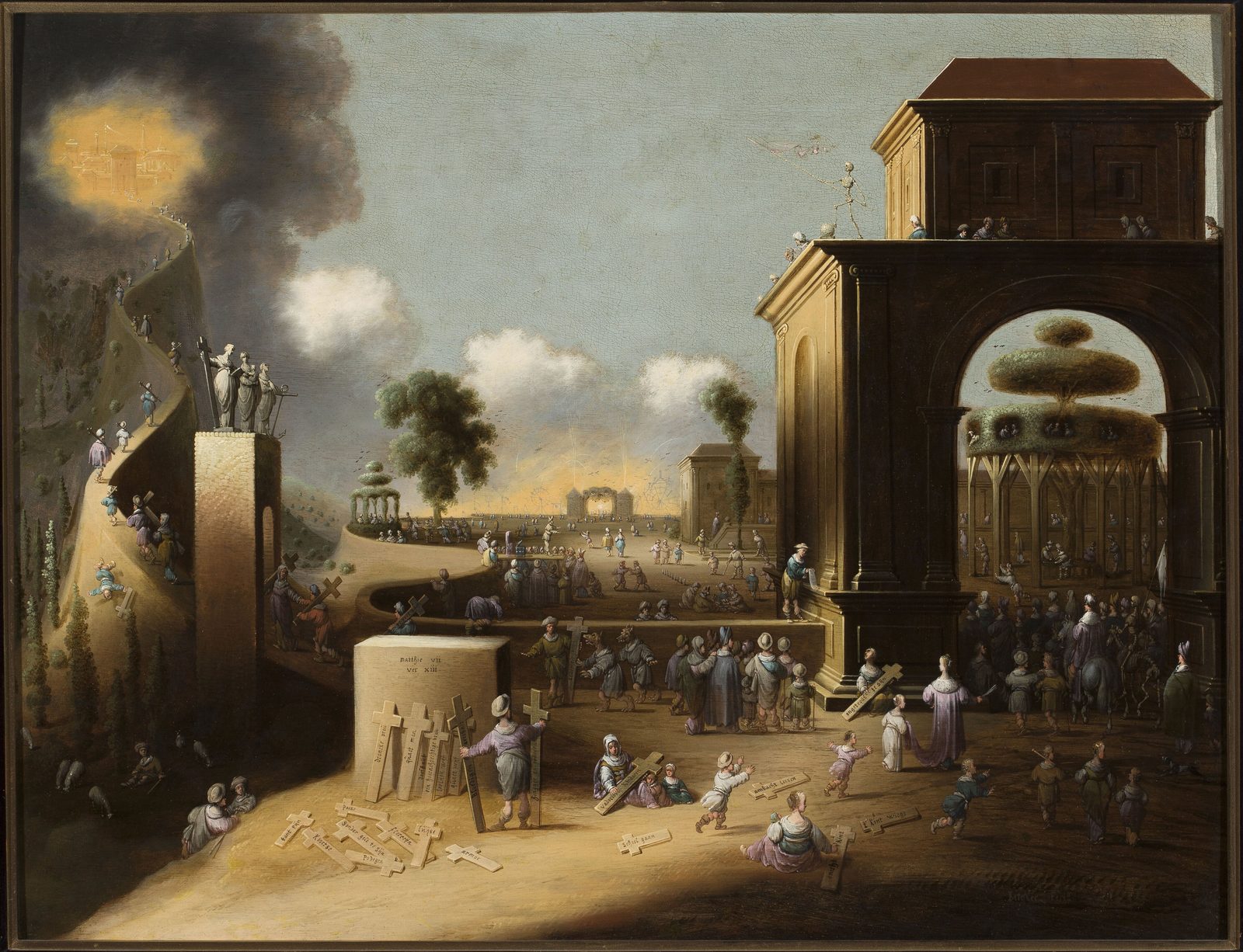
The painting
Narrow Road of Virtue and Wide Road of Sin. Jan Micker, not stated on the file page. National Museum in Warsaw. Public domain.