
Psalm 144
15 verses · Royal psalm
Man is like a breath; his days are like a passing shadow.
Introduction
David, the Warrior King, Book 5: The return and the great Hallelujah, Poetry, Psalms Overview.
David speaks here as a soldier king who learned war and knows where his skill came from. The psalm takes up lines from his older songs and sets them in a new order, and it ends on a picture of a nation at peace. Listen for the swing between the king's smallness before God and God's power over the enemy, and then for the plain household blessings the fighting was meant to secure. It shows a leader praying for his people's ordinary life.
Context
- Who
- Israelites whose farms, barns and children depended on whether the fighting stopped
- Where
- A king on campaign, praying for the war to end so that ordinary life can start again
- When
- The united monarchy under David. The heading reads By David, which places it in his reign, about 1010 to 970 BC
Historical context
The heading names David, and the psalm speaks as a king, the servant God frees from the deadly sword at verse 10. Hands trained for war were exactly what a soldier learned, the bow drawn with the fingers and the sling whirled and released, and skill of that kind took years. The storm language that follows is how the Old Testament describes God going into battle, and Exodus 19:18 has Sinai enveloped in smoke because the LORD descended on it in fire. A raised right hand sealed an oath, and a neighbour state that swore and then raided was the constant political problem of a small kingdom. The last section is the peace the war is for: sons grown like well tended plants, full storehouses, flocks by the thousand, no breach in the walls and no cry of lament in the streets.
Significance
For people who had lived through raids, that list described a year in which nothing terrible happened. The psalm sets it beside a hard fact about the king himself, that his days pass like a shadow. The one asking for the harvest knows he may not be there to eat it, and asks anyway.
This chapter in Jewish lifeWhat this chapter is in Jewish life and reading.
What is done
Psalm 144 stands in the third Davidic collection, which the book's structure file gives as Psalms 108 to 110 and 138 to 145. It is a king's psalm of war and of the settled prosperity war is fought for, and its closing verses about full storehouses, strong cattle and no breach in the streets are the part Jewish teaching has taken as a picture of a people at rest. The corpus holds no liturgical locator for this chapter, so this site records the collection and the reading rather than a custom.
How it is read
Rashi reads the third verse as a question about the nations rather than about mankind at large, and his text names Persia and Ishmael, with manuscripts reading Esau in place of Persia: what are they before God, that He should know them and lavish greatness on them. This site reports the reading in his own terms and holds that no reading of a psalm licenses contempt for any people, the posture set out at /featured/reading-rabbinic-sources-as-a-christian. On the fourth verse he reads the fleeting shadow against Ecclesiastes, and says that Solomon left the kind of shadow unexplained while his father had already fixed it as "the shadow of a flying bird" (Rashi on Psalms 144:4:1, the Judaica Press complete Tanach with Rashi, translated by A. J. Rosenberg, CC-BY). On the second verse he works the Hebrew through the Targum and the Masorah, on the eighth he distinguishes what a false mouth will say from what a false right hand will swear, and on the tenth he ties the deliverance of kings to the Rock of the Divisions and the messenger who called Saul away while David was nearly taken. On the twelfth he reads the blessing on sons and daughters as a claim about the present, that this generation too is righteous, and on the fourteenth he reads the princes borne up as the small obeying the great so that there is no breach. Radak comments on seven verses, Metzudat David on four, Ibn Ezra and Malbim on one each, and the corpus holds no English version of those, so they stand as citations: Radak on Psalms 144:1:1, Metzudat David on Psalms 144:1:1, Ibn Ezra on Psalms 144:8:1, Malbim on Psalms 144:9:1.
What the rabbis say
The corpus records forty locators on this chapter, thirty-one Midrash and nine Talmud. The opening blessing on the God who trains hands for war is taken up at Midrash Tehillim 144:1, Pesikta Rabbati 37:1 and Mekhilta DeRabbi Yishmael, Tractate Shirah 4:6. The question of what man is comes up at Pirkei DeRabbi Eliezer 13:1, Midrash Tanchuma, Vayera 2:6 and Aggadat Bereshit 19:2, and the fleeting shadow at Kohelet Rabbah 1:2:1 and 6:12:1 and Bereshit Rabbah 96:2. The new song of the ninth verse is taken up at Bamidbar Rabbah 15:11 and Pirkei DeRabbi Eliezer 21:10. The mouth that speaks vanity is taken up at Bava Batra 45a:6 and three passages of the Jerusalem Talmud, the sons like plants at Bava Batra 75a:13, and the streets without outcry at Berakhot 17a:16 and 17b:1. Each is a locator without text in the corpus.
Sources: Rashi, Rashi on Psalms 144:2:1, 144:3:1, 144:4:1, 144:8:1, 144:10:1, 144:12:1 and 144:14:1, the Judaica Press complete Tanach with Rashi, translated by A. J. Rosenberg, CC-BY; Radak, Radak on Psalms 144:1:1, cited only, no English version in the corpus; Metzudat David, Metzudat David on Psalms 144:1:1, cited only; Ibn Ezra, Ibn Ezra on Psalms 144:8:1, cited only; Malbim, Malbim on Psalms 144:9:1, cited only; Midrash, Midrash Tehillim 144:1, 18:7 and 7:15, Pesikta Rabbati 37:1, Mekhilta DeRabbi Yishmael, Tractate Shirah 4:6, Pirkei DeRabbi Eliezer 13:1 and 21:10, Kohelet Rabbah 1:2:1 and 6:12:1, Bereshit Rabbah 96:2, Bamidbar Rabbah 15:11 and 14:10; Babylonian Talmud, Bava Batra 45a:6 and 75a:13, Pesachim 87a:10, Berakhot 17a:16 and 17b:1; Jerusalem Talmud, Berakhot 1:5:15, Gittin 1:4:5, Yevamot 16:5:1, Pesachim 8:6:2; MannaFest, the collections of the Psalter, src/components/book/dossier-content/psalms-structure.ts; the posture toward rabbinic sources, at /featured/reading-rabbinic-sources-as-a-christian, 2026.
Psalms 144:1-2
Blessed be the LORD, my Rock: The LORD is blessed here as the Rock, and the hands He trains learn war while the fingers learn battle. Verse 2 then stacks the titles of Psalm 18:2, fortress, stronghold, deliverer, shield and refuge. Chesed stands first, covenant loyalty, and Spurgeon read it as mercy.
Psalms 144:1
“Blessed be the Lord my God, who teaches my hands for the fight. He who interprets briefly gains this: that he himself has no praise, and yet whatever there is in the interpretation, those who have heard retain it. Blessed be the Lord my God, who teaches my hands for the fight, and my fingers for war. Let us lift up our hands in holy things without thoughts and disputes, and let us lift them up in every place; and when we have lifted up our hands, our prayer to God is a weapon against the devil.”
Jerome · written before 420 · Homily 54, on Psalm 143patristic
3 more voices on this verseWhat preachers and commentators have said about this verse, in their own words.
Psalms 144:1
“Blessed be the Lord my strength,.... The author and giver of his natural strength of body, and of the fortitude of his mind, and of all the spiritual strength he had, to exercise grace, to bear up under afflictions and trials, to perform duty, and withstand enemies. It may be applied to Christ, the antitype of David, the man of God's right hand, he has made strong for himself.”
Psalms 144:1
“Blessed be the Lord my strength. He cannot delay the utterance of his gratitude, he bursts at once into a loud note of praise. His best word is given to his best friend—"Blessed be Jehovah." When the heart is in a right state it must praise God, it cannot be restrained; its utterances leap forth as waters forcing their way from a living spring. With all his strength David blesses the God of his strength.”
Charles Spurgeon · The Treasury of David, Vol. 7 (1885)Particular Baptist
Psalms 144:1
“Blessed be Jehovah, my strength It is very evident that David, since he celebrates the favor of God in such high terms, had not only obtained the kingdom, but gained signal victories.”
John Calvin · Commentaries (1554)reformed
who subdues peoples under me: Jerome said God has as many names as He gives benefits. The last line credits God with the loyalty of David's people, and Albert Barnes read it as his subjects made submissive by God's power. Matthew Henry saw in it the bringing of souls into subjection to the Lord Jesus.
Psalms 144:2
“Now our royal poet multiplies metaphors to extol his God. My goodness, and my fortress. The word for goodness signifies mercy. Whoever we may be, and wherever we may be, we need mercy such as can only be found in the infinite God. It is all of mercy that he is any of the other good things to us, so that this is a highly comprehensive Title — O how truly has the Lord been mercy to many of us in a thousand ways! He is goodness itself, and he has been unbounded goodness to us.”
Charles Spurgeon · The Treasury of David, Vol. 7 (1885)Particular Baptist
1 more voice on this verse
Psalms 144:2
“There was a special hand of God inclining the people of Israel to be subject to David, pursuant to the promise God had made him; and it was typical of that great act of divine grace, the bringing of souls into subjection to the Lord Jesus and making them willing in the day of his power.”
Matthew Henry · Commentary on the Whole Bible (1707-1721)puritan
Psalms 144:3-4
what is man, that You regard him: Verse 3 asks the question of Psalm 8:4 again, what man is, that God should notice him. Henry set the two psalms side by side: Psalm 8:5 crowns man with glory, and this one gives him a breath and a passing shadow. The word for the breath is hebel, emptiness.
Psalms 144:3
“Lord, what is man, that you have made yourself known to him? or the son of man, that you take account of him? This very thing is said also in the eighth psalm. 'What is man, that you are mindful of him? or the son of man, that you visit him?' Lord, what is man, that you have made yourself known to him? He speaks of the frailty of the body and of the human condition: and what does he say? If you look at the flesh, what is man? If at the spirit, man is a great thing.”
Jerome · written before 420 · Homily 54, on Psalm 143patristic
2 more voices on this verse
Psalms 144:3
“Lord, what is man, that thou takest knowledge of him?.... Man, that is at most and best but a creature, made of the dust of the earth, is but dust and ashes; yea, a sinful creature, that drinks up iniquity like water: and yet the Lord not only knows him, as he is the omniscient God, but takes notice of him in a way of providence, and in a way of grace.”
Psalms 144:3
“Lord, what is man, that thou takest knowledge of him? What a contrast between Jehovah and man! The Psalmist turns from the glorious all sufficiency of God to the insignificance and nothingness of man. He sees Jehovah to be everything, and then cries, "Lord, what is man!" What is man in the presence of the Infinite God? What can he be compared to? He is too little to be described at all; only God, who knows the most minute object, can tell what man is.”
Charles Spurgeon · The Treasury of David, Vol. 7 (1885)Particular Baptist
his days are like a passing shadow: The Hebrew reads Adam is like hebel, and Adam Clarke and Charles Spurgeon heard the name Abel, the son whose life was cut short. Albert Barnes watched the shadow move with the setting sun until it is gone. Psalm 102:11 uses the same picture.
Psalms 144:4
“Man is made like to vanity: his days pass away like a shadow. Truly our days are like a shadow. I was a little infant, I was a boy, I was a young lad, I was a youth, I was a man, that is, of perfect age, I was of middle age. While I know it not, I am an old man. Death creeps up upon old age. I am changed daily, and I do not perceive that I am nothing.”
Jerome · written before 420 · Homily 54, on Psalm 143patristic
1 more voice on this verse
Psalms 144:4
“Man is like to vanity. Adam is like to Abel. He is like that which is nothing at all. He is actually vain, and he resembles that unsubstantial empty thing which is nothing but a blown up nothing, —a puff, a bubble. Yet he is not vanity, but only like it. He is not so substantial as that unreal thing; he is only the likeness of it. Lord, what is a man? It is wonderful that God should think of such a pretentious insignificance. His days are as a shadow that passeth away.”
Charles Spurgeon · The Treasury of David, Vol. 7 (1885)Particular Baptist
Psalms 144:5-6
Part Your heavens, O LORD: The prayer asks God to come down, to touch the mountains until they smoke, and to scatter the enemy with lightning and arrows. Exodus 19:18 has Sinai wrapped in smoke when the LORD came down on it in fire. Gill read the heavens bending low, like clouds heavy with rain.
Psalms 144:5
“Lord, bow down your heavens, and descend. You will not be able to save this vileness of man, unless you yourself put it on. Lord, bow down your heavens, and descend. Your straying sheep will not be able to be healed, unless it is carried back on your shoulders. Touch the mountains, and they shall smoke. 'Amen I say to you: if you shall have faith like a grain of mustard seed, you shall say to this mountain, Pass over, and it shall be transferred.' There it was being said concerning the lunatic.”
Jerome · written before 420 · Homily 54, on Psalm 143patristic
2 more voices on this verse
Psalms 144:5
“Bow thy heavens, O Lord, and come down,.... The heavens, which the Lord has made, and where he dwells; and which are under his influence, and he can cause to incline or bow at his pleasure: and which literally may be said to bow, particularly the airy heavens, when these are filled with clouds heavy with rain, and hang low, ready to fall upon the earth, and being rent, let down showers on it: and mystically may design storms of wrath gathering over the heads of ungodly men, and revealed from heaven against them.”
Psalms 144:5
“Smoke - As Sinai did at thy glorious appearance, Exod. xix, 18. This is a figurative and poetical description of God's coming to take vengeance upon his enemies.”
John Wesley · Explanatory Notes upon the Old Testament (1765)evangelical
Flash forth Your lightning and scatter them: Albert Barnes noted that the Hebrew says lighten lightning, and the word is used as a verb only here. Psalm 18:14 had told it as done. Charles Spurgeon marked the faith of a man who had likened man to a breath and now asks for heaven's lightning on his behalf.
Psalms 144:6
“Cast forth lightning, and scatter them. The Eternal can hurl his lightnings wheresoever he pleases, and effect his purpose instantaneously. The artillery of heaven soon puts the enemy to flight: a single bolt sets the armies running hither and thither in utter rout. Shoot out thine arrows, and destroy them. Jehovah never misses the mark; his arrows are fatal to his foes when he goes forth to war.”
Charles Spurgeon · The Treasury of David, Vol. 7 (1885)Particular Baptist
1 more voice on this verse
Psalms 144:6
“Flash forth the lightning, and you shall scatter them. See what he says. He did not say, you shall destroy them: but, you shall scatter them. We read in Genesis, at that time when they were building the tower, God says: 'Come, let us descend and confound their tongue' lest at some time they should have agreement among themselves; but let them be scattered abroad, it profits them.”
Jerome · written before 420 · Homily 54, on Psalm 143patristic
Psalms 144:7-8
Reach down from on high: The plea is for a hand reaching down into deep waters. The danger is foreigners whose mouths speak falsehood and whose right hands are deceitful. Henry took that right hand as the hand men give on their word, which cannot be trusted.
Psalms 144:7
“Send forth your hand from on high. 'Lord, who has believed our report? and to whom has the arm of the Lord been revealed?' Send forth your hand from on high. Lord, bow down your heavens, and descend. This is said to the Son: Bow down your heavens, and descend. And how does he say, Send forth your hand from on high? If he descended, how does he send his hand from on high? But although he may be on earth, still he sends his hand from heaven: for he does not withdraw from heaven.”
Jerome · written before 420 · Homily 54, on Psalm 143patristic
2 more voices on this verse
Psalms 144:7
“Send thine hand from above. Let thy long and strong arm be stretched out till thine hand seizes my foes, and delivers me from them. Rid me, and deliver me out of great waters. Make a Moses of me, —one drawn out of the waters. My foes pour in upon me like torrents, they threaten to overwhelm me; save me from their force and fury; take them from me, and me from them. From the hand of strange children.”
Charles Spurgeon · The Treasury of David, Vol. 7 (1885)Particular Baptist
Psalms 144:7
“That he might see the public peace and prosperity: "Lord, let us have victory, that we may have quietness, which we shall never have while our enemies have it in their power to do us mischief." David, as a king, here expresses the earnest desire he had of the welfare of his people, wherein he was a type of Christ, who provides effectually for the good of his chosen.”
Matthew Henry · Commentary on the Whole Bible (1707-1721)puritan
whose right hands are deceitful: Charles Spurgeon tied the empty speech to verse 4, since men who are a breath speak what is empty. He found mouth and hand in agreement, both false, and the right hand skilled at deceit. Jerome read mouth and hand as knowledge and works, both condemned.
Psalms 144:8
“Whose mouth speaketh vanity. No wonder that men who are vanity speak vanity. "When he speaketh a lie, he speaketh of his own. "They cannot be depended upon, let them promise as fairly as they may: their solemn declarations are light as the foam of the sea, in no wise to be depended upon. Good men desire to be rid of such characters: of all men deceivers and liars are among the most disgusting to true hearts. And their right hand is a right hand of falsehood.”
Charles Spurgeon · The Treasury of David, Vol. 7 (1885)Particular Baptist
1 more voice on this verse
Psalms 144:8
“Whose mouth has spoken vanity. They promise themselves knowledge, and they raise up their mouth against their Creator. 'They have set their mouth against heaven.' Whose mouth has spoken vanity. Their knowledge is the knowledge of vanity. And their right hand is the right hand of iniquity. Both are condemned, both mouth and hand, both knowledge and works. Whose mouth has spoken vanity: this to knowledge. And their right hand is the right hand of iniquity. The right hand, in work. They say that they have a right hand, but they are wholly left-handed.”
Jerome · written before 420 · Homily 54, on Psalm 143patristic
I will sing to You a new song: The vow is a new song, sung to God with music. The instrument named is the nebel, a lyre, with asor for its ten strings. Both verbs look forward, a song still to come.
Psalms 144:9
“O God, I will sing to you a new song. A new man, a new song. O God, I will sing to you a new song. 'Sing to the Lord a new song.' How beautifully he did not say, I sing, but, I will sing. In the future he made his promise; for in the present he knows there is a battle, not a song. An army never sings, except when it has conquered. Therefore since in the present I fight, I have no leisure to sing. When I shall have conquered, then I will sing.”
Jerome · written before 420 · Homily 54, on Psalm 143patristic
1 more voice on this verse
Psalms 144:9
“In the midst of his complaints concerning the power and treachery of his enemies, here is a holy exultation in his God: I will sing a new song to thee, O God! a song of praise for new mercies, for those compassions that are new every morning.”
Matthew Henry · Commentary on the Whole Bible (1707-1721)puritan
Psalms 144:10-11
who gives victory to kings: Victory belongs to the one who gives it, and the servant David is named as the man freed from the deadly sword. Verse 11 repeats the plea of verses 7 and 8, leaving out only the deep waters. The same foreigners and the same false right hands are named.
Psalms 144:10
“It is he that giveth salvation unto kings. Those whom the Lord sets up he will keep up. Kings, from their conspicuous position, are exposed to special danger, and when their lives and their thrones are preserved to them they should give the Lord the glory of it. In his many battles David would have perished had not almighty care preserved him. He had by his valour wrought salvation for Israel, but he lays his laurels at the feet of his Lord and Preserver.”
Charles Spurgeon · The Treasury of David, Vol. 7 (1885)Particular Baptist
rescue me from the grasp of foreigners: Charles Spurgeon called this plea the refrain of the song, aimed at foreign enemies who broke their treaties. John Gill heard urgency in the repetition. Albert Barnes saw the plea lead straight into the peace of verses 12 to 14, the answer it hoped for.
Psalms 144:11
“Rid me, and deliver me from the hand of strange children,.... This is repeated from Psa 144:7; and is done to show the vehemency and importunity of the request, and the danger David was in, and his sense of it; See Gill on Psa 144:7; whose mouth speaketh vanity, and their right hand is a right hand of falsehood. See Gill on Psa 144:8.”
1 more voice on this verse
Psalms 144:11
“Because of what the Lord had done, David returns to his pleading. He begs deliverance from him who is ever delivering him. Rid me, and deliver me from the hand of strange children. This is in measure the refrain of the song, and the burden of the prayer. He desired to be delivered from his open and foreign adversaries, who had broken compacts, and treated treaties as vain things. Whose mouth speaketh vanity, and their right hand is a right hand of falsehood.”
Charles Spurgeon · The Treasury of David, Vol. 7 (1885)Particular Baptist
Psalms 144:12-13
our sons will be like plants: Sons are plants grown in their youth, daughters the carved corner pillars of a palace. Henry read the daughters as the corner pillars that tie a family together, and Gill read the storehouses as the corners stocked with food. The word for corner pillar means a projecting angle.
Psalms 144:12
“God's blessing works wonders for a people. That our sons may be as plants grown up in their youth. Our sons are of first importance to the state, since men take a leading part in its affairs; and that the young men are the older men will be. He desires that they may be like strong, well rooted, young trees, which promise great things. If they do not grow in their youth, when will they grow? If in their opening manhood they are dwarfed, they will never get over it. O the joys which we may have through our sons!”
Charles Spurgeon · The Treasury of David, Vol. 7 (1885)Particular Baptist
1 more voice on this verse
Psalms 144:12
“By daughters families are united and connected, to their mutual strength, as the parts of a building are by the corner-stones; and when they are graceful and beautiful both in body and mind they are then polished after the similitude of a nice and curious structure.”
Matthew Henry · Commentary on the Whole Bible (1707-1721)puritan
supplying all manner of produce: Albert Barnes gave the Hebrew behind all manner of produce as from sort to sort, every kind of grain in store. Adam Clarke read the last word as the sheep pens outside the town, which the Berean renders fields. He also took these lines as blessings already in hand.
Psalms 144:13
“That our garners may be full, affording all manner of store. A household must exercise thrift and forethought: it must have its granary as well as its nursery. Husbands should husband their resources; and should not only furnish their tables but fill their garners. Where there are happy households, there must needs be plentiful provision for them, for famine brings misery even where love abounds. It is well when there is plenty, and that plenty consists of "all manner of store." We have occasionally heard murmurs concerning the abundance of grain, and the cheapness of the poor man's loaf.”
Charles Spurgeon · The Treasury of David, Vol. 7 (1885)Particular Baptist
1 more voice on this verse
Psalms 144:13
“That our garners may be full, affording all manner of store,.... Or "our corners" (s), the corners of their houses, as Aben Ezra and Kimchi; the nooks that were in them might be full of provisions for the supply of the family; or that their barns and granaries might be full of all kind of corn, as wheat, rye, barley, &c. which might be sufficient from year to year, as the Targum; plenty of all food is intended, in opposition to a scarcity, dearth, and famine, Pro 3:9; that so there might be enough for increasing families.”
Psalms 144:14-15
Our oxen will bear great loads: Strong oxen, walls with no breach and streets with no cry of lament fill out the land at rest. Verse 15 says blessed twice, and the second names the people whose God is the LORD. Spurgeon read that line as the reason for the rest.
Psalms 144:14
“That our oxen may be strong to labour; so that the ploughing and cartage of the farm may be duly performed, and the husbandman's work may be accomplished without unduly taxing the cattle, or working them cruelly. That there be no breaking in, nor going out; no irruption of marauders, and no forced emigration; no burglaries and no evictions. That there be no complaining in our streets; no secret dissatisfaction, no public riot; no fainting of poverty, no clamour for rights denied, nor concerning wrongs unredressed.”
Charles Spurgeon · The Treasury of David, Vol. 7 (1885)Particular Baptist
1 more voice on this verse
Psalms 144:14
“That our oxen may be strong to labour,.... To draw carriages, to plough with, and to tread out the corn: or "may be burdened" (w); fit to carry burdens; or burdened with flesh, be plump and fat, and in good condition to work; or burdened with young, as some (x) understand it, and then it must be meant of cows, as the word is used, Deu 7:13; and so here an increase of kine is wished for, as of sheep before.”
whose God is the LORD: Matthew Henry heard the second blessing correct the first: the psalmist began to praise prosperity and turned to people who have the LORD. Augustine gave the first line to the strangers of verse 11. In a letter he called the second line the brief, true answer to what happiness is.
Psalms 144:15
“They called blessed the people who have these things. Many, not knowing, think such people blessed. But for us there is Christian simplicity: we do not want Platonic eloquence, but we want the apostolic simplicity of fishermen. This one holds the net, has feet and hands muddied from the work; this one has a calloused hand from the work. Blessed the people whose God is their Lord. Blessed is the people, who instead of all riches have Christ. Those people have sons and daughters, and storehouses, fruitful sheep, oxen fat and sleek and comely.”
Jerome · written before 420 · Homily 54, on Psalm 143patristic
2 more voices on this verse
Psalms 144:15
“The psalmist began to say, as most do, Happy are the people that are in such a case; those are blessed that prosper in the world. But he immediately corrects himself: Yea, rather, happy are the people whose God is the Lord, who have his favour, and love, and grace, according to the tenour of the covenant, though they have not abundance of this world's goods.”
Matthew Henry · Commentary on the Whole Bible (1707-1721)puritan
Psalms 144:15
“Happy is that people that is in such a case. Such things are not to be overlooked. Temporal blessings are not trifles, for the miss of them would be a dire calamity. It is a great happiness to belong to a people so highly favoured. Yea, happy is that people, whose God is the Lord. This comes in as an explanation of their prosperity. Under the Old Testament Israel had present earthly rewards for obedience: when Jehovah was their God they were a nation enriched and flourishing.”
Charles Spurgeon · The Treasury of David, Vol. 7 (1885)Particular Baptist
How this psalm is built
The form: A royal psalm of a king who had already known God's favour in battle and asks for it again, as Calvin classes it.
The patterns in this chapter
| Device | What it does | Where to see it |
|---|---|---|
| The names heaped up | Verses 1 and 2 give God seven titles in two verses: my Rock, my steadfast love, my fortress, my stronghold, my deliverer, my shield, my refuge. Spurgeon says the royal poet multiplies metaphors to extol his God. Jerome puts the reason plainly, that God is called by as many names as He gives benefits. Calvin notes that one expression of help would not have been enough for the weakness the psalm is praying out of.Charles Spurgeon, The Treasury of David, Vol. 7, 1885, on Psalm 144:2. | Psalm 144:1, Psalm 144:2 |
| Adam is like Abel | Verse 4 says man is like a breath. Clarke gives the Hebrew literally as Adam is like to Abel, the same word that names the second son of Adam and means a vapour or a breath. Spurgeon makes the same point in English, that Adam is like to Abel and resembles that unsubstantial thing which is nothing at all. The pun is in the text and it carries the verse.Adam Clarke, Commentary on the Bible, 1832, on Psalm 144:4. | Psalm 144:4 |
| Come down, and the mountains smoke | Verses 5 and 6 ask God to part the heavens and come down, to touch the mountains so that they smoke, to flash lightning and shoot arrows. Wesley identifies the picture as Sinai, which smoked at God's appearing in Exodus 19:18. Matthew Henry reads the lightnings as God's arrows, the weapons of a God who fights from heaven.John Wesley, Explanatory Notes upon the Old Testament, 1765, on Psalm 144:5. | Psalm 144:5, Psalm 144:6 |
| The same request, said twice | Verses 7 and 8 ask to be set free and rescued from the grasp of foreigners whose mouths speak falsehood and whose right hands are deceitful. Verse 11 says it again in almost the same words, with the new song of verses 9 and 10 standing between them. The repetition marks the song as an interruption of the prayer rather than its conclusion.Albert Barnes, Notes, Explanatory and Practical, on the Old and New Testaments, 1832 to 1869, on Psalm 144:5. | Psalm 144:7, Psalm 144:8, Psalm 144:11 |
| What peace is made of | Verses 12 to 14 list the peace the psalm is asking for, item by item and all of it concrete. Sons like well tended plants and daughters like the carved corner pillars of a palace. Storehouses full, flocks bringing forth by the thousand, oxen bearing great loads. No breach in the walls, no going into captivity, no cry of lament in the streets. It is a description of a year in which nothing terrible happened.Matthew Henry, Commentary on the Whole Bible, 1710, on Psalm 144:4. | Psalm 144:12, Psalm 144:13, Psalm 144:14 |
The structure
8 more paragraphs on the patterns
The psalm is built on a repetition that frames its centre. Verses 7 and 8 ask for rescue from the grasp of foreigners. Verses 9 and 10 promise a new song on a harp of ten strings, and verse 11 repeats the earlier request almost word for word. The song stands inside the prayer rather than after it. Then verses 12 to 15 change subject entirely and describe the peace.
The links inside the Psalter
Two of its lines stand elsewhere in the same words. Verse 1, that God trains his hands for war, is the line of Psalm 18:34 and of 2 Samuel 22:35, David's great victory song in two places. Verses 3 and 4, asking what man is that God regards him, are Psalm 8:4 turned from wonder into brevity. Psalm 8 asks the question and answers it with dominion; this psalm asks it and answers it with a passing shadow.
The prophecy and the New Testament's use
No New Testament writer quotes Psalm 144. Its third verse reaches the New Testament through Psalm 8, which Hebrews 2:6 quotes in that form, and the two psalms should be read together for that reason. The new song of verse 9 belongs to a line running from Psalm 33:3 through Isaiah to Revelation 5:9, where a new song is sung to the Lamb.
The debate
Whether verses 12 to 15 belong with the rest is the standing question about this psalm. The subject changes completely, the prayer for rescue is finished, and the vocabulary of the last four verses is domestic rather than military.
Those who read it as one psalm take the peace as the object of the war prayer, which is how Matthew Henry and Spurgeon read it. Those who hear a separate piece point to the break in sense. Nothing in the text settles it, and the psalm reads coherently either way, since a king's prayer for rescue and a king's prayer for a quiet country are the same prayer at two ends.
Keep studying
Sources for this chapter
The summary
Jamieson, Fausset & Brown, Commentary Critical and Explanatory; John Calvin, Commentaries; John Wesley, Notes on the Old Testament and Matthew Henry, Complete Commentary.
The form and classifications
Adam Clarke, Commentary on the Bible, 1832, on Psalm 144:2; John Calvin, Commentaries, 1554, on Psalm 144:1 and Matthew Henry, Commentary on the Whole Bible, 1710, on Psalm 144:1.
The exposition
Adam Clarke, Commentary on the Bible; Albert Barnes; Augustine of Hippo; Charles Spurgeon, The Treasury of David; Franz Delitzsch, Biblical Commentary on the Psalms; Jerome, Homily 54, on Psalm 143; John Gill, Exposition of the Old Testament and Matthew Henry, Commentary on the Whole Bible.
The painting
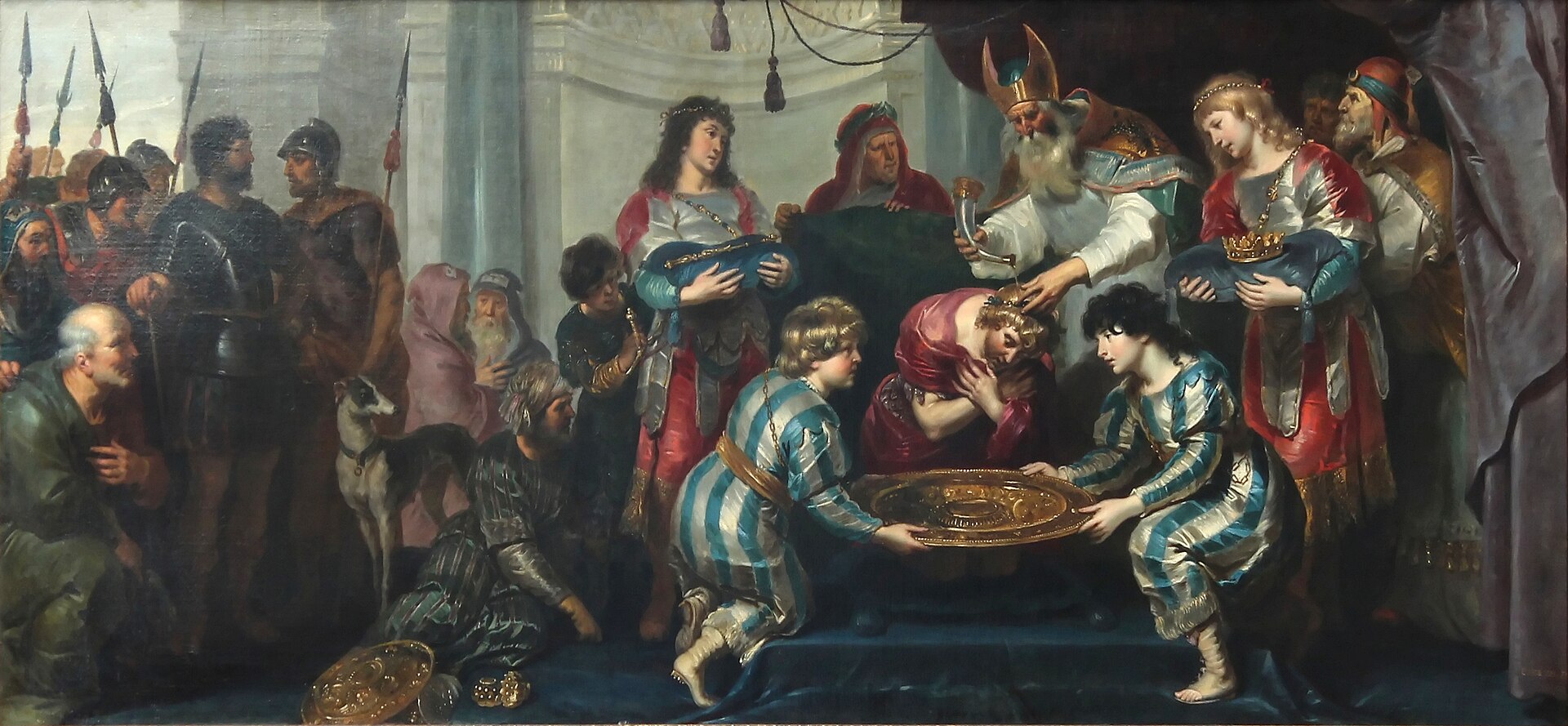
The anointing of Solomon. Cornelis de Vos, 17th century. Wikimedia Commons. Public domain.