
Psalms 144:10
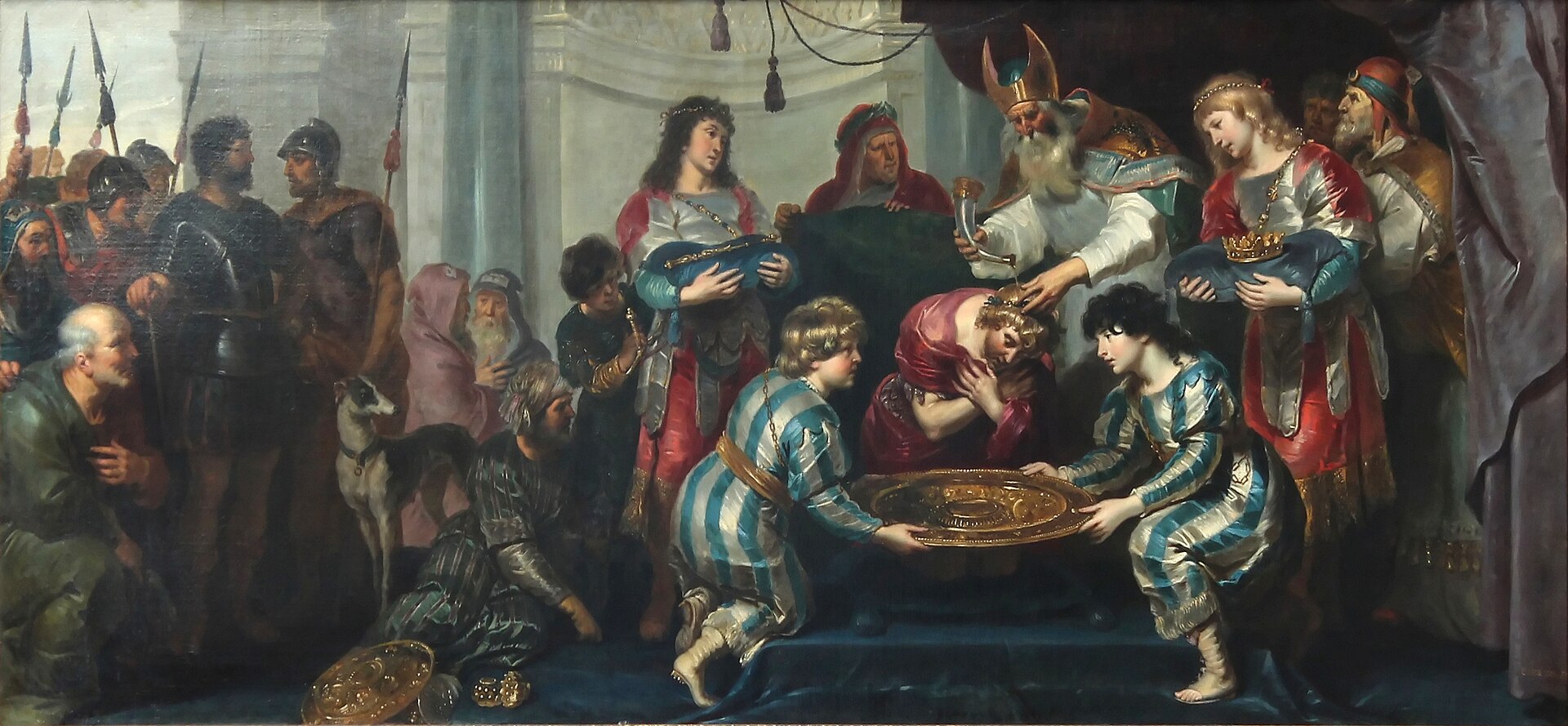
in Psalms 144to Him who gives victory to kings, who frees His servant David from the deadly sword.
BSB
The same verse in ASV and KJV ▾
ASV
Thou art he that giveth salvation unto kings; Who rescueth David his servant from the hurtful sword.
KJV
It is he that giveth salvation unto kings: who delivereth David his servant from the hurtful sword.
⋯
This verse in Psalms 144
Commentary
10 notes on this verseIt is he that giveth salvation unto kings. Those whom the Lord sets up he will keep up. Kings, from their conspicuous position, are exposed to special danger, and when their lives and their thrones are preserved to them they should give the Lord the glory of it. In his many battles David would have perished had not almighty care preserved him. He had by his valour wrought salvation for Israel, but he lays his laurels at the feet of his Lord and Preserver.
This site's exposition
who gives victory to kings
on Psalms 144:10-11
Victory belongs to the one who gives it, and the servant David is named as the man freed from the deadly sword. Verse 11 repeats the plea of verses 7 and 8, leaving out only the deep waters. The same foreigners and the same false right hands are named.
The record, by era
The Church Fathers2 voices
"Who giveth salvation to kings, who redeemeth David His servant" (ver. 10). Ye know who David is; be yourselves David. Whence "redeemeth He David His servant"? Whence redeemeth He Christ? Whence redeemeth He the Body of Christ? "From the sword of ill intent deliver me." "From the sword" is not sufficient; he addeth, "of ill intent." Without doubt there is a sword of good intent. What is the sword of good intent? That whereof the Lord saith, "I came not to send peace on earth, but a sword." For He was about to separate believers from unbelievers, sons from parents, and to sever all other ties, while the sword cut off what was diseased, but healed the members of Christ. Of good intent then is the sword twice sharpened, powerful with both edges, the Old and New Testaments, with the narration of the past and the promise of the future. That then is the sword of good intent: but the other is of ill intent, wherewith they talk vanity, for that is of good intent, wherewith God speaketh verity. For truly "the sons of men have teeth which are spears and arrows, and their tongue is a sharp sword."
Who gives salvation to kings. To what kings? 'The heart of the king is in the hand of God.' Even of Julian the persecutor, and of Nero, and of Decius? The heart of the king is in the hand of God. Those who reign over their own body, who subject their body and reduce it to servitude, lest, while preaching to others, they themselves be found reprobate. These are the kings of whom wisdom says in Proverbs: 'She gives a kingdom to kings.'
The Puritans and the Awakening3 voices
In the midst of his complaints concerning the power and treachery of his enemies, here is a holy exultation in his God: I will sing a new song to thee, O God! a song of praise for new mercies, for those compassions that are new every morning.
): It is he that giveth salvation unto kings. That great kings cannot save themselves without him. Kings have their life-guards, and have armies at command, and all the means of safety that can be devised; but, after all, it is God that gives them their salvation, and secures them by those means, which he could do, if there were occasion, without them, Ps. xxxiii.
quarantine:debris (2026-07-29) — leading-punctuation+unbalanced-parens
It is he that giveth salvation to kings,.... Which is the reason of singing the new song to the Lord, or this is the matter of it.
3 more voices on this verse
The Nineteenth Century3 voices
It is he that giveth salvation unto kings. Those whom the Lord sets up he will keep up. Kings, from their conspicuous position, are exposed to special danger, and when their lives and their thrones are preserved to them they should give the Lord the glory of it. In his many battles David would have perished had not almighty care preserved him. He had by his valour wrought salvation for Israel, but he lays his laurels at the feet of his Lord and Preserver. If any men need salvation kings do, and if they get it the fact is so astonishing that it deserves a verse to itself in the psalm of praise. Who delivereth David his servant from the hurtful sword. He traces his escape from death to the delivering hand of God. Note, he speaks in the present tense— delivereth, for this was an act which covered his whole life. He puts his name to the confession of his indebtedness: it is David who owns without demur to mercy given to himself. He styles himself the Lord's servant, accepting this as the highest title he had attained or desired.
He that giveth salvation unto kings - Monarchy, in the principle, is from God: it is that form of government which, in the course of the Divine providence, has principally prevailed; and that which, on the whole, has been most beneficial to mankind. God, therefore, has it under his peculiar protection. It is by him that kings reign; and by his special providence they are protected.
A commentator
Albert Barnes1798–1870
Notes, Explanatory and Practical, on the Old and New Testaments (1832-1869)
proposed
It is he that giveth salvation unto kings - Margin, “Victory.” The Hebrew word means “salvation,” but it is used here in the sense of deliverance or rescue. Even “kings,” with all their armies, have no hope but in God. They seem to be the most powerful of men, but they are, like all other people, wholly dependent on him for deliverance from danger. David thus recognizes his own entire dependence. Though a king in the divine purpose and in fact, yet he had no power but as derived from God; he had no hope of deliverance but in him. It is implied further that God might as readily be supposed to be willing to interpose in behalf of kings as of other people when their cause was right, and when they looked to him for aid. See the notes at Psa 33:16: “there is no king saved by the multitude of an host.” Compare Psa 44:5-6. Who delivereth David his servant from the hurtful sword - Who has done it; who can do it again; on whom alone David is dependent as all other men are. David speaks of himself by name elsewhere. See Psa 18:50; 2Sa 7:26. He refers to himself also under the name of “the king,” Psa 61:6; Psa 63:11. Caesar, in his writings, often speaks of himself in the same way.
How the passage was read
What the Jewish commentators add
Who gives salvation to kings This speaks about the Rock of the Divisions, when David was close to being seized by Saul (I Sam.:27): “A messenger came to Saul, saying, ‘Make haste and go, etc.’” He saved Saul from shedding innocent blood, and David from being killed.
1 more on this passage, in their own words ▾
Deliver me and rescue me As You delivered me then, so shall You deliver me now.
This section is reception history: how the passage was read and kept in the Jewish tradition. Where a reading parts from an essential of the Christian faith, the section says so at that point.
Texts and citation data: Sefaria; each excerpt follows its version’s licence. 3 further sources are cited on this chapter that carry no English text this site may quote or only restate the verse.
The words behind it
9 Hebrew wordsEvery Hebrew word of this verse in the order it stands, with what it means and the door to its own study. The last column counts the times a word stands in the whole Bible: the rarer the word, the more the places it appears belong together.
| Hebrew | Sound | Meaning | Word study | In the Bible |
|---|---|---|---|---|
| הַנּוֹתֵ֥ן | hanoten | who gives | H5414 → | 2011 times |
| תְּשׁוּעָ֗ה | teshuah | deliverance | H8668 → | 34 times |
| לַמְּלָ֫כִ֥ים | lamelakhim | to <the> kings | H4428 → | 2525 times |
| הַ֭פּוֹצֶה | hapotzeh | who sets free | H6475 → | 15 times |
| אֶת־ | ʾet- | <obj.> | H853 → | 10935 times |
| דָּוִ֥ד | david | David | H1732 → | 999 times |
| עַבְדּ֗וֹ | avdo | servant his | H5650 → | 799 times |
| מֵחֶ֥רֶב | mecherev | from a sword | H2719 → | 413 times |
| רָעָֽה׃ | raah | evil | H7451 → | 662 times |
הַנּוֹתֵ֥ןwho gives
hanotenH5414 →2011 times
תְּשׁוּעָ֗הdeliverance
teshuahH8668 →34 times
לַמְּלָ֫כִ֥יםto <the> kings
lamelakhimH4428 →2525 times
הַ֭פּוֹצֶהwho sets free
hapotzehH6475 →15 times
אֶת־<obj.>
ʾet-H853 →10935 times
דָּוִ֥דDavid
davidH1732 →999 times
עַבְדּ֗וֹservant his
avdoH5650 →799 times
מֵחֶ֥רֶבfrom a sword
mecherevH2719 →413 times
רָעָֽה׃evil
raahH7451 →662 times
A shaded row is a word that stands 400 times or fewer in the Bible.
The walk
8 stopsEach card is a verse this one points to, and under it the verses that one points to in turn. Where several paths arrive at the same place, that place is listed first: the text keeps returning to it.
Through
Psalms 140:7O GOD the Lord, the strength of my salvation, You shield my head in the day of battle.
it leads to
- Psalms 62:7
My salvation and my honor rest on God, my strong rock; my refuge is in God.
- Psalms 89:26
He will call to Me, ‘You are my Father, my God, the Rock of my salvation.’
- Psalms 18:1–2
I love You, O LORD, my strength.
- Psalms 62:2
He alone is my rock and my salvation. He is my fortress; I will never be shaken.
- Deuteronomy 33:27–29
The eternal God is your dwelling place, and underneath are the everlasting arms. He drives out the enemy before you, giving the command, ‘Destroy him!’
- Psalms 62:7
Through
Psalms 18:50Great salvation He brings to His king. He shows loving devotion to His anointed, to David and his descendants forever.
it leads to
- Psalms 132:10
For the sake of Your servant David, do not reject Your anointed one.
- 2 Samuel 7:13
He will build a house for My Name, and I will establish the throne of his kingdom forever.
- Psalms 89:3–4
You said, “I have made a covenant with My chosen one, I have sworn to David My servant:
- Psalms 132:10
Where this verse is studied
On this page
About Psalms
Who and where
1 name in this verse with a page on the site.
This page draws on 9 works. Open the list of works
This page draws on Adam Clarke, Commentary on the Bible; Albert Barnes, Notes on the Book of Psalms; Albert Barnes, Notes, Explanatory and Practical, on the Old and New Testaments (1832-1869); Augustine of Hippo, ON THE PSALMS, Psalm 144; Charles Spurgeon, The Treasury of David, Vol. 7; Franz Delitzsch, Biblical Commentary on the Psalms; Jerome, Homily 54, on Psalm 143; John Gill, Exposition of the Old Testament (1748-1763) and Matthew Henry, Commentary on the Whole Bible.