
Psalm 136
26 verses · Historical recital psalm
Give thanks to the LORD, for He is good. His loving devotion endures forever.
Introduction
Author unstated, the Great Hallel, Book 5: The return and the great Hallelujah, Poetry, Psalms Overview.
This psalm names no writer, and it was made to be sung by two voices. A leader states one thing God has done, and the whole congregation answers with the same line every time. Israel sang its refrain when Solomon's temple was dedicated and when the second temple was founded, and it became known as the Great Hallel. It runs through the nation's story in order, from the making of the world to the gift of the land. Listen for how the answer never changes while the deeds grow, and for the small, daily mercy placed at the end of the list.
Context
- Who
- Israelites who did not need a scroll to take part, because their whole share was one sentence
- Where
- The temple courts, with a singer calling out the line and the whole congregation answering it
- When
- Israel's temple worship, the Great Hallel. No author is named in the heading; the psalm's use in the temple is recorded from Solomon's day onward
Historical context
The psalm carries no name and no date. What it carries instead is a record of use: its refrain is the line 2 Chronicles 5:13 puts in the mouths of the singers at the dedication of Solomon's temple, and it is sung again when the foundation of the second temple is laid in Ezra 3:11. The manner is antiphonal. One voice states an act of God and the whole assembly answers with the same words, twenty six times without a change of wording. Known later as the Great Hallel, it was sung at Passover. The list it recites runs in a set order that a first hearer would have recognised as the nation's own story: creation, then the Exodus, then the desert and the kings east of the Jordan, then the land handed over as an inheritance. The closing lines are deliberately small, and the same refrain covers dinner.
Significance
The design is teaching by repetition. A child standing in the congregation learned the entire history of his nation while singing one sentence, and the sentence he sang was the meaning of every event in it. Creation, rescue, land and daily bread are one loyalty, running on and without stopping.
This chapter in Jewish lifeWhat this chapter is in Jewish life and reading.
What is done
Psalm 136 is the Great Hallel in Jewish usage, the Hallel ha-Gadol, and it is the one psalm the name belongs to. The site's page on the Hallel records that the Talmud preserves opinions extending the name to Psalms 135 and 136, or to 134 through 136, and that the accepted opinion holds this psalm alone. The same page records the distinction this site keeps throughout: the Egyptian Hallel is Psalms 113 to 118, and the Great Hallel is Psalm 136. Every one of its twenty-six verses closes with the same refrain, which is what makes it a psalm said with a congregation answering.
How it is read
The classical commentary reads the psalm as a recital of creation and the exodus, and works the verses where God acts alone. Rashi reads the wonders done alone as wonders done before any angel existed, when God made the heaven, the earth, the sun and the moon. Ibn Ezra reads the God of gods and the Lord of lords of the second and third verses as God over the angels, who have no bodies, and says "the angels are the lords of the earth" (Ibn Ezra on Psalms 136:3:1, Sefaria Community Translation, CC0). On the smiting of Egypt Rashi reads the preposition closely and takes the verse to say that Egypt was struck with their firstborn rather than in them, and gives the tradition that the firstborn, hearing of the tenth plague from Moses, beat their own fathers for detaining Israel. On the dividing of the sea he passes on the reading that it was divided into twelve pieces for the twelve tribes. On the great kings he names the thirty-one kings and the comparison drawn in the Aggadah, and says Sihon was equal to all of them. Radak and Metzudat David comment on four verses with no English version in the corpus, and stand as citations at Radak on Psalms 136:9:1 and Metzudat David on Psalms 136:19:1.
What the rabbis say
The corpus records forty locators on this chapter, thirty-five Midrash and five Talmud. The opening call to give thanks is taken up at Bereshit Rabbah 32:3 and 71:5 and Bamidbar Rabbah 12:12. The wonders done alone are taken up at Midrash Tehillim 136:2, Midrash Tehillim 106:1 and Mekhilta DeRabbi Yishmael, Tractate Shirah 8:22. The spreading of the earth on the waters is taken up at Chagigah 12b:2 and Ein Yaakov, Khagigah 2:3. The smiting of the firstborn is taken up at Mekhilta DeRabbi Yishmael, Tractate Pischa 7:7 and 13:5 and Midrash Sekhel Tov, Shemot 12:12:1, the dividing of the sea at Bereshit Rabbah 20:9 and 44:21 and Avot DeRabbi Natan 33:2, and the closing line about God giving food to all flesh at Berakhot 4b:19. Each is a locator without text in the corpus.
Sources: Rashi, Rashi on Psalms 136:4:1, 136:10:1, 136:13:1, 136:17:1 and 136:23:1, the Judaica Press complete Tanach with Rashi, translated by A. J. Rosenberg, CC-BY; Ibn Ezra, Ibn Ezra on Psalms 136:2:1 and 136:3:1, Sefaria Community Translation, CC0; Radak, Radak on Psalms 136:9:1, cited only, no English version in the corpus; Metzudat David, Metzudat David on Psalms 136:19:1, cited only; Midrash, Bereshit Rabbah 32:3, 71:5, 20:9 and 44:21, Bamidbar Rabbah 12:12, Midrash Tehillim 136:2 and 106:1, Mekhilta DeRabbi Yishmael, Tractate Shirah 8:22 and Tractate Pischa 7:7 and 13:5, Midrash Sekhel Tov, Shemot 12:12:1; Babylonian Talmud, Chagigah 12b:2, Avot DeRabbi Natan 33:2, Berakhot 4b:19; Jerusalem Talmud, Pesachim 5:7:2, Taanit 3:11:5; MannaFest, the Hallel, at /featured/the-hallel, 2026.
Psalms 136:1-3
Give thanks to the LORD: Three titles open the psalm, the LORD, the God of gods, and the Lord of lords. Every one of its twenty-six verses closes with the same line, that His loving devotion endures forever. No act of God is named yet.
Psalms 136:1
“THIS 136th Psalm was constantly sung in the Temple by appointed singers, among whom the names of Heman and Jeduthun are mentioned. These, we are told in the Book of Chronicles, were chosen to give thanks unto Jehovah, whose "mercy endures forever." This continued service of song was most fitting, for, if Jehovah's mercy endures forever, our praise should endure forever! If His goodness never ceases, our thanksgiving should never be silent!”
Give thanks to the God of gods: God of gods is the Hebrew superlative, the one God set over all gods, as holy of holies is the holiest place. Deuteronomy 10:17 gives the LORD this title. Exodus 12:12 names the night the firstborn of Egypt were struck as judgment on the gods of Egypt.
Give thanks to the Lord of lords: The Hebrew adon is the word for a master, used of men as well as of God. Lord of lords sets Him above every such master. Pharaoh in verse 15 and the kings Sihon and Og in verses 19 and 20 are the lords the psalm will see brought down.
Psalms 136:3
“Confess to the Lord of lords. This is referred to the Son, and "to the God of gods" to the Father. To the Father, then, and to the Son we confess: for the Father is in the Son, and the Son in the Father.”
Jerome · written before 420 · Homily 47, on Psalm 135patristic
Psalms 136:4-9
He alone does great wonders: The recital starts at creation, the heavens made by His insight and the earth spread out upon the waters. The sun and moon are given dominion, memshalah, the same noun Genesis 1:16 uses of the day and the night. Henry reads the wonders as God's work with no helper.
Psalms 136:4
Who alone does great wonders. First he said, "Confess to the God of gods"; and again, "to the Lord of lords." And since he named two persons, now he says, "Who alone does great wonders," so that he may not speak of two gods. For it is written: "One God, from whom are all things; and one Lord Jesus, through whom are all things, and we through him."
Jerome · written before 420 · Homily 47, on Psalm 135patristic
By His insight He made the heavens: Insight is tevunah, the understanding by which Proverbs 3:19 says the LORD made the heavens firm. Jeremiah 10:12 also joins His understanding to the heavens. The recital begins where Genesis 1:1 begins, with the heavens and the earth.
Psalms 136:5
“Who made the heavens with understanding. These are the heavens which "declare the glory of God," who have put on the image of the heavenly One: and there are heavens who have not put on the image of the earthly one. With understanding, in wisdom: for Christ is the power of God and the wisdom of God, just as Wisdom herself also says in Proverbs: "When he made the heavens, I was with him," and the rest.”
Jerome · written before 420 · Homily 47, on Psalm 135patristic
He spread out the earth: Spread out renders raqa, to beat out thin, and from it comes raqia, the expanse God made on the second day in Genesis 1:6. Genesis 1:9 gathers the waters so the dry land appears. Psalm 24:2 also founds the earth on the seas.
Psalms 136:6
“To him that stretched out the earth above the waters. Lifting it up from the mingled mass, the dank morass, the bottomless bog, of mixed land and sea; and so fitting it to be the abode of man. Who but the Lord could have wrought this marvel? Few even think of the divine wisdom and power which performed all this of old; yet, if a continent can be proved to have risen or fallen an inch within historic memory, the fact is recorded in the "transactions" of learned societies, and discussed at every gathering of philosophers.”
Charles Spurgeon · The Treasury of David, Vol. 7 (1885)Particular Baptist
He made the great lights—: The line recalls Genesis 1:16, where God made two great lights on the fourth day. Light itself had come on the first day, in Genesis 1:3. Verses 8 and 9 give each light its hours.
Psalms 136:7
Who made the great lights. According to the letter he speaks of the stars. Although we behold them as small, yet they are great. For just as with us, if we climb a high mountain, and see a man in the valley below, he seems to us as if something small: so also the stars are great, but from their height they seem small to us. For the star that is seen in Britain appears everywhere as well. But he says this to those to whom he said: "You are the light of the world."
Jerome · written before 420 · Homily 47, on Psalm 135patristic
the sun to rule the day: Genesis 1:16 calls it the greater light, and the psalm gives it its name, the sun. Deuteronomy 4:19 warned Israel against bowing down to the sun, moon and stars. Here the sun is a made thing with a task.
Psalms 136:8
“The sun to rule by day - Gen 1:16. Margin, as in Hebrew, for the ruling of the day. That is, to control, as it were, the day; to determine its length - its beginning - its ending - to make it what it is. For his mercy ...”
the moon and stars to govern: Genesis 1:16 adds the stars in a closing clause, and the psalm sets them beside the moon over the night. With this verse the creation lines end. The psalm's next night is the one in Egypt when the LORD struck down the firstborn at midnight, in Exodus 12:29.
Psalms 136:10-15
He struck down the firstborn of Egypt: The acts begin in Egypt, with the firstborn struck down and Israel brought out under a mighty hand and outstretched arm. Deuteronomy 4:34 names the same strong hand and an outstretched arm at work in Egypt. One sea carried Israel through and drowned Pharaoh's army.
Psalms 136:10
“We have heard of the glory of the world's creation, we are now to praise the Lord for the creation of his favoured nation by their Exodus from Egypt. Because the monarch of Egypt stood in the way of the Lord's gracious purposes it became needful for the Lord to deal with him in justice; but the great design was mercy to Israel, and through Israel mercy to succeeding ages, and to all the world. To him that smote Egypt in their firstborn. The last and greatest of the plagues struck all Egypt to the heart.”
Charles Spurgeon · The Treasury of David, Vol. 7 (1885)Particular Baptist
1 more voice on this verse
Psalms 136:10
“That was a mercy which endured long to them, and our redemption by Christ, which was typified by that, does indeed endure for ever, for it is an eternal redemption.”
Matthew Henry · Commentary on the Whole Bible (1707-1721)puritan
and brought Israel out from among them: The verb is the one God uses of Himself in Exodus 20:2, the LORD who brought Israel out of Egypt. Exodus 12:41 sets it on the day the 430 years in Egypt ended. Exodus 12:31 has Pharaoh send them out that same night.
Psalms 136:11
“And brought out Israel from among them. Scattered as the tribes were up and down the country, and apparently held in a grasp which would never be relaxed, the Lord wrought their deliverance, and severed them from their idolatrous task masters. None of them remained in bondage. The Lord brought them out; brought them all out; brought them out at the very hour when his promise was due; brought them out despite their being mingled among the Egyptians; brought them out never to return.”
Charles Spurgeon · The Treasury of David, Vol. 7 (1885)Particular Baptist
2 more voices on this verse
Psalms 136:11
"Who brought out Israel from the midst of them" [Psalm 136:11]. He brought out also His saints and faithful ones from the midst of the wicked.
Augustine of Hippo · written before 430 · Exposition on Psalm 136patristic
Psalms 136:11
“And brought Israel out from among them - From the land of Egypt. By all the wonders manifested in their deliverance, and in conducting them out of the land so that they should escape from their pursuers. For his mercy ... - His mercy in this respect was to be measured by all that there was of power in conducting them forth in safety, and by the results of it.”
a mighty hand and an outstretched arm: The phrase answers the promise of Exodus 6:6, given before any plague, that the LORD would redeem Israel with an outstretched arm. Exodus 3:19 and 20 had said Pharaoh would let them go only under a mighty hand. The verse names the manner of the rescue in verse 11.
Psalms 136:12
“With a strong hand, and with a stretched out arm. Not only the matter but the manner of the Lord's mighty acts should be the cause of our praise. We ought to bless the Lord for adverbs as well as adjectives. In the Exodus the great power and glory of Jehovah were seen. He dashed in pieces the enemy with his right hand. He led forth his people in no mean or clandestine manner. "He brought them forth also with silver and gold, and there was not one feeble person in all their tribes." Egypt was glad when they departed.”
Charles Spurgeon · The Treasury of David, Vol. 7 (1885)Particular Baptist
He divided the Red Sea in two: Divided renders gazar, to cut, and in two renders gezarim, pieces, so the LORD cut the Red Sea apart. The same word names the pieces of Abram's sacrifice in Genesis 15:17. In Exodus 14:21 the LORD divided the waters of the sea by night.
Psalms 136:13
“To him which divided the Red sea into parts. He made a road across the sea bottom, causing the divided waters to stand like walls on either side. Men deny miracles; but, granted that there is a God, they become easy of belief. Since it requires me to be an atheist that I may logically reject miracles, I prefer the far smaller difficulty of believing in the infinite power of God. He who causes the waters of the sea ordinarily to remain as one mass can with equal readiness divide them.”
Charles Spurgeon · The Treasury of David, Vol. 7 (1885)Particular Baptist
and led Israel through the midst: Led through renders avar, the verb for crossing over water. In Exodus 14:22 Israel went through the middle of the sea on dry ground, with the waters as a wall on each side. Joshua 4:23 sets the Jordan crossing beside this one.
Psalms 136:14
“And made Israel to pass through the midst of it. He gave the people courage to follow the predestined track through the yawning abyss, which might well have terrified a veteran host. It needed no little generalship to conduct so vast and motley a company along a way so novel and apparently so dangerous. He made them to pass, by the untrodden road; he led them down into the deep and up again on the further shore in perfect order, keeping their enemies back by the thick darkness of the cloudy pillar.”
Charles Spurgeon · The Treasury of David, Vol. 7 (1885)Particular Baptist
2 more voices on this verse
Psalms 136:14
"And brought out Israel through the midst of it" [Psalm 136:14]. So too He brings out His renewed people through the laver of regeneration.
Augustine of Hippo · written before 430 · Exposition on Psalm 136patristic
Psalms 136:14
“And made Israel to pass through the midst of it - Exo 14:29. For his mercy ... - The mercy manifested in keeping the waves from returning on them and overwhelming them.”
Albert Barnes · Notes, Explanatory and Practical, on the Old and New Testaments (1832-1869) (1832)Presbyterian
swept Pharaoh and his army: The Hebrew verb means to shake off, as a garment is shaken out in Nehemiah 5:13. Exodus 14:27 uses it of the LORD sweeping the Egyptians into the sea. The water that opened for Israel closed over Pharaoh.
Psalms 136:16-22
He led His people through the wilderness: The whole wilderness takes one line. The psalm names two kings, Sihon of the Amorites and Og of Bashan, whom Israel met east of the Jordan in Numbers 21. Their land is given to Israel as an inheritance and a heritage.
Psalms 136:16
“To him which led his people through the wilderness. He led them into it, and therefore he was pledged to lead them through it. They were "his people", and yet they must go into the wilderness, and the wilderness must remain as barren as ever it was; but in the end they must come out of it into the promised land. God's dealings are mysterious, but they must be right, simply because they are his.”
Charles Spurgeon · The Treasury of David, Vol. 7 (1885)Particular Baptist
4 more voices on this verse
Psalms 136:16
“To him which led his people through the wilderness,.... Where there was no path.”
Psalms 136:16
"Who led His people through the wilderness" [Psalm 136:16]. Us too He leads through the drought and barrenness of this world, that we perish not therein.
Augustine of Hippo · written before 430 · Exposition on Psalm 136Early Church
Psalms 136:16
“Which led his people through the wilderness - It was an astonishing miracle of God to support so many hundreds of thousands of people in a wilderness totally deprived of all necessaries for the life of man, and that for the space of forty years.”
Adam Clarke · Commentary on the Bible (1810-1826)evangelical
Psalms 136:16
“To him which led his people through the wilderness - For all the manifestations of his care during a period of forty years. For his mercy ... - That is, his mercy was to be measured by all the protection extended over them; by all the provision made for their needs; by all that God did to defend them; by all his interposition when attacked by their enemies; by safely bringing them to the land to which he had promised to conduct them.”
He struck down great kings: Struck down repeats the verb of verse 10, used there of the firstborn of Egypt. The blow that fell on Egypt now falls on the kings who stood between the wilderness and the land. Psalm 135:10 to 12 recites the same kings.
Psalms 136:17
“Who struck the great kings. First he struck Pharaoh, who is understood to be the devil, and thus his army.”
Jerome · written before 420 · Homily 47, on Psalm 135patristic
2 more voices on this verse
Psalms 136:17
“To him which smote great kings,.... Either the thirty one kings in the land of Canaan; or those who are after particularly mentioned; which seems best, since the kings of Canaan were petty kings, when these were greater ones; for his mercy endureth for ever; the smiting of those kings were in mercy to Israel; both to preserve them from falling into their hands, and that they might possess their countries, as is later declared.”
Psalms 136:17
“THESE six verses iterate and reiterate the same fact. They rehearse and repeat the same reflection. Is the tautology tedious? Do the chimes weary you with their monotony? No. And this is a veritable charm in poetry. When the poet touches upon some important theme which illuminates his soul and kindles his nobler passions to a flame, he is very apt to dwell upon it with enthusiasm, inclined to pursue it with eagerness, to follow it up with feeling and echo it over and over again with strong and yet stronger emotion.”
and slaughtered mighty kings—: Slaughtered is harag, to kill, a harder word for the blow on the kings than struck down in verse 17. Mighty is addirim, majestic, a grander word than great. Each pair of lines from verse 17 to 22 carries the first line further.
Psalms 136:18
“And slew famous kings. What good was their fame to them? As they opposed God they became infamous rather than famous. Their deaths made the Lord's fame to increase among the nations while their fame ended in disgraceful defeat. For his mercy endureth for ever. Israelitish patriots felt that they, could never have too much of this music; God had protected their nation, and they chanted his praises with unwearied iteration.”
Charles Spurgeon · The Treasury of David, Vol. 7 (1885)Particular Baptist
Sihon king of the Amorites: Sihon ruled the Amorites from Heshbon. In Numbers 21:21 to 24 Israel asked to pass through his land, and Sihon came out to fight Israel in the wilderness at Jahaz. Israel struck him down and took his land as far as the Jabbok.
Psalms 136:19
“Sihon king of the Amorites. Let the name be mentioned that the mercy may be the better remembered. Sihon smote Moab, but he could not smite Israel, for the Lord smote him. He was valiant and powerful, so as to be both great and famous; but as he wilfully refused to give a peaceful passage to the Israelites, and fought against them in malice, there was no choice for it but to let him run into that destruction which he courted.”
Charles Spurgeon · The Treasury of David, Vol. 7 (1885)Particular Baptist
1 more voice on this verse
Psalms 136:19
“It is good to enter into the detail of God's favours and not to view them in the gross, and in each instance to observe, and own, that God's mercy endureth for ever.”
Matthew Henry · Commentary on the Whole Bible (1707-1721)puritan
and Og king of Bashan—: Og and his army met Israel at Edrei and were struck down, in Numbers 21:33 to 35. Deuteronomy 3:11 names him the last of the Rephaim, with an iron bed nine cubits long. His land in Bashan passes to Israel in verse 21.
Psalms 136:20
“And Og the king of Bashan. He was of the race of the giants, but he was routed like a pygmy when he entered the lists with Israel's God. The Lord's people were called upon to fight against him, but it was God who won the victory. The fastnesses of Bashan were no defence against Jehovah. Og was soon ousted from his stronghold when the captain of the Lord's host led the war against him. He had to exchange his bedstead of iron for a bed in the dust, for he fell on the battle field.”
Charles Spurgeon · The Treasury of David, Vol. 7 (1885)Particular Baptist
He gave their land as an inheritance: Inheritance is nachalah, land held by a family and handed down. Moses gave the land of Sihon and Og to Reuben, Gad and half of Manasseh, as Joshua 13:8 to 12 records. Israel's first inheritance lay east of the Jordan.
Psalms 136:21
“And gave their land for an heritage. As Lord of the whole earth he transferred his estate from one tenant to another. The land did not become the property of the Israelites by their own sword and bow, but by a grant from the throne. This was the great end which all along had been aimed at from Egypt to Jordan. He who brought his people out also brought them in. He who had promised the land to the seed of Abraham also saw to it that the deed of gift did not remain a dead letter.”
Charles Spurgeon · The Treasury of David, Vol. 7 (1885)Particular Baptist
1 more voice on this verse
Psalms 136:21
“As he said to the Egyptians, Let my people go, so to the Canaanites, Let my people in, that they may serve me. In this God's mercy to them endureth for ever, because it was a figure of the heavenly Canaan, the mercy of our Lord Jesus Christ unto eternal life.”
Matthew Henry · Commentary on the Whole Bible (1707-1721)puritan
a heritage to His servant Israel: Israel is named as one servant, as in Isaiah 41:8, where the LORD calls Israel His servant. Joshua 21:43 records that the LORD gave Israel all the land He had sworn to give. With this gift the psalm's account of the past ends.
Psalms 136:22
“Even an heritage unto Israel his servant,.... The land of those that served idols, the Lord took and gave to Israel for an inheritance, who served him, the true God.”
1 more voice on this verse
Psalms 136:22
Even an heritage unto Israel his servant. Repetitions are effective in poetry, and the more so if there be some little variation in them, bringing out into fuller light some point which else had not been noticed. The lands of the heathen kings were given to "Israel", the name by which the chosen seed is here mentioned for the third time in the Psalm, with the addition of the words, "his servant."
Charles Spurgeon · The Treasury of David, Vol. 7 (1885)Particular Baptist
Psalms 136:23-26
He remembered us in our low estate: The recital turns to the singers themselves, remembered in their low estate and freed from their enemies. Verse 25 reaches past Israel to every creature, and Spurgeon weighed that feeding beside God's special favour to Israel as equally worth praise. The psalm ends where it began, at give thanks.
Psalms 136:23
“Who remembered us in our low estate,.... The Israelites; either in Egypt, as Jarchi, when in bondage and distress there, and sent them a deliverer; or in the times of the Judges, whom God raised up one after another, to save his people out of the hands of their enemies, by whom they were oppressed; or in the Babylonian captivity, as Aben Ezra and Kimchi: though the latter thinks their present captivity is rather intended; but as yet they are not remembered in a gracious way and manner.”
2 more voices on this verse
Psalms 136:23
“Who remembered us in our low estate. Personal mercies awake the sweetest song—"he remembered us." Our prayer is, "Lord, remember me", and this is our encouragement—he has remembered us. For the Lord even to think of us is a wealth of mercy. Ours was a sorry estate, —an estate of bankruptcy and mendicancy. Israel rested in its heritage, but we were still in bondage, groaning in captivity: the Lord seemed to have forgotten us, and left us in our sorrow; but it was not so for long: he turned again in his compassion, bethinking himself of his afflicted children.”
Charles Spurgeon · The Treasury of David, Vol. 7 (1885)Particular Baptist
Psalms 136:23
For in our humility he was mindful of us. He did not say, "in wisdom": he did not say, "in riches": he did not say, "in learning"; but, "in humility he was mindful of us." For although these too are virtues; yet unless someone has humility, he is not received by God. "For God resists the proud, but to the humble he gives grace."
Jerome · written before 420 · Homily 47, on Psalm 135patristic
and freed us from our enemies: Freed renders paraq, to tear away, the verb Genesis 27:40 uses of breaking a yoke from the neck. The enemies go unnamed, and the line fits every time the LORD freed Israel from its enemies after He gave the land. It answers the low estate of verse 23.
Psalms 136:24
“And he redeemed us from our enemies. He did not say, "he freed," but "he redeemed," that is, with his own blood.”
Jerome · written before 420 · Homily 47, on Psalm 135patristic
2 more voices on this verse
Psalms 136:24
“And hath redeemed us from our enemies,.... Temporal enemies, tyrants, and oppressors: and spiritual ones, sin, Satan, the world, the law, death, and hell; for his mercy endureth for ever; as is clearly seen in redemption by Jesus Christ, where mercy and truth have met together; and which is a distinguishing mercy to the sons of men, not granted to angels.”
Psalms 136:24
“And hath redeemed us from our enemies. Israel's enemies brought the people low; but the Lord intervened, and turned the tables by a great redemption. The expression implies that they had become like slaves, and were not set free without price and power; for they needed to be "redeemed." In our case the redemption which is in Christ Jesus is an eminent reason for giving thanks unto the Lord.”
Charles Spurgeon · The Treasury of David, Vol. 7 (1885)Particular Baptist
He gives food to every creature: Food is lechem, bread, and every creature is all flesh, the phrase Genesis 9:15 uses for every living creature after the flood. Psalm 145:15 and 16 praise the same daily food. The God who led His people through the wilderness on manna in Exodus 16 feeds all flesh.
Psalms 136:25
“Who gives food to all flesh. Consider for me the elephant, the camel, the ox, the stag, and these great four-footed beasts, how each one has on its face eyes, nostrils, mouth, feet. But consider also the tiny creatures, that is, the fly, the ant, the flea and the rest, and in these tiny ones consider also the eyes, and the nostrils, and the mouth, and the feet, and all things in like manner as in the greater ones, and glorify the Lord: and to all these he furnishes food.”
Jerome · written before 420 · Homily 47, on Psalm 135patristic
1 more voice on this verse
Psalms 136:25
“Who giveth food to all flesh. Common providence, which cares for all living things, deserves our most devout thanks. If we think of heavenly food, by which all saints are supplied, our praises rise to a still greater height; but meanwhile the universal goodness of God in feeding all his creatures is as worthy of praise as his special favours to the elect nation. Because the Lord feeds all life therefore we expect him to take special care of his own family. For his mercy endureth for ever.”
Charles Spurgeon · The Treasury of David, Vol. 7 (1885)Particular Baptist
Give thanks to the God of heaven!: The title God of heaven is frequent in Ezra and Nehemiah, used by Cyrus in Ezra 1:2 and in prayer in Nehemiah 1:4. It returns the psalm to verse 5, where He made the heavens. Jonah 1:9 joins the title to the maker of sea and land.
Psalms 136:26
“O give thanks unto the God of heaven. The title is full of honour. The Lord is God in the highest realms, and among celestial beings. His throne is set in glory, above all, out of reach of foes, in the place of universal oversight. He who feeds ravens and sparrows is yet the glorious God of the highest realms. Angels count it their glory to proclaim his glory in every heavenly street. See herein the greatness of his nature, the depth of his condescension, and the range of his love.”
Charles Spurgeon · The Treasury of David, Vol. 7 (1885)Particular Baptist
How this psalm is built
The form: The Great Hallel, a responsive thanksgiving sung in the temple by appointed singers, as Spurgeon classes it.
The patterns in this chapter
| Device | What it does | Where to see it |
|---|---|---|
| The answer after every line | Twenty-six verses, and twenty-six times the same eight words close the line. The leader states one act of God and the congregation answers with the reason. Spurgeon preached on the repetition directly and asked whether the chimes weary the hearer, answering that a fact of this size is followed up with feeling and echoed over and over with stronger emotion.Charles Spurgeon, The Metropolitan Tabernacle Pulpit, Sermon No. 1330, 1876, on Psalm 136:17. | Psalm 136:1, Psalm 136:13, Psalm 136:26 |
| The story taken in order | The acts are not gathered at random. Creation comes first at verses 5 to 9, the heavens and the earth and the lights set to rule the day and the night. The Exodus follows at verses 10 to 15, the firstborn, the mighty hand, the sea divided and Pharaoh swept into it. Then the wilderness, the kings east of the Jordan, and the land given as an inheritance at verses 16 to 22. Barnes reads each item as mercy carried out in power, the strong hand and the stretched out arm belonging to one purpose.Albert Barnes, Notes, Explanatory and Practical, on the Old and New Testaments, 1832 to 1869, on Psalm 136:12. | Psalm 136:5, Psalm 136:10, Psalm 136:16, Psalm 136:21 |
| Give thanks at the start and give thanks at the close | The psalm opens at verse 1 with the call to give thanks to the LORD and closes at verse 26 with the call to give thanks to the God of heaven. Everything between the two calls is the reason for them, and the last title is the largest one the psalm uses.John Wesley, Explanatory Notes upon the Old Testament, 1765, on Psalm 136:3. | Psalm 136:1, Psalm 136:26 |
| The God of gods and the Lord of lords | Verses 2 and 3 say one thing twice, in the Hebrew idiom that makes a superlative by doubling a noun. Wesley reads the titles as putting God infinitely above all that are called gods, whether angels or princes or idols. Clarke reads them of rulers, God being ruler over all the rulers of the earth in things sacred and civil alike.Adam Clarke, Commentary on the Bible, 1832, on Psalm 136:2. | Psalm 136:2, Psalm 136:3 |
| From the cosmos down to dinner | After the kings and the land, the last three verses drop the scale without changing the refrain. He remembered us in our low estate at verse 23, He freed us from our enemies at verse 24, and He gives food to every creature at verse 25. The same loyalty that divided the sea is what puts food on a table.Albert Barnes, Notes, Explanatory and Practical, on the Old and New Testaments, 1832 to 1869, on Psalm 136:23. | Psalm 136:23, Psalm 136:25 |
The structure
7 more paragraphs on the patterns
Every verse of the twenty six ends with the same line, which the store's own count confirms: all twenty six verses of the Berean text carry it. The psalm opens at verse 1 with the call to give thanks to the LORD. It closes at verse 26 with the call to give thanks to the God of heaven, so the whole recital stands inside one frame. Verses 2 and 3 use the Hebrew superlative that doubles a noun, the God of gods and the Lord of lords.
In the New Testament
No New Testament writer quotes Psalm 136. Its refrain reaches the New Testament through the Hallel rather than through a citation. The Gospels record a hymn sung at the end of the Last Supper, and the Hallel psalms are what Passover ended with. The psalm's own claim that God gives food to every creature is the claim Paul makes to a pagan audience at Acts 14:17. God did not leave Himself without witness, Paul says, but gave rain and fruitful seasons.
The debate
The one contested point is how far the refrain reaches. Gill argues that even the smiting of the kings at verses 17 to 20 is mercy, since those kings had blocked the road of the people God was bringing home. Judgment on some, on that reading, is mercy to others. Barnes takes the same position on the firstborn of Egypt at verse 10, that the act was the means of a people's deliverance. A reader who finds the judgment verses hard is meeting a real question, and the psalm's own answer is that the same loyalty runs through all of it.
Where to go next
The Hallel collections are a subject of their own, and the site owes a page on them. Until it is built, the short form stands in the context of Psalm 117 and the run of Psalms 113 to 118.
Keep studying
Studies7
Words12
Sources for this chapter
The summary
Jamieson, Fausset & Brown, Commentary Critical and Explanatory; John Calvin, Commentaries; John Wesley, Notes on the Old Testament and Matthew Henry, Complete Commentary.
The form and classifications
Charles Spurgeon and Matthew Henry, Commentary on the Whole Bible, 1710, on Psalm 136:1.
The exposition
Adam Clarke, Commentary on the Bible; Albert Barnes, Notes on the Book of Psalms; Alexander Maclaren, Expositions of Holy Scripture; Charles Spurgeon, The Treasury of David; Franz Delitzsch, Biblical Commentary on the Psalms; Jamieson Fausset and Brown, Commentary Critical and Explanatory on the Whole Bible; John Calvin, Commentary on the Psalms; John Gill, Exposition of the Old Testament; Keil and Delitzsch, Biblical Commentary on the Old Testament and Matthew Henry, Commentary on the Whole Bible.
The painting
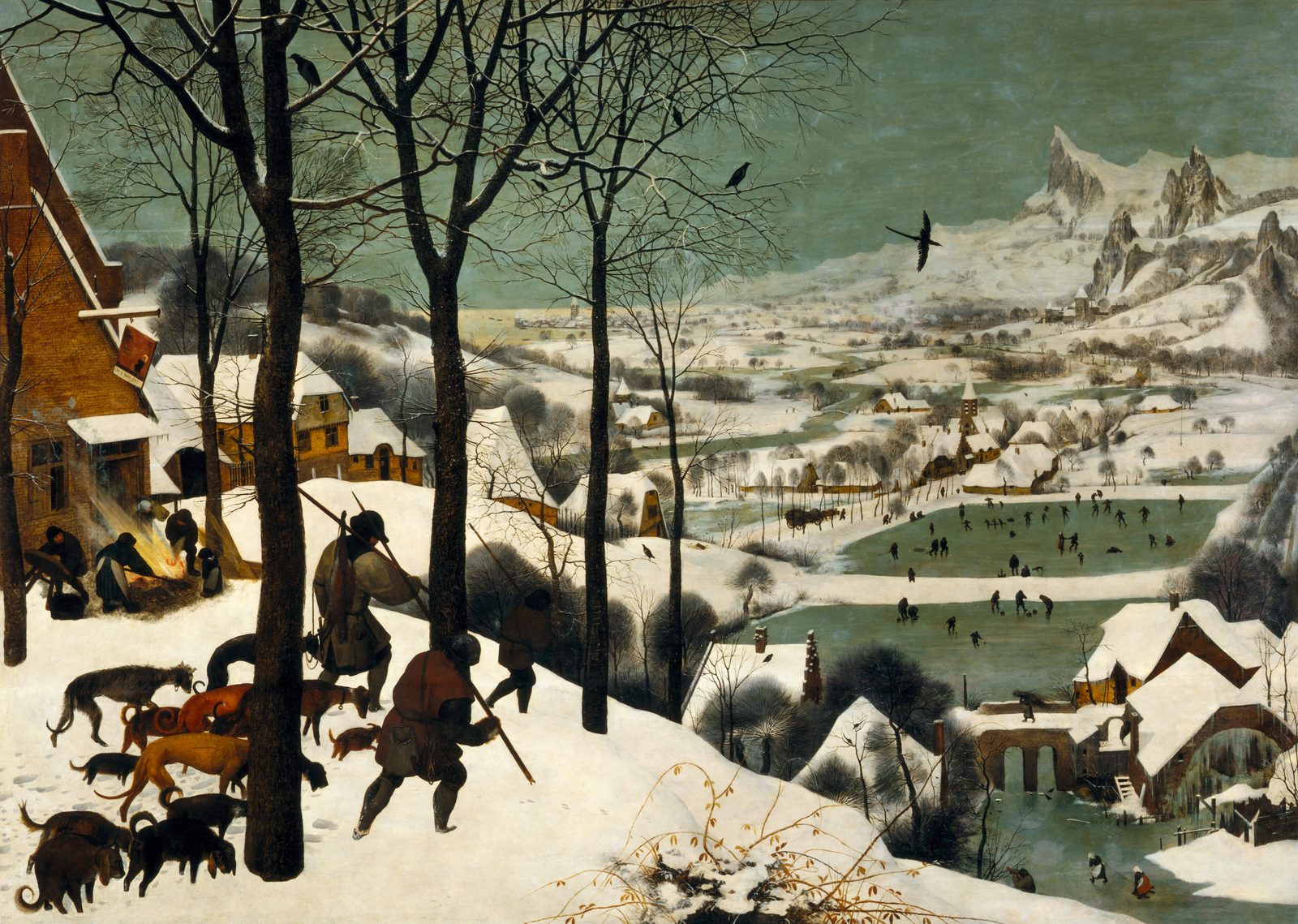
The Hunters in the Snow. Pieter Brueghel the Elder, 1565. Wikimedia Commons. Public domain.