
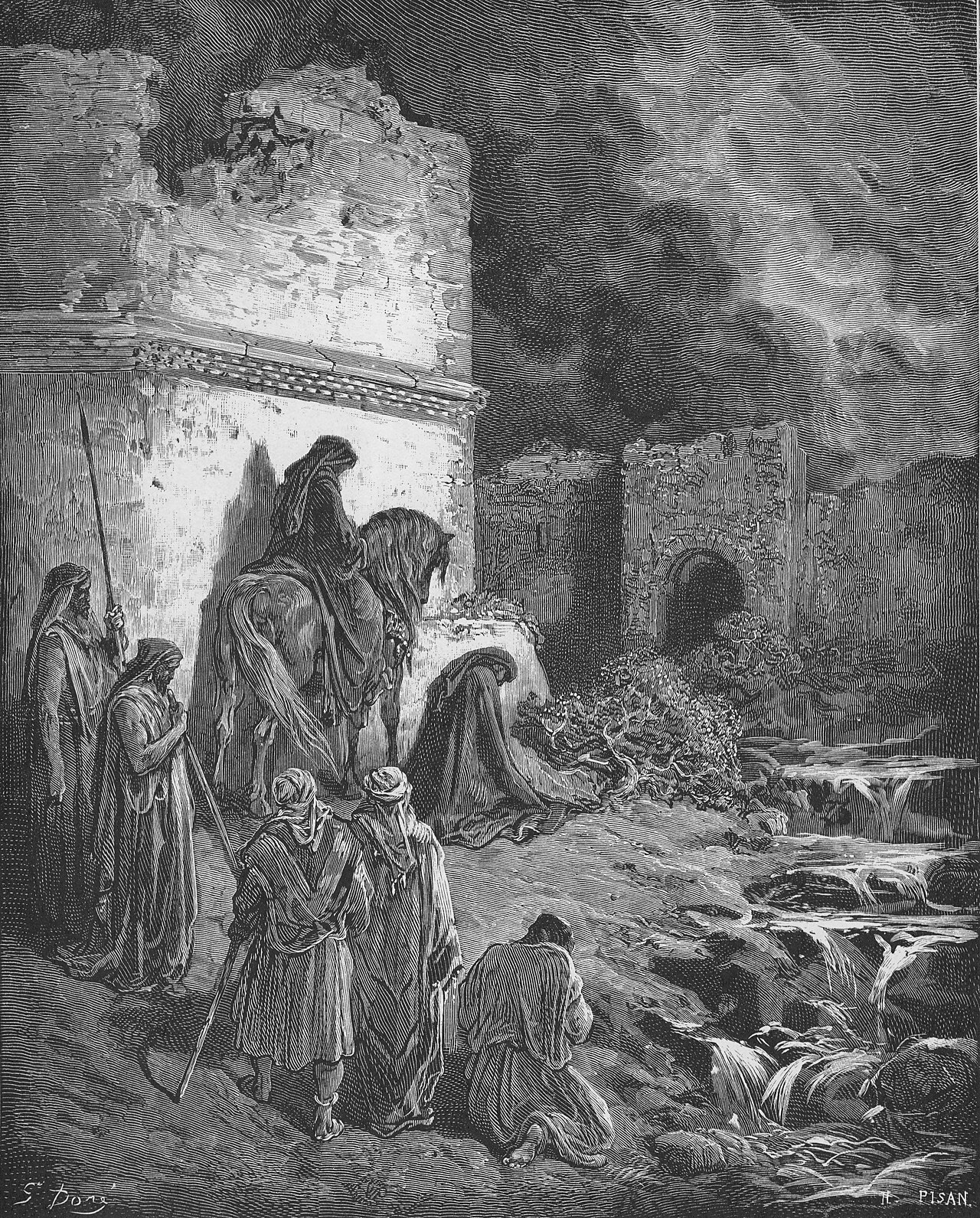
Nehemiahchapter 11
36 verses · Nehemiah · 5th century BC · History
Now the leaders of the people settled in Jerusalem, and the rest of the people cast lots to bring one out of ten to live in the holy city of Jerusalem, while the remaining nine were to dwell in their own towns.
Introduction
Nehemiah, History, Nehemiah Overview.
This chapter picks up the problem of the empty city that was left open in chapter 7. Its first hearers were families asked to leave their land and move into a walled capital with a thin economy and enemies nearby. Most of the chapter is a list of those who lived in Jerusalem and the towns where the rest settled. Listen for the name the chapter gives the city, and for the people who chose to move there of their own will. The list names priests, Levites, gatekeepers and fighting men. It shows what a holy city needed in order to stand.
Context
- Who
- Families being asked to leave their land and move into the capital
- What
- The casting of lots to bring one family in ten into Jerusalem, the roll of those who lived there, and the towns of Judah and Benjamin.
- Where
- Jerusalem, and the towns and villages of Judah and Benjamin from Beersheba to the Valley of Hinnom.
- When
- About 445 to 444 BC, after the covenant was sealed.
- Why
- To record how Jerusalem was filled with people so that the city and its temple could be sustained.
Historical context
The mechanism is a lottery. The rulers already lived in Jerusalem; for everyone else they cast lots to bring one out of ten to live in the holy city, and the other nine stayed in their towns. Ancient states did move populations into a walled centre to make it viable, and this is a small, voluntary-by-lot version of it.
Show the rest of the historical context, 2 more paragraphs
The cost was real. A family in Jerusalem was away from its fields and its inherited land, in a city with a thin economy and enemies on the borders. That is why the chapter says the people blessed all the men that willingly offered themselves to dwell at Jerusalem.
The rest of the chapter is a settlement roster: who lived in the city by clan, how many mighty men of valour, the officers over the temple business, the Levites and gatekeepers, the singers whose maintenance came under the king's own order, and then a list of the villages of Judah and Benjamin where the rest lived, from Beersheba in the south to the valley of Hinnom.
Significance
Cities in the ancient world grew because trade or safety pulled people in. This one had to be stocked on purpose, by lot, by people willing to give up better ground.
Show the rest of the significance, 1 more paragraph
Twice in the chapter Jerusalem is called "the holy city." That is the whole argument for moving there. Not opportunity, the temple was in it, and a temple without a town around it was a building.
This chapter in Jewish lifeWhat this chapter is in Jewish life and reading.
What is done
This chapter has no place in the synagogue year. The site's own table in src/lib/hebraic/readings.ts printed parashot total 0 and haftarah uses total 0 for Nehemiah, and no festival reading.
Its first verses settle one in ten of the people in Jerusalem by lot, and Rashi gives the reason, that they should dwell there to guard the city (Rashi on Nehemiah 11:1:1). Under the second verse, the men who volunteered, the corpus carries Ketubot 110b:4. Under the twenty-first it carries the Jerusalem Talmud at Kiddushin 4:1:7 and Sanhedrin 6:7:3, with Bamidbar Rabbah 8:4, Midrash Shmuel 28:7 and Midrash Tehillim 1:8.
How it is read
Rashi is the one commentator on this chapter whose English the corpus carries, quoted here from The Judaica Press complete Tanach with Rashi, translated by A. J. Rosenberg, which Sefaria reports as CC-BY. The volunteers he reads as men whose spirit moved them to live in Jerusalem and guard it from enemies (Rashi on Nehemiah 11:2:1). He says the list is selective, that "the entire chapter enumerates only the great and esteemed ones among them." (Rashi on Nehemiah 11:4:1).
The Temple offices are glossed one by one. The brothers who did the work of the house performed the service of the Temple and its sacrifices (Rashi on Nehemiah 11:12:1). The outside work of the house was the repair of its buildings and the wood for the altar, brought in from outside (Rashi on Nehemiah 11:16:1). The gatekeepers were appointed over the gates of the Temple (Rashi on Nehemiah 11:19:1).
One man is singled out as the leader of the song. Mattaniah was the head who began the thanksgiving in prayer, first to start the songs of the Levites, and Rashi explains the extra letter in the Hebrew verb from the pair Joseph and Jehoseph (Rashi on Nehemiah 11:17:1). The king's command over the singers he reads as the king's trust in them (Rashi on Nehemiah 11:23:1), and Pethahiah at the king's hand as a man privy to the counsel of Darius (Rashi on Nehemiah 11:24:1).
The corpus carries eight further notes on this chapter without an English text. Seven are marked linked because Sefaria holds no English version of the ref, and one because the fetch of Rashi on Nehemiah 11:21:1 returned nothing, which the corpus records as its reason. They stand cited and unquoted at Metzudat David on Nehemiah 11:5:1, 11:6:1, 11:8:1, 11:10:1, 11:15:1 and 11:25:1, Malbim on Nehemiah 11:7:1 and a further note of Rashi on Nehemiah 11:21:1.
What the rabbis say
The corpus carries ten rabbinic locators on this chapter and the text of none, so each is cited and linked here rather than quoted. On the second verse it holds Ketubot 110b:4. On the twenty-first it holds Bamidbar Rabbah 8:4, Jerusalem Talmud Kiddushin 4:1:7, Jerusalem Talmud Sanhedrin 6:7:3, Midrash Shmuel 28:7 and Midrash Tehillim 1:8. On the thirty-fourth it holds Jerusalem Talmud Challah 4:5:1, Jerusalem Talmud Peah 8:7:3 and Jerusalem Talmud Yevamot 1:6:4.
On the thirty-fifth verse the corpus holds Jerusalem Talmud Megillah 1:1:8. What each of them teaches is a saying of the rabbis, and is reported as theirs wherever this site quotes one. The quotations wait on a fetch that carries the text.
Sources: Rashi, Rashi on Nehemiah 11:1:1 to 11:24:1, The Judaica Press complete Tanach with Rashi, translated by A. J. Rosenberg, reported CC-BY; Metzudat David, Metzudat David on Nehemiah 11:5:1, 11:6:1, 11:8:1, 11:10:1, 11:15:1 and 11:25:1, cited by ref because the corpus carries no English text; Malbim, Malbim on Nehemiah 11:7:1, cited by ref because the corpus carries no English text; Rashi, a further note of Rashi on Nehemiah 11:21:1, cited by ref because the corpus records that the text fetch returned nothing; The Sefaria corpus, scripts/data/sources/sefaria/nehemiah/11.json, the 10 Talmud and Midrash locators of this chapter; The site's own files, src/lib/hebraic/readings.ts, printing no portion, no Haftarah and no festival reading for this book.
The heads below are this chapter's scenes. The numbered points under each are its verses.
One in ten chosen by lot to live in the holy city
Nehemiah 11:1-2
to bring one out of ten: The wall now stood, but Jerusalem stood thin. Verse 2 honors the volunteers: "the people blessed all the men who volunteered to live in Jerusalem" (11:2). The Hebrew verb behind volunteered is the verb of the freewill offering, so settling in the exposed city is named as a gift.
Nehemiah 11:1
“To bring one of ten - Artificial enlargements of capitals by forcible transfers of population to them, were not unusual in ancient times. About 500 B.C., Syracuse became a great city in this way. Tradition ascribed the greatness of Rome, in part, to this cause.”
1 more voice on this verseWhat preachers and commentators have said about this verse, in their own words.
Nehemiah 11:1
“Jerusalem was no trading city, and therefore there was no money to be got there by merchandise, as there was in the country by corn and cattle. Note, All seek their own, not the things that are Jesus Christ's, Phil. ii. It is a general and just complaint that most people prefer their own wealth, credit, pleasure, ease, and safety, before the glory of God and the public good.”
Matthew Henry · Commentary on the Whole Bible (1707-1721)puritan
blessed all the men who volunteered: Wesley gives the reason the people blessed the men who volunteered: Jerusalem was the mark of every plot of its enemies. Henry adds that the lots of verse 1 fell as the LORD chose. The people blessed them for it.
Nehemiah 11:2
“God and man will bless those that are public blessings, which should encourage us to be zealous in doing good. They, finding that yet there was room, concluded upon a review of their whole body to bring one in ten to dwell in Jerusalem; who they should be was determined by lot, the disposal whereof, all knew, was of the Lord.”
Matthew Henry · Commentary on the Whole Bible (1707-1721)puritan
1 more voice on this verse
Nehemiah 11:2
“Blessed - Because they denied themselves, and their own safety and profit for the publick good; for this city was the butt of all the malicious plots of their enemies; and for the present it was rather chargeable than beneficial to its inhabitants.”
John Wesley · Explanatory Notes upon the Old Testament (1765)evangelical
the heads of the provinces: Verse 3 works as the roster's table of contents: "the heads of the provinces who settled in Jerusalem," then everyone else on his own property. They are sorted into the five classes this book has counted since Ezra 2, "the Israelites, priests, Levites, temple servants, and descendants of Solomon’s servants".
Nehemiah 11:3
“Now these are the chief of the province that dwelt in Jerusalem,.... That is, of Judea, reduced to a province by the king of Babylon, and now a province of the Persian monarchy: but in the cities of Judah dwelt everyone in his possession in their cities; in which they or their ancestors had formerly dwelt: to wit, Israel: the people in general of the tribes of Judah and Benjamin, and such of the other tribes that returned with them: the priests, and the Levites, and the Nethinims, and the children of Solomon's servants; of whom see Ezr 2:55.”
2 more voices on this verse
Nehemiah 11:3
“Israel--This general name, which designated the descendants of Jacob before the unhappy division of the two kingdoms under Rehoboam, was restored after the captivity, the Israelites being then united with the Jews, and all traces of their former separation being obliterated.”
Jamieson, Fausset & Brown · Commentary Critical and Explanatory on the Whole Bible (1871)reformed
Nehemiah 11:3
“Now these are the chief - A good deal of difference will be found between the enumeration here and that in 1Ch 9:2, etc. There, those only who came with Zerubbabel appear to be numbered; here, those, and the persons who came with Ezra and Nehemiah, enter into the account.”
Adam Clarke · Commentary on the Bible (1810-1826)evangelical
Nehemiah 11:4-9
some of the descendants of Judah and Benjamin settled in Jerusalem.): The men of Judah trace through Perez to "468 men of valor," and the men of Benjamin through Sallu to "928 men." Genealogy here does legal and military work, naming households that can prove their place and men fit to defend it.
Nehemiah 11:4
“And at Jerusalem dwelt certain of the children of Judah, and of the children of Benjamin,.... It belonging partly to one tribe and partly to the other, and so inhabited by both, as it originally was, Jos 15:63 of the children of Judah; Athaiah; called Uthai, 1Ch 9:4 whose lineage is traced through Uzziah, Zechariah, Amariah, Shephatiah, Mahalaleel: of the children of Perez; a son of Judah, see 1Ch 9:4.”
1 more voice on this verse
Nehemiah 11:4
“See the margin reference notes. Both accounts appear to be extracts from a public official register which Nehemiah caused to be made of his census. The census itself seems to have been confined to the dwellers at Jerusalem.”
and Maaseiah son of Baruch: Gill identifies this Maaseiah with the Asaiah of the Shilonites at 1 Chronicles 9:5 and traces his line to Shelah, another son of Judah. Verse 4 had traced Athaiah through Perez. Two branches of Judah's house settle in the city.
totaled 468 men of valor: The descendants of Perez in Jerusalem totaled 468 men of valor, while the line of Shelah in verse 5 carries no count. Gill reads men of valor as men able to defend the city against its enemies. The holy city gained defenders.
Nehemiah 11:6
“All the sons of Perez that dwelt at Jerusalem were four hundred threescore and eight valiant men. And so well qualified to defend the city against its enemies.”
Sallu son of Meshullam: also heads the descendants of Benjamin at 1 Chronicles 9:7, where his ancestors differ from the names given here. Clarke explains: Chronicles counts those who came with Zerubbabel, and this chapter adds those who came with Ezra and Nehemiah. The lists record two moments.
Nehemiah 11:7
“And these are the sons of Benjamin,.... That were of that tribe, and inhabited Jerusalem, namely, that follow: Sallu the son of Meshullam; who from him is traced up through Joed, Pedaiah, Kolaiah, Maaseiah, Ithiel, to Jesaiah.”
Sallu's followers Gabbai and Sallai bring the descendants of Benjamin to 928, nearly twice the 468 of Perez. Gill reads the larger share as a tribe more willing to live in the city, which stood in Benjamin's allotment at Joshua 18:28. The roll at 1 Chronicles 9:9 gives 956.
Joel son of Zichri was the officer: Gill takes Joel as the city's chief governor and Judah son of Hassenuah as his deputy over the Second District. Henry sets civil order beside the new wall: a people needs good magistrates as much as good soldiers. Chapter 3 had already named rulers of half-districts at 3:9 and 3:12.
Nehemiah 11:9
“And Joel the son of Zichri was their overseer,.... Or chief governor of the city: and Judah the son of Senuah was second over the city; or the deputy governor of it; so Pitholaus is called an under governor in Jerusalem by Josephus (l). (l) Antiqu. l. 14. c. 6. sect. 1.”
1 more voice on this verse
Nehemiah 11:9
“For it is as necessary for a people to have good order kept up among themselves as to be fortified against the attacks of their enemies from abroad, to have good magistrates as to have good soldiers.”
Matthew Henry · Commentary on the Whole Bible (1707-1721)puritan
Priests, Levites, and the porters keeping watch at the gates
Nehemiah 11:10-14
From the priests: The priestly roll names Seraiah as "the chief official of the house of God." It counts by function: 822 who did the work at the temple, 242 leaders of families, and "128 mighty men of valor". The temple's daily service and the city's defense drew from the same priestly families.
Nehemiah 11:10
“Who dwelt in Jerusalem, of whom the same account is given in these two verses as in 1Ch 9:10, only Seraiah here is called Azariah there.”
the chief official of the house of God: The priests open with Jedaiah and Jachin, and Seraiah son of Hilkiah is chief official of God's house. The roll at 1 Chronicles 9:11 gives the same line under the name Azariah, and Gill takes the two for one man. Jachin names the twenty-first course at 1 Chronicles 24:17.
Nehemiah 11:11
“Ruler of the house of God - He had the command over all secular matters, as the high priest had over those which were spiritual.”
Adam Clarke · Commentary on the Bible (1810-1826)evangelical
Gill names the temple work as the sacrifices, the incense, the showbread and the lamps. The 822 associates of Jedaiah, Jachin and Seraiah are the largest of the three groups of priests in Jerusalem. The roll at 1 Chronicles 9:13 counts 1,760.
Nehemiah 11:12
“And their brethren that did the work of the house were eight hundred twenty and two,.... That offered the sacrifices, burnt incense, set on the shewbread, lighted the lamps, &c. and Adaiah the son of Jeroham; see 1Ch 9:12 whose genealogy is traced here through Pelaliah, Amzi, Zechariah, Pashur, to Malchiah.”
Adaiah son of Jeroham, the son of Pelaliah: 1 Chronicles 9:12 gives the same Adaiah son of Jeroham with a shorter line, passing from Jeroham straight to Pashhur and Malchijah. Gill takes the 242 as Adaiah's own kinsmen, the heads of their fathers' houses. This verse adds three generations, Pelaliah, Amzi and Zechariah.
Nehemiah 11:13
“And his brethren, chief of the fathers, two hundred forty and two,.... That is, the brethren or relations of Adaiah: and Amashai; called Maasiai, 1Ch 9:12, whose lineage is traced here through Azareel, Ahasai, Meshillemoth, to Immer.”
Gill reads Haggedolim two ways, as a proper name or as the great men, so that Zabdiel was a leading man's son. Amashai son of Azarel traces his line to Immer, the house of priests counted at 1,052 in Ezra 2:37. These priests were mighty men of valor.
Nehemiah 11:14
“And their brethren, mighty men of valour, an hundred twenty and eight,.... The brethren of Adaiah and Amashai, who were able men to do the work of their office as priests, and men of courage to fight the enemy, and defend the city upon occasion: and their overseer was Zabdiel, the son of one of the great men; or the son of Hagedolim, or Gedolim, as some, who take it to be the proper name of a man.”
Nehemiah 11:15-19
Shemaiah son of Hasshub: The Levites total 284, and the gatekeepers count 172, doorkeeping entered as a numbered office. Verse 17 keeps a liturgical detail the register did not need: Mattaniah, of the line of Asaph, "led in thanksgiving and prayer." For one verse a name list records who led Israel's praise.
Nehemiah 11:15
“Also of the Levites,.... Who dwelt in Jerusalem: Shemaiah the son of Hashub: traced from him through Azrikam and Hashabiah to Bunni; these were of the sons of Merari, the third son of Levi, see 1Ch 9:14.”
supervised the work outside the house: Shabbethai and Jozabad, leaders of the Levites, both instructed the people in the Law at 8:7. Gill, following Jarchi, takes the work outside the house of God as the temple repairs and the third of a shekel pledged at 10:32. Clarke notes that the Septuagint lacks this verse.
Nehemiah 11:16
“And Shabbethai and Jozabad, of the chief of the Levites,.... Along with Shemaiah; these had the oversight of the outward business of the house of God: who had the care of the repairs of the temple, and of getting in the wood for the altar, as Jarchi, and collecting the third part of the shekel, to purchase things with for the use of the temple.”
1 more voice on this verse
Nehemiah 11:16
“And Shabbethai - This verse, with Neh 11:20, Neh 11:21, Neh 11:28, Neh 11:29, Neh 11:32, Neh 11:33, Neh 11:34, and Neh 11:35, are all wanting in the Septuagint and the whole chapter is wanting in the Arabic, the translator not being concerned in Jewish genealogies. The outward business - Calmet supposes that he provided the victuals for the priests, victims for the sacrifices, the sacerdotal vestments, the sacred vessels, and other necessaries for the service of the temple.”
Adam Clarke · Commentary on the Bible (1810-1826)evangelical
who led in thanksgiving and prayer: Mattaniah son of Mica descends from Asaph and Abda from Jeduthun, two of the three houses of singers David set apart at 1 Chronicles 25:1. Wesley places Mattaniah's lead in thanksgiving and prayer at the morning and evening sacrifice. Heman's house goes unnamed here.
Nehemiah 11:17
“Observe, Thanksgiving is necessary in prayer; they should go together; giving thanks for former mercies is a becoming way of begging further mercies. And care should be taken in public service that every thing be done in the best manner, decently and in good order-- in prayer, that one speak and the rest join--in singing, that one begin and the rest follow.”
Matthew Henry · Commentary on the Whole Bible (1707-1721)puritan
1 more voice on this verse
Nehemiah 11:17
“To begin - In the publick and solemn prayers and praises, which were constantly joined with the morning and evening sacrifice, at which the singers were present, and praised God with a psalm or hymn which, this man began.”
John Wesley · Explanatory Notes upon the Old Testament (1765)evangelical
The Levites in the holy city totaled 284: The Levites of the holy city totaled 284, against 1,192 priests in verses 12 to 14. The first return had brought only 74 Levites at 7:43, and Ezra found no Levites in his company at Ezra 8:15. Clarke calls the Levites few.
Nehemiah 11:18
“All the Levites in the holy city were two hundred fourscore and four. Who had their residence there, Neh 11:1.”
Akkub, Talmon, and their associates: Akkub and Talmon are gatekeeper houses of the first return at 7:45, and they keep the gates again at 12:25. The earlier roll at 1 Chronicles 9:22 counts 212 gatekeepers, appointed to their trust by David and Samuel the seer. This verse counts 172.
Nehemiah 11:19
“Moreover, the porters, Akkub, Talmon, and their brethren that kept the gates, were one hundred and seventy two. Of whom see 1Ch 9:17.”
The villages of Judah and Benjamin, from Beersheba to Hinnom
Nehemiah 11:20-24
The rest of the Israelites: s, with the priests and Levites," kept their inheritance in the villages of Judah. The singers had "an ordinance regulating their daily activities" by "a command from the king," the Persian court supporting Israel's worship. Pethahiah was "the king’s agent in every matter concerning the people."
Nehemiah 11:20
“The returned community, though consisting mainly of members of the two tribes, represented the entire people of Israel. The ground, however, which they occupied, was not the whole land, but that which had constituted the kingdom of Judah.”
1 more voice on this verse
Nehemiah 11:20
“It was requisite that Jerusalem should be replenished, yet not so as to drain the country. The king himself is served of the field, which will do little service if there be not hands to manage it.”
Matthew Henry · Commentary on the Whole Bible (1707-1721)puritan
lived on the hill of Ophel: Ziha is the first house named among the temple servants at 7:46, and Gill counts Ziha and Gishpa as the principal men of that order. The temple servants on Ophel had repaired the wall opposite the Water Gate at 3:26. Barnes calls Ophel the southern spur of the temple hill.
Nehemiah 11:21
“Ophel, the southern spur of the temple hill, having a wall of its own Neh 3:27 might be reckoned either in Jerusalem or outside it. Here it is made a separate place.”
2 more voices on this verse
Nehemiah 11:21
“But the Nethinims dwelt in Ophel,.... An high place or tower on the wall of Jerusalem, see 2Ch 27:3, and Ziha, and Gispa, were over the Nethinims; had the oversight of them, and took care that they did their work; they were such themselves, but the principal of them, see Ezr 2:43.”
Nehemiah 11:21
“The Nethinims dwelt in Ophel - Which was upon the wall of Jerusalem, because they were to do the servile work of the temple: therefore they were to be posted near it, that they might be ready to attend.”
John Wesley · Explanatory Notes upon the Old Testament (1765)evangelical
the overseer of the Levites in Jerusalem: Clarke gives the Hebrew title as pekid, an inspector, and notes that the Septuagint and the Vulgate render it episkopos, the word later translated bishop. Uzzi descends from Mattaniah son of Mica, the Asaphite who led the thanksgiving at verse 17. A singer oversaw the Levites.
Nehemiah 11:22
“The overseer also of the Levites - פקיד pekid, the visitant, the inspector; translated επισκοπος, bishop, both by the Septuagint and Vulgate.”
Adam Clarke · Commentary on the Bible (1810-1826)evangelical
a command from the king concerning the singers: Gill records two readings of the king, David or the king of Persia, and prefers the king of Persia. Barnes traces the favor to Ezra 7:24, where Artaxerxes freed the singers and temple servants from tax, and reads this ordinance as a daily allowance. Gill calls it a daily salary.
Nehemiah 11:23
“For it was the king's commandment concerning them,.... Either of King David as some, see Neh 12:24 or rather of the king of Persia: that a certain portion should be for the singers, due for every day; he settled a daily salary for them, to be paid out of his treasury; having perhaps a peculiar respect for such sort of men, being a lover of music, by means of which they had a settled habitation in Jerusalem.”
1 more voice on this verse
Nehemiah 11:23
“The goodwill of Artaxerxes toward the ministers employed in the temple service, had been previously shown by his exempting them from taxation of every kind Ezr 7:24. Now, it would seem, he had gone further and assigned to the singers an allowance from the royal revenue.”
was the king’s agent in every matter: Pethahiah descends from Zerah, the twin brother of Perez in Gill's note, so the men of Judah come from three branches: Perez, Shelah and Zerah. Henry makes his office the channel for the king's dues and the temple's royal allowance. One Jew stood between court and people.
Nehemiah 11:24
“And Pethahiah the son of Meshezabeel, of the children of Zerah, the son of Judah,.... The twin brother of Pharez, Gen 38:30 was at the king's hand in all matters concerning the people; to speak for them to the king, as Jarchi; when they had a favour to ask of him, a petition to present to him, he delivered it for them, and by him the king returned the answer.”
1 more voice on this verse
Nehemiah 11:24
“He is said to be at the king's hand, or on the king's part, in all matters concerning the people, to determine controversies that arose between the king's officers and his subjects, to see that what was due to the king from the people was duly paid in and what was allowed by the king for the temple service was duly paid out, and happy it was for the Jews that one of themselves was in this post.”
Matthew Henry · Commentary on the Whole Bible (1707-1721)puritan
Nehemiah 11:25-36
the villages with their fields: The chapter widens from Jerusalem to "the villages with their fields" (11:25). Judah's towns run from Kiriath-arba, the old name of Hebron, "from Beersheba all the way to the Valley of Hinnom". Benjamin's run from Geba through Michmash and Anathoth to "Lod, and Ono" and "the Valley of the Craftsmen".
in Jeshua, Moladah, and Beth-pelet: Jeshua, Moladah and Beth-pelet are towns where some of the people of Judah lived. Moladah and Beth-pelet stand in Joshua's list of the southernmost cities of Judah toward Edom, at Joshua 15:21 and 15:26-27. The next verse reaches Beersheba.
Nehemiah 11:26
“And at Jeshua - This city is nowhere else mentioned.”
Adam Clarke · Commentary on the Bible (1810-1826)evangelical
1 more voice on this verse
Nehemiah 11:26
“Many of the places mentioned in these verses are mentioned in Jos 15:27-39; Jos 18:21-28.”
in Hazar-shual; in Beersheba: Some of the people of Judah lived in Hazar-shual and in Beersheba and its villages. Hazar-shual stands beside Beersheba in Joshua's list at Joshua 15:28, and verse 30 makes Beersheba the southern bound of the settlement. Judah settled from Beersheba to the Valley of Hinnom.
in Ziklag; in Meconah: Ziklag is the town David and his men came home to at 1 Samuel 30:1, only to find it burned by the Amalekites. Joshua 15:31 lists it among Judah's southern cities. The settlers returned to David's old refuge.
in En-rimmon, Zorah, Jarmuth: En-rimmon, Zorah and Jarmuth are towns where some of the people of Judah lived. Zorah and Jarmuth stand in the foothills at Joshua 15:33-35, and the king of Jarmuth was one of the five Amorite kings at Joshua 10:5. Lachish and Azekah follow in verse 30.
So they settled from Beersheba: Zanoah's men had rebuilt the Valley Gate at 3:13. Joshua pursued the five kings as far as Azekah at Joshua 10:10 and captured Lachish at 10:32. The closing clause frames Judah, Beersheba in the south and the Valley of Hinnom by Jerusalem in the north.
The descendants of Benjamin from Geba: Gill takes Aija as Ai, which lay east of Bethel, and the men of Bethel and Ai were counted together in 7:32. Geba and Michmash faced each other in Saul's war, with Saul at Geba and the Philistines camped at Michmash in 1 Samuel 13:16. Old battlefields became villages again.
in Anathoth, Nob, Ananiah: Gill names Anathoth as the priests' town of Jeremiah 1:1, and Nob as the city that Saul put to the sword at 1 Samuel 22:19. Two priestly towns of the old kingdom are lived in again.
Nehemiah 11:32
“Ananiah - No city of this name is known.”
Adam Clarke · Commentary on the Bible (1810-1826)evangelical
Hazor, Ramah, Gittaim: Gill counts these among the towns of Benjamin inhabited by men of that tribe. Ramah was counted with Geba at the first return, 621 men at 7:30, and Joshua 18:25 lists it among the cities of Benjamin. Ramah kept its old place in the tribe.
Nehemiah 11:33
“Hadid - This place is also unknown. Neballat - Also unknown.”
Adam Clarke · Commentary on the Bible (1810-1826)evangelical
Hadid, Zeboim, Neballat: Hadid is counted with Lod and Ono, 721 men together, at the first return in 7:37. The next verse names Lod and Ono, so the three towns stand close together in both registers. The settlement kept the old groupings.
Lod, and Ono; and in the Valley: Clarke traces Lod and Ono to their builders, the sons of Elpaal of Benjamin at 1 Chronicles 8:12-13. Ono is the plain where Sanballat and Geshem asked Nehemiah to meet them at 6:2, planning to harm him. Clarke places a town in the Valley of the Craftsmen.
Nehemiah 11:35
“Lod, and Ono - These towns were built by the sons of Elpaal, 1Ch 8:12. The valley of craftsmen - See 1Ch 4:14. Probably this latter town was built in this valley.”
Adam Clarke · Commentary on the Bible (1810-1826)evangelical
some divisions of the Levites of Judah: Some Levites of Judah settled in Benjamin, and Gill reads the division as deliberate, with Levites placed in both tribes to instruct the people. Wesley adds that Malachi prophesied about this time and charged the people with lukewarmness. Wesley says prophecy then ceased for some ages.
Nehemiah 11:36
“And of the Levites were divisions in Judah, and in Benjamin. They were scattered about, some here and some there, in both these tribes, for the better instruction of the people.”
2 more voices on this verse
Nehemiah 11:36
“And of the Levites were divisions - The Levites had their dwellings in the divisions of Judah and Benjamin. This is probably the meaning: the Syriac says, They had the half of Judah and Benjamin; which is not likely. That the people whose hearts were now turned towards the Lord, would make the best provision for the support of God’s work, and all those engaged in it, we may naturally suppose; but this could not be very great, as the complete service was not yet established, and the Levites themselves were few in number.”
Adam Clarke · Commentary on the Bible (1810-1826)evangelical
Nehemiah 11:36
“Thus were they settled free and easy, tho' few and poor. And they might have been happy, but for that general lukewarmness, with which they are charged by the prophet Malachi, who prophesied about this time and in whom prophecy ceased for some ages, 'till it revived in the great prophet.”
John Wesley · Explanatory Notes upon the Old Testament (1765)evangelical
Keep studying
Sources for this chapter
The summary
Jamieson, Fausset & Brown, Commentary Critical and Explanatory; John Wesley, Notes on the Old Testament and Matthew Henry, Complete Commentary.
The exposition
Adam Clarke, Commentary on the Bible; Albert Barnes, Notes, Explanatory and Practical, on the Old and New Testaments (1832-1869); Berean Standard Bible; Jamieson Fausset and Brown, Commentary Critical and Explanatory on the Whole Bible; John Gill; John Wesley, Explanatory Notes upon the Old Testament and Matthew Henry, Commentary on the Whole Bible.