
Lamentationschapter 5
22 verses · Jeremiah, by tradition · about 586 BC · The Prophets
Remember, O LORD, what has happened to us. Look and see our disgrace!
Introduction
Jeremiah, by tradition, The Prophets, Lamentations Overview.
Tradition gives this poem to Jeremiah, and some early translations head it as his prayer. Here the whole people speaks together from the first line to the last. It was written for survivors living in an occupied land, paying foreign masters for what had once been their own. It keeps the twenty-two verses of the alphabet poems before it and lets the letters go. Listen for what the people ask God to do first, before they ask for anything to change. Listen too for the last line, which leaves the book's question open.
Context
- Who
- The survivors themselves, praying together out loud
- What
- A prayer of the whole people that lays their shame before the LORD and asks Him to restore them.
- Where
- Judah under foreign rule after the armies had gone, with Mount Zion lying desolate.
- When
- The years of occupation after 586 BC; the poem gives no date of its own.
- Why
- To bring the survivors' daily humiliation before God and to ask Him to remember them and renew their days.
Historical context
This last poem breaks the pattern. It still has twenty-two verses, one for each letter of the alphabet, but it does not begin them with those letters in order. The alphabet has come apart, and the chapter is a straight prayer rather than a lament.
Show the rest of the historical context, 3 more paragraphs
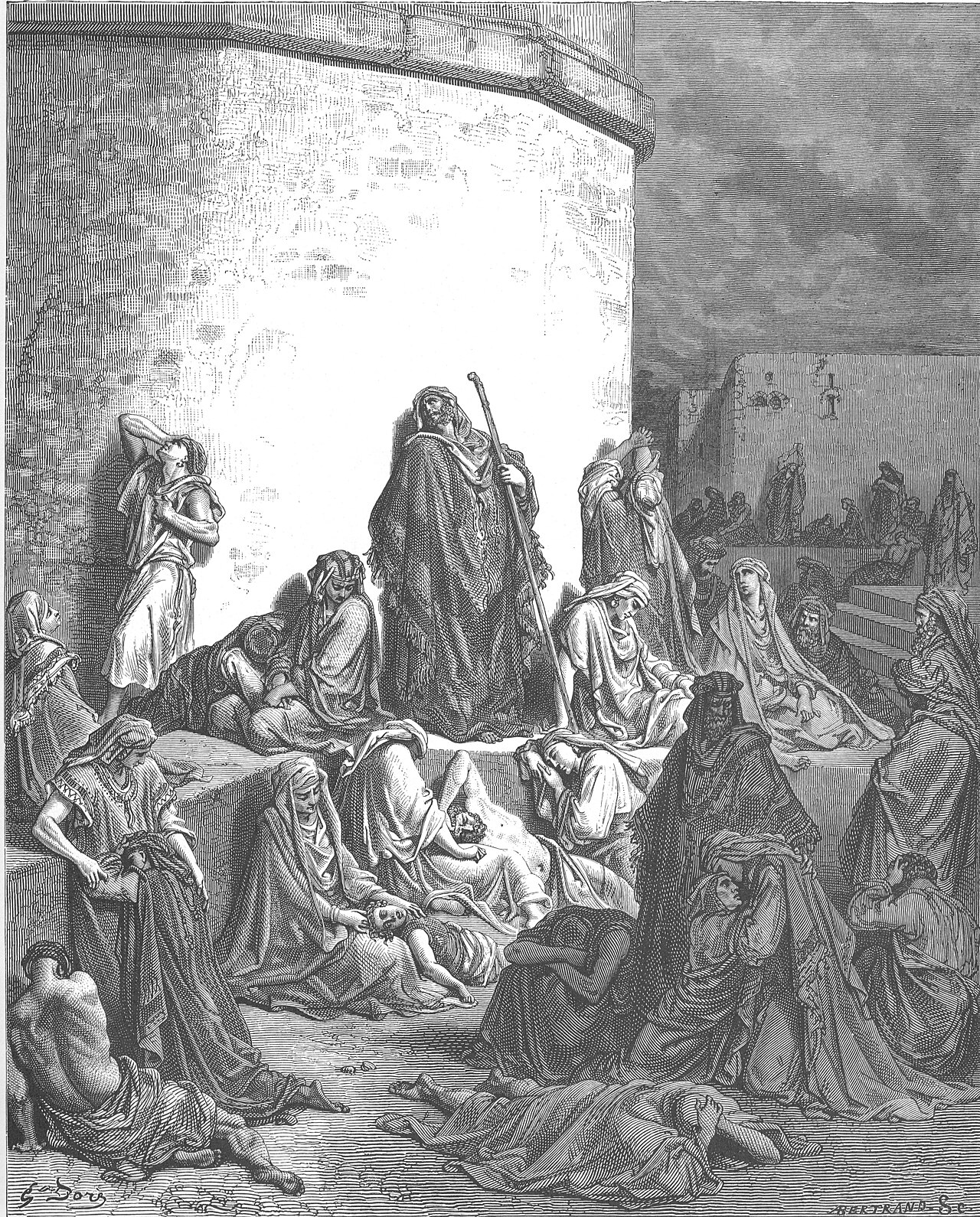
The economics of occupation are described exactly. We must pay for the water we drink, and our wood comes only at a price, that is, the springs and the woodlands are now controlled and taxed by someone else. We stretch out our hand to Egypt and to Assyria to get enough bread. Our inheritance has been turned over to strangers, our homes to foreigners. Servants rule over us, and there is no one to deliver.
The humiliations are listed by group. Women assaulted in the towns of Judah; princes hung up by their hands; elders shown no respect at the gate where they used to judge; young men made to carry the grinding stones and boys staggering under loads of wood, grinding grain was daily work done by women and slaves, so putting the young men on the millstones was designed to shame.
And the temple mount: Mount Zion lies desolate, and jackals prowl over it. Jackals moving into an abandoned site is what a ruined place in that country actually looks like within a year or two.
Significance
The prayer's shape is what the first hearers needed. Remember, O LORD, what has befallen us; look, and see our disgrace. It asks God to pay attention before it asks him to fix anything.
Show the rest of the significance, 1 more paragraph
It ends unresolved, and that honesty is the point: restore us to yourself, O LORD, that we may be restored; renew our days as of old, unless you have utterly rejected us and remain exceedingly angry with us. In later Jewish practice, when this book is read aloud the hopeful verse is repeated after that last line, so the reading does not end on the word anger. But the text itself leaves the question open, and a people sitting in the rubble was allowed to end there.
This chapter in Jewish lifeWhat this chapter is in Jewish life and reading.
What is done
This chapter closes the one public reading the book receives in the year. The site's own table in src/lib/hebraic/readings.ts records that Lamentations is read on the eve of the fast of Tisha B'Av. It is read at night in a darkened room, and the congregation sits on the floor or on low stools as mourners do. It sources the practice to Shulchan Aruch, Orach Chayim 559. The table records one custom that belongs to this chapter alone. The last verse is read again after the closing one, so that the book does not end on its hardest line. Probed for this lane, the same table printed parashot total 0 and haftarah uses total 0 for this book.
Rashi's own text gives the reason for the repeated verse. "Because he concludes with words of reproof, he had to repeat the preceding verse again," he says (Rashi on Lamentations 5:22:2). He names three other books that end the same way: "and so did Yeshayahu, Trei Osor, and Koheles."
How it is read
Rashi is the one commentator on this chapter whose English the corpus carries, quoted here from The Metsudah Five Megillot, Lakewood, N.J., 2001, which Sefaria reports as CC-BY. The translation is modern, so every quotation is held to fifty words or fewer. The edition sets numbered notes of its own inside Rashi's text, and only Rashi's own words are quoted as his.
Rashi reads the chapter as the life of the people under the enemy. The water of the fourth verse was bought because the river was guarded. "Since we were afraid to draw water from the river because of the enemies, we bought [water] from them with money" (Rashi on Lamentations 5:4:1). The pursuit of the fifth verse was "Because of the yoke of hard labor" (Rashi on Lamentations 5:5:1). At the sixth verse the hand stretched to Egypt is the hand of one who falls. "It is customary for a person who is falling and wishes to stand up to stretch out a hand to someone nearby to help him" (Rashi on Lamentations 5:6:1). The hand stretched to Ashur was stretched "That they sate us with their bread" (Rashi on Lamentations 5:6:2).
The bread of the ninth verse was gathered in danger. "We were in danger when we would bring our food from the field because of the sword of the wilderness" (Rashi on Lamentations 5:9:1). The young men of the thirteenth verse carried millstones on the road into exile. The enemies "would place on their shoulders millstones and burdens in order to tire them" (Rashi on Lamentations 5:13:1). The ache of the seventeenth verse, Rashi says, is explained by the verse that follows, on Mount Zion laid waste (Rashi on Lamentations 5:17:1).
The close of the chapter he reads as an argument with God. At the nineteenth verse, "We know that You will remain forever" (Rashi on Lamentations 5:19:1). At the twentieth, "Have You not sworn to us Yourself that just as You exist, so does Your oath exist?" (Rashi on Lamentations 5:20:1). The last verse he reads as a confession joined to a protest. "Although we have sinned, [nonetheless] You should not have been angered as much as You have been" (Rashi on Lamentations 5:22:1).
The corpus carries eleven further notes on this chapter without an English text, each marked linked because Sefaria holds no English version of the ref. They stand cited and unquoted at Ibn Ezra on Lamentations 5:1:1, 5:3:1, 5:4:1, 5:7:1, 5:8:1, 5:11:1, 5:12:1, 5:14:1, 5:15:1, 5:16:1 and 5:18:1.
What the rabbis say
The corpus carries forty rabbinic locators on this chapter and the text of none, so each is cited and linked here rather than quoted. Eikhah Rabbah stands on nearly every verse. It is set on the first verse at 3:1 and 5:1, and on the second through the sixteenth at 5:2, 5:3, 5:4, 5:5, 5:6, 5:7, 5:8, 5:9, 5:10, 5:11, 5:12, 5:13, 5:14, 5:15 and 5:16. It stands on the seventeenth at 1:57, on the nineteenth through the twenty-first at 5:19, 5:20 and 5:21, and on the twenty-second at 1:23.
Midrash Lekach Tov on Lamentations stands beside it at 5:2:1, 5:5:1, 5:8:1, 5:9:1, 5:10:1, 5:12:1 and 5:13:1. Aggadat Bereshit stands at 84:3 on the third verse and 68:2 on the sixth. Mekhilta DeRabbi Shimon Ben Yochai 20:5 stands on the seventh. Bereshit Rabbah stands at 69:7 on the seventeenth verse and 56:10 on the eighteenth.
The Talmud and Ein Yaakov stand at five places. Ein Yaakov, Yevamot 13:1, is set on the fourth verse. Ein Yaakov (Glick Edition) stands at Kiddushin 4:12 on the eleventh and Sotah 9:15 on the fourteenth. Jerusalem Talmud Sotah stands at 9:12:4 on the fifteenth and 9:15:2 on the sixteenth. One further locator, Midrash Lekach Tov, Genesis 28:17:1, stands in the file under a verse number of 36, which this chapter does not reach, and it is cited as the file prints it. What each of them teaches is a saying of the rabbis, and is reported as theirs wherever this site quotes one. The quotations wait on a fetch that carries the text.
Sources: Rashi, Rashi on Lamentations 5:4:1 to 5:22:2, The Metsudah Five Megillot, Lakewood, N.J., 2001, reported CC-BY; Ibn Ezra, Ibn Ezra on Lamentations 5:1:1, 5:3:1, 5:4:1, 5:7:1, 5:8:1, 5:11:1, 5:12:1, 5:14:1, 5:15:1, 5:16:1 and 5:18:1, cited by ref because the corpus carries no English text; The Sefaria corpus, scripts/data/sources/sefaria/lamentations/5.json, the 40 Talmud and Midrash locators of this chapter; The site's own files, src/lib/hebraic/readings.ts, probed for this book and printing parashot total 0, haftarah uses total 0, and the festival reading on the eve of the fast of Tisha B'Av, sourced there to Shulchan Aruch, Orach Chayim 559.
The heads below are this chapter's scenes. The numbered points under each are its verses.
Remember, O LORD, What Is Come Upon Us
Lamentations 5:1-2
Remember, O LORD, what has happened to us: Lamentations 5 is a communal prayer of twenty-two verses, the length of the alphabet kept without the letter-by-letter form. It opens as address to the LORD: “Remember, O LORD, what has happened to us”. It turns to loss: “Our inheritance has been turned over to strangers, our houses to foreigners”.
Lamentations 5:1
“Remember, O Lord - In the Vulgate, Syriac, and Arabic, this is headed, “The prayer of Jeremiah.” In my old MS. Bible: Here bigynneth the orison of Jeremye the prophete. Though this chapter consists of exactly twenty-two verses, the number of letters in the Hebrew alphabet, yet the acrostic form is no longer observed. Perhaps any thing so technical was not thought proper when in agony and distress (under a sense of God’s displeasure on account of sin) they prostrated themselves before him to ask for mercy.”
Adam Clarke · Commentary on the Bible (1810-1826)evangelical
turned over to strangers: John Gill takes the inheritance as the land promised to Abraham. Foreigners now held its fields and houses. Adam Clarke adds that those left under Gedaliah were slaves too (Jeremiah 40:9-10).
Lamentations 5:2
“Our inheritance is turned to strangers,.... The land of Canaan in general, which was given to Abraham and his seed to be their inheritance; and their field, and vineyards in particular, which came to them by inheritance from their fathers, were now in the hands of the Chaldeans, strangers to God, and aliens from the commonwealth of Israel, as all Gentiles were, Eph 2:12; our houses to aliens; which they had built or purchased, or their fathers had left them, were now inhabited by those of another country.”
1 more voice on this verse
Lamentations 5:2
“Our inheritance is turned to strangers - The greater part of the Jews were either slain or carried away captive; and even those who were left under Gedaliah were not free, for they were vassals to the Chaldeans.”
Adam Clarke · Commentary on the Bible (1810-1826)evangelical
Lamentations 5:3-4
We have become fatherless orphans: Verse 3 states the plainest fact of famine and slaughter: “We have become fatherless orphans; our mothers are widows”. Verse 4 measures the loss in trade: “We must buy the water we drink; our wood comes at a price”, the barest needs now sold.
Lamentations 5:3
“Our mothers are as widows - The particle “as” suggests that the whole verse is metaphorical. Our distress and desolation is comparable only to that of fatherless orphans or wives just bereaved of their husbands.”
1 more voice on this verse
Lamentations 5:3
“We - We are all of us without a king, (our common father) we are deprived of thy fatherly protection, and many young children among us are left without an earthly parent.”
John Wesley · Explanatory Notes upon the Old Testament (1765)evangelical
buy the water: Albert Barnes sees the bitterness here: the water and the wood were the people's own, and now they come at a price. Adam Clarke reads a Chaldean tax. Isaiah 55:1 invites anyone who would drink to come and buy water with no money.
Lamentations 5:4
“We have drunken our water for money - I suppose the meaning of this is, that every thing was taxed by the Chaldeans, and that they kept the management in their own hands, so that wood and water were both sold, the people not being permitted to help themselves. They were now so lowly reduced by servitude, that they were obliged to pay dearly for those things which formerly were common and of no price.”
Adam Clarke · Commentary on the Bible (1810-1826)evangelical
1 more voice on this verse
Lamentations 5:4
“Thus, "our" means the water which we need, the commonest necessary of life. our wood--In Judea each one could get wood without pay; in Babylon, "our wood," the wood we need, must be paid for.”
Jamieson, Fausset & Brown · Commentary Critical and Explanatory on the Whole Bible (1871)reformed
Lamentations 5:5-6
We are closely pursued: In the Hebrew of verse 5 the pursuers are on the people's necks: “We are closely pursued; we are weary and find no rest”. Verse 6 names the diplomacy that failed, “We submitted to Egypt and Assyria to get enough bread”, as Jeremiah 2:18 names the same two powers.
Lamentations 5:5
“Our necks are under persecution,.... A yoke of hard servitude and bondage was put upon their necks, as Jarchi interprets it; which they were forced to submit unto: or, "upon our necks we are pursued" (s); or, "suffer persecution": which Aben Ezra explains thus, in connection with the Lam 5:4; if we carry water or wood upon our necks, the enemy pursues us; that is, to take it away from us.”
submitted to Egypt and Assyria: Albert Barnes reads the verse as hunger outweighing every other loyalty: Judah submitted to Egypt or to Assyria for enough bread. Jamieson, Fausset and Brown take Assyria as the Babylonian power that held its old empire. Jeremiah 2:36 had warned that both would fail.
Lamentations 5:6
“We have given our hand to the Egyptians,.... Either by way of supplication, to beg bread of them; or by way of covenant and agreement; or to testify subjection to them, in order to be supplied with food: many of the Jews went into Egypt upon the taking of the city, Jer 43:5; and to the Assyrians, to be satisfied with bread; among whom many of the captives were dispersed; since from hence they are said to be returned, as well as from Egypt, Isa 11:16.”
1 more voice on this verse
Lamentations 5:6
“We - The ten tribes were all carried captives into Assyria, and many of the kingdom of Judah fled into Egypt. Giving the hand may signify labouring for them: or, yielding up themselves to their power.”
John Wesley · Explanatory Notes upon the Old Testament (1765)evangelical
Lamentations 5:7-8
Our fathers sinned and are no more: Verse 7 states a burden: “Our fathers sinned and are no more, but we bear their punishment”. Jeremiah 31:29-30 answers the same complaint with each person's own account for sin. Verse 8 completes the humiliation: “Slaves rule over us; there is no one to deliver us from their hands”.
Lamentations 5:7
“And are not; and we ... - Or, they are not; “we have borne their iniquities.” Our fathers who began this national apostasy died before the hour of punishment.”
Slaves rule over us: Matthew Henry hears the curse of Canaan from Genesis 9:25 turned on Judah, now under the rule of slaves. Adam Clarke takes the slaves as Chaldean soldiers. The LORD who once set Israel free from Egypt has now given Judah over to slaves.
Lamentations 5:8
“Servants have ruled over us - To be subject to such is the most painful and dishonorable bondage: - Quio domini faciant, audent cum talia fures? Virg. Ecl. 3:16. “Since slaves so insolent are grown, What may not masters do?” Perhaps he here alludes to the Chaldean soldiers, whose will the wretched Jews were obliged to obey.”
Adam Clarke · Commentary on the Bible (1810-1826)evangelical
2 more voices on this verse
Lamentations 5:8
“The curse of Canaan had now become the doom of Judah: A servant of servants shall he be. They would not be ruled by their God, and by his servants the prophets, whose rule was gentle and gracious, and therefore justly are they ruled with rigour by their enemies and their servants.”
Matthew Henry · Commentary on the Whole Bible (1707-1721)puritan
Lamentations 5:8
“Israel, once a "kingdom of priests" (Ex 19:6), is become like Canaan, "a servant of servants," according to the curse (Ge 9:25). The Chaldeans were designed to be "servants" of Shem, being descended from Ham (Ge 9:26). Now through the Jews' sin, their positions are reversed.”
Jamieson, Fausset & Brown · Commentary Critical and Explanatory on the Whole Bible (1871)reformed
Lamentations 5:9-10
We get our bread at the risk of our lives: Verse 9 puts a price on daily bread: “We get our bread at the risk of our lives because of the sword in the wilderness”. Verse 10 reads the famine on the body, “Our skin is as hot as an oven with fever from our hunger”.
Lamentations 5:9
“We gat our bread with the peril of our lives,.... This seems to refer to the time of the siege when they privately went out of the city to get in some provision, but went in danger of their lives: because of the sword of the wilderness: or, "of the plain" (t); because of the, word of the Chaldean army, which lay in the plain about Jerusalem into whose hand there was danger of falling, and of being cut to pieces. (t) מפני חרב המדבר "propter gladium in deserto, sive plano", Gataker.”
1 more voice on this verse
Lamentations 5:9
We gat - Or, We get “our bread at the peril of our lives.” This verse apparently refers to those who were left in the land, and who in gathering in such fruits as remained, were exposed to incursions of the Bedouin, here called “the sword of the desert.”
hot as an oven: Jamieson, Fausset and Brown compare the fever of hunger to the hot desert wind, which leaves skin as dry as an oven. Lamentations 4:8 had already shown this skin shriveled on the bone.
Lamentations 5:10
“Our skin was black - because of the terrible famine - Because of the searching winds that burnt up every green thing, destroying vegetation, and in consequence producing a famine.”
Adam Clarke · Commentary on the Bible (1810-1826)evangelical
Princes Hanged by Their Hand; the Crown Fallen from Our Head
Lamentations 5:11-12
Women have been ravished in Zion: Verse 11 names an atrocity of the conquest plainly: “Women have been ravished in Zion, virgins in the cities of Judah”. Verse 12 adds an outrage against rank: “Princes have been hung up by their hands; elders receive no respect”. The city's leaders are shamed along with its women.
Lamentations 5:11
“They ravished the women in Zion, and the maids in the cities of Judah - The evil mentioned here was predicted by Moses, Deu 28:30, Deu 28:32, and by Jeremiah, Jer 6:12.”
Adam Clarke · Commentary on the Bible (1810-1826)evangelical
Princes have been hung up by their hands: Albert Barnes reads the verse as princes put to death and hung up by the hands, a disgrace like Saul's body in 1 Samuel 31:10. Jeremiah 52:10 records the officials of Judah killed at Riblah. Old age brought the elders the same shame.
Lamentations 5:12
“Some think that the dead bodies of the princes, after they were slain with the sword, were hung up, as the bodies of Saul's sons, in disgrace to them, and as it were to expiate the nation's guilt. (3.) No respect was shown to magistrates and those in authority: The faces of elders, elders in age, elders in office, were not honoured.”
Matthew Henry · Commentary on the Whole Bible (1707-1721)puritan
1 more voice on this verse
Lamentations 5:12
“Princes are hanged up by their hand - It is very probable that this was a species of punishment. They were suspended from hooks in the wall by their hands till they died through torture and exhaustion. The body of Saul was fastened to the wall of Bethshan, probably in the same way; but his head had already been taken off. They were hung in this way that they might be devoured by the fowls of the air.”
Adam Clarke · Commentary on the Bible (1810-1826)evangelical
Lamentations 5:13-15
Young men toil at millstones: Verse 13 sets the young at a slave's labor: “Young men toil at millstones; boys stagger under loads of wood”. Verse 14 empties the gate of its elders, and verse 15 states the result: “Joy has left our hearts; our dancing has turned to mourning”.
Lamentations 5:13
“They took the young men to grind,.... In the mill, which was laborious service; and which persons were sometimes put to, by way of punishment; and was the punishment of servants; see Jdg 16:21. Some render it, "the young men bore the grist" (x); carried the corn, the meal ground, from place to place. The Targum is, "the young men carried the millstones;'' and so Jarchi, they put millstones upon their shoulders, and burdens so as to weary them.”
1 more voice on this verse
Lamentations 5:13
“They took the young men to grind - Or, “The young men” have borne the mill, a menial and laborious task usually performed by slaves (compare Isa 47:2). The children fell under the wood - Or, lads have stumbled under burdens of wood. By lads are meant youths up to the age of military service; another form of menial labor.”
The elders have left the city gate: The city gate served as court and meeting place, where elders heard cases, as in Ruth 4:1-2. Adam Clarke notes that justice left with them. John Gill ties the stopped music to the harps hung up by the rivers of Babylon in Psalm 137:1-2.
Lamentations 5:14
“The elders have ceased from the gate,.... Of the sanhedrim, or court of judicature, as the Targum; from the gate of the city, where they used to sit and try causes; but now there was nothing of this kind done: the young men from their music; vocal and instrumental; the latter is more particularly specified, though both may be intended; neither were any more heard; their harps were hung upon the willows on the banks of Euphrates, which ran through the city of Babylon, Psa 137:1.”
1 more voice on this verse
Lamentations 5:14
“The elders have ceased from the gate - There is now no more justice administered to the people; they are under military law, or disposed of in every sense according to the caprice of their masters.”
Adam Clarke · Commentary on the Bible (1810-1826)evangelical
our dancing has turned to mourning: Psalm 30:11 turned mourning into dancing. Thomas Aquinas sets this verse beside Amos 8:10, where the LORD turned feasts into mourning. John Gill notes that the Hebrew verb behind left is the root of sabbath, as if joy had stopped work.
Lamentations 5:15
“Here reference is made to the exercise of joy: "The joy of our hearts has ceased, our dancing has been turned to mourning." As the prophet Amos states: "I will turn your feasts into mourning, and all your songs into lamentations." (Amos 8:10).”
Thomas Aquinas · written before 1274 · Commentary on Lamentationspatristic
1 more voice on this verse
Lamentations 5:15
“The joy of our heart is ceased,.... ward joy was gone, as well as the external signs of it: it "sabbatized" (y), as it may be rendered; alluding perhaps to the cordial joy expressed formerly on their sabbaths and other festivals, now not observed; at least, not with that joy, inward and outward, they formerly were: our dance is turned into mourning; which also was used at their solemn feasts, as well as at their common diversions, Jdg 21:21; but now no more of that; but, instead of it, mourning at the calamities they were oppressed with; and at the…”
Lamentations 5:16-18
The crown has fallen from our head: Verse 16 mourns that “The crown has fallen from our head” and names the cause as confession: “we have sinned”. The body answers with faint hearts and dim eyes, and the grief lands on one hill, “Mount Zion, which lies desolate, patrolled by foxes”.
Lamentations 5:16
“The crown is fallen from our head,.... Or, "the crown of our head is fallen" (a); all their honour and glory as a nation were gone; the glory of their kingdom and priesthood, to both which a crown or mitre belonged; the glory of church and state. Aben Ezra interprets it of the temple, the place of the divine Majesty.”
1 more voice on this verse
Lamentations 5:16
“The crown is fallen from our head - At feasts, marriages, etc., they used to crown themselves with garlands of flowers; all festivity of this kind was now at an end. Or it may refer to their having lost all sovereignty, being made slaves.”
Adam Clarke · Commentary on the Bible (1810-1826)evangelical
our hearts are faint: Albert Barnes ties the first cause to the fallen crown of verse 16, and verse 18 names the second as Mount Zion. Jeremiah speaks of his own heart growing faint in Jeremiah 8:18. Thomas Aquinas reads the dim eyes as eyes worn out by tears.
Lamentations 5:17
Second, is the glory of the temple. Here sadness is placed upon it. That is, due to a multitude of tears. For, as the prophet Jeremiah 8:18 declares: "My grief is beyond healing, my heart is sick within me."
Thomas Aquinas · written before 1274 · Commentary on Lamentationspatristic
patrolled by foxes: Mount Zion, where the temple stood, lies desolate, and Albert Barnes takes the foxes as jackals that live only among ruins. The holy mountain had become wild land. Micah 3:12 had said Zion would be plowed like a field, and Thomas Aquinas reads this verse as that word come true.
Lamentations 5:18
“The foxes walk upon it - Foxes are very numerous in Palestine, see on Jdg 15:4 (note). It was usual among the Hebrews to consider all desolated land to be the resort of wild beasts; which is, in fact, the case every where when the inhabitants are removed from a country.”
Adam Clarke · Commentary on the Bible (1810-1826)evangelical
Turn Thou Us Unto Thee, O LORD, and We Shall Be Turned
Lamentations 5:19-20
You, O LORD, reign forever: Verse 19 turns from the ruined mountain to the throne that stands: “You, O LORD, reign forever; Your throne endures from generation to generation”. Verse 20 sets the present distance beside that permanence, asking “Why have You forsaken us for so long?” of the God whose reign it has confessed.
Lamentations 5:19
“Of the never-failing continuance of his dominion: Thy throne is from generation to generation; the throne of glory, the throne of grace, and the throne of government, are all unchangeable, immovable; and this is matter of comfort to us when the crown has fallen from our head.”
Matthew Henry · Commentary on the Whole Bible (1707-1721)puritan
2 more voices on this verse
Lamentations 5:19
“Thou, O Lord, remainest for ever - Thou sufferest no change. Thou didst once love us, O let that love be renewed towards us!”
Adam Clarke · Commentary on the Bible (1810-1826)evangelical
Lamentations 5:19
“The perpetuity of God's rule over human affairs, however He may seem to let His people be oppressed for a time, is their ground of hope of restoration.”
Jamieson, Fausset & Brown · Commentary Critical and Explanatory on the Whole Bible (1871)reformed
Why have You forgotten us forever?: The word forever answers verse 19. The LORD reigns forever, and the people fear He has forgotten them forever, a complaint John Gill grounds in God's constancy. Thomas Aquinas sets beside it Isaiah 49:15, where the LORD promises to remember Zion more surely than a mother remembers her child.
Lamentations 5:20
“Wherefore dost thou, forget us for ever,.... Since thou art firm, constant, and unchangeable, and thy love and covenant the same.”
Lamentations 5:21-22
Restore us to Yourself, O LORD, so we may return: Verse 21 asks for the turning as a gift: “Restore us to Yourself, O LORD, so we may return; renew our days as of old”. The book's last line ends without resolution: “unless You have utterly rejected us and remain angry with us beyond measure”.
Lamentations 5:21
“Renew our days as of old - Restore us to our former state. Let us regain our country, our temple, and all the Divine offices of our religion; but, more especially, thy favor.”
Adam Clarke · Commentary on the Bible (1810-1826)evangelical
1 more voice on this verse
Lamentations 5:21
“Jeremiah is not speaking of spiritual conversion, but of that outward turning whereby God receives men into His fatherly favor, manifested in bestowing prosperity [CALVIN]. Still, as Israel is a type of the Church, temporal goods typify spiritual blessings; and so the sinner may use this prayer for God to convert him.”
Jamieson, Fausset & Brown · Commentary Critical and Explanatory on the Whole Bible (1871)reformed
utterly rejected us: Albert Barnes reads the verse as hope: the LORD will remain angry only if He has utterly rejected His people, and faith holds that impossible. Adam Clarke notes that the LORD did restore them after seventy years (Jeremiah 29:10). The prayer was heard.
Lamentations 5:22
“Rather, "Unless haply Thou hast utterly rejected us, and art beyond measure wroth against us," that is, Unless Thou art implacable, which is impossible, hear our prayer [CALVIN].”
Jamieson, Fausset & Brown · Commentary Critical and Explanatory on the Whole Bible (1871)reformed
2 more voices on this verse
Lamentations 5:22
“For converting grace to prepare and qualify them for mercy: Turn us to thee, O Lord! They had complained that God had forsaken and forgotten them, and then their prayer is not, Turn thou to us, but, Turn us to thee, which implies an acknowledgment that the cause of the distance was in themselves.”
Matthew Henry · Commentary on the Whole Bible (1707-1721)puritan
Lamentations 5:22
“But thou hast utterly rejected us - It appears as if thou hadst sealed our final reprobation, because thou showest against us exceeding great wrath. But convert us, O Lord, onto thee, and we shall be converted. We are now greatly humbled, feel our sin, and see our folly: once more restore us, and we shall never again forsake thee! He heard the prayer; and at the end of seventy years they were restored to their own land.”
Adam Clarke · Commentary on the Bible (1810-1826)evangelical
How this psalm is built
The form: A communal prayer of twenty-two verses, the number of the Hebrew alphabet, without the alphabetic order, as Clarke classes it.
The patterns in this chapter
| Device | What it does | Where to see it |
|---|---|---|
| The count kept, the letters let go | The poem has twenty-two verses, the number of letters in the Hebrew alphabet. Counted over the store's own tagged Hebrew, the verses open in no alphabetic order, with Zayin at verse 1 and Kaf at verse 22. Adam Clarke notes that the chapter keeps exactly twenty-two verses while the acrostic form is no longer observed.Adam Clarke, Commentary on the Bible, on Lamentations 5:1. | Lamentations 5:1, Lamentations 5:22 |
| Remember, look, restore | The prayer opens by asking the LORD to remember and to look, and it closes by asking Him to restore and renew. Between the two stand the people's losses, set out as we and our in nearly every verse. Verse 19, the one line about the LORD's reign, stands just before the closing plea.the site's Lamentations guide, src/components/book/guides/lamentations/LamentationsGuide.tsx, the chapter spine, chapter 5. | Lamentations 5:1, Lamentations 5:19, Lamentations 5:21, Lamentations 5:22 |
How this chapter is built
2 more paragraphs on the patterns
The poem keeps the twenty-two verses of the alphabet poems and drops the alphabetic order, as the store's Hebrew shows verse by verse. It opens by asking the LORD to remember and to look. Verses 2 to 18 list the people's losses in the first person plural. Verse 19 confesses the LORD's reign, and verses 21 and 22 ask Him to restore His people.
The opening letters are counted from the store's tagged Hebrew. Adam Clarke notes the kept count and the dropped letters in his Commentary on the Bible at Lamentations 5:1. The outline follows the chapter spine of the site's Lamentations guide.
Key words
The words this chapter repeats, each one a lemma of the store’s tagged Hebrew however the chapter inflects it, with the verses it stands in. The grammar words are struck out, and the eight terms the psalm says the word of God by stand in the figure above the patterns rather than here. Every row opens that word’s own page.
| Word | Said | No.Strong’s | Meaning | Where it stands |
|---|---|---|---|---|
| בָּחוּר | bâchûwr | H970 | youth | 13, 14 |
| שָׁבַת | shâbath | H7673 | to cease | 14, 15 |
| מָאַס | mâʼaç | H3988 | to reject | 22 |
| הָפַךְ | hâphak | H2015 | to overturn | 2, 15 |
| צִיּוֹן | Tsîyôwn | H6726 | Zion | 11, 18 |
| דּוֹר | dôwr | H1755 | generation | 19 |
Show the next 12 words
| Word | Said | No.Strong’s | Meaning | Where it stands |
|---|---|---|---|---|
| זָקֵן | zâqên | H2205 | old | 12, 14 |
| חָטָא | châṭâʼ | H2398 | to sin | 7, 16 |
| לֶחֶם | lechem | H3899 | food | 6, 9 |
| עֵץ | ʻêts | H6086 | tree | 4, 13 |
| אַיִן | ʼayin | H369 | nothing | 3, 7, 8 |
| לֵב | lêb | H3820 | heart | 15, 17 |
| יָד | yâd | H3027 | hand | 6, 8, 12 |
| שׁוּב | shûwb | H7725 | to return | 21 |
| אָב | ʼâb | H1 | father | 3, 7 |
| יוֹם | yôwm | H3117 | day | 20, 21 |
| בּוֹא | bôwʼ | H935 | to come (in) | 4, 9 |
| יְהֹוָה | Yᵉhôvâh | H3068 | LORD | 1, 19, 21 |
Keep studying
People and groups1
Sources for this chapter
The summary
Jamieson, Fausset & Brown, Commentary Critical and Explanatory; John Calvin, Commentaries; John Wesley, Notes on the Old Testament and Matthew Henry, Complete Commentary.
The form and classifications
Adam Clarke, Commentary on the Bible, on Lamentations 5:1.
The exposition
Adam Clarke, Commentary on the Bible; Albert Barnes; Carl Friedrich Keil, Lamentations; Jamieson, Fausset & Brown, Commentary Critical and Explanatory on the Whole Bible; John Gill; John Wesley, Explanatory Notes upon the Old Testament; Matthew Henry, Commentary on the Whole Bible and Thomas Aquinas, Commentary on Lamentations.