
Lamentations 5:13
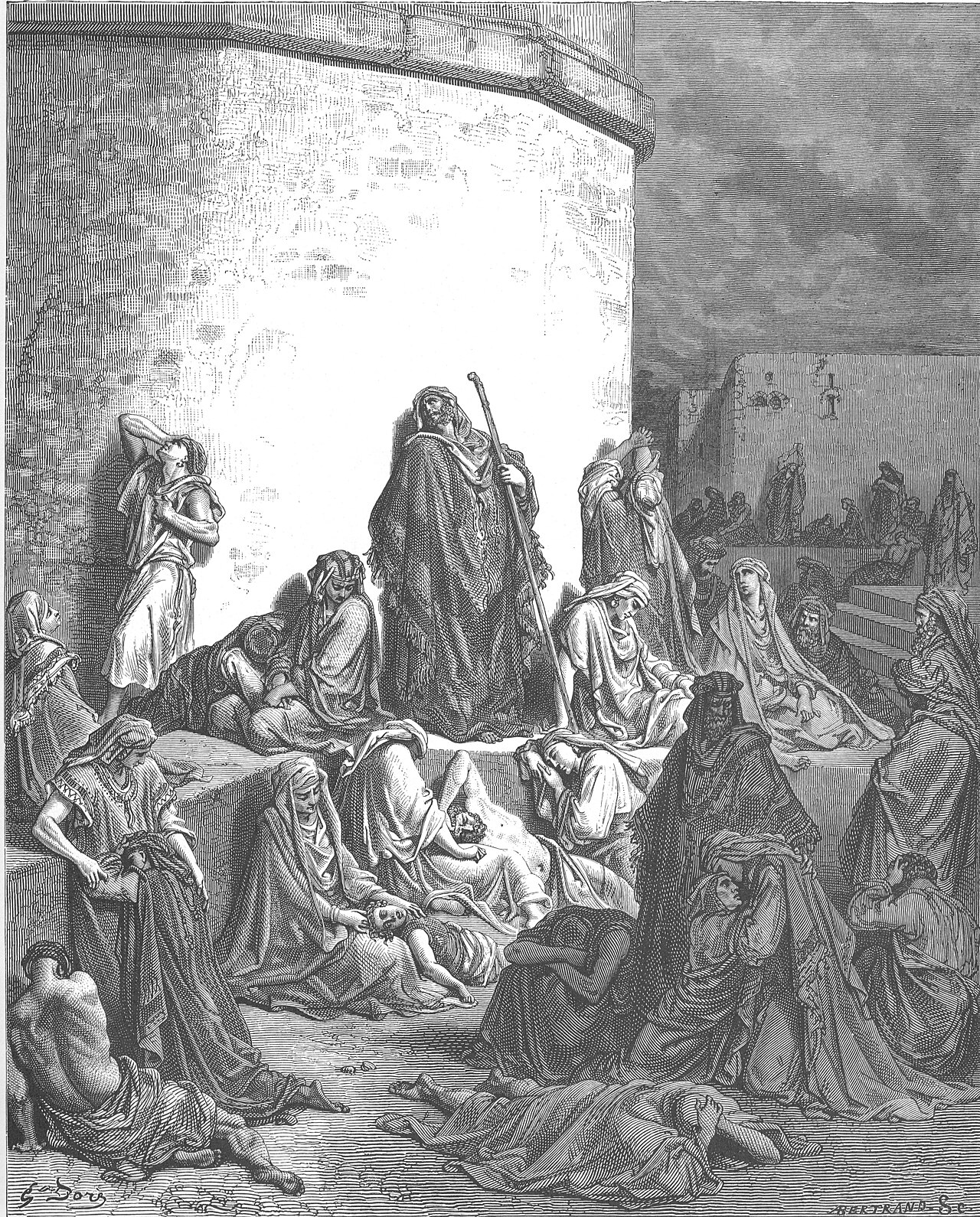
in Lamentations 5Young men toil at millstones; boys stagger under loads of wood.
BSB
The same verse in ASV and KJV ▾
ASV
The young men bare the mill; And the children stumbled under the wood.
KJV
They took the young men to grind, and the children fell under the wood.
⋯
This verse in Lamentations 5
Commentary
3 notes on this verseThey took the young men to grind,.... In the mill, which was laborious service; and which persons were sometimes put to, by way of punishment; and was the punishment of servants; see Jdg 16:21. Some render it, "the young men bore the grist" (x); carried the corn, the meal ground, from place to place. The Targum is, "the young men carried the millstones;'' and so Jarchi, they put millstones upon their shoulders, and burdens so as to weary them.
This site's exposition
They took the young men to grind
on Lamentations 5:13-15
Verse 13 sets the young men to a slave's labor at the millstone and the children stumbling under loads of wood, work once done by servants now forced on the free. Verse 14 empties the city gate of its elders and its music of its young men, the two institutions of civic and social life silenced together, and verse 15 states the result in one line, the joy of our heart is ceased, our dance is turned into mourning, celebration itself gone out of the city.
The record, by era
The Nineteenth Century1 voice
A commentator
Albert Barnes1798–1870
Notes, Explanatory and Practical, on the Old and New Testaments (1832-1869)
They took the young men to grind - Or, “The young men” have borne the mill, a menial and laborious task usually performed by slaves (compare Isa 47:2). The children fell under the wood - Or, lads have stumbled under burdens of wood. By lads are meant youths up to the age of military service; another form of menial labor.
How the passage was read
What the Jewish commentators add
Encumbered with millstones. When the enemies led them away in neck irons, they would place on their shoulders millstones and burdens in order to tire them. 10 Alternatively, ‘youths were forced to grind wheat,’ a task which drains their strength.
This section is reception history: how the passage was read and kept in the Jewish tradition. Where a reading parts from an essential of the Christian faith, the section says so at that point.
Texts and citation data: Sefaria; each excerpt follows its version’s licence. 3 further sources are cited on this chapter that carry no English text this site may quote or only restate the verse.
The words behind it
6 Hebrew wordsEvery Hebrew word of this verse in the order it stands, with what it means and the door to its own study. The last column counts the times a word stands in the whole Bible: the rarer the word, the more the places it appears belong together.
| Hebrew | Sound | Meaning | Word study | In the Bible |
|---|---|---|---|---|
| בַּחוּרִים֙ | bachurim | young men | H970 → | 44 times |
| טְח֣וֹן | techon | a mill | H2911 → | |
| נָשָׂ֔אוּ | nasau | they have lifted | H5375 → | 656 times |
| וּנְעָרִ֖ים | unearim | and young men | H5288 → | |
| בָּעֵ֥ץ | baetz | with <the> wood | H6086 → | 328 times |
| כָּשָֽׁלוּ׃ | kashalu | they have staggered | H3782 → |
בַּחוּרִים֙young men
bachurimH970 →44 times
טְח֣וֹןa mill
techonH2911 →
נָשָׂ֔אוּthey have lifted
nasauH5375 →656 times
וּנְעָרִ֖יםand young men
unearimH5288 →
בָּעֵ֥ץwith <the> wood
baetzH6086 →328 times
כָּשָֽׁלוּ׃they have staggered
kashaluH3782 →
A shaded row is a word that stands 400 times or fewer in the Bible.
The walk
8 stopsEach card is a verse this one points to, and under it the verses that one points to in turn. Where several paths arrive at the same place, that place is listed first: the text keeps returning to it.
Through
Matthew 23:4They tie up heavy, burdensome loads and lay them on men’s shoulders, but they themselves are not willing to lift a finger to move them.
it leads to
- Luke 11:46
“Woe to you as well, experts in the law!” He replied. “You weigh men down with heavy burdens, but you yourselves will not lift a finger to lighten their load.
- Acts 15:10
Now then, why do you test God by placing on the necks of the disciples a yoke that neither we nor our fathers have been able to bear?
- Galatians 6:13
For the circumcised do not even keep the law themselves, yet they want you to be circumcised that they may boast in your flesh.
- Luke 11:46
Through
Exodus 2:11One day, after Moses had grown up, he went out to his own people and observed their hard labor. He saw an Egyptian beating a Hebrew, one of his own people.
it leads to
- Hebrews 11:24–26
By faith Moses, when he was grown, refused to be called the son of Pharaoh’s daughter.
- Acts 7:22–24
So Moses was educated in all the wisdom of the Egyptians and was powerful in speech and action.
- Exodus 1:11
So the Egyptians appointed taskmasters over the Israelites to oppress them with forced labor. As a result, they built Pithom and Rameses as store cities for Pharaoh.
- Hebrews 11:24–26
Through
Exodus 23:5If you see the donkey of one who hates you fallen under its load, do not leave it there; you must help him with it.
it leads to
- Deuteronomy 22:4
If you see your brother’s donkey or ox fallen on the road, you must not ignore it; you must help him lift it up.
- Deuteronomy 22:4
Through
Judges 16:21Then the Philistines seized him, gouged out his eyes, and brought him down to Gaza, where he was bound with bronze shackles and forced to grind grain in the prison.
it leads to
- Proverbs 2:19
None who go to her return or negotiate the paths of life.
- Proverbs 2:19
Where this verse is studied
On this page
Studies1
About Lamentations
This page draws on Albert Barnes, Notes, Explanatory and Practical, on the Old and New Testaments (1832-1869); John Gill, Exposition of the Old Testament (1748-1763); John Gill, Exposition of the Old Testament and John Wesley, Explanatory Notes upon the Old Testament.