
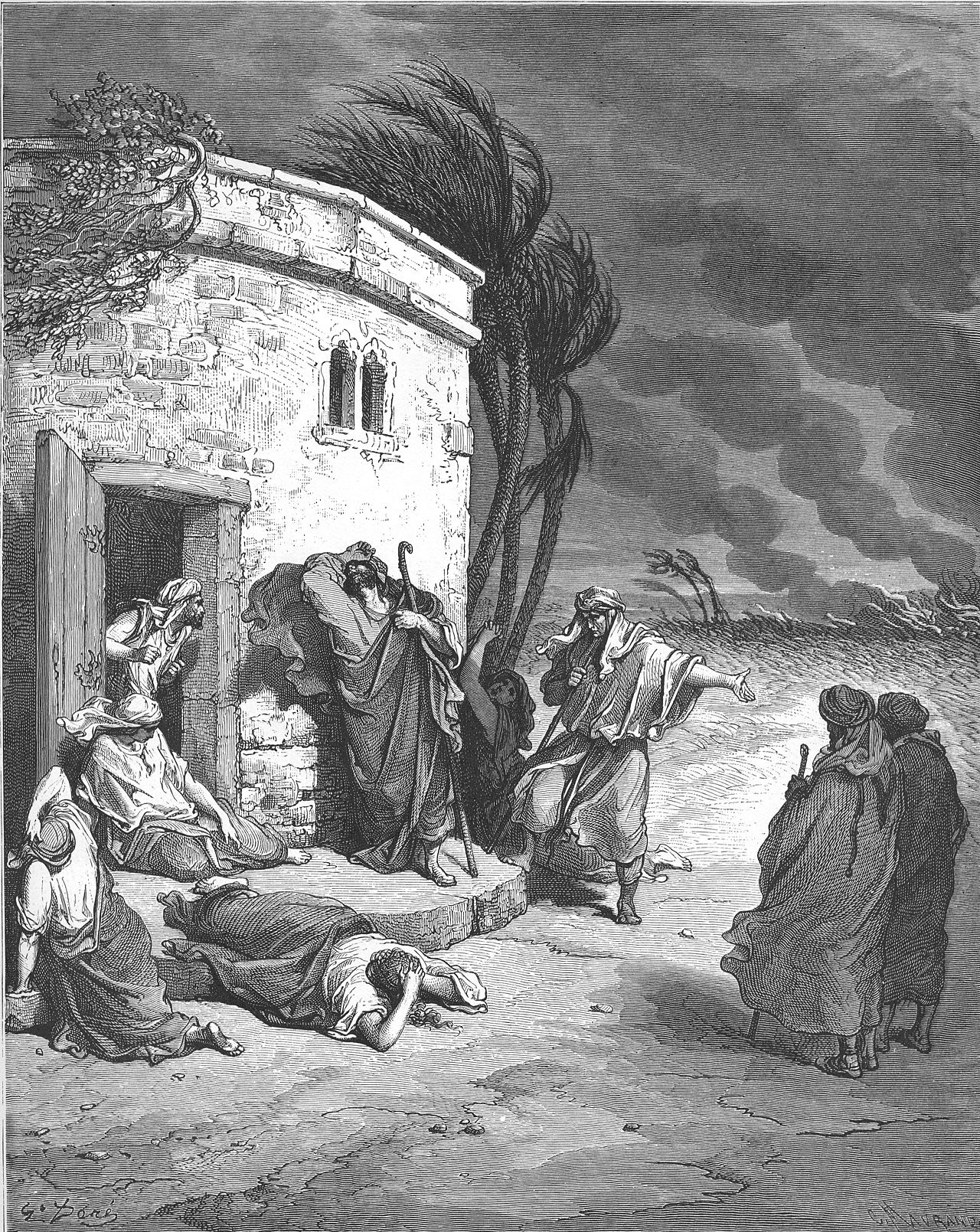
Jobchapter 7
21 verses · unknown · 10th century BC · Wisdom and poetry
I loathe my life! I would not live forever. Leave me alone, for my days are but a breath.
Introduction
unknown, Wisdom and poetry, Job Overview.
Job is still answering Eliphaz, and partway through this chapter he stops speaking to his friends and begins speaking to God. He is a sick man who cannot sleep, and his words come out of long nights. His hearers were laborers who watched for evening and weavers who knew how quickly a shuttle runs out of thread. Listen for the working men he compares himself to. Listen for a question that Psalm 8 also asks, and notice what Job does with it. From here on Job keeps addressing God, and that turn is one of the book's main moves.
Context
- Who
- Hearers who worked hard days and had lain awake through worse nights
- What
- The close of Job's reply, a complaint to God about the hard service of human life, his sleepless nights and God's unrelenting watch over him.
- Where
- The ash heap outside Job's town, through a sleepless night.
- When
- The continuation of the same reply to Eliphaz in the first round of speeches.
- Why
- To show Job bringing his complaint to God Himself, which he goes on doing to the end of the book.
Historical context
Job compares his life to two working men everyone knew. The first is the conscript or forced labourer, serving a fixed term he cannot shorten. The second is the hired day-labourer, who works in the sun watching the shadows and is paid only at sundown, which is why the Law later insisted his wage be handed over the same day. Both men live for the end of the shift, and Job says his shift never ends.
Show the rest of the historical context, 3 more paragraphs
The weaver's shuttle is the other trade image: thrown back and forth across the loom faster than the eye follows, and then the thread runs out. Ancient looms were upright, worked standing, and everyone had watched one.
The physical description is unsparing and specific, flesh clothed with worms and crusts of dirt, skin breaking open and running, nights of tossing until dawn, and the fear of sleep itself because of the dreams. This is the sickness of chapter 2 seen from inside.
The last section takes a line of Psalm 8 and turns it inside out. 'What is man, that thou shouldest magnify him?', but where the psalm marvels that God pays attention to so small a creature, Job asks to be left alone. He calls himself a 'watcher of men' target, asks why God will not look away long enough for him to swallow his spit, and wonders whether he is the sea or a sea-monster that has to be kept under guard.
Significance
This is the chapter where Job stops arguing with his friends and starts addressing God directly, and he never really stops again. That move is the book's real argument: the sufferer who talks to God is doing better than the counsellors who only talk about him.
Show the rest of the significance, 1 more paragraph
Hearers in Israel would have felt both the shock and the permission. The complaint is bitter enough to be uncomfortable in a worship gathering, and it was preserved and read anyway.
This chapter in Jewish lifeWhat this chapter is in Jewish life and reading.
What is done
This chapter is part of no reading in the site's table of the synagogue year. The site's own table in src/lib/hebraic/readings.ts printed parashot total 0 and haftarah uses total 0 for Job, and no festival reading.
The corpus ties the chapter to one tractate more than any other. Under the eighteenth verse it carries Rosh Hashanah 16a:7 with Jerusalem Talmud Rosh Hashanah 1:3:2, and under the first verse two entries of Ein Yaakov on Rosh Hashanah. Bava Batra 16a:16 stands under the ninth verse. Midrash named for Torah portions appears at Midrash Tanchuma, Bereshit 5:3 on the ninth verse and Midrash Tanchuma, Beshalach 16:2 on the twentieth.
How it is read
Rashi is quoted from The Judaica Press complete Tanach with Rashi, translated by A. J. Rosenberg, which Sefaria reports as CC-BY. He reads the chapter's opening as Job's answer on why he cannot keep silent. Job asks how he can keep from crying out, and appeals to the limit on a man's life. "Do you not know that the time a man has to live is limited?" (Rashi on Job 7:1:1).
The slave and the hireling are read as two kinds of waiting. The slave toils all day and longs for the shadow of evening. The hireling hopes for his wages at sunset (Rashi on Job 7:2:1). Job's months of futility and nights of weariness were appointed to him from Heaven (Rashi on Job 7:3:1 and 7:3:2).
Malbim, quoted from Malbim's Job, translated by Jeremy I. Pfeffer (Ktav, 2003), which Sefaria reports as CC-BY, reads the same verses as an answer to Eliphaz. Eliphaz had said that God purges the righteous man through suffering so that he may mend his service. A man bed-ridden or distraught cannot work toward his perfection, and so "he is thereby precluded from serving Him at all". He falls further behind (Malbim on Job 7:2:1).
The seventh verse carries the note a Christian reader will weigh most. Rashi writes of the eye that will not return: "Here Job denies the dogma of the Resurrection of the Dead" (Rashi on Job 7:7:1). Rashi calls the resurrection a dogma, and he reads Job as denying it here. The next note keeps to the same line, that the eye that wishes to see Job will not see him after he dies (Rashi on Job 7:8:1).
From here Rashi reads the chapter as open complaint. Since God does not leave Job alone, he will not restrain his speech from complaining about God's ways (Rashi on Job 7:11:1). Job asks whether he is a sea, set about with sand as a guard (Rashi on Job 7:12:1). He hoped his couch would bear his trouble so that he could hold his speech (Rashi on Job 7:13:1). He would choose death over the limbs of his body (Rashi on Job 7:15:1). He despised his life, since in the end he will not live forever (Rashi on Job 7:16:1).
The closing questions are read as Job's protest at being watched. Man is given importance only so that God may visit his deeds every morning and test him every moment (Rashi on Job 7:17:1). The mark is an object a man strikes when angry, venting on it all his hatred. Rashi notes that other editions read "his sin" in place of hatred (Rashi on Job 7:20:1). The last note asks why God does not forgive (Rashi on Job 7:21:1).
The corpus carries four further notes on this chapter without an English text, each marked linked because Sefaria holds no English version of the ref. They stand cited and unquoted at Metzudat David on Job 7:9:1, 7:10:1 and 7:14:1, and at Ibn Ezra on Job 7:18:1.
What the rabbis say
The corpus carries thirty-one rabbinic locators on this chapter and the text of none, so each is cited here by ref. On the first verse it holds Bereshit Rabbah 10:5, Ein Yaakov (Glick Edition), Rosh Hashanah 1:8, Ein Yaakov, Rosh Hashanah 1:10 and Otzar Midrashim, Midrashim on Missing and Extra Letters 1:38. On the second it holds Midrash Tehillim 25:1. On the third it holds Midrash Lekach Tov, Exodus 7:5:2, Midrash Sekhel Tov, Shemot 7:5:3 and Seder Olam Rabbah 3:1. On the fourth it holds Bereshit Rabbah 72:4.
The body and the grave draw the next run. On the fifth verse the corpus holds Bereshit Rabbati, Parashat Bereshit 25, Pirkei DeRabbi Eliezer 22:5 and Otzar Midrashim, Midrashim of Rabbi Akiba, The Small Letters and their Purposes 5. On the seventh it holds Midrash Tehillim 114:1. On the eighth it holds Bamidbar Rabbah 14:6 and 14:7 and Midrash Tehillim 87:5. On the ninth it holds Bava Batra 16a:16, Ein Yaakov (Glick Edition), Bava Batra 1:37, Ein Yaakov, Bava Batra 1:38 and Midrash Tanchuma, Bereshit 5:3.
The closing protest carries the rest. On the eighteenth verse the corpus holds Rosh Hashanah 16a:7, Jerusalem Talmud Rosh Hashanah 1:3:2 and Midrash Tehillim 72:4. On the twentieth it holds seven. They are Avot DeRabbi Natan, Recension B 44:6, Mekhilta DeRabbi Yishmael, Tractate Shirah 6:3 and Midrash Lekach Tov on Ruth 1:16:1. Midrash Sekhel Tov, Shemot 15:21:18, Midrash Tanchuma, Beshalach 16:2, Sifrei Bamidbar 84:4 and Yalkut Shimoni on Torah 736:1 stand with them. On the twenty-first it holds Otzar Midrashim, Sefer HaBahir ("The Book of Brightness") 2.
What each of them teaches is a saying of the rabbis, and is reported as theirs wherever this site quotes one. The quotations wait on a fetch that carries the text.
Sources: Rashi, Rashi on Job 7:1:1 to 7:21:1, The Judaica Press complete Tanach with Rashi, translated by A. J. Rosenberg, reported CC-BY; Malbim, Malbim on Job 7:2:1, Malbim's Job, trans. Jeremy I. Pfeffer, Ktav, 2003, reported CC-BY; Metzudat David, Metzudat David on Job 7:9:1, 7:10:1 and 7:14:1, cited by ref because the corpus carries no English text; Ibn Ezra, Ibn Ezra on Job 7:18:1, cited by ref because the corpus carries no English text; The Sefaria corpus, scripts/data/sources/sefaria/job/7.json, the 31 Talmud and Midrash locators of this chapter; The site's own files, src/lib/hebraic/readings.ts, printing no portion, no Haftarah and no festival reading for this book.
The heads below are this chapter's scenes. The numbered points under each are its verses.
Job: My Days Are Swifter Than a Weaver's Shuttle
Job 7:1-3
Job reads his own life through the figure of a hired laborer: "Are not his days like those of a hired hand". The complaint grows from a bad day into a whole allotted season, Job's answer to the friends' view that his suffering is a passing correction.
Job 7:1
“The life of man upon earth is a warfare. In this passage in the old Translation the life of man is not called 'a warfare' at all, but 'a trial,' yet if the meaning of either word be regarded, the sound that meets the ear outwardly is different, yet they make one and the same concordant meaning. For what is represented by the title of 'a trial,' saving our contest with evil spirits? and what by the designation of 'a warfare,' but an exercising against our enemies?”
Gregory the Dialogist · written before 604 · Morals on the Book of Job, Book VIIIpatristic
1 more voice on this verseWhat preachers and commentators have said about this verse, in their own words.
Job 7:1
“Is there not an appointed time to man upon earth? - Margin, or, warfare. The word used here צבא tsâbâ' means properly a host, an army, see the notes, Isa 1:9; then it means warfare, or the hard service of a soldier; notes, Isa 40:2. Here it means that man on the earth was enlisted, so to speak, for a certain time. He had a certain and definite hard service to perform, and which he must continue to discharge until he was relieved by death.”
Like a slave he longs for shade: Barnes gives longs the sense of panting for breath. The slave longs for the evening shade and the hireling waits for his wages, and both wait for the end of the day. Henry takes the shade as a figure for death.
Job 7:2
“Earnestly desireth the shadow - As a man who labors hard in the heat of the day earnestly desires to get under a shade, or wishes for the long evening shadows, that he may rest from his labor, get his day’s wages, retire to his food, and then go to rest.”
Adam Clarke · Commentary on the Bible (1810-1826)evangelical
months of futility: Barnes gives allotted the sense of inherit, so the months of futility are the estate he has been handed. Nights of misery are appointed him too. Wesley adds that night is the hardest time for the sick.
Job 7:3
“So am I made to possess - Hebrew I am made to inherit. The meaning is, that such sad and melancholy seasons now were his only portion. Months of vanity - That is, months which were destitute of comfort; in other words, months of affliction. How long his trials had continued before this, we have no means of ascertaining. There is no reason, however, to suppose that his bodily sufferings came upon him all at once, or that they had not continued for a considerable period.”
Job 7:4-6
When I lie down I think: The night that should end labor only starts a new one for Job: "the night drags on, and I toss and turn until dawn". His days are "swifter than a weaver’s shuttle" and "come to an end without hope," so speed itself becomes grief, a shorter sentence.
Job 7:4
“Literally, "When shall be the flight of the night?" [GESENIUS]. UMBREIT, not so well, "The night is long extended"; literally, "measured out" (so Margin).”
Jamieson, Fausset & Brown · Commentary Critical and Explanatory on the Whole Bible (1871)reformed
My flesh is clothed with worms: The worms and the cracked, festering skin are the sores of chapter 2 at their worst. Barnes treats the verse as one of the plainest clues to his disease. Clarke takes the worms literally, bred in open sores.
Job 7:5
“His sores bred worms, the scabs were like clods of dust, and his skin was broken; so evil was the disease which cleaved fast to him. See what vile bodies we have, and what little reason we have to pamper them or be proud of them; they have in themselves the principles of their own corruption: as fond as we are of them now, the time may come when we may loathe them and long to get rid of them.”
Matthew Henry · Commentary on the Whole Bible (1707-1721)puritan
My days are swifter than a weaver’s shuttle: Clarke notes that the Hebrew names the weaver more than his shuttle. Gregory reads the days as threads added to a web, each one bringing its end nearer. The days come to an end without hope.
Job 7:6
“Swifter than a weaver’s shuttle - The word ארג areg signifies rather the weaver than his shuttle. And it has been doubted whether any such instrument were in use in the days of Job. Dr. Russell, in his account of Aleppo, shows that though they wove many kinds of curious cloth, yet no shuttle was used, as they conducted every thread of the woof by their fingers.”
Adam Clarke · Commentary on the Bible (1810-1826)evangelical
1 more voice on this verse
Job 7:6
“My days are past more swiftly than a web is cut off by the weaver. By a very suitable image the time of the flesh is compared to a web. For as the web advances by threads, so this mortal life by the several days; but in proportion as it grows to its bigness, it is advancing to its cutting off. For as we have also said above, whilst the time in our hands passes, the time before us is shortened.”
Gregory the Dialogist · written before 604 · Morals on the Book of Job, Book VIIIpatristic
Job 7:7-10
Remember that my life is but a breath: Job says his eyes "will never again see happiness". He speaks within the Old Testament's ordinary hope of Sheol, and the later reach of 19:25-26 stands out against it. "He never returns to his house" states the plain fact of mortality without yet claiming anything beyond it.
Job 7:7
“He is now in a softer mood; a beam from former days of prosperity falling upon memory and the thought of the unseen world, where one is seen no more (Job 7:8), drew from him an expression of regret at leaving this world of light (Ec 11:7); so Hezekiah (Isa 38:11). Grace rises above nature (2Co 5:8).”
Jamieson, Fausset & Brown · Commentary Critical and Explanatory on the Whole Bible (1871)reformed
The eye that beholds me will no longer see me: The eye that beholds him will look and he will be no more. Jamieson, Fausset and Brown read it closely: he vanishes even while the watcher of mankind looks at him. Clarke adds that death leaves no chance to clear his name.
Job 7:8
“The eye of man shall not see me. For 'the eye of Man' is the pity of the Redeemer, which softens the hardness of our insensibility, when it looks upon us. Hence, as the Gospel witnesses, it is said, And the Lord turned, and looked upon Peter. And Peter remembered the word of the Lord. And he went out, and wept bitterly. But the soul when divested of the flesh 'the eye of Man' doth not henceforth at all regard, in that it never delivers him after death, whom grace doth not restore to pardon before death.”
Gregory the Dialogist · written before 604 · Morals on the Book of Job, Book VIIIpatristic
1 more voice on this verse
Job 7:8
“The eye of him who beholds me (present, not past), that is, in the very act of beholding me, seeth me no more. Thine eyes are upon me, and I am not--He disappears, even while God is looking upon him.”
Jamieson, Fausset & Brown · Commentary Critical and Explanatory on the Whole Bible (1871)reformed
As a cloud vanishes and is gone: Sheol is the place of the dead. Jamieson, Fausset and Brown read the line as no return to this present life, and Wesley adds until the general resurrection. A cloud vanishes and is gone.
Job 7:9
“As the cloud is consumed and vanisheth away - This image is taken from the light and fleecy clouds, which become smaller and smaller until they wholly vanish. For an illustration of a similar phrase, see the notes at Isa 44:22. To the grave - - שׁאול she'ôl. Septuagint, εἰς ᾅδην eis hadēn, to Hades. The word may mean grave, or the place of departed spirits; see Isa 5:14, note; Isa 14:9, note; compare the notes at Job 10:21-22. Either signification will apply here. Shall come up no more - Shall no more live on the earth.”
He never returns to his house: Clarke reads the verse as the end of life on earth, with the dead still existing in Sheol. His house and his place forget him. Henry recalls the rich man of Luke 16, who asked that Lazarus be sent to his father's house because he knew he could never go.
Job 7:10
“He shall return no more to his house, neither shall his place know him any more - He does not mean that he shall be annihilated but that he shall never more become an inhabitant of the earth. The word שאול, which we properly enough translate grave, here signifies also the state of the dead, hades, and sometimes any deep pit, or even hell itself.”
Adam Clarke · Commentary on the Bible (1810-1826)evangelical
1 more voice on this verse
Job 7:10
“The rich man in hell desired that Lazarus might be sent to his house, knowing it was to no purpose to ask that he might have leave to go himself. Glorified saints shall return no more to the cares, and burdens, and sorrows of their house; nor damned sinners to the gaieties and pleasures of their house.”
Matthew Henry · Commentary on the Whole Bible (1707-1721)puritan
Job: Why Hast Thou Set Me as a Mark for Thee?
Job 7:11-12
Therefore I will not restrain my mouth: Job announces: "I will complain in the bitterness of my soul". His question reads God's attention as a guard set on a dangerous thing. The reader can see what Job cannot, that a watch has in fact been set on him through the wager of chapters 1 and 2.
Job 7:11
“Therefore, as such is my hard lot, I will at least have the melancholy satisfaction of venting my sorrow in words. The Hebrew opening words, "Therefore I, at all events," express self-elevation [UMBREIT].”
Jamieson, Fausset & Brown · Commentary Critical and Explanatory on the Whole Bible (1871)reformed
Am I the sea, or the monster of the deep: Barnes hears a man asking why he is kept under guard like the sea or a monster of the deep. Clarke reports that the Targum heard Pharaoh in the sea. A sick man poses little danger.
Job 7:12
“Am I a sea, or a whale - “Am I condemned as the Egyptians were who were drowned in the Red Sea? or am I as Pharaoh, who was drowned in it in his sins, that thou settest a keeper over me?” Targum. Am I as dangerous as the sea, that I should be encompassed about with barriers, lest I should hurt mankind? Am I like an ungovernable wild beast or dragon, that I must be put under locks and bars? I think our own version less exceptionable than any other hitherto given of this verse.”
Adam Clarke · Commentary on the Bible (1810-1826)evangelical
1 more voice on this verse
Job 7:12
“JOB was in great pain when he thus bitterly complained. These moans came from him when his skin was broken and had become loathsome and he sat upon a dunghill and scraped himself with a potsherd. We are amazed at his patience, but we are not amazed at his impatience! He had fits of complaining and failed in that very patience for which he was noted. Where God's saints are most glorious, there you will find their spots. The weaknesses of the saints lie near their strength. Elijah is the bravest of the brave and flees from Jezebel.”
Job 7:13-16
When I think my bed will comfort me: Even sleep is taken from Job: when he thinks "my bed will comfort me," then "You frighten me with dreams and terrify me with visions". The line "I would prefer strangling and death over my life in this body" is the book's plainest statement of a wish to die.
Job 7:13
“When I say, My bed shall comfort me - The idea in this verse and the following is, that there was no intermission to his sorrows. Even the times when people usually sought repose were to him times of distress. Then he was disturbed and alarmed by the most frightful dreams and visions, and sleep fled from him. Shall ease my complaint - The word rendered “shall ease” ישׂא yı̂śâ' means rather, shall bear; that is, shall lighten or sustain. The meaning is, that he sought relief on his bed.”
1 more voice on this verse
Job 7:13
“When I say my bed shall comfort me, I shall be eased in speaking with myself on my couch, then Thou scarest me with dreams, and terrifiest me through visions. For in Holy Writ a 'bed,' a 'couch,' or 'litter,' is usually taken for the secret depth of the heart. For it is hence that under the likeness of each separate soul, the Spouse, urged by the piercing darts of holy love, says in the Song of Songs, By night on my bed I sought him, whom my soul loveth.”
Gregory the Dialogist · written before 604 · Morals on the Book of Job, Book VIIIpatristic
then You frighten me with dreams: Job credits the terrors to God, though the reader knows from chapter 2 that Satan holds leave to strike him. Clarke takes the dreams as Satan's work, permitted to haunt Job's sleep until he feared to close his eyes. Eliphaz had boasted of a night vision in Job 4:13.
Job 7:14
“Then Thou scarest me with dreams, and terrifiest me through visions. But lest anyone should be at pains to make out these words after the literal sense, it is of great importance to find out in how many ways the mind is affected by images from dreams. For sometimes dreams are engendered of fulness or emptiness of the belly, sometimes of illusion, sometimes of illusion and thought combined, sometimes of revelation, while sometimes they are engendered of imagination, thought, and revelation together.”
Gregory the Dialogist · written before 604 · Morals on the Book of Job, Book VIIIpatristic
1 more voice on this verse
Job 7:14
“Thou sparest me with dreams - There is no doubt that Satan was permitted to haunt his imagination with dreadful dreams and terrific appearances; so that, as soon as he fell asleep, he was suddenly roused and alarmed by those appalling images. He needed rest by sleep, but was afraid to close his eyes because of the horrid images which were presented to his imagination. Could there be a state more deplorable than this?”
Adam Clarke · Commentary on the Bible (1810-1826)evangelical
I would prefer strangling and death: Body here is literally bones, as Jamieson, Fausset and Brown note, the frame the disease has left. Clarke ties strangling to the terror of the dreams in verse 14. He would prefer death to that life.
Job 7:15
“So that my soul - So that I; the soul being put for himself. Chooseth strangling - Dr. Good renders it “suffocation,” and supposes that Job alludes to the oppression of breathing, produced by what is commonly called the night-mare, and that he means that he would prefer the sense of suffocation excited at such a time to the terrible images before his mind. Herder renders it, death. Jerome, suspendium. The Septuagint, “Thou separatest (ἀπαλλάξεις apallaceis) my life from my spirit, and my bones from death;” but what idea they attached to it, it is impossible now to tell.”
1 more voice on this verse
Job 7:15
“Perhaps the meaning is simply, "My soul chooses (even) strangling (or any violent death) rather than my life," literally, "my bones" (Ps 35:10); that is, rather than the wasted and diseased skeleton, left to him.”
Jamieson, Fausset & Brown · Commentary Critical and Explanatory on the Whole Bible (1871)reformed
I loathe my life!: Clarke reads I loathe my life as a refusal to live forever on these terms. Days offered with such misery are a gift worth refusing. Breath is hebel, the vapor Ecclesiastes finds in everything under the sun.
Job 7:16
“I loathe it; I would not live alway - Life, in such circumstances, is hateful to me; and though I wish for long life, yet if length of days were offered to me with the sufferings which I now undergo, I would despise the offer and spurn the boon. Mr. Good is not satisfied with our common version, and has adopted the following, which in his notes he endeavors to illustrate and defend: Job 7:15 So that my soul coveteth suffocation, And death in comparison with my suffering. Job 7:16 No longer would I live! O, release me!”
Adam Clarke · Commentary on the Bible (1810-1826)evangelical
Job 7:17-19
What is man that You should exalt him: Job takes the question of Psalm 8:4 and turns it against itself: "What is man that You should exalt him". The visitation the psalm blesses, Job feels as a watch kept on a prisoner. To "swallow my spittle" is proverbial for the shortest respite, and Job cannot get even that.
Job 7:17
“Job ought rather to have reasoned from God's condescending so far to notice man as to try him, that there must be a wise and loving purpose in trial. David uses the same words, in their right application, to express wonder that God should do so much as He does for insignificant man. Christians who know God manifest in the man Christ Jesus may use them still more.”
Jamieson, Fausset & Brown · Commentary Critical and Explanatory on the Whole Bible (1871)reformed
that You attend to him every morning: Barnes reads attend as a visit to test him with pain every morning. Jamieson, Fausset and Brown set it beside Lamentations 3:23, where the mercies of the LORD are new every morning. He feels only the test.
Job 7:18
“With each new day (Ps 73:14). It is rather God's mercies, not our trials, that are new every morning (La 3:23). The idea is that of a shepherd taking count of his flock every morning, to see if all are there [COCCEIUS].”
Jamieson, Fausset & Brown · Commentary Critical and Explanatory on the Whole Bible (1871)reformed
Will You never look away from me: Swallowing spittle is a proverb Clarke found still used among the Arabs, meaning a moment's pause, the time to draw a breath. Barnes notes the verb for look away returns at Job 14:6. Job asks for that one moment free of God's eye.
Job 7:19
How long (like a jealous keeper) wilt thou never take thine eyes off (so the Hebrew for "depart from") me? Nor let me alone for a brief respite (literally, "so long as I take to swallow my spittle"), an Arabic proverb, like our, "till I draw my breath."
Jamieson, Fausset & Brown · Commentary Critical and Explanatory on the Whole Bible (1871)reformed
1 more voice on this verse
Job 7:19
“How long wilt thou not depart? - How long is this to continue? The same word occurs in Job 14:6. The word rendered “depart” שׁעה shâ‛âh means to look, to look around, and then to look away from anyone or anything. The idea here is, that God had fixed his eyes upon Job, and he asks with anxiety, how long this was to continue, and when he would turn his eyes away; compare the notes at Job 7:8. Schultens supposes that the metaphor here is taken from combatants, who never take their eyes from their antagonists.”
Job 7:20-21
If I have sinned, what have I done to You: The words "If I have sinned, what have I done to You, O watcher of mankind" make a concession without Job knowing the offense. His question, "Why have You made me Your target," protests that even a real fault would not explain an assault this total.
Job 7:20
“I have sinned; what shall I do - Dr. Kennicott contends that these words are spoken to Eliphaz, and not to God, and would paraphrase them thus: “You say I must have been a sinner. What then? I have not sinned against thee, O thou spy upon mankind! Why hast thou set up me as a butt or mark to shoot at? Why am I become a burden unto thee? Why not rather overlook my transgression, and pass by mine iniquity? I am now sinking to the dust!”
Adam Clarke · Commentary on the Bible (1810-1826)evangelical
1 more voice on this verse
Job 7:20
“I have sinned; what shall I do unto Thee, O Thou Preserver of men? Observe how he confesses the ill that he has done, but the good that he should present to God in compensation, he no where can find, in that all virtue whatever of human practice is without power to wash out the guilt of sin, except His mercifulness in sparing foster it, and not His justice in judging press hard upon it.”
Gregory the Dialogist · written before 604 · Morals on the Book of Job, Book VIIIpatristic
Why do You not pardon my transgression: Jamieson, Fausset and Brown see a visitor coming at dawn to a sick man who died in the night. Job asks God to forgive now, while he lives. Henry distinguishes the two verbs, pardon removing the guilt of sin and taking away breaking its power.
Job 7:21
“And why dost Thou not take away my transgression, and remove mine iniquity? By which same words, what else is intimated but the desire of the expected Mediator, concerning Whom John saith, Behold the Lamb of God, Which taketh away the sin of the world. Or rather sin is then completely taken away from mankind, when our corruption is changed in the glory of incorruption.”
Gregory the Dialogist · written before 604 · Morals on the Book of Job, Book VIIIpatristic
2 more voices on this verse
Job 7:21
“NO man should rest until he is sure that his sin is forgiven. It may be forgiven and he may be sure that it is forgiven—and he ought not to give rest to his eyes, nor slumber to his eyelids till he has been assured, with absolute certainty that his transgression is pardoned and that his iniquity is taken away. You, dear Friends, may be patient under suffering, but not patient under sin.”
Charles Spurgeon · written before 1892 · The Metropolitan Tabernacle Pulpit, Sermon No. 2705: “Why Some Sinners Are Not Pardoned” (lightly modernized text, CCEL edition)Particular Baptist
Job 7:21
“It is a figure, from one seeking a sick man in the morning, and finding he has died in the night. So Job implies that, if God does not help him at once, it will be too late, for he will be gone. The reason why God does not give an immediate sense of pardon to awakened sinners is that they think they have a claim on God for it.”
Jamieson, Fausset & Brown · Commentary Critical and Explanatory on the Whole Bible (1871)reformed
Keep studying
Sources for this chapter
The summary
Jamieson, Fausset & Brown, Commentary Critical and Explanatory; John Wesley, Notes on the Old Testament and Matthew Henry, Complete Commentary.
The exposition
Adam Clarke, Commentary on the Bible; Albert Barnes; Franz Delitzsch, Biblical Commentary on the Book of Job; Gregory the Dialogist, Morals on the Book of Job; Jamieson, Fausset & Brown, Commentary Critical and Explanatory on the Whole Bible; John Gill, Exposition of the Old Testament; John Wesley, Explanatory Notes upon the Old Testament and Matthew Henry, Commentary on the Whole Bible.