
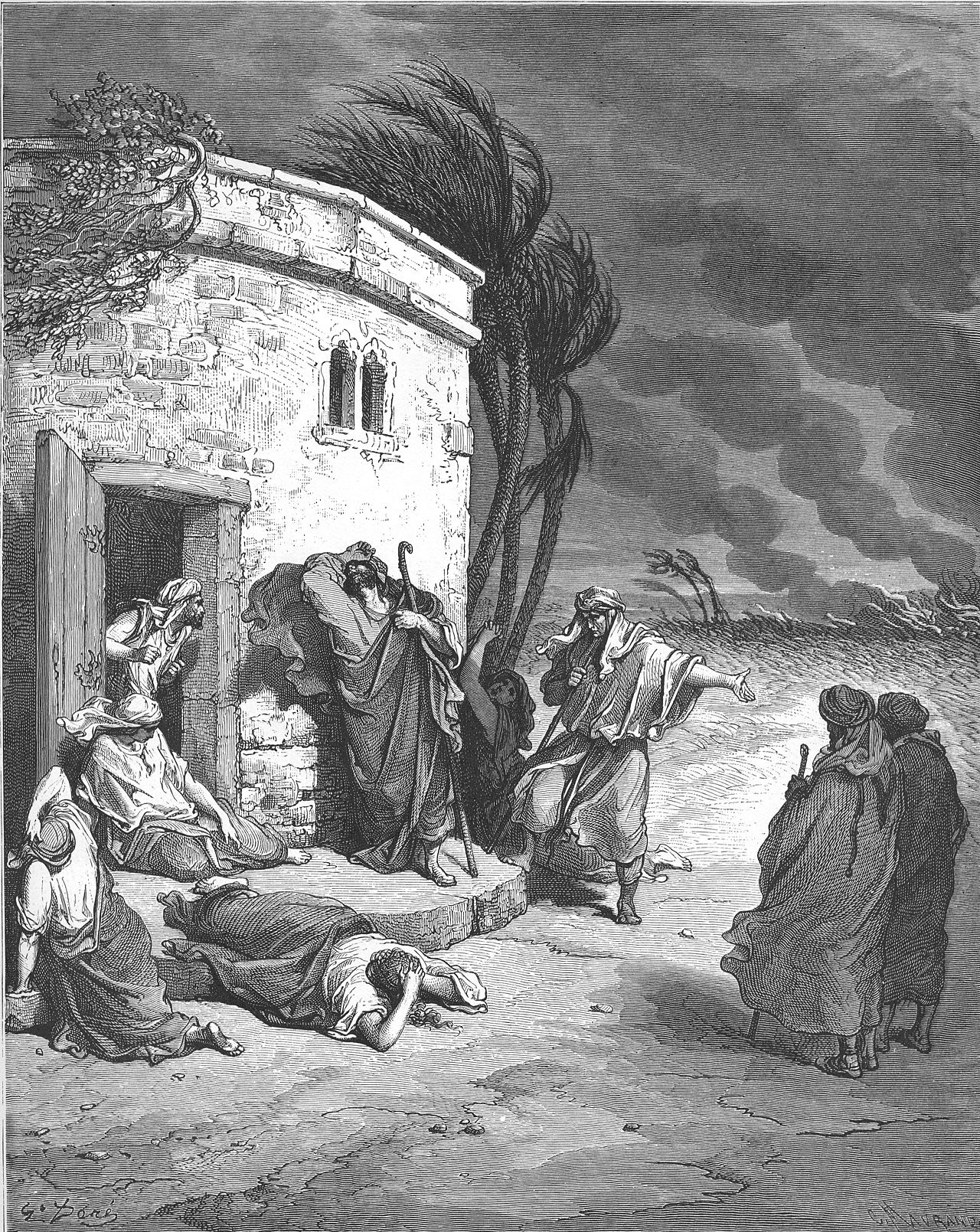
Jobchapter 39
30 verses · unknown · 10th century BC · Wisdom and poetry
Who set the wild donkey free? Who released the swift donkey from the harness?
Introduction
unknown, Wisdom and poetry, Job Overview.
The LORD's first speech continues in this chapter with a procession of wild animals. Job's wealth had been counted in animals he owned and managed. These are the ones no one manages, and his hearers, who bred animals for a living, knew each of them. The chapter asks, animal by animal, whether Job can feed, tame or command them. Listen for the delight in the telling, especially of the ostrich and the war horse. The chapter ends with Job still silent and the speech still under way.
Context
- Who
- Hearers who bred animals for a living and knew which ones could never be tamed
- What
- The continuation of the LORD's first speech, a series of questions about wild animals that live beyond human control.
- Where
- The cliffs, deserts, salt flats and battlefields of the ancient Near East, as God describes them.
- When
- The book sets Job in the age of the patriarchs, commonly placed about 2000 to 1800 BC, and it gives no date.
- Why
- To show Job a creation that God cares for and that no one else manages.
Historical context
The whole chapter is a parade of animals no human being manages, addressed to a man whose wealth had been measured in animals he did manage.
Show the rest of the historical context, 3 more paragraphs
The mountain goats and hinds calve in inaccessible places with no herdsman attending, and their young grow up and leave. The wild donkey, the onager, a real species of the eastern deserts, never domesticated, has been given the barren land and the salt flats for a home, and it scorns the noise of the city and hears no driver shouting. The wild ox is the aurochs, the huge wild cattle that Assyrian kings boasted of hunting and that survived into recorded history before dying out; God asks whether Job can tie it to a plough harrow and trust it to bring in his grain. Every hearer knew the answer.
The ostrich passage is the strangest and the funniest. She leaves her eggs in the earth and warms them in the dust, forgetting that a foot may crush them; she is hardened against her young as though they were not hers, because God did not give her a share of wisdom. And then, what time she lifts herself on high, she scorns the horse and his rider. Ostriches really did nest in shallow scrapes in the open and really could outrun a horse, and both halves of the description are accurate.
The war horse gets the longest and grandest treatment. His neck is clothed with thunder; he paws in the valley and goes out to meet the armed men; he mocks at fear and does not turn back from the sword. The quiver rattles against him, the glittering spear and the shield; he swallows the ground with fierceness and does not believe it is the sound of the trumpet. He says among the trumpets, Ha, ha, and smells the battle afar off. Chariot warfare was the height of military technology in that age, and the horse's courage in the noise was the thing that made it possible. The hawk's migration and the eagle nesting on a crag and spotting prey from far off close the list.
Significance
The chapter is God's answer delivered as a tour, and its argument is carried by delight rather than logic. He is not merely powerful; he is fond of these animals, and he made a great deal of the world for no human use at all.
Show the rest of the significance, 1 more paragraph
For hearers who assumed creation was a system of rewards arranged around human behaviour, an ostrich that forgets her own eggs and outruns a horse was a genuine correction. The world is not a courtroom with Job at the centre.
This chapter in Jewish lifeWhat this chapter is in Jewish life and reading.
What is done
This chapter has no place in the synagogue year. The site's own table in src/lib/hebraic/readings.ts printed parashot total 0 and haftarah uses total 0 for the book of Job, and no festival reading.
The corpus joins it to the study of the Torah portions through the Midrash arranged by them. Under the twenty-fourth verse it carries Midrash Tanchuma, Nitzavim 4:1. Under the twenty-seventh verse it carries Midrash Tanchuma Buber, Achrei Mot 4:1. Under the twenty-seventh verse it carries Midrash Tanchuma, Achrei Mot 3:1. Under the twenty-ninth verse it carries Midrash Tanchuma Buber, Achrei Mot 4:2.
How it is read
Rashi is the one commentator on this chapter whose English the corpus carries, quoted here from The Judaica Press complete Tanach with Rashi, translated by A. J. Rosenberg, which Sefaria reports as CC-BY. The chapter is a run of wild creatures, and Rashi reads each one closely, giving the animal its name and its habit.
He opens with the mountain goat, which he names in Old French. He says it hates its young and gives birth at the top of a high rock, so that the young should fall and die. God prepares an eagle, which receives the young on its wings (Rashi on Job 39:1:1). The young are raised on grain, seeds and grasses once they have grown a little, and need no raising by father or mother (Rashi on Job 39:4:2).
The wild donkey and the wild ox are read as beasts no man can put to work. No man can raise a wild donkey to teach it the work of cattle (Rashi on Job 39:5:1). Rashi glosses the rope of the tenth verse as the one that ties oxen to the furrows of the plow (Rashi on Job 39:10:1). At the eleventh verse he reads the question of trusting the ox's great strength to carry a harvest (Rashi on Job 39:11:1).
Rashi names the bird of the thirteenth verse as the huge bird the Mishnah calls Bar Yochni, citing Bechoroth 57b (Rashi on Job 39:13:1). She deals harshly with her young, as though they were not hers (Rashi on Job 39:16:1). Rashi studies the verb of her flight at the eighteenth verse. The word "applies to a man whose heart prompts him to stray from his lifestyle, his upbringing, and his country" (Rashi on Job 39:18:1). He finds the same root in the rebellious son of Deuteronomy and in a Talmud passage at Kethuboth 63b (Rashi on Job 39:18:1).
Rashi's last notes read the horse in battle. He reads its fierceness in the nineteenth verse as a word of thunder and fright, like the thunderstruck faces in Ezekiel (Rashi on Job 39:19:1). It skips like a locust and shakes itself all over (Rashi on Job 39:20:1). In the twenty-first verse the horsemen lie in wait in the valleys and ravines (Rashi on Job 39:21:1). The twenty-fourth verse carries two readings. The horse makes holes with its feet, or, by a second reading, it swallows the ground, as the same word is used in Genesis (Rashi on Job 39:24:1).
The corpus carries five further notes on this chapter without an English text, each marked linked because Sefaria holds no English version of the ref. They stand cited by ref and unquoted. Two stand at Metzudat David on Job 39:2:1 and 39:6:1. Three stand at Ibn Ezra on Job 39:7:1, 39:12:1 and 39:17:1.
What the rabbis say
The corpus carries thirty-eight rabbinic locators on this chapter and the text of none, so each is cited and linked here rather than quoted. On the first verse it holds Bava Batra 16a:21, Bava Batra 16b:2, Bereshit Rabbah 20:6, Ein Yaakov (Glick Edition), Bava Batra 1:38 and Ein Yaakov, Bava Batra 1:39. It also holds Jerusalem Talmud Yevamot 4:11:5 and Pirkei DeRabbi Eliezer 41:12. On the seventh verse it holds Eikhah Rabbah, Petichta 24. On the ninth verse it holds Pesikta Rabbati, Supplement A 1:4. On the tenth verse it holds Bereshit Rabbah 31:13 and Yalkut Shimoni on Torah 54:2.
On the thirteenth verse it holds Avot DeRabbi Natan, Recension B 44:4, Bekhorot 57b:5, Ein Yaakov, Bekhorot 9:3, Menachot 66b:5, Shemot Rabbah 25:8 and Sifra, Vayikra Dibbura DeNedavah, Section 13 9. On the fifteenth verse it holds Kohelet Rabbah 5:2:1. On the seventeenth verse it holds Midrash Lekach Tov, Deuteronomy 32:18:1. On the eighteenth verse it holds Pirkei DeRabbi Eliezer 13:2 and Yalkut Shimoni on Torah 25:2. On the twentieth verse it holds Midrash Aggadah, Numbers 27:16:1. On the twenty-fourth verse it holds Midrash Tanchuma, Nitzavim 4:1.
On the twenty-sixth verse it holds Bava Batra 25a:5, Ein Yaakov, Gittin 3:2, Gittin 31b:11, Midrash Sekhel Tov, Bereshit 49:24:3 and Vayikra Rabbah 22:10. On the twenty-seventh verse it holds Midrash Tanchuma Buber, Achrei Mot 4:1, Midrash Tanchuma, Achrei Mot 3:1, Pesikta DeRav Kahana 26:4, Pesikta Rabbati 47:1 and Vayikra Rabbah 20:4. On the twenty-eighth verse it holds Midrash Aggadah, Numbers 24:22:2 and Midrash Sekhel Tov, Bereshit 49:12:2. On the twenty-ninth verse it holds Midrash Tanchuma Buber, Achrei Mot 4:2. On the thirtieth verse it holds Chullin 22b:6 and Yalkut Shimoni on Torah 446:7. What each of them teaches is a saying of the rabbis, and is reported as theirs wherever this site quotes one. The quotations wait on a fetch that carries the text.
Sources: Rashi, Rashi on Job 39:1:1 to 39:24:1, The Judaica Press complete Tanach with Rashi, translated by A. J. Rosenberg, reported CC-BY; Metzudat David, Metzudat David on Job 39:2:1 and 39:6:1, cited by ref because the corpus carries no English text; Ibn Ezra, Ibn Ezra on Job 39:7:1, 39:12:1 and 39:17:1, cited by ref because the corpus carries no English text; The Sefaria corpus, scripts/data/sources/sefaria/job/39.json, the 38 Talmud and Midrash locators of this chapter; The site's own files, src/lib/hebraic/readings.ts, printing no portion, no Haftarah and no festival reading for this book.
The heads below are this chapter's scenes. The numbered points under each are its verses.
Jehovah: Knowest Thou When the Wild Goats Bring Forth?
Job 39:1-4
mountain goats give birth?: The list of creatures opens with births no man attends: the “mountain goats” and the doe keep their own times. Their young “leave and do not return”. Delitzsch notes the argument beneath every portrait, that God sustains whole orders of life that owe man nothing and lie outside his management.
Job 39:1
“Knowest thou the time when the wild goats bring forth in the rocks, or hast thou observed the hinds when they calve? 36. The southern part of the world calls birds, which inhabit the streams of the Nile, 'ibices.' But the eastern and western quarters term small quadrupeds, 'ibices,' whose custom also it is to bring forth in the rocks, because they know not how to dwell except in the rocks. And if they ever fall down, even from the lofty tops of the mountains, they catch themselves without hurt on their own horns.”
Gregory the Dialogist · written before 604 · Morals on the Book of Job, Book XXXpatristic
2 more voices on this verseWhat preachers and commentators have said about this verse, in their own words.
Job 39:1
“Knowest thou, the time when the wild goats of the rock bring forth? - That is, the particular season when the mountain goats bring forth their young. Of domestic animals - the sheep, the tame goat, etc., the habits would be fuIly understood. But the question here relates to the animals that roamed at large on inaccessible cliffs; that were buried in deep forests; that were far from the dwellings and observation of people; and the meaning is, that there were many facts in regard to such points of Natural History which Job could not explain.”
Job 39:1
“Shall we pretend to tell what is in the womb of Providence, or what a day will bring forth, who know not the time of the pregnancy of a hind or a wild goat?”
Matthew Henry · Commentary on the Whole Bible (1707-1721)puritan
count the months they are pregnant?: Barnes explains why Job could never count these months. The mountain goats live on crags out of reach, so their habits stay hidden from men who know every season of their tame flocks. Gill notes that some take the question of both the goats and the deer.
Job 39:2
“Hast thou numbered the months of their conception? 44. For when holy men think of the improvement of their hearers, they bear already a conception, as it were, in their womb. But when they put off some things which ought to be said, and seek a season fit for their exhortations, they are detained, as it were, by a weary length of months, from that birth which they wish to take place.”
Gregory the Dialogist · written before 604 · Morals on the Book of Job, Book XXXpatristic
2 more voices on this verse
Job 39:2
“Canst thou number the months ... - That is, as they wander in the wilderness, as they live in inaccessible crags and cliffs of the rocks, it is impossible for man to be acquainted with their habits as he can with those of the domestic animals.”
Job 39:2
“Canst thou number the months that they fulfil?.... Which some understand both of wild goats and hinds.”
bring forth their young: The doe and the mountain goat give birth in the wild with no shepherd near, Barnes notes, and God alone to guard their young. Clarke reads the Hebrew chebleyhem, rendered their sorrows in older versions, as the afterbirth. Henry drew comfort here for women in labor.
Job 39:3
“They bow themselves for the birth, and bring forth, and utter roarings. 47. For they roar in truth, whilst by bending themselves down, they bring forth the souls of their hearers in the conversation of light; because they cannot release us from eternal punishments, except by tears and pain. For holy preachers sow in tears now, that they may afterwards reap a crop of joys. They are now like hinds in the pangs of bringing forth, that they may afterwards be fruitful in spiritual offspring.”
Gregory the Dialogist · written before 604 · Morals on the Book of Job, Book XXXpatristic
2 more voices on this verse
Job 39:3
“Some think it is intimated ( Ps. xxix. 9 ) that God by thunder helps the hinds in calving. Let it be observed, for the comfort of women in labour, that God helps even the hinds to bring forth their young; and shall he not much more succour them, and save them in child-bearing, who are his children in covenant with him?”
Matthew Henry · Commentary on the Whole Bible (1707-1721)puritan
Job 39:3
“They bow themselves - literally, they curve or bend themselves; that is, they draw their limbs together. They cast out their sorrows - That is, they cast forth the offspring of their pains, or the young which cause their pains. The idea seems to be, that they do this without any of the care and attention which shepherds are obliged to show to their flocks at such seasons. They do it when God only guards them; when they are in the wilderness or on the rocks far away from the abodes of man.”
grow up in the open field: Their young grow up in the open field, where older versions read corn from the Hebrew bar. Barnes and Clarke follow the sense of open field, for fawns are born after harvest and feed on grass. They leave to find their own pasture.
Job 39:4
“Their young ones are in good liking,.... Plump, fat, and sleek, as fawns are: they grow up with corn; by which they grow, or without in the field, as the word also signifies; and their growth and increase is very quick, as Aristotle observes (l); they go forth, and return not unto them: they go forth into the fields, and shift and provide for themselves, and trouble their dams no more; and return not to them, nor are they known by them. (l) Ib. (Aristot. Hist. Animal.) l. 6. c. 29.”
1 more voice on this verse
Job 39:4
“In good liking - After the fawns have sucked for some time, the dam leads them to the pastures, where they feed on different kinds of herbage; but not on corn, for they are not born before harvest-time in Arabia and Palestine, and the stag does not feed on corn, but on grass, moss, and the shoots of the fir, beech, and other trees: therefore the word בר bar, here translated corn, should be translated the open field or country. See Parkhurst. Their nurslings bound away - Mr. Good.”
Adam Clarke · Commentary on the Bible (1810-1826)evangelical
Job 39:5-8
Who set the wild donkey free?: The wild donkey pictures a freedom Job knew. God names Himself the one who set him free, so the animal's liberty is a provision of God. Gill notes that “the salt flats” are salt land in the Hebrew, a country men call waste and God calls a home.
Job 39:5
“Who hath sent out the wild ass free? - For a description of the wild ass, see the notes at Job 11:12. On the meaning of the word rendered “free” (חפשׁי chophshı̂y), see the notes at Isa 58:6. These animals commonly “inhabit the dry and mountainous parts of the deserts of Great Tartary, but not higher than about latitude 48 degrees. They are migratory, and arrive in vast troops to feed, during the summer, on the tracts to the north and east of the sea of Aral.”
the salt flats his dwelling: Aquinas notes that a tame donkey needs a shelter built by men, while God made the wilderness a home for the wild donkey. Henry pictures it free there to roam and sniff the wind, as at Jeremiah 2:24. Gill adds that its home keeps it far from the city.
Job 39:6
“Whose house - Habitation, or place of resort. The barren land - מלחה melechah, the salt land, or salt places, as in the margin. See above.”
Adam Clarke · Commentary on the Bible (1810-1826)evangelical
the shouts of a driver: The driver was first a collector of taxes, Barnes notes, and so an oppressor. The wild donkey never hears his shouts. In the East, say Jamieson, Fausset and Brown, it stood for freedom, and some kings took its name.
Job 39:7
“He scorneth the multitude of the city - That is, he sets all this at defiance; he is not intimidated by it. He finds his home far away from the city in the wild freedom of the wilderness. Neither regardeth he the crying of the driver - Margin, “exacter.” The Hebrew word properly means a collector of taxes or revenue, and hence, an oppressor, and a driver of cattle. The allusion here is to a driver, and the meaning is, that he is not subject to restraint, but enjoys the most unlimited freedom.”
He roams the mountains for pasture: The word for roams is yathur, which Barnes explains as a searching out, and then what the search finds. He cites Pallas, who saw the wild donkey keep to desolate hills. Aquinas adds that the mountains give it free range for pasture.
Job 39:8
“The range of the mountains - The mountains and desert places are his peculiar places of pasture; and he lives on any thing that is green, or any kind of vegetable production.”
Adam Clarke · Commentary on the Bible (1810-1826)evangelical
1 more voice on this verse
Job 39:8
“The range of the mountains is his pasture - The word rendered “range” יתור yâthûr, means properly a “searching out,” and then that which is obtained by search. The word “range” expresses the idea with sufficient exactness. The usual range of the wild ass is the mountains. Pallas, who has given a full description of the habits of the Onager, or wild ass, states, that it, especially loves desolate hills as its abode. “Acts of the Society of Sciences of Petersburg,” for the year 1777.”
Job 39:9-12
Will the wild ox consent to serve you?: The King James reads unicorn for the Hebrew re'em, which Clarke traces through the older readings and Delitzsch identifies as the great untamable “wild ox”. The questions run through a farmer's year, the “manger”, the “furrow”, the “harness” and the “threshing floor”, and the wild ox meets none of them.
Job 39:9
“Will the unicorn be willing to serve thee? - In the previous part of the argument, God had appealed to the lion, the raven, the goats of the rock, the hind, and the wild ass; and the idea was, that in the instincts of each of these classes of animals, there was some special proof of wisdom.”
plow the valleys behind you?: Barnes notes that the valleys were the ground a farmer could plow. Hills were dug by hand, as at Isaiah 7:25. Gill adds the harrow that follows the plow, hard work the wild ox refuses.
Job 39:10
“Canst thou bind the unicorn with his band in the furrow?.... Put the yoke and harness upon him, and fasten it to the plough to draw it, that he may make furrows with it in the field, or plough up the ground as the tame ox does? thou canst not; or will he harrow the valleys after thee? draw the harrow which is used after ploughing to break the clods, and make the land smooth and even? he will not: valleys are particularly mentioned, because arable land is usually in them; see Psa 65:13.”
1 more voice on this verse
Job 39:10
“Wilt thou bind the rhinoceros with thy band to plough? Or will he break the clods of the valleys after thee? 3. By 'crib' in this place, Holy Scripture itself is, not unfitly, understood; in which holy animals are fed with the food of the word. Of whom it is said by the Prophet; Thine animals will dwell therein. [Ps. 68, 10] Hence also our Lord, when born, was found by shepherds in a manger, because His Incarnation is learned in that Scripture of the Prophets, which refreshes us.”
Gregory the Dialogist · written before 604 · Morals on the Book of Job, Book XXXIpatristic
rely on his great strength?: Barnes notes the trust a farmer places in his ox. Great strength alone earns no such trust, and the wild ox cannot be tamed enough to carry it. Henry adds that a will to work is as much the gift of God as the strength for it.
Job 39:11
“Wilt thou have confidence in his great strength, and wilt thou leave to him thy labours? [MYSTICAL INTERPRETATION] 33. The Lord had confidence in the strength of this rhinoceros; because the more He endured him cruelly inflicting hardships upon Him, the more firmly He foresaw him enduring adversities for His sake. To whom also He left the labours, which He Himself had endured in the flesh; because He led him when converted even to the imitation of His own Passion.”
Gregory the Dialogist · written before 604 · Morals on the Book of Job, Book XXXIpatristic
1 more voice on this verse
Job 39:11
“Wilt thou trust him? - As thou dost the ox. In the domestic animals great confidence is of necessity placed, and the reliance on the fidelity of the ox and the horse is not usually misplaced. The idea here is, that the unicorn could not be so tamed that important interests could be safely entrusted to him. Because his strength is great? - Wilt thou consider his strength as a reason why important interests might be entrusted to him?”
gather it to your threshing floor?: Barnes gives the threshing floor from the Hebrew goren. Grain laid on a wild ox might go anywhere he pleased. Gregory read the grain as the word preached and the threshing floor as the Church.
Job 39:12
“Wilt thou believe him? - That is, wilt thou trust him with the productions of the field? The idea is, that he was an untamed and unsubdued animal. He could not be governed, like the camel or the ox. If the sheaves of the harvest were laid on him, there would be no certainty that he would convey them where the farmer wished them. And gather it into thy barn? - Or, rather, “to thy threshing-floor,” for so the word used here (גרן gôren) means.”
Jehovah: The Ostrich, and the Horse That Saith Aha Among the Trumpets
Job 39:13-18
The wings of the ostrich flap joyfully: Where the King James has peacocks, the Hebrew has the ostrich. “God has deprived her of wisdom”, so her want of sense is His appointment. Yet she “laughs at the horse and its rider” with a speed no wisdom could buy, so her lack and gift come from one hand.
Job 39:13
"Is it not like the quill and feathers of the pious bird" (the stork)? [UMBREIT]. The vibrating, quivering wing, serving for sail and oar at once, is characteristic of the ostrich in full course. Its white and black feathers in the wing and tail are like the stork's.
Jamieson, Fausset & Brown · Commentary Critical and Explanatory on the Whole Bible (1871)reformed
1 more voice on this verse
Job 39:13
“The wing of the ostrich is like the wings of the heron, and of the hawk. 11. Who can be ignorant how much the heron and the hawk surpass all other birds in the swiftness of their flight? But an ostrich has the likeness of their wing, but not the celerity of their flight. For it cannot in truth rise from the ground, and raises its wings, in appearance as if to fly, but yet never raises itself from the earth in flying.”
Gregory the Dialogist · written before 604 · Morals on the Book of Job, Book XXXIpatristic
lets them warm in the sand: Counts of her eggs vary. Barnes cites Shaw for thirty to fifty, and Gill cites Leo Africanus for ten or twelve, laid in a hollow in the sand. Aquinas says she covers the eggs with sand and leaves them to warm on the ground.
Job 39:14
“Which leaveth her eggs in the earth,.... Lays them and leaves them there. Aelianus, agreeably to this, says (w), that it builds a low nest in the ground, making a hollow in the sand with its feet; though he seems to be mistaken as to the number of its eggs, which he makes to be more than eighty; more truly Leo Africanus (x), who reckons them ten or twelve; which, he says, it lays in the sand, and each of them are of the size of a cannon ball, and weigh fifteen pounds, more or less.”
a foot may crush them: Henry asks how the ostrich survives at all. He offers two answers, that God hatches the neglected eggs by the heat of sun and sand, or that she leaves them only at times. Barnes adds that she often wanders far from them.
Job 39:15
“And forgetteth that the foot may crush them - She lays her eggs in the sand, and not, as most birds do, in nests made on branches of trees, or on the crags of rocks, where they would be inaccessible, as if she was forgetful of the fact that the wild beast might pass along and crush them. She often wanders away from them, also, and does not stay near them to guard them, as most parent birds do, as if she were unmindful of the danger to which they might be exposed when she was absent.”
1 more voice on this verse
Job 39:15
“But how then are any young ones brought forth, and whence is it that the species has not perished? We must suppose either that God, by a special providence, with the heat of the sun and the sand (so some think), hatches the neglected eggs of the ostrich, as he feeds the neglected young ones of the raven, or that, though the ostrich often leaves her eggs thus, yet not always.”
Matthew Henry · Commentary on the Whole Bible (1707-1721)puritan
She treats her young harshly: Her eggs may be left for good at a slight noise, say Jamieson, Fausset and Brown. Clarke cites Shaw on her young left half starved. Henry notes that her labor is in vain because she has no fear for them.
Job 39:16
“On a slight noise she often forsakes her eggs, and returns not, as if she were "hardened towards her young." her labour--in producing eggs, is in vain, (yet) she has not disquietude (about her young), unlike other birds, who, if one egg and another are taken away, will go on laying till their full number is made up.”
Jamieson, Fausset & Brown · Commentary Critical and Explanatory on the Whole Bible (1871)reformed
1 more voice on this verse
Job 39:16
“She is hardened against her young - See before, and the extracts from Dr. Shaw at the end of the chapter, Job 39:30 (note). She neglects her little ones, which are often found half starved, straggling, and moaning about, like so many deserted orphans, for their mother.”
Adam Clarke · Commentary on the Bible (1810-1826)evangelical
God has deprived her of wisdom: The Arabs say foolish as an ostrich, Jamieson, Fausset and Brown report. They set her lack of wisdom beside the understanding God gives at Job 35:11. Gregory reads the second line as explaining the first: God has justly withheld wisdom from her.
Job 39:17
“God hath deprived her of wisdom, neither hath He given her understanding. 26. Although to deprive is one thing, and not to give is another, yet His first expression 'deprived,' He repealed by subjoining, 'hath not given.' As if He were saying, My expression 'deprived' means not that He has unjustly taken away wisdom, but that He has justly not given it. Whence the Lord is described as having hardened the heart of Pharaoh, not because He Himself inflicted hardness, but because, according as his deserts demanded, He softened it not by any sensibility of heaven-infused fear.”
Gregory the Dialogist · written before 604 · Morals on the Book of Job, Book XXXIpatristic
1 more voice on this verse
Job 39:17
“Because God hath deprived her of wisdom ... - That is, he has not imparted to her the wisdom which has been conferred on other animals. The meaning is, that all this remarkable arrangement, which distinguished the ostrich so much from other animals was to be traced to God. It was not the result of chance; it could not be pretended that it was by a human arrangement, but it was the result of divine appointment.”
she laughs at the horse: Clarke describes her gait as half flight and half run, her wings spread like sails for speed. Aquinas ties this back to the wings of verse 13. Their use appears when she must flee, and then no horse and rider can keep pace with her.
Job 39:18
“She lifteth up herself - When she raiseth up herself to run away. Proofs of the fleetness of this bird have already been given. It neither flies nor runs distinctly, but has a motion composed of both; and, using its wings as sails, makes great speed. So Claudian: - Vasta velut Libyae venantum vocibus ales Cum premitur, calidas cursu transmittit arenas, Inque modum veli sinuatis flamine pennis Pulverulenta volat. “Xenophon says, Cyrus had horses that could overtake the goat and the wild ass; but none that could reach this creature.”
Adam Clarke · Commentary on the Bible (1810-1826)evangelical
Job 39:19-25
Do you give strength to the horse: The war horse is the one creature in this list that serves man. Where the King James reads thunder, Delitzsch takes the Hebrew of the quivering mane. Henry draws the point that the courage men prize in battle is lent by the God whose rule Job has questioned.
Job 39:19
“Rather "the trembling, quivering mane," answering to the "vibrating wing" of the ostrich (see on Job 39:13) [MAURER]. "Mane" in Greek also is from a root meaning "fear." English Version is more sublime.”
Jamieson, Fausset & Brown · Commentary Critical and Explanatory on the Whole Bible (1871)reformed
make him leap like a locust: The horse leaps like a locust, arbeh in Hebrew, Barnes notes, the locust in its swarms. Joel 2:4 makes the same comparison of locusts and war horses. Their heads are so alike that Italians call the locust little horse.
Job 39:20
“Canst thou make him afraid as a grasshopper? - Or, rather, “as a locust” - כארבה kā'arbeh. This is the word which is commonly applied to the locust considered as gregarious, or as appearing in great numbers (from רבה râbâh, “to be multiplied”). On the variety of the species of locusts, see Bochart “Hieroz.” P. ii. Lib. iv. c. 1ff The Hebrew word here rendered “make afraid” (רעשׁ râ‛ash) means properly “to be moved, to be shaken,” and hence, to tremble, to be afraid.”
1 more voice on this verse
Job 39:20
“Wilt thou rouse him as the locusts? 45. By the name 'locusts' is sometimes signified the Jewish people, sometimes the converted Gentiles, sometimes the tongue of flatterers, but sometimes, by comparison, the Resurrection of the Lord, or the life of preachers. For, that locusts express the people of the Jews, the life of John points out to us; of whom it is written; He did eat locusts and wild honey. [Mark 1, 6] For John proclaims, even in the kind of his food, Him, Whom he foretells with the authority of prophecy.”
Gregory the Dialogist · written before 604 · Morals on the Book of Job, Book XXXIpatristic
He paws in the valley: The Hebrew for paws is yachperu, they dig, as Clarke notes. Henry sets this horse against the donkey of verse 7, one spending strength in the service of man and the other in scorn of him.
Job 39:21
“He paweth in the valley - Margin, “or, His feet dig.” The marginal reading is more in accordance with the Hebrew. The reference is to the well known fact of the “pawing” of the horse with his feet, as if he would dig up the ground. The same idea occurs in Virgil, as quoted above: caavatque Tellurem, et solido graviter solar ungula cornu. Also in Apollonius, L. iii. “Argonauticon:” Ὡς δ ̓ ἀρήΐος ἵππος, ἐελδόμενος πολεμοίο, Σκαρθμῷ ἐπιχρεμέθων κρούει πέδον.”
1 more voice on this verse
Job 39:21
“He diggeth up the earth with his hoof. He exulteth boldly, he goeth on to meet the armed men. 53. By the 'hoof of the horse,' the strength of labour is usually understood. What then is designated by the 'hoof,' except the perfection of virtues in a holy preacher? And with this hoof he, in truth, digs up the earth, when, by the example of his own works, he ejects worldly thoughts from the heart of his hearers.”
Gregory the Dialogist · written before 604 · Morals on the Book of Job, Book XXXIpatristic
He laughs at fear: Gill notes that the Egyptians made the horse their symbol of courage. Henry pictures sword, quiver and spear all brandished to drive him back, and he presses forward still. His courage passes into his rider.
Job 39:22
“He mocketh at fear, and is not affrighted,.... At those things which cause fear and fright to men; as arms, though ever so terrible, and armies, though never so numerous; neither turneth he back from the sword; the naked sword, when it is drawn against him, and ready to be thrust into him; the horse being so bold and courageous was with the Egyptians a symbol of courage and boldness (v). (v) Clement. Alex. Stromat. l. 5. p. 567.”
1 more voice on this verse
Job 39:22
“He mocketh at fear, and yieldeth not to the sword. [MORAL INTERPRETATION] 80. He mocketh at fear, because he is not so far alarmed by fear of any temptation, as to keep silence. And he yieldeth not to the sword; because though violent temptation assails him, it yet drives him not away from the care of his neighbour. Whence also Paul, teaching us an example of resolute conversation, both states what swords he endures from the enemy, and shews how he yields not to these same swords.”
Gregory the Dialogist · written before 604 · Morals on the Book of Job, Book XXXIpatristic
A quiver rattles at his side: The flashing spear is literally the glittering of the spear, say Jamieson, Fausset and Brown, like the lightning of the spear at Habakkuk 3:11. Barnes notes that mounted warriors fought with bows as well as swords. The horse carries all of it into battle.
Job 39:23
“Over him will rattle the quiver, the spear will shake, and the shield. 62. In Holy Scripture by the word 'quiver' is designated, sometimes the just and hidden counsel of God; but sometimes the clandestine machination of the wicked. By 'quiver' is expressed the just and hidden counsel of God, as this same blessed Job in a former part bears witness, saying, Because He hath opened His quiver, and afflicted me. [Job 30, 11] That is, He has disclosed His hidden counsel, and has wounded me with an open blow.”
Gregory the Dialogist · written before 604 · Morals on the Book of Job, Book XXXIpatristic
1 more voice on this verse
Job 39:23
“The quiver rattleth against him - The quiver was a case made for containing arrows. It was usually slung over the shoulder, so that it could be easily reached to draw out an arrow. Warriors on horseback, as well as on foot, fought with bows and arrows, as well as with swords and spears; and the idea here is, that the war-horse bore upon himself these instruments of war.”
he devours the distance: Devours the distance renders a Hebrew figure, to swallow the ground, which Barnes calls common in Arabic. Older versions read that the horse does not believe the horn has sounded. Wesley took it as gladness too great to trust his ears.
Job 39:24
“He swalloweth the ground - He seems as if he would absorb the earth. That is, he strikes his feet into it with such fierceness, and raises up the dust in his prancing, as if he would devour it. This figure is unusual with us, but it is common in the Arabic. See Schultens, “in loc.,” and Bochart, “Hieroz,” P. i. L. ii. c. viii. pp. 143-145. So Statius: Stare loco nescit, pereunt vestigia mille Ante fugam, absentemque ferit gravis ungula campum.”
the scent of battle from afar—: Gill reads afar as distance in time. The horse senses from the preparations that battle is near, as Pliny said horses foretell a fight. Gregory the Dialogist argued that a brute cannot speak its joy, so the horse must stand for a holy preacher.
Job 39:25
“When he heareth the trumpet, he saith, Vah. He smelleth the battle afar off, the exhortation of the captains, and the howling of the army. 69. By which words this also is plainly shewn, that, in this place, nothing is said by the Lord of the irrational horse. For a brute animal cannot say, 'Vah;' but while it is said to say that, which it is quite unable to say, it is pointed out whom it designates. For 'Vah' is a word of exultation.”
Gregory the Dialogist · written before 604 · Morals on the Book of Job, Book XXXIpatristic
1 more voice on this verse
Job 39:25
“He saith among the trumpets, ha, ha,.... As pleased with the sound of them, rejoicing thereat, and which he signifies by neighing; and he smelleth the battle afar off; which respects not so much the distance of place as of time; he perceives beforehand that it is near, by the preparations making for it, and particularly by what follows; so Pliny (b) says of horses, they presage a fight.”
Jehovah: Doth the Hawk Soar by Thy Wisdom?
Job 39:26-30
Does the hawk take flight by your understanding: Jamieson, Fausset and Brown find the proverb of the last line, “where the slain are, there he is”, on the Lord's lips at Matthew 24:28. The chapter asks whether a man who cannot govern a doe's labor or a hawk's flight is fit to judge God's government of the world.
Job 39:26
“Doth the hawk fly by thy wisdom,.... With so much swiftness, steadiness, and constancy, until she has seized her prey. The Vulgate Latin version and some others read, "does she become feathered", or "begin to have feathers?" and so Bochart: either when first fledged; or when, as it is said (d) she casts her old feathers and gets new ones, and this every year. Now neither her flight nor her feathers, whether at one time or the other, are owing to men, but to the Lord, who gives both; and stretch her wings towards the south?”
2 more voices on this verse
Job 39:26
“Doth the hawk get feathers by thy wisdom, stretching her wings toward the South? 92. That the hawk casts off its old feathers every year, as the new grow up, and gets a plumage without intermission, hardly any one is ignorant. But that time of plumage, when it is clothed in the nest, is not here spoken of; because, namely, at that time, being doubtless yet but young, it is not able to stretch its wings towards the South. But that annual plumage is described, which is renewed, as the old feathers become loose.”
Gregory the Dialogist · written before 604 · Morals on the Book of Job, Book XXXIpatristic
Job 39:26
“Doth the hawk fly by thy wisdom - The hawk is called נץ nets, from its swiftness in darting down upon its prey; hence its Latin name, nisus, which is almost the same as the Hebrew. It may very probably mean the falcon, observes Dr. Shaw. The flight of a strong falcon is wonderfully swift. A falcon belonging to the Duke of Cleves flew out of Westphalia into Prussia in one day; and in the county of Norfolk, a hawk has made a flight at a woodcock of near thirty miles in an hour.”
Adam Clarke · Commentary on the Bible (1810-1826)evangelical
Does the eagle soar at your command: At your command is by your mouth in Hebrew, Barnes notes. Ephrem the Syrian read the eagle as Christ, the high rock as the cross, and the young ones that feast on blood as the saints.
Job 39:27
“Will the eagle mount up at thy command, and make for thee her nest in high places. 94. In Holy Scripture, by the word 'eagle' are sometimes designated malignant spirits, the spoilers of souls, sometimes the powers of the present world, but sometimes either the very subtle understandings of the Saints, or the Incarnate Lord, swiftly flying over things below, and presently seeking again those on high.”
Gregory the Dialogist · written before 604 · Morals on the Book of Job, Book XXXIpatristic
1 more voice on this verse
Job 39:27
“Doth the eagle mount up at thy command? - Margin, as in Hebrew, “by thy mouth.” The meaning is, that Job had not power to direct or order the eagle in his lofty flight. The eagle has always been celebrated for the height to which it ascends. When Ramond had reached the summit of Mount Perdu, the highest of the Pyrenees, he perceived no living creature but an eagle which passed above him, flying with inconceivable rapidity in direct opposition to a furious wind. “Edin.”
his stronghold is on a rocky crag: The rocky crag is the tooth of the rock in Hebrew, Clarke notes, a point jutting from the cliff. Barnes adds that a pair keeps one cliff for life. Henry recalls Jeremiah 49, where the Lord brings down those who make their nest on high.
Job 39:28
“She dwelleth and abideth on the rock, upon the crag of the rock, and the strong place. Where she and her young are safe: so Pliny (r) says, eagles make their nests in rocks, even in the precipices of them, as the philosopher quoted in the preceding verse; and here on the tooth, edge, or precipice of the rock, which is inaccessible, and so like a strong fortified place. (r) Nat. Hist. l. 10. 3.”
2 more voices on this verse
Job 39:28
Upon the crag of the rock - שן סלע shen sela, the tooth of the rock, i.e., some projecting part, whither adventurous man himself dares not follow her. And the strong place - ומצודה umetsudah. Mr. Good translates this word ravine, and joins it to Job 39:29, thus: “And thence espieth the ravine: her eyes trace the prey afar off.”
Adam Clarke · Commentary on the Bible (1810-1826)evangelical
Job 39:28
“She abideth in the rocks. And she dwelleth in the abrupt flints, and in the inaccessible rocks. 97. In Holy Scripture, when a 'rock' is mentioned in the singular number, who else is understood but Christ? As Paul witnesses, who says, But the rock was Christ. [1 Cor. 10, 4] But when 'rocks' are spoken of, in the plural number, His members are described, namely, holy men, who are confirmed by His strength.”
Gregory the Dialogist · written before 604 · Morals on the Book of Job, Book XXXIpatristic
his eyes see it from afar: Barnes cites a report that an eagle too high for any eye to see can spy a hare on the ground and dive on it. Wesley says its eyes can look straight at the sun. Clarke notes its sight was a proverb.
Job 39:29
“From thence she beholdeth her food. Her eyes behold afar off. 100. That is, from these choirs of Angels he directs the eyes of his mind to contemplate the glory of the Majesty on high: and, not seeing it, he is still hungry: and seeing it, at length, he is satisfied. For it is written, Because his soul, hath laboured, he shall see and be satisfied. [Is.”
Gregory the Dialogist · written before 604 · Morals on the Book of Job, Book XXXIpatristic
2 more voices on this verse
Job 39:29
“From, thence she seeketh the prey, and her eyes behold afar off - “When far aloft, and no longer discernible by the human eye, such is the wonderful acuteness of its sight, that from the same elevation it will mark a hare, or even a smaller animal, and dart down on it with unerring aim.” “Edin. Ency.” “Of all animals, the eagle has the quickest eye; but his sense of smelling is far inferior to that of the vulture. He never pursues, therefore, but in sight.” “Goldsmith.” This power of sight was early known, and is celebrated by the ancients.”
Job 39:29
“Her eyes - Her sight is exceeding sharp and strong, so that she is able to look upon the sun with open eyes, and to behold the smallest prey upon the earth or sea, when she is mounted out of our sight. Blood - There are divers eagles who do not feed upon carcases, but many eagles do feed on them.”
John Wesley · Explanatory Notes upon the Old Testament (1765)evangelical
His young ones feast on blood: Jamieson, Fausset and Brown explain the feast of blood. The young are too weak for flesh, so they feed on the blood of prey the parent brings. They count the vulture, which feeds on the slain, in the eagle's kind.
Job 39:30
“Her young ones also suck up blood,.... As well as herself, being brought up to it by her. The eagle cares not for water, but drinks the blood of her prey; and so her young ones after her, as naturalists report (w). And Aelianus says (x) the same of the hawk, that it eats no seeds, but devours flesh and drinks blood, and nourishes her young ones with the same. And where the slain are, there is she; where there has been a battle, and carcasses left on the field, the eagles will gather to them.”
3 more voices on this verse
Job 39:30
“Her young ones also suck up blood - The eagle does not feed her young with carrion, but with prey newly slain, so that they may suck up blood. Where the slain are, there is she - These words are quoted by our Lord. “Wheresoever the carcass is, there will the eagles be gathered together,” Mat 24:28 (note). It is likely, however, that this was a proverbial mode of expression; and our Lord adapts it to the circumstances of the Jewish people, who were about to fall a prey to the Romans. See the notes there.”
Adam Clarke · Commentary on the Bible (1810-1826)evangelical
Job 39:30
“Her young ones suck up blood. And wheresoever the carcase shall be, she is immediately present. 104. As if it were plainly said; She herself indeed feeds on the contemplation of His Godhead, but because her hearers cannot understand the mysteries of the Godhead, they are satiated with hearing of the blood of the Lord Crucified. For to suck up blood, is to reverence the weaknesses of the Lord's Passion.”
Gregory the Dialogist · written before 604 · Morals on the Book of Job, Book XXXIpatristic
Job 39:30
“Quoted partly by Jesus Christ (Mt 24:28). The food of young eagles is the blood of victims brought by the parent, when they are still too feeble to devour flesh. slain--As the vulture chiefly feeds on carcasses, it is included probably in the eagle genus.”
Jamieson, Fausset & Brown · Commentary Critical and Explanatory on the Whole Bible (1871)reformed
Keep studying
Sources for this chapter
The summary
Jamieson, Fausset & Brown, Commentary Critical and Explanatory; John Wesley, Notes on the Old Testament and Matthew Henry, Complete Commentary.
The exposition
Adam Clarke, Commentary on the Bible; Albert Barnes, Notes, Explanatory and Practical, on the Old and New Testaments (1832-1869); Ephrem the Syrian, COMMENTARY ON JOB 39:27; Franz Delitzsch, Biblical Commentary on the Book of Job; Gregory the Dialogist, Morals on the Book of Job, Book XXXI; Jamieson, Fausset & Brown, Commentary Critical and Explanatory on the Whole Bible; Jamieson, Fausset and Brown, Commentary Critical and Explanatory on the Whole Bible; John Gill; John Wesley, Explanatory Notes upon the Old Testament; Matthew Henry, Commentary on the Whole Bible and Thomas Aquinas, Commentary on Job.