
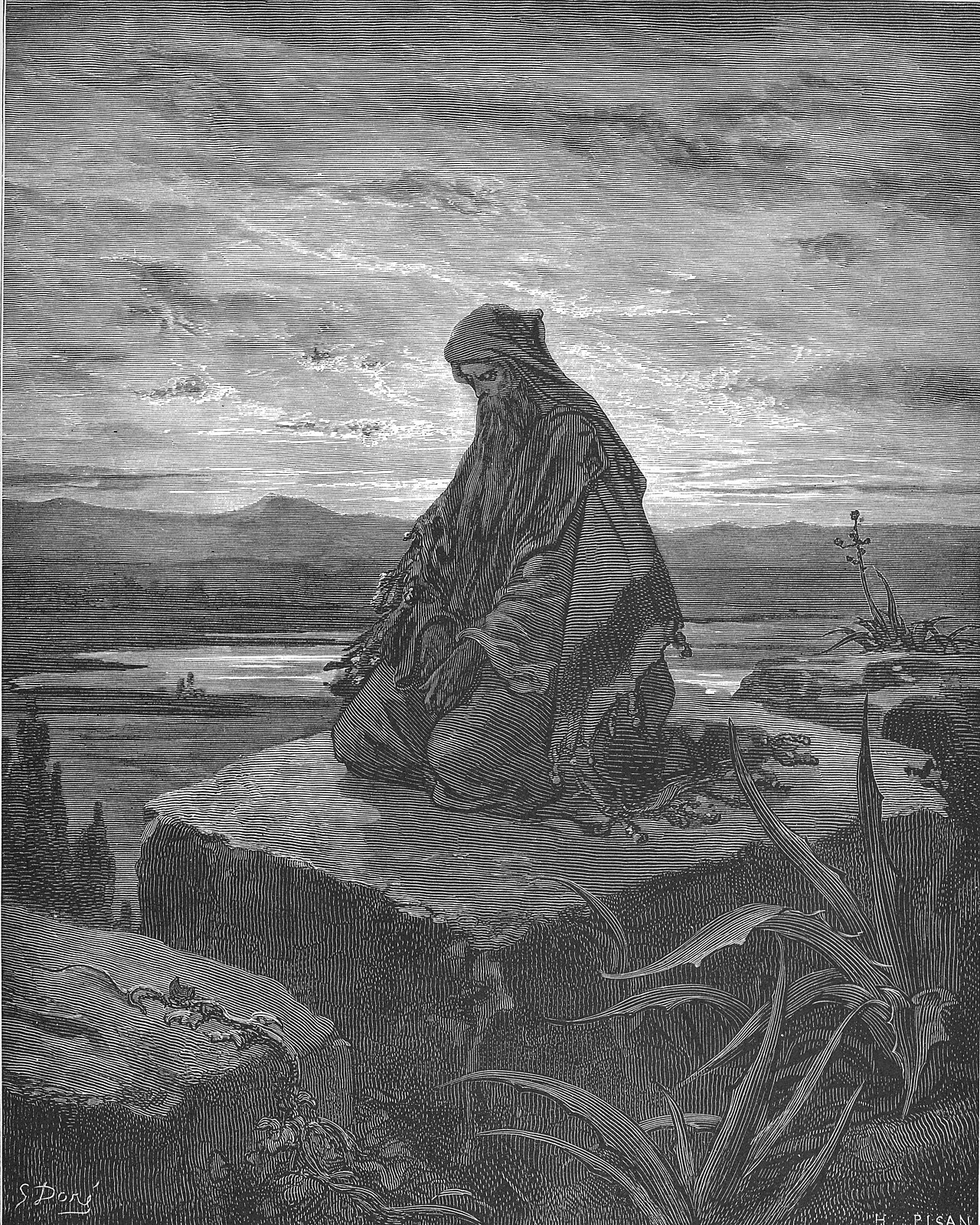
Isaiahchapter 6
13 verses · Isaiah · 8th century BC · The Prophets
In the year that King Uzziah died, I saw the Lord seated on a throne, high and exalted; and the train of His robe filled the temple.
Introduction
Isaiah, The Prophets, Isaiah Overview.
Isaiah wrote this chapter in his own voice and dated it to the year King Uzziah died. Its first hearers had lost the only king most of them could remember, a strong ruler who ended his reign set apart with a skin disease. It is the account of a vision and of the commission that came out of it. Listen for what the prophet sees, what he hears and what he says about himself. Notice what is done for him before he is sent. Mark the hard task he receives and the question he asks in reply. The chapter explains the message of the whole book from its source.
Context
- Who
- Judeans who had just lost the only king most of them could remember
- What
- A vision of the LORD enthroned in holiness, the cleansing of the prophet, and his commission to a people whose hearts will be hardened.
- Where
- The temple in Jerusalem, with its altar, its doorposts and the smoke of incense.
- When
- The year King Uzziah died, about 740 or 739 BC.
- Why
- To ground Isaiah's message in his meeting with the holy King and to prepare the hearers for a judgment that leaves a holy remnant.
Historical context
Uzziah had reigned about fifty-two years, long, strong, and prosperous. He ended it isolated in a separate house with a skin disease, struck down (the Chronicler says) for pushing into the temple to burn incense himself, which only priests could do. So the year he died, Judah was burying a great king who had died unclean, and the throne felt shaky. That is the year Isaiah sees the real throne, occupied.
Show the rest of the historical context, 3 more paragraphs
The room is furnished with what a worshipper would recognize. There is an altar with coals kept burning on it, and tongs beside it for handling them, because no one picks up altar coals by hand. Incense smoke fills the house at the hour of prayer. The doorposts shake, the frames of the great doors of the sanctuary.
The word translated seraphim means burning ones. The same root names the fiery serpents in the wilderness, and thrones in Egypt and Canaan were pictured guarded by winged serpent figures, so the image was not strange to that world. What is strange is what these ones do: with two wings they cover their faces and with two their feet, because they are not the frightening thing in the room.
The threefold holy is the strongest form of emphasis Hebrew has. There is no word for holiest; you say it three times.
Significance
For hearers who assumed a prophet's job was to change minds, the commission was brutal: go and preach, and the preaching will thicken the deafness. Some people are hardened by hearing.
Show the rest of the significance, 1 more paragraph
But the last line was the one they would need. When the tree is felled, a stump remains, and the holy seed is that stump. Judah was about to be cut down. Isaiah was told at the start that the stump would still be alive.
This chapter in Jewish lifeWhat this chapter is in Jewish life and reading.
What is done
This chapter is read aloud in the synagogue once a year, on the Sabbath of the portion Yitro, which carries the giving of the Ten Commandments (Exodus 18:1 to 20:23). The site's table in src/lib/hebraic/readings.ts records the Haftarah in two forms. In the Ashkenazi rite it runs Isaiah 6:1 to 7:6 and 9:5 to 9:6, and in the Sephardi rite Isaiah 6:1 to 6:13, the one chapter alone. The probe printed both rites for this chapter.
The verse numbers of the Haftarah are the Hebrew ones. The table itself states that the Hebrew Bible and an English translation part company by a verse in several places. Isaiah 9:5 to 9:6 in a Hebrew Bible is the child born and the son given, which an English Bible numbers 9:6 to 9:7.
How it is read
Rashi is the main commentator on this chapter in the corpus, quoted here from The Judaica Press complete Tanach with Rashi, translated by A. J. Rosenberg, which Sefaria reports as CC-BY. Ibn Ezra is quoted from the Commentary of Ibn Ezra on Isaiah, translated by M. Friedlander in 1873, which Sefaria reports as Public Domain.
The year King Uzziah died is read as the year he was struck with leprosy: "when he was smitten with zaraath" (Rashi on Isaiah 6:1:1). Rashi pictures the vision as God seated on His throne in heaven with His feet in the Temple (Rashi on Isaiah 6:1:2). On the threefold cry of the seraphim he writes only "Three times, as the Targum renders" (Rashi on Isaiah 6:3:2). He reads the calling of one to another as the angels taking permission from each other, so that none would begin before the rest (Rashi on Isaiah 6:3:1).
The prophet's cry "I am lost" is read as "I will die, for I was not worthy of seeing the Countenance of the Shechinah" (Rashi on Isaiah 6:5:1). Rashi sets it beside Manoah in Judges 13:22. The coal on the lips is for pain, "to atone for your iniquity that you degraded Israel" (Rashi on Isaiah 6:7:1).
At the question of the eighth verse the two commentators differ. Rashi reads it as God asking whom to send, after Amos had been mocked as tongue-tied (Rashi on Isaiah 6:8:1). Ibn Ezra takes "us" as God speaking to the seraphim, and his translator notes that by this reading he "avoids referring the plural for us to God" (Ibn Ezra on Isaiah 6:8:1). A Christian reader who takes the plural as God speaking of Himself should know that this classical Jewish reading gives it another sense. On the hardened heart of the tenth verse Rashi reads a continuous action: "Their heart continuously becomes fatter" (Rashi on Isaiah 6:10:1).
What the rabbis say
The corpus carries 40 rabbinic locators on the verses of this chapter, 8 in the Talmud and 32 in the Midrash. It carries the text of none, so each is cited by ref here and never quoted or paraphrased. The verse numbers are the Hebrew ones the corpus prints.
On verse 1 it holds Aggadat Bereshit 14:1, Aggadat Bereshit 14:2 and Chagigah 13b:5. It also holds Ein Yaakov (Glick Edition), Yevamot 4:2. On verse 2 it holds Aggadat Bereshit 31:1, Bamidbar Rabbah 12:8 and Bereshit Rabbah 1:3. It also holds Bereshit Rabbah 3:8. On verse 3 it holds Aggadat Bereshit 51:1, Aggadat Bereshit 55:1 and Avot DeRabbi Natan 12:6. It also holds Avot DeRabbi Natan, Recension B 26:1. On verse 4 it holds Jerusalem Talmud Pesachim 9:5:2, Mekhilta DeRabbi Yishmael, Tractate Pischa 11:9 and Mekhilta DeRabbi Yishmael, Tractate Pischa 6:1. It also holds Midrash Lekach Tov, Exodus 12:7:1. On verse 5 it holds Midrash Tanchuma, Vayishlach 2:5, Otzar Midrashim, Midrashim of Rabbi Akiba, Aleph Bet of Rabbi Akiba (Version 2) 16 and Pesikta Rabbati 11:1. It also holds Shir HaShirim Rabbah 1:6:1.
On verse 6 it holds Berakhot 4b:23, Berakhot 4b:25 and Devarim Rabbah 8:2. It also holds Ein Yaakov (Glick Edition), Berakhot 1:13. On verse 7 it holds Berakhot 57a:5, Ein Yaakov (Glick Edition), Shabbat 16:16 and Ein Yaakov, Shabbat 16:17. It also holds Midrash Sekhel Tov, Shemot 16:29:252. On verse 8 it holds Aggadat Bereshit 14:4, Midrash Aggadah, Deuteronomy 3:23:1 and Midrash Lekach Tov, Exodus 1:22:2. On verse 10 it holds Ein Yaakov (Glick Edition), Megillah 2:2, Ein Yaakov (Glick Edition), Rosh Hashanah 1:17 and Ein Yaakov, Rosh Hashanah 1:20. On verse 11 it holds Midrash Sekhel Tov, Bereshit 24:21:1 and Tanna DeBei Eliyahu Rabbah 16:1.
On verse 12 it holds Kohelet Rabbah 3:8:2. On verse 13 it holds Ein Yaakov (Glick Edition), Ketubot 13:22, Ein Yaakov, Ketubbot 13:19 and Ketubot 112b:2.
What each of them teaches is a saying of the rabbis, and is reported as theirs wherever this site quotes one. The quotations wait on a fetch that carries the text.
Sources: Rashi, Rashi on Isaiah 6:1:1 to 6:13:1, The Judaica Press complete Tanach with Rashi, translated by A. J. Rosenberg, reported CC-BY; Ibn Ezra, Ibn Ezra on Isaiah 6:7:1 to 6:9:1, Commentary of Ibn Ezra on Isaiah - trans. by M. Friedlander, 1873, reported Public Domain; The Sefaria corpus, scripts/data/sources/sefaria/isaiah/6.json, the 40 Talmud and Midrash locators on the verses of this chapter; The site's own files, src/lib/hebraic/readings.ts, probed for Isaiah 6: the Haftarah of Yitro, Isaiah 6:1 to 7:6 and 9:5 to 9:6 in the Ashkenazi rite and Isaiah 6:1 to 6:13 in the Sephardi rite.
The heads below are this chapter's scenes. The numbered points under each are its verses.
I Saw the Lord High and Lifted Up
In the year that King Uzziah: The vision is dated to the year King Uzziah died, a king whose presumption in burning incense had left him a leper. John 12:41 reads the vision as Isaiah seeing the glory of Christ. Delitzsch and Barnes note that the vision stands after five chapters of oracles.
Isaiah 6:1
“We have talked about standing; we have talked about walking; let us talk about sitting. Whenever God is represented as seated, the portrayal takes one of two forms: either he appears as the ruler or as the judge. If he is like a king, one sees him as Isaiah does: "I saw the Lord seated on a high and lofty throne." There he is presented as the sovereign king.”
Jerome · written before 420 · Homilies on the Psalms 14 (Psalm 81)patristic
2 more voices on this verseWhat preachers and commentators have said about this verse, in their own words.
Isaiah 6:1
“From the mortality of great and good men we should take occasion to look up with an eye of faith to the King eternal, immortal. King Uzziah died under a cloud, for he was shut up as a leper till the day of his death. As the lives of princes have their periods, so their glory is often eclipsed; but, as God is everliving, so his glory is everlasting.”
Matthew Henry · Commentary on the Whole Bible (1707-1721)puritan
Isaiah 6:1
“This is not the first beginning of Isaiah's prophecies, but his inauguration to a higher degree of the prophetic office: Isa 6:9, &c., implies the tone of one who had already experience of the people's obstinacy. Lord--here Adonai, Jehovah in Isa 6:5; Jesus Christ is meant as speaking in Isa 6:10, according to Joh 12:41.”
Jamieson, Fausset & Brown · Commentary Critical and Explanatory on the Whole Bible (1871)reformed
ConnectionsJohn 12:41
Isaiah 6:2-3
Above Him stood seraphim: Seraphim, throne attendants distinct from the cherubim, appear only in this chapter. The threefold "Holy, holy, holy" marks a superlative in Hebrew. The cry that "all the earth is full of His glory" carries that holiness out over the whole earth.
Isaiah 6:2
“Above it stood the seraphim - שרפים seraphim, from שרף seraph, to burn. He saw says Kimchi, the angels as flames of fire, that the depravity of that generation might be exhibited, which was worthy of being totally burnt up. He covered his feet “He covereth his feet” - By the feet the Hebrews mean all the lower parts of the body.”
Adam Clarke · Commentary on the Bible (1810-1826)evangelical
2 more voices on this verse
Isaiah 6:2
“Stood - As ministers attending upon their Lord. Seraphim - An order of holy angels, thus called from fire and burning, which this word properly signifies; to represent either their nature, which is bright and glorious, subtile, and pure; or their property, of fervent zeal for God's service and glory.”
John Wesley · Explanatory Notes upon the Old Testament (1765)evangelical
Isaiah 6:2
“Seraph is to burn; implying the burning zeal, dazzling brightness (2Ki 2:11; Mt 28:3) and serpent-like rapidity of the seraphim in God's service. Perhaps Satan's form as a serpent (nachash) in his appearance to man has some connection with his original form as a seraph of light.”
Jamieson, Fausset & Brown · Commentary Critical and Explanatory on the Whole Bible (1871)reformed
The seraphim call Holy three times, one to another, before the LORD of Hosts on His throne. Jerome and Fulgentius saw a sign of the Trinity in the three, and Cyril of Alexandria saw the earth full of His glory through Christ. Revelation 4:8 repeats the cry.
Isaiah 6:3
“Cherubim and seraphim with unwearied voices praise him and say, "Holy, holy, holy is the Lord God of hosts." They say it not once, lest you should believe that there is but one; not twice, lest you should exclude the Spirit; they say not holies [in the plural], lest you should imagine that there is plurality, but they repeat three times and say the same word, that even in a hymn you may understand the distinction of persons in the Trinity and the oneness of the Godhead, and while they say this they proclaim God.”
Ambrose of Milan · written before 397 · On the Holy Spirit 3.16.110patristic
2 more voices on this verse
Isaiah 6:3
“Cried - Singing in consort. Holy - This is repeated thrice, to intimate the Trinity of persons united in the Divine essence. Glory - Of the effects and demonstrations of his glorious holiness, as well as of his power, wisdom, and goodness.”
John Wesley · Explanatory Notes upon the Old Testament (1765)evangelical
Isaiah 6:3
“And one cried to another - Hebrew ‘This cried to this.’ That is, they cried to each other in alternate responses.”
Isaiah 6:4-5
At the sound of their voices: At the seraphim's cry "the temple was filled with smoke," the same smoke that filled the tabernacle when the Lord's glory took possession of it. Isaiah answers, "Woe is me, for I am ruined," and confesses unclean lips, the very organ the seraphim used to sing holiness.
Isaiah 6:4
“This violent concussion of the temple was an indication of God's wrath and displeasure against the people for their sins; it was an earnest of the destruction of it and the city by the Babylonians first, and afterwards by the Romans; and it was designed to strike an awe upon us.”
Matthew Henry · Commentary on the Whole Bible (1707-1721)puritan
1 more voice on this verse
Isaiah 6:4
“The posts - Together with the door itself. Such violent motions were commonly tokens of God's anger. Smoak - Which elsewhere is a token of God's presence and acceptance, but here of his anger.”
John Wesley · Explanatory Notes upon the Old Testament (1765)evangelical
A Live Coal from the Altar: Here Am I, Send Me
I am a man of unclean lips: The Hebrew verb for ruined can mean silenced, and Jerome and Clarke take it that way. Clarke says Isaiah was unworthy to join the seraphim calling holy. Henry says that after the seraphim praised holiness, Isaiah names his sin as unclean lips.
Isaiah 6:5
“The angels had celebrated the purity and holiness of God; and therefore the prophet, when he reflects upon sin, calls it uncleanness; for the sinfulness of sin is its contrariety to the holy nature of God, and upon that account especially it should appear both hateful and frightful to us.”
Matthew Henry · Commentary on the Whole Bible (1707-1721)puritan
Isaiah 6:6-7
Then one of the seraphim flew: A seraph answers the confession before Isaiah asks. Atonement is pictured as fire from the altar applied to the very lips Isaiah had just confessed unclean. The word spoken over the act names removal and cleansing together, "your iniquity is removed and your sin is atoned for."
Isaiah 6:6
“A live coal - The word of prophecy, which was put into the mouth of the prophet. From off the altar - That is, from the altar of burnt-offerings, before the door of the temple, on which the fire that came down at first from heaven (Lev 9:24; 2Ch 7:1) was perpetually burning. It was never to be extinguished, Lev 6:12, Lev 6:13.”
Adam Clarke · Commentary on the Bible (1810-1826)evangelical
your iniquity is removed: The coal touches the lips called unclean in 6:5. Barnes takes the touch as a sign that Isaiah was cleansed and his iniquity removed. The coal came from the altar, and the pardon comes before the LORD asks whom He shall send.
Isaiah 6:7
Tell me, then, whoever you are who deny the divinity of the Holy Spirit. The Spirit could not be liable to sin, who rather forgives sin. Does an angel forgive? Does an archangel? Certainly not, but the Father alone, the Son alone and the Holy Spirit alone [can forgive sins]. Now one is obviously able to avoid that which he has power to forgive.But perhaps someone will say that the seraph said to Isaiah, "Behold, this has touched your lips and shall take away your iniquities and purge away your sins."
Ambrose of Milan · written before 397 · On the Holy Spirit 1.10.112patristic
2 more voices on this verse
Isaiah 6:7
“And he laid it upon my mouth - Margin, ‘And he caused it to touch my mouth.’ This is the more correct rendering. It was a slight, momentary touch, sufficient merely to be a “sign or token” that he was cleansed. Thine iniquity is taken away - That is, whatever obstacle there existed to your communicating the message of God to this people, arising from your own consciousness of unworthiness, is taken away. You are commissioned to bear that message, and your own consciousness of guilt should not be a hinderance.”
Isaiah 6:7
“Laid it - So as only to touch my lips, and not to burn them; which God could easily effect. Lo - This is a sign that I have pardoned and purged the uncleanness of thy lips.”
John Wesley · Explanatory Notes upon the Old Testament (1765)evangelical
Then I heard the voice: The Lord asks who will go "for Us," the plural God uses of Himself at Genesis 1:26. Isaiah answers "Here am I" before the terms of the mission are given, volunteering for one of the hardest commissions any prophet received. The offer comes after the coal has touched his lips.
Isaiah 6:8
“The voice of the Lord - Hebrew: “The voice of Yahweh.” He had before been addressed by one of the seraphim. Whom shall I send, and who will go for us? - The change of number here, from the singular to the plural, is very remarkable. Jerome, on this place, says that it indicates the ‘sacrament’ of the Trinity.”
2 more voices on this verse
Isaiah 6:8
“Who - To deliver the following message. The change of the number, I and us, is very remarkable; and both being meant of one and the same Lord, do sufficiently intimate a plurality of persons in the Godhead.”
John Wesley · Explanatory Notes upon the Old Testament (1765)evangelical
Isaiah 6:8
BROTHERS AND SISTERS, the heathen are perishing and there is but one way of salvation for them, for there is but one name given under Heaven among men whereby they must be saved. God, in the glorious unity of His Divine Nature is calling for messengers who shall proclaim to men the way of life. Out of the thick darkness my ears can hear that sound mysterious and Divine, "Whom shall I send?" If you will but listen with the ear of faith you may hear it in this house today—"Whom shall I send?"
Preach Until the Cities Lie Waste: but a Holy Seed Remains
Isaiah 6:9-10
The New Testament quotes this hardening at Matthew 13:15, Mark 4:12 and Luke 8:10, and at John 12:40 and Acts 28:27. The hardening is spoken as the Lord's own command, "Make the hearts of this people calloused," with the stated end that they would not turn.
Isaiah 6:9
“And he said ... - The expressions which follow are those which denote hardness of heart and blindness of mind. They would hear the words of the prophet, but they would not understand him. They were so obstinately bent on iniquity that they would neither believe nor regard him. This shows the spirit with which ministers must deliver the message of God. It is their business to deliver the message, though they should know that it will neither be understood nor believed. Hear ye indeed - Hebrew ‘In hearing, hear.’ This is a mode of expressing emphasis.”
2 more voices on this verse
Isaiah 6:9
“Perceive not - The Hebrew words are imperative; yet they are not to be taken as a command what the people ought to do, but only as a prediction what they would do. The sense is, because you have so long heard my words, and seen my works, to no purpose, and have hardened your hearts, and will not learn nor reform, I will punish you in your own kind, your sin shall be your punishment.”
John Wesley · Explanatory Notes upon the Old Testament (1765)evangelical
Isaiah 6:9
“They see indeed (for the vision is made plain on tables, so that he who runs may read it); but they perceive not their own concern in it; it is to them as a tale that is told.”
Matthew Henry · Commentary on the Whole Bible (1707-1721)puritan
Cross references
Isaiah 6:9
- Quoted inActs 28:26‘Go to this people and say, “You will be ever hearing but never understanding; you will be ever seeing but never perceiving.”
'Hearing ye shall hear, and shall not understand', Paul's closing word in Rome
- Quoted inLuke 8:10“He replied, “The knowledge of the mysteries of the kingdom of God has been given to you, but to others I speak in parables, so that, ‘though seeing, they may not see; though hearing, they may not understand.’”
'that seeing they might not see' (parables rationale)
- Quoted inMark 4:12so that, ‘they may be ever seeing but never perceiving, and ever hearing but never understanding; otherwise they might turn and be forgiven.’”
'seeing they may see, and not perceive' (parables rationale)
- Quoted inMatthew 13:14“In them the prophecy of Isaiah is fulfilled: ‘You will be ever hearing but never understanding; you will be ever seeing but never perceiving.”
'By hearing ye shall hear, and shall not understand' (parables rationale; most-quoted OT text in NT)
Make the hearts of this people calloused: Clarke holds that the prophet is said to do what he foretells, so the people's hearts grow calloused as they hear him. Henry says God gives those who refuse to see and hear over to blindness. Matthew 13:15 and John 12:40 cite it.
Isaiah 6:10
“It is from the heart that corruption flows into the ears and eyes (Mr 7:21, 22); but through the eyes and ears healing reaches the heart (Ro 10:17), [BENGEL]. In Mt 13:15, the words are quoted in the indicative, "is waxed gross" (so the Septuagint), not the imperative, "make fat"; God's word as to the future is as certain as if it were already fulfilled.”
Jamieson, Fausset & Brown · Commentary Critical and Explanatory on the Whole Bible (1871)reformed
1 more voice on this verse
Isaiah 6:10
“This making of their hearts fat, is here ascribed to the prophet, as it is ascribed to God in the repetition of this prophecy, John xii, 40, because God inflicted this judgment upon them by the ministry of the prophet, partly by way of prediction, foretelling that this would be the effect of his preaching; and partly by withdrawing the light and help of his Spirit.”
John Wesley · Explanatory Notes upon the Old Testament (1765)evangelical
Cross references
Isaiah 6:10
- Quoted inJohn 12:40“He has blinded their eyes and hardened their hearts, so that they cannot see with their eyes, and understand with their hearts, and turn, and I would heal them.”
'He hath blinded their eyes' (hardening; John says Isaiah 'saw his glory')
Isaiah 6:11-12
Isaiah asks how long the hardening will last. Verse 12 carries the ruin into exile, language that reaches past the near Assyrian crisis to the Babylonian captivity a century off. The answer gives no date, only a condition, the land emptied and its people driven away.
Isaiah 6:11
“How long - The prophet did not dare to pray that this effect should not follow. He asked merely therefore “how long” this state of things must continue; how long this message was to be delivered, and how long it should be attended with these painful effects. Until the cities ... - They will remain perverse and obstinate until the land is completely destroyed by divine judgments. Still the truth is to be proclaimed, though it is known it will have no effect in reforming the nation. This refers, doubtless, to the destruction that was accomplished by the Babylonians.”
1 more voice on this verse
Isaiah 6:11
“Lord - An abrupt speech, arising from the prophet's great passion and astonishment: how long shall this dreadful judgment last? Until - Until this land be totally destroyed, first by the Babylonians, and afterward by the Romans.”
John Wesley · Explanatory Notes upon the Old Testament (1765)evangelical
the land is utterly forsaken: The LORD's answer to the question of 6:11 is exile. Barnes says the men driven far away are the strength of the nation, carried to a distant land and leaving the land forsaken. Assyria took Israel, and Babylon later took Judah.
Isaiah 6:12
“And the Lord have removed ... - The land shall be given up to desolation. The men - the strength of the nation - shall be taken to a distant land. And there be a great forsaking - A great desolation; the cities and dwellings shall be abandoned by the inhabitants; compare Isa 17:2; Jer 4:29; Zep 2:4.”
And though a tenth remains: The chapter refuses to end on desolation, for even "though a tenth remains in the land, it will be burned again," and still something survives. A felled tree leaves a living stump. Chapter 11 takes up the same image, a shoot growing from the stump of Jesse.
Isaiah 6:13
“According to Isaiah, not all Israel, but the elect remnant alone, is destined to salvation. God shows unchangeable severity towards sin, but covenant faithfulness in preserving a remnant, and to it Isaiah bequeaths the prophetic legacy of the second part of his book (the fortieth through sixty-sixth chapters).”
Jamieson, Fausset & Brown · Commentary Critical and Explanatory on the Whole Bible (1871)reformed
1 more voice on this verse
Isaiah 6:13
“God will turn them, and they shall be turned. (2.) That they shall be eaten, that is, shall be accepted of God as the tithe was, which was meat in God's house, Mal. iii. The saving of this remnant shall be meat to the faith and hope of those that wish well to God's kingdom.”
Matthew Henry · Commentary on the Whole Bible (1707-1721)puritan
Keep studying
Studies17
People and groups1
Words12
Sources for this chapter
The summary
Jamieson, Fausset & Brown, Commentary Critical and Explanatory; John Calvin, Commentaries; John Wesley, Notes on the Old Testament and Matthew Henry, Complete Commentary.
The exposition
Adam Clarke, Commentary on the Bible; Albert Barnes; Cyril of Alexandria, COMMENTARY ON ISAIAH 1:4; Franz Delitzsch, Biblical Commentary on the Prophecies of Isaiah; Fulgentius of Ruspe, TO PETER ON THE FAITH 6; Jerome, Commentary on Isaiah; John Calvin, Commentary on the Book of the Prophet Isaiah; John Gill and Matthew Henry, Commentary on the Whole Bible.