
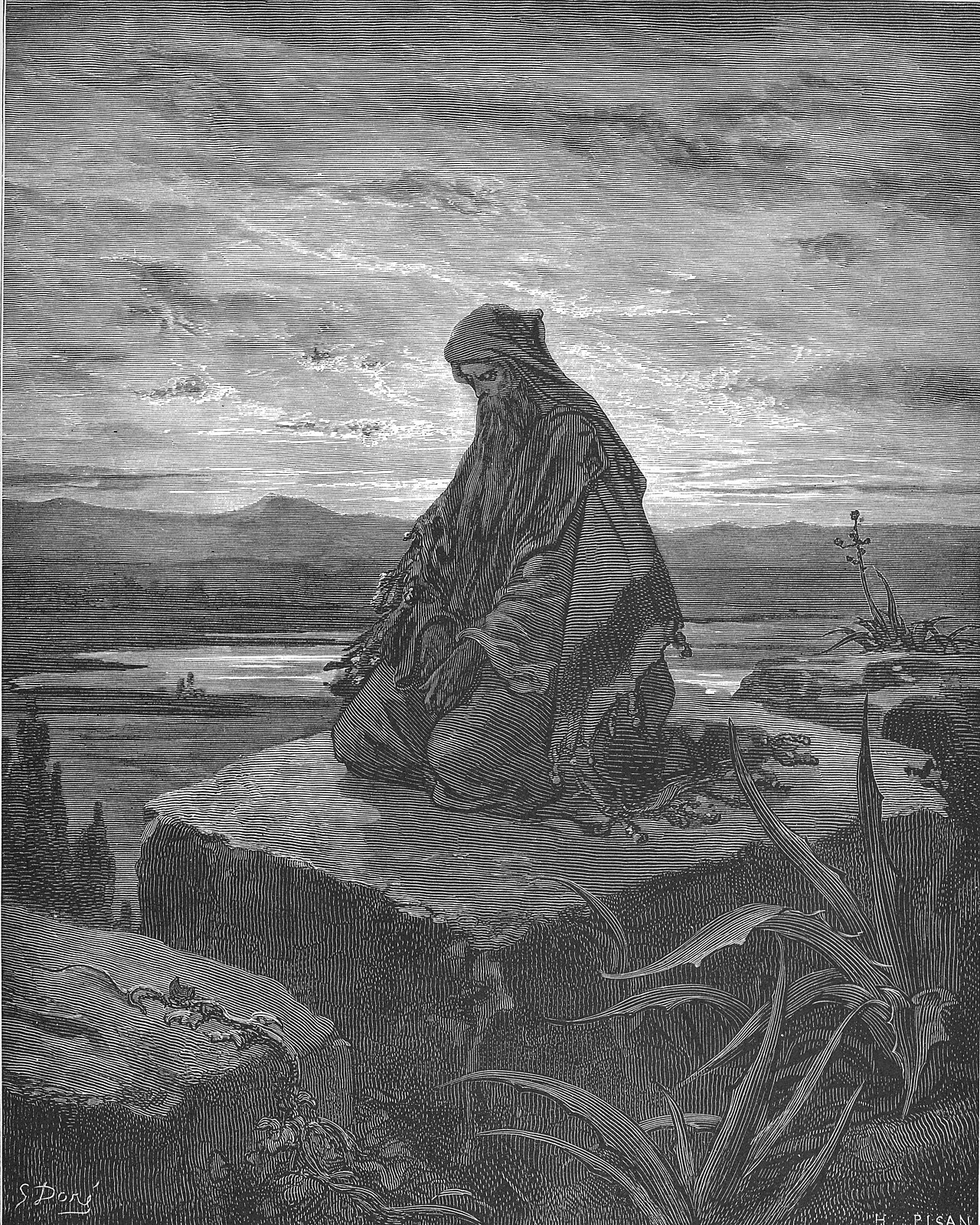
Isaiahchapter 32
20 verses · Isaiah · 8th century BC · The Prophets
But a noble man makes honorable plans; he stands up for worthy causes.
Introduction
Isaiah, The Prophets, Isaiah Overview.
Isaiah sets this chapter between the warnings about Egypt and the woe on the destroyer. It speaks to a comfortable city and to the women who ran its households at ease. Its hearers lived in dry country, where shade, water and shelter from a storm decided who lived. The chapter sets out what good rule looks like and then gives a close date for the loss of a harvest. Listen for the names given to fools and scoundrels, and for the turn that comes when the Spirit is poured out.
Context
- Who
- The women of the capital, and everyone living off a good vintage
- What
- A picture of a king who reigns in righteousness, a warning to the complacent women of Jerusalem, and a promise of the Spirit poured out.
- Where
- Jerusalem and its farmland, pictured against the dry country of the south.
- When
- Spoken about 705 to 701 BC, with the failed harvest dated a little more than a year away.
- Why
- To set the justice of a coming reign against the ease of a city about to lose its harvest, and to show that renewal comes from God.
Historical context
The four pictures of a good ruler are all survival images from a dry land. A hiding place from the wind, when the desert storm comes off the east and strips a field in hours. A cover from the tempest, when the winter rain arrives in a wall. Streams of water in a dry place. And the shade of a great rock in a weary land, on the Negev routes, a boulder's shadow at midday was the difference between walking on and lying down. A king was measured by whether being under him felt like that.
Show the rest of the historical context, 4 more paragraphs
Then a village-square observation. In a society run on honor, what people are publicly called is what they get to be, and Isaiah says the change comes when the fool is no longer called noble and the swindler is no longer called generous. He defines the terms himself: the fool speaks folly, his hands work wickedness, he leaves the hungry empty and the thirsty without a drink; the swindler's schemes are aimed at destroying the poor with lying words, even when the needy speaks a case that is right.
The address to the women at ease has a date on it. In a little more than a year you will be troubled, the vintage will fail, the harvest will not come. Then the instructions are mourning instructions: strip off your fine clothes, put sackcloth on your waist, beat your breasts for the pleasant fields and the fruitful vine.
The ruin is described concretely. The palace forsaken, the crowded city deserted, the fortress hill and the watchtower given over to wild donkeys grazing and flocks pasturing where houses were. That is what an abandoned town looked like within a few seasons.
The turn comes with a phrase used sparingly in the Old Testament: until the Spirit is poured on us from on high. Then the wilderness becomes farmland and the farmland looks like forest, justice lives in the desert and righteousness in the field, and the fruit of it is quietness and confidence forever. The chapter ends with a farmer's blessing, happy are you who sow beside all waters, who send out the feet of the ox and the donkey.
Significance
The chapter puts two futures side by side and dates one of them. The good king is coming; the failed harvest is coming first, and much sooner.
Show the rest of the significance, 1 more paragraph
For a comfortable class, the alarming word was ease itself. Isaiah calls them careless daughters twice, not wicked ones. Complacency was the charge.
This chapter in Jewish lifeWhat this chapter is in Jewish life and reading.
What is done
No part of this chapter is read aloud in the synagogue. The site's own table in src/lib/hebraic/readings.ts printed parashot 0 and haftarah uses 0 for Isaiah 32, and no festival reading for the book. The table records Isaiah only as a source of Haftarot, and none of the Haftarot it records reaches this chapter.
The chapter is met instead in the study of the weekly portions, and the corpus names the doors. Under the first verse it carries Midrash Tanchuma Buber, Ha'Azinu 2:2 and Midrash Tanchuma, Ha'Azinu 2:1. Each of those locators is named for the Torah portion whose study it belongs to.
How it is read
Rashi is quoted here from The Judaica Press complete Tanach with Rashi, translated by A. J. Rosenberg, which Sefaria reports as CC-BY, and Ibn Ezra from the Commentary of Ibn Ezra on Isaiah translated by M. Friedlander in 1873, which Sefaria reports as public domain. Rashi's first note states a rule of kingship in one line. "Behold a king has no right to reign except to execute righteous judgment" (Rashi on Isaiah 32:1:1). He reads the verse of Ahaz, a wicked man, and of Hezekiah his son, who is worthy to reign (Rashi on Isaiah 32:1:2). The man who is a hiding place from the wind is Hezekiah, in whom the remnant of the ten tribes will trust (Rashi on Isaiah 32:2:1 and 32:2:2).
The opened eyes and ears of the third and fourth verses Rashi reads as the undoing of the commission in chapter 6. The eyes that were sealed and the heart that was made fat are healed, and he cites both verses (Rashi on Isaiah 32:3:1 and 32:4:1). At the seventh verse he gives the Hebrew word for judgment three senses: the first plea, the sentence, and the carrying out of the verdict (Rashi on Isaiah 32:7:1).
The spirit poured from on high at the fifteenth verse he joins to Zechariah 12:10 and Joel 3:1, where the same verb of pouring is used of the spirit (Rashi on Isaiah 32:15:1). Ibn Ezra reads the peace of the seventeenth verse "as in the time of Hezekiah", and the translator's note records that others read the passage he compares of the Messiah (Ibn Ezra on Isaiah 32:17:1). The two readings stand in the one entry. Rashi closes the chapter on a blessing of Israel: "the sowing of your righteousness has succeeded like those who sow by all waters" (Rashi on Isaiah 32:20:1).
What the rabbis say
The corpus carries forty rabbinic locators on this chapter and the text of none, so each is cited by ref here and none is quoted or paraphrased. On the first verse it holds Midrash Tanchuma Buber, Ha'Azinu 2:2, Midrash Tanchuma, Ha'Azinu 2:1 and Shir HaShirim Rabbah 2:7:1. On the fifth verse it holds Ein Yaakov (Glick Edition), Sotah 7:34, Ein Yaakov, Sotah 7:39, Sotah 41b:8 and Yalkut Shimoni on Torah 133:14. On the sixth verse it holds Tanna DeBei Eliyahu Rabbah 25:1. On the seventh verse it holds Ein Yaakov (Glick Edition), Bava Batra 1:13 and Jerusalem Talmud Sanhedrin 10:2:7. On the eighth verse it holds Tanna DeBei Eliyahu Rabbah 17:1.
On the ninth verse it holds Berakhot 17a:13, Bereshit Rabbah 79:6, Ein Yaakov (Glick Edition), Berakhot 2:13, Ein Yaakov, Berakhot 2:22 and Otzar Midrashim, Midrash Gadol u'Gedolah 22. On the eleventh verse it holds Bereshit Rabbati, Parashat Vayetze 1, Eikhah Rabbah, Petichta 24 and Tractate Semachot 8:9. On the twelfth verse it holds Jerusalem Talmud Sotah 7:5:2 and Moed Katan 27b:7. On the fourteenth verse it holds Eikhah Rabbah 3:17. On the fifteenth verse it holds Eikhah Rabbah 1:23, Midrash Aggadah, Deuteronomy 1:1:12, Pesikta Rabbati 12:1 and Pesikta Rabbati 29:45.
On the sixteenth verse it holds Otzar Midrashim, Midrash Gadol u'Gedolah 4. On the seventeenth verse it holds Bamidbar Rabbah 11:7, Bamidbar Rabbah 14:10, Bava Batra 9a:13, Bereshit Rabbati, Parashat Toldot 10 and Bereshit Rabbati, Parashat Vayechi 34. On the eighteenth verse it holds Midrash Lekach Tov, Numbers 6:26:2, Midrash Tehillim 92:4 and Otzar Midrashim, Midrashim of Rabbi Akiba, Aleph Bet of Rabbi Akiba (Version 2) 50. The same verse also carries Otzar Midrashim, Midrashim on Megilat Esther, Introduction 3. On the twentieth verse it holds Avodah Zarah 5b:3, Bava Kamma 17a:8, Bava Kamma 2b:19 and Bava Kamma 3a:11. What each of them teaches is a saying of the rabbis, and it is reported as theirs wherever this site quotes one. The quotations wait on a fetch that carries the text.
Sources: Rashi, Rashi on Isaiah 32:1:1 to 32:20:1, The Judaica Press complete Tanach with Rashi, translated by A. J. Rosenberg, reported CC-BY; Ibn Ezra, Ibn Ezra on Isaiah 32:3:1 to 32:18:1, Commentary of Ibn Ezra on Isaiah, translated by M. Friedlander, 1873, reported public domain; The Sefaria corpus, scripts/data/sources/sefaria/isaiah/32.json, the 40 Talmud and Midrash locators of this chapter; The site's own files, src/lib/hebraic/readings.ts, printing no portion, no Haftarah and no festival reading for this chapter, and src/data/bible/chapter-verse-counts.json for the verse count.
The heads below are this chapter's scenes. The numbered points under each are its verses.
A King Shall Reign in Righteousness, a Hiding Place from the Wind
Isaiah 32:1-2
a king will reign in righteousness: Isaiah announces that "a king will reign in righteousness, and princes will rule with justice". Matthew Henry and John Wesley found the nearest occasion in the reign of Hezekiah, who followed Ahaz. Each ruler will be "like a shelter from the wind, a refuge from the storm".
Isaiah 32:1
“They shall reign in righteousness and in judgment, with wisdom and equity, protecting the good and punishing the bad; and those kings and princes Christ owns as reigning by him who decree justice, Prov. viii. Such a King, such a Prince, Christ himself is; he reigns by rule, and in righteousness will he judge the world, ch. ix.”
Matthew Henry · Commentary on the Whole Bible (1707-1721)puritan
1 more voice on this verseWhat preachers and commentators have said about this verse, in their own words.
Isaiah 32:1
“Behold, a king - That is, Hezekiah. That it refers to him is apparent from the connection. The reign of Ahaz had been one of oppression and idolatry. This was to be succeeded by the reign of one under whom the rights of the people would be secured, and under whom there would be a state of general prosperity. This may have been uttered while Ahaz was on the throne, or it may have been when Hezekiah began to reign.”
the shadow of a great rock: Each figure answers a desert hazard: wind, storm, thirst and heat. Adam Clarke noted that a great rock gives the coolest shade in a hot country, for the stone itself holds a chill. The rulers of verse 1 are to shelter their people in the same way.
Isaiah 32:2
“As the shadow of a great rock - The shadow of a great projecting rock is the most refreshing that is possible in a hot country, not only as most perfectly excluding the rays of the sun, but also as having in itself a natural coolness, which it reflects and communicates to every thing about it. Speluncaeque tegant, et saxea procubet umbra. Virg. Georg. 3:145. “Let the cool cave and shady rock protect them.” Επει κεφαλην και γουνατα Σειριος αζει, Αυαλεος δε τε χρως απο καυματος· αλλα τοτ’ ηδη Ειη πετραιη τε σκιν, και Βιβλινος οινος. Hesiod.”
Adam Clarke · Commentary on the Bible (1810-1826)evangelical
2 more voices on this verse
Isaiah 32:2
“It is a great reviving to a good man, who makes conscience of doing his duty, in the midst of contempt and contradiction, at length to be backed, and favoured, and smiled upon in it by a good magistrate. All this, and much more, the man Christ Jesus is to all the willing faithful subjects of his kingdom.”
Matthew Henry · Commentary on the Whole Bible (1707-1721)puritan
Isaiah 32:2
“I SUPPOSE it must be conceded that the surface sense of this passage refers to Hezekiah and to other good kings who were the means of great blessings to the declining kingdom of Judah. We can scarcely be thankful enough for a righteous government. If, for a few years, we could feel the yoke of despotism, we should better appreciate the joys of freedom. In the prophecy before us, very much is said in praise of a king who shall reign in righteousness and princes who shall rule in judgment.”
Isaiah 32:3-4
the eyes of those who see: Under this reign "the eyes of those who see will no longer be closed". The older commentators set this beside Isaiah 6:9 and 10, now turned back. Albert Barnes traced the same words into the later chapters, where blindness and deafness are undone as marks of the coming kingdom.
Isaiah 32:3
“And the eyes of them that see ... - The sense of this verse is, that there shall be, under the reign of this wise and pious prince, on the part of the prophets and teachers, a clear view of divine truth, and on the part of the people who hear, a disposition to hearken and to attend to it.”
the stammering tongue will speak clearly: The rash judge in haste and fall into error. Barnes read the promise as a mind given time to weigh a matter, so that it will know and understand. Under the king who reigns in righteousness, the stammering tongue speaks clearly as well.
Isaiah 32:4
“The heart also of the rash - Margin, ‘Hasty.’ The Hebrew word denotes those who hasten; that is, those who are precipitate in forming a judgment, or deciding on a course of action. They do not take time to deliberate, and consequently they are led headlong into error, and into improper courses of life. Shall understand knowledge - They shall take time to deliberate; and they shall consequently form a more enlightened judgment.”
1 more voice on this verse
Isaiah 32:4
“The heart of fools, who formerly erred following idols; and the tongue of stammerers, the prophets, who formerly spoke obscurely and enigmatically: wisdom opened the mouth of the dumb, and made the tongues of infants eloquent (Wis 10:21).”
Thomas Aquinas · written before 1274 · Commentary on Isaiahpatristic
Isaiah 32:5-8
No longer will a fool be called noble: Under the righteous king, "No longer will a fool be called noble, nor a scoundrel be respected". The fool "leaves the hungry empty", the scoundrel "hatches plots to destroy the poor with lies". Matthew Henry noted that the promise corrects common speech, so that flattering names no longer cover greed.
Isaiah 32:5
“The vile person shall be no more called liberal,.... Or "Nabal" (a fool) "shall no more be called Nadib" (e) (a prince); or have this name put upon him, or be advanced to honour and dignity, or be flattered with such a title, so unbecoming him.”
2 more voices on this verse
Isaiah 32:5
“The vile person - Hebrew, ‘Fool.’ But the connection requires us to understand this as the opposite of liberal; and it means a person who is close, miserly, narrow-minded, covetous. This person is designated, very appropriately, as a fool. Shall be no more called liberal - It is probable that under the reign of former princes, when all views of right and wrong had been perverted, people of unprincipled character had been the subjects of flattery, and names of virtue had been attributed to them by their friends and admirers.”
Isaiah 32:5
“Whether this was fulfilled in the reign of Hezekiah, and how far it refers to the kingdom of Christ (in which we are sure men are judged of by what they are, not by what they have, nor is any man's character mistaken), we will not say; but it prescribes an excellent rule both to prince and people, to respect men according to their personal merit.”
Matthew Henry · Commentary on the Whole Bible (1707-1721)puritan
a fool speaks foolishness: The line reads like a proverb, and Adam Clarke found the same saying in Euripides. The fool's words, plans and deeds all run one way. In the end he leaves the needy hungry and thirsty.
Isaiah 32:6
“The vile person will speak villany “The fool will still utter folly” - A sort of proverbial saying, which Euripides (Bacchae, 369) has expressed in the very same manner and words: Μωρα γαρ μωρος λεγει· “The fool speaks folly. “Of this kind of simple and unadorned proverb or parable, see De S. Poes, Hebr. Praelect. xxiv. Against the Lord “Against Jehovah” - For אל El, two MSS. read אל al, more properly; but both are of nearly the same meaning.”
Adam Clarke · Commentary on the Bible (1810-1826)evangelical
1 more voice on this verse
Isaiah 32:6
“They labour at it; their hearts are intent upon it, and with a great deal of art and application they work iniquity. They devise wicked devices with all the subtlety of the old serpent and a great deal of deliberation, which makes the sin exceedingly sinful; and the more there is of plot and management in a sin the more there is of Satan in it.”
Matthew Henry · Commentary on the Whole Bible (1707-1721)puritan
The weapons of the scoundrel are destructive: The Hebrew plays on the sound of scoundrel and his weapons, a wordplay no translation can carry. Barnes took the weapons to be words, court rulings and schemes turned against the poor. The needy lose even when their plea is just.
Isaiah 32:7
“The instruments also - In the Hebrew here there is a paronomasia which cannot be imitated in a translation. The word ‘instruments’ here denotes evidently the means by which the churl accomplishes his object; whether it be by words, by judicial decisions, or by crafty devices. This is also a kind of proverbial expression, and is given as a further reason why such a person would not be employed by a wise and virtuous prince.”
a noble man makes honorable plans: Verse 5 named four kinds of people, and verses 6 to 8 describe the fool, the scoundrel and now the noble. Adam Clarke noted that the fourth, the respected man of verse 5, receives no portrait of his own. The noble man stands by what he plans.
Isaiah 32:8
“Third, the prudence of Ezechias in his reign: the prince, for Ezechias commanded that no one should respond to Sennacherib, above: I will restore your princes as they were before (Isa 1:26).”
Thomas Aquinas · written before 1274 · Commentary on Isaiahpatristic
1 more voice on this verse
Isaiah 32:8
“Liberal things “Generous purposes” - “Of the four sorts of persons mentioned Isa 32:5, three are described, Isa 32:6, Isa 32:7, and Isa 32:8, but not the fourth.” - Secker. Perhaps for והוא vehu, and he, we ought to read ושוע veshoa, the bountiful.”
Adam Clarke · Commentary on the Bible (1810-1826)evangelical
Tremble, Careless Women: Thorns Come Up on the Land
Isaiah 32:9-11
Stand up, you complacent women: The prophet turns to the women of Jerusalem, "complacent women", "overconfident daughters", and tells them to tremble and "put sackcloth around your waists". Trouble is near, "In a little more than a year you will tremble". The older commentators tie this to the Assyrian ruin of Judah’s countryside.
Isaiah 32:9
“Rise up, ye women that are at ease,.... On beds of down, unconcerned about the present or future state of the nation; who had their share of guilt in the nation's sins, particularly pride, luxury, superstition, rejection of the Messiah, and contempt of his Gospel, and so should have their part in its punishment. Some think that the men of the nation are so called, because of their effeminacy.”
1 more voice on this verse
Isaiah 32:9
“Address to the women of Jerusalem who troubled themselves little about the political signs of the times, but lived a life of self-indulgence (Isa 3:16-23); the failure of food through the devastations of the enemy is here foretold, being what was most likely to affect them as mothers of families, heretofore accustomed to every luxury.”
Jamieson, Fausset & Brown · Commentary Critical and Explanatory on the Whole Bible (1871)reformed
In a little more than a year: The secure women have little more than a year before they tremble. Only the grape harvest and the fruit harvest are named. Jamieson, Fausset & Brown took the wheat to be gathered already, so the enemy would arrive when grapes and fruit still hung on the vine.
Isaiah 32:10
“As the wheat harvest is omitted, Isaiah must look for the invasion in the summer or autumn of 714 B.C., when the wheat would have been secured already, and the later fruit "gathering," and vintage would be still in danger.”
Jamieson, Fausset & Brown · Commentary Critical and Explanatory on the Whole Bible (1871)reformed
1 more voice on this verse
Isaiah 32:10
“Many days and years - Margin, ‘Days above a year.’ This is a literal translation of the Hebrew. Septuagint, ‘Make mention of a day of a year in sorrow, with hope.’ Targum, ‘Days with years.’ Kimchi supposes it means ‘two years.’ Grotius supposes it means ‘within three years.’ Various other interpretations may be seen in Poole’s Synopsis. Gesenius renders it, ‘For a year’s time,’ according to the common expression ‘a year and a day,’ denoting a complete year, and supposes that it means a considerable time, a long period.”
put sackcloth around your waists: The complacent women of verse 9 are told to strip off their fine clothing and put on the sackcloth of mourning. Barnes sent the reader back to Isaiah 3:24. Their leisure ends when the harvest fails.
Isaiah 32:11
“Strip ye, and make ye bare - That is, take off your joyful and splendid apparel, and put on the habiliments of mourning, indicative of a great calamity. And gird sackcloth - (See the note at Isa 3:24).”
2 more voices on this verse
Isaiah 32:11
“Second, as to the devastation of the fields, he prescribes mourning, be astonished: I have put off the robe of peace (Bar 4:20), above: and the Lord in that day shall call to weeping (Isa 22:12).”
Thomas Aquinas · written before 1274 · Commentary on Isaiahpatristic
Isaiah 32:11
“Such times they saw in the latter end of the reign of Hezekiah; but the prophecy may well be supposed to look further, to the days of the Messiah, who is King of righteousness and King of peace, and to whom all the prophets bear witness.”
Matthew Henry · Commentary on the Whole Bible (1707-1721)puritan
Isaiah 32:12-14
Beat your breasts for the pleasant fields: The lament moves from "the pleasant fields" and "the fruitful vines" to a land "overgrown with thorns and briers". Then "the palace will be forsaken, the busy city abandoned", and "The hill and the watchtower will become caves forever". Albert Barnes set the words in the Assyrian crisis under Sennacherib.
Isaiah 32:12
“They shall lament - for the pleasant fields “Mourn ye for the pleasant field” - The Septuagint, Syriac, and Vulgate read ספדו siphdu, mourn ye, imperative; twelve MSS., (five ancient), two editions, the Septuagint, Aquila, Symmachus, Theodotion, Syriac, and Vulgate, all read שדה sadeh, a field; not שדי shedey, breasts.”
Adam Clarke · Commentary on the Bible (1810-1826)evangelical
1 more voice on this verse
Isaiah 32:12
“The foregoing prophecy was delivered, not in the time of Ahaz for he sent to the Assyrian, not the Egyptian, for help; it was Hezekiah, who rebelled against the king of Assyria, and was too prone to trust upon the staff of Egypt. But this seems to have been delivered in the time of Ahaz. A king - Hezekiah, a type of Christ, and Christ typified by him.”
John Wesley · Explanatory Notes upon the Old Testament (1765)evangelical
Thorns and briers over farmland repeat the picture Isaiah drew at 7:20-25 for the Assyrian invasion, and Barnes read both passages of the same event. The city of revelry is Jerusalem, called by that name at Isaiah 22:2. Joy gives way to weeds.
Isaiah 32:13
“Upon the land of my people - A description similar to this, in regard to the consequences of the invasion of Sennacherib, is given in Isa 7:20-25 (see the notes at that passage). Yea, upon all the houses of joy - Margin, ‘Burning upon.’ The marginal readling has originated from the supposition that the word כי kı̂y is derived from כיה kâvâh, “to be burned.” This conjecture has been adopted by Junius and Tremellius, and by some others. But it is evidently mere conjecture, and is not demanded.”
2 more voices on this verse
Isaiah 32:13
“They shall be abandoned; the owners shall never return to them; every body shall look upon them to be like Jericho, an anathema; so that, even when peace returns, they shall not be rebuilt, but shall be thrown to the waste: A joy of wild asses and a pasture of flocks. Thus is many a house brought to ruin by sin.”
Matthew Henry · Commentary on the Whole Bible (1707-1721)puritan
Isaiah 32:13
“However, the prophecy, in its full accomplishment, refers to the utter desolation of Judea and its capital by Rome, and subsequently, previous to the second coming of the King (Ps 118:26; 19:38); "the joyous city" is in this view, Jerusalem (Isa 22:2).”
Jamieson, Fausset & Brown · Commentary Critical and Explanatory on the Whole Bible (1871)reformed
the busy city abandoned: The hill here is the Ophel, a raised spur of Zion near the temple with a wall of its own, as Adam Clarke explained. The strongest quarter of the city becomes a haunt of wild donkeys. Flocks graze where guards once stood.
Isaiah 32:14
“Because the palaces shall be forsaken,.... The palaces of the princes and nobles shall be forsaken by them, they being obliged to flee from the enemy, or being taken, and either slain, or carried captive.”
1 more voice on this verse
Isaiah 32:14
“The palaces shall be forsaken - The house of the sanctuary (the temple) shall be destroyed. - Targum. The forts “Ophel” - It was a part of Mount Zion, rising higher than the rest, at the eastern extremity, near to the temple, a little to the south of it; called by Micah, Mic 4:8, “Ophel of the daughter of Zion. “It was naturally strong by its situation; and had a wall of its own, by which it was separated from the rest of Zion.”
Adam Clarke · Commentary on the Bible (1810-1826)evangelical
Until the Spirit Be Poured Upon Us from on High
the Spirit is poured out upon us: The ruin lasts "until the Spirit is poured out upon us from on high". The commentators set this pouring beside Joel 2:28, the promise of the Spirit poured out on all people, read at Pentecost. Then "the desert will be an orchard, and the orchard will seem like a forest".
Isaiah 32:15
“Until - Until the time come, in which God will pour, or, as the Hebrew word properly signifies, reveal, evidently and plentifully pour out his spirit from heaven upon his people, which was fully accomplished in the days of the Messiah.”
John Wesley · Explanatory Notes upon the Old Testament (1765)evangelical
1 more voice on this verse
Isaiah 32:15
“Until the Spirit - The Spirit of God, as the source of all blessings, and especially as able to meet and remove the ills of the long calamity and desolation. This evidently refers to some future period, when the evils which the prophet was contemplating would be succeeded by the spread of the true religion. If the prophet meant to confine his description of calamities to those which would attend the invasion of Sennacherib, then this refers to the piety and prosperity which would prevail after that during the reign of Hezekiah.”
Isaiah 32:16-18
justice will inhabit the wilderness: Now "justice will inhabit the wilderness, and righteousness will dwell in the fertile field". "The work of righteousness will be peace; the service of righteousness will be quiet confidence forever". Matthew Henry drew out this order, righteousness bringing peace and peace bringing the "safe and secure places of rest".
Isaiah 32:16
“Then judgment shall dwell - Or, justice shall make its appropriate dwelling-place there. In the wilderness - In the place that was a wilderness, but that shall now be turned to a fruitful field. In the fruitful field - In the nation that is like a fruitful field; in Judea restored.”
1 more voice on this verse
Isaiah 32:16
“The law of Christ introduces a judgment or rule by which we must be governed, and the gospel of Christ a righteousness by which we must be saved; and, wherever the Spirit is poured out, both these dwell and remain as an everlasting righteousness.”
Matthew Henry · Commentary on the Whole Bible (1707-1721)puritan
The work of righteousness will be peace: Peace here is the product of righteousness, and the verse traces cause to effect. Barnes took the peace to include calm at home and freedom from foreign war. This confidence replaces the overconfidence of the women in verse 9.
Isaiah 32:17
“And the work of righteousness - That which righteousness produces; or the effect of the prevalence of righteousness on the nation. Shall be peace - There shall be no internal agitation, and no conflicts with foreign nations. Quietness and assurance - This is a beautiful description of the happy effect of the prevalence of piety; and it is as true now as it was in the time of Isaiah. True religion would put an end to strifes and litigations; to riots and mobs; to oppressions and tumults; to alarms and robbery; to battle, and murder, and conflict.”
will dwell in a peaceful place: The palace and busy city left empty in verse 14 are answered here by homes made safe. Matthew Henry pictured a people who had lived through Sennacherib's invasion valuing an undisturbed house as never before. Peace reaches the doorstep.
Isaiah 32:18
“And my people shall dwell in a peaceable habitation - In cities and towns that would not be alarmed bv internal or external foes. And in sure dwellings - In dwellings that would be secure from invasion. - All this is descriptive of the peaceful times, and the general security which followed the return from Babylon. To this period of happiness and prosperity, Isaiah, as well as the other prophets, often refers.”
1 more voice on this verse
Isaiah 32:18
“It is a great mercy when those who by the grace of God have quiet and peaceable spirits are by the providence of God made to dwell in quiet and peaceable habitations, not disturbed in their houses or solemn assemblies. When the terror of Sennacherib's invasion was over, the people, no doubt, were more sensible than ever of the mercy of a quiet habitation, not disturbed with the alarms of war.”
Matthew Henry · Commentary on the Whole Bible (1707-1721)puritan
Isaiah 32:19-20
hail will level the forest: The chapter sets judgment beside the promise of peace: "But hail will level the forest". It closes with a blessing on "those who sow beside abundant waters, who let the ox and donkey range freely". John Gill read it as peace so full that working animals labor free of raids.
Isaiah 32:19
“Hail, namely, of tribulation, in the descent of the forest, that is, it shall descend from the Lord upon your enemies; the city, Ninive, above: the high city he shall lay low (Isa 26:5).”
Thomas Aquinas · written before 1274 · Commentary on Isaiahpatristic
3 more voices on this verse
Isaiah 32:19
“When it shall hail - Hebrew, ברדת ברד bârad beredeth - ‘And it shall hail in coming down. There is a paranomasia in the original here, which cannot be expressed in a translation - a figure of speech, which, as we have seen, is common in Isaiah. ‘Hail’ is an image of divine vengeance or punishment; and the reference here is, doubtless, to the storms of indignation that would come on the enemies of the Jews, particularly on the Assyrians (see the notes at Isa 30:30).”
Isaiah 32:19
“The city - Jerusalem, which, though now it was the seat of God's worship and people, yet he foresaw, would be the great enemy of the Messiah. Low - Hebrew. shall be humbled with humiliation: shall be greatly humbled, or brought very low.”
John Wesley · Explanatory Notes upon the Old Testament (1765)evangelical
Isaiah 32:19
“Those that would dwell in a peaceable habitation must be willing to dwell low, and in a low place. Some think here is an allusion to the preservation of the land of Goshen from the plague of hail, which made great destruction in the land of Egypt.”
Matthew Henry · Commentary on the Whole Bible (1707-1721)puritan
who sow beside abundant waters: Land beside abundant waters was the field most likely to bear good fruit. Adam Clarke cited a traveller who watched rice sown on flooded land, where the ox and donkey first trod the ground. The chapter ends in the fields mourned in verse 12.
Isaiah 32:20
“Accordingly, like a perfect man learned in the law and made firm in the gospel, accept the faith of both Testaments, for, as we read today, "Blessed is he who sows upon every water, where the ox and the donkey tread," that is, who sows upon the people who follow the teaching of both Testaments. This is the ploughman's ox, wearing the yoke of the law, of which the law says, "You shall not muzzle the ox that treads out your corn," for this ox has the horns of holy Scripture.”
Ambrose of Milan · written before 397 · Letter 63.88patristic
4 more voices on this verse
Isaiah 32:20
“That sow beside all waters “Who sow your seed in every well-watered place” - Sir John Chardin’s note on this place is: “This exactly answers the manner of planting rice; for they sow it upon the water, and before sowing, while the earth is covered with water, they cause the ground to be trodden by oxen, horses, and asses, who go mid-leg deep; and this is the way of preparing the ground for sowing.”
Adam Clarke · Commentary on the Bible (1810-1826)evangelical
Isaiah 32:20
“This is applicable, [1.] To the preaching of the word. Some think it points at the ministry of the apostles, who, as husbandmen, went forth to sow their seed ( Matt. xiii. 3 ); they sowed beside all waters; they preached the gospel wherever they came.”
Matthew Henry · Commentary on the Whole Bible (1707-1721)puritan
Isaiah 32:20
“CASTALIO thinks there is an allusion to the Mosaic precept, not to plough with an ox and ass together, mystically implying that the Jew was to have no intercourse with Gentiles; the Gospel abolishes this distinction (Col 3:11); thus the sense here is, Blessed are ye that sow the gospel seed without distinction of race in the teachers or the taught.”
Jamieson, Fausset & Brown · Commentary Critical and Explanatory on the Whole Bible (1871)reformed
Isaiah 32:20
“Waters - In all moist grounds, which are like to yield good fruit. But this also is to be understood of the times of the gospel, and of the great and happy success of the ministers of it.”
John Wesley · Explanatory Notes upon the Old Testament (1765)evangelical
Keep studying
Sources for this chapter
The summary
Jamieson, Fausset & Brown, Commentary Critical and Explanatory; John Calvin, Commentaries; John Wesley, Notes on the Old Testament and Matthew Henry, Complete Commentary.
The exposition
Adam Clarke, Commentary on the Bible; Albert Barnes; Franz Delitzsch, Biblical Commentary on the Prophecies of Isaiah; Jamieson, Fausset & Brown, Commentary Critical and Explanatory on the Whole Bible; John Gill, Exposition of the Old Testament; John Wesley, Explanatory Notes upon the Old Testament and Matthew Henry, Commentary on the Whole Bible.