
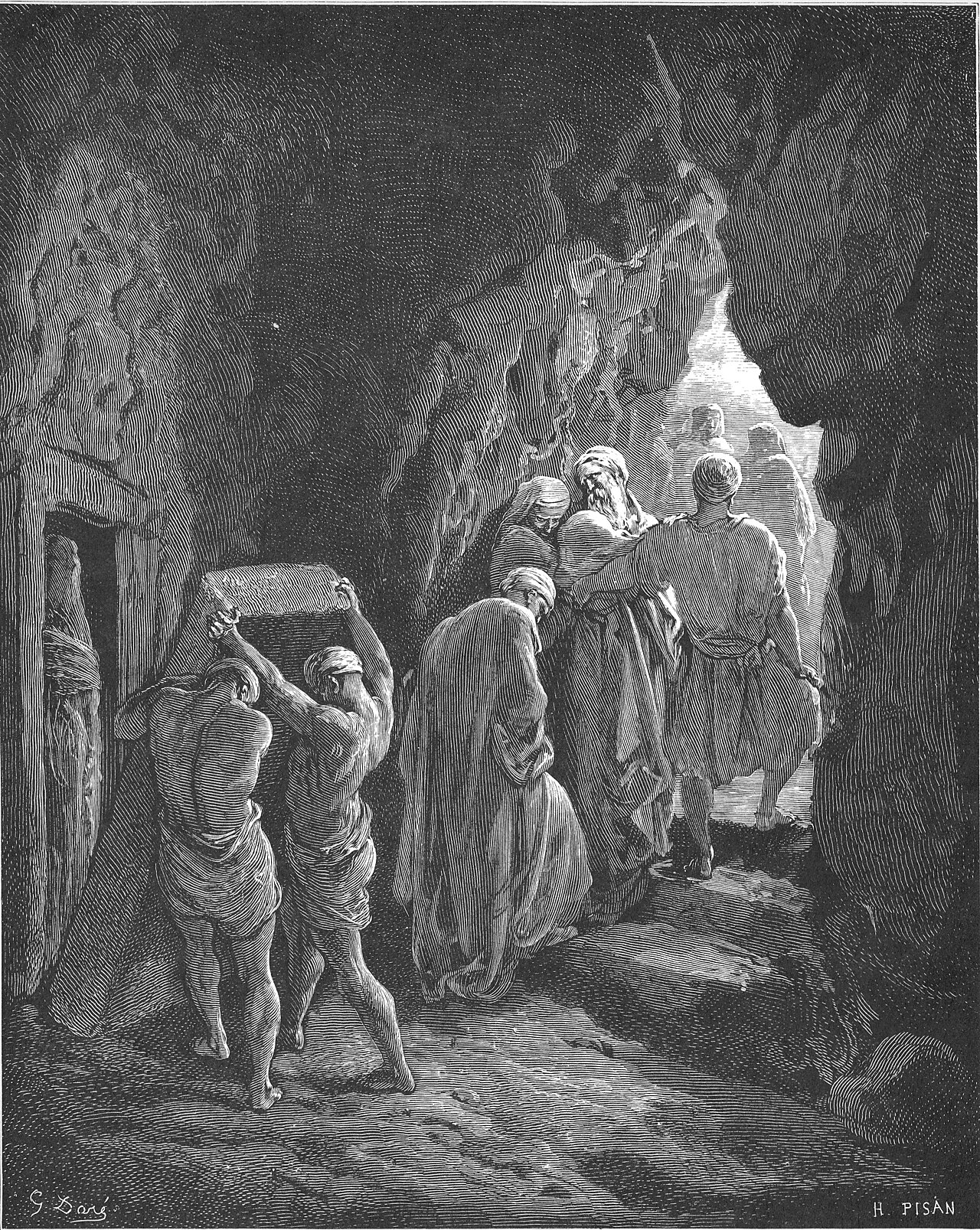
Genesischapter 23
20 verses · Moses, by tradition · 15th to 13th century BC · The Law
In Jewish life
The reading
Weekly portion 5 of 54
חַיֵּי שָׂרָה Chayei Sarah, Genesis 23:1 to 25:18
Read with it: 1 Kings 1:1 to 1:31.
The verse numbers here are the ones a Hebrew Bible carries, which differ from an English Bible by a verse or two in several places. The Sephardi reading is named only where this site records a difference; communities vary beyond what is listed. What these books are, and how a Christian reader meets them →
What is done
This chapter opens the fifth portion of the annual cycle, and the portion runs from its first verse to Genesis 25:18 (src/lib/hebraic/readings.ts). A congregation hears the death of Sarah, the buying of the cave, the finding of Rebecca and the death of Abraham in one sitting. The card above carries the portion and the prophetic reading set beside it.
How it is read
Rashi is quoted here from the public domain Rosenbaum and Silbermann edition. Radak and Malbim are quoted from the CC-BY translation of Eliyahu Munk, HaChut Hameshulash.
The chapter is a purchase, and the classical comment reads it as a legal record. Rashi reads the standing of Abraham in the fourth verse two ways. The plain sense is a man from another land who has settled among them. The Midrashic sense is an offer and a claim together, that he will buy as a stranger or take as a settler by the promise given him (Rashi on Genesis 23:4:1, citing Genesis Rabbah 58:6).
Malbim reads the answer of the sons of Heth as the custom of the place. A man of his standing "may have the best grave in the public cemetery", or may ask for the private plot of any man in town. Their own custom keeps a plot of his own out of the hands of a sojourner (Malbim on Genesis 23:5:1). Radak adds that the townspeople were willing, and wanted Abraham to hold a burial plot among them (Radak on Genesis 23:20:1).
Rashi reads the sitting of Ephron in the tenth verse from a missing letter. The man had been made an officer that same day, so that Abraham would deal with someone of standing (Rashi on Genesis 23:10:1, citing Genesis Rabbah 58:7). He reads the name of Ephron in the sixteenth verse as written short because the man was short in his dealing, promising much and doing little (Rashi on Genesis 23:16:1, citing Bava Metzia 87a). He notes that Abraham paid in shekels that passed everywhere at full weight.
Ibn Ezra carries four comments on this chapter that the corpus holds by reference alone, at Ibn Ezra on Genesis 23:3:1, 23:7:1, 23:12:1 and 23:19:1.
What the rabbis say
Rashi carries three sayings of the rabbis on this chapter, and each stands here as what they taught.
The first is on the years of Sarah. Rashi reads the repeated word for years in the first verse as a sign that each number stands on its own. At a hundred she was as a woman of twenty as to sin, and the years were all equally good (Rashi on Genesis 23:1:1 and 23:1:2).
The second is on the name of the city. Rashi reports that Kiriath-arba is the city of the four, named either for the four giants who lived there or for the four couples buried there. The couples he names are Adam and Eve, Abraham and Sarah, Isaac and Rebecca, and Jacob and Leah (Rashi on Genesis 23:2:1, citing Genesis Rabbah 58:4). He reads the name of the cave in the same way, as a double cave with a chamber above and below, or as doubled by those couples (Rashi on Genesis 23:9:1, citing Eruvin 53a).
The third is on what the sale did to the field. Rashi reports the reading that the field rose in standing, since it passed from a commoner to a king. He gives the plain sense of the verse beside it (Rashi on Genesis 23:17:1, citing Genesis Rabbah 58:8).
The corpus records forty places where the Midrash and the Talmud cite this chapter, twenty seven under Midrash and thirteen under Talmud, which is the heaviest Talmud weight of these twenty five. The weight falls on the purchase, because the tractates that argue about sale and title are the tractates that cite it.
The Talmud is cited at Bava Kamma 93a:3 on the mourning, Berakhot 18a:3 on the rising from the dead, Chullin 120a:18 on the eighth verse and Bekhorot 50a:8 on the tenth. It is cited at Bava Metzia 87a:3 and Avot DeRabbi Natan 13:3 on the fifteenth verse, and at Bava Batra 69b:1 on the seventeenth. The Jerusalem Talmud is cited at Bava Metzia 9:11:1 on the fourth verse and Kiddushin 1:3:4 on the eighth. It is cited at Berakhot 4:3:5 and Kiddushin 1:1:3 on the thirteenth verse, Berakhot 9:5:2 on the eighteenth and Sotah 5:6:2 on the twenty first.
Bereshit Rabbah reads the first verse at 58:1, the second at 58:4, the tenth at 58:7 and the twelfth at 58:6. It reads the sixteenth verse at 79:7, the seventeenth at 58:8 and the nineteenth at 58:9. Bereshit Rabbati reads four places in Parashat Chayei Sarah, at 9, 10, 11 and 12. Aggadat Bereshit reads the fourth verse at 58:4, the sixth at 29:3 and 56:1, and the nineteenth at 34:1. Bamidbar Rabbah reads the first verse at 14:11 and the third at 2:26, and the Mekhilta of Rabbi Yishmael reads the fifth and sixth at Tractate Pischa 18:2.
The text, verse by verse
Each word shows the Hebrew, the English under it, how it sounds and its Strong’s number. A rule between verses marks where the Hebrew manuscripts end a paragraph.
Sarah Dies at Hebron
Ramban on Genesis 23:1
A HUNDRED AND TWENTY YEARS Rashi comments: “The reason the word ‘years’ is written at every term is that it informs you that each term must be interpreted by itself.
Read it in full at Sefaria · Commentary on the Torah by Ramban (Nachmanides). Translated and annotated by Charles B. Chavel. New York, Shilo Pub. House, 1971-1976
Buying the Cave of Machpelah
Ibn Ezra on Genesis 23:12
Abraham bowed before Ephron in the presence of the people of the land in order to honor him.
Read it in full at Sefaria · Ibn Ezra's commentary on the Pentateuch, tran. and annot. by H. Norman Strickman and Arthur M. Silver. Menorah Pub., 1988-2004
Ramban on Genesis 23:13
‘LU’ (IF) THOU WILT HEAR ME. This is equivalent to saying, “If you, if you will hear me,” and the purport thereof is like, “if you, if you would hear me,” the redundancy being for the purpose of emphasizing the matter.
Read it in full at Sefaria · Commentary on the Torah by Ramban (Nachmanides). Translated and annotated by Charles B. Chavel. New York, Shilo Pub. House, 1971-1976
The Field Deeded to Abraham
Hebrew words in this chapter
The 40 most used Hebrew words of the chapter, counted by lemma. The article, the object marker, the negatives and the common prepositions are left out.
| Word | Sense here | Uses | Strong’s |
|---|---|---|---|
| אַבְרָהָםʼAbrâhâm | Abraham | 12 | H85 |
| בֵּןbên | son | 10 | H1121 |
| מוּתmûwth | and she died | 9 | H4191 |
| חֵתChêth | Heth | 8 | H2845 |
| קָבַרqâbar | to bury | 8 | H6912 |
| עֶפְרוֹןʻEphrôwn | Ephron | 8 | H6085 |
| שָׂדֶהsâdeh | field his | 8 | H7704 |
| נָתַןnâthan | to give | 7 | H5414 |
| אֶרֶץʼerets | land | 6 | H776 |
| אָמַרʼâmar | to say | 6 | H559 |
| שָׁמַעshâmaʻ | listen to us | 6 | H8085 |
| שָׂרָהSârâh | Sarah | 5 | H8283 |
| קֶבֶרqeber | a burial site | 5 | H6913 |
| מְעָרָהmᵉʻârâh | cave | 5 | H4631 |
| כֶּסֶףkeçeph | silver | 5 | H3701 |
| שָׁנֶהshâneh | year | 4 | H8141 |
| קוּםqûwm | and he arose | 4 | H6965 |
| דָבַרdâbar | and he spoke | 4 | H1696 |
| עַםʻam | people | 4 | H5971 |
| מֵאָהmêʼâh | hundred | 3 | H3967 |
| Word | Sense here | Uses | Strong’s |
|---|---|---|---|
| בּוֹאbôwʼ | and he went | 3 | H935 |
| אֲחֻזָּהʼăchuzzâh | possession | 3 | H272 |
| עָנָהʻânâh | and they answered | 3 | H6030 |
| אָדוֹןʼâdôwn | lord | 3 | H113 |
| תָּוֶךְtâvek | midst | 3 | H8432 |
| מַכְפֵּלָהMakpêlâh | Machpelah | 3 | H4375 |
| אֹזֶןʼôzen | ear | 3 | H241 |
| חַיchay | life of | 2 | H2416 |
| קִרְיַת אַרְבַּעQiryath ʼArbaʻ | at kiriath | 2 | H7153 |
| חֶבְרוֹןChebrôwn | Hebron | 2 | H2275 |
| כְּנַעַןKᵉnaʻan | Canaan | 2 | H3667 |
| פָּנִיםpânîym | face | 2 | H6440 |
| שָׁחָהshâchâh | to bow | 2 | H7812 |
| שַׁעַרshaʻar | gate | 2 | H8179 |
| עִירʻîyr | city his | 2 | H5892 |
| עַיִןʻayin | to eyes of | 2 | H5869 |
| אַרְבַּעʼarbaʻ | four | 2 | H702 |
| שֶׁקֶלsheqel | shekel | 2 | H8255 |
| מַמְרֵאMamrêʼ | Mamre | 2 | H4471 |
| עֶשְׂרִיםʻesrîym | twenty | 1 | H6242 |
Keep studying
Sources for this chapter
The Hebrew text
STEP Bible, the tagged Hebrew text and its English glosses and James Strong, Strong's Exhaustive Concordance.
In Jewish life
Rashi, Rashi on Genesis 23, in Pentateuch with Rashi's commentary by M. Rosenbaum and A. M. Silbermann, 1929 to 1934, public domain; Radak, Radak on Genesis 23:3:1, 23:5:1 and 23:20:1, in HaChut Hameshulash, translated by Eliyahu Munk, CC-BY; Malbim, Malbim on Genesis 23:5:1, in HaChut Hameshulash, translated by Eliyahu Munk, CC-BY; Ibn Ezra, his four comments on Genesis 23, cited by reference; the licence Sefaria reports for the English version keeps the text out of the corpus; The Midrash and the Talmud, the forty locators on Genesis 23 in scripts/data/sources/sefaria/genesis/23.json and MannaFest, the annual cycle table at src/lib/hebraic/readings.ts.
The rabbinic texts
Ramban, Commentary on the Torah by Ramban (Nachmanides). Translated and annotated by Charles B. Chavel. New York, Shilo Pub. House, 1971-1976; Ibn Ezra, Ibn Ezra's commentary on the Pentateuch, tran. and annot. by H. Norman Strickman and Arthur M. Silver. Menorah Pub., 1988-2004 and Sefaria, texts and citation data.