
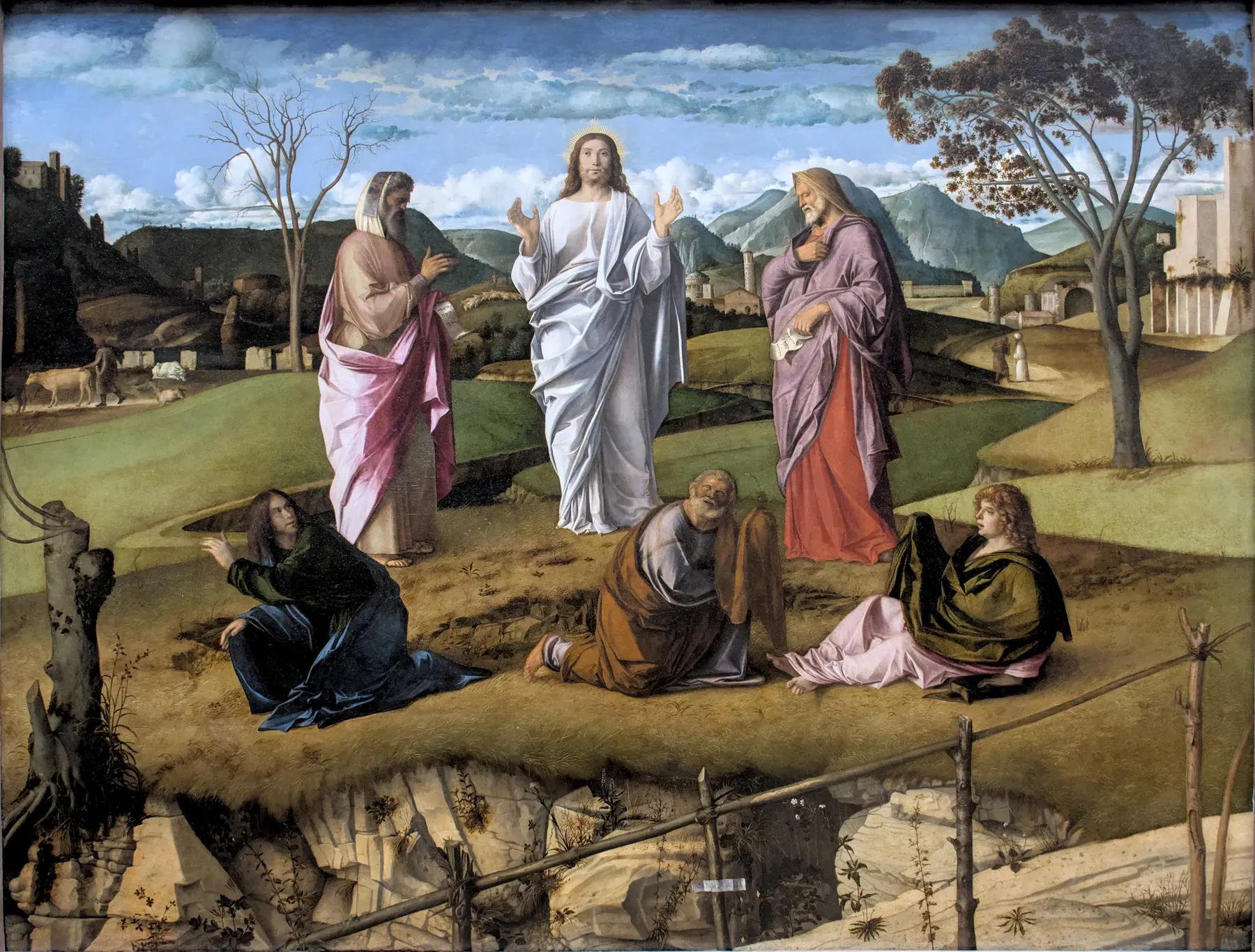
2 Peterchapter 2
22 verses · Peter, by tradition · AD 64 to 68 · The general letters
For if God did not spare the angels when they sinned, but cast them deep into hell, placing them in chains of darkness to be held for judgment;
Introduction
Peter, by tradition, The general letters, 2 Peter Overview.
This chapter is the hardest part of Peter's last letter, a warning about teachers who had already found a place in the churches. He writes for believers who welcomed these men to their meals and supported them. The chapter answers them with history, drawn from the early pages of Genesis and from the book of Numbers. Listen for the long sentence built on the word if, and for the two rescues set inside the three judgments. Listen also for the pictures of animals, water and mist that describe the teachers. Read it as a warning to people who were being taken in.
Context
- Who
- Congregations paying and housing men who were exploiting them
- What
- A warning about false teachers inside the church, proved from three judgments of old and followed by a portrait of the teachers' greed, lust and empty promises.
- Where
- The churches of Asia Minor, most likely addressed from Rome, where these teachers ate at the believers' shared meals.
- When
- About AD 65 to 68 on the traditional dating, as teachers who used grace as an excuse for sin gained ground in the churches.
- Why
- To show that God judges those who lead His people astray and rescues the righteous among them, so believers can recognize these teachers and stand firm.
Historical context
The teachers described made money. Peter says they exploit people with fabricated stories, which describes a trade: a persuasive man attaches himself to a house church, gathers a following, and lives off it, the same abuse the earlier letters warned about, now grown bold.
Show the rest of the historical context, 3 more paragraphs
The first judgment named is angels who sinned, cast down and held in chains of gloomy darkness. Peter uses a word that names the deepest pit of Greek myth, and the sequence, angels, then the flood, then Sodom, is the sequence of Genesis. The house reading takes this as the Watchers of Genesis 6, the sons of God who crossed a line and were imprisoned for it, as 1 Enoch describes at length.
The alternative reading, that these are simply the angels who fell with Satan before creation, is named here rather than dismissed; the reason the Watchers reading is preferred is the tight link Peter makes to Noah's generation and the parallel in Jude, which quotes 1 Enoch by name.
Balaam is the third example and the most pointed, because he was a prophet with real ability who sold his services. The two proverbs at the end, the dog returning to its vomit and the washed pig going back to the mud, were common folk sayings; the first is in Proverbs, and both are the kind of blunt farmyard line everyone had heard.
Significance
The hearers were being asked to look at men they had welcomed and see them in the company of the angels who fell, the world that drowned, and the cities that burned. That is a deliberately shocking lineup.
Show the rest of the significance, 1 more paragraph
The chapter's mercy is in the same examples. Noah was preserved and Lot was pulled out, so the same account that promises judgment also promises rescue for the ones being taken advantage of.
The heads below are this chapter's scenes. The numbered points under each are its verses.
False Teachers, and a God Who Knows How to Rescue
As false prophets troubled Israel, false teachers will secretly introduce destructive heresies, pareisaxousin. Denying the Master who bought them, agorasanta, names a purchase that some read as real redemption later denied and others as professed only. Their destruction is swift.
2 Peter 2:1
“But there were false prophets also among the people - In the previous chapter, 2Pe 2:19-21, Peter had appealed to the prophecies as containing unanswerable proofs of the truth of the Christian religion. He says, however, that he did not mean to say that all who claimed to be prophets were true messengers of God. There were many who pretended to be such, who only led the people astray. It is unnecessary to say, that such men have abounded in all ages where there have been true prophets.”
2 more voices on this verseWhat preachers and commentators have said about this verse, in their own words.
2 Peter 2:1
“Either the heresies are the effect of denying the Lord, or the denying the Lord was the consequence of the heresies. Even denying - Both by their doctrine and their works. The Lord that bought them - With his own blood.”
John Wesley · Explanatory Notes upon the New Testament (1755)evangelical
2 Peter 2:1
“Whom the true doctrine teaches to be their OWNER by right of purchase. Literally, "denying Him who bought them (that He should be thereby), their Master." bought them--Even the ungodly were bought by His "precious blood." It shall be their bitterest self-reproach in hell, that, as far as Christ's redemption was concerned, they might have been saved.”
Jamieson, Fausset & Brown · Commentary Critical and Explanatory on the Whole Bible (1871)reformed
2 Peter 2:2-3
Many will follow in their depravity: , and the way of truth will be defamed. In their greed, these false teachers will exploit you with deceptive words, plastois logois, molded speech, and exploit is emporeuontai, the trader's verb. Their destruction does not sleep.
2 Peter 2:2
“Many shall follow - Will follow, because determined to gratify their sinful propensities. Pernicious ways - Ταις απωλειαις· Their destructions; i.e. the heresies of destruction, or destructive opinions, mentioned above. But instead of απωλειαις, destructions, ασελγειαις, lasciviousnesses or uncleannesses, is the reading of ABC, and upwards of sixty others, most of which are among the most ancient, correct, and authentic. This is the reading also of both the Syriac, all the Arabic, the Coptic, Ethiopic, Armenian, Slavonic, Vulgate, Chrysostom, Theophylact, Ecumenius, and Jerome. A very few, and those of little repute, have the word in the text.”
Adam Clarke · Commentary on the Bible (1810-1826)evangelical
1 more voice on this verse
2 Peter 2:2
“False doctrine and immoral practice generally go together (2Pe 2:18, 19). by reason of whom--"on account of whom," namely, the followers of the false teachers. the way of truth shall be evil spoken of--"blasphemed" by those without, who shall lay on Christianity itself the blame of its professors' evil practice.”
Jamieson, Fausset & Brown · Commentary Critical and Explanatory on the Whole Bible (1871)reformed
greed: drives these teachers. Albert Barnes names it beside sensual indulgence as a common force behind teachers of error, men who find religion an easy living. The sentence passed on them long ago still stands.
2 Peter 2:3
“And through covetousness - This shows what one of the things was by which they were influenced - a thing which, like licentiousness, usually exerts a powerful influence over the teachers of error. The religious principle is the strongest that is implanted in the human bosom: and men who can obtain a livelihood in no other way, or who are too unprincipled or too indolent to labor for an honest living, often turn public teachers of religion, and adopt the kind of doctrines that will be likely to give them the greatest power over the purses of others.”
if God did not spare the angels when they sinned: God did not spare the angels when they sinned, but cast them deep into hell, tartaroo, placing them in chains of darkness. Jude 6 says the same, and many read both with Genesis 6:1-4 and 1 Peter 3:19-20.
2 Peter 2:4
“The oldest manuscripts read, "dens," as ALFORD translates: the Greek, however, may, in Hellenistic Greek, mean "chains," as Jude expresses it. They are "reserved" unto hell's "mist of darkness" as their final "judgment" or doom, and meanwhile their exclusion from the light of heaven is begun.”
Jamieson, Fausset & Brown · Commentary Critical and Explanatory on the Whole Bible (1871)reformed
3 more voices on this verse
2 Peter 2:4
“When Christ came from heaven, he bound the leaders of the demons in hell. This is clear from the way in which he commanded the spirits, lest they be thrown into the abyss. For he bound some and ordered others to depart, as we can see from sayings like "Look, I have given you power over unclean spirits"; "Cast out demons," and so on. Afterwards, in order to perfect the punishment of those whom he had earlier bound, he cast them into eternal fire.”
Cyril of Alexandria · written before 444 · CATENApatristic
2 Peter 2:4
“There is no place nor state between the height of glory and the depth of misery in which they shall be allowed to rest. If creatures sin in heaven, they must suffer in hell. Sin is the work of darkness, and darkness is the wages of sin.”
Matthew Henry · Commentary on the Whole Bible (1707-1721)puritan
2 Peter 2:4
“For if God spared not the angels - The angels were originally placed in a state of probation; some having fallen and some having stood proves this. How long that probation was to last to them, and what was the particular test of their fidelity, we know not; nor indeed do we know what was their sin; nor when nor how they fell. St. Jude says they kept not their first estate, but left their own habitation; which seems to indicate that they got discontented with their lot, and aspired to higher honors, or perhaps to celestial domination.”
Adam Clarke · Commentary on the Bible (1810-1826)evangelical
if He did not spare the ancient world: The flood follows the angels, as in Genesis 6. God did not spare the ancient world, but preserved Noah, a preacher of righteousness, kerux, a herald, a title this letter gives no other man. The God who judged that world will judge this one.
2 Peter 2:5
“Contrasted with the densely peopled "world of the ungodly." preacher--not only "righteous" himself (compare 2Pe 2:8), but also "a preacher of righteousness": adduced by Peter against the licentiousness of the false teachers (2Pe 2:2) who have no prospect before them but destruction, even as it overtook the ungodly world in Noah's days.”
Jamieson, Fausset & Brown · Commentary Critical and Explanatory on the Whole Bible (1871)reformed
2 more voices on this verse
2 Peter 2:5
“And spared not the old, the antediluvian, world, but he preserved Noah the eighth person - that is, Noah and seven others, a preacher as well as practicer, of righteousness.”
John Wesley · Explanatory Notes upon the New Testament (1755)evangelical
2 Peter 2:5
“And spared not the old world - The world before the flood. The argument here is, that he cut off that wicked race, and thus showed that he would punish the guilty. By that awful act of sweeping away the inhabitants of a world, he showed that people could not sin with impunity, and that the incorrigibly wicked must perish.”
ConnectionsGenesis 6:9
2 Peter 2:6-8
if He condemned the cities of Sodom and Gomorrah: Sodom and Gomorrah were reduced to ashes, tephrosas, as an example, hypodeigma, for the ungodly. Lot, a righteous man, was tormented in his righteous soul by the lawless deeds he saw and heard. God judges and rescues in one act, as at the flood.
2 Peter 2:6
“And turning the cities of Sodom and Gomorrha into ashes,.... By raining brimstone and fire upon them from heaven, Gen 19:24 which soon reduced them to ashes, with Admah and Zeboiim, Deu 29:25, cities delightfully situated, which were as the garden of God, and the land of Egypt, together with the inhabitants of them; and after they had received a signal mercy, in being rescued by Abraham from the kings who had carried them captive; and though Abraham, the friend of God, interceded for them, and righteous Lot dwelt among them.”
1 more voice on this verse
2 Peter 2:6
“The cities of Sodom and Gomorrha - See the notes on Genesis 19 (note), for an account of the sin and punishment of these cities. Making them an ensample - These three words, ὑποδειγμα, παραδειγμα, and δειγμα, are used to express the same idea; though the former may signify an example to be shunned, the second an example to be followed, and the third a simple exhibition. But these differences are not always observed.”
Adam Clarke · Commentary on the Bible (1810-1826)evangelical
Lot: is the second rescue, after Noah. Clement of Rome reads the rescue as proof that the Lord stands by those who hope in Him and hands over those who turn away. John Gill calls Lot righteous because he was justified by faith, though he was far from sinless.
2 Peter 2:7
“And delivered just Lot - Gen 19:16. This case is incidentally referred to, to show that God makes a distinction between the righteous and the wicked; and that while the latter will be destroyed, the former will be saved. See 2Pe 2:9. Lot is called “just,” because he preserved himself uncontaminated amidst the surrounding wickedness. As long as he lived in Sodom he maintained the character of an upright and holy man. Vexed with the filthy conversation of the wicked - By the corrupt and licentious conduct of the wicked around him.”
1 more voice on this verse
2 Peter 2:7
“By rescuing Lot the Lord made clear that he does not abandon those who hope in him but that he hands those who turn away over to punishment and torture.”
Clement of Rome · written before 99 · Letter to the Corinthians 11.1patristic
tormented in his righteous soul: Lot lived in Sodom about twenty years by Adam Clarke's reckoning, and every day brought fresh grief. Clarke notes that the word for tormented is as strong as the word for distressed in verse 7. His grief marks him as righteous.
2 Peter 2:8
“That righteous man dwelling among them - Lot, after his departure from Abraham, A. M. 2086, lived at Sodom till A. M. 2107, a space of about twenty years; and, as he had a righteous soul, he must have been tormented with the abominations of that people from day to day. The word εβασανιζεν, tormented, is not less emphatic than the word καταπονουμενον, grievously pained, in the preceding verse, and shows what this man must have felt in dwelling so long among a people so abandoned.”
Adam Clarke · Commentary on the Bible (1810-1826)evangelical
the Lord knows how to rescue the godly from trials: Verse 9 states: the Lord knows how to rescue the godly from trials and to hold the unrighteous for punishment on the day of judgment. Noah and Lot are the proof. Oiden, knows, names a standing skill.
2 Peter 2:9
“That "fear him", as the Syriac version renders it; or that "rightly worship", as the Arabic; such as Noah and Lot, men that know God in Christ spiritually and experimentally; that believe in him, love him, fear him, worship him in spirit and truth, and live soberly, righteously, and godly.”
1 more voice on this verse
2 Peter 2:9
“The Lord knoweth ... - That is, the cases referred to show that God is able to deliver his people when tempted, and understands the best way in which it should be done. He sees a way to do it when we cannot, though it is often a way which we should not have thought of. He can send an angel to take his tempted people by the hand; he can interpose and destroy the power of the tempter; he can raise up earthly friends; he can deliver his people completely and forever from temptation, by their removal to heaven.”
Creatures of Instinct and the Madness of Balaam
2 Peter 2:10-11
Such punishment is specially reserved: The unrighteous despise authority, kyriotetos, and are bold, tolmetai, and self-willed, authadeis. They are unafraid to slander glorious beings, doxas, while angels, though greater in strength and power, hold back. Jude 9 shows the same restraint in Michael before the devil.
2 Peter 2:10
“But chiefly them that walk - That is, God will in the most signal manner punish them that walk after the flesh - addict themselves to sodomitical practices, and the lust of pollution; probably alluding to those most abominable practices where men abuse themselves and abuse one another.”
Adam Clarke · Commentary on the Bible (1810-1826)evangelical
angels: , though stronger, hold back from slander before the Lord. Albert Barnes reads the verse as a rebuke to the teachers' harsh speech, and he grants that the event Peter has in mind is unknown. Jamieson, Fausset and Brown add that judgment belongs to God alone.
2 Peter 2:11
“Judgment belongs to God, not the angels. How great is the dignity of the saints who, as Christ's assessors, shall hereafter judge angels! Meanwhile, railing judgments, though spoken with truth, against dignities, as being uttered irreverently, are of the nature of "blasphemies" (Greek, 1Co 4:4, 5).”
Jamieson, Fausset & Brown · Commentary Critical and Explanatory on the Whole Bible (1871)reformed
1 more voice on this verse
2 Peter 2:11
“Whereas angels - The object, by the reference to angels here, is to show that they, even when manifesting the greatest zeal in a righteous cause, and even when opposing others, did not make use of reproachful terms, or of harsh and violent language. It is not known precisely to what Peter alludes here, nor on what the statement here is based.”
2 Peter 2:12-13
These men are like irrational animals: , aloga zoa, who blaspheme in matters they do not understand. They carouse in broad daylight and are blots and blemishes, spiloi kai momoi, as they feast with you. The danger sits inside the church's own meals.
2 Peter 2:12
“The inspired psalmist said this when he sang: "Man, when honored, had no understanding. He is like the beasts that perish." Although human beings had laws, their morals were irrational, and they soon degenerated into animals whose only end was destruction.”
Cyril of Alexandria · written before 444 · CATENApatristic
1 more voice on this verse
2 Peter 2:12
“But these, as natural brute beasts - ‘Ὡς αλογα ζωα φυσικα· As those natural animals void of reason, following only the gross instinct of nature, being governed neither by reason nor religion. Made to be taken and destroyed - Intended to be taken with nets and gins, and then destroyed, because of their fierce and destructive nature; so these false teachers and insurgents must be treated; first incarcerated, and then brought to judgment, that they may have the reward of their doings.”
Adam Clarke · Commentary on the Bible (1810-1826)evangelical
blots and blemishes: The teachers sat at the church's own shared meals. Jamieson, Fausset and Brown read the phrase as men who bring blame on the church and on the faith itself. John Wesley says they make a jest of those they deceive, even while deceiving their own souls.
2 Peter 2:13
“They count it pleasure to riot in the day time - They glory in doing it in the face of the sun. They are spots in themselves, blemishes to any church. Sporting themselves with their own deceivings - Making a jest of those whom they deceive and even jesting while they are deceiving their own souls.”
John Wesley · Explanatory Notes upon the New Testament (1755)evangelical
2 Peter 2:14-16
Their eyes are full of adultery: , and they seduce the unstable, deleazontes, baiting a hook. They follow the way of Balaam son of Beor, who loved the wages of wickedness, as Jude 11 and Revelation 2:14 also warn. A donkey restrained the prophet’s madness.
2 Peter 2:14
“Having eyes full of adultery - Μοιχαλιδος· Of an adulteress; being ever bent on the gratification of their sensual desires, so that they are represented as having an adulteress constantly before their eyes, and that their eyes can take in no other object but her. But instead of μοιχαλιδος of an adulteress, the Codex Alexandrinus, three others, with the Coptic, Vulgate, and one copy of the Itala, together with several of the fathers, have μοιχαλιας, of adultery.”
Adam Clarke · Commentary on the Bible (1810-1826)evangelical
1 more voice on this verse
2 Peter 2:14
“Job 31:7, "Mine heart walked after mine eyes." covetous practices--The oldest manuscripts read singular, "covetousness." cursed children--rather as Greek, "children of curse," that is, devoted to the curse.”
Jamieson, Fausset & Brown · Commentary Critical and Explanatory on the Whole Bible (1871)reformed
Balaam son of Beor: Balaam is the pattern of a prophet for hire. John Wesley names his way as covetousness, a man who longed for the money Balak offered for cursing Israel. Albert Barnes points back to Numbers 22 and pictures sin as a turn from the straight path.
2 Peter 2:15
“Which have forsaken the right way - The straight path of honesty and integrity. Religion is often represented as a straight path, and to do wrong is to go out of that path in a crooked way. Following the way of Balaam the son of Bosor - See Num 22:5, following. In the Book of Numbers, Balaam is called the son of “Beor.” Perhaps the name Beor was corrupted into Bosor; or, as Rosenmuller suggests, the father of Balaam may have had two names. Schleusner (Lexicon) supposes that it was changed by the Greeks because it was more easily pronounced.”
1 more voice on this verse
2 Peter 2:15
“The way of Balaam the son of Bosor - So the Chaldeans pronounced what the Jews termed Beor; namely, the way of covetousness. Who loved - Earnestly desired, though he did not dare to take, the reward of unrighteousness - The money which Balak would have given him for cursing Israel.”
John Wesley · Explanatory Notes upon the New Testament (1755)evangelical
donkey: A beast without speech rebuked a prophet. Cyprian draws from it that God can open any mouth, and so can give His confessors courage to speak. Adam Clarke finds the same words of rebuke for the prophet's madness in the Aramaic Targums on Numbers 22.
2 Peter 2:16
“The dumb ass, speaking with man’s voice - See the note on Num 22:28. The madness of the prophet - Is not this a reference to the speech of the ass, as represented in the Targums of Jonathan ben Uzziel and Jerusalem? “Wo to thee, Balaam, thou sinner, thou madman: there is no wisdom found in thee.” These words contain nearly the same expressions as those in St. Peter.”
Adam Clarke · Commentary on the Bible (1810-1826)evangelical
1 more voice on this verse
2 Peter 2:16
“Nor is it difficult for God to open the mouth of a man devoted to Himself, and to inspire constancy and confidence in speech to His confessor; since in the book of Numbers He made even a she-ass to speak against the prophet Balaam.”
Cyprian · written before 258 · Treatise XI Exhortation to Martyrdom Addressed to Fortunatuspatristic
Wells Without Water, the Dog and the Washed Sow
2 Peter 2:17-19
These men are springs without water: Springs without water and mists driven by a storm name one failure twice. With lofty but empty words, hyperonka, they entice new converts. They promise them freedom, while they themselves are slaves to depravity, douloi tes phthoras.
2 Peter 2:17
"Clouds" is a transcriber's correction from Jude 12, where it is appropriate, "clouds . . . without water" (promising what they do not perform); but not here, "mists driven along by a tempest." mist--blackness; "the chilling horror accompanying darkness" [BENGEL].
Jamieson, Fausset & Brown · Commentary Critical and Explanatory on the Whole Bible (1871)reformed
1 more voice on this verse
2 Peter 2:17
“These are wells without water - Jud 1:12-13 employs several other epithets to describe the same class of persons. The language employed both by Peter and Jude is singularly terse, pointed, and emphatic. Nothing to an oriental mind would be more expressive than to say of professed religious teachers, that they were “wells without water.” It was always a sad disappointment to a traveler in the hot sands of the desert to come to a well where it was expected that water might be found, and to find it dry.”
lofty but empty words: The teachers' speech sounds grand and holds nothing. Adam Clarke notes that the Greek word can mean great and grand, or swollen and bombastic, and reads their promises of high privilege as vain. Their targets are new believers.
2 Peter 2:18
“They speak great swelling words of vanity - The word ὑπερογκα signifies things of great magnitude, grand, superb, sublime; it sometimes signifies inflated, tumid, bombastic. These false teachers spoke of great and high things, and no doubt promised their disciples the greatest privileges, as they themselves pretended to a high degree of illumination; but they were all false and vain, though they tickled the fancy and excited the desires of the flesh; and indeed this appears to have been their object. And hence some think that the impure sect of the Nicolaitans is meant. See the preface.”
Adam Clarke · Commentary on the Bible (1810-1826)evangelical
freedom: The teachers offer freedom while serving corruption themselves. John Wesley names the freedom they promised as release from restraint and from the law, and their own slavery as bondage to sin. Irenaeus compares such teachers to the serpent, who promised Eve what he did not have.
2 Peter 2:19
“While they promise them liberty - From needless restraints and scruples; from the bondage of the law. Themselves are slaves of corruption - Even sin, the vilest of all bondage.”
John Wesley · Explanatory Notes upon the New Testament (1755)evangelical
1 more voice on this verse
2 Peter 2:19
“For as the serpent beguiled Eve, by promising her what he had not himself, so also do these men, by pretending [to possess] superior knowledge, and [to be acquainted with] ineffable mysteries; and, by promising that admittance which they speak of as taking place within the Pleroma, plunge those that believe them into death, rendering them apostates from Him who made them.”
Irenaeus · written before 202 · Against Heresies Book IVpatristic
2 Peter 2:20-22
If indeed they have escaped the corruption of the world: To escape through the knowledge of our Lord and Savior Jesus Christ and be overcome again leaves a condition worse than it was at first. The proverbs of the dog and the sow, from Proverbs 26:11 and daily life, show a nature the washing never changed.
2 Peter 2:20
“Have escaped the pollutions of the world - The sins which pollute all who know not God. Through the knowledge of Christ - That is, through faith in him, chap. i, 3. They are again entangled therein, and overcome, their last state is worse than the first - More inexcusable, and causing a greater damnation.”
John Wesley · Explanatory Notes upon the New Testament (1755)evangelical
2 more voices on this verse
2 Peter 2:20
“But in this mercifulness of God, dearly beloved, the greatness of which towards us we cannot explain, Christians must be extremely careful lest they be caught again in the devil's wiles and once more entangled in the errors which they have renounced. For the old enemy does not cease to "transform himself into an angel of light," and spread everywhere the snares of his deceptions, and make every effort to corrupt the faith of believers.”
Leo the Great · written before 461 · SERMONS 27.3patristic
2 Peter 2:20
“The pollutions of the world - Sin in general, and particularly superstition, idolatry, and lasciviousness. These are called μιασματα, miasmata, things that infect, pollute, and defile. The word was anciently used, and is in use at the present day, to express those noxious particles of effluvia proceeding from persons infected with contagious and dangerous diseases; or from dead and corrupt bodies, stagnant and putrid waters, marshes etc., by which the sound and healthy may be infected and destroyed.”
Adam Clarke · Commentary on the Bible (1810-1826)evangelical
way of righteousness: Leaving the known way is worse than never knowing it. Albert Barnes gives three reasons: the shame brought on the faith, the deeper fall into vice, and the heavier judgment. Andreas of Caesarea adds that such teachers only deepen their followers' error.
2 Peter 2:21
“For it had been better for them ... - Compare the notes at Mat 26:24. It would have been better for them, for: (1) Then they would not have dishonored the cause of religion as they have now done; (2) They would not have sunk so deep in profligacy as they now have; and, (3) They would not have incurred so aggravated a condemnation in the world of woe. If people are resolved on being wicked, they had better never pretend to be good.”
1 more voice on this verse
2 Peter 2:21
“Peter shows by this that these men were not liberating those who followed them from their deception but merely making that deception worse.”
Andreas of Caesarea · written before 614 · CATENApatristic
Peter closes with two proverbs from ordinary life. John Wesley applies them to all people before grace and to those who have wrecked their faith. Jamieson, Fausset and Brown read the point as a nature that stayed the same: dogs and swine before, dogs and swine still.
2 Peter 2:22
“According to the true proverb - This seems to be a reference to Pro 26:11: ככלב שב אל קאו kekeleb shab al keo; as the dog returneth to his vomit, so a fool repeateth his folly. In substance this proverb is found among the rabbins; so Midrash Ruth, in Sohar Chadash, fol. 62: Orphah is returned to her mire, Ruth persevered in spirit; and again, Ibid. fol. 64: “Orphah, which is נפש הבהמית nephesh habbehemith, the bestial soul, is returned to her mire.” The Greeks have something like it; so Arrian, Dissert. Epict. l. iv. c.”
Adam Clarke · Commentary on the Bible (1810-1826)evangelical
2 more voices on this verse
2 Peter 2:22
“The dog, the sow - Such are all men in the sight of God before they receive his grace, and after they have made shipwreck of the faith.”
John Wesley · Explanatory Notes upon the New Testament (1755)evangelical
2 Peter 2:22
“But--You need not wonder at the event; for dogs and swine they were before, and dogs and swine they will continue. They "scarcely" (2Pe 2:18) have escaped from their filthy folly, when they again are entangled in it.”
Jamieson, Fausset & Brown · Commentary Critical and Explanatory on the Whole Bible (1871)reformed
Cross references
2 Peter 2:22
- QuotingProverbs 26:11“As a dog returns to its vomit, so a fool repeats his folly.”
'The dog is turned to his own vomit again' (the true proverb of apostates)
How this psalm is built
The form: A warning in three parts: the false teachers foretold at 2:1 to 3, one long conditional sentence of judgments and rescues at 2:4 to 10, and a portrait of the teachers at 2:10 to 22, as the site's 2 Peter exposition, notes on 2:1, 2:9 and 2:10 to 11 classes it.
The patterns in this chapter
| Device | What it does | Where to see it |
|---|---|---|
| Three judgments and two rescues | Verses 4 to 8 run as one sentence of four if clauses: the angels, the flood, Sodom and Gomorrah, and Lot. Verse 9 draws the conclusion. Noah is kept through the flood and Lot is pulled from the fire, and Albert Barnes reads the cases as proof that God is able to deliver His people and knows the best way to do it.Albert Barnes, Notes, Explanatory and Practical, on the Old and New Testaments, on 2 Peter 2:9. | 2 Peter 2:4, 2 Peter 2:5, 2 Peter 2:6, 2 Peter 2:7, 2 Peter 2:9 |
| The teachers drawn in pictures | Verses 12 to 22 describe the teachers through a run of pictures: animals of instinct, blots on a feast, Balaam and his donkey, springs without water, mists driven by a storm, the dog and the sow. Each picture names a promise that fails or a nature that stays the same. Adam Clarke traces the dog proverb to Proverbs 26:11 and finds the same saying among the rabbis.Adam Clarke, Commentary on the Bible, on 2 Peter 2:22. | 2 Peter 2:12, 2 Peter 2:13, 2 Peter 2:15, 2 Peter 2:17, 2 Peter 2:22 |
The debate
5 more paragraphs on the patterns
The angels of verse 4 are read two ways. The site's historical context for this chapter and its exposition of the verse follow the reading that ties them to the sons of God of Genesis 6, a story 1 Enoch tells at length. Adam Clarke reads them as angels who fell from a first state of trial, and he holds that the length of that trial and its test are unknown.
Jude and 2 Peter
Much of verses 1 to 18 runs close to Jude 4 to 16. Both letters name the angels who sinned, Sodom and Gomorrah, the slander of glorious beings, Balaam, and teachers pictured as water that fails. Jude adds Cain, Korah and the words of Enoch, and this chapter adds Noah and Lot, the two rescues.
Where to go deeper
The angels of verse 4 have a page at /featured/watchers-nephilim. The flood stands at /featured/the-flood, the cities at /featured/sodom-and-gomorrah, and Balaam at /featured/balaams-donkey.
Keep studying
Studies17
Places1
Words12
Subjects1
Sources for this chapter
The summary
Jamieson, Fausset & Brown, Commentary Critical and Explanatory; John Calvin, Commentaries; John Wesley, Explanatory Notes Upon the New Testament and Matthew Henry, Complete Commentary.
The form and classifications
Albert Barnes, Notes, Explanatory and Practical, on the Old and New Testaments, on 2 Peter 2:1 and the site's 2 Peter exposition, notes on 2:1, 2:9 and 2:10 to 11, citing John Calvin, Commentary on 2 Peter, Albert Barnes, Notes on the New Testament, and Adam Clarke, Commentary on the Bible.
The exposition
Adam Clarke, Commentary on the Bible; Albert Barnes; Andreas of Caesarea, Catena on 2 Peter; Clement of Rome, Letter to the Corinthians 11.1; Cyprian, Treatise XI, Exhortation to Martyrdom, Addressed to Fortunatus; Irenaeus, Against Heresies, Book IV; Jamieson, Fausset & Brown, Commentary Critical and Explanatory on the Whole Bible; John Calvin, Commentary on 2 Peter; John Gill, Exposition of the New Testament; John Wesley, Explanatory Notes upon the New Testament; Matthew Henry, Commentary on the Whole Bible and Michael Heiser, The Unseen Realm.