
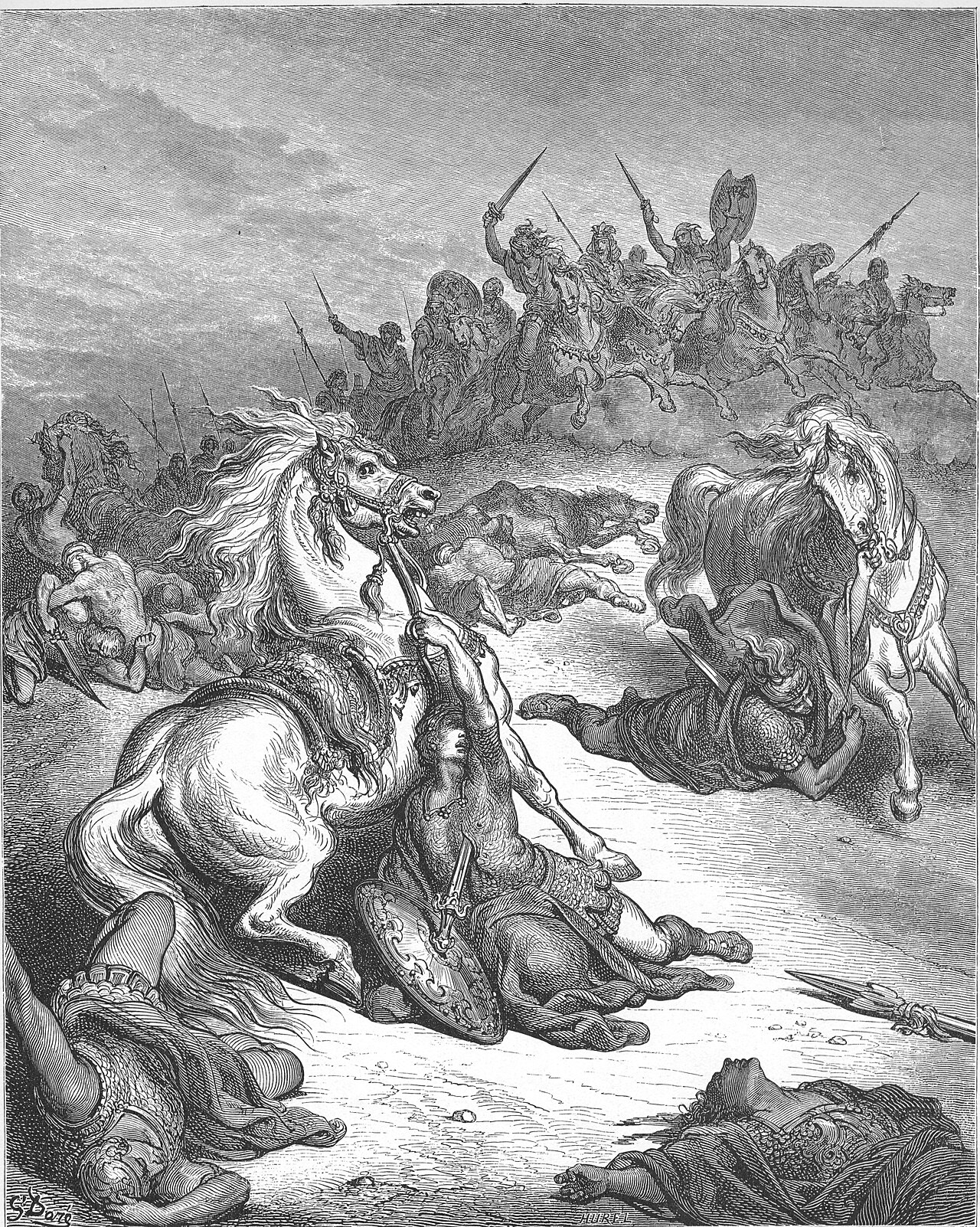
1 Samuelchapter 31
13 verses · Samuel, Nathan and Gad, by tradition · 10th century BC · History
And the battle went sore against Saul, and the archers hit him; and he was sore wounded of the archers.
Introduction
Samuel, Nathan and Gad, by tradition, History, 1 Samuel Overview.
This chapter closes the book and was kept for a people who lost their king and their northern valley in one day. It moves quickly and speaks plainly, in the voice of a battle report. Listen for how the word spoken at Endor the night before comes to pass. Listen for what the Philistines do with their victory and where they send the news. Then watch who comes by night from across the Jordan, and remember what Saul did for that town at the start of his reign. The book ends in mourning.
Context
- Who
- Israelites who lost the northern valley and their king in a single day
- What
- An account of Israel's defeat on Mount Gilboa, the deaths of Saul and three of his sons, and the recovery of their bodies by the men of Jabesh-gilead.
- Where
- Mount Gilboa above the valley of Jezreel, the wall of Beth-shan, and Jabesh-gilead east of the Jordan.
- When
- The day after the night at Endor; on the common reckoning about 1010 BC, at the end of Saul's reign.
- Why
- To record the end of Saul's reign as the word at Endor had said, and to honour the town that repaid his early rescue of it.
Historical context
The chapter belongs to Saul, king of Israel, and to three of his sons, Jonathan, Abinadab and Malchishua, who die with him.
Show the rest of the historical context, 6 more paragraphs
The time is the day after the night at En-dor, which 28:19 had named in advance. The site places the battle about 1010 BC.
The place is a ridge on the southeastern edge of the Jezreel valley, and then Beth-shan, a fortress city where that valley meets the Jordan.
The occasion is a battle fought on the worst possible ground for Israel. The Philistines held the flat valley for their chariots and the numbers to press uphill, and Israel had no line of retreat except back into the hills. Yigael Yadin describes the archers as the arm that broke infantry at a distance, which is what happens to Saul at verse 3.
A first hearer knew what Saul feared at verse 4. A captured king was displayed, mutilated and paraded, and the word he uses for what the uncircumcised would do to him means to make sport of him.
A first hearer also knew what the victors did next. Cutting off the head, sending the news around the temples, placing the armour in a temple and fastening the body to a city wall announced to a whole region who now held it. Beth-shan had been an Egyptian garrison for centuries, and its excavated remains include temple structures of the period.
The burning at verse 12 was unusual in Israel, where burial was the rule. The older writers read it as the state of bodies left days on a wall in the heat, and the bones are then buried and a fast of seven days kept.
Significance
The book closes where its first battle chapter left off, with Israel beaten by the Philistines, the northern valley lost and the towns emptied.
Show the rest of the significance, 2 more paragraphs
The king Israel had asked for so that it might be like the nations and have someone to fight its battles is dead on a hillside with his armour in a Philistine temple.
The men who bury him come from the town he rescued at the start of his reign, in the one hour of it that was wholly good. Israel was left with that, the kindness he did as a young man coming back for him at the end.
This chapter in Jewish lifeWhat this chapter is in Jewish life and reading.
How it is read
The last chapter of the book carries one point of Jewish practice, and it concerns the burial of a king. On what the men of Jabesh-gilead did with the bodies Rashi follows the Targum (Rashi on I Samuel 31:12:1, the Metsudah Tanach series, Lakewood, N.J., CC-BY). They burned for them as they burn for kings (same ref). The burning he describes is of a king's own belongings, so that no one else uses them, and he cites Maseches Avoda Zarah 11a. On that ruling the practice is performed at the burial of kings and is not counted an Amorite custom (same ref). He carries Radak's reading beside it, that incense was burned to cover the odour and hold back the decay of the bodies (same ref). On the opening words of the chapter he marks the return to the thread the account had left. It reads as a man saying that they should go back to the earlier subject (Rashi on I Samuel 31:1:1, same edition). On the report the men of Jabesh heard he settles the sense of the preposition, that they heard about Saul (Rashi on I Samuel 31:11:1, same edition). Radak stands as a citation at I Samuel 31:2:1, 31:3:1, 31:4:1, 31:5:1, 31:6:1, 31:7:1, 31:9:1, 31:10:1, 31:11:1, 31:12:1 and 31:13:1. Metzudat David stands at 31:1:1, 31:3:1, 31:4:1, 31:5:1, 31:6:1, 31:7:1 and 31:13:1, and Malbim at 31:2:1, 31:9:1 and 31:10:1. The corpus holds no English version of them.
What the rabbis say
The corpus records twenty-four rabbinic locators on this chapter, twenty-one of them Midrash and three Talmud, each a locator without text. The battle on Gilboa draws Sotah 44b:1, Jerusalem Talmud Sotah 8:10:1, Ein Yaakov, Sotah 8:8 and Bereshit Rabbah 62:3, which is where the rabbis take up the law of going out to war. The same verse draws Midrash Tannaim on Deuteronomy 20:9:1, Yalkut Shimoni on Torah 110:9 and Yalkut Shimoni on Torah 923:13. The archers who found Saul draw Bamidbar Rabbah 19:9, Midrash Tanchuma, Chukat 9:1 and Yalkut Shimoni on Torah 763:17. Saul's word to his armour-bearer draws Sotah 10a:12, Bereshit Rabbah 34:13, Ein Yaakov, Sotah 1:33 and Ein Yaakov (Glick Edition), Sotah 1:27. The same verse draws Midrash Lekach Tov, Numbers 22:29:1 and Otzar Midrashim, Chuppah of Eliyahu, Chuppat Eliyahu Rabbah 197. The death of Saul and his three sons in one day draws Kohelet Rabbah 7:16:1, Midrash Shmuel 18:4, Midrash Tanchuma, Vayechi 14:9 and Midrash Tanchuma Buber, Vayechi 15:2. The same verse draws Midrash Tehillim 7:2, Midrash Tehillim 120:2 and Pirkei DeRabbi Eliezer 33:12. The burial under the tamarisk at Jabesh draws Pirkei DeRabbi Eliezer 17:8. The rabbis teach in these places, and this site reports them as their teaching rather than as a rule of the text.
Sources: Rashi, Rashi on I Samuel 31:1:1, 31:11:1 and 31:12:1, the Metsudah Tanach series, Lakewood, N.J., CC-BY; Radak, Radak on I Samuel 31:2:1, 31:3:1, 31:4:1, 31:5:1, 31:6:1, 31:7:1, 31:9:1, 31:10:1, 31:11:1, 31:12:1 and 31:13:1, cited only, no English version in the corpus; and Radak on the incense as Rashi carries him; Metzudat David, Metzudat David on I Samuel 31:1:1, 31:3:1, 31:4:1, 31:5:1, 31:6:1, 31:7:1 and 31:13:1, cited only; Malbim, Malbim on I Samuel 31:2:1, 31:9:1 and 31:10:1, cited only.
The heads below are this chapter's scenes. The numbered points under each are its verses.
Gilboa: Saul and his sons fall
1 Samuel 31:1-2
fought against Israel: The rout at Gilboa is where the king Israel asked for goes down in full view, on the same hillside where he had gone the night before to consult the dead because the LORD would no longer answer him at Endor. Jonathan dies with his brothers Abinadab and Malchi-shua, ending at the sword the covenant he had made with David at the throne's own door; the dirge David sings over him waits for the next chapter and is not drawn forward here. Wesley reads a mercy folded into the loss: of Saul's sons Jonathan alone stood fairest for the crown, and his death clears the road David's anointing had already marked.
1 Samuel 31:1
“The best of the troops were put into disorder, and multitudes slain, probably those whom Saul had employed in pursuing David. Thus those who had followed him and served him in his sin went before him in his fall and shared with him in his plagues.”
Matthew Henry · Commentary on the Whole Bible (1707-1721)puritan
Adam Clarke reads the sons as holding their ground to the last while the army of Israel fled around them. Matthew Henry sees the death of Jonathan as part of the judgment on the house of Saul. When the family fell, he fell with it.
1 Samuel 31:2
“Followed hard upon Saul and upon his sons - They, seeing the discomfiture of their troops, were determined to sell their lives as dear as possible, and therefore maintained the battle till the three brothers were slain.”
Adam Clarke · Commentary on the Bible (1810-1826)evangelical
1 Samuel 31:3-5
sore wounded of the archers: Saul's request that his armourbearer run him through, and the refusal born of fear, plays out the sentence Samuel had spoken to him from beyond the grave at Endor, that he and his sons would be with Samuel by the morrow, the word chapter 15 had already fixed when Saul spared Agag against the ban on Amalek. The armourbearer's fear answers Saul's own fear of Philistine abuse, and in the end neither man dies by an enemy's hand; both fall on their own swords. The text narrates the act without comment and passes no verdict beyond the one Samuel had already spoken.
1 Samuel 31:3
“He was sore wounded of the archers - It is likely that Saul’s sons were slain by the archers, and that Saul was now mortally wounded by the same. Houbigant translates, The archers rushed upon him, from whom he received a grievous wound. He farther remarks that had not Saul been grievously wounded, and beyond hope of recovery, he would not have wished his armor-bearer to despatch him; as he might have continued still to fight, or have made his escape from this most disastrous battle.”
Adam Clarke · Commentary on the Bible (1810-1826)evangelical
Adam Clarke, following Dr. Delaney, notes that the Hebrew says Saul took the sword, the one his armor-bearer refused to draw. On that reading Saul and his armor-bearer died by one sword. John Gill records a Jewish tradition that the armor-bearer was Doeg the Edomite, who had killed the priests at Nob.
1 Samuel 31:4
“Then said Saul unto his armourbearer,.... Who, the Jews (b) say, was Doeg the Edomite, promoted to this office for slaying the priests: draw thy sword, and thrust me through therewith; for if he was wounded, yet not mortally, and it is certain he did not so apprehend it.”
1 more voice on this verse
1 Samuel 31:4
“Draw thy sword, and thrust me through - Dr. Delaney has some good observations on this part of the subject: “Saul and his armor-bearer died by the same sword. That his armor-bearer died by his own sword is out of all doubt; the text expressly tells us so; and that Saul perished by the same sword is sufficiently evident. Draw Thy sword, says he to him, and thrust me through; which, when he refused, Saul, says the text, took The sword, (את החרב eth hachereb, the very sword), and fell upon it. What sword?”
Adam Clarke · Commentary on the Bible (1810-1826)evangelical
Matthew Henry counts this death against Saul. His example drew his servant into the same act, so the king did not die alone in his sin. The armor-bearer who was too terrified to run Saul through dies by his own sword that same day.
1 Samuel 31:5
“This was an aggravating circumstance of the death of Saul, that, by the example of his wickedness in murdering himself, he drew in his servant to be guilty of the same wickedness, and perished not alone in his iniquity.”
Matthew Henry · Commentary on the Whole Bible (1707-1721)puritan
that same day together: The verse counts the dead together, king, sons, armourbearer and army entangled in one sentence, on the day Samuel's word from Endor had already named. Chronicles supplies the verdict this history leaves the reader to draw for himself: Saul died for his transgression which he committed against the LORD, and also for asking counsel of one that had a familiar spirit, and enquired not of the LORD. The king raised up because the people would not have the LORD reign over them goes down having refused, at the last, to ask the LORD anything at all.
1 Samuel 31:6
“So Saul died, and his three sons, and his armourbearer,.... Only with this difference, his three sons died honourably in the field of battle, but he and his armourbearer destroyed themselves.”
1 more voice on this verse
1 Samuel 31:6
“And all his men - Probably meaning those of his troops which were his life or body guards: as to the bulk of the army, it fled at the commencement of the battle, 1Sa 31:1.”
Adam Clarke · Commentary on the Bible (1810-1826)evangelical
they forsook the cities, and fled: The defeat at Gilboa reaches past the battlefield: towns across the valley and beyond the Jordan empty rather than face a Philistine army with no king and no standing force left to answer it, and the Philistines settle into cities Joshua's conquest had won. Barnes locates the abandoned country in the north, the ground of Naphtali, Zebulun and Issachar, held by the tribes since the conquest itself. One lost battle undoes what generations had kept, the practical cost of the manner of a king Samuel had catalogued back at chapter eight.
1 Samuel 31:7
“The men on the other side of the valley - This must mean to the north of the plain of Jezreel, and would comprise the tribe of Naphtali, and Zabulon, and probably Issachar. But the text of 1Ch 10:7 has “that were in the valley,” limiting the statement to the inhabitants of the plain of Jezreel. On the other side Jordan - This phrase most commonly means on the east of Jordan, the speaker being supposed to be on the west side. But it is also used of the west of Jordan, as here, if the text be sound.”
1 more voice on this verse
1 Samuel 31:7
“They consecrated the armor of the king and his sons to the temple of Ashtaroth fastened their bodies on the temple of Shen, while they fixed the royal heads ignominiously in the temple of Dagon (1Ch 10:10); thus dividing the glory among their several deities.”
Jamieson, Fausset & Brown · Commentary Critical and Explanatory on the Whole Bible (1871)reformed
Fastened to the wall, and the men of Jabesh come by night
1 Samuel 31:8-10
came to strip the slain: The Philistines strip Saul as David once stripped Goliath, and cut off his head as David cut off the head of Gath's own champion; the roles have reversed since chapter seventeen, and the head that once stood higher than any man in Israel is carried through Philistine territory as a trophy. Samuel's own text says only the house of their idols; Chronicles names it plainly, that they fastened his head in the temple of Dagon, the same god who had fallen on his face before the ark at Ashdod and now receives Israel's anointed in triumph. The armour goes to the house of Ashtaroth and the body to the wall of Beth-shan, and the cry raised at Shiloh, the glory is departed, reaches its full picture here in a king hung up for a god that could not stand on its own threshold.
1 Samuel 31:8
“There was also a special providence of God, in taking away Jonathan, (who of all Saul's sons, seems to have been the fairest for the crown) for preventing divisions, which might have happened amongst the people concerning the successor: David's way to the crown being by this means made the more clear.”
John Wesley · Explanatory Notes upon the Old Testament (1765)evangelical
1 more voice on this verse
1 Samuel 31:8
“They intended it, in general, for a reproach to Israel, who promised themselves that a crowned and an anointed head would save them from the Philistines, and a particular reproach to Saul, who was taller by the head than other men (which perhaps he was wont to boast of), but was now shorter by the head.”
Matthew Henry · Commentary on the Whole Bible (1707-1721)puritan
Adam Clarke asks whether the sons were beheaded too. Only the head of Saul is named, yet the men of Jabesh-gilead took the bodies of all four from the wall in verse 12. John Wesley reads the news sent to the temples as giving the idols the glory of the victory.
1 Samuel 31:9
“Cut off his head - As the Israelites did by Goliath, and fastened it in the temple of Dagon, 1 Chron. x, 10. Idols - To give them the glory of this victory.”
John Wesley · Explanatory Notes upon the Old Testament (1765)evangelical
Albert Barnes places this temple of the Ashtoreths at Ashkelon, which may be why David names that city in his lament at 2 Samuel 1:20. Adam Clarke sets it beside Goliath's sword at the tabernacle. John Gill notes that the Philistines, like other nations, put the armor they took in the temples of their gods.
1 Samuel 31:10
“They put his armor in the house of Ashtaroth - As David had done in placing the sword of Goliath in the tabernacle. We have already seen that it was common for the conquerors to consecrate armor and spoils taken in war, to those who were the objects of religious worship. They fastened his body to the wall - Probably by means of iron hooks; but it is said, 2Sa 21:12, that these bodies were fastened in the Street of Beth-shan.”
Adam Clarke · Commentary on the Bible (1810-1826)evangelical
1 Samuel 31:11-13
heard of that which the Philistines had done: Jabesh-gilead is the one city in the book with a debt to Saul, delivered from Nahash the Ammonite and the threat of a gouged right eye in the first act of his reign, and it becomes the one place that pays a kindness back in full. Its valiant men march all night to take Saul and his sons down from the wall of Beth-shan, an open defiance of the army now settled in the land, then burn the bodies already corrupted by the heat and the days on the wall, bury the bones under a tamarisk, and fast seven days, the length Israel had once kept for Jacob. Samuel's history opens with Saul's finest hour, delivering a besieged city; it closes with that city delivering him, the one unbroken act of gratitude the book records.
1 Samuel 31:11
“And the inhabitants of Jabeshgilead,.... Who lived on the other side Jordan, about eight miles from Bethshan, according to Fuller (p): heard of that which the Philistines had done to Saul; not only that they had got the victory over him, and routed his army, but had abused his body, and hung it up by way of reproach and ignominy; which they could not bear to hear of, remembering with gratitude the kindness he had shown to them, in delivering them out of the hands of Nahash the Ammonite, 1Sa 11:1. (p) Pisgah-Sight of Palestine, b.”
2 more voices on this verse
1 Samuel 31:11
“When the inhabitants of Jabesh-Gilead heard ... - See 1Sa 11:1-15. This is a touching and rare example of national gratitude.”
1 Samuel 31:11
“The day of recompence has now come, in which Saul must account for the blood of the Amalekites which he had sinfully spared, and that of the priests which he had more sinfully spilt; that of David too, which he would have spilt, must come into the account.”
Matthew Henry · Commentary on the Whole Bible (1707-1721)puritan
Burning was an unusual way for Hebrews to treat the dead. Albert Barnes thinks the men of Jabesh did it to hide the mutilation of the headless bodies and keep them from further insult. Matthew Henry notes that Saul fell on his sword to escape abuse by the Philistines, and his body suffered it anyway.
1 Samuel 31:12
“And burnt them there - It has been denied that the Hebrews burnt the bodies of the dead, but that they buried them in the earth, or embalmed them, and often burnt spices around them, etc. These no doubt were the common forms of sepulture, but neither of these could be conveniently practiced in the present case. They could not have buried them about Beth-shan without being discovered; and as to embalming, that was most likely out of all question, as doubtless the bodies were now too putrid to bear it.”
Adam Clarke · Commentary on the Bible (1810-1826)evangelical
1 more voice on this verse
1 Samuel 31:12
“Saul slew himself to avoid being abused by the Philistines, and never was royal corpse so abused as his was, perhaps the more if they understood that he slew himself for that reason. He that thinks to save his honour by sin will certainly lose it. See to what a height of insolence the Philistines had arrived just before David was raised up, who perfectly subdued them.”
Matthew Henry · Commentary on the Whole Bible (1707-1721)puritan
John Gill notes that 1 Chronicles 10:12 calls the tree an oak, and he compares Deborah, buried under an oak in Genesis 35. John Wesley takes the seven days they fasted as days of scant food and water only. Adam Clarke ends the reign of Saul with these bones.
1 Samuel 31:13
“Under a tree - Rather, “Under the tamarisk,” a well-known tree at Jabesh which was standing when this narrative was written. They fasted seven days - In imitation of the mourning for Jacob (marginal reference). They would give full honor to Saul though he was fallen.”
1 more voice on this verse
1 Samuel 31:13
“But you must not understand this word of fasting strictly, as if they eat nothing for seven whole days; but in a more large sense, as it is used both in sacred and profane writers; that they did eat but little, and that but mean food, and drank only water for that time.”
John Wesley · Explanatory Notes upon the Old Testament (1765)evangelical
How this psalm is built
The form: Narrative, a battle report closing a reign, with the disposal of the bodies and a burial notice, as Jamieson, Fausset & Brown classes it.
The patterns in this chapter
| Device | What it does | Where to see it |
|---|---|---|
| That same day, together | Verse 6 gathers the dead into one sentence, the king, three sons, the armour-bearer and all his men. The store's exposition note on verse 6 records that the day is the one Samuel had named at 28:19. The chapter counts them together rather than one by one, which is how it reads the fall of a house rather than the death of a man.John Gill, Exposition of the Old Testament, 1748 to 1763, on 1 Samuel 31:6. | 1 Samuel 31:6, 1 Samuel 28:19, 1 Samuel 31:2 |
| Stripped and beheaded, as Goliath was | At verse 9 the Philistines cut off Saul's head and strip his armour, which is what David did to the champion of Gath at 17:51 and 17:54. The store's exposition note on verses 8 to 10 marks the reversal and adds a second one. The armour goes to the house of the Ashtoreths, and Dagon had fallen before the ark at Ashdod in chapter 5. The cry of 4:21, that the glory has departed, reaches its full picture here.Jamieson, Fausset & Brown, Commentary Critical and Explanatory on the Whole Bible, 1871, on 1 Samuel 31:9. | 1 Samuel 31:9, 1 Samuel 17:51, 1 Samuel 5:4, 1 Samuel 4:21 |
| Jabesh-gilead at both ends of the reign | Saul's first act as king was to lift the Ammonite siege of Jabesh-gilead in chapter 11, and the men of that city are the ones who take his body off the wall at verse 12. The store's exposition note on verses 11 to 13 marks the frame, that the history opens with Saul delivering a besieged city and closes with that city delivering him. Nothing else in the book pays him back.Albert Barnes, Notes, Explanatory and Practical, on the Old and New Testaments, 1832 to 1869, on 1 Samuel 31:11. | 1 Samuel 31:11, 1 Samuel 31:12, 1 Samuel 11:1, 1 Samuel 11:11 |
| Two men and one sword apiece | Saul asks the armour-bearer to run him through at verse 4 and is refused out of fear, so he falls on his own sword. At verse 5 the armour-bearer does the same. The store's exposition note on verses 3 to 5 records that neither man dies by an enemy's hand, and that the text narrates the act without comment.Adam Clarke, Commentary on the Bible, 1832, on 1 Samuel 31:4. | 1 Samuel 31:4, 1 Samuel 31:5 |
The historical value
12 more paragraphs on the patterns
The chapter is precise about places. Mount Gilboa is the high ground above the valley of Jezreel, opposite Shunem, where 28:4 set the two camps. Beth-shan stands at the eastern end of that valley on the road to the Jordan, which is why the bodies hung there could be reached in one night's march from Jabesh-gilead across the river.
The treatment of the bodies matches what the chapter's own writers describe of the practice. Adam Clarke, quoted in the store's pool on verse 10, notes that conquerors commonly consecrated armour and spoils taken in war to the objects of their worship. He points to David placing Goliath's sword in the tabernacle. He adds that the bodies were probably fastened by iron hooks, and that 2 Samuel 21:12 says they were fastened in the street of Beth-shan.
The burning at verse 12 is unusual in Israel, where burial was the rule. The store's exposition note on verses 11 to 13 gives the reason the older writers offer, that the bodies had been corrupted by the heat and the days on the wall. It records that the bones were then buried and a seven-day fast kept.
The debated concept
How Saul died is the chapter's contested point, because Scripture carries a second account. Verse 4 says he fell on his own sword after the armour-bearer refused. At 2 Samuel 1:6 to 10 an Amalekite tells David that he himself killed Saul at Saul's request, and that he took the crown and the armlet. David then executes him on his own testimony at 2 Samuel 1:16. The positions the older writers take are that the Amalekite lied to claim a reward, and that the two accounts describe different moments of the same death. The site states both accounts and takes no verdict, and the reader can set 1 Samuel 31:4 beside 2 Samuel 1:10 and see the difference.
Where Saul's head was fastened is the second point where the witnesses differ. Verse 10 says the armour went to the house of the Ashtoreths and the body to the wall of Beth-shan. Verse 9 says the news was proclaimed in the temples of their idols. The store's exposition note on verses 8 to 10 records that 1 Chronicles 10:10 names the place plainly, the temple of Dagon. The two books are reporting the same event and one is more specific than the other.
What the burning at verse 12 means is the third question, since cremation is rare in the Old Testament. The store's exposition note on verses 11 to 13 carries the reading the older writers give, the state of bodies left days on a wall in the heat. The text states the act and the burial of the bones and gives no explanation.
The divine connection
The chapter is the fulfilment of a dated prediction. At 28:19 Samuel told Saul that tomorrow he and his sons would be with him, and that the LORD would deliver Israel into Philistine hands. Both clauses are carried out here, at verses 2 and 6 and at verse 7. The store's exposition note on verses 3 to 5 records that the sentence chapter 15 had already fixed, when Saul spared Agag against the ban on Amalek, is what plays out on this hillside.
The chapter states no verdict of its own, and the Old Testament supplies one elsewhere. The verdict stands at 1 Chronicles 10:13 and 14. Saul died for his unfaithfulness against the LORD, and for asking counsel of a medium rather than enquiring of the LORD. The store's exposition note on verse 6 records that Chronicles gives the verdict this history leaves the reader to draw.
How the rest of Scripture reads this chapter
The New Testament does not cite 1 Samuel 31. Paul refers to the length of Saul's reign at Acts 13:21 without describing its end. Within the Old Testament the chapter is told again at 1 Chronicles 10:1 to 14. That account follows this one closely and adds the temple of Dagon at its verse 10 and the verdict at its verses 13 and 14. David's lament over Saul and Jonathan stands at 2 Samuel 1:17 to 27 and names Gilboa by name. At 2 Samuel 2:4 to 7 David blesses the men of Jabesh-gilead for the kindness this chapter records. At 2 Samuel 21:12 to 14 he brings the bones of Saul and Jonathan back from Jabesh for burial in the tomb of Kish.
Keep studying
Sources for this chapter
The summary
Jamieson, Fausset & Brown, Commentary Critical and Explanatory; John Wesley, Notes on the Old Testament and Matthew Henry, Complete Commentary.
The form and classifications
Albert Barnes, Notes, Explanatory and Practical, on the Old and New Testaments, 1832 to 1869, on 1 Samuel 31:11; Jamieson, Fausset & Brown, Commentary Critical and Explanatory on the Whole Bible, 1871, cited in the store's exposition note on verses 8 to 10; John Wesley, Explanatory Notes upon the Old Testament, 1765, on 1 Samuel 31:2 and Keil and Delitzsch, Biblical Commentary on the Books of Samuel, cited in the store's exposition note on verses 3 to 5.
The exposition
Adam Clarke, Commentary on the Bible; Albert Barnes; Jamieson Fausset and Brown, Commentary Critical and Explanatory on the Whole Bible; John Gill; John Wesley, Explanatory Notes upon the Old Testament; Keil and Delitzsch, Biblical Commentary on the Books of Samuel and Matthew Henry, Commentary on the Whole Bible.