
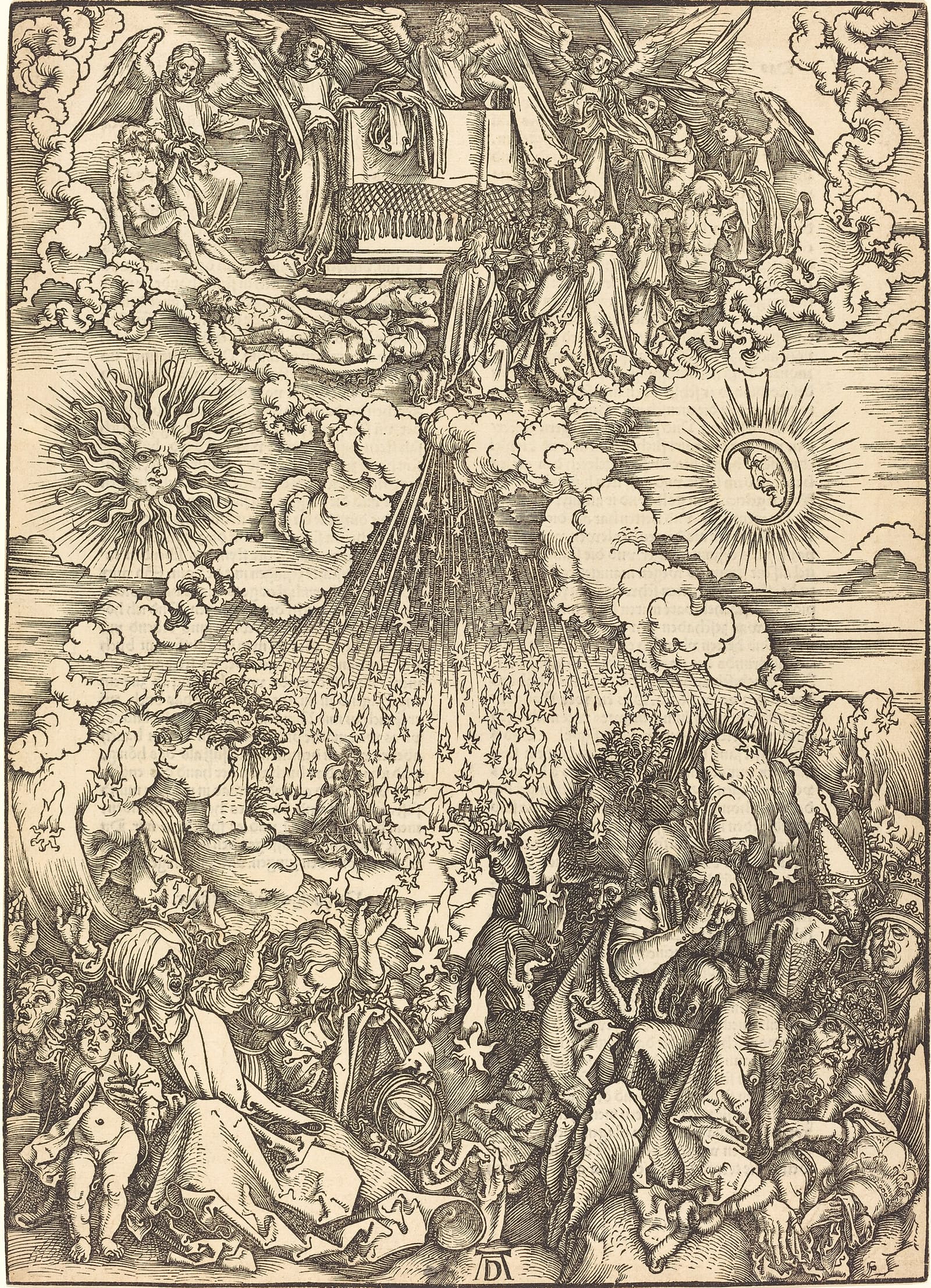
Albrecht Dürer, The Opening of the Fifth and Sixth Seals, about 1498. Public domain.
Lyon, 177, to the World Watch List, 2026 · Debate · Featured Study
How Many Martyrs?
Five definitions of a martyr side by side, with the count each one gives.
In 177 the confessors of Lyon, scarred from the arena, would not let their brethren call them martyrs.
And when the Lamb opened the fifth seal, I saw under the altar the souls of those who had been slain for the word of God and for the testimony they had upheld.
And when the Lamb opened the fifth seal, I saw under the altar the souls of those who had been slain for the word of God and for the testimony they had upheld.
- The question
- How many Christians have died as martyrs, and what makes a death a martyr's death?
- The texts
- Acts 22:20, Revelation 2:13, Revelation 6:9, Matthew 5:10
Summary
No one count of Christian martyrs stands alone, because each count rests on a definition of a martyr. The early church argued over the name, and the modern counts differ widely. Each count below answers to the rule its makers chose, and the table sets those rules beside one another.
- The confessors of Lyon kept the name for those who had died.
- Clement of Alexandria counted a whole life of obedience as witness.
- Augustine held that the cause, and not the punishment, makes the martyr.
- Two modern counts rest on a broad and a narrow definition.
The Texts Every Count Reads
Acts and Revelation call the slain witnesses, and Matthew blesses the persecuted.
The word martyr comes from the Greek word for a witness. In McGiffert's English of the letter from Lyon the same word is rendered witnesses, and the Berean Standard Bible calls Stephen and Antipas witnesses.
The witnesses who died
And when the blood of Your witness Stephen was shed, I stood there giving my approval and watching over the garments of those who killed him.’
Paul calls the slain Stephen the Lord's witness, the word every later count begins from.
Acts 22:20BSB
I know where you live, where the throne of Satan sits. Yet you have held fast to My name and have not denied your faith in Me, even in the day when My faithful witness Antipas was killed among you, where Satan dwells.
Christ Himself gives the title of witness to a believer slain at Pergamum.
The cause
Blessed are those who are persecuted because of righteousness, for theirs is the kingdom of heaven.
Augustine sets this blessing beside his rule that the cause makes the martyr.
Matthew 5:10BSB
Matthew 5:10
Five Definitions Side by Side
Each row names a definition's holders, what it admits and the count it yields.
Each row is one definition of a martyr, and the counts differ because the definitions differ.
| The definition | Who holds it | What it admits | The count it gives |
|---|---|---|---|
| Only those who have died in their confession | The Gallic churches held it in their letter, which Eusebius kept | Those taken up in their confession, and not the living confessors | No count |
| A witness by life and word | Clement of Alexandria held it | Every soul that lived purely and obeyed the commandments, however it died | No count |
| The cause makes the martyr | Augustine of Hippo held it | Those who suffer for righteousness, and not all who are punished | No count |
| Believers who died in situations of witness, as a result of human hostility | Barrett and Johnson hold it, with the Center for the Study of Global Christianity | Every such death, the dead of wars included where the counters judge them so | About 70 million up to the year 2000, 45 million of them in the twentieth century |
| Documented killings of Christians for being Christians | Open Doors and Thomas Schirrmacher hold it | Only the cases the counters can document | 4,849 in the World Watch List of 2026 |
The Early Definitions in Their Own Terms
Three early writers set the bounds of the name in their own terms.
The churches of Lyon and Vienne wrote that their confessors had borne witness many times and still refused the title. They gave it to Christ and to those already taken up.
Clement wrote that if confession to God is martyrdom, then a soul which lived purely in the knowledge of God is a witness by life and word.
Augustine wrote on Psalm 35 that punishment falls on the good and the bad alike. The cause set Christ's death apart from the robbers who died beside Him.
The Counts and Their Critics
The broad count met the BBC's question in 2013, and Open Doors keeps a documented count.
Massimo Introvigne reported Barrett and Johnson's count from World Christian Trends in 2011.
In November 2013 BBC News found that the figure of 100,000 martyrs a year was an estimate of about a million for the years 2000 to 2010, divided by ten.
Thomas Schirrmacher of the International Society for Human Rights told the BBC that "there is no scientific number at the moment".
Open Doors counts only the cases it can document.
In Their Own Words
Clement of Alexandria (died 215)
Stromata, book 4, chapter 4
Clement counted a whole life as witness.
“If the confession to God is martyrdom, each soul which has lived purely in the knowledge of God, which has obeyed the commandments, is a witness both by life and word, in whatever way it may be released from the body”
Early Church
About this saying1 paragraph
Clement, head of the school at Alexandria at the close of the second century, wrote this under the praises of martyrdom.
Augustine of Hippo (died 430)
Expositions on the Psalms, Psalm 35
Augustine made the cause the mark of a martyr.
“Therefore Martyrs, not the punishment, but the cause maketh, for if punishment made Martyrs, all the mines would be full of Martyrs, every chain would drag Martyrs, all that are executed with the sword would be crowned.”
Patristic
About this saying1 paragraph
Augustine, bishop of Hippo from 395 to 430, preached this on Psalm 35 after quoting the blessing on the persecuted.
The churches of Vienne and Lyons
the letter of the churches of Vienne and Lyons, in Eusebius, Church History, 5.2.3
The confessors of Lyon gave the name to the dead.
“They are already witnesses whom Christ has deemed worthy to be taken up in their confession, having sealed their testimony by their departure; but we are lowly and humble confessors.”
Church
About this saying1 paragraph
Eusebius copied this sentence from the letter the churches of Lyon and Vienne wrote in 177.
Where the Counts Are Contested
Each count answers to the definition beneath it.
A broad count includes deaths that no one could document, and a narrow count leaves them out. A reader can weigh two counts only by setting their rules side by side.
Books to Read Next
Church History
Eusebius of Caesarea, translated by Arthur Cushman McGiffert · 1890
The fifth book holds the Gallic churches' account of their persecution.
Free at the Christian Classics Ethereal LibraryExpositions on the Psalms
Augustine of Hippo · 1888
The exposition of Psalm 35 holds his rule on the cause of a martyr.
Free at the Christian Classics Ethereal LibraryStromata
Clement of Alexandria · 1885
Book 4 holds his chapter on the praises of martyrdom.
Free at the Christian Classics Ethereal LibraryThe Souls Under the Altar
Each definition draws a line around a different company of the dead. John's vision counts the slain by the word of God and their testimony, and gives no number.
Sources
Scripture is the Berean Standard Bible.
- The Holy Bible, Berean Standard Bible (read 2026)
- Eusebius, Church History, tr. Arthur Cushman McGiffert, Nicene and Post-Nicene Fathers, second series 1 (New York, 1890), book 5, chapter 2, pages 217 to 218.
- Clement of Alexandria, Stromata, book 4, chapter 4, Ante-Nicene Fathers 2 (Buffalo, 1885), page 412.
- Augustine, Expositions on the Psalms, Psalm 35, Nicene and Post-Nicene Fathers, first series 8 (New York, 1888), page 84.
- Ruth Alexander, Are there really 100,000 new Christian martyrs every year?, BBC News (12 November 2013), and Massimo Introvigne, CESNUR (2011), on the martyr counts of Barrett and Johnson, World Christian Trends (2001)
- Open Doors International, World Watch List 2026, and Thomas Schirrmacher on the counts of 2015 and 2016 (12 April 2017)