
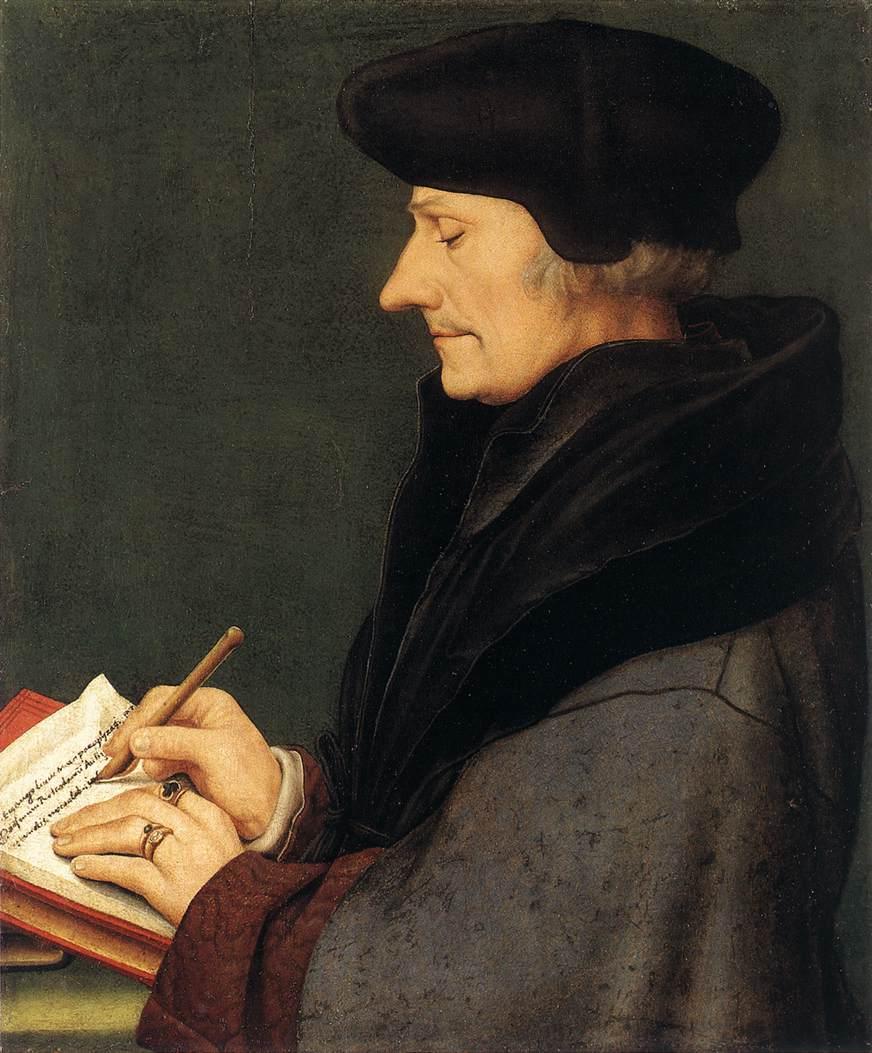
Hans Holbein the Younger, Erasmus Writing, 1523. Public domain.
Luke 1:3 · Subject · Featured Study
The Printed Greek New Testament
Every printed edition of the Greek text rests on handwritten copies, and each editor has had to choose between their readings.
Erasmus gave ten months at most to the first Greek Testament ever published, a book of 1,027 pages.
Therefore, having carefully investigated everything from the beginning, it seemed good also to me to write an orderly account for you, most excellent Theophilus,
- Book
- Luke
- Hold in memory
- Luke 1:3, 1 Peter 1:25
Summary
Erasmus put out at Basel the first printed Greek Testament that readers could buy. Later editors used older copies, and Burgon argued for the old text.
- Erasmus's book was printed two years after a Spanish one, but readers had it six years sooner.
- Stephanus printed our verse numbers in his small edition of 1551.
- The Elzevir printers' preface gave the old text its name, the Received Text.
- Westcott and Hort held that hardly one word in a thousand was still in doubt.
A Gospel Handed Down
Luke wrote his Gospel from accounts that eyewitnesses had handed down.
just as they were handed down to us by the initial eyewitnesses and servants of the word.Luke rests his Gospel on words handed down, and the printed Greek text rests on copies handed down the same way.
Until the sixteenth century, every copy of the Greek New Testament was written out by hand. A copy written by hand is called a manuscript.
Seven Steps from 1514 to 1881
Six printed editions and one discovery mark the history of the printed Greek text.
The printed Greek text grew from one hurried edition to editions built on the oldest copies known.
- 1514The New Testament volume of the Complutensian Bible is printed in Spain
- 1516Erasmus's first edition comes from John Froben's press at Basel
- 1550Robert Stephanus prints his large folio edition
- 1551Stephanus's small edition appears at Geneva
- 1633An Elzevir preface calls its text the one received by all
- 1859Tischendorf studies Codex Sinaiticus
- 1881Westcott and Hort publish The New Testament in the Original Greek
Read down the rows from the Spanish printing of 1514 to the edition of 1881.
Erasmus and Froben's Press
A printer at Basel named John Froben asked Erasmus to prepare an edition at once.
Froben had heard of the Spanish Bible then being printed, and he wanted his edition out first.
The closing note of the first edition, called its colophon, is dated February 1516. Erasmus himself said the book was rushed out rather than edited.
The Spanish New Testament had been printed in 1514, and Pope Leo licensed that Bible only in March 1520. Erasmus saw it no earlier than 1522.
The Last Verses of Revelation
The Greek copy of Revelation that Erasmus used had lost its last six verses.
I testify to everyone who hears the words of prophecy in this book: If anyone adds to them, God will add to him the plagues described in this book.The warning against adding to this book stands among the six verses Erasmus had to supply from the Latin.
Scrivener wrote that some words of that home-made Greek stand in no known Greek manuscript. Some of them, he added, still remained in the printed text of his day.
Verse Numbers and the Received Text
Two printers' editions gave the Greek text its verse numbers and its name.
Scrivener noted that many scholars regarded the folio of Robert Stephanus, printed in 1550, as the standard text.
His son Henry wrote that Robert divided the verses on a ride from Paris to Lyons. The Geneva English Testament of 1557 took the numbers over.
The Elzevir printers issued their edition in 1633. Its Latin preface told the reader that he now had the text received by all.
The Oldest Copies and the Critical Editions
A discovery at Mount Sinai and a new edition of 1881 turned editors to the oldest copies.
In 1844 Tischendorf picked forty-three leaves of the Greek Old Testament out of a basket at St Catherine's monastery on Mount Sinai.
On 4 February 1859, on his third visit to the East, he sat up through the night over the whole manuscript. It is known as Codex Sinaiticus, and a codex is a book of bound leaves.
In 1881 B. F. Westcott and F. J. A. Hort published their Greek text. An edition that weighs the copies against one another is called a critical edition.
Which Greek Text Should Translators Follow?
Westcott and Hort and their critic John William Burgon answered the question in opposite ways.
Follow the oldest manuscriptsB. F. Westcott and F. J. A. Hort, The New Testament in the Original Greek, Introduction (1881)
Westcott and Hort set aside small matters such as the order of words when they counted the words still in doubt.
Burgon answered that Codex Sinaiticus and two other old copies were among the most corrupt copies in existence.
Keep the traditional textJohn William Burgon, The Revision Revised (1883), Article I
Burgon called the new Greek text of the Revised Version utterly inadmissible. He counted nearly 6,000 places where it left the traditional text.
The Word That Stands
Peter wrote of a word that lasts, and the editors' long work bears on that claim.
but the word of the Lord stands forever.” And this is the word that was proclaimed to you.Peter's promise that the Lord's word stands forever answers the fear that copying by hand could lose it.
Westcott and Hort wrote that the great bulk of the New Testament's words is free from variation and needs only to be copied.
Sources
Scripture is the Berean Standard Bible.
- F. H. A. Scrivener, A Plain Introduction to the Criticism of the New Testament, 4th edition, ed. Edward Miller, volumes 1 and 2 (London: George Bell and Sons, 1894)
- B. F. Westcott and F. J. A. Hort, The New Testament in the Original Greek, American edition (New York: Harper and Brothers, 1881), the editors' Introduction.
- John William Burgon, The Revision Revised (1883), Article I, The New Greek Text.
Keep Studying
Symbols1
Go further1
Church history1