
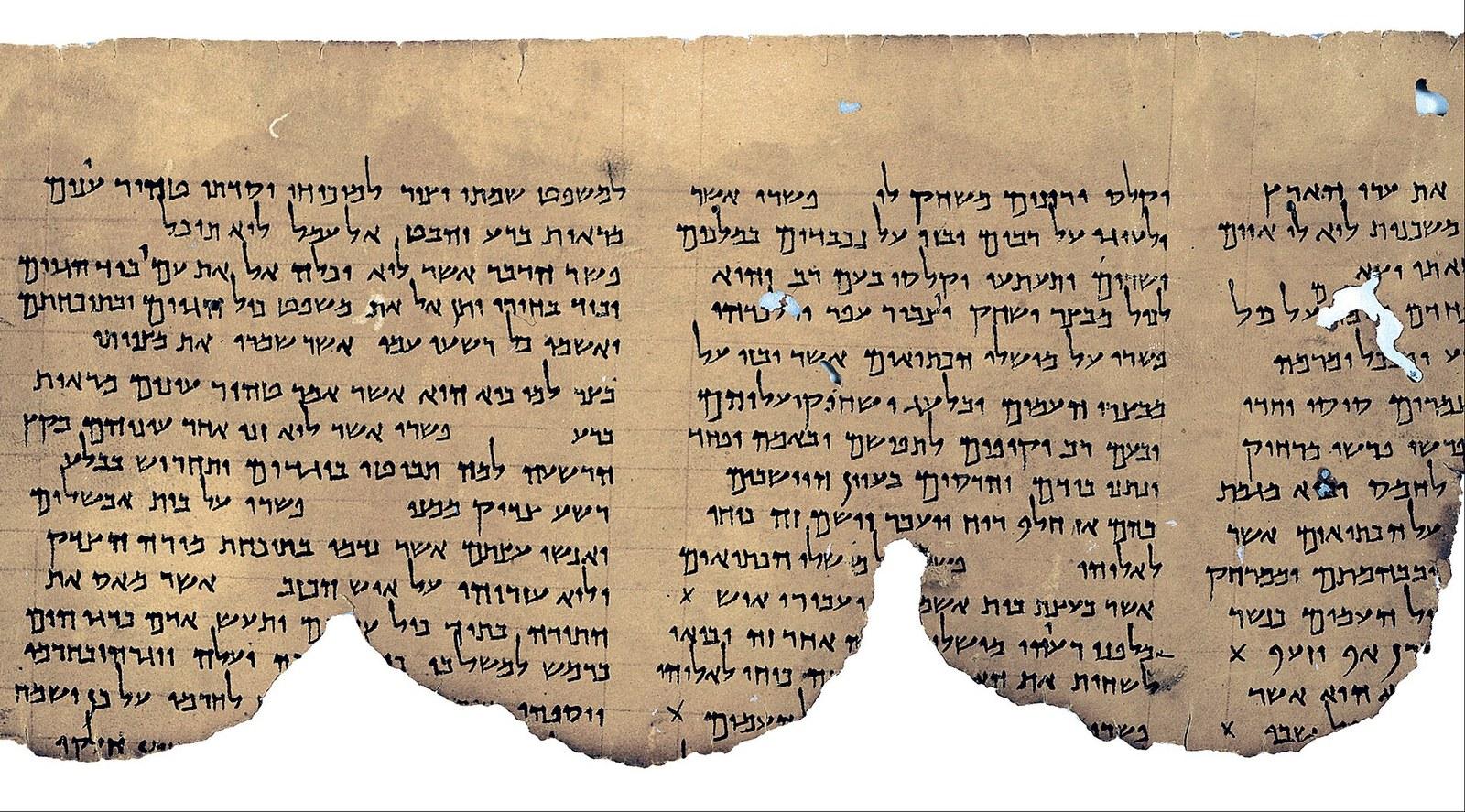
Commentary on Habakkuk Scroll, Qumran Cave 1, first century BC. Public domain.
Habakkuk 1 and 2 · Subject · Featured Study
The Qumran Commentary on Habakkuk
A scroll found at Qumran in 1947 explains Habakkuk 1 and 2 as a prophecy of its writer's own time.
Then the LORD answered me: “Write down this vision and clearly inscribe it on tablets, so that a herald may run with it.
- Book
- Habakkuk
The scribe wrote God's name in the old Hebrew letters and every other word in a square script.
Summary
This study describes a commentary on Habakkuk found among the Dead Sea Scrolls. It also shows how the scroll reads the prophet.
- The scroll holds thirteen columns of Hebrew written on parchment.
- The museum dates the copying to the second half of the first century BC.
- Its people include the Teacher of Righteousness, the Wicked Priest and the Kittim.
The Scroll from Cave 1
The scroll is one of the first seven found at Qumran.
It is parchment, 148 centimetres long by the museum's measure, and its text stands in a square script the museum calls Herodian.
F. F. Bruce noted that the scroll is two pieces of leather sewn together with linen thread between columns 7 and 8.
Where the Scroll Reads Each Verse
Six of the thirteen columns show how the commentator reads the prophet.
The commentator reads Habakkuk's Chaldeans and wicked men as the people of his own time.
| Column | Habakkuk | The commentator's reading |
|---|---|---|
| Column 2 | Habakkuk 1:6 | The Chaldeans are the Kittim, swift and mighty in war. |
| Column 5 | Habakkuk 1:13 | The house of Absalom kept silent and did not help the Teacher of Righteousness against the Man of the Lie. |
| Column 7 | Habakkuk 2:1 to 3 | God told Habakkuk to write what would come on the last generation, and did not make known to him when the age would end. |
| Column 8 | Habakkuk 2:4 | God will deliver the doers of the law in the house of Judah for their labour and their faith in the Teacher. |
| Column 11 | Habakkuk 2:15 | The Wicked Priest came upon the Teacher's company on their Day of Atonement. |
| Column 13 | Habakkuk 2:19 to 20 | On the Day of Judgment God will destroy all who serve idols. |
How a Pesher Reads
The Israel Museum names the Hebrew word that opens each comment.
In the museum's account each comment opens pishro, its meaning, or with a longer phrase of the same sense. The comments speak of events of the writer's own time.
The museum identifies the Kittim of the scroll with the Romans. The museum notes that no historical person is named in the scroll, and that the identities of its chief figures have yet to be established.
The Scroll's Text of Habakkuk
The museum notes that the scroll's Habakkuk differs at times from the Masoretic Text, the Hebrew text the Jewish scribes handed down.
You will be filled with shame instead of glory. You too must drink and expose your uncircumcision! The cup in the LORD’s right hand will come around to you, and utter disgrace will cover your glory.The scroll reads this verse with a different verb.
The Masoretic Text tells the oppressor to expose his uncircumcision, and the scroll reads reel or stagger. Bruce wrote that the Greek and Syriac versions agree with the scroll. Ream's note puts the Syriac and Jerome with the Masoretic Text, and the Septuagint, the old Greek translation, with the scroll.
The commentator used both words in column 11, where he says the Wicked Priest did not circumcise the foreskin of his heart and walked in the ways of drunkenness.
The Teacher and the Wicked Priest
The scroll's history turns on a teacher and a priest who opposed him.
Woe to him who gives drink to his neighbors, pouring it from the wineskin until they are drunk, in order to gaze at their nakedness!The commentator turns this woe of drink and shame into an attack on the Teacher.
Bruce reads the attack as a sign that the Teacher's group kept the fast by its own calendar.
Where the Scroll Stops
Bruce explains why the prayer of chapter 3 has no comment.
This is a prayer of Habakkuk the prophet, according to Shigionoth:Chapter 3 has a title and a musical note of its own.
Bruce wrote that the scroll never copied or explained the third chapter, and that its original ending shows this. He judged it more probable that the prayer was counted a work apart from the oracle.
Bruce set aside the view that a psalm did not suit the method, since commentaries on the Psalter were found at Qumran.
The Righteous One at Qumran and in Paul
The scroll and the apostle read the same line of Habakkuk in two ways.
For the gospel reveals the righteousness of God that comes by faith from start to finish, just as it is written: “The righteous will live by faith.”Paul quotes Habakkuk 2:4 for the righteousness the gospel reveals.
Paul quotes the line right after naming everyone who believes, the Jew first and then the Greek (Romans 1:16).
The Just Shall Live by His Faith: the line in the New Testament
The Vision in the Church
Two Christian writers read the written vision of Habakkuk 2:2 to 3 in their own way.
Augustine of Hippo (died 430)
Augustine read the appointed time of the vision as the coming of Christ.
“Of what else than the advent of Christ, who was to come, is Habakkuk understood to say, ‘And the Lord answered me, and said, 'Write the vision openly on a tablet of boxwood so that the one who reads these things may understand.' ‘ For the vision is yet for a time appointed, and it will arise in the end, and it will not become void. If it delays, wait for it, because it will surely come and will not be delayed.”
Augustine of Hippo · City of God 18.31 · on Habakkuk 2:2 to 3Patristic
Matthew Henry (1662 to 1714)
Matthew Henry gave the reason the vision had to be written down.
“He must write it, that he might imprint it on his own mind, and make it more clear to himself, but especially that it might be notified to those in distant places and transmitted to those in future ages. What is handed down by tradition is easily mistaken and liable to corruption; but what is written is reduced to a certainty, and preserved safe and pure.”
Matthew Henry · Commentary on the Whole Bible · on Habakkuk 2:2Puritan
Books to Read Next
An English translation of 1953 and an article of 1958 to 1959 can be read free.
A Translation and Interpretation of the Dead Sea Habakkuk Scroll
Peter Tennant Ream · 1953
Ream gives all thirteen columns in English with his notes.
Read it free at the Internet ArchiveThe Dead Sea Habakkuk Scroll
F. F. Bruce · 1958 to 1959
Bruce quotes the scroll in his own English and cites it column by column.
Read it free at Biblical StudiesHe Who Is Coming
The letter to the Hebrews sets Habakkuk 2:3 to 4 inside its call to endure.
For, “In just a little while, He who is coming will come and will not delay.The coming one of this verse is a Person.
The commentator at Qumran read in Habakkuk 2:3 that the last age would be prolonged, and he waited with his community. The reader of Hebrews is asked to wait for Christ by faith.
Sources
Scripture is the Berean Standard Bible.
- The Israel Museum, Jerusalem, The Digital Dead Sea Scrolls: The Commentary on Habakkuk Scroll.
- F. F. Bruce, The Dead Sea Habakkuk Scroll, Annual of Leeds University Oriental Society 1 (1958 to 1959)
- Peter Tennant Ream, A Translation and Interpretation of the Dead Sea Habakkuk Scroll, University of Alberta, 1953.
- Augustine of Hippo, City of God 18.31.
- Matthew Henry, Commentary on the Whole Bible (1710), on Habakkuk 2:2.
Keep Studying
Read it3