
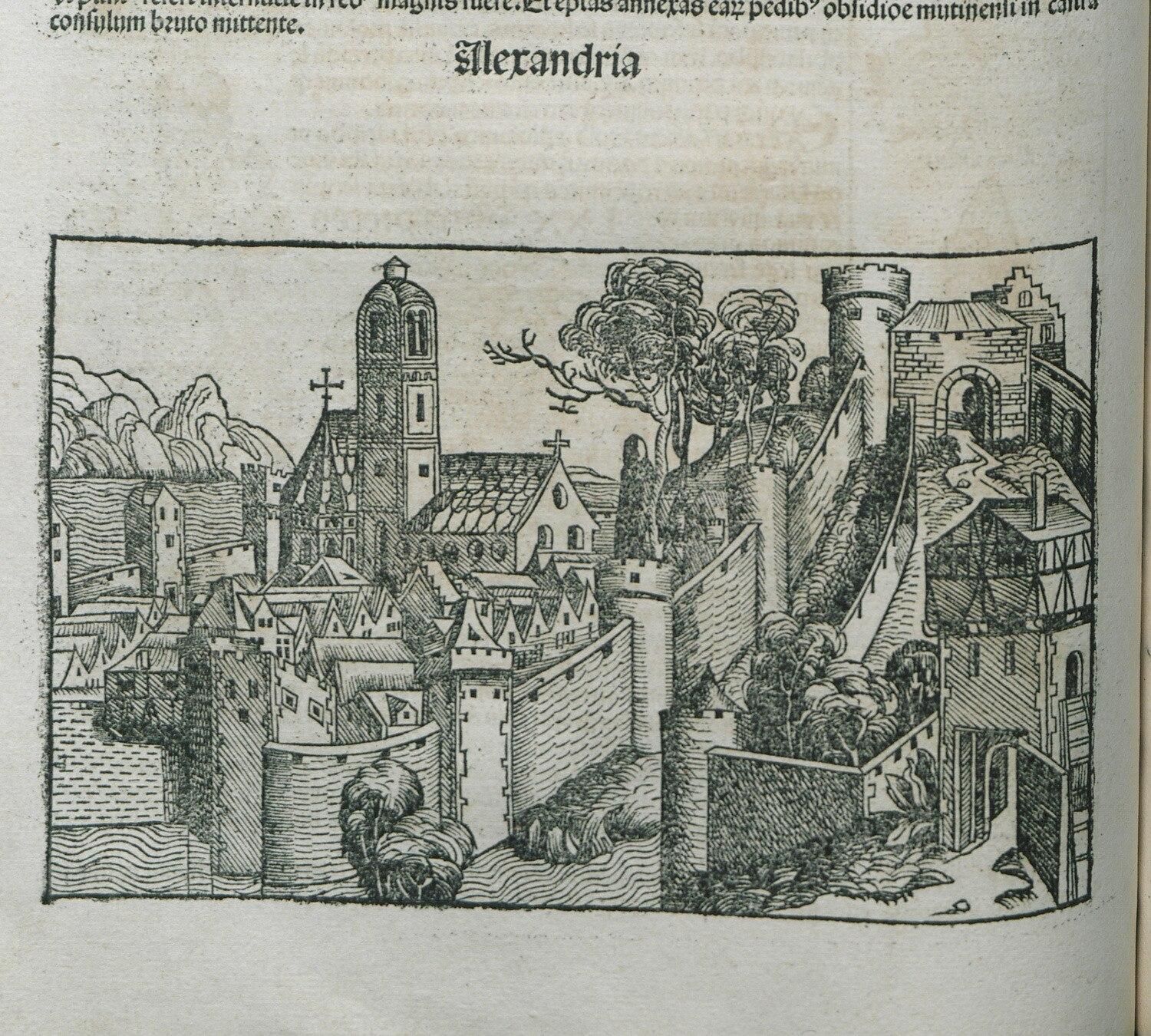
Hartmann Schedel, Alexandria, Liber Chronicarum, 1493. Public domain.
Alexandria and the desert of Egypt, from Pantaenus to 338 · Place · Featured Study
The Desert and the City: Alexandria
Eusebius and Athanasius tell how the city's teachers and the monks of the desert each stood beside the martyrs.
A boy of not quite seventeen wrote to his father in prison, "Take heed not to change your mind on our account."
Take no bag for the road, or second tunic, or sandals, or staff; for the worker is worthy of his provisions.
- Today
- Alexandria, Egypt
- Region
- Lower Egypt, on the Mediterranean coast
- First named
- Acts 18:24 “Meanwhile a Jew named Apollos, a native of…”
Summary
Alexandria was the great city of Egypt by the sea. Its church ran a school for new believers. Pantaenus led it first, then Clement, then Origen. Under the emperor Severus many of its people were put to death for Christ.
- Origen's father, Leonides, was put to death in that persecution.
- Origen ran the school at about eighteen, after the other teachers fled.
- Antony came in from the desert twice, to help the prisoners and to answer the Arians.
Three Words of Scripture
Acts names a preacher from Alexandria, and Origen and Antony each obeyed a saying of Jesus to the letter.
Meanwhile a Jew named Apollos, a native of Alexandria, came to Ephesus. He was an eloquent man, well versed in the Scriptures.Luke gives the city as the home of a preacher who came to Ephesus.
Jesus told him, “If you want to be perfect, go, sell your possessions and give to the poor, and you will have treasure in heaven. Then come, follow Me.”This is the word that sent Antony into the desert.
The City and the Desert in Order
Seven moments from the school under Commodus to the Life Athanasius wrote.
The school, the martyrs and the monks of Alexandria fill about a century and a half.
- Under CommodusPantaenus, trained as a Stoic, leads the school of the faithfulEusebius 5.10.1
- After PantaenusClement takes charge of the instruction, with the boy Origen among his pupilsEusebius 6.6
- The tenth year of SeverusLeonides dies a martyr under SeverusEusebius 6.1 and 6.2.2
- Origen's eighteenth yearOrigen takes charge of the catechetical schoolEusebius 6.3.3
- Under Maximinus, 303 to 311Antony comes into the city to serve the confessorsLife of Antony 46, with note 1088
- 25 to 27 July 338Antony comes down again and denounces the AriansLife of Antony 69, with note 1116
- 356 to 362Athanasius writes the Life of AntonyRobertson's introduction to the Life
Each row gives the moment and the place in Eusebius or Athanasius that records it.
Leonides and His Son
Eusebius tells the persecution under Severus through one family of Alexandria.
When Severus began to persecute the churches, Eusebius writes, believers were brought to Alexandria from all Egypt and the Thebaid. The city was their great theatre, and many died there under torture.
Leonides had taught his son the Scriptures before any Greek learning, and made him learn and recite a passage every day. The boy asked questions about their deeper meaning that his father could not answer. Leonides rebuked him to his face and thanked God for him in private.
When Leonides was arrested, Origen meant to go out and die with him, and his mother hid all his clothes to keep him at home.
After Leonides was beheaded, the treasury took his property, so Origen had to support his mother and six younger brothers before he turned seventeen.
The Desert Answers the City
Athanasius tells how Antony left the world for the desert and came back into Alexandria when the church needed him.
HE GAVE AWAY THREE HUNDRED ACRES
At eighteen or twenty Antony heard the Gospel of the rich young man read in church and gave his family's fertile land to the villagers.
HE SERVED THE CONFESSORS IN THE MINES
In the persecution under Maximinus he followed the martyrs to Alexandria. When the judge ordered every monk out of the city, he stood in plain view before the governor.
HE ANSWERED THE ARIANS IN THE CITY
Later he came down from his mountain and taught the people that the Son of God was the eternal Word and not a created being.
The School of Alexandria
The young Origen taught while the persecution went on, and stood by his pupils when they were taken.
When persecution had driven every other teacher out of the city, heathen enquirers came to the young Origen to hear the word of God. Plutarch, the first of them, later died a martyr.
Origen stayed with the martyrs in prison and at their trials. He walked beside them to their deaths and greeted them with a kiss, until the crowd nearly fell on him. Several of his own pupils were seized and put to death.
He gave up teaching grammar and sold his books of ancient literature for four obols a day. For years he slept on the ground, fasted, went without wine and walked without shoes.
His teaching was disputed after his death. Eusebius and Pamphilus wrote a Defense of Origen in six books, and only the first survives, in a Latin translation.
What Eusebius Leaves Unsaid
The historian does not know who began the school.
Eusebius writes that the school had been established at Alexandria in ancient times and does not say who began it. He tells of Pantaenus only as he had been informed. Much of Origen's early life comes from the letters and the people he could still consult.
The Voices of Alexandria
Two writers of the fourth century give the teacher and the monk in their own words.
Eusebius of Caesarea (died 339)
Church History, book 6, chapter 3, section 7
Eusebius and Athanasius on Alexandria
“For they say that his manner of life was as his doctrine, and his doctrine as his life.”
Patristic
About this saying1 paragraph
Eusebius of Caesarea gives the reason Origen's pupils followed him into danger.
Athanasius of Alexandria (296 to 373)
Life of Antony, chapter 14
Eusebius and Athanasius on Alexandria
“And thus it happened in the end that cells arose even in the mountains, and the desert was colonised by monks, who came forth from their own people, and enrolled themselves for the citizenship in the heavens.”
Early Church
About this saying1 paragraph
Athanasius of Alexandria described what Antony's preaching made of the desert.
Athanasius of Alexandria
Life of Antony, chapter 46
Eusebius and Athanasius on Alexandria
“Let us go too, that if called, we may contend or behold them that are contending.”
Early Church
About this saying1 paragraph
Athanasius also recorded what Antony said when the martyrs were led into Alexandria.
In Their Own Words
Clement and Origen of the school of Alexandria, its bishop Athanasius and the monk Antony speak here in their own words.
Clement of Alexandria (died 215)
The Stromata, or Miscellanies, translated by William Wilson (Ante-Nicene Fathers, volume 2, first printed 1885), book 1, chapter 5
Greek learning as a schoolmaster
“For this was a schoolmaster to bring ‘the Hellenic mind,’ as the law, the Hebrews, ‘to Christ.’ Philosophy, therefore, was a preparation, paving the way for him who is perfected in Christ.”
Early Church
About this saying1 paragraph
Clement was at the head of the school of Alexandria by about 190, probably until 202, when he left the city as the persecution of Severus broke out. In the first book of his Stromata he wrote of the Greeks' philosophy.
Origen of Alexandria (died 253)
De Principiis (On First Principles), translated by Frederick Crombie (Ante-Nicene Fathers, volume 4, 1885), preface, section 2
The teaching handed down
“seeing there are many who think they hold the opinions of Christ, and yet some of these think differently from their predecessors, yet as the teaching of the Church, transmitted in orderly succession from the apostles, and remaining in the Churches to the present day, is still preserved, that alone is to be accepted as truth which differs in no respect from ecclesiastical and apostolical tradition.”
Early Church
About this saying1 paragraph
Origen wrote On First Principles at Alexandria before he left the city in 231. The whole book survives only in the Latin of Rufinus, who greatly altered it.
Anthony the Great (died 356)
Athanasius, Life of Antony, translated by H. Ellershaw (Nicene and Post-Nicene Fathers, second series, volume 4, 1892), chapter 16
A beginning every day
“Let this especially be the common aim of all, neither to give way having once begun, nor to faint in trouble, nor to say: We have lived in the discipline a long time: but rather as though making a beginning daily let us increase our earnestness.”
Patristic
About this saying1 paragraph
Antony spoke in the Egyptian tongue to the monks who gathered to hear him. Athanasius, bishop of Alexandria from 328, set down the charge in his Life of Antony.
Athanasius of Alexandria (296 to 373)
On the Incarnation of the Word, translated by Archibald Robertson (Nicene and Post-Nicene Fathers, second series, volume 4, 1892), section 54
Why the Word became man
“For He was made man that we might be made God; and He manifested Himself by a body that we might receive the idea of the unseen Father; and He endured the insolence of men that we might inherit immortality.”
Early Church
About this saying1 paragraph
Athanasius wrote On the Incarnation of the Word in about 318, as his editor Archibald Robertson dates it.
Books to Read Next
The Church History of Eusebius
Eusebius of Caesarea, translated by Arthur Cushman McGiffert · 1890
Eusebius tells of Leonides, the young Origen and the school in book 6, chapters 1 to 6.
Read Eusebius free at CCELThe Life of Antony
Athanasius of Alexandria, translated by H. Ellershaw · 1892
Athanasius wrote his account of Antony between 356 and 362.
Read the Life of Antony free at CCELA School and a Desert
Alexandria gave the church a teacher who lived as he taught. It also gave a monk who left the city and still came back to stand with its martyrs.
Sources
Scripture is the Berean Standard Bible.
- The Holy Bible, Berean Standard Bible (read 2026)
- Eusebius, Church History, tr. McGiffert (1890), and Athanasius, Life of Antony, tr. Ellershaw (1892), Nicene and Post-Nicene Fathers, second series, volumes 1 and 4.
- Clement of Alexandria, The Stromata, or Miscellanies, tr. William Wilson, Ante-Nicene Fathers, volume 2 (first printed 1885), and Origen, De Principiis, tr. Frederick Crombie, Ante-Nicene Fathers, volume 4 (1885)
- Athanasius, On the Incarnation of the Word, tr. Archibald Robertson, Nicene and Post-Nicene Fathers, second series, volume 4 (1892)
Keep Studying
Studies1
People and groups5
Church history5
Trials of life1