
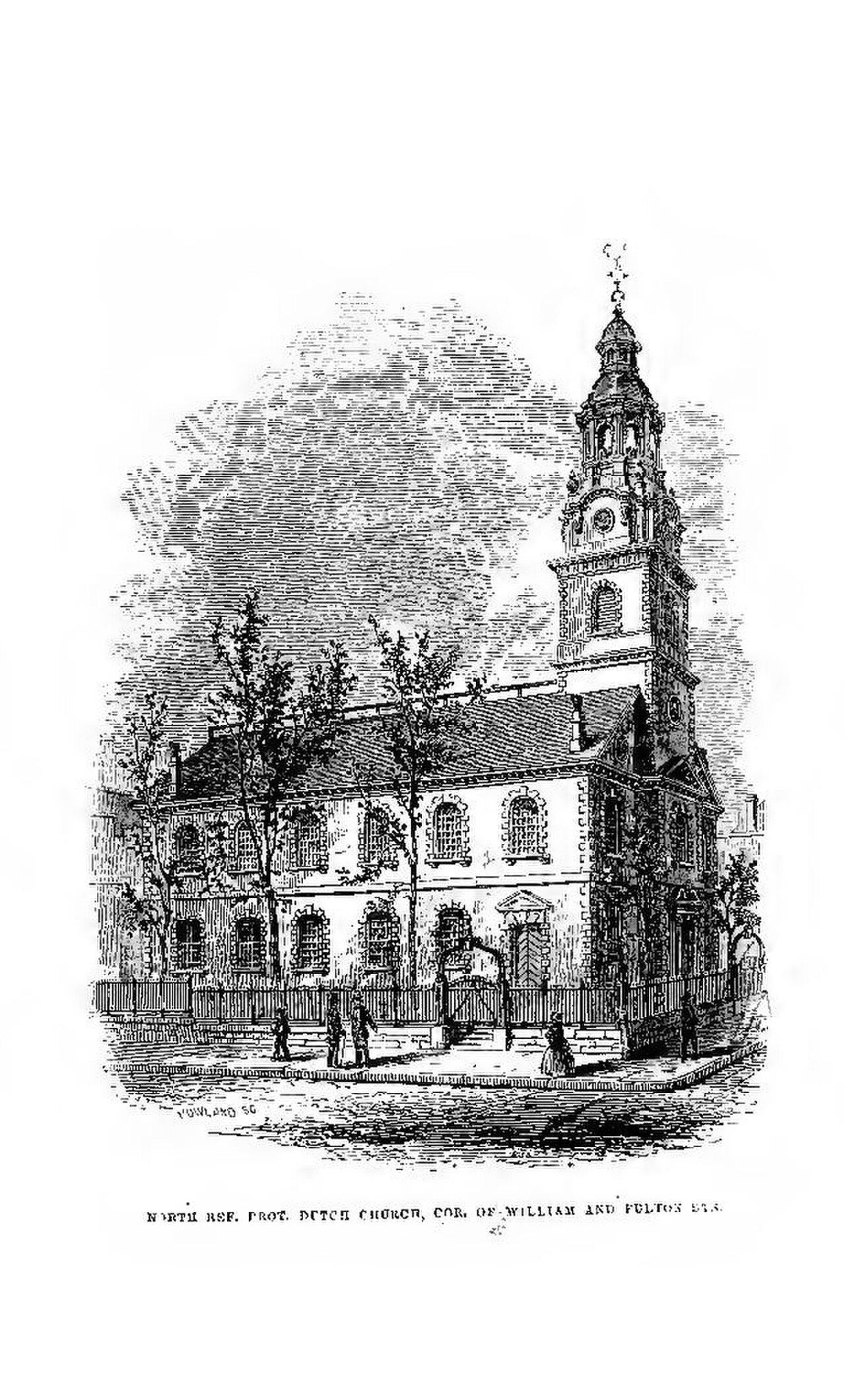
North Ref. Prot. Dutch Church, cor. of William and Fulton Sts., 1858. Public domain.
1727 to 1907 · Subject · Featured Study
Prayer Before the Outpouring
The Scottish concert of prayer, Carey's monthly meetings, Lanphier's noon meeting, Loughor and Pyeng Yang, each dated by its own record.
On 23 September 1857 Jeremiah Lanphier opened a church lecture room at noon and prayed alone for half an hour before anyone came.
This is what the LORD of Hosts says: “Peoples will yet come—the residents of many cities— and the residents of one city will go to another, saying: ‘Let us go at once to plead before the LORD and to seek the LORD of Hosts. I myself am going.’ And many peoples and strong nations will come to seek the LORD of Hosts in Jerusalem and to plead before the LORD.”
This is what the LORD of Hosts says: “Peoples will yet come—the residents of many cities— and the residents of one city will go to another, saying: ‘Let us go at once to plead before the LORD and to seek the LORD of Hosts. I myself am going.’ And many peoples and strong nations will come to seek the LORD of Hosts in Jerusalem and to plead before the LORD.”
- Books
- Zechariah, Acts
- Hold in memory
- Zechariah 8:20 to 22, Acts 1:14
Summary
Many revival accounts say that people met to pray before the revival came. Pastors, editors and missionaries wrote them, and they often give the dates. The writers' own words give those dates, beside the teachers who said it must be so.
- Ministers in Scotland agreed in 1744 to pray together for two years.
- Edwards asked American churches to join the Scottish concert.
- Lanphier's noon prayer meeting grew from six people to over one hundred in three weeks.
- At Herrnhut in 1727 the order ran the other way, and the prayer came after the revival.
The Verses the Praying Churches Read
Edwards built his call on Zechariah 8, Carey cited Zechariah 12, and the accounts point back to the upper room.
The writers who called the churches to pray for revival did not start from a method. They started from prophecies they read as promises for the last days, and from the days before Pentecost.
The prophecies Edwards and Carey read
Then I will pour out on the house of David and on the people of Jerusalem a spirit of grace and prayer, and they will look on Me, the One they have pierced. They will mourn for Him as one mourns for an only child, and grieve bitterly for Him as one grieves for a firstborn son.
Carey cited this verse in 1792 for the Spirit of grace and supplication poured out when the churches join in prayer.
The pattern in Acts
With one accord they all continued in prayer, along with the women and Mary the mother of Jesus, and with His brothers.
The disciples continued with one accord in prayer in the upper room before the day of Pentecost.
Acts 1:14BSB
When the day of Pentecost came, they were all together in one place. Suddenly a sound like a mighty rushing wind came from heaven and filled the whole house where they were sitting. They saw tongues like flames of fire that separated and came to rest on each of them. And they were all filled with the Holy Spirit and began to speak in other tongues as the Spirit enabled them.
Blair told of Pyeng Yang in 1907 in the same order as these two chapters, the prayer first and the outpouring after.
Acts 1:14, Acts 2:1 to 4
The Dated Prayer and the Dated Outpouring
Six records, each giving a date for a season of prayer and a date for what followed.
In five of the six records the prayer is dated first, and at Herrnhut the outpouring is.
- Herrnhut1727The outpouring at the communion of 13 AugustHutton, History of the Moravian Church
- Scotland1744The call to prayEdwards, Humble Attempt
- Carey's churches in England1792Monthly prayerCarey's Enquiry
- New York1857The noon prayerPrime, The Power of Prayer
- Loughor1904Morning prayerStead, The Welsh Revival
- Pyeng Yang1906 and 1907The agreement to prayBlair, The Korea Pentecost
Each row names the place, the year, which of the two the record dates first, and the record.
The era page on the revival streams holds the wider story of Wales, Azusa Street and Korea.
The Concert of Prayer, 1744 to 1792
Scottish ministers set the times, Edwards carried the call to America, and Carey's churches kept it monthly.
Edwards tells how the concert began. In October 1744 some ministers in Scotland judged that the times called for united prayer for an outpouring of the Spirit on all the churches.
They fixed a method for the next two years. Each would pray on Saturday evening and Sabbath morning each week, and more solemnly on the first Tuesday of each quarter.
The ministers bound no one by a promise. They asked only that a person kept from the day agreed would take the first convenient day after it.
A memorial from the Scottish ministers reached America. Edwards answered it with a book printed at Boston in 1747 by D. Henchman, which he opened with Zechariah 8:20 to 22.
Forty-five years later William Carey printed his Enquiry at Leicester. In its fifth section he wrote of the monthly prayer meetings kept by his own connection of churches.
Carey judged that the churches which kept those meetings had been on the increase since they began.
Fulton Street, Loughor and Pyeng Yang
Three accounts written within a few years of the events date the prayer meetings and count who came.
Samuel Irenaeus Prime printed the story of the noon meetings in 1859 from Lanphier's private journal. Lanphier had been the North Dutch Church's missionary in lower New York since 1 July 1857.
His journal records that six came to the first noon meeting. Twenty came on 30 September and between thirty and forty on 7 October, and from 8 October the meeting was held every day.
On 14 October he counted over one hundred, many of them, he wrote, under conviction of sin.
Stead, a London editor, wrote that Evan Roberts began to preach and pray at Moriah chapel, Loughor, about the start of November 1904. After meetings that ran past four in the morning, he says, the village woke at six to crowds going to the early prayer meetings.
William Newton Blair, a missionary at Pyeng Yang, writes that the missionaries agreed in 1906 to pray for the winter Bible classes for men. He tells the meeting of January 1907 in which the whole room prayed aloud together.
In Their Own Words
William Carey (1761 to 1834)
An Enquiry into the Obligations of Christians to Use Means for the Conversion of the Heathens, section V
Carey set the works of grace beside prayer.
“The most glorious works of grace that have ever took place, have been in answer to prayer; and it is in this way, we have the greatest reason to suppose, that the glorious out-pouring of the Spirit, which we expect at last, will be bestowed.”
Particular Baptist
About this saying1 paragraph
Carey wrote this in 1792, a few lines before he named the monthly meetings.
Jeremiah C. Lanphier (born 1809)
Journal, 23 September 1857, as printed in Samuel Irenaeus Prime, The Power of Prayer, page 22
Lanphier counted the first six on the stairs.
“At half-past twelve the step of a solitary individual was heard upon the stairs. Shortly after another, and another; then another, and last of all, another, until six made up the whole company!”
Reformed Dutch lay missionary
About this saying1 paragraph
Prime copied this entry from Lanphier's journal for 23 September 1857.
William Newton Blair
The Korea Pentecost and Other Experiences on the Mission Field, page 47
Blair said the outpouring they prayed for had come.
“We had prayed to God for an outpouring of His Spirit upon the people and it had come.”
Presbyterian missionary
About this saying1 paragraph
Blair wrote this about 1910, three years after the meeting.
Must Prayer Come First?
Three readings of the record, each held by writers who were there or near it.
Edwards and Carey held that God had appointed united prayer as the way the outpouring would come. Prime's book, titled The Power of Prayer, told the New York meetings as proof of it.
Isaac Watts and John Guyse, who published Edwards's earlier narrative in London in 1737, stressed God's free and sovereign grace at Northampton. They noted that the work there rose without any calamity to frighten the town.
Charles Finney taught in 1835 that a revival follows the right use of the means God has given, as a crop follows sowing. He added in the same lecture that the means will not produce it without the blessing of God.
Books to Read Next
An Humble Attempt
Jonathan Edwards · 1747
Edwards gives the history of the Scottish concert and argues for joining it.
Read the Boston printingThe Power of Prayer
Samuel Irenaeus Prime · 1859
Prime's book went to an eleventh edition within two years.
Read the eleventh editionThe Korea Pentecost
William Newton Blair · 1910
Blair recalls the Korean church's history before the revival he saw.
Free at the Internet ArchiveWhat the Record Shows
From Scotland to Korea, the people who wrote these accounts dated their prayer meetings and counted who came. Herrnhut keeps the record honest, since there the prayer that lasted followed the outpouring.
Sources
Scripture is the Berean Standard Bible.
- The Holy Bible, Berean Standard Bible (read 2026)
- Jonathan Edwards, An Humble Attempt to Promote Explicit Agreement and Visible Union of God's People in Extraordinary Prayer (Boston: D. Henchman, 1747), the text on page 1 and the history of the concert on pages 14 to 16.
- William Carey, An Enquiry into the Obligations of Christians to Use Means for the Conversion of the Heathens (Leicester: Ann Ireland, 1792), section V.
- Samuel Irenaeus Prime, The Power of Prayer, eleventh edition (New York: Charles Scribner, 1859), pages 21 to 25.
- J. E. Hutton, A History of the Moravian Church, second edition (1909), Book Two, chapter III.
- W. T. Stead, The Revival in the West, in The Welsh Revival (Boston: The Pilgrim Press, 1905), pages 49 to 50 and 55.
- William Newton Blair, The Korea Pentecost and Other Experiences on the Mission Field (New York: Board of Foreign Missions of the Presbyterian Church in the U.S.A., dated 1910 by the Internet Archive), pages 43 to 47.
- Jonathan Edwards, A Faithful Narrative of the Surprizing Work of God (London: John Oswald, 1737), the preface by I. Watts and J. Guyse.
- Charles G. Finney, Lectures on Revivals of Religion, sixth edition (New York: Leavitt, Lord and Co., 1835), Lecture I, page 12.
Keep Studying
People and groups1
Church history9
Values1