
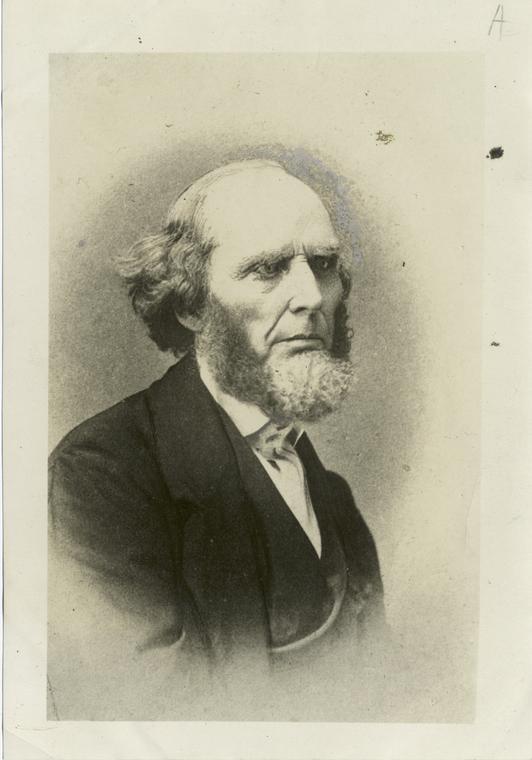
Charles G. Finney, unknown photographer, about 1860. Public domain.
New York, Ohio and England, 1792 to 1875 · Person · Featured Study
Charles Finney
He was an American revival preacher who taught theology at Oberlin College for forty years and was its president from 1851 to 1866.
He left the law at Adams in 1821 to preach, and he gave his last course of lectures at Oberlin in July 1875.
You will seek Me and find Me when you search for Me with all your heart.
You will seek Me and find Me when you search for Me with all your heart.
- Born
- 29 August 1792
- Died
- 16 August 1875
- Family
- wife: Lydia Andrews; wife: Elizabeth Ford Atkinson; wife: Rebecca Allen Rayl
- Places
- Warren, Adams, New York, Oberlin, London, Bolton
Summary
Charles Grandison Finney was born at Warren, Connecticut, and grew up near Lake Ontario. He preached revivals until 1832. Then he served two churches in Manhattan. From 1835 he lived and taught at Oberlin in Ohio.
- He went to Oberlin only when its trustees agreed to take black students on the same terms as white.
- He preached in Britain twice, in 1849 and in 1858.
- G. Frederick Wright judged his part in the fight against slavery a side matter. Yet his Lectures barred slaveholders from communion.
The Texts He Leaned On
A promise in Jeremiah settled his conversion, and a line of Paul opened his lectures to the lawyers of Rochester.
Before and after the revivals of the 1820s he was a lawyer, a city pastor, a teacher at Oberlin and a visiting preacher in Britain. His own Memoirs, written late in his life, and the life by Wright of 1891 are the witnesses.
Instead, we have renounced secret and shameful ways. We do not practice deceit, nor do we distort the word of God. On the contrary, by open proclamation of the truth, we commend ourselves to every man’s conscience in the sight of God.He took this verse for the first of his lectures to the lawyers and judges of Rochester in 1855.
The Life in Order
The early years stand on his Memoirs, and the marriages and the presidency on Wright.
Oberlin was his home for forty years, from 1835.
- 29 August 1792Birth at Warren, ConnecticutThe Memoirs, page 4
- 1818Law studies begun in an office at AdamsThe Memoirs, page 5
- 10 October 1821Conversion in the woods near AdamsThe Memoirs, page 18
- October 1824Marriage to Lydia AndrewsThe Memoirs, page 110
- April 1832Pastor in the Chatham Street theatreThe Memoirs, page 320
- January 1834Sails to the Mediterranean to recoverThe Memoirs, page 325
- 1835Professor of theology at OberlinThe Memoirs, page 333
- December 1847Lydia Finney diedWright, page 283
- Autumn 1849First visit to EnglandThe Memoirs, page 386
- 1851Elected president of OberlinWright, page 161
- December 1858Second visit to BritainThe Memoirs, page 448
- 16 August 1875Death at OberlinWright, page 285
Each step of the life stands with its witness.
1835, December 1847, Autumn 1849, 1851, December 1858, 16 August 1875
From the Law Office to Oberlin
A schoolteacher read law, left it to preach, and spent his last forty years at one college.
His father moved the family to Oneida County when Finney was about two, and later to the shore of Lake Ontario south of Sackett's Harbor. Finney taught school in New Jersey for about three years and then read law at Adams in the office of Benjamin Wright. His law books so often cited the Mosaic Institutes that he bought a Bible, the first he had owned.
After his conversion he told a client on the morning of a trial that he could not plead his case. The presbytery licensed him in March 1824, and that October he married Lydia Andrews. The revivals of the next eight years are told on the page of his revivals.
In April 1832 Lewis Tappan and others called him to the Second Free Presbyterian Church, which met in the Chatham Street theatre they had leased. Cholera reached the city that summer. In January 1834 his health sent him on a voyage of about six months to Malta and Sicily. He came home to find that a meeting of abolitionists on the fourth of July had raised a mob.
The Broadway Tabernacle was built for him, to a plan of the interior he drew himself, and he left the presbytery to be pastor of its Congregational church. In January 1835 John Jay Shipherd of Oberlin and Asa Mahan of Cincinnati came to ask him to teach theology at Oberlin. His friends in the city pledged to endow eight professorships within an hour or two once the trustees met his terms.
At Oberlin he published two volumes of systematic theology in 1846. Lydia died in December 1847, and he then married Elizabeth Ford Atkinson of Rochester, who led meetings for women on his later travels. After Elizabeth's death in 1863 he married Rebecca Allen Rayl, assistant principal of the ladies' department. He resigned as pastor of the First Church in 1872 and died at Oberlin three years later.
In Their Own Words
His prayer in the woods, his answer to a client, his stand on slavery and his tribute to his first wife.
Charles G. Finney (1792 to 1875)
Memoirs of Rev. Charles G. Finney, Written by Himself, chapter 2, page 16
I take thee at thy word
“Lord, I take thee at thy word. Now thou knowest that I do search for thee with all my heart, and that I have come here to pray to thee; and thou hast promised to hear me.”
Presbyterian and Congregational revivalist
About this saying1 paragraph
He recalls in the Memoirs what he said aloud in the woods in 1821, once the verse from Jeremiah came to him.
Charles G. Finney
Memoirs of Rev. Charles G. Finney, Written by Himself, chapter 3, page 24
A retainer from the Lord Jesus Christ
“I have a retainer from the Lord Jesus Christ to plead his cause, and I cannot plead yours.”
Presbyterian and Congregational revivalist
About this saying1 paragraph
The day after his conversion in 1821, Deacon B came to the office expecting his lawyer to be ready for a suit set for ten that morning.
Charles G. Finney
Memoirs of Rev. Charles G. Finney, Written by Himself, chapter 23, page 324
Anxious to arouse public attention
“When I first went to New York, I had made up my mind on the question of slavery, and was exceedingly anxious to arouse public attention to the subject. I did not, however, turn aside to make it a hobby, or divert the attention of the people from the work of converting souls.”
Presbyterian and Congregational revivalist
About this saying1 paragraph
He wrote this of his years at the Chatham Street chapel from 1832, when the city was divided over slavery.
Charles G. Finney
Letter to the Oberlin Evangelist, 25 December 1847, as printed by G. Frederick Wright, pages 284 to 285
How to die
“She showed me in many things how to live, and now she has shown me how to die.”
Presbyterian and Congregational revivalist
About this saying1 paragraph
He wrote of Lydia in the Oberlin Evangelist on 25 December 1847, and Wright prints the letter.
The People Around Him
The witnesses name his three wives, his teacher at Adams, the merchants who brought him to Manhattan and the men who brought him to Ohio.
Lewis and Arthur Tappan brought him to Manhattan and backed him at Oberlin.
| Person | Tie to Finney | The witness |
|---|---|---|
| Lydia Andrews | His first wife, married in 1824, who died in 1847 | The Memoirs; Wright |
| Elizabeth Ford Atkinson | His second wife, married after Lydia's death | Wright |
| Rebecca Allen Rayl | His third wife, who outlived him | Wright |
| George W. Gale | Pastor at Adams and his first teacher in theology | The Memoirs |
| Lewis Tappan | Led the group that called him to the city in 1832 | The Memoirs |
| Arthur Tappan | Offered to bear the cost if he would teach the students who left Lane Seminary | The Memoirs; Wright |
| John Jay Shipherd and Asa Mahan | Brought him the call from Ohio | The Memoirs |
| Joshua Leavitt | Editor of the New York Evangelist, who reported the lectures on revivals | The Memoirs |
John Jay Shipherd and Asa Mahan, Joshua Leavitt
The Places of His Life
His life ran from Connecticut to the shore of Lake Ontario, then to Manhattan, Ohio and the cities of Britain.
His pulpits ran from a theatre on Chatham Street to Whitefield's old chapel in London.
| Place | What the witnesses say | The witness |
|---|---|---|
| Warren | He was born there, in Litchfield County, Connecticut. | The Memoirs |
| Adams | He read law there and was converted in the woods north of the village. | The Memoirs; Wright |
| New York | He preached in the Chatham Street theatre and then at the Broadway Tabernacle. | The Memoirs |
| Oberlin | He taught theology there, led the college and was pastor of its First Church. | The Memoirs; Wright |
| London | He preached at the Tabernacle in Moorfields with John Campbell. | The Memoirs |
| Edinburgh and Bolton | He preached three months at Edinburgh and reached Bolton on Christmas Eve 1859. | The Memoirs |
The Visits to Britain
Twice he left Oberlin for more than a year to preach in Britain.
Finney sailed with his wife in the autumn of 1849 and landed at Southampton early in November. Potto Brown, a miller of Houghton, sent his pastor to meet them, and Finney began in the village chapel there, between Huntingdon and St Ives. From there he went to Birmingham and Worcester, and then to London.
In London he preached with John Campbell in Whitefield's old Tabernacle at Moorfields. When he asked inquirers to rise, he writes, many hundreds would stand, and on some evenings not less than two thousand. They reached Oberlin again in May 1851.
They sailed for Liverpool in the steamer Persia in December 1858. Finney spent three months at Edinburgh, preaching mostly in Mr. Kirk's church, and went on to Aberdeen. He worked in Bolton from Christmas Eve 1859 and then in Manchester, and left for home from Liverpool in August 1860.
How the Key Verse Was Taught
Matthew Henry, Adam Clarke and the commentary of Jamieson, Fausset and Brown read the promise to the exiles that they would find God.
Matthew Henry (1662 to 1714)
Commentary on the Whole Bible
Matthew Henry read the whole heart of the verse as sincerity and fervour in prayer.
“We must continue seeking, and take pains in seeking, as those that search; and this we must do with our heart (that is, in sincerity and uprightness), and with our whole heart (that is, with vigour and fervency, putting forth all that is within us in prayer), and those who thus seek God shall find him, and shall find him their bountiful rewarder, Heb. xi.”
on Jeremiah 29:13Puritan
Adam Clarke (1762 to 1832)
Commentary on the Bible
Adam Clarke drew four lessons from the promise, among them that the people must pray, seek and search.
“Thoughts of peace - Here God gives them to understand, 1. That his love was moved towards them. 2. That he would perform his good word, his promises often repeated, to them. 3. That for the fulfillment of these they must pray, seek, and search. 4. That he would hearken, and they should find him; provided, 5. They sought him with their whole heart, Jer 29:10-13.”
on Jeremiah 29:11Evangelical
Jamieson, Fausset & Brown (1802 to 1910)
Commentary Critical and Explanatory on the Whole Bible
Jamieson, Fausset and Brown saw a spirit of prayer as the sign of the mercy God was about to give.
“When God designs mercy, He puts it into the hearts of His people to pray for the mercy designed. When such a spirit of prayer is poured out, it is a sure sign of coming mercy.”
on Jeremiah 29:12Reformed
What the Witnesses Leave Open
Readers differ on how far to trust a memoir written from memory and on how large a part slavery played in his work.
How far the Memoirs can be trustedFinney himself; the editor of 1876
Finney writes that he kept no diary and must depend on his memory, which he calls naturally very tenacious. He finished the narrative at the beginning of 1868, decades after the revivals it tells.
Where Lyman Beecher recalled threatening to fight him at the State line, Finney answered "I do not remember this" and let Beecher's memory stand. The editor of 1876 says the only changes were occasional omissions.
Whether slavery was more than a side matter for himG. Frederick Wright; Finney's Lectures and Memoirs
Wright judged in 1891 that Finney's part in Oberlin's work against slavery was largely incidental, as Finney and Arthur Tappan intended. Finney himself says he would not make slavery a hobby, and he warned Joshua Leavitt not to go too fast.
Against that reading stand his own Lectures of 1835, which exclude slaveholders from communion, and his terms for going to Oberlin.
Books to Read Next
Memoirs of Rev. Charles G. Finney, Written by Himself
Charles G. Finney · 1876
It is his own account to 1868, with his pastorates, Oberlin and the visits to Britain.
Read the Memoirs free at the Internet ArchiveCharles Grandison Finney
G. Frederick Wright · 1891
Wright was a professor in the Oberlin seminary, and his life gives the marriages, the presidency and the last years.
Read Wright free at the Internet ArchiveWhat Finney Left
Finney left the Memoirs, the lectures and the theology he taught, and a college that admitted black students from its first years. The editor of 1876 wrote that the narrative shows him chiefly as an evangelist and a preacher of righteousness.
Sources
Scripture is the Berean Standard Bible.
- The Holy Bible, Berean Standard Bible (read 2026)
- Charles G. Finney, Memoirs of Rev. Charles G. Finney, Written by Himself (New York: A. S. Barnes, 1876)
- G. Frederick Wright, Charles Grandison Finney (Boston: Houghton, Mifflin, 1891)
- Charles G. Finney, Lectures on Revivals of Religion (New York: Leavitt, Lord and Co., 1835), Lecture XV.
- Matthew Henry, Commentary on the Whole Bible (1710), on Jeremiah 29:13.
- Adam Clarke, Commentary on the Bible (1832), on Jeremiah 29:11.
- Robert Jamieson, A. R. Fausset and David Brown, Commentary Critical and Explanatory on the Whole Bible (1871), on Jeremiah 29:12.
Keep Studying
Studies1
Subjects1
People and groups2
Values1
Doctrines1